

SUBJECT
FOUNDATION ENGINEERING
TOPIC
DEFINITION OF SHALLOW FOUNDATION.
TYPES OF SHALLOW FOUNDATIONS.
DEPTH AND FACTOR AFFECTING IT.
PREPARED
BY
ER. SANJEEV SINGH
SNJV432@GMAIL.COM
CONTENT
 Definition of shallow foundation.
 Types of shallow foundations.
 Depth and factor affecting it.
SHALLOW FOUNDATION
 A shallow foundation, according to Terzaghi, is one whose width is
greater than its depth ( i.e, 𝐷𝑓/B ≤ 1).
 Shallow foundation are located just below the lower part of the wall or a
column which they support.
 Footing are structural member, made of brick work, masonry or
concrete, that are used to transmit the load of the wall or column such
the load distributed over a large area.
TYPES OF SHALLOW
FOUNDATIONS
 Strip Foundation
 Spread or Isolated Footing
 Combined Foundation
 Strap or cantilever foundation
 Mat or Raft Foundation
STRIP FOUNDATION
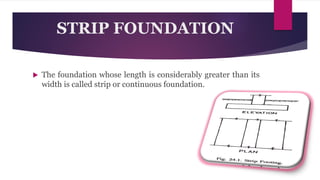
 The foundation whose length is considerably greater than its
width is called strip or continuous foundation.
SPREAD OR ISOLATED
FOOTING
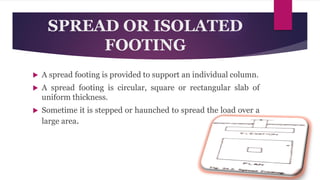
 A spread footing is provided to support an individual column.
 A spread footing is circular, square or rectangular slab of
uniform thickness.
 Sometime it is stepped or haunched to spread the load over a
large area.
COMBINED FOUNDATION
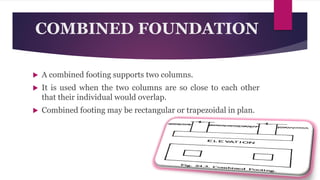
 A combined footing supports two columns.
 It is used when the two columns are so close to each other
that their individual would overlap.
 Combined footing may be rectangular or trapezoidal in plan.
STRAP OR CANTILEVER
FOUNDATION
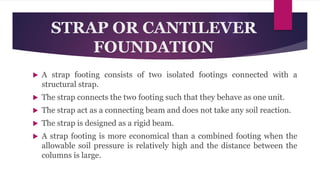
 A strap footing consists of two isolated footings connected with a
structural strap.
 The strap connects the two footing such that they behave as one unit.
 The strap act as a connecting beam and does not take any soil reaction.
 The strap is designed as a rigid beam.
 A strap footing is more economical than a combined footing when the
allowable soil pressure is relatively high and the distance between the
columns is large.
MAT OR RAFT
FOUNDATION
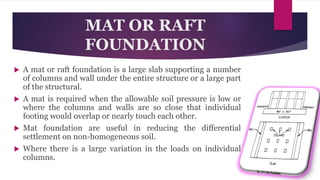
 A mat or raft foundation is a large slab supporting a number
of columns and wall under the entire structure or a large part
of the structural.
 A mat is required when the allowable soil pressure is low or
where the columns and walls are so close that individual
footing would overlap or nearly touch each other.
 Mat foundation are useful in reducing the differential
settlement on non-homogeneous soil.
 Where there is a large variation in the loads on individual
columns.
DEPTH AND FACTOR
AFFECTING IT
 Depth of top soil.
 Frost depth.
 Zone of soil volume change.
 Water level.
 Scour depth.
 Underground defects.
 Root holes.
 Minimum depth.
DEPTH OF TOP SOIL
 The footing should be located below the top soil consisting of
organic matters which is eventually decompose.
 The top soil should be removed over an area slightly larger
than the footing.
FROST DEPTH
 The footing should be carried below the depth of frost penetration.
 If the footing is located at insufficient depth, it would be subjected to the frost
damage due to formation of ice lenses and consequent frost heave.
 During summer, thawing occurs from the top downwards and the melted water is
entrapped.
 As the soil water freezes and melts, the footing is lifted during cold weather and it
settles during warm weather.
 The shear strength of the soil is also decreased during warm weather due to an
increase in water content.
 To prevent frost damage, the footings should be placed below the frost depth,
which may be 1 m or more in cold climate.
ZONE OF SOIL VOLUME
CHANGE
 Some soils, especially clays having high plasticity, such as
black cotton soil, undergo excessive volume change. Such as
soil shrinks upon drying and swell upon wetting.
 The volume changes are generally greatest near the ground
surface and decrease with increasing depth.
 Large volume changes beneath a footing may cause alternate
lifting and droping.
WATER LEVEL
 The footing should be placed above ground water table as far
as possible.
 The presence of ground water with in the soil immediately
around a footing in undesirable as it reduce the bearing
capacity of the soil and there are difficulties during
construction.
SCOUR DEPTH
 The footings located in stream, on water fronts or other
locations where there is a possibility of scouring, should be
placed below the potential scour depth.
UNDERGROUND
DEFECTS
 The depth of footings is also affected by the presence of
underground defects, such as faults, caves and mines.
 If there are man made discontinuities, such as sewer lines,
water mains, underground cables, these should be shifted or
the footing relocated.
ROOT HOLES
 If there are root holes or cavities caused by burrowing
animals or worms, the footing should be placed below such a
zone of weakened soil.
MINIMUM DEPTH
 Is: 1904-1978 specifies that all foundation should extend to a
depth of at least 50 cm below the natural ground surface.
 However, in case of rocks, only top soil should be removed
and the surface should be cleaned.
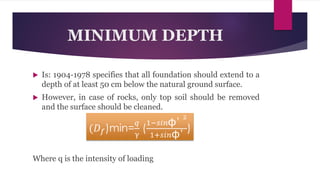
Where q is the intensity of loading
(𝐷 𝑓)min=
𝑞
γ
(
1−𝑠𝑖𝑛 ’
2
1+𝑠𝑖𝑛 ’
)
shallow foundation, types and factor

shallow foundation, types and factor

  • 1.
    SUBJECT FOUNDATION ENGINEERING TOPIC DEFINITION OFSHALLOW FOUNDATION. TYPES OF SHALLOW FOUNDATIONS. DEPTH AND FACTOR AFFECTING IT. PREPARED BY ER. SANJEEV SINGH SNJV432@GMAIL.COM
  • 2.
    CONTENT  Definition ofshallow foundation.  Types of shallow foundations.  Depth and factor affecting it.
  • 3.
    SHALLOW FOUNDATION  Ashallow foundation, according to Terzaghi, is one whose width is greater than its depth ( i.e, 𝐷𝑓/B ≤ 1).  Shallow foundation are located just below the lower part of the wall or a column which they support.  Footing are structural member, made of brick work, masonry or concrete, that are used to transmit the load of the wall or column such the load distributed over a large area.
  • 4.
    TYPES OF SHALLOW FOUNDATIONS Strip Foundation  Spread or Isolated Footing  Combined Foundation  Strap or cantilever foundation  Mat or Raft Foundation
  • 5.
    STRIP FOUNDATION  Thefoundation whose length is considerably greater than its width is called strip or continuous foundation.
  • 6.
    SPREAD OR ISOLATED FOOTING A spread footing is provided to support an individual column.  A spread footing is circular, square or rectangular slab of uniform thickness.  Sometime it is stepped or haunched to spread the load over a large area.
  • 7.
    COMBINED FOUNDATION  Acombined footing supports two columns.  It is used when the two columns are so close to each other that their individual would overlap.  Combined footing may be rectangular or trapezoidal in plan.
  • 8.
    STRAP OR CANTILEVER FOUNDATION A strap footing consists of two isolated footings connected with a structural strap.  The strap connects the two footing such that they behave as one unit.  The strap act as a connecting beam and does not take any soil reaction.  The strap is designed as a rigid beam.  A strap footing is more economical than a combined footing when the allowable soil pressure is relatively high and the distance between the columns is large.
  • 9.
    MAT OR RAFT FOUNDATION A mat or raft foundation is a large slab supporting a number of columns and wall under the entire structure or a large part of the structural.  A mat is required when the allowable soil pressure is low or where the columns and walls are so close that individual footing would overlap or nearly touch each other.  Mat foundation are useful in reducing the differential settlement on non-homogeneous soil.  Where there is a large variation in the loads on individual columns.
  • 10.
    DEPTH AND FACTOR AFFECTINGIT  Depth of top soil.  Frost depth.  Zone of soil volume change.  Water level.  Scour depth.  Underground defects.  Root holes.  Minimum depth.
  • 11.
    DEPTH OF TOPSOIL  The footing should be located below the top soil consisting of organic matters which is eventually decompose.  The top soil should be removed over an area slightly larger than the footing.
  • 12.
    FROST DEPTH  Thefooting should be carried below the depth of frost penetration.  If the footing is located at insufficient depth, it would be subjected to the frost damage due to formation of ice lenses and consequent frost heave.  During summer, thawing occurs from the top downwards and the melted water is entrapped.  As the soil water freezes and melts, the footing is lifted during cold weather and it settles during warm weather.  The shear strength of the soil is also decreased during warm weather due to an increase in water content.  To prevent frost damage, the footings should be placed below the frost depth, which may be 1 m or more in cold climate.
  • 13.
    ZONE OF SOILVOLUME CHANGE  Some soils, especially clays having high plasticity, such as black cotton soil, undergo excessive volume change. Such as soil shrinks upon drying and swell upon wetting.  The volume changes are generally greatest near the ground surface and decrease with increasing depth.  Large volume changes beneath a footing may cause alternate lifting and droping.
  • 14.
    WATER LEVEL  Thefooting should be placed above ground water table as far as possible.  The presence of ground water with in the soil immediately around a footing in undesirable as it reduce the bearing capacity of the soil and there are difficulties during construction.
  • 15.
    SCOUR DEPTH  Thefootings located in stream, on water fronts or other locations where there is a possibility of scouring, should be placed below the potential scour depth.
  • 16.
    UNDERGROUND DEFECTS  The depthof footings is also affected by the presence of underground defects, such as faults, caves and mines.  If there are man made discontinuities, such as sewer lines, water mains, underground cables, these should be shifted or the footing relocated.
  • 17.
    ROOT HOLES  Ifthere are root holes or cavities caused by burrowing animals or worms, the footing should be placed below such a zone of weakened soil.
  • 18.
    MINIMUM DEPTH  Is:1904-1978 specifies that all foundation should extend to a depth of at least 50 cm below the natural ground surface.  However, in case of rocks, only top soil should be removed and the surface should be cleaned. Where q is the intensity of loading (𝐷 𝑓)min= 𝑞 γ ( 1−𝑠𝑖𝑛 ’ 2 1+𝑠𝑖𝑛 ’ )