
Resuscitative thoracotomyResuscitative thoracotomy
&&
pericardial decompressionpericardial decompression
Professor Mark Fitzgerald ASM
MB BS MD FACEM AFRACMA
GCSRP
Director of Trauma Services, The Alfred
Director, National Trauma Research Institute
Professor, Department of Surgery, Central
Clinical School, Monash University
Professor, Faculty of Science Engineering and
Technology, Swinburne University of Technology
Resuscitative Thoracotomy 2016 2
Thoracic TraumaThoracic Trauma
• Responsible for 20-25% of all deaths attributed to trauma.
• Contributing cause of death in an additional 25% of patients who
die from their injuries.
• Incidence of 12 persons per million of population per day.
Approximately 33% of these injuries require hospital admission1
.
1 http://www.emedicine.com/med/topic3658.htm
12/27/16
Resuscitative Thoracotomy 2016 3
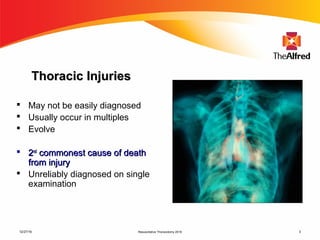
Thoracic InjuriesThoracic Injuries
 May not be easily diagnosed
 Usually occur in multiples
 Evolve
 22ndnd
commonest cause of deathcommonest cause of death
from injuryfrom injury
 Unreliably diagnosed on single
examination
12/27/16
Resuscitative Thoracotomy 2016 4
Thoracic TraumaThoracic Trauma
• Many patients survive to hospital with potentially lethal injuriesMany patients survive to hospital with potentially lethal injuries
that take time to become clinically apparent.that take time to become clinically apparent.
• Tension pneumothorax
• Massive haemothorax
• Cardiac tamponade
• Flail chest
• Pulmonary contusion
• Ruptured diaphragm
• Torn aorta
12/27/16
Resuscitative Thoracotomy 2016 5
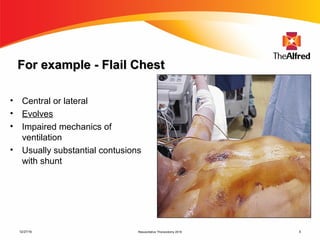
For example - Flail ChestFor example - Flail Chest
• Central or lateral
• Evolves
• Impaired mechanics of
ventilation
• Usually substantial contusions
with shunt
12/27/16
Resuscitative Thoracotomy 2016 6
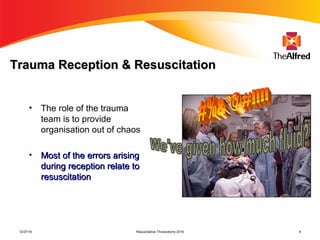
Trauma Reception & ResuscitationTrauma Reception & Resuscitation
• The role of the trauma
team is to provide
organisation out of chaos
• Most of the errors arisingMost of the errors arising
during reception relate toduring reception relate to
resuscitationresuscitation
12/27/16
Resuscitative Thoracotomy 2016 7
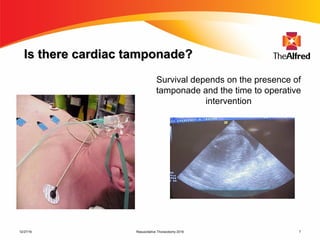
Is there cardiac tamponade?Is there cardiac tamponade?
Survival depends on the presence of
tamponade and the time to operative
intervention
12/27/16
Resuscitative Thoracotomy 2016 8
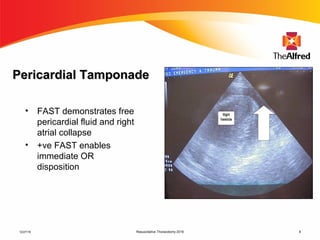
Pericardial TamponadePericardial Tamponade
• FAST demonstrates free
pericardial fluid and right
atrial collapse
• +ve FAST enables
immediate OR
disposition
12/27/16
Resuscitative Thoracotomy 2016 9
Penetrating Chest TraumaPenetrating Chest Trauma
• Decompress chest
• Stop uncontrolled haemorrhage
• Exclude cardiac tamponade
• Operative intervention
12/27/16
Resuscitative Thoracotomy 2016 10
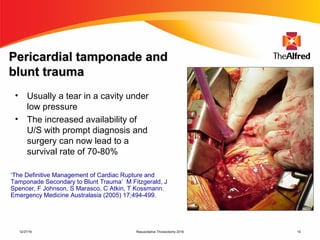
Pericardial tamponade andPericardial tamponade and
blunt traumablunt trauma
• Usually a tear in a cavity under
low pressure
• The increased availability of
U/S with prompt diagnosis and
surgery can now lead to a
survival rate of 70-80%
‘The Definitive Management of Cardiac Rupture and
Tamponade Secondary to Blunt Trauma’ M Fitzgerald, J
Spencer, F Johnson, S Marasco, C Atkin, T Kossmann.
Emergency Medicine Australasia (2005) 17;494-499.
12/27/16
Resuscitative Thoracotomy 2016 11
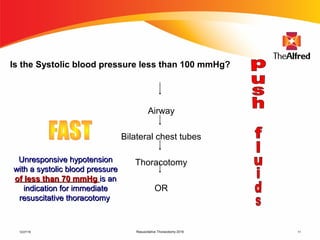
Is the Systolic blood pressure less than 100 mmHg?
Airway
Bilateral chest tubes
Thoracotomy
OR
Unresponsive hypotensionUnresponsive hypotension
with a systolic blood pressurewith a systolic blood pressure
of less than 70 mmHgof less than 70 mmHg is anis an
indication for immediateindication for immediate
resuscitative thoracotomyresuscitative thoracotomy
12/27/16
Resuscitative Thoracotomy 2016 12
Time to TheatreTime to Theatre
• Data extracted from the Alfred Trauma Registry for the 12 months
(October 2002–September 2003) revealed 5 patients with cardiac
tamponade (not requiring resuscitative thoracotomy in the trauma
centre) had a median time from arrival to operating theatre of 45
minutes.
• More than 1 hour elapsed before initiation of repair in 59% of
patients with haemopericardium in a North American series
published in 20001
.
1 Tyburski JG, Astral L, Wilson RF et al. Factors affecting prognosis with penetrating wounds of
the heart (annual meeting articles). J. Trauma 2000;48:587-91
12/27/16
Resuscitative Thoracotomy 2016 13
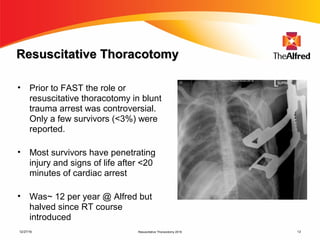
Resuscitative ThoracotomyResuscitative Thoracotomy
• Prior to FAST the role or
resuscitative thoracotomy in blunt
trauma arrest was controversial.
Only a few survivors (<3%) were
reported.
• Most survivors have penetrating
injury and signs of life after <20
minutes of cardiac arrest
• Was~ 12 per year @ Alfred but
halved since RT course
introduced
12/27/16
Resuscitative Thoracotomy 2016 14
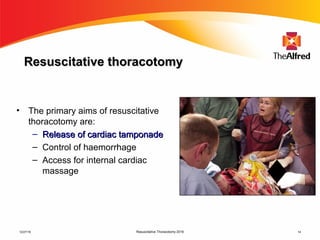
Resuscitative thoracotomyResuscitative thoracotomy
• The primary aims of resuscitative
thoracotomy are:
– Release of cardiac tamponadeRelease of cardiac tamponade
– Control of haemorrhage
– Access for internal cardiac
massage
12/27/16
Resuscitative Thoracotomy 2016 15
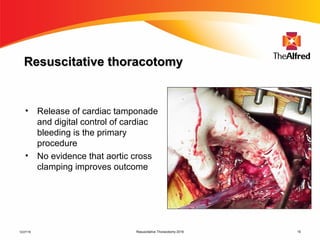
Resuscitative thoracotomyResuscitative thoracotomy
• Release of cardiac tamponade
and digital control of cardiac
bleeding is the primary
procedure
• No evidence that aortic cross
clamping improves outcome
12/27/16
Resuscitative Thoracotomy 2016 1612/27/16
Resuscitative Thoracotomy 2016 17
ResuscitativeResuscitative tthoracotomyhoracotomy & blunt trauma arrest& blunt trauma arrest
• Patients with blunt trunk trauma and cardiac arrest after
hemorrhagic shock may benefit from open-chest CPR with the
same probability as shown for patients with penetrating injuries.
This is especially true if the procedure is started as soon as
possible, but at the latest within 20 minutes after initial CCCPR1
.
1.Open-Chest Cardiopulmonary Resuscitation after Cardiac Arrest in Cases of Blunt Chest or
Abdominal Trauma: A Consecutive Series of 38 Cases. Fialka C, Sebök C, Kemetzhofer P,
Kwasny O, Sterz F, Vécsei V. J Trauma: Volume 57(4) October 2004 pp 809-814.
12/27/16
Resuscitative Thoracotomy 2016 18
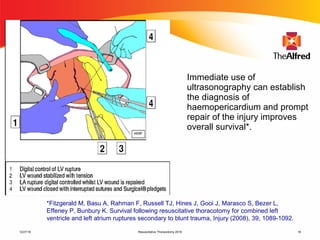
Immediate use of
ultrasonography can establish
the diagnosis of
haemopericardium and prompt
repair of the injury improves
overall survival*.
*Fitzgerald M, Basu A, Rahman F, Russell TJ, Hines J, Gooi J, Marasco S, Bezer L,
Effeney P, Bunbury K. Survival following resuscitative thoracotomy for combined left
ventricle and left atrium ruptures secondary to blunt trauma, Injury (2008), 39, 1089-1092.
12/27/16
Resuscitative Thoracotomy 2016 19
Thoracotomy TrayThoracotomy Tray
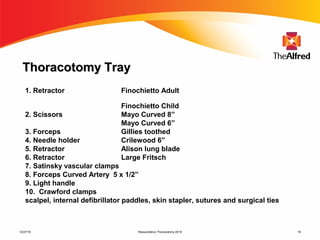
1. Retractor Finochietto Adult
Finochietto Child
2. Scissors Mayo Curved 8”
Mayo Curved 6”
3. Forceps Gillies toothed
4. Needle holder Crilewood 6”
5. Retractor Alison lung blade
6. Retractor Large Fritsch
7. Satinsky vascular clamps
8. Forceps Curved Artery 5 x 1/2”
9. Light handle
10. Crawford clamps
scalpel, internal defibrillator paddles, skin stapler, sutures and surgical ties
12/27/16
Resuscitative Thoracotomy 2016 20
Credentialing ProcessCredentialing Process
• Pre-reading 17 page overview ‘Alfred Trauma Centre Resuscitative
Thoracotomy’
• 30 minute didactic lecture
• 2 hour surgical skills station using anaesthetised pigs
• Preparation/positioning/approach
• Left anterolateral thoracotomy
• Phrenic nerve identification and pericardial decompression
• Evacuation of pericardial clot
• Digital control of right ventricular and left ventricular wounds
• Application of vascular clamps to both atrial appendages
• Open cardiac massage
• Internal defibrillation
• Credentialing certificate signed by the Director of Trauma/Director
of Emergency Medicine Training
12/27/16
Resuscitative Thoracotomy 2016 21
Surgical Skills LabSurgical Skills Lab
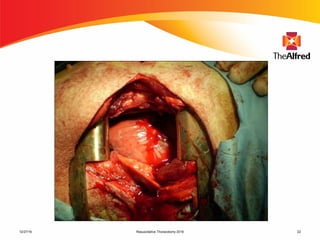
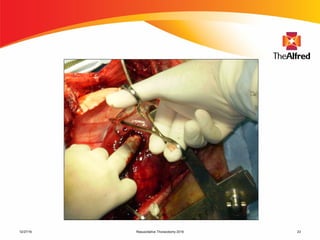
• Candidates are required to sequentially demonstrate haemorrhage
control using digital pressure (Figure 2) and then atrial appendage
clamping.
• Although simple wound repair techniques are demonstrated, it is
emphasized that pericardial decompression and haemorrhage
control is the primary goal – and that definitive surgical repair
should be performed by responding surgical staff.
12/27/16
Resuscitative Thoracotomy 2016 2212/27/16
Resuscitative Thoracotomy 2016 2312/27/16
Resuscitative Thoracotomy 2016 24
Thoracotomy Specific CredentialingThoracotomy Specific Credentialing
• Focussed Assessment with Sonography for Trauma
• Resuscitative Thoracotomy for Trauma
• Refresher every 2 years
12/27/16
Resuscitative Thoracotomy 2016 25
Trauma Centre ThoracotomyTrauma Centre Thoracotomy
• Clinical Audit & Performance Monitoring
• Comprehensive multidisciplinary clinical audit conducted as
required.
• All resuscitative thoracotomies undergo clinical audit at the :
– Trauma Service Audit meeting
– The Emergency Department Audit meeting
– Cardiothoracic Unit Audit meeting
• The Trauma Registry collects data on all resuscitative
thoracotomies and report ad hoc and annually activity and
mortality.
12/27/16
?
27/12/16 Resuscitative Thoracotomy 2016 26

Resuscitative Thoracotomy - Mark Fitzgerald

  • 1.
    Resuscitative thoracotomyResuscitative thoracotomy && pericardialdecompressionpericardial decompression Professor Mark Fitzgerald ASM MB BS MD FACEM AFRACMA GCSRP Director of Trauma Services, The Alfred Director, National Trauma Research Institute Professor, Department of Surgery, Central Clinical School, Monash University Professor, Faculty of Science Engineering and Technology, Swinburne University of Technology
  • 2.
    Resuscitative Thoracotomy 20162 Thoracic TraumaThoracic Trauma • Responsible for 20-25% of all deaths attributed to trauma. • Contributing cause of death in an additional 25% of patients who die from their injuries. • Incidence of 12 persons per million of population per day. Approximately 33% of these injuries require hospital admission1 . 1 http://www.emedicine.com/med/topic3658.htm 12/27/16
  • 3.
    Resuscitative Thoracotomy 20163 Thoracic InjuriesThoracic Injuries  May not be easily diagnosed  Usually occur in multiples  Evolve  22ndnd commonest cause of deathcommonest cause of death from injuryfrom injury  Unreliably diagnosed on single examination 12/27/16
  • 4.
    Resuscitative Thoracotomy 20164 Thoracic TraumaThoracic Trauma • Many patients survive to hospital with potentially lethal injuriesMany patients survive to hospital with potentially lethal injuries that take time to become clinically apparent.that take time to become clinically apparent. • Tension pneumothorax • Massive haemothorax • Cardiac tamponade • Flail chest • Pulmonary contusion • Ruptured diaphragm • Torn aorta 12/27/16
  • 5.
    Resuscitative Thoracotomy 20165 For example - Flail ChestFor example - Flail Chest • Central or lateral • Evolves • Impaired mechanics of ventilation • Usually substantial contusions with shunt 12/27/16
  • 6.
    Resuscitative Thoracotomy 20166 Trauma Reception & ResuscitationTrauma Reception & Resuscitation • The role of the trauma team is to provide organisation out of chaos • Most of the errors arisingMost of the errors arising during reception relate toduring reception relate to resuscitationresuscitation 12/27/16
  • 7.
    Resuscitative Thoracotomy 20167 Is there cardiac tamponade?Is there cardiac tamponade? Survival depends on the presence of tamponade and the time to operative intervention 12/27/16
  • 8.
    Resuscitative Thoracotomy 20168 Pericardial TamponadePericardial Tamponade • FAST demonstrates free pericardial fluid and right atrial collapse • +ve FAST enables immediate OR disposition 12/27/16
  • 9.
    Resuscitative Thoracotomy 20169 Penetrating Chest TraumaPenetrating Chest Trauma • Decompress chest • Stop uncontrolled haemorrhage • Exclude cardiac tamponade • Operative intervention 12/27/16
  • 10.
    Resuscitative Thoracotomy 201610 Pericardial tamponade andPericardial tamponade and blunt traumablunt trauma • Usually a tear in a cavity under low pressure • The increased availability of U/S with prompt diagnosis and surgery can now lead to a survival rate of 70-80% ‘The Definitive Management of Cardiac Rupture and Tamponade Secondary to Blunt Trauma’ M Fitzgerald, J Spencer, F Johnson, S Marasco, C Atkin, T Kossmann. Emergency Medicine Australasia (2005) 17;494-499. 12/27/16
  • 11.
    Resuscitative Thoracotomy 201611 Is the Systolic blood pressure less than 100 mmHg? Airway Bilateral chest tubes Thoracotomy OR Unresponsive hypotensionUnresponsive hypotension with a systolic blood pressurewith a systolic blood pressure of less than 70 mmHgof less than 70 mmHg is anis an indication for immediateindication for immediate resuscitative thoracotomyresuscitative thoracotomy 12/27/16
  • 12.
    Resuscitative Thoracotomy 201612 Time to TheatreTime to Theatre • Data extracted from the Alfred Trauma Registry for the 12 months (October 2002–September 2003) revealed 5 patients with cardiac tamponade (not requiring resuscitative thoracotomy in the trauma centre) had a median time from arrival to operating theatre of 45 minutes. • More than 1 hour elapsed before initiation of repair in 59% of patients with haemopericardium in a North American series published in 20001 . 1 Tyburski JG, Astral L, Wilson RF et al. Factors affecting prognosis with penetrating wounds of the heart (annual meeting articles). J. Trauma 2000;48:587-91 12/27/16
  • 13.
    Resuscitative Thoracotomy 201613 Resuscitative ThoracotomyResuscitative Thoracotomy • Prior to FAST the role or resuscitative thoracotomy in blunt trauma arrest was controversial. Only a few survivors (<3%) were reported. • Most survivors have penetrating injury and signs of life after <20 minutes of cardiac arrest • Was~ 12 per year @ Alfred but halved since RT course introduced 12/27/16
  • 14.
    Resuscitative Thoracotomy 201614 Resuscitative thoracotomyResuscitative thoracotomy • The primary aims of resuscitative thoracotomy are: – Release of cardiac tamponadeRelease of cardiac tamponade – Control of haemorrhage – Access for internal cardiac massage 12/27/16
  • 15.
    Resuscitative Thoracotomy 201615 Resuscitative thoracotomyResuscitative thoracotomy • Release of cardiac tamponade and digital control of cardiac bleeding is the primary procedure • No evidence that aortic cross clamping improves outcome 12/27/16
  • 16.
  • 17.
    Resuscitative Thoracotomy 201617 ResuscitativeResuscitative tthoracotomyhoracotomy & blunt trauma arrest& blunt trauma arrest • Patients with blunt trunk trauma and cardiac arrest after hemorrhagic shock may benefit from open-chest CPR with the same probability as shown for patients with penetrating injuries. This is especially true if the procedure is started as soon as possible, but at the latest within 20 minutes after initial CCCPR1 . 1.Open-Chest Cardiopulmonary Resuscitation after Cardiac Arrest in Cases of Blunt Chest or Abdominal Trauma: A Consecutive Series of 38 Cases. Fialka C, Sebök C, Kemetzhofer P, Kwasny O, Sterz F, Vécsei V. J Trauma: Volume 57(4) October 2004 pp 809-814. 12/27/16
  • 18.
    Resuscitative Thoracotomy 201618 Immediate use of ultrasonography can establish the diagnosis of haemopericardium and prompt repair of the injury improves overall survival*. *Fitzgerald M, Basu A, Rahman F, Russell TJ, Hines J, Gooi J, Marasco S, Bezer L, Effeney P, Bunbury K. Survival following resuscitative thoracotomy for combined left ventricle and left atrium ruptures secondary to blunt trauma, Injury (2008), 39, 1089-1092. 12/27/16
  • 19.
    Resuscitative Thoracotomy 201619 Thoracotomy TrayThoracotomy Tray 1. Retractor Finochietto Adult Finochietto Child 2. Scissors Mayo Curved 8” Mayo Curved 6” 3. Forceps Gillies toothed 4. Needle holder Crilewood 6” 5. Retractor Alison lung blade 6. Retractor Large Fritsch 7. Satinsky vascular clamps 8. Forceps Curved Artery 5 x 1/2” 9. Light handle 10. Crawford clamps scalpel, internal defibrillator paddles, skin stapler, sutures and surgical ties 12/27/16
  • 20.
    Resuscitative Thoracotomy 201620 Credentialing ProcessCredentialing Process • Pre-reading 17 page overview ‘Alfred Trauma Centre Resuscitative Thoracotomy’ • 30 minute didactic lecture • 2 hour surgical skills station using anaesthetised pigs • Preparation/positioning/approach • Left anterolateral thoracotomy • Phrenic nerve identification and pericardial decompression • Evacuation of pericardial clot • Digital control of right ventricular and left ventricular wounds • Application of vascular clamps to both atrial appendages • Open cardiac massage • Internal defibrillation • Credentialing certificate signed by the Director of Trauma/Director of Emergency Medicine Training 12/27/16
  • 21.
    Resuscitative Thoracotomy 201621 Surgical Skills LabSurgical Skills Lab • Candidates are required to sequentially demonstrate haemorrhage control using digital pressure (Figure 2) and then atrial appendage clamping. • Although simple wound repair techniques are demonstrated, it is emphasized that pericardial decompression and haemorrhage control is the primary goal – and that definitive surgical repair should be performed by responding surgical staff. 12/27/16
  • 22.
  • 23.
  • 24.
    Resuscitative Thoracotomy 201624 Thoracotomy Specific CredentialingThoracotomy Specific Credentialing • Focussed Assessment with Sonography for Trauma • Resuscitative Thoracotomy for Trauma • Refresher every 2 years 12/27/16
  • 25.
    Resuscitative Thoracotomy 201625 Trauma Centre ThoracotomyTrauma Centre Thoracotomy • Clinical Audit & Performance Monitoring • Comprehensive multidisciplinary clinical audit conducted as required. • All resuscitative thoracotomies undergo clinical audit at the : – Trauma Service Audit meeting – The Emergency Department Audit meeting – Cardiothoracic Unit Audit meeting • The Trauma Registry collects data on all resuscitative thoracotomies and report ad hoc and annually activity and mortality. 12/27/16
  • 26.