Rhabdomyolysis
Bishan Rajapakse – ED Registrar
Wollongong Hospital ED Reg teaching - 3/10/12


                               Image courtesy of Dr Carl Oller
Rhabdomyolysis - Overview
   Rhabdomyolysis in ACEM fellowship
    curriculum
   Clinical Case – „teaser‟
   “Rhabdo facts”
     Epidemiology,   causes, pathophys&management
   Clinical Cases – „pleaser‟
   Discussion
   Summary – take home points
ACEM fellowship syllabus


                           7-10% of
                           ARF is 2˚ to
                           Rhabdo
Case 1 – „Young crush‟
   26yo male
   Crush injury to R arm, 4x4 rolled back onto R arm
    whilst under car
       Posterior compartment R Arm bruised and swollen
       Numbness and paraesthesia
       Suspected brachial plexus, CT Neck unremarkable
   Labs results in resus(16/9/12 19:36)
       Ph 6.92, Lactate 21, Cr 96
       CK 419
   Urine dipstick –
       Haematuria ++
       Urine myoglobinuria not ordered
What do you think?
   Is Rhabdomyolysis present?
     How do we make the diagnosis?
     What are the key features?

   If it is Rhabdomyolysis?
     What is the management?
     What are his risks of ARF & death?
Progress
   2nd CK 4 hours later
       CK 2,353 U/L
   Admitted under trauma surgery
       Aggressive fluids, good UO
   Serial CKs
       17/9/12
         03:11 – 3,999 U/L
         06:00 – 4,604 U/L
         14:30 – 6,275 U/L, Na 142, K 4.2, Ur 5.4, Cr 96

   Pain and paraesthesia improving day 2
       Patient discharged against medical advice!!
Rhabdomyolysis
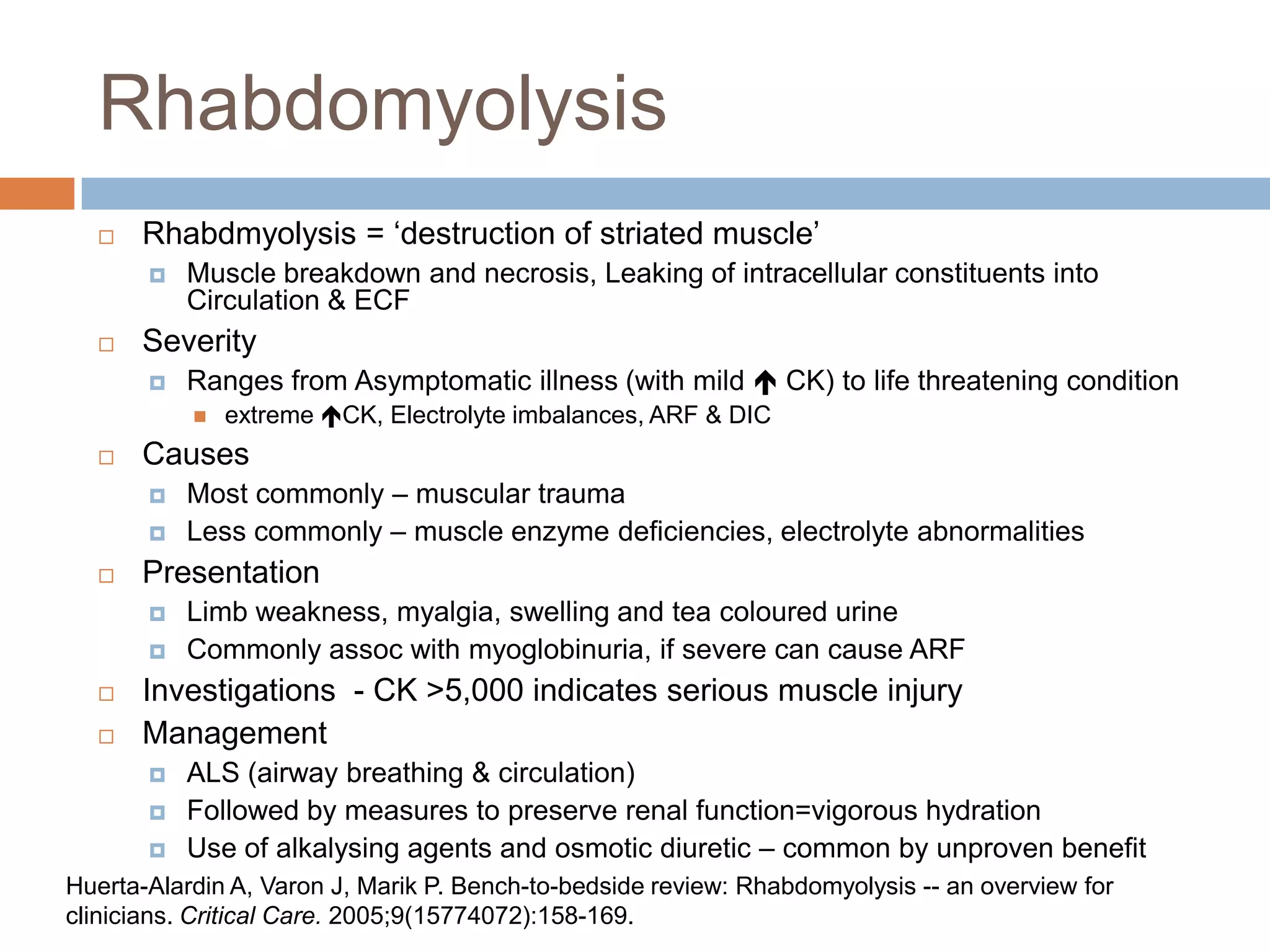
     Rhabdmyolysis = „destruction of striated muscle‟
          Muscle breakdown and necrosis, Leaking of intracellular constituents into
           Circulation & ECF
     Severity
          Ranges from Asymptomatic illness (with mild  CK) to life threatening condition
              extreme CK, Electrolyte imbalances, ARF & DIC
     Causes
          Most commonly – muscular trauma
          Less commonly – muscle enzyme deficiencies, electrolyte abnormalities
     Presentation
          Limb weakness, myalgia, swelling and tea coloured urine
          Commonly assoc with myoglobinuria, if severe can cause ARF
     Investigations - CK >5,000 indicates serious muscle injury
     Management
          ALS (airway breathing & circulation)
          Followed by measures to preserve renal function=vigorous hydration
          Use of alkalysing agents and osmotic diuretic – common by unproven benefit
Huerta-Alardin A, Varon J, Marik P. Bench-to-bedside review: Rhabdomyolysis -- an overview for
clinicians. Critical Care. 2005;9(15774072):158-169.
Rhabdomyolysis - epidemiology
   Seen in 85% of patients with traumatic injury
   Common in Earthquakes
   Acute Kidney injury in 10-50%
     7-80%   mortality
   Outcome generally good, but…
     Co-existing valculopathy – mortality 32%
     In ICU patients – 22% mortality if RF absent, 59%
      if RF present
Categories of cause
   Physical
       Trauma (Crush syndrome)
       Exertion (strenuous exercise, siezure, AWS)
       Muscle hypoxia (limb compression, prolonged immobilisation or
        LOC, major artery occlusion)
   Non Physical
       Genetic defects (glycolysis or glyconeogenesis)
       Infections (legionella, malaria, herpes)
       Body temp changes
       Metabolic and electrolyte disorders (Na,K)
       Drugs and toxins (cocaine, statins)
       Endocrine/Autoimmune causes (polymyositis)
       Idiopathic
Clinical Illustrations
   Dengue viral myositis
     17 yo boy, fever and myalgia
     Day 4 developed oliguria, CK 60,000 (rpt 90,000)
     Reduced Calcium, elevated Phospate
     Oliguria and refractory hypotension – leading to
      death
     Viral infections Rhabdomyolyis
Sunderalingam et al “Dengue viral myositis complicated with rhabdomyolyis and
super infection of methicillin resistant Staphylococcus aureus” awaiting
publication

   Young male, heroin OD
     Elevated    CK, Hyperkalaemia, Hypocalcaemia,
Pathophysiology
   Method (and mechanism) of cellular
    destruction
     Direct injury to cell membrane (crushing,
      tearing, dissolving)
     Muscle cell hypoxialeading to depletion ATP
      (Anaerobic conditions, shock states, vascular
      occlusion and tissue compression)
     Electrolyte disturbance disrupting the Na/K pump (K
      :vomiting diarrhoea, extensive diuresis, Na:
      water intoxication)
Pathophysiology


Huerta-Alardin A, Varon J, Marik P. Bench-to-bedside review: Rhabdomyolysis -- an overview for
clinicians. Critical Care. 2005;9(15774072):158-169.
How does Myoglobin cause
ARF?


       Myoglobin


                     Perutz (Hb), Kendrick
                     (Myoglobin)


       Haemoglobin
Myoglobinuric ARF                                    Pigmented Cast
                                                       formation

                                                       Cast formation
                     2 Cruicial Factors                enhanced by
                     -Hypovolaemia/dehydration         urine Ph
                     -Aciduria

                                  ARF


                      Haem protein toxicity
                      -Renal vasoconstriction
                      -Diminished renal circulation
                      -Intraluminal cast formation &
                      direct haem protein-induced
                      cytotoxicity
                                                       It is suggested that
                                                       ARF is caused by
“in absence of hypovolaemia&aciduriaheme proteins      tubular obstruction
have minimal nephrotoxic effects”
The New England journal of medicine. 2009;361(19571284):62-
Investigations
   CK levels
       >5000 U/L related to ARF (norm 45-260)
       Rises within 12 hrs, peak 1-3 days, declines 3-5days post muscle injury
       After peak drops by 40% per day (T ½ 1.5d)
   Myoglobinuria
       Urine dipstick positive for “blood” no red bood cells in urine sediment
   Electrolytes
       K+, PO4, Uric acid, LDH, ALT, AST, carbonic anhydrase III
       Ca++, (initially low as moves into cells, may increase later)
   Coagulation studies
       DIC may develop
   Tox screen
       Etoh commonly associated with diagnosis
       Heroin and other illicit drugs
Urinalysis
Management
   Advance Life Support
   Aggressive fluid therapy
                              Commonly used but controversial
   Urinary Alkalinisation    -Little clinical evidence
   +/-Mannitol               -Rationale “preserving urine flow
   Follow up CK and Electrolytes may reduce damage”
                              in ARF

   If suspect ARF            -Useful if become fluid overloaded
                              whilst being treated for
     Cardiac  monitoring            Rhabdomyolysis

     Dialysis if necessary
Case 3 – Could it be renal colic
   65 year-old male presenting with right-sided
    flank pain radiating to the groin. The following
    CT scan was taken to confirm a
    presumed diagnosis of renal colic:


        http://lifeinthefastlane.com/2009/12/renal-riddle-001/
CT scan


   -Right sided retro peritoneal
   blood                           Patient went for
                                   emergency AAA
   - AAA                           repair
Routine post op biochemistry


  • increased urea and creatinine (with urea-to-creatinineratio)
  •hyperphosphataemia, hypocalcaemia, hyperkalaemia
  • increased CK (usually to greater than 40,000)


      http://lifeinthefastlane.com/2009/12/renal-riddle-001/
Rhabdomyolysis - treatment
   aggressively correct hypovolaemia
       Target UO 2-3ml/kg/hr
   Monitor K closely and treat hypokalaemia
   Alternate N/Saline with 1L litre of D5W
     Avoid K & lactate containing solutions
     100mmol of HCO3 if urine pH <6.5

   “Consider” mannitol, up to 200g/day, not > 800g
    total dose.
   Consider haemodyalysis if resistant hyperkalemia
    of more than 6.5mmol/L

Bosch X, Poch E, Grau JM. Rhabdomyolysis and acute kidney injury. The New
England journal of medicine. 2009;361(19571284):62-72.
Hyperkalaemia (>5.5) in
Rhabdo
   Check K every 4 hours when CK>60,000
        Treat hyperkalaemia aggressively
        ECG
            CaCl or CaGluconate
        Consider cardiac monitoring if K>6
        Check plasma Calcium (aggravates hyperK)
   K>6
        1) Insulin and glucose, Salbutamol,
        2) NaHCO3 if acidaemia (may worsen HypoCa, not efficacious as
         no1 above)
   Optional - Remove potassium
        Resins (sodium polystyrene sulfonate)
        Haemodialysis
        Loop diuretics (only once fluid level has been expanded
    The New England journal of medicine. 2009;361(19571284):62-72.
Summary
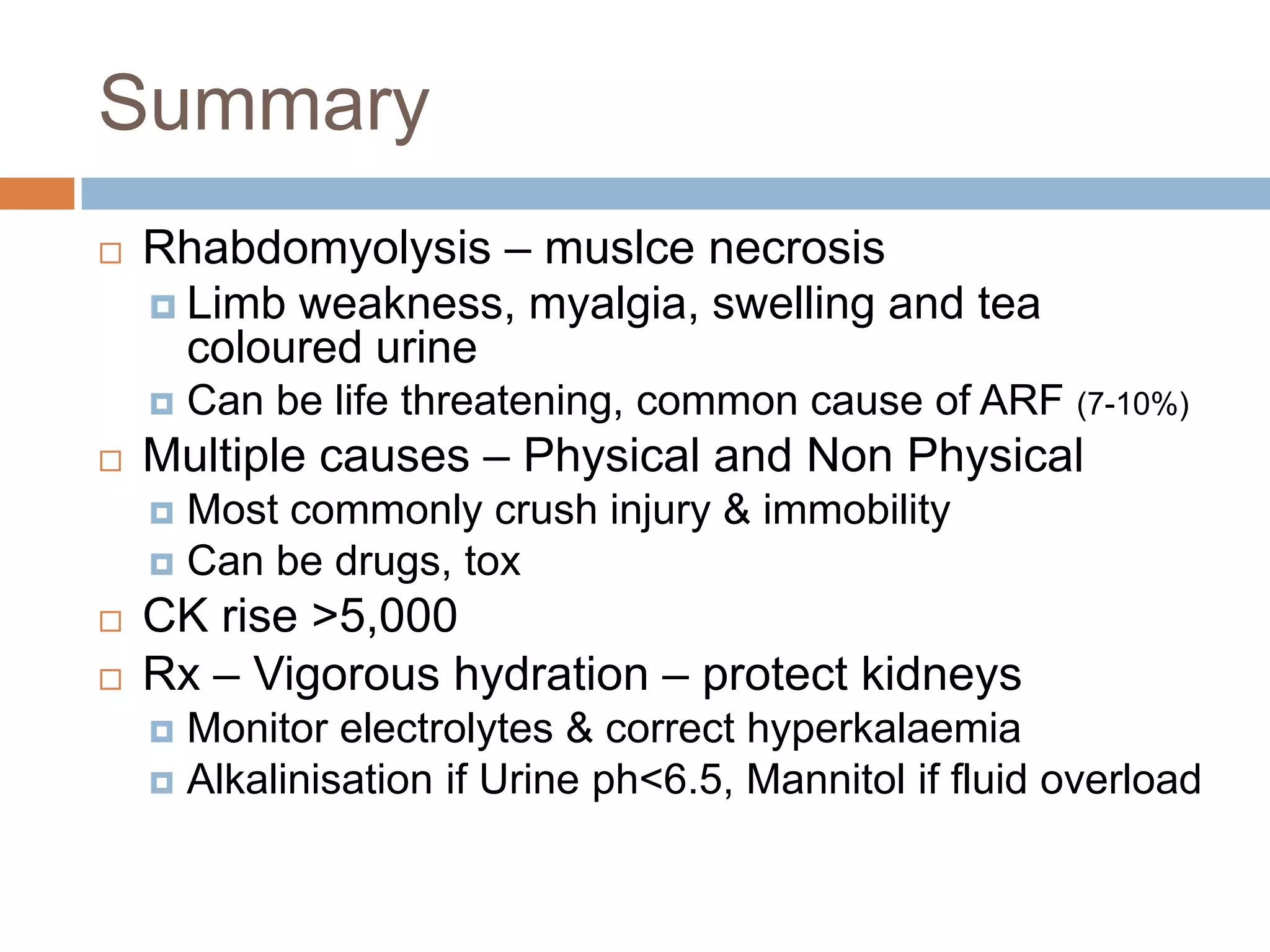
   Rhabdomyolysis – muslce necrosis
     Limb weakness, myalgia, swelling and tea
      coloured urine
       Can be life threatening, common cause of ARF (7-10%)
   Multiple causes – Physical and Non Physical
     Most commonly crush injury & immobility
     Can be drugs, tox
   CK rise >5,000
   Rx – Vigorous hydration – protect kidneys
     Monitor electrolytes & correct hyperkalaemia
     Alkalinisation if Urine ph<6.5, Mannitol if fluid overload
References/Acknowledgements
   Critical Care
       Huerta-Alardin A, Varon J, Marik P. Bench-to-bedside review: Rhabdomyolysis -- an
        overview for clinicians. Critical Care. 2005;9(15774072):158-169.
   NEJM
       Bosch X, Poch E, Grau JM. Rhabdomyolysis and acute kidney injury. The New
        England journal of medicine. 2009;361(19571284):62-72.
   LTFL
       Paul Young (Intensivist Wellington, NZ) http://lifeinthefastlane.com/2009/12/renal-riddle-
        001/
   Free EM talks (Joe Lex)
       Garry Gaddis (Orthopaedic Surgeon) – talk “Rabdomyolysis& compartment syndrome” Cancun
        Trauma conference 2008 (http://freeemergencytalks.net/2010/04/gary-gaddis-rhabdomyolysis-and-
        compartment-syndrome/)

   Personal discussion/case reports unpublished data
       Darren Roberts (Clinical Pharm and Tox, UK)
       VinothanSunderalingam (Physician Trainee, Sri Lanka)
       Jorge Sesperz (Trauma researcher)
Wollongong ED RegFacebook
group


                   Look it‟s a site just for us!
                     Please join up today!

                  http://www.facebook.com/gr
                   oups/131728460307304/

                  And do start commenting –
                   remember – it‟s only “us”
And don‟t forget “Free EM talks –
rock!!”


  (http://freeemergencytalks.net/2010/04/gary-gaddis-rhabdomyolysis-and-
  compartment-syndrome/)
Discussion:
…..Time for your thoughts!
Extra slides
BUN : Cr Ratio

                                                        BUN: Cr ratio is low in
                                                        Rhabdomyolysis


 http://en.wikipedia.org/wiki/BUN-to-creatinine_ratio
Mannitol& Loop diuretics??
   Limited evidence for
      Diuretics preventing acute kidney injury
      Diuretics decreasing Mortality

   Diuretics are useful if become fluid overloaded
    whilst being treated for Rhabdomyolysis

Gary Gaddis MD, Orthopaedist “Rhabdomyolysis& Compartment Syndrome
    Talk at Orthopaedic Emergencies and Trauma (Cancun 2008)
    Pod cast from Joe Lex @ http://freeemergencytalks.net/


    Huerta-Alardin A, Varon J, Marik P. Bench-to-bedside review: Rhabdomyolysis --
    an overview for clinicians. Critical Care. 2005;9(15774072):158-169.

Rhabdomyolysis -Registar teaching (9-10-12)b

  • 1.
    Rhabdomyolysis Bishan Rajapakse –ED Registrar Wollongong Hospital ED Reg teaching - 3/10/12 Image courtesy of Dr Carl Oller
  • 2.
    Rhabdomyolysis - Overview  Rhabdomyolysis in ACEM fellowship curriculum  Clinical Case – „teaser‟  “Rhabdo facts”  Epidemiology, causes, pathophys&management  Clinical Cases – „pleaser‟  Discussion  Summary – take home points
  • 3.
    ACEM fellowship syllabus 7-10% of ARF is 2˚ to Rhabdo
  • 4.
    Case 1 –„Young crush‟  26yo male  Crush injury to R arm, 4x4 rolled back onto R arm whilst under car  Posterior compartment R Arm bruised and swollen  Numbness and paraesthesia  Suspected brachial plexus, CT Neck unremarkable  Labs results in resus(16/9/12 19:36)  Ph 6.92, Lactate 21, Cr 96  CK 419  Urine dipstick –  Haematuria ++  Urine myoglobinuria not ordered
  • 5.
    What do youthink?  Is Rhabdomyolysis present?  How do we make the diagnosis?  What are the key features?  If it is Rhabdomyolysis?  What is the management?  What are his risks of ARF & death?
  • 6.
    Progress  2nd CK 4 hours later  CK 2,353 U/L  Admitted under trauma surgery  Aggressive fluids, good UO  Serial CKs  17/9/12  03:11 – 3,999 U/L  06:00 – 4,604 U/L  14:30 – 6,275 U/L, Na 142, K 4.2, Ur 5.4, Cr 96  Pain and paraesthesia improving day 2  Patient discharged against medical advice!!
  • 7.
    Rhabdomyolysis  Rhabdmyolysis = „destruction of striated muscle‟  Muscle breakdown and necrosis, Leaking of intracellular constituents into Circulation & ECF  Severity  Ranges from Asymptomatic illness (with mild  CK) to life threatening condition  extreme CK, Electrolyte imbalances, ARF & DIC  Causes  Most commonly – muscular trauma  Less commonly – muscle enzyme deficiencies, electrolyte abnormalities  Presentation  Limb weakness, myalgia, swelling and tea coloured urine  Commonly assoc with myoglobinuria, if severe can cause ARF  Investigations - CK >5,000 indicates serious muscle injury  Management  ALS (airway breathing & circulation)  Followed by measures to preserve renal function=vigorous hydration  Use of alkalysing agents and osmotic diuretic – common by unproven benefit Huerta-Alardin A, Varon J, Marik P. Bench-to-bedside review: Rhabdomyolysis -- an overview for clinicians. Critical Care. 2005;9(15774072):158-169.
  • 8.
    Rhabdomyolysis - epidemiology  Seen in 85% of patients with traumatic injury  Common in Earthquakes  Acute Kidney injury in 10-50%  7-80% mortality  Outcome generally good, but…  Co-existing valculopathy – mortality 32%  In ICU patients – 22% mortality if RF absent, 59% if RF present
  • 9.
    Categories of cause  Physical  Trauma (Crush syndrome)  Exertion (strenuous exercise, siezure, AWS)  Muscle hypoxia (limb compression, prolonged immobilisation or LOC, major artery occlusion)  Non Physical  Genetic defects (glycolysis or glyconeogenesis)  Infections (legionella, malaria, herpes)  Body temp changes  Metabolic and electrolyte disorders (Na,K)  Drugs and toxins (cocaine, statins)  Endocrine/Autoimmune causes (polymyositis)  Idiopathic
  • 10.
    Clinical Illustrations  Dengue viral myositis  17 yo boy, fever and myalgia  Day 4 developed oliguria, CK 60,000 (rpt 90,000)  Reduced Calcium, elevated Phospate  Oliguria and refractory hypotension – leading to death  Viral infections Rhabdomyolyis Sunderalingam et al “Dengue viral myositis complicated with rhabdomyolyis and super infection of methicillin resistant Staphylococcus aureus” awaiting publication  Young male, heroin OD  Elevated CK, Hyperkalaemia, Hypocalcaemia,
  • 11.
    Pathophysiology  Method (and mechanism) of cellular destruction  Direct injury to cell membrane (crushing, tearing, dissolving)  Muscle cell hypoxialeading to depletion ATP (Anaerobic conditions, shock states, vascular occlusion and tissue compression)  Electrolyte disturbance disrupting the Na/K pump (K :vomiting diarrhoea, extensive diuresis, Na: water intoxication)
  • 12.
    Pathophysiology Huerta-Alardin A, VaronJ, Marik P. Bench-to-bedside review: Rhabdomyolysis -- an overview for clinicians. Critical Care. 2005;9(15774072):158-169.
  • 13.
    How does Myoglobincause ARF? Myoglobin Perutz (Hb), Kendrick (Myoglobin) Haemoglobin
  • 14.
    Myoglobinuric ARF Pigmented Cast formation Cast formation 2 Cruicial Factors enhanced by -Hypovolaemia/dehydration urine Ph -Aciduria ARF Haem protein toxicity -Renal vasoconstriction -Diminished renal circulation -Intraluminal cast formation & direct haem protein-induced cytotoxicity It is suggested that ARF is caused by “in absence of hypovolaemia&aciduriaheme proteins tubular obstruction have minimal nephrotoxic effects”
  • 15.
    The New Englandjournal of medicine. 2009;361(19571284):62-
  • 16.
    Investigations  CK levels  >5000 U/L related to ARF (norm 45-260)  Rises within 12 hrs, peak 1-3 days, declines 3-5days post muscle injury  After peak drops by 40% per day (T ½ 1.5d)  Myoglobinuria  Urine dipstick positive for “blood” no red bood cells in urine sediment  Electrolytes  K+, PO4, Uric acid, LDH, ALT, AST, carbonic anhydrase III  Ca++, (initially low as moves into cells, may increase later)  Coagulation studies  DIC may develop  Tox screen  Etoh commonly associated with diagnosis  Heroin and other illicit drugs
  • 17.
  • 18.
    Management  Advance Life Support  Aggressive fluid therapy Commonly used but controversial  Urinary Alkalinisation -Little clinical evidence  +/-Mannitol -Rationale “preserving urine flow  Follow up CK and Electrolytes may reduce damage” in ARF  If suspect ARF -Useful if become fluid overloaded whilst being treated for  Cardiac monitoring Rhabdomyolysis  Dialysis if necessary
  • 19.
    Case 3 –Could it be renal colic  65 year-old male presenting with right-sided flank pain radiating to the groin. The following CT scan was taken to confirm a presumed diagnosis of renal colic: http://lifeinthefastlane.com/2009/12/renal-riddle-001/
  • 20.
    CT scan -Right sided retro peritoneal blood Patient went for emergency AAA - AAA repair
  • 21.
    Routine post opbiochemistry • increased urea and creatinine (with urea-to-creatinineratio) •hyperphosphataemia, hypocalcaemia, hyperkalaemia • increased CK (usually to greater than 40,000) http://lifeinthefastlane.com/2009/12/renal-riddle-001/
  • 22.
    Rhabdomyolysis - treatment  aggressively correct hypovolaemia  Target UO 2-3ml/kg/hr  Monitor K closely and treat hypokalaemia  Alternate N/Saline with 1L litre of D5W  Avoid K & lactate containing solutions  100mmol of HCO3 if urine pH <6.5  “Consider” mannitol, up to 200g/day, not > 800g total dose.  Consider haemodyalysis if resistant hyperkalemia of more than 6.5mmol/L Bosch X, Poch E, Grau JM. Rhabdomyolysis and acute kidney injury. The New England journal of medicine. 2009;361(19571284):62-72.
  • 23.
    Hyperkalaemia (>5.5) in Rhabdo  Check K every 4 hours when CK>60,000  Treat hyperkalaemia aggressively  ECG  CaCl or CaGluconate  Consider cardiac monitoring if K>6  Check plasma Calcium (aggravates hyperK)  K>6  1) Insulin and glucose, Salbutamol,  2) NaHCO3 if acidaemia (may worsen HypoCa, not efficacious as no1 above)  Optional - Remove potassium  Resins (sodium polystyrene sulfonate)  Haemodialysis  Loop diuretics (only once fluid level has been expanded The New England journal of medicine. 2009;361(19571284):62-72.
  • 24.
    Summary  Rhabdomyolysis – muslce necrosis  Limb weakness, myalgia, swelling and tea coloured urine  Can be life threatening, common cause of ARF (7-10%)  Multiple causes – Physical and Non Physical  Most commonly crush injury & immobility  Can be drugs, tox  CK rise >5,000  Rx – Vigorous hydration – protect kidneys  Monitor electrolytes & correct hyperkalaemia  Alkalinisation if Urine ph<6.5, Mannitol if fluid overload
  • 25.
    References/Acknowledgements  Critical Care  Huerta-Alardin A, Varon J, Marik P. Bench-to-bedside review: Rhabdomyolysis -- an overview for clinicians. Critical Care. 2005;9(15774072):158-169.  NEJM  Bosch X, Poch E, Grau JM. Rhabdomyolysis and acute kidney injury. The New England journal of medicine. 2009;361(19571284):62-72.  LTFL  Paul Young (Intensivist Wellington, NZ) http://lifeinthefastlane.com/2009/12/renal-riddle- 001/  Free EM talks (Joe Lex)  Garry Gaddis (Orthopaedic Surgeon) – talk “Rabdomyolysis& compartment syndrome” Cancun Trauma conference 2008 (http://freeemergencytalks.net/2010/04/gary-gaddis-rhabdomyolysis-and- compartment-syndrome/)  Personal discussion/case reports unpublished data  Darren Roberts (Clinical Pharm and Tox, UK)  VinothanSunderalingam (Physician Trainee, Sri Lanka)  Jorge Sesperz (Trauma researcher)
  • 26.
    Wollongong ED RegFacebook group Look it‟s a site just for us! Please join up today! http://www.facebook.com/gr oups/131728460307304/ And do start commenting – remember – it‟s only “us”
  • 27.
    And don‟t forget“Free EM talks – rock!!” (http://freeemergencytalks.net/2010/04/gary-gaddis-rhabdomyolysis-and- compartment-syndrome/)
  • 28.
  • 29.
  • 30.
    BUN : CrRatio BUN: Cr ratio is low in Rhabdomyolysis http://en.wikipedia.org/wiki/BUN-to-creatinine_ratio
  • 31.
    Mannitol& Loop diuretics??  Limited evidence for  Diuretics preventing acute kidney injury  Diuretics decreasing Mortality  Diuretics are useful if become fluid overloaded whilst being treated for Rhabdomyolysis Gary Gaddis MD, Orthopaedist “Rhabdomyolysis& Compartment Syndrome Talk at Orthopaedic Emergencies and Trauma (Cancun 2008) Pod cast from Joe Lex @ http://freeemergencytalks.net/ Huerta-Alardin A, Varon J, Marik P. Bench-to-bedside review: Rhabdomyolysis -- an overview for clinicians. Critical Care. 2005;9(15774072):158-169.

Editor's Notes

  • #9 85% in patients with traumatic injury NEJM (Acute Kidney injury ranges from 13-50%, or 10-50%)Earthquates
  • #14 Max Perutz, Jon Kendrick
  • #15 3 main mechanisms influencing haem protein toxicity
  • #17 Carbonic anydrase 3
  • #23 aggressively correct hypovolaemia (a common problem due to sequestration of fluid in muscle)alternate each litre of saline with 1L litre of D5W plus 100mmol of bicarbonate if the urine pH is less than 6.5 (they suggest abandoning urinary alkalinisation if the urine pH does not rise after 4-6 hours of treatment or if symptomatic hypocalaemia develops)
  • #31 Likely to indicateLow in Rhabdo