RIGHT HEART
ASSESMENT
Is It Important?
• Not just a conduit
• Connected and affected
• Risk stratification
• Therapy guidance
• Controversial
• Understudied
• Examiners favorite
The Purposes Of Guidelines
▪ Describe the acoustic windows
▪ Describe the echocardiographic parameters of RV size and
function.
▪ Advantages and disadvantages of each measure or technique.
▪ Recommend which right-sided measures should be included in
the standard echocardiographic report.
▪ Provide revised reference values
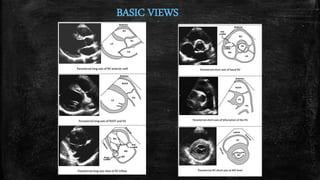
BASIC VIEWS
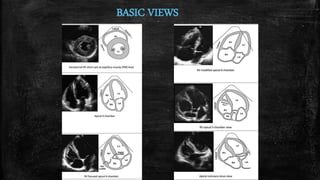
BASIC VIEWS
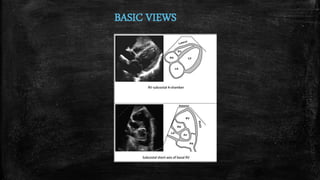
BASIC VIEWS
Segmental Nomenclature
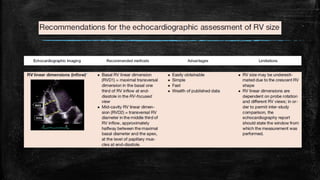
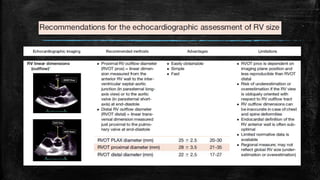
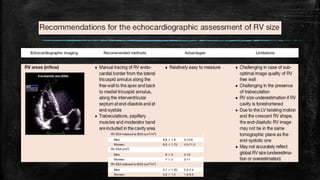
Right Heart Dimensions
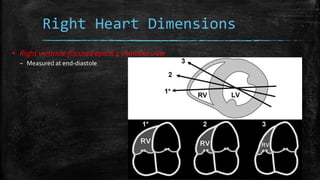
▪ Right ventricle-focused apical 4 chamber view
– Measured at end-diastole
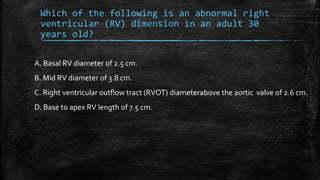
Which of the following is an abnormal right
ventricular (RV) dimension in an adult 30
years old?
A. Basal RV diameter of 2.5 cm.
B. Mid RV diameter of 3.8 cm.
C. Right ventricular outflow tract (RVOT) diameterabove the aortic valve of 2.6 cm.
D. Base to apex RV length of 7.5 cm.
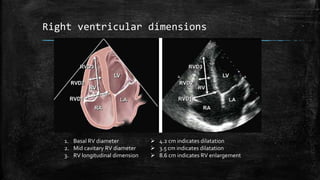
Right ventricular dimensions
1. Basal RV diameter
2. Mid cavitary RV diameter
3. RV longitudinal dimension
 4.2 cm indicates dilatation
 3.5 cm indicates dilatation
 8.6 cm indicates RV enlargement
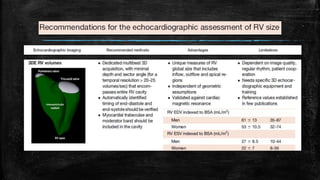
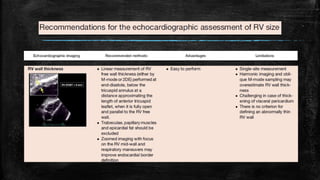
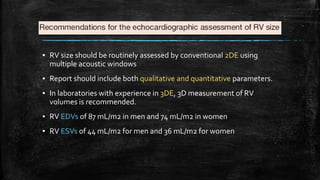
▪ RV size should be routinely assessed by conventional 2DE using
multiple acoustic windows
▪ Report should include both qualitative and quantitative parameters.
▪ In laboratories with experience in 3DE, 3D measurement of RV
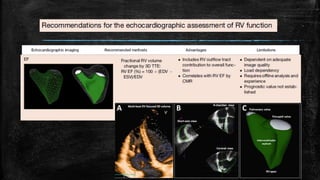
volumes is recommended.
▪ RV EDVs of 87 mL/m2 in men and 74 mL/m2 in women
▪ RV ESVs of 44 mL/m2 for men and 36 mL/m2 for women
TAPSE
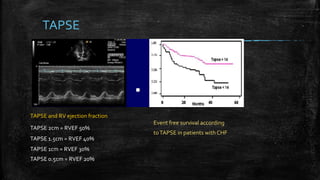
TAPSE and RV ejection fraction
TAPSE 2cm = RVEF 50%
TAPSE 1.5cm = RVEF 40%
TAPSE 1cm = RVEF 30%
TAPSE 0.5cm = RVEF 20%
Event free survival according
toTAPSE in patients with CHF
RV Diastolic Function
▪ From the apical 4-chamber view, the Doppler beam should
be aligned parallel to RV inflow
▪ Sample volume is placed at the tips of the tricuspid valve
leaflets
▪ Measure at held end-expiration and/or take the average of
≥ 5 consecutive beats
▪ Measurements are essentially the same as those used for
the left side
Recommendation
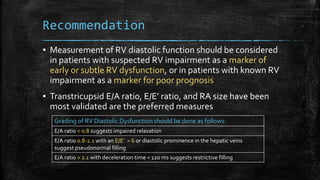
▪ Measurement of RV diastolic function should be considered
in patients with suspected RV impairment as a marker of
early or subtle RV dysfunction, or in patients with known RV
impairment as a marker for poor prognosis
▪ Transtricupsid E/A ratio, E/E’ ratio, and RA size have been
most validated are the preferred measures
Grading of RV Diastolic Dysfunction should be done as follows:
E/A ratio < 0.8 suggests impaired relaxation
E/A ratio 0.8-2.1 with an E/E’ > 6 or diastolic prominence in the hepatic veins
suggest pseudonormal filling
E/A ratio > 2.1 with deceleration time < 120 ms suggests restrictive filling
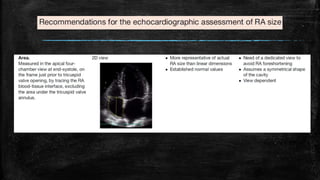
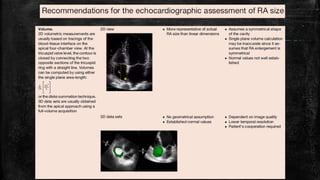
Recommendations
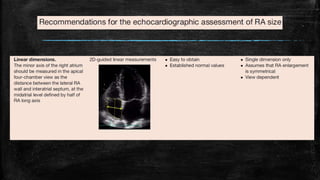
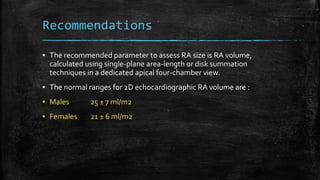
▪ The recommended parameter to assess RA size is RA volume,
calculated using single-plane area-length or disk summation
techniques in a dedicated apical four-chamber view.
▪ The normal ranges for 2D echocardiographic RA volume are :
▪ Males 25 ± 7 ml/m2
▪ Females 21 ± 6 ml/m2
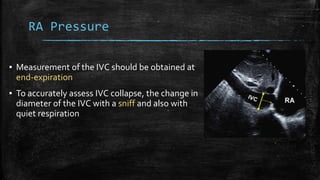
RA Pressure
▪ Measurement of the IVC should be obtained at
end-expiration
▪ To accurately assess IVC collapse, the change in
diameter of the IVC with a sniff and also with
quiet respiration
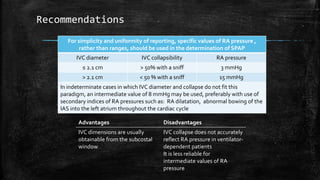
Recommendations
For simplicity and uniformity of reporting, specific values of RA pressure ,
rather than ranges, should be used in the determination of SPAP
IVC diameter IVC collapsibility RA pressure
≤ 2.1 cm > 50% with a sniff 3 mmHg
> 2.1 cm < 50 % with a sniff 15 mmHg
In indeterminate cases in which IVC diameter and collapse do not fit this
paradigm, an intermediate value of 8 mmHg may be used, preferably with use of
secondary indices of RA pressures such as: RA dilatation, abnormal bowing of the
IAS into the left atrium throughout the cardiac cycle
Advantages Disadvantages
IVC dimensions are usually
obtainable from the subcostal
window
IVC collapse does not accurately
reflect RA pressure in ventilator-
dependent patients
It is less reliable for
intermediate values of RA
pressure
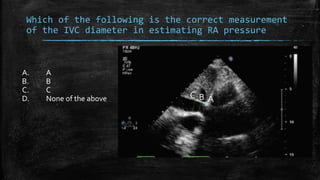
Which of the following is the correct measurement
of the IVC diameter in estimating RA pressure
A. A
B. B
C. C
D. None of the above ABC
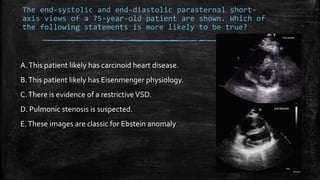
The end-systolic and end-diastolic parasternal short-
axis views of a 75-year-old patient are shown. Which of
the following statements is more likely to be true?
A.This patient likely has carcinoid heart disease.
B.This patient likely has Eisenmenger physiology.
C.There is evidence of a restrictiveVSD.
D. Pulmonic stenosis is suspected.
E.These images are classic for Ebstein anomaly
Other Recommendations
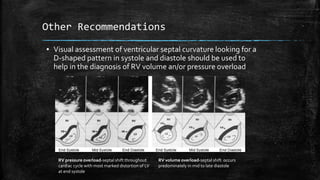
▪ Visual assessment of ventricular septal curvature looking for a
D-shaped pattern in systole and diastole should be used to
help in the diagnosis of RV volume an/or pressure overload
RV pressure overload-septal shift throughout
cardiac cycle with most marked distortion of LV
at end systole
RV volume overload-septal shift occurs
predominately in mid to late diastole
Pulmonary Artery Pressures
▪ PASP should be estimated and reported in all subjects with
reliable tricuspid regurgitant jets
Which of the following parameters are used to
calculate Pulmonary artery systolic pressure?
A. TR only
B. TR and PR only
C. TR andVSD only
D. TR, PR, andVSD only
E. TR, AR, PR, andVSD
What is the PA systolic pressure of the patient with
pulmonary stenosis, where peak TR velocity is 4
m/sec, peak velocity across pulmonic valve 3 m/sec,
and RA pressure 10 mm Hg?
A. PA systolic pressure 46 mm Hg.
B. PA systolic pressure 74 mm Hg.
C. PA systolic pressure 38 mm Hg.
D. PA systolic pressure 50 mm Hg.
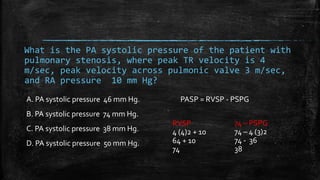
What is the PA systolic pressure of the patient with
pulmonary stenosis, where peak TR velocity is 4
m/sec, peak velocity across pulmonic valve 3 m/sec,
and RA pressure 10 mm Hg?
A. PA systolic pressure 46 mm Hg.
B. PA systolic pressure 74 mm Hg.
C. PA systolic pressure 38 mm Hg.
D. PA systolic pressure 50 mm Hg.
RVSP
4 (4)2 + 10
64 + 10
74
74 – PSPG
74 – 4 (3)2
74 - 36
38
PASP = RVSP - PSPG
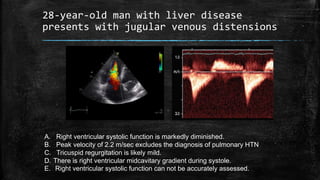
28-year-old man with liver disease
presents with jugular venous distensions
A. Right ventricular systolic function is markedly diminished.
B. Peak velocity of 2.2 m/sec excludes the diagnosis of pulmonary HTN
C. Tricuspid regurgitation is likely mild.
D. There is right ventricular midcavitary gradient during systole.
E. Right ventricular systolic function can not be accurately assessed.
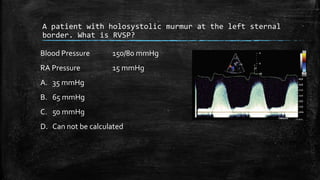
A patient with holosystolic murmur at the left sternal
border. What is RVSP?
Blood Pressure 150/80 mmHg
RA Pressure 15 mmHg
A. 35 mmHg
B. 65 mmHg
C. 50 mmHg
D. Can not be calculated
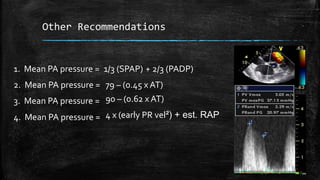
Other Recommendations
1/3 (SPAP) + 2/3 (PADP)1. Mean PA pressure =
2. Mean PA pressure = 79 – (0.45 x AT)
3. Mean PA pressure = 90 – (0.62 x AT)
4. Mean PA pressure = 4 x (early PR vel²) + est. RAP
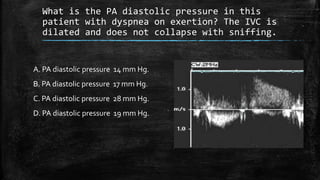
What is the PA diastolic pressure in this
patient with dyspnea on exertion? The IVC is
dilated and does not collapse with sniffing.
A. PA diastolic pressure 14 mm Hg.
B. PA diastolic pressure 17 mm Hg.
C. PA diastolic pressure 28 mm Hg.
D. PA diastolic pressure 19 mm Hg.
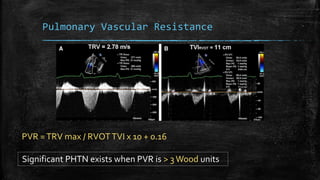
Pulmonary Vascular Resistance
PVR =TRV max / RVOTTVI x 10 + 0.16
Significant PHTN exists when PVR is > 3 Wood units
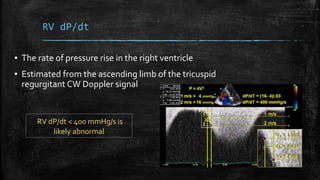
RV dP/dt
▪ The rate of pressure rise in the right ventricle
▪ Estimated from the ascending limb of the tricuspid
regurgitant CW Doppler signal
RV dP/dt < 400 mmHg/s is
likely abnormal
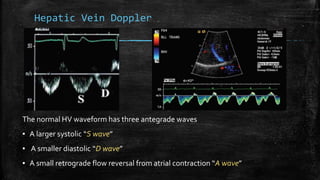
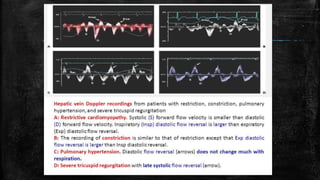
Hepatic Vein Doppler
The normal HV waveform has three antegrade waves
▪ A larger systolic “S wave”
▪ A smaller diastolic “D wave”
▪ A small retrograde flow reversal from atrial contraction “A wave”
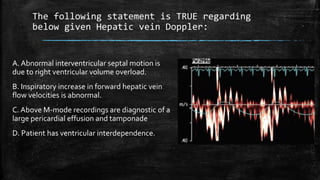
The following statement is TRUE regarding
below given Hepatic vein Doppler:
A. Abnormal interventricular septal motion is
due to right ventricular volume overload.
B. Inspiratory increase in forward hepatic vein
flow velocities is abnormal.
C. Above M-mode recordings are diagnostic of a
large pericardial effusion and tamponade
D. Patient has ventricular interdependence.
Which of the following is most compatible
with the hepatic venous flow in Figure below:
A. 56-year-old man with systemic hypertension
under control with medical therapy.
B. 39-year-old woman with hypotension in the
setting of acute inferior wall MI.
C. 25-year-old man with recurrent septic pulmonary
embolism.
D. 63-year-old man in atrial fibrillation
Thanks for your patience

Right Ventricle Echocardiography

  • 2.
  • 4.
    Is It Important? •Not just a conduit • Connected and affected • Risk stratification • Therapy guidance • Controversial • Understudied • Examiners favorite
  • 5.
    The Purposes OfGuidelines ▪ Describe the acoustic windows ▪ Describe the echocardiographic parameters of RV size and function. ▪ Advantages and disadvantages of each measure or technique. ▪ Recommend which right-sided measures should be included in the standard echocardiographic report. ▪ Provide revised reference values
  • 6.
  • 7.
  • 8.
  • 9.
  • 10.
    Right Heart Dimensions ▪Right ventricle-focused apical 4 chamber view – Measured at end-diastole
  • 12.
    Which of thefollowing is an abnormal right ventricular (RV) dimension in an adult 30 years old? A. Basal RV diameter of 2.5 cm. B. Mid RV diameter of 3.8 cm. C. Right ventricular outflow tract (RVOT) diameterabove the aortic valve of 2.6 cm. D. Base to apex RV length of 7.5 cm.
  • 13.
    Right ventricular dimensions 1.Basal RV diameter 2. Mid cavitary RV diameter 3. RV longitudinal dimension  4.2 cm indicates dilatation  3.5 cm indicates dilatation  8.6 cm indicates RV enlargement
  • 18.
    ▪ RV sizeshould be routinely assessed by conventional 2DE using multiple acoustic windows ▪ Report should include both qualitative and quantitative parameters. ▪ In laboratories with experience in 3DE, 3D measurement of RV volumes is recommended. ▪ RV EDVs of 87 mL/m2 in men and 74 mL/m2 in women ▪ RV ESVs of 44 mL/m2 for men and 36 mL/m2 for women
  • 24.
    TAPSE TAPSE and RVejection fraction TAPSE 2cm = RVEF 50% TAPSE 1.5cm = RVEF 40% TAPSE 1cm = RVEF 30% TAPSE 0.5cm = RVEF 20% Event free survival according toTAPSE in patients with CHF
  • 30.
    RV Diastolic Function ▪From the apical 4-chamber view, the Doppler beam should be aligned parallel to RV inflow ▪ Sample volume is placed at the tips of the tricuspid valve leaflets ▪ Measure at held end-expiration and/or take the average of ≥ 5 consecutive beats ▪ Measurements are essentially the same as those used for the left side
  • 31.
    Recommendation ▪ Measurement ofRV diastolic function should be considered in patients with suspected RV impairment as a marker of early or subtle RV dysfunction, or in patients with known RV impairment as a marker for poor prognosis ▪ Transtricupsid E/A ratio, E/E’ ratio, and RA size have been most validated are the preferred measures Grading of RV Diastolic Dysfunction should be done as follows: E/A ratio < 0.8 suggests impaired relaxation E/A ratio 0.8-2.1 with an E/E’ > 6 or diastolic prominence in the hepatic veins suggest pseudonormal filling E/A ratio > 2.1 with deceleration time < 120 ms suggests restrictive filling
  • 36.
    Recommendations ▪ The recommendedparameter to assess RA size is RA volume, calculated using single-plane area-length or disk summation techniques in a dedicated apical four-chamber view. ▪ The normal ranges for 2D echocardiographic RA volume are : ▪ Males 25 ± 7 ml/m2 ▪ Females 21 ± 6 ml/m2
  • 37.
    RA Pressure ▪ Measurementof the IVC should be obtained at end-expiration ▪ To accurately assess IVC collapse, the change in diameter of the IVC with a sniff and also with quiet respiration
  • 38.
    Recommendations For simplicity anduniformity of reporting, specific values of RA pressure , rather than ranges, should be used in the determination of SPAP IVC diameter IVC collapsibility RA pressure ≤ 2.1 cm > 50% with a sniff 3 mmHg > 2.1 cm < 50 % with a sniff 15 mmHg In indeterminate cases in which IVC diameter and collapse do not fit this paradigm, an intermediate value of 8 mmHg may be used, preferably with use of secondary indices of RA pressures such as: RA dilatation, abnormal bowing of the IAS into the left atrium throughout the cardiac cycle Advantages Disadvantages IVC dimensions are usually obtainable from the subcostal window IVC collapse does not accurately reflect RA pressure in ventilator- dependent patients It is less reliable for intermediate values of RA pressure
  • 39.
    Which of thefollowing is the correct measurement of the IVC diameter in estimating RA pressure A. A B. B C. C D. None of the above ABC
  • 40.
    The end-systolic andend-diastolic parasternal short- axis views of a 75-year-old patient are shown. Which of the following statements is more likely to be true? A.This patient likely has carcinoid heart disease. B.This patient likely has Eisenmenger physiology. C.There is evidence of a restrictiveVSD. D. Pulmonic stenosis is suspected. E.These images are classic for Ebstein anomaly
  • 41.
    Other Recommendations ▪ Visualassessment of ventricular septal curvature looking for a D-shaped pattern in systole and diastole should be used to help in the diagnosis of RV volume an/or pressure overload RV pressure overload-septal shift throughout cardiac cycle with most marked distortion of LV at end systole RV volume overload-septal shift occurs predominately in mid to late diastole
  • 42.
    Pulmonary Artery Pressures ▪PASP should be estimated and reported in all subjects with reliable tricuspid regurgitant jets
  • 43.
    Which of thefollowing parameters are used to calculate Pulmonary artery systolic pressure? A. TR only B. TR and PR only C. TR andVSD only D. TR, PR, andVSD only E. TR, AR, PR, andVSD
  • 44.
    What is thePA systolic pressure of the patient with pulmonary stenosis, where peak TR velocity is 4 m/sec, peak velocity across pulmonic valve 3 m/sec, and RA pressure 10 mm Hg? A. PA systolic pressure 46 mm Hg. B. PA systolic pressure 74 mm Hg. C. PA systolic pressure 38 mm Hg. D. PA systolic pressure 50 mm Hg.
  • 45.
    What is thePA systolic pressure of the patient with pulmonary stenosis, where peak TR velocity is 4 m/sec, peak velocity across pulmonic valve 3 m/sec, and RA pressure 10 mm Hg? A. PA systolic pressure 46 mm Hg. B. PA systolic pressure 74 mm Hg. C. PA systolic pressure 38 mm Hg. D. PA systolic pressure 50 mm Hg. RVSP 4 (4)2 + 10 64 + 10 74 74 – PSPG 74 – 4 (3)2 74 - 36 38 PASP = RVSP - PSPG
  • 46.
    28-year-old man withliver disease presents with jugular venous distensions A. Right ventricular systolic function is markedly diminished. B. Peak velocity of 2.2 m/sec excludes the diagnosis of pulmonary HTN C. Tricuspid regurgitation is likely mild. D. There is right ventricular midcavitary gradient during systole. E. Right ventricular systolic function can not be accurately assessed.
  • 47.
    A patient withholosystolic murmur at the left sternal border. What is RVSP? Blood Pressure 150/80 mmHg RA Pressure 15 mmHg A. 35 mmHg B. 65 mmHg C. 50 mmHg D. Can not be calculated
  • 48.
    Other Recommendations 1/3 (SPAP)+ 2/3 (PADP)1. Mean PA pressure = 2. Mean PA pressure = 79 – (0.45 x AT) 3. Mean PA pressure = 90 – (0.62 x AT) 4. Mean PA pressure = 4 x (early PR vel²) + est. RAP
  • 49.
    What is thePA diastolic pressure in this patient with dyspnea on exertion? The IVC is dilated and does not collapse with sniffing. A. PA diastolic pressure 14 mm Hg. B. PA diastolic pressure 17 mm Hg. C. PA diastolic pressure 28 mm Hg. D. PA diastolic pressure 19 mm Hg.
  • 50.
    Pulmonary Vascular Resistance PVR=TRV max / RVOTTVI x 10 + 0.16 Significant PHTN exists when PVR is > 3 Wood units
  • 51.
    RV dP/dt ▪ Therate of pressure rise in the right ventricle ▪ Estimated from the ascending limb of the tricuspid regurgitant CW Doppler signal RV dP/dt < 400 mmHg/s is likely abnormal
  • 52.
    Hepatic Vein Doppler Thenormal HV waveform has three antegrade waves ▪ A larger systolic “S wave” ▪ A smaller diastolic “D wave” ▪ A small retrograde flow reversal from atrial contraction “A wave”
  • 53.
    The following statementis TRUE regarding below given Hepatic vein Doppler: A. Abnormal interventricular septal motion is due to right ventricular volume overload. B. Inspiratory increase in forward hepatic vein flow velocities is abnormal. C. Above M-mode recordings are diagnostic of a large pericardial effusion and tamponade D. Patient has ventricular interdependence.
  • 54.
    Which of thefollowing is most compatible with the hepatic venous flow in Figure below: A. 56-year-old man with systemic hypertension under control with medical therapy. B. 39-year-old woman with hypotension in the setting of acute inferior wall MI. C. 25-year-old man with recurrent septic pulmonary embolism. D. 63-year-old man in atrial fibrillation
  • 56.