TRAUMATIC SHOCK
ภาวะช็อกจากการบาดเจ็บ
ผศ.ดร.กรองได อุ ณ ห สู ต
thaitraumanurse@gmail.com
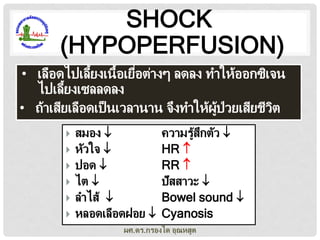
SHOCK
(HYPOPERFUSION)
• เลือดไปเลี้ยงเนื้อเยือต่างๆ ลดลง ทาให้ออกซิเจน
่
ไปเลี้ยงเซลลดลง
• ถ้าเสียเลือดเป็ นเวลานาน จึงทาให้ผป่วยเสียชีวต
ู้
ิ







สมอง 
หัวใจ 
ปอด 
ไต 
ลาไส้ 
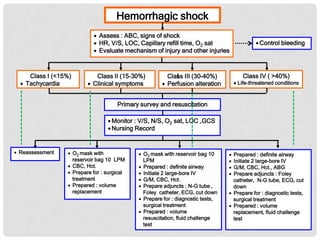
หลอดเลือดฝอย 

ความรูสกตัว 
้ ึ
HR 
RR 
ปัสสาวะ 
Bowel sound 
Cyanosis

ผศ.ดร.กรองได อุณหสูต
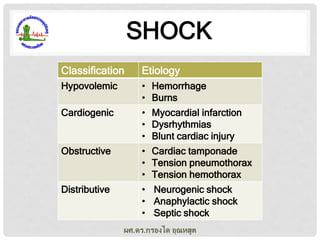
SHOCK
Classification

Etiology

Hypovolemic

• Hemorrhage
• Burns

Cardiogenic

• Myocardial infarction
• Dysrhythmias
• Blunt cardiac injury

Obstructive

• Cardiac tamponade
• Tension pneumothorax
• Tension hemothorax

Distributive

• Neurogenic shock
• Anaphylactic shock
• Septic shock
ผศ.ดร.กรองได อุณหสูต
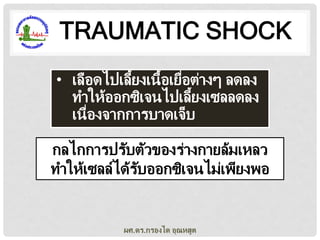
TRAUMATIC SHOCK
• เลือดไปเลี้ยงเนื้อเยือต่างๆ ลดลง
่
ทาให้ออกซิเจนไปเลี้ยงเซลลดลง
เนื่องจากการบาดเจ็บ
กลไกการปรับตัวของร่างกายล้มเหลว
ทาให้เซลล์ได้รบออกซิเจนไม่เพียงพอ
ั

ผศ.ดร.กรองได อุณหสูต
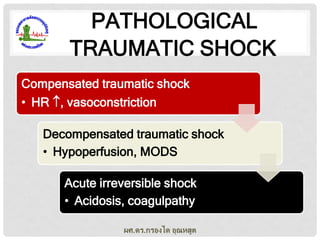
PATHOLOGICAL
TRAUMATIC SHOCK
Compensated traumatic shock
• HR , vasoconstriction
Decompensated traumatic shock
• Hypoperfusion, MODS
Acute irreversible shock
• Acidosis, coagulpathy
ผศ.ดร.กรองได อุณหสูต
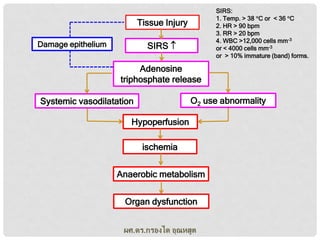
SIRS:
1. Temp. > 38 C or < 36 C
2. HR > 90 bpm
3. RR > 20 bpm
4. WBC >12,000 cells mm-3
or < 4000 cells mm-3
or > 10% immature (band) forms.

Tissue Injury
Damage epithelium

SIRS 
Adenosine
triphosphate release

O2 use abnormality

Systemic vasodilatation
Hypoperfusion
ischemia

Anaerobic metabolism
Organ dysfunction
ผศ.ดร.กรองได อุณหสูต
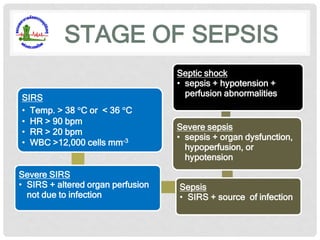
STAGE OF SEPSIS
SIRS
• Temp. > 38 C or < 36 C
• HR > 90 bpm
• RR > 20 bpm
• WBC >12,000 cells mm-3
Severe SIRS
• SIRS + altered organ perfusion
not due to infection

Septic shock
• sepsis + hypotension +
perfusion abnormalities

Severe sepsis
• sepsis + organ dysfunction,
hypoperfusion, or
hypotension
Sepsis
• SIRS + source of infection
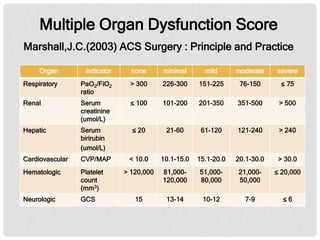
Multiple Organ Dysfunction Score
Marshall,J.C.(2003) ACS Surgery : Principle and Practice
Organ

indicator

none

minimal

mild

moderate

severe

Respiratory

PaO2/FiO2
ratio

> 300

226-300

151-225

76-150

≤ 75

Renal

Serum
creatinine
(umol/L)

≤ 100

101-200

201-350

351-500

> 500

Hepatic

Serum
birirubin
(umol/L)

≤ 20

21-60

61-120

121-240

> 240

Cardiovascular

CVP/MAP

< 10.0

10.1-15.0

15.1-20.0

20.1-30.0

> 30.0

Hematologic

Platelet
count
(mm3)

> 120,000

81,000120,000

51,00080,000

21,00050,000

≤ 20,000

Neurologic

GCS

15

13-14

10-12

7-9

≤6
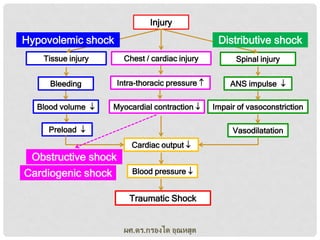
Injury

Hypovolemic shock

Distributive shock

Tissue injury

Chest / cardiac injury

Spinal injury

Bleeding

Intra-thoracic pressure 

ANS impulse 

Blood volume 

Myocardial contraction 

Preload 

Obstructive shock
Cardiogenic shock

Impair of vasoconstriction
Vasodilatation

Cardiac output 
Blood pressure 

Traumatic Shock
ผศ.ดร.กรองได อุณหสูต
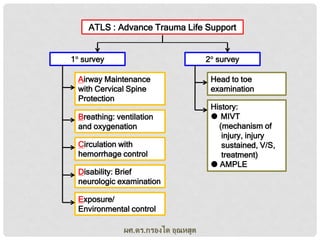
ATLS : Advance Trauma Life Support

1 survey

2 survey

Airway Maintenance
with Cervical Spine
Protection
Breathing: ventilation
and oxygenation
Circulation with
hemorrhage control
Disability: Brief
neurologic examination
Exposure/
Environmental control
ผศ.ดร.กรองได อุณหสูต

Head to toe
examination
History:
 MIVT
(mechanism of
injury, injury
sustained, V/S,
treatment)
 AMPLE
ปัจจัยที่เกี่ยวข้อง
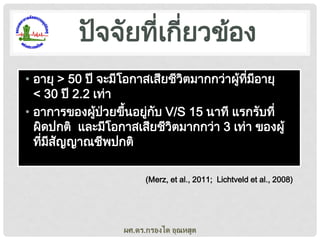
• อายุ > 50 ปี จะมีโอกาสเสียชีวตมากกว่าผู้ที่มีอายุ
ิ
< 30 ปี 2.2 เท่า
• อาการของผูปวยขึนอยูกบ V/S 15 นาที แรกรับที่
้ ่
้
่ ั
ผิดปกติ และมีโอกาสเสียชีวตมากกว่า 3 เท่า ของผู้
ิ
ที่มีสัญญาณชีพปกติ
(Merz, et al., 2011; Lichtveld et al., 2008)

ผศ.ดร.กรองได อุณหสูต
การประเมินผูป่วยอุบตเหตุ
้
ั ิ
ทางการพยาบาล
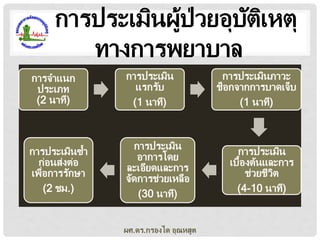
การจาแนก
ประเภท
(2 นาที)

การประเมิน
แรกรับ
(1 นาที)

การประเมินซา
้
ก่อนส่งต่อ
เพือการรักษา
่
(2 ชม.)

การประเมิน
อาการโดย
ละเอียดและการ
จัดการช่วยเหลือ
(30 นาที)
ผศ.ดร.กรองได อุณหสูต

การประเมินภาวะ
ช็อกจากการบาดเจ็บ
(1 นาที)

การประเมิน
เบื้องต้นและการ
ช่วยชีวต
ิ
(4-10 นาที)
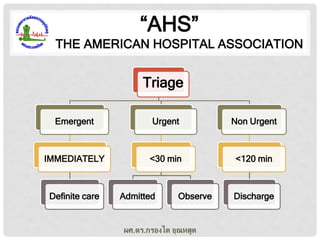
“AHS”
THE AMERICAN HOSPITAL ASSOCIATION

Triage
Emergent

Urgent

Non Urgent

IMMEDIATELY

<30 min

<120 min

Definite care

Admitted

Observe

ผศ.ดร.กรองได อุณหสูต

Discharge
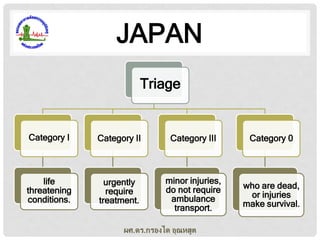
JAPAN
Triage

Category I

Category II

Category III

Category 0

life
threatening
conditions.

urgently
require
treatment.

minor injuries,
do not require
ambulance
transport.

who are dead,
or injuries
make survival.

ผศ.ดร.กรองได อุณหสูต
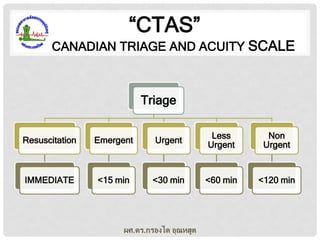
“CTAS”
CANADIAN TRIAGE AND ACUITY SCALE

Triage
Resuscitation

Emergent

Urgent

Less
Urgent

Non
Urgent

IMMEDIATE

<15 min

<30 min

<60 min

<120 min

ผศ.ดร.กรองได อุณหสูต
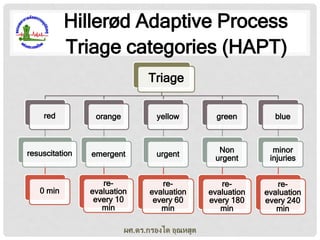
Hillerød Adaptive Process
Triage categories (HAPT)
Triage
red

orange

yellow

green

blue

resuscitation

emergent

urgent

Non
urgent

minor
injuries

reevaluation
every 10
min

reevaluation
every 60
min

reevaluation
every 180
min

reevaluation
every 240
min

0 min

ผศ.ดร.กรองได อุณหสูต
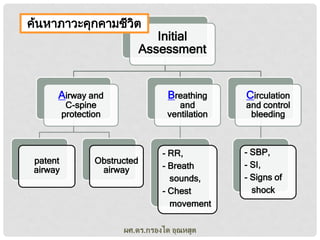
ค้นหาภาวะคุกคามชีวต
ิ

Initial
Assessment

Airway and

Breathing

C-spine
protection

patent
airway

and
ventilation

Obstructed
airway

- RR,
- Breath
sounds,
- Chest
movement

ผศ.ดร.กรองได อุณหสูต

Circulation

and control
bleeding

- SBP,
- SI,
- Signs of
shock
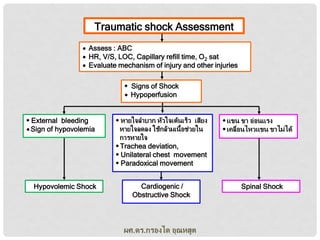
Traumatic shock Assessment
 Assess : ABC
 HR, V/S, LOC, Capillary refill time, O2 sat
 Evaluate mechanism of injury and other injuries

Signs of Shock
 Hypoperfusion


External bleeding
 Sign of hypovolemia


Hypovolemic Shock

หายใจลาบาก หัวใจเต้นเร็ว เสียง
หายใจลดลง ใช้กล้ามเนื้อช่วยใน
การหายใจ
 Trachea deviation,
 Unilateral chest movement
 Paradoxical movement


Cardiogenic /
Obstructive Shock

ผศ.ดร.กรองได อุณหสูต

แขน ขา อ่อนแรง
 เคลือนไหวแขน ขาไม่ได้
่


Spinal Shock
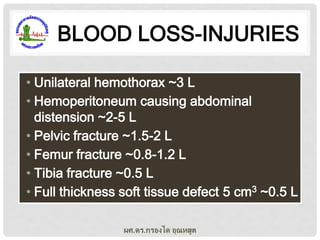
BLOOD LOSS-INJURIES
• Unilateral hemothorax ~3 L
• Hemoperitoneum causing abdominal
distension ~2-5 L
• Pelvic fracture ~1.5-2 L
• Femur fracture ~0.8-1.2 L
• Tibia fracture ~0.5 L
• Full thickness soft tissue defect 5 cm3 ~0.5 L
ผศ.ดร.กรองได อุณหสูต
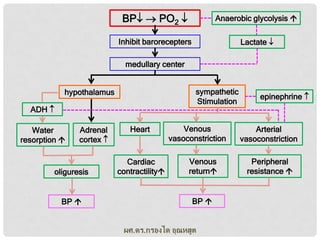
BP  PO2 

Anaerobic glycolysis 

Inhibit barorecepters

Lactate 

medullary center
sympathetic
Stimulation

hypothalamus
ADH 
Water
resorption 

Adrenal
cortex 

oliguresis

BP 

Heart

Cardiac
contractility

Venous
vasoconstriction
Venous
return

BP 
ผศ.ดร.กรองได อุณหสูต

epinephrine 

Arterial
vasoconstriction

Peripheral
resistance 
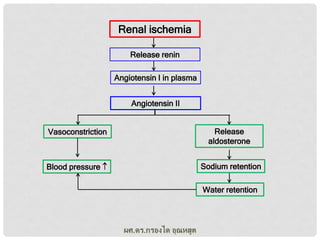
Renal ischemia
Release renin
Angiotensin I in plasma
Angiotensin II
Vasoconstriction

Release
aldosterone

Blood pressure 

Sodium retention
Water retention

ผศ.ดร.กรองได อุณหสูต
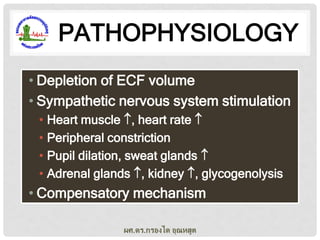
PATHOPHYSIOLOGY
• Depletion of ECF volume
• Sympathetic nervous system stimulation
• Heart muscle , heart rate 
• Peripheral constriction
• Pupil dilation, sweat glands 
• Adrenal glands , kidney , glycogenolysis

• Compensatory mechanism
ผศ.ดร.กรองได อุณหสูต
Hemorrhagic shock
 Assess : ABC, signs of shock
 HR, V/S, LOC, Capillary refill time, O2 sat
 Evaluate mechanism of injury and other injuries

Class I (<15%)
 Tachycardia

Class II (15-30%)
 Clinical symptoms

 Control bleeding

Class IV ( >40%)

Class III (30-40%)
 Perfusion alteration

 Life-threatened conditions

Primary survey and resuscitation
 Monitor : V/S, N/S, O2 sat, LOC ,GCS
 Nursing Record

 Reassessment

 O2 mask with
reservoir bag 10 LPM
 CBC, Hct.
 Prepare for : surgical
treatment
 Prepared : volume
replacement

 O2 mask with reservoir bag 10
LPM
 Prepared : definite airway
 Initiate 2 large-bore IV
 G/M, CBC, Hct.
 Prepare adjuncts : N-G tube ,
Foley catheter, ECG, cut down
 Prepare for : diagnostic tests,
surgical treatment
 Prepared : volume
resuscitation, fluid challenge
test

Prepared : definite airway
Initiate 2 large-bore IV
G/M, CBC, Hct., ABG
Prepare adjuncts : Foley
catheter, N-G tube, ECG, cut
down
 Prepare for : diagnostic tests,
surgical treatment
 Prepared : volume
replacement, fluid challenge
test




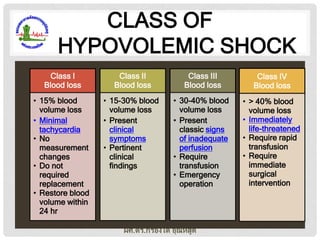
CLASS OF
HYPOVOLEMIC SHOCK
Class I
Blood loss

Class II
Blood loss

Class III
Blood loss

Class IV
Blood loss

• 15% blood
volume loss
• Minimal
tachycardia
• No
measurement
changes
• Do not
required
replacement
• Restore blood
volume within
24 hr

• 15-30% blood
volume loss
• Present
clinical
symptoms
• Pertinent
clinical
findings

• 30-40% blood
volume loss
• Present
classic signs
of inadequate
perfusion
• Require
transfusion
• Emergency
operation

• > 40% blood
volume loss
• Immediately
life-threatened
• Require rapid
transfusion
• Require
immediate
surgical
intervention

ผศ.ดร.กรองได อุณหสูต
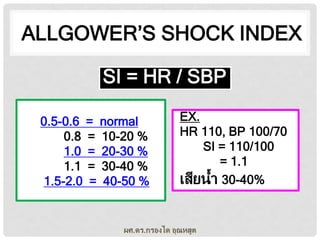
ALLGOWER’S SHOCK INDEX
SI = HR / SBP
0.5-0.6 = normal
0.8 = 10-20 %
1.0 = 20-30 %
1.1 = 30-40 %
1.5-2.0 = 40-50 %

EX.
HR 110, BP 100/70
SI = 110/100
= 1.1
เสียน้า 30-40%

ผศ.ดร.กรองได อุณหสูต
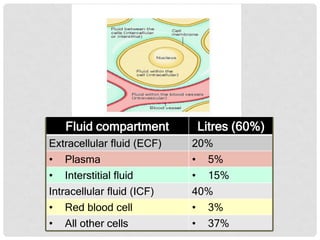
Fluid compartment

Litres (60%)

Extracellular fluid (ECF)
• Plasma

20%
• 5%

• Interstitial fluid
Intracellular fluid (ICF)
• Red blood cell
• All other cells

• 15%
40%
• 3%
• 37%
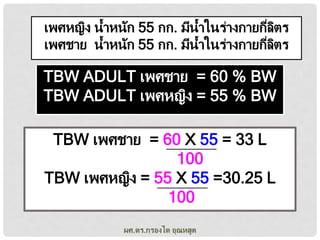
เพศหญิง น้าหนัก 55 กก. มีน้าในร่างกายกีลตร
่ ิ
เพศชาย น้าหนัก 55 กก. มีน้าในร่างกายกีลตร
่ ิ

TBW ADULT เพศชาย = 60 % BW
TBW ADULT เพศหญิง = 55 % BW
TBW เพศชาย = 60 X 55 = 33 L
100
TBW เพศหญิง = 55 X 55 =30.25 L
100
ผศ.ดร.กรองได อุณหสูต
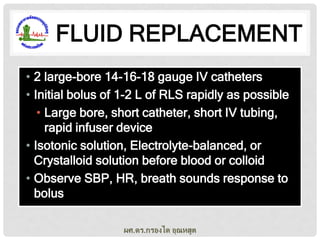
FLUID REPLACEMENT
• 2 large-bore 14-16-18 gauge IV catheters
• Initial bolus of 1-2 L of RLS rapidly as possible
• Large bore, short catheter, short IV tubing,
rapid infuser device
• Isotonic solution, Electrolyte-balanced, or
Crystalloid solution before blood or colloid
• Observe SBP, HR, breath sounds response to
bolus
ผศ.ดร.กรองได อุณหสูต
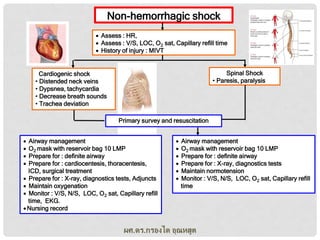
Non-hemorrhagic shock
 Assess : HR,
 Assess : V/S, LOC, O2 sat, Capillary refill time
 History of injury : MIVT
Spinal Shock
• Paresis, paralysis

Cardiogenic shock
• Distended neck veins
• Dypsnea, tachycardia
• Decrease breath sounds
• Trachea deviation
Primary survey and resuscitation





Airway management
O2 mask with reservoir bag 10 LMP
Prepare for : definite airway
Prepare for : cardiocentesis, thoracentesis,
ICD, surgical treatment
 Prepare for : X-ray, diagnostics tests, Adjuncts
 Maintain oxygenation
 Monitor : V/S, N/S, LOC, O2 sat, Capillary refill
time, EKG.
 Nursing record








Airway management
O2 mask with reservoir bag 10 LMP
Prepare for : definite airway
Prepare for : X-ray, diagnostics tests
Maintain normotension
Monitor : V/S, N/S, LOC, O2 sat, Capillary refill
time

ผศ.ดร.กรองได อุณหสูต
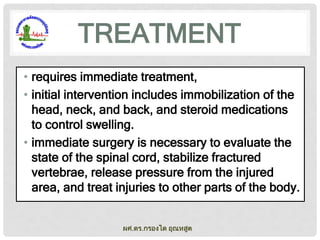
TREATMENT
• requires immediate treatment,
• initial intervention includes immobilization of the
head, neck, and back, and steroid medications
to control swelling.
• immediate surgery is necessary to evaluate the
state of the spinal cord, stabilize fractured
vertebrae, release pressure from the injured
area, and treat injuries to other parts of the body.
ผศ.ดร.กรองได อุณหสูต
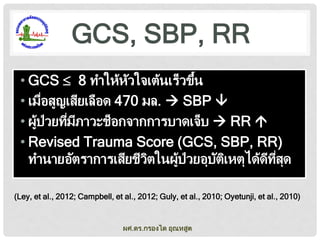
GCS, SBP, RR
้
• GCS  8 ทาให้หวใจเต้นเร็วขึน
ั
• เมือสูญเสียเลือด 470 มล.  SBP 
่
• ผูป่วยทีมภาวะช็อกจากการบาดเจ็บ  RR 
้
่ ี
• Revised Trauma Score (GCS, SBP, RR)
ทานายอัตราการเสียชีวตในผูป่วยอุบตเหตุได้ดทสด
ิ
้
ั ิ
ี ี่ ุ
(Ley, et al., 2012; Campbell, et al., 2012; Guly, et al., 2010; Oyetunji, et al., 2010)

ผศ.ดร.กรองได อุณหสูต
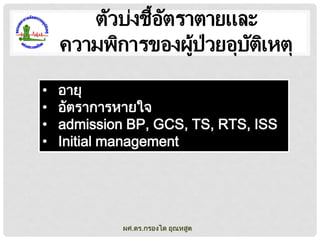
ตัวบ่งชี้อตราตายและ
ั
ความพิการของผูป่วยอุบตเหตุ
้
ั ิ
•
•
•
•

อายุ
อัตราการหายใจ
admission BP, GCS, TS, RTS, ISS
Initial management

ผศ.ดร.กรองได อุณหสูต
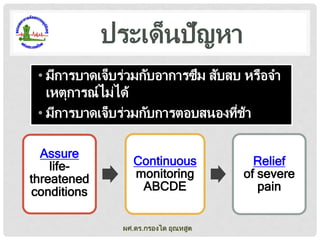
ประเด็นปัญหา
• มีการบาดเจ็บร่วมกับอาการซึม สับสบ หรือจา
เหตุการณ์ ไม่ได้
• มีการบาดเจ็บร่วมกับการตอบสนองทีชา
่ ้
Assure
lifethreatened
conditions

Continuous
monitoring
ABCDE
ผศ.ดร.กรองได อุณหสูต

Relief
of severe
pain
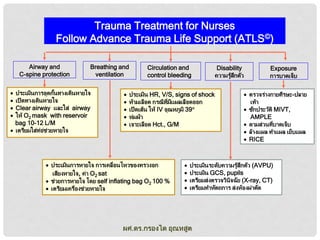
Trauma Treatment for Nurses
Follow Advance Trauma Life Support (ATLS ©)
Airway and
C-spine protection





Breathing and
ventilation

ประเมินการอุดกันทางเดินหายใจ
้
เปิ ดทางเดินหายใจ
Clear airway และใส่ airway
ให้ O2 mask with reservoir
bag 10-12 L/M
 เตรียมใส่ทอชวยหายใจ
่ ่ ่







Circulation and
control bleeding
ประเมิน HR, V/S, signs of shock
ห้ามเลือด กรณี ทมแผลเลือดออก
ี่ ี
เปิ ดเส้น ให้ IV อุณหภูมิ 39
ห่มผ้า
เจาะเลือด Hct., G/M

 ประเมินการหายใจ การเคลือนไหวของทรวงอก
่
เสียงหายใจ, ค่า O2 sat
 ช่วยการหายใจ โดย self inflating bag O2 100 %
 เตรียมเครืองช่วยหายใจ
่






Disability
ความรูสกตัว
้ ึ

Exposure
การบาดเจ็บ

 ตรวจร่างกายศีรษะ-ปลาย
เท้า
 ซักประวัติ MIVT,
AMPLE
 ดามส่วนทีบาดเจ็บ
่
 ล้างแผล ทาแผล เย็บแผล
 RICE

ประเมินระดับความรูสกตัว (AVPU)
้ ึ
ประเมิน GCS, pupils
เตรียมส่งตรวจวินิจฉัย (X-ray, CT)
เตรียมทาหัตถการ ส่งห้องผ่าตัด

ผศ.ดร.กรองได อุณหสูต

Traumatic shock

  • 1.
  • 2.
    SHOCK (HYPOPERFUSION) • เลือดไปเลี้ยงเนื้อเยือต่างๆ ลดลงทาให้ออกซิเจน ่ ไปเลี้ยงเซลลดลง • ถ้าเสียเลือดเป็ นเวลานาน จึงทาให้ผป่วยเสียชีวต ู้ ิ       สมอง  หัวใจ  ปอด  ไต  ลาไส้  หลอดเลือดฝอย  ความรูสกตัว  ้ ึ HR  RR  ปัสสาวะ  Bowel sound  Cyanosis ผศ.ดร.กรองได อุณหสูต
  • 3.
    SHOCK Classification Etiology Hypovolemic • Hemorrhage • Burns Cardiogenic •Myocardial infarction • Dysrhythmias • Blunt cardiac injury Obstructive • Cardiac tamponade • Tension pneumothorax • Tension hemothorax Distributive • Neurogenic shock • Anaphylactic shock • Septic shock ผศ.ดร.กรองได อุณหสูต
  • 4.
    TRAUMATIC SHOCK • เลือดไปเลี้ยงเนื้อเยือต่างๆลดลง ่ ทาให้ออกซิเจนไปเลี้ยงเซลลดลง เนื่องจากการบาดเจ็บ กลไกการปรับตัวของร่างกายล้มเหลว ทาให้เซลล์ได้รบออกซิเจนไม่เพียงพอ ั ผศ.ดร.กรองได อุณหสูต
  • 5.
    PATHOLOGICAL TRAUMATIC SHOCK Compensated traumaticshock • HR , vasoconstriction Decompensated traumatic shock • Hypoperfusion, MODS Acute irreversible shock • Acidosis, coagulpathy ผศ.ดร.กรองได อุณหสูต
  • 6.
    SIRS: 1. Temp. >38 C or < 36 C 2. HR > 90 bpm 3. RR > 20 bpm 4. WBC >12,000 cells mm-3 or < 4000 cells mm-3 or > 10% immature (band) forms. Tissue Injury Damage epithelium SIRS  Adenosine triphosphate release O2 use abnormality Systemic vasodilatation Hypoperfusion ischemia Anaerobic metabolism Organ dysfunction ผศ.ดร.กรองได อุณหสูต
  • 7.
    STAGE OF SEPSIS SIRS •Temp. > 38 C or < 36 C • HR > 90 bpm • RR > 20 bpm • WBC >12,000 cells mm-3 Severe SIRS • SIRS + altered organ perfusion not due to infection Septic shock • sepsis + hypotension + perfusion abnormalities Severe sepsis • sepsis + organ dysfunction, hypoperfusion, or hypotension Sepsis • SIRS + source of infection
  • 8.
    Multiple Organ DysfunctionScore Marshall,J.C.(2003) ACS Surgery : Principle and Practice Organ indicator none minimal mild moderate severe Respiratory PaO2/FiO2 ratio > 300 226-300 151-225 76-150 ≤ 75 Renal Serum creatinine (umol/L) ≤ 100 101-200 201-350 351-500 > 500 Hepatic Serum birirubin (umol/L) ≤ 20 21-60 61-120 121-240 > 240 Cardiovascular CVP/MAP < 10.0 10.1-15.0 15.1-20.0 20.1-30.0 > 30.0 Hematologic Platelet count (mm3) > 120,000 81,000120,000 51,00080,000 21,00050,000 ≤ 20,000 Neurologic GCS 15 13-14 10-12 7-9 ≤6
  • 9.
    Injury Hypovolemic shock Distributive shock Tissueinjury Chest / cardiac injury Spinal injury Bleeding Intra-thoracic pressure  ANS impulse  Blood volume  Myocardial contraction  Preload  Obstructive shock Cardiogenic shock Impair of vasoconstriction Vasodilatation Cardiac output  Blood pressure  Traumatic Shock ผศ.ดร.กรองได อุณหสูต
  • 10.
    ATLS : AdvanceTrauma Life Support 1 survey 2 survey Airway Maintenance with Cervical Spine Protection Breathing: ventilation and oxygenation Circulation with hemorrhage control Disability: Brief neurologic examination Exposure/ Environmental control ผศ.ดร.กรองได อุณหสูต Head to toe examination History:  MIVT (mechanism of injury, injury sustained, V/S, treatment)  AMPLE
  • 11.
    ปัจจัยที่เกี่ยวข้อง • อายุ >50 ปี จะมีโอกาสเสียชีวตมากกว่าผู้ที่มีอายุ ิ < 30 ปี 2.2 เท่า • อาการของผูปวยขึนอยูกบ V/S 15 นาที แรกรับที่ ้ ่ ้ ่ ั ผิดปกติ และมีโอกาสเสียชีวตมากกว่า 3 เท่า ของผู้ ิ ที่มีสัญญาณชีพปกติ (Merz, et al., 2011; Lichtveld et al., 2008) ผศ.ดร.กรองได อุณหสูต
  • 12.
    การประเมินผูป่วยอุบตเหตุ ้ ั ิ ทางการพยาบาล การจาแนก ประเภท (2 นาที) การประเมิน แรกรับ (1นาที) การประเมินซา ้ ก่อนส่งต่อ เพือการรักษา ่ (2 ชม.) การประเมิน อาการโดย ละเอียดและการ จัดการช่วยเหลือ (30 นาที) ผศ.ดร.กรองได อุณหสูต การประเมินภาวะ ช็อกจากการบาดเจ็บ (1 นาที) การประเมิน เบื้องต้นและการ ช่วยชีวต ิ (4-10 นาที)
  • 13.
    “AHS” THE AMERICAN HOSPITALASSOCIATION Triage Emergent Urgent Non Urgent IMMEDIATELY <30 min <120 min Definite care Admitted Observe ผศ.ดร.กรองได อุณหสูต Discharge
  • 14.
    JAPAN Triage Category I Category II CategoryIII Category 0 life threatening conditions. urgently require treatment. minor injuries, do not require ambulance transport. who are dead, or injuries make survival. ผศ.ดร.กรองได อุณหสูต
  • 15.
    “CTAS” CANADIAN TRIAGE ANDACUITY SCALE Triage Resuscitation Emergent Urgent Less Urgent Non Urgent IMMEDIATE <15 min <30 min <60 min <120 min ผศ.ดร.กรองได อุณหสูต
  • 16.
    Hillerød Adaptive Process Triagecategories (HAPT) Triage red orange yellow green blue resuscitation emergent urgent Non urgent minor injuries reevaluation every 10 min reevaluation every 60 min reevaluation every 180 min reevaluation every 240 min 0 min ผศ.ดร.กรองได อุณหสูต
  • 17.
    ค้นหาภาวะคุกคามชีวต ิ Initial Assessment Airway and Breathing C-spine protection patent airway and ventilation Obstructed airway - RR, -Breath sounds, - Chest movement ผศ.ดร.กรองได อุณหสูต Circulation and control bleeding - SBP, - SI, - Signs of shock
  • 18.
    Traumatic shock Assessment Assess : ABC  HR, V/S, LOC, Capillary refill time, O2 sat  Evaluate mechanism of injury and other injuries Signs of Shock  Hypoperfusion  External bleeding  Sign of hypovolemia  Hypovolemic Shock หายใจลาบาก หัวใจเต้นเร็ว เสียง หายใจลดลง ใช้กล้ามเนื้อช่วยใน การหายใจ  Trachea deviation,  Unilateral chest movement  Paradoxical movement  Cardiogenic / Obstructive Shock ผศ.ดร.กรองได อุณหสูต แขน ขา อ่อนแรง  เคลือนไหวแขน ขาไม่ได้ ่  Spinal Shock
  • 19.
    BLOOD LOSS-INJURIES • Unilateralhemothorax ~3 L • Hemoperitoneum causing abdominal distension ~2-5 L • Pelvic fracture ~1.5-2 L • Femur fracture ~0.8-1.2 L • Tibia fracture ~0.5 L • Full thickness soft tissue defect 5 cm3 ~0.5 L ผศ.ดร.กรองได อุณหสูต
  • 20.
    BP  PO2 Anaerobic glycolysis  Inhibit barorecepters Lactate  medullary center sympathetic Stimulation hypothalamus ADH  Water resorption  Adrenal cortex  oliguresis BP  Heart Cardiac contractility Venous vasoconstriction Venous return BP  ผศ.ดร.กรองได อุณหสูต epinephrine  Arterial vasoconstriction Peripheral resistance 
  • 21.
    Renal ischemia Release renin AngiotensinI in plasma Angiotensin II Vasoconstriction Release aldosterone Blood pressure  Sodium retention Water retention ผศ.ดร.กรองได อุณหสูต
  • 22.
    PATHOPHYSIOLOGY • Depletion ofECF volume • Sympathetic nervous system stimulation • Heart muscle , heart rate  • Peripheral constriction • Pupil dilation, sweat glands  • Adrenal glands , kidney , glycogenolysis • Compensatory mechanism ผศ.ดร.กรองได อุณหสูต
  • 23.
    Hemorrhagic shock  Assess: ABC, signs of shock  HR, V/S, LOC, Capillary refill time, O2 sat  Evaluate mechanism of injury and other injuries Class I (<15%)  Tachycardia Class II (15-30%)  Clinical symptoms  Control bleeding Class IV ( >40%) Class III (30-40%)  Perfusion alteration  Life-threatened conditions Primary survey and resuscitation  Monitor : V/S, N/S, O2 sat, LOC ,GCS  Nursing Record  Reassessment  O2 mask with reservoir bag 10 LPM  CBC, Hct.  Prepare for : surgical treatment  Prepared : volume replacement  O2 mask with reservoir bag 10 LPM  Prepared : definite airway  Initiate 2 large-bore IV  G/M, CBC, Hct.  Prepare adjuncts : N-G tube , Foley catheter, ECG, cut down  Prepare for : diagnostic tests, surgical treatment  Prepared : volume resuscitation, fluid challenge test Prepared : definite airway Initiate 2 large-bore IV G/M, CBC, Hct., ABG Prepare adjuncts : Foley catheter, N-G tube, ECG, cut down  Prepare for : diagnostic tests, surgical treatment  Prepared : volume replacement, fluid challenge test    
  • 24.
    CLASS OF HYPOVOLEMIC SHOCK ClassI Blood loss Class II Blood loss Class III Blood loss Class IV Blood loss • 15% blood volume loss • Minimal tachycardia • No measurement changes • Do not required replacement • Restore blood volume within 24 hr • 15-30% blood volume loss • Present clinical symptoms • Pertinent clinical findings • 30-40% blood volume loss • Present classic signs of inadequate perfusion • Require transfusion • Emergency operation • > 40% blood volume loss • Immediately life-threatened • Require rapid transfusion • Require immediate surgical intervention ผศ.ดร.กรองได อุณหสูต
  • 25.
    ALLGOWER’S SHOCK INDEX SI= HR / SBP 0.5-0.6 = normal 0.8 = 10-20 % 1.0 = 20-30 % 1.1 = 30-40 % 1.5-2.0 = 40-50 % EX. HR 110, BP 100/70 SI = 110/100 = 1.1 เสียน้า 30-40% ผศ.ดร.กรองได อุณหสูต
  • 26.
    Fluid compartment Litres (60%) Extracellularfluid (ECF) • Plasma 20% • 5% • Interstitial fluid Intracellular fluid (ICF) • Red blood cell • All other cells • 15% 40% • 3% • 37%
  • 27.
    เพศหญิง น้าหนัก 55กก. มีน้าในร่างกายกีลตร ่ ิ เพศชาย น้าหนัก 55 กก. มีน้าในร่างกายกีลตร ่ ิ TBW ADULT เพศชาย = 60 % BW TBW ADULT เพศหญิง = 55 % BW TBW เพศชาย = 60 X 55 = 33 L 100 TBW เพศหญิง = 55 X 55 =30.25 L 100 ผศ.ดร.กรองได อุณหสูต
  • 28.
    FLUID REPLACEMENT • 2large-bore 14-16-18 gauge IV catheters • Initial bolus of 1-2 L of RLS rapidly as possible • Large bore, short catheter, short IV tubing, rapid infuser device • Isotonic solution, Electrolyte-balanced, or Crystalloid solution before blood or colloid • Observe SBP, HR, breath sounds response to bolus ผศ.ดร.กรองได อุณหสูต
  • 29.
    Non-hemorrhagic shock  Assess: HR,  Assess : V/S, LOC, O2 sat, Capillary refill time  History of injury : MIVT Spinal Shock • Paresis, paralysis Cardiogenic shock • Distended neck veins • Dypsnea, tachycardia • Decrease breath sounds • Trachea deviation Primary survey and resuscitation     Airway management O2 mask with reservoir bag 10 LMP Prepare for : definite airway Prepare for : cardiocentesis, thoracentesis, ICD, surgical treatment  Prepare for : X-ray, diagnostics tests, Adjuncts  Maintain oxygenation  Monitor : V/S, N/S, LOC, O2 sat, Capillary refill time, EKG.  Nursing record       Airway management O2 mask with reservoir bag 10 LMP Prepare for : definite airway Prepare for : X-ray, diagnostics tests Maintain normotension Monitor : V/S, N/S, LOC, O2 sat, Capillary refill time ผศ.ดร.กรองได อุณหสูต
  • 30.
    TREATMENT • requires immediatetreatment, • initial intervention includes immobilization of the head, neck, and back, and steroid medications to control swelling. • immediate surgery is necessary to evaluate the state of the spinal cord, stabilize fractured vertebrae, release pressure from the injured area, and treat injuries to other parts of the body. ผศ.ดร.กรองได อุณหสูต
  • 31.
    GCS, SBP, RR ้ •GCS  8 ทาให้หวใจเต้นเร็วขึน ั • เมือสูญเสียเลือด 470 มล.  SBP  ่ • ผูป่วยทีมภาวะช็อกจากการบาดเจ็บ  RR  ้ ่ ี • Revised Trauma Score (GCS, SBP, RR) ทานายอัตราการเสียชีวตในผูป่วยอุบตเหตุได้ดทสด ิ ้ ั ิ ี ี่ ุ (Ley, et al., 2012; Campbell, et al., 2012; Guly, et al., 2010; Oyetunji, et al., 2010) ผศ.ดร.กรองได อุณหสูต
  • 32.
  • 33.
    ประเด็นปัญหา • มีการบาดเจ็บร่วมกับอาการซึม สับสบหรือจา เหตุการณ์ ไม่ได้ • มีการบาดเจ็บร่วมกับการตอบสนองทีชา ่ ้ Assure lifethreatened conditions Continuous monitoring ABCDE ผศ.ดร.กรองได อุณหสูต Relief of severe pain
  • 34.
    Trauma Treatment forNurses Follow Advance Trauma Life Support (ATLS ©) Airway and C-spine protection     Breathing and ventilation ประเมินการอุดกันทางเดินหายใจ ้ เปิ ดทางเดินหายใจ Clear airway และใส่ airway ให้ O2 mask with reservoir bag 10-12 L/M  เตรียมใส่ทอชวยหายใจ ่ ่ ่      Circulation and control bleeding ประเมิน HR, V/S, signs of shock ห้ามเลือด กรณี ทมแผลเลือดออก ี่ ี เปิ ดเส้น ให้ IV อุณหภูมิ 39 ห่มผ้า เจาะเลือด Hct., G/M  ประเมินการหายใจ การเคลือนไหวของทรวงอก ่ เสียงหายใจ, ค่า O2 sat  ช่วยการหายใจ โดย self inflating bag O2 100 %  เตรียมเครืองช่วยหายใจ ่     Disability ความรูสกตัว ้ ึ Exposure การบาดเจ็บ  ตรวจร่างกายศีรษะ-ปลาย เท้า  ซักประวัติ MIVT, AMPLE  ดามส่วนทีบาดเจ็บ ่  ล้างแผล ทาแผล เย็บแผล  RICE ประเมินระดับความรูสกตัว (AVPU) ้ ึ ประเมิน GCS, pupils เตรียมส่งตรวจวินิจฉัย (X-ray, CT) เตรียมทาหัตถการ ส่งห้องผ่าตัด ผศ.ดร.กรองได อุณหสูต