Restriction Enzymes
Presented by
Devi Lekshmi S
M.Sc Plant Biotechnology
Restriction Enzymes
A protein isolated from bacteria
Also called restriction endonuclease/ restrictase
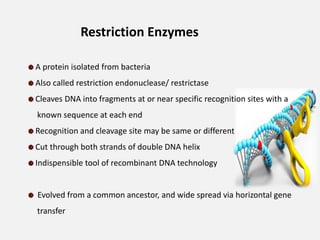
Cleaves DNA into fragments at or near specific recognition sites with a
known sequence at each end
Recognition and cleavage site may be same or different
Cut through both strands of double DNA helix
Indispensible tool of recombinant DNA technology
Evolved from a common ancestor, and wide spread via horizontal gene
transfer
Recognition site
A specific sequence of nucleotide, usually 4 to 8 bases
Randomly distributed throughout the DNA
Many of them are palindromic in sequences
(read same both backward and forward)
1. Mirror like palindrome
eg. GTAATG (Similar from backward and forward in a
single strand)
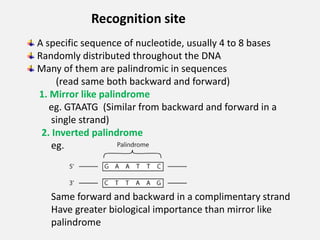
2. Inverted palindrome
eg.
Same forward and backward in a complimentary strand
Have greater biological importance than mirror like
palindrome
Restriction digestion
After recognizes the sequence, restriction enzymes snips
through the DNA
Catalyzing the hydrolysis of the bond b/t adjacent
nucleotides
Hydrolysis – splitting of a chemical bond by addition of a
water molecule
Bacteria - Restriction modification system exists
Methylase enzyme add methyl group (-CH3) to adenine or
cytosine bases within the recognition sequences, which
modifies and protects the host DNA
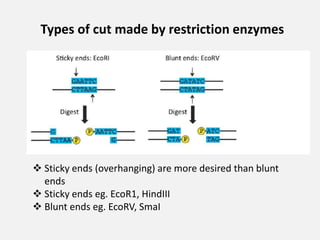
Types of cut made by restriction enzymes
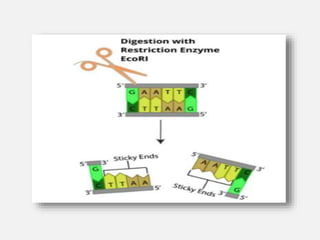
 Sticky ends (overhanging) are more desired than blunt
ends
 Sticky ends eg. EcoR1, HindIII
 Blunt ends eg. EcoRV, SmaI
Types of recognition enzymes
Type I
• First to be identified
• Cut at a site that differs, a random distance of at least 1000 bp
away
• Cleavage site remote from recognition site
• Requires both ATP and S-adenosyl-L-methionine
• Multifunctional (Restriction digestion and methylase activity)
Type II
• Cleave within or short specific distance from restriction sites
• Requires Mg
• Only restriction digestion no methylase activity
Types of recognition enzymes….
Type III
Type I and III are similar both restriction and methylase
activities
Type IV
Enzyme targeted modified DNA
Cleave only methylated DNA
Show weak sequence specificity
Eg. Methylated, Hydroxy methylated, Glucosyl-hydroxy
methylated
Type V
Utilize guide RNAs (gRNAs)
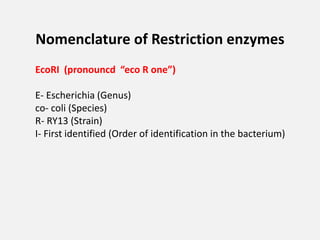
Nomenclature of Restriction enzymes
EcoRI (pronouncd “eco R one”)
E- Escherichia (Genus)
co- coli (Species)
R- RY13 (Strain)
I- First identified (Order of identification in the bacterium)
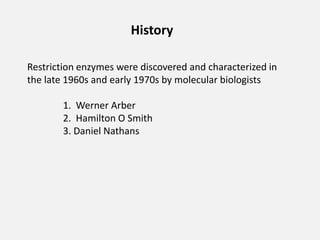
History
Restriction enzymes were discovered and characterized in
the late 1960s and early 1970s by molecular biologists
1. Werner Arber
2. Hamilton O Smith
3. Daniel Nathans
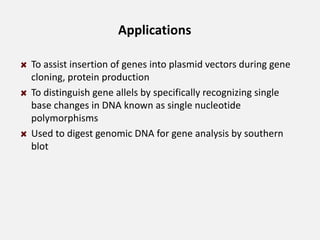
Applications
To assist insertion of genes into plasmid vectors during gene
cloning, protein production
To distinguish gene allels by specifically recognizing single
base changes in DNA known as single nucleotide
polymorphisms
Used to digest genomic DNA for gene analysis by southern
blot
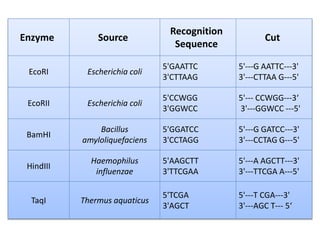
Enzyme Source
Recognition
Sequence
Cut
EcoRI Escherichia coli
5'GAATTC
3'CTTAAG
5'---G AATTC---3'
3'---CTTAA G---5'
EcoRII Escherichia coli
5'CCWGG
3'GGWCC
5'--- CCWGG---3‘
3'---GGWCC ---5'
BamHI
Bacillus
amyloliquefaciens
5'GGATCC
3'CCTAGG
5'---G GATCC---3'
3'---CCTAG G---5'
HindIII
Haemophilus
influenzae
5'AAGCTT
3'TTCGAA
5'---A AGCTT---3'
3'---TTCGA A---5'
TaqI Thermus aquaticus
5'TCGA
3'AGCT
5'---T CGA---3'
3'---AGC T--- 5‘
Some extra points…
• Neoschizomers – different recognition enzymes identify same
sequence but cleave different locii
• Isoschizomers – different enzymes cleave and recognize same
locii
• Most commonly used artificial restriction enzymes used in
genetically engineered applications – Zinc finger nucleases
Thank
you….

Restriction endonucleases.pptx

  • 1.
    Restriction Enzymes Presented by DeviLekshmi S M.Sc Plant Biotechnology
  • 2.
    Restriction Enzymes A proteinisolated from bacteria Also called restriction endonuclease/ restrictase Cleaves DNA into fragments at or near specific recognition sites with a known sequence at each end Recognition and cleavage site may be same or different Cut through both strands of double DNA helix Indispensible tool of recombinant DNA technology Evolved from a common ancestor, and wide spread via horizontal gene transfer
  • 4.
    Recognition site A specificsequence of nucleotide, usually 4 to 8 bases Randomly distributed throughout the DNA Many of them are palindromic in sequences (read same both backward and forward) 1. Mirror like palindrome eg. GTAATG (Similar from backward and forward in a single strand) 2. Inverted palindrome eg. Same forward and backward in a complimentary strand Have greater biological importance than mirror like palindrome
  • 5.
    Restriction digestion After recognizesthe sequence, restriction enzymes snips through the DNA Catalyzing the hydrolysis of the bond b/t adjacent nucleotides Hydrolysis – splitting of a chemical bond by addition of a water molecule Bacteria - Restriction modification system exists Methylase enzyme add methyl group (-CH3) to adenine or cytosine bases within the recognition sequences, which modifies and protects the host DNA
  • 6.
    Types of cutmade by restriction enzymes  Sticky ends (overhanging) are more desired than blunt ends  Sticky ends eg. EcoR1, HindIII  Blunt ends eg. EcoRV, SmaI
  • 7.
    Types of recognitionenzymes Type I • First to be identified • Cut at a site that differs, a random distance of at least 1000 bp away • Cleavage site remote from recognition site • Requires both ATP and S-adenosyl-L-methionine • Multifunctional (Restriction digestion and methylase activity) Type II • Cleave within or short specific distance from restriction sites • Requires Mg • Only restriction digestion no methylase activity
  • 8.
    Types of recognitionenzymes…. Type III Type I and III are similar both restriction and methylase activities Type IV Enzyme targeted modified DNA Cleave only methylated DNA Show weak sequence specificity Eg. Methylated, Hydroxy methylated, Glucosyl-hydroxy methylated Type V Utilize guide RNAs (gRNAs)
  • 9.
    Nomenclature of Restrictionenzymes EcoRI (pronouncd “eco R one”) E- Escherichia (Genus) co- coli (Species) R- RY13 (Strain) I- First identified (Order of identification in the bacterium)
  • 10.
    History Restriction enzymes werediscovered and characterized in the late 1960s and early 1970s by molecular biologists 1. Werner Arber 2. Hamilton O Smith 3. Daniel Nathans
  • 11.
    Applications To assist insertionof genes into plasmid vectors during gene cloning, protein production To distinguish gene allels by specifically recognizing single base changes in DNA known as single nucleotide polymorphisms Used to digest genomic DNA for gene analysis by southern blot
  • 12.
    Enzyme Source Recognition Sequence Cut EcoRI Escherichiacoli 5'GAATTC 3'CTTAAG 5'---G AATTC---3' 3'---CTTAA G---5' EcoRII Escherichia coli 5'CCWGG 3'GGWCC 5'--- CCWGG---3‘ 3'---GGWCC ---5' BamHI Bacillus amyloliquefaciens 5'GGATCC 3'CCTAGG 5'---G GATCC---3' 3'---CCTAG G---5' HindIII Haemophilus influenzae 5'AAGCTT 3'TTCGAA 5'---A AGCTT---3' 3'---TTCGA A---5' TaqI Thermus aquaticus 5'TCGA 3'AGCT 5'---T CGA---3' 3'---AGC T--- 5‘
  • 13.
    Some extra points… •Neoschizomers – different recognition enzymes identify same sequence but cleave different locii • Isoschizomers – different enzymes cleave and recognize same locii • Most commonly used artificial restriction enzymes used in genetically engineered applications – Zinc finger nucleases
  • 14.