Presenter
TUBA NAFEES
M.Sc. In Biotechnology, University of Karachi
1
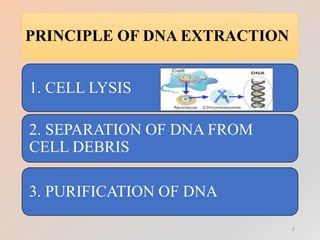
PRINCIPLE OF DNA EXTRACTION
1. CELL LYSIS
2. SEPARATION OF DNA FROM
CELL DEBRIS
3. PURIFICATION OF DNA
2
METHODS OF DNA EXTRACTION
1. Phenol-chloroform extraction
2. Magnetic bead separation
3. Precipitation chemistry (or “Salting out”).
When the ionic strength of a protein solution is increased
by adding salt, the solubility decreases, and protein
precipitates
Results in little-to-no contamination, gives high DNA yields
and is cost-effective.
ADVANTAGES
3
Salt
molecules Protein
molecules
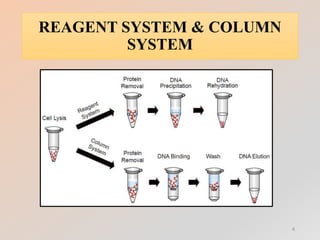
REAGENT SYSTEM & COLUMN
SYSTEM
4
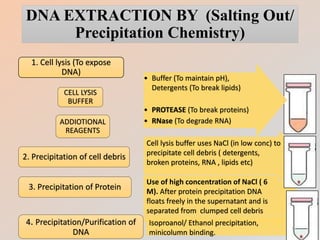
DNA EXTRACTION BY (Salting Out/
Precipitation Chemistry)
1. Cell lysis (To expose
DNA)
• Buffer (To maintain pH),
Detergents (To break lipids)
• PROTEASE (To break proteins)
• RNase (To degrade RNA)
CELL LYSIS
BUFFER
Use of high concentration of NaCl ( 6
M). After protein precipitation DNA
floats freely in the supernatant and is
separated from clumped cell debris
2. Precipitation of cell debris
4. Precipitation/Purification of
DNA
Isoproanol/ Ethanol precipitation,
minicolumn binding.
ADDIOTIONAL
REAGENTS
Cell lysis buffer uses NaCl (in low conc) to
precipitate cell debris ( detergents,
broken proteins, RNA , lipids etc)
3. Precipitation of Protein
5
MATERIALS & METHOD
CHEMICALS
• CELL LYSIS BUFFER ( pH 7.6)
Tris HCl , Triton-X, Mg Cl2 , KCl , NaCl (low conc),
EDTA( Ethylenediaminetetraacetic acid).
• SDS Solution
• NaCl ( High concentration)
• Isopropanol ( Ice cold)
• 70 % Ethanol
6
METHODOLOGY
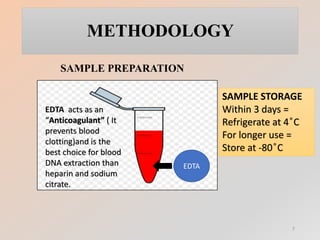
EDTA
EDTA acts as an
“Anticoagulant” ( It
prevents blood
clotting)and is the
best choice for blood
DNA extraction than
heparin and sodium
citrate.
SAMPLE STORAGE
Within 3 days =
Refrigerate at 4 ͦC
For longer use =
Store at -80 ͦC
SAMPLE PREPARATION
7
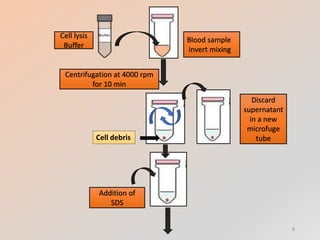
Blood sample
invert mixing
Cell lysis
Buffer
Centrifugation at 4000 rpm
for 10 min
Discard
supernatant
in a new
microfuge
tube
Addition of
SDS
8
Cell debris
Incubate at
50 °C for 30
min
Addition of
NaCl
Collection of
Supernatant
Centrifugation at 4500
rpm for 15 min
9
DNA
Precipitation of
Proteins
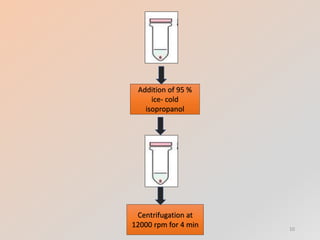
Addition of 95 %
ice- cold
isopropanol
Centrifugation at
12000 rpm for 4 min 10
Wash the pellet
with 70 %
ethanol
Centrifugation at
12000 rpm for 4 min
Air dry and
Resuspend in TE
buffer ( pH 8 )
/Pure water
11
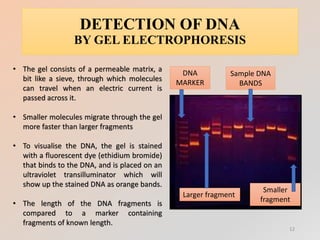
DETECTION OF DNA
BY GEL ELECTROPHORESIS
• The gel consists of a permeable matrix, a
bit like a sieve, through which molecules
can travel when an electric current is
passed across it.
• Smaller molecules migrate through the gel
more faster than larger fragments
• To visualise the DNA, the gel is stained
with a fluorescent dye (ethidium bromide)
that binds to the DNA, and is placed on an
ultraviolet transilluminator which will
show up the stained DNA as orange bands.
• The length of the DNA fragments is
compared to a marker containing
fragments of known length.
12
DNA
MARKER
Sample DNA
BANDS
Smaller
fragment
Larger fragment
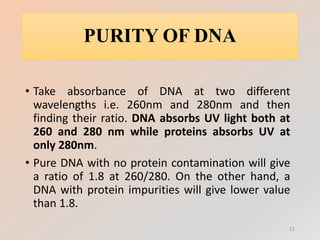
PURITY OF DNA
• Take absorbance of DNA at two different
wavelengths i.e. 260nm and 280nm and then
finding their ratio. DNA absorbs UV light both at
260 and 280 nm while proteins absorbs UV at
only 280nm.
• Pure DNA with no protein contamination will give
a ratio of 1.8 at 260/280. On the other hand, a
DNA with protein impurities will give lower value
than 1.8.
13
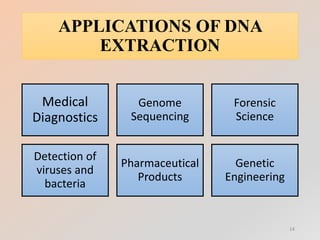
APPLICATIONS OF DNA
EXTRACTION
Medical
Diagnostics
Genome
Sequencing
Forensic
Science
Detection of
viruses and
bacteria
Pharmaceutical
Products
Genetic
Engineering
14
15
REFERENCES
• Sugna et al. (2014). DNA Isolation from Human Whole Blood
Samples by Non-Enzymatic Salting Out Method.
International Journal of Pharmacy and Pharmaceutical
Sciences, Vol 6, 198-199.
• Shahid. (2019). Genomic DNA Extraction – Principle, Steps
and Functions of Reagents. How Biotech. Retrieved from
http://howbiotech.com/genomic-dna-extraction-principle-
steps-and-functions-of-reagents
• Miller, S.A., Dykes, D.D., Polesky, H.F. (1998). A Simple
Salting Out Procedure for Extracting DNA from Human
Nucleated. Nucleic Acids Research,16(3), 1215
• Rice G.DNA Extraction. Educational Resources, Microbial
Life. Montana State University. Retrieved 17 February 2017.
16

Dna extraction from whole blood

  • 1.
    Presenter TUBA NAFEES M.Sc. InBiotechnology, University of Karachi 1
  • 2.
    PRINCIPLE OF DNAEXTRACTION 1. CELL LYSIS 2. SEPARATION OF DNA FROM CELL DEBRIS 3. PURIFICATION OF DNA 2
  • 3.
    METHODS OF DNAEXTRACTION 1. Phenol-chloroform extraction 2. Magnetic bead separation 3. Precipitation chemistry (or “Salting out”). When the ionic strength of a protein solution is increased by adding salt, the solubility decreases, and protein precipitates Results in little-to-no contamination, gives high DNA yields and is cost-effective. ADVANTAGES 3 Salt molecules Protein molecules
  • 4.
    REAGENT SYSTEM &COLUMN SYSTEM 4
  • 5.
    DNA EXTRACTION BY(Salting Out/ Precipitation Chemistry) 1. Cell lysis (To expose DNA) • Buffer (To maintain pH), Detergents (To break lipids) • PROTEASE (To break proteins) • RNase (To degrade RNA) CELL LYSIS BUFFER Use of high concentration of NaCl ( 6 M). After protein precipitation DNA floats freely in the supernatant and is separated from clumped cell debris 2. Precipitation of cell debris 4. Precipitation/Purification of DNA Isoproanol/ Ethanol precipitation, minicolumn binding. ADDIOTIONAL REAGENTS Cell lysis buffer uses NaCl (in low conc) to precipitate cell debris ( detergents, broken proteins, RNA , lipids etc) 3. Precipitation of Protein 5
  • 6.
    MATERIALS & METHOD CHEMICALS •CELL LYSIS BUFFER ( pH 7.6) Tris HCl , Triton-X, Mg Cl2 , KCl , NaCl (low conc), EDTA( Ethylenediaminetetraacetic acid). • SDS Solution • NaCl ( High concentration) • Isopropanol ( Ice cold) • 70 % Ethanol 6
  • 7.
    METHODOLOGY EDTA EDTA acts asan “Anticoagulant” ( It prevents blood clotting)and is the best choice for blood DNA extraction than heparin and sodium citrate. SAMPLE STORAGE Within 3 days = Refrigerate at 4 ͦC For longer use = Store at -80 ͦC SAMPLE PREPARATION 7
  • 8.
    Blood sample invert mixing Celllysis Buffer Centrifugation at 4000 rpm for 10 min Discard supernatant in a new microfuge tube Addition of SDS 8 Cell debris
  • 9.
    Incubate at 50 °Cfor 30 min Addition of NaCl Collection of Supernatant Centrifugation at 4500 rpm for 15 min 9 DNA Precipitation of Proteins
  • 10.
    Addition of 95% ice- cold isopropanol Centrifugation at 12000 rpm for 4 min 10
  • 11.
    Wash the pellet with70 % ethanol Centrifugation at 12000 rpm for 4 min Air dry and Resuspend in TE buffer ( pH 8 ) /Pure water 11
  • 12.
    DETECTION OF DNA BYGEL ELECTROPHORESIS • The gel consists of a permeable matrix, a bit like a sieve, through which molecules can travel when an electric current is passed across it. • Smaller molecules migrate through the gel more faster than larger fragments • To visualise the DNA, the gel is stained with a fluorescent dye (ethidium bromide) that binds to the DNA, and is placed on an ultraviolet transilluminator which will show up the stained DNA as orange bands. • The length of the DNA fragments is compared to a marker containing fragments of known length. 12 DNA MARKER Sample DNA BANDS Smaller fragment Larger fragment
  • 13.
    PURITY OF DNA •Take absorbance of DNA at two different wavelengths i.e. 260nm and 280nm and then finding their ratio. DNA absorbs UV light both at 260 and 280 nm while proteins absorbs UV at only 280nm. • Pure DNA with no protein contamination will give a ratio of 1.8 at 260/280. On the other hand, a DNA with protein impurities will give lower value than 1.8. 13
  • 14.
    APPLICATIONS OF DNA EXTRACTION Medical Diagnostics Genome Sequencing Forensic Science Detectionof viruses and bacteria Pharmaceutical Products Genetic Engineering 14
  • 15.
  • 16.
    REFERENCES • Sugna etal. (2014). DNA Isolation from Human Whole Blood Samples by Non-Enzymatic Salting Out Method. International Journal of Pharmacy and Pharmaceutical Sciences, Vol 6, 198-199. • Shahid. (2019). Genomic DNA Extraction – Principle, Steps and Functions of Reagents. How Biotech. Retrieved from http://howbiotech.com/genomic-dna-extraction-principle- steps-and-functions-of-reagents • Miller, S.A., Dykes, D.D., Polesky, H.F. (1998). A Simple Salting Out Procedure for Extracting DNA from Human Nucleated. Nucleic Acids Research,16(3), 1215 • Rice G.DNA Extraction. Educational Resources, Microbial Life. Montana State University. Retrieved 17 February 2017. 16