Ikram Ullah
M.Phil MLSc
The Amerithrax Story
 In the weeks following the 2001 terrorist attacks in the
United States,
 Several people, including two senators and individuals
at several media outlets, received letters containing
threatening messages and a mysterious white powder.
 Of the 22 people who opened the letters and were
exposed to the contents—spores of Bacillus anthracis
—five died of inhalation anthrax.
 The Federal Bureau of Investigation (FBI) dubbed the
investigation, which took 7 years, “Amerithrax
Mutation
 A mutation is a change in a DNA sequence that is present
in less than 1 percent of individuals in a population.
 “mutate” refers to the process of altering a DNA sequence.
 Mutations range in size from alteration of a single DNA
base; to deletion or duplication of tens, hundreds,
thousands, or even millions of bases; to missing or extra
entire chromosomes.
 Mutation can affect any part of the genome, including
sequences that encode proteins or control transcription; in
introns; repeats; and sites critical to intron removal and
exon splicing
 The effects of mutation vary. Mutations may impair a
function, have no effect, or even be beneficial.
 A deleterious (harmful) mutation can stop or slow
production of a protein, overproduce it, or impair the
protein’s function—such as altering its secretion, location,
or interaction with another protein.
 Geneticists describe the effect of a mutation as a “loss of
function” when the gene’s product is reduced or absent,
 or as a “gain of function” when the gene’s action changes in
some way.
 Most mutations are recessive and cause a loss of function.
Gain-of function mutations tend to be dominant.
 Geneticists define a mutation as being present in less
than 1 percent of a population and a polymorphism as
being present in more than 1 percent of a population.
 The term mutation refers to genotype—that is, a
change at the DNA or chromosome level. The familiar
term mutant refers to phenotype.
 In a germline mutation, the change occurs during
the DNA replication that precedes meiosis
 A somatic mutation happens during DNA
replication before a mitotic cell division
The Beta Globin Gene
 The first genetic illness understood at the molecular level was
sickle cell disease
 In 1904, young medical intern Ernest Irons noted “many pear-
shaped and elongated forms
 Irons sketched this first view of sickle cell disease at the cellular
level,
 In 1949, Linus Pauling discovered that hemoglobin from healthy
people and from people with the anemia, when placed in a
solution in an electrically charged field (a technique called
electrophoresis), moved to different positions
 The difference between the two types of hemoglobin lay in beta
globin
 Protein chemist V. M. Ingram took a shortcut to localize
the mutation in the 146-amino-acid-long beta subunit.
 He cut normal and sickle hemoglobin with a protein-
digesting enzyme, separated the pieces, stained them, and
displayed them on filter paper.
 Ingram identified the tiny mutation responsible for sickle
cell disease:
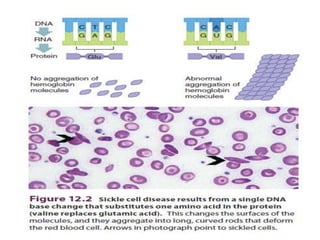
 a substitution of the amino acid valine for the glutamic acid
that is normally the sixth amino acid in the beta globin
polypeptide chain
 At the DNA level, the change was even smaller—a CTC to a
CAC, corresponding to RNA codons GAG and GUG
 The valine at this position changes the surfaces of
hemoglobin molecules so that in low-oxygen
conditions they attach at many more points than they
would if the wild type glutamic acid were at the site.
 The aggregated hemoglobin molecules form ropelike
cables that bend red blood cells into rigid, fragile,
sickle-shaped structures
Causes of Mutation
 A mutation can occur spontaneously or be induced by
exposure to a chemical or radiation. An agent that causes
mutation is called a mutagen
 Spontaneous Mutation
 Two healthy people of normal height may have a child with
achondroplasia, an autosomal dominant form of dwarfism.
 How could this happen when no other family members are
affected?
 If the mutation is dominant, why are the parents of normal
height?
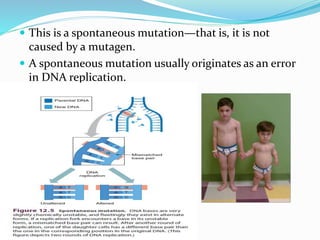
 This is a spontaneous mutation—that is, it is not
caused by a mutagen.
 A spontaneous mutation usually originates as an error
in DNA replication.
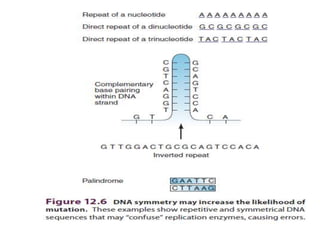
Mutational Hot Spots
 In some genes mutations are more likely to occur in regions
called hot spots, where sequences are repetitive.
 It is as if the molecules that guide and carry out replication
become “confused” by short repeated sequences
 The increased incidence of mutations in repeats has a
physical basis.
 Within a gene, when DNA strands locally unwind to
replicate in symmetrical or repeated sequences, bases
located on the same strand may pair.
 A stretch of ATATAT might pair with TATATA elsewhere on
the same strand, creating a loop that interferes with
replication and repair enzymes, increasing risk of error
 Induced Mutation: Geneticists use mutagens on model
organisms to infer normal gene functions, yielding many
collections and insights into human health
 Intentional Use of Mutagens: Researchers have developed
several ways to test the mutagenicity of a substance
 Researchers exposed human connective tissue cells
growing in culture to liquefied cigarette smoke.
 The chemicals from the smoke cut chromosomes through
both DNA strands.
 This is an especially damaging insult because broken
chromosomes can join with each other in different ways
that can activate cancer-causing genes
 Accidental Exposures to Mutagens: Some mutagen
exposure is unintentional.
 This occurs from workplace contact before the danger
is known; from industrial accidents; from medical
treatments such as chemotherapy and radiation; and
from exposure to weapons that emit radiation.
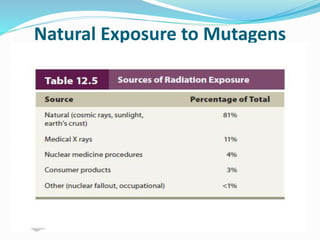
Natural Exposure to Mutagens

Mutation and its types

  • 1.
  • 2.
    The Amerithrax Story In the weeks following the 2001 terrorist attacks in the United States,  Several people, including two senators and individuals at several media outlets, received letters containing threatening messages and a mysterious white powder.  Of the 22 people who opened the letters and were exposed to the contents—spores of Bacillus anthracis —five died of inhalation anthrax.  The Federal Bureau of Investigation (FBI) dubbed the investigation, which took 7 years, “Amerithrax
  • 3.
    Mutation  A mutationis a change in a DNA sequence that is present in less than 1 percent of individuals in a population.  “mutate” refers to the process of altering a DNA sequence.  Mutations range in size from alteration of a single DNA base; to deletion or duplication of tens, hundreds, thousands, or even millions of bases; to missing or extra entire chromosomes.  Mutation can affect any part of the genome, including sequences that encode proteins or control transcription; in introns; repeats; and sites critical to intron removal and exon splicing
  • 4.
     The effectsof mutation vary. Mutations may impair a function, have no effect, or even be beneficial.  A deleterious (harmful) mutation can stop or slow production of a protein, overproduce it, or impair the protein’s function—such as altering its secretion, location, or interaction with another protein.  Geneticists describe the effect of a mutation as a “loss of function” when the gene’s product is reduced or absent,  or as a “gain of function” when the gene’s action changes in some way.  Most mutations are recessive and cause a loss of function. Gain-of function mutations tend to be dominant.
  • 5.
     Geneticists definea mutation as being present in less than 1 percent of a population and a polymorphism as being present in more than 1 percent of a population.  The term mutation refers to genotype—that is, a change at the DNA or chromosome level. The familiar term mutant refers to phenotype.  In a germline mutation, the change occurs during the DNA replication that precedes meiosis  A somatic mutation happens during DNA replication before a mitotic cell division
  • 6.
    The Beta GlobinGene  The first genetic illness understood at the molecular level was sickle cell disease  In 1904, young medical intern Ernest Irons noted “many pear- shaped and elongated forms  Irons sketched this first view of sickle cell disease at the cellular level,  In 1949, Linus Pauling discovered that hemoglobin from healthy people and from people with the anemia, when placed in a solution in an electrically charged field (a technique called electrophoresis), moved to different positions  The difference between the two types of hemoglobin lay in beta globin
  • 7.
     Protein chemistV. M. Ingram took a shortcut to localize the mutation in the 146-amino-acid-long beta subunit.  He cut normal and sickle hemoglobin with a protein- digesting enzyme, separated the pieces, stained them, and displayed them on filter paper.  Ingram identified the tiny mutation responsible for sickle cell disease:  a substitution of the amino acid valine for the glutamic acid that is normally the sixth amino acid in the beta globin polypeptide chain  At the DNA level, the change was even smaller—a CTC to a CAC, corresponding to RNA codons GAG and GUG
  • 8.
     The valineat this position changes the surfaces of hemoglobin molecules so that in low-oxygen conditions they attach at many more points than they would if the wild type glutamic acid were at the site.  The aggregated hemoglobin molecules form ropelike cables that bend red blood cells into rigid, fragile, sickle-shaped structures
  • 10.
    Causes of Mutation A mutation can occur spontaneously or be induced by exposure to a chemical or radiation. An agent that causes mutation is called a mutagen  Spontaneous Mutation  Two healthy people of normal height may have a child with achondroplasia, an autosomal dominant form of dwarfism.  How could this happen when no other family members are affected?  If the mutation is dominant, why are the parents of normal height?
  • 11.
     This isa spontaneous mutation—that is, it is not caused by a mutagen.  A spontaneous mutation usually originates as an error in DNA replication.
  • 12.
    Mutational Hot Spots In some genes mutations are more likely to occur in regions called hot spots, where sequences are repetitive.  It is as if the molecules that guide and carry out replication become “confused” by short repeated sequences  The increased incidence of mutations in repeats has a physical basis.  Within a gene, when DNA strands locally unwind to replicate in symmetrical or repeated sequences, bases located on the same strand may pair.  A stretch of ATATAT might pair with TATATA elsewhere on the same strand, creating a loop that interferes with replication and repair enzymes, increasing risk of error
  • 14.
     Induced Mutation:Geneticists use mutagens on model organisms to infer normal gene functions, yielding many collections and insights into human health  Intentional Use of Mutagens: Researchers have developed several ways to test the mutagenicity of a substance  Researchers exposed human connective tissue cells growing in culture to liquefied cigarette smoke.  The chemicals from the smoke cut chromosomes through both DNA strands.  This is an especially damaging insult because broken chromosomes can join with each other in different ways that can activate cancer-causing genes
  • 15.
     Accidental Exposuresto Mutagens: Some mutagen exposure is unintentional.  This occurs from workplace contact before the danger is known; from industrial accidents; from medical treatments such as chemotherapy and radiation; and from exposure to weapons that emit radiation.
  • 16.