Metabolism and Cellular
Respiration
2
3
Learning Outcomes
Metabolism and Cellular Respiration
1. Explain how cells use energy in food to produce ATP.
2. Draw and explain the net reaction in aerobic respiration.
3. Compare and contrast the events of glycolysis, the Krebs cycle, and the
electron transport chain.
4. Describe where, in a eukaryotic cell, each step in respiration occurs.
5. Draw and explain the net reaction in glycolysis.
6. Draw and explain the net reaction in the Krebs cycle.
7. Diagram and explain the flow of electrons in the electron transport chain.
8. Explain the role of O2 in respiration.
9. Explain what would happen in each part of cellular respiration if the cell
is deprived of O2.
10. Explain why fermentation is necessary in O2 deprived cells. Compare
and contrast aerobic respiration, anaerobic respiration, and fermentation.
11. Compare and contrast respiration and photosynthesis.
12. Compare and contrast homeothermic, poikilothermic, endothermic, and
ectothermic and give examples.
4
©McGraw-Hill Education. All rights reserved. Authorized only for instructor use in the classroom.
No reproduction or further distribution permitted without the prior written consent of McGraw-Hill Education. 6-5
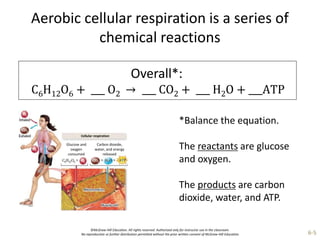
Aerobic cellular respiration is a series of
chemical reactions
Overall*:
C6H12O6 + ___ O2 → ___ CO2 + ___ H2O + ___ATP
*Balance the equation.
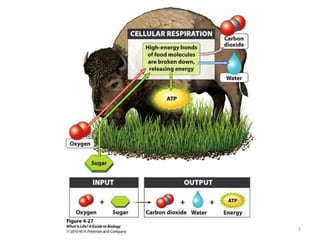
The reactants are glucose
and oxygen.
The products are carbon
dioxide, water, and ATP.
Cellular respiration
Glucose and
oxygen
consumed
Carbon dioxide,
water, and energy
released
©McGraw-Hill Education. All rights reserved. Authorized only for instructor use in the classroom.
No reproduction or further distribution permitted without the prior written consent of McGraw-Hill Education. 6-6
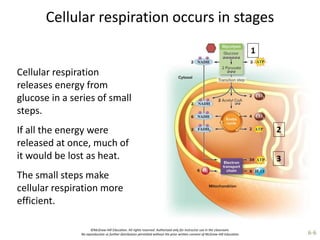
Cellular respiration occurs in stages
Cellular respiration
releases energy from
glucose in a series of small
steps.
If all the energy were
released at once, much of
it would be lost as heat.
The small steps make
cellular respiration more
efficient.
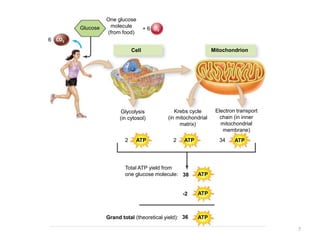
One glucose
molecule
(from food)
Cell Mitochondrion
Glucose
Glycolysis
(in cytosol)
Krebs cycle
(in mitochondrial
matrix)
Electron transport
chain (in inner
mitochondrial
membrane)
Total ATP yield from
one glucose molecule:
Grand total (theoretical yield): 36
-2
38
2 2 34
CO2
O2
6
+ 6
ATP ATP ATP
ATP
ATP
ATP
7
Cellular Respiration Overview
1. Glycolysis
2. Breakdown of Pyruvate = Transition Step = Acetyl
Co-A production
3. Citric Acid Cycle = Krebs Cycle
4. Oxidative Phosphorylation = Electron Transport
Chain (ETC)
8
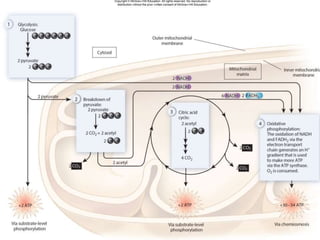
Follow the
Carbon!
9
10
©McGraw-Hill Education. All rights reserved. Authorized only for instructor use in the classroom.
No reproduction or further distribution permitted without the prior written consent of McGraw-Hill Education. 6-11
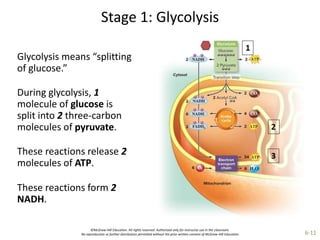
Stage 1: Glycolysis
Glycolysis means “splitting
of glucose.”
During glycolysis, 1
molecule of glucose is
split into 2 three-carbon
molecules of pyruvate.
These reactions release 2
molecules of ATP.
These reactions form 2
NADH.
©McGraw-Hill Education. All rights reserved. Authorized only for instructor use in the classroom.
No reproduction or further distribution permitted without the prior written consent of McGraw-Hill Education. 6-12
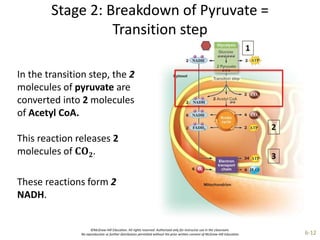
Stage 2: Breakdown of Pyruvate =
Transition step
In the transition step, the 2
molecules of pyruvate are
converted into 2 molecules
of Acetyl CoA.
This reaction releases 2
molecules of 𝐂𝐎𝟐.
These reactions form 2
NADH.
©McGraw-Hill Education. All rights reserved. Authorized only for instructor use in the classroom.
No reproduction or further distribution permitted without the prior written consent of McGraw-Hill Education. 6-13
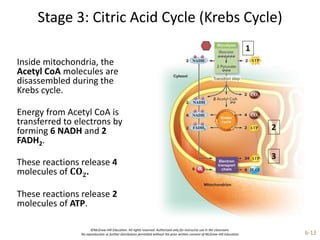
Stage 3: Citric Acid Cycle (Krebs Cycle)
Inside mitochondria, the
Acetyl CoA molecules are
disassembled during the
Krebs cycle.
Energy from Acetyl CoA is
transferred to electrons by
forming 6 NADH and 2
FADH2.
These reactions release 4
molecules of 𝐂𝐎𝟐.
These reactions release 2
molecules of ATP.
©McGraw-Hill Education. All rights reserved. Authorized only for instructor use in the classroom.
No reproduction or further distribution permitted without the prior written consent of McGraw-Hill Education. 6-14
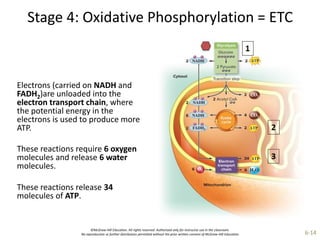
Stage 4: Oxidative Phosphorylation = ETC
Electrons (carried on NADH and
FADH2)are unloaded into the
electron transport chain, where
the potential energy in the
electrons is used to produce more
ATP.
These reactions require 6 oxygen
molecules and release 6 water
molecules.
These reactions release 34
molecules of ATP.
Glycolysis
2 Pyruvate
2
2
6
2
6 6
34
2
4
2
2 Acetyl CoA
Transition step
Krebs
cycle
Electron
transport
chain
Glucose
2
Cytosol
Mitochondrion
NADH
NADH
NADH
FADH2
ATP
ATP
ATP
CO2
CO2
H2O
O2
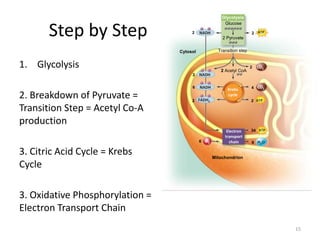
Step by Step
1. Glycolysis
2. Breakdown of Pyruvate =
Transition Step = Acetyl Co-A
production
3. Citric Acid Cycle = Krebs
Cycle
3. Oxidative Phosphorylation =
Electron Transport Chain
15
Time to add more detail…
16
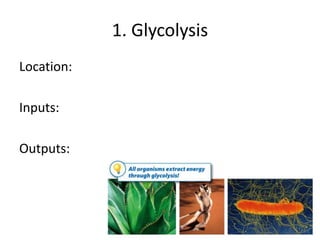
1. Glycolysis
Location:
Inputs:
Outputs:
17
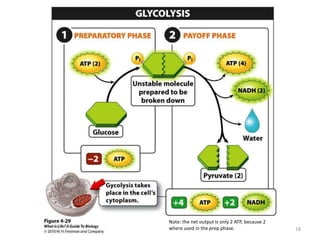
Note: the net output is only 2 ATP, because 2
where used in the prep phase. 18
©McGraw-Hill Education. All rights reserved. Authorized only for instructor use in the classroom.
No reproduction or further distribution permitted without the prior written consent of McGraw-Hill Education. 6-19
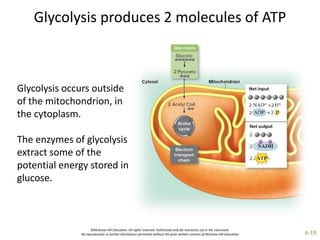
Glycolysis produces 2 molecules of ATP
Glycolysis occurs outside
of the mitochondrion, in
the cytoplasm.
The enzymes of glycolysis
extract some of the
potential energy stored in
glucose.
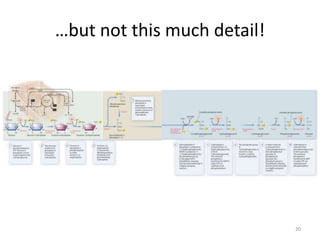
…but not this much detail!
20
©McGraw-Hill Education. All rights reserved. Authorized only for instructor use in the classroom.
No reproduction or further distribution permitted without the prior written consent of McGraw-Hill Education. 6-21
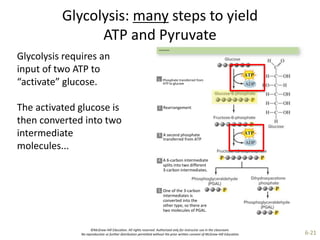
Glycolysis: many steps to yield
ATP and Pyruvate
Glycolysis requires an
input of two ATP to
“activate” glucose.
The activated glucose is
then converted into two
intermediate
molecules...
Energy investment
1. Phosphate transferred from
ATP to glucose
2. Rearrangement
3. A second phosphate
transferred from ATP
4. A 6-carbon intermediate
splits into two different
3-carbon intermediates.
5. One of the 3-carbon
intermediates is
converted into the
other type, so there are
two molecules of PGAL.
©McGraw-Hill Education. All rights reserved. Authorized only for instructor use in the classroom.
No reproduction or further distribution permitted without the prior written consent of McGraw-Hill Education. 6-22
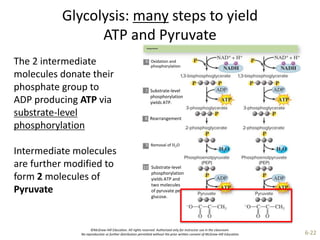
The 2 intermediate
molecules donate their
phosphate group to
ADP producing ATP via
substrate-level
phosphorylation
Intermediate molecules
are further modified to
form 2 molecules of
Pyruvate
Energy harvest
6. Oxidation and
phosphorylation
7. Substrate-level
phosphorylation
yields ATP.
8. Rearrangement
9. Removal of H2O
10. Substrate-level
phosphorylation
yields ATP and
two molecules
of pyruvate per
glucose.
Glycolysis: many steps to yield
ATP and Pyruvate
©McGraw-Hill Education. All rights reserved. Authorized only for instructor use in the classroom.
No reproduction or further distribution permitted without the prior written consent of McGraw-Hill Education. 6-23
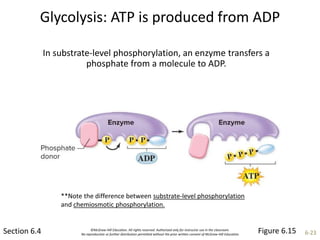
Glycolysis: ATP is produced from ADP
Section 6.4
In substrate-level phosphorylation, an enzyme transfers a
phosphate from a molecule to ADP.
Figure 6.15
**Note the difference between substrate-level phosphorylation
and chemiosmotic phosphorylation.
©McGraw-Hill Education. All rights reserved. Authorized only for instructor use in the classroom.
No reproduction or further distribution permitted without the prior written consent of McGraw-Hill Education. 6-24
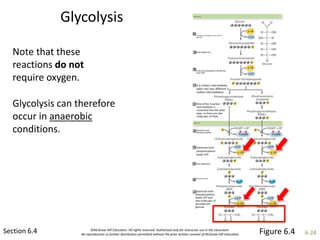
Glycolysis
Section 6.4
Note that these
reactions do not
require oxygen.
Glycolysis can therefore
occur in anaerobic
conditions.
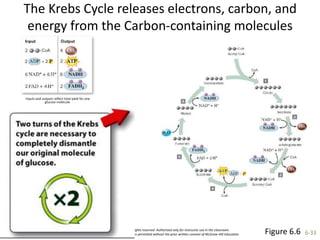
Figure 6.4
Energy investment
1. Phosphate transferred from ATP to
glucose
2. Rearrangement
3. A second phosphate transferred
from ATP
4. A 6-carbon intermediate
splits into two different 3-
carbon intermediates.
5. One of the 3-carbon
intermediates is
converted into the other
type, so there are two
molecules of PGAL.
Energy harvest
6. Oxidationand
phosphorylation
7. Substrate-level
phosphorylation
yields ATP.
8. Rearrangement
9. Removal of H2O
10.Substrate-level
phosphorylation
yields ATP and
two molecules of
pyruvate per
glucose.
©McGraw-Hill Education. All rights reserved. Authorized only for instructor use in the classroom.
No reproduction or further distribution permitted without the prior written consent of McGraw-Hill Education. 6-25
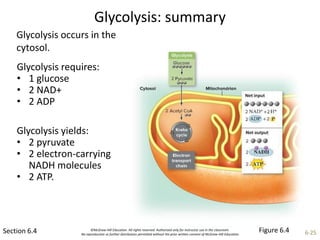
Glycolysis: summary
Section 6.4
Glycolysis requires:
• 1 glucose
• 2 NAD+
• 2 ADP
Glycolysis yields:
• 2 pyruvate
• 2 electron-carrying
NADH molecules
• 2 ATP.
Figure 6.4
Glycolysis occurs in the
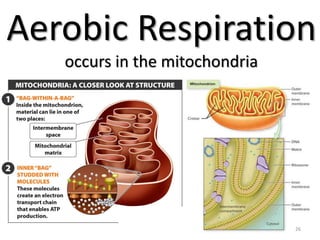
cytosol.
Aerobic Respiration
occurs in the mitochondria
26
©McGraw-Hill Education. All rights reserved. Authorized only for instructor use in the classroom.
No reproduction or further distribution permitted without the prior written consent of McGraw-Hill Education. 6-27
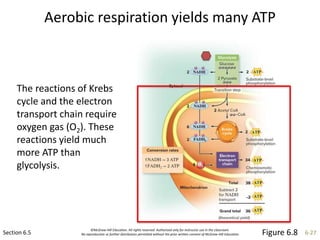
Aerobic respiration yields many ATP
Section 6.5
The reactions of Krebs
cycle and the electron
transport chain require
oxygen gas (O2). These
reactions yield much
more ATP than
glycolysis.
Figure 6.8
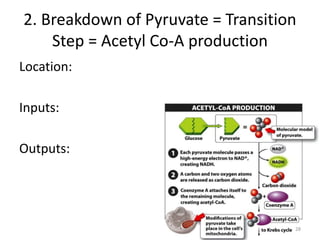
2. Breakdown of Pyruvate = Transition
Step = Acetyl Co-A production
Location:
Inputs:
Outputs:
28
©McGraw-Hill Education. All rights reserved. Authorized only for instructor use in the classroom.
No reproduction or further distribution permitted without the prior written consent of McGraw-Hill Education. 6-29
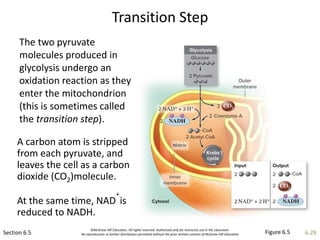
Transition Step
Section 6.5
The two pyruvate
molecules produced in
glycolysis undergo an
oxidation reaction as they
enter the mitochondrion
(this is sometimes called
the transition step).
Figure 6.5
A carbon atom is stripped
from each pyruvate, and
leaves the cell as a carbon
dioxide (CO2)molecule.
At the same time, NAD
+
is
reduced to NADH.
©McGraw-Hill Education. All rights reserved. Authorized only for instructor use in the classroom.
No reproduction or further distribution permitted without the prior written consent of McGraw-Hill Education. 6-30
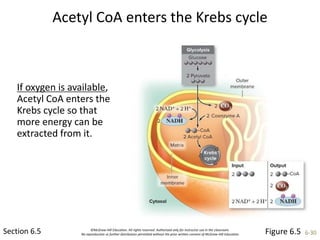
Acetyl CoA enters the Krebs cycle
Section 6.5
If oxygen is available,
Acetyl CoA enters the
Krebs cycle so that
more energy can be
extracted from it.
Figure 6.5
Location:
Inputs:
Outputs:
31
©McGraw-Hill Education. All rights reserved. Authorized only for instructor use in the classroom.
No reproduction or further distribution permitted without the prior written consent of McGraw-Hill Education. 6-32
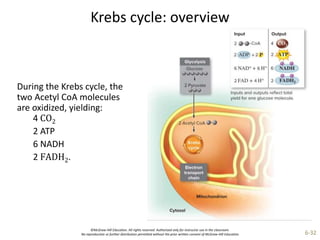
Krebs cycle: overview
During the Krebs cycle, the
two Acetyl CoA molecules
are oxidized, yielding:
4 CO2
2 ATP
6 NADH
2 FADH2.
©McGraw-Hill Education. All rights reserved. Authorized only for instructor use in the classroom.
No reproduction or further distribution permitted without the prior written consent of McGraw-Hill Education. 6-33
The Krebs Cycle releases electrons, carbon, and
energy from the Carbon-containing molecules
Figure 6.6
Inputs and outputs reflect total yield for one
glucose molecule.
©McGraw-Hill Education. All rights reserved. Authorized only for instructor use in the classroom.
No reproduction or further distribution permitted without the prior written consent of McGraw-Hill Education. 6-34
How much ATP is produced?
So far, aerobic respiration of one glucose molecule has yielded
only four ATP.
©McGraw-Hill Education. All rights reserved. Authorized only for instructor use in the classroom.
No reproduction or further distribution permitted without the prior written consent of McGraw-Hill Education. 6-35
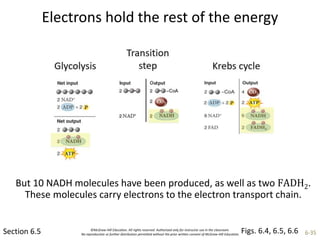
Electrons hold the rest of the energy
Section 6.5
But 10 NADH molecules have been produced, as well as two FADH2.
These molecules carry electrons to the electron transport chain.
Figs. 6.4, 6.5, 6.6
Follow the
Electrons!
36
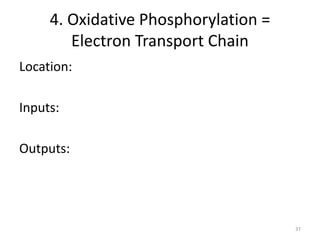
4. Oxidative Phosphorylation =
Electron Transport Chain
Location:
Inputs:
Outputs:
37
38
©McGraw-Hill Education. All rights reserved. Authorized only for instructor use in the classroom.
No reproduction or further distribution permitted without the prior written consent of McGraw-Hill Education. 6-39
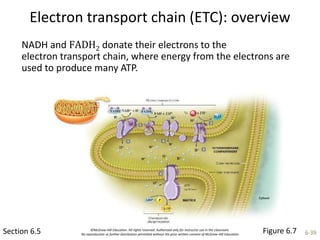
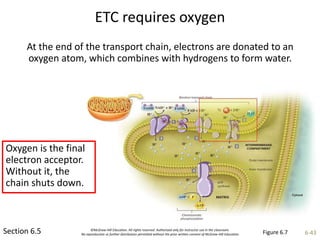
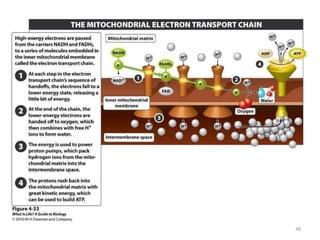
Electron transport chain (ETC): overview
Section 6.5
NADH and FADH2 donate their electrons to the
electron transport chain, where energy from the electrons are
used to produce many ATP.
Figure 6.7
©McGraw-Hill Education. All rights reserved. Authorized only for instructor use in the classroom.
No reproduction or further distribution permitted without the prior written consent of McGraw-Hill Education. 6-40
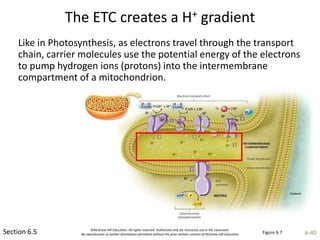
The ETC creates a H+ gradient
Section 6.5
Like in Photosynthesis, as electrons travel through the transport
chain, carrier molecules use the potential energy of the electrons
to pump hydrogen ions (protons) into the intermembrane
compartment of a mitochondrion.
Figure 6.7
©McGraw-Hill Education. All rights reserved. Authorized only for instructor use in the classroom.
No reproduction or further distribution permitted without the prior written consent of McGraw-Hill Education. 6-41
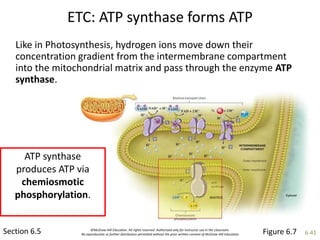
ETC: ATP synthase forms ATP
Section 6.5
Like in Photosynthesis, hydrogen ions move down their
concentration gradient from the intermembrane compartment
into the mitochondrial matrix and pass through the enzyme ATP
synthase.
ATP synthase
produces ATP via
chemiosmotic
phosphorylation.
Figure 6.7
©McGraw-Hill Education. All rights reserved. Authorized only for instructor use in the classroom.
No reproduction or further distribution permitted without the prior written consent of McGraw-Hill Education. 6-42
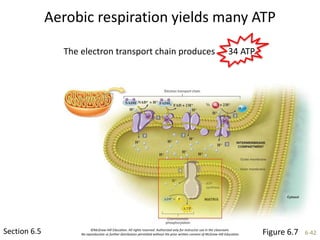
Aerobic respiration yields many ATP
Section 6.5
The electron transport chain produces 34 ATP.
Figure 6.7
©McGraw-Hill Education. All rights reserved. Authorized only for instructor use in the classroom.
No reproduction or further distribution permitted without the prior written consent of McGraw-Hill Education. 6-43
ETC requires oxygen
Section 6.5
At the end of the transport chain, electrons are donated to an
oxygen atom, which combines with hydrogens to form water.
Oxygen is the final
electron acceptor.
Without it, the
chain shuts down.
Figure 6.7
©McGraw-Hill Education. All rights reserved. Authorized only for instructor use in the classroom.
No reproduction or further distribution permitted without the prior written consent of McGraw-Hill Education. 6-44
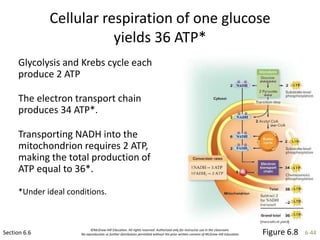
Cellular respiration of one glucose
yields 36 ATP*
Section 6.6
Glycolysis and Krebs cycle each
produce 2 ATP
The electron transport chain
produces 34 ATP*.
Transporting NADH into the
mitochondrion requires 2 ATP,
making the total production of
ATP equal to 36*.
*Under ideal conditions.
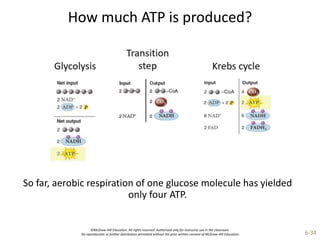
Figure 6.8
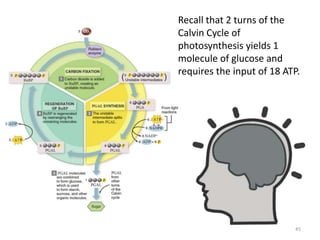
Recall that 2 turns of the
Calvin Cycle of
photosynthesis yields 1
molecule of glucose and
requires the input of 18 ATP.
45
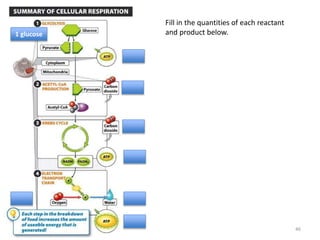
Fill in the quantities of each reactant
and product below.
1 glucose
46
©McGraw-Hill Education. All rights reserved. Authorized only for instructor use in the classroom.
No reproduction or further distribution permitted without the prior written consent of McGraw-Hill Education. 6-47
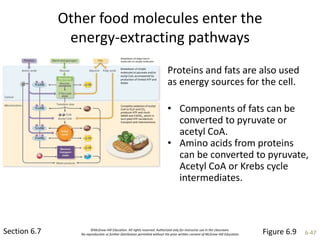
Other food molecules enter the
energy-extracting pathways
Section 6.7
Proteins and fats are also used
as energy sources for the cell.
• Components of fats can be
converted to pyruvate or
acetyl CoA.
• Amino acids from proteins
can be converted to pyruvate,
Acetyl CoA or Krebs cycle
intermediates.
Figure 6.9
Breakdown of large macro-
molecules to simple molecules
Breakdown of simple
molecules to pyruvate and/or
acetyl CoA, accompanied by
production of limited ATP and
NADH
Complete oxidation of acetyl
CoA to H2O and CO2
produces ATP and much
NADH and FADH2, which in
turn yield ATP via electron
transport and chemiosmosis.
48
©McGraw-Hill Education. All rights reserved. Authorized only for instructor use in the classroom.
No reproduction or further distribution permitted without the prior written consent of McGraw-Hill Education. 6-49
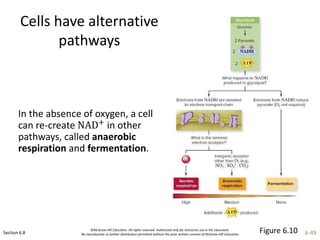
Cells have alternative
pathways
Section 6.8
In the absence of oxygen, a cell
can re-create NAD+ in other
pathways, called anaerobic
respiration and fermentation.
Figure 6.10
©McGraw-Hill Education. All rights reserved. Authorized only for instructor use in the classroom.
No reproduction or further distribution permitted without the prior written consent of McGraw-Hill Education. 6-50
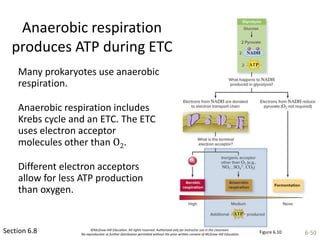
Anaerobic respiration
produces ATP during ETC
Section 6.8
Many prokaryotes use anaerobic
respiration.
Anaerobic respiration includes
Krebs cycle and an ETC. The ETC
uses electron acceptor
molecules other than O2.
Different electron acceptors
allow for less ATP production
than oxygen.
Figure 6.10
51
©McGraw-Hill Education. All rights reserved. Authorized only for instructor use in the classroom.
No reproduction or further distribution permitted without the prior written consent of McGraw-Hill Education. 6-52
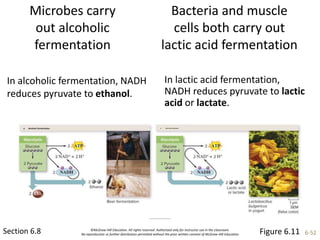
Microbes carry
out alcoholic
fermentation
Section 6.8
In alcoholic fermentation, NADH
reduces pyruvate to ethanol.
Figure 6.11
a. Alcoholic fermentation b. Lactic acid fermentation
(a):©Adam Woolfitt/Corbis; (b):©Scimat/ScienceSource
Bacteria and muscle
cells both carry out
lactic acid fermentation
In lactic acid fermentation,
NADH reduces pyruvate to lactic
acid or lactate.
©McGraw-Hill Education. All rights reserved. Authorized only for instructor use in the classroom.
No reproduction or further distribution permitted without the prior written consent of McGraw-Hill Education. 6-53
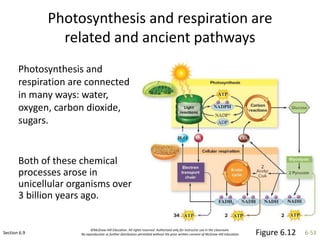
Photosynthesis and respiration are
related and ancient pathways
Section 6.9
Photosynthesis and
respiration are connected
in many ways: water,
oxygen, carbon dioxide,
sugars.
Figure 6.12
Both of these chemical
processes arose in
unicellular organisms over
3 billion years ago.

Cellular respiration

  • 1.
  • 2.
  • 3.
  • 4.
    Learning Outcomes Metabolism andCellular Respiration 1. Explain how cells use energy in food to produce ATP. 2. Draw and explain the net reaction in aerobic respiration. 3. Compare and contrast the events of glycolysis, the Krebs cycle, and the electron transport chain. 4. Describe where, in a eukaryotic cell, each step in respiration occurs. 5. Draw and explain the net reaction in glycolysis. 6. Draw and explain the net reaction in the Krebs cycle. 7. Diagram and explain the flow of electrons in the electron transport chain. 8. Explain the role of O2 in respiration. 9. Explain what would happen in each part of cellular respiration if the cell is deprived of O2. 10. Explain why fermentation is necessary in O2 deprived cells. Compare and contrast aerobic respiration, anaerobic respiration, and fermentation. 11. Compare and contrast respiration and photosynthesis. 12. Compare and contrast homeothermic, poikilothermic, endothermic, and ectothermic and give examples. 4
  • 5.
    ©McGraw-Hill Education. Allrights reserved. Authorized only for instructor use in the classroom. No reproduction or further distribution permitted without the prior written consent of McGraw-Hill Education. 6-5 Aerobic cellular respiration is a series of chemical reactions Overall*: C6H12O6 + ___ O2 → ___ CO2 + ___ H2O + ___ATP *Balance the equation. The reactants are glucose and oxygen. The products are carbon dioxide, water, and ATP. Cellular respiration Glucose and oxygen consumed Carbon dioxide, water, and energy released
  • 6.
    ©McGraw-Hill Education. Allrights reserved. Authorized only for instructor use in the classroom. No reproduction or further distribution permitted without the prior written consent of McGraw-Hill Education. 6-6 Cellular respiration occurs in stages Cellular respiration releases energy from glucose in a series of small steps. If all the energy were released at once, much of it would be lost as heat. The small steps make cellular respiration more efficient.
  • 7.
    One glucose molecule (from food) CellMitochondrion Glucose Glycolysis (in cytosol) Krebs cycle (in mitochondrial matrix) Electron transport chain (in inner mitochondrial membrane) Total ATP yield from one glucose molecule: Grand total (theoretical yield): 36 -2 38 2 2 34 CO2 O2 6 + 6 ATP ATP ATP ATP ATP ATP 7
  • 8.
    Cellular Respiration Overview 1.Glycolysis 2. Breakdown of Pyruvate = Transition Step = Acetyl Co-A production 3. Citric Acid Cycle = Krebs Cycle 4. Oxidative Phosphorylation = Electron Transport Chain (ETC) 8
  • 9.
  • 10.
  • 11.
    ©McGraw-Hill Education. Allrights reserved. Authorized only for instructor use in the classroom. No reproduction or further distribution permitted without the prior written consent of McGraw-Hill Education. 6-11 Stage 1: Glycolysis Glycolysis means “splitting of glucose.” During glycolysis, 1 molecule of glucose is split into 2 three-carbon molecules of pyruvate. These reactions release 2 molecules of ATP. These reactions form 2 NADH.
  • 12.
    ©McGraw-Hill Education. Allrights reserved. Authorized only for instructor use in the classroom. No reproduction or further distribution permitted without the prior written consent of McGraw-Hill Education. 6-12 Stage 2: Breakdown of Pyruvate = Transition step In the transition step, the 2 molecules of pyruvate are converted into 2 molecules of Acetyl CoA. This reaction releases 2 molecules of 𝐂𝐎𝟐. These reactions form 2 NADH.
  • 13.
    ©McGraw-Hill Education. Allrights reserved. Authorized only for instructor use in the classroom. No reproduction or further distribution permitted without the prior written consent of McGraw-Hill Education. 6-13 Stage 3: Citric Acid Cycle (Krebs Cycle) Inside mitochondria, the Acetyl CoA molecules are disassembled during the Krebs cycle. Energy from Acetyl CoA is transferred to electrons by forming 6 NADH and 2 FADH2. These reactions release 4 molecules of 𝐂𝐎𝟐. These reactions release 2 molecules of ATP.
  • 14.
    ©McGraw-Hill Education. Allrights reserved. Authorized only for instructor use in the classroom. No reproduction or further distribution permitted without the prior written consent of McGraw-Hill Education. 6-14 Stage 4: Oxidative Phosphorylation = ETC Electrons (carried on NADH and FADH2)are unloaded into the electron transport chain, where the potential energy in the electrons is used to produce more ATP. These reactions require 6 oxygen molecules and release 6 water molecules. These reactions release 34 molecules of ATP.
  • 15.
    Glycolysis 2 Pyruvate 2 2 6 2 6 6 34 2 4 2 2Acetyl CoA Transition step Krebs cycle Electron transport chain Glucose 2 Cytosol Mitochondrion NADH NADH NADH FADH2 ATP ATP ATP CO2 CO2 H2O O2 Step by Step 1. Glycolysis 2. Breakdown of Pyruvate = Transition Step = Acetyl Co-A production 3. Citric Acid Cycle = Krebs Cycle 3. Oxidative Phosphorylation = Electron Transport Chain 15
  • 16.
    Time to addmore detail… 16
  • 17.
  • 18.
    Note: the netoutput is only 2 ATP, because 2 where used in the prep phase. 18
  • 19.
    ©McGraw-Hill Education. Allrights reserved. Authorized only for instructor use in the classroom. No reproduction or further distribution permitted without the prior written consent of McGraw-Hill Education. 6-19 Glycolysis produces 2 molecules of ATP Glycolysis occurs outside of the mitochondrion, in the cytoplasm. The enzymes of glycolysis extract some of the potential energy stored in glucose.
  • 20.
    …but not thismuch detail! 20
  • 21.
    ©McGraw-Hill Education. Allrights reserved. Authorized only for instructor use in the classroom. No reproduction or further distribution permitted without the prior written consent of McGraw-Hill Education. 6-21 Glycolysis: many steps to yield ATP and Pyruvate Glycolysis requires an input of two ATP to “activate” glucose. The activated glucose is then converted into two intermediate molecules... Energy investment 1. Phosphate transferred from ATP to glucose 2. Rearrangement 3. A second phosphate transferred from ATP 4. A 6-carbon intermediate splits into two different 3-carbon intermediates. 5. One of the 3-carbon intermediates is converted into the other type, so there are two molecules of PGAL.
  • 22.
    ©McGraw-Hill Education. Allrights reserved. Authorized only for instructor use in the classroom. No reproduction or further distribution permitted without the prior written consent of McGraw-Hill Education. 6-22 The 2 intermediate molecules donate their phosphate group to ADP producing ATP via substrate-level phosphorylation Intermediate molecules are further modified to form 2 molecules of Pyruvate Energy harvest 6. Oxidation and phosphorylation 7. Substrate-level phosphorylation yields ATP. 8. Rearrangement 9. Removal of H2O 10. Substrate-level phosphorylation yields ATP and two molecules of pyruvate per glucose. Glycolysis: many steps to yield ATP and Pyruvate
  • 23.
    ©McGraw-Hill Education. Allrights reserved. Authorized only for instructor use in the classroom. No reproduction or further distribution permitted without the prior written consent of McGraw-Hill Education. 6-23 Glycolysis: ATP is produced from ADP Section 6.4 In substrate-level phosphorylation, an enzyme transfers a phosphate from a molecule to ADP. Figure 6.15 **Note the difference between substrate-level phosphorylation and chemiosmotic phosphorylation.
  • 24.
    ©McGraw-Hill Education. Allrights reserved. Authorized only for instructor use in the classroom. No reproduction or further distribution permitted without the prior written consent of McGraw-Hill Education. 6-24 Glycolysis Section 6.4 Note that these reactions do not require oxygen. Glycolysis can therefore occur in anaerobic conditions. Figure 6.4 Energy investment 1. Phosphate transferred from ATP to glucose 2. Rearrangement 3. A second phosphate transferred from ATP 4. A 6-carbon intermediate splits into two different 3- carbon intermediates. 5. One of the 3-carbon intermediates is converted into the other type, so there are two molecules of PGAL. Energy harvest 6. Oxidationand phosphorylation 7. Substrate-level phosphorylation yields ATP. 8. Rearrangement 9. Removal of H2O 10.Substrate-level phosphorylation yields ATP and two molecules of pyruvate per glucose.
  • 25.
    ©McGraw-Hill Education. Allrights reserved. Authorized only for instructor use in the classroom. No reproduction or further distribution permitted without the prior written consent of McGraw-Hill Education. 6-25 Glycolysis: summary Section 6.4 Glycolysis requires: • 1 glucose • 2 NAD+ • 2 ADP Glycolysis yields: • 2 pyruvate • 2 electron-carrying NADH molecules • 2 ATP. Figure 6.4 Glycolysis occurs in the cytosol.
  • 26.
    Aerobic Respiration occurs inthe mitochondria 26
  • 27.
    ©McGraw-Hill Education. Allrights reserved. Authorized only for instructor use in the classroom. No reproduction or further distribution permitted without the prior written consent of McGraw-Hill Education. 6-27 Aerobic respiration yields many ATP Section 6.5 The reactions of Krebs cycle and the electron transport chain require oxygen gas (O2). These reactions yield much more ATP than glycolysis. Figure 6.8
  • 28.
    2. Breakdown ofPyruvate = Transition Step = Acetyl Co-A production Location: Inputs: Outputs: 28
  • 29.
    ©McGraw-Hill Education. Allrights reserved. Authorized only for instructor use in the classroom. No reproduction or further distribution permitted without the prior written consent of McGraw-Hill Education. 6-29 Transition Step Section 6.5 The two pyruvate molecules produced in glycolysis undergo an oxidation reaction as they enter the mitochondrion (this is sometimes called the transition step). Figure 6.5 A carbon atom is stripped from each pyruvate, and leaves the cell as a carbon dioxide (CO2)molecule. At the same time, NAD + is reduced to NADH.
  • 30.
    ©McGraw-Hill Education. Allrights reserved. Authorized only for instructor use in the classroom. No reproduction or further distribution permitted without the prior written consent of McGraw-Hill Education. 6-30 Acetyl CoA enters the Krebs cycle Section 6.5 If oxygen is available, Acetyl CoA enters the Krebs cycle so that more energy can be extracted from it. Figure 6.5
  • 31.
  • 32.
    ©McGraw-Hill Education. Allrights reserved. Authorized only for instructor use in the classroom. No reproduction or further distribution permitted without the prior written consent of McGraw-Hill Education. 6-32 Krebs cycle: overview During the Krebs cycle, the two Acetyl CoA molecules are oxidized, yielding: 4 CO2 2 ATP 6 NADH 2 FADH2.
  • 33.
    ©McGraw-Hill Education. Allrights reserved. Authorized only for instructor use in the classroom. No reproduction or further distribution permitted without the prior written consent of McGraw-Hill Education. 6-33 The Krebs Cycle releases electrons, carbon, and energy from the Carbon-containing molecules Figure 6.6 Inputs and outputs reflect total yield for one glucose molecule.
  • 34.
    ©McGraw-Hill Education. Allrights reserved. Authorized only for instructor use in the classroom. No reproduction or further distribution permitted without the prior written consent of McGraw-Hill Education. 6-34 How much ATP is produced? So far, aerobic respiration of one glucose molecule has yielded only four ATP.
  • 35.
    ©McGraw-Hill Education. Allrights reserved. Authorized only for instructor use in the classroom. No reproduction or further distribution permitted without the prior written consent of McGraw-Hill Education. 6-35 Electrons hold the rest of the energy Section 6.5 But 10 NADH molecules have been produced, as well as two FADH2. These molecules carry electrons to the electron transport chain. Figs. 6.4, 6.5, 6.6
  • 36.
  • 37.
    4. Oxidative Phosphorylation= Electron Transport Chain Location: Inputs: Outputs: 37
  • 38.
  • 39.
    ©McGraw-Hill Education. Allrights reserved. Authorized only for instructor use in the classroom. No reproduction or further distribution permitted without the prior written consent of McGraw-Hill Education. 6-39 Electron transport chain (ETC): overview Section 6.5 NADH and FADH2 donate their electrons to the electron transport chain, where energy from the electrons are used to produce many ATP. Figure 6.7
  • 40.
    ©McGraw-Hill Education. Allrights reserved. Authorized only for instructor use in the classroom. No reproduction or further distribution permitted without the prior written consent of McGraw-Hill Education. 6-40 The ETC creates a H+ gradient Section 6.5 Like in Photosynthesis, as electrons travel through the transport chain, carrier molecules use the potential energy of the electrons to pump hydrogen ions (protons) into the intermembrane compartment of a mitochondrion. Figure 6.7
  • 41.
    ©McGraw-Hill Education. Allrights reserved. Authorized only for instructor use in the classroom. No reproduction or further distribution permitted without the prior written consent of McGraw-Hill Education. 6-41 ETC: ATP synthase forms ATP Section 6.5 Like in Photosynthesis, hydrogen ions move down their concentration gradient from the intermembrane compartment into the mitochondrial matrix and pass through the enzyme ATP synthase. ATP synthase produces ATP via chemiosmotic phosphorylation. Figure 6.7
  • 42.
    ©McGraw-Hill Education. Allrights reserved. Authorized only for instructor use in the classroom. No reproduction or further distribution permitted without the prior written consent of McGraw-Hill Education. 6-42 Aerobic respiration yields many ATP Section 6.5 The electron transport chain produces 34 ATP. Figure 6.7
  • 43.
    ©McGraw-Hill Education. Allrights reserved. Authorized only for instructor use in the classroom. No reproduction or further distribution permitted without the prior written consent of McGraw-Hill Education. 6-43 ETC requires oxygen Section 6.5 At the end of the transport chain, electrons are donated to an oxygen atom, which combines with hydrogens to form water. Oxygen is the final electron acceptor. Without it, the chain shuts down. Figure 6.7
  • 44.
    ©McGraw-Hill Education. Allrights reserved. Authorized only for instructor use in the classroom. No reproduction or further distribution permitted without the prior written consent of McGraw-Hill Education. 6-44 Cellular respiration of one glucose yields 36 ATP* Section 6.6 Glycolysis and Krebs cycle each produce 2 ATP The electron transport chain produces 34 ATP*. Transporting NADH into the mitochondrion requires 2 ATP, making the total production of ATP equal to 36*. *Under ideal conditions. Figure 6.8
  • 45.
    Recall that 2turns of the Calvin Cycle of photosynthesis yields 1 molecule of glucose and requires the input of 18 ATP. 45
  • 46.
    Fill in thequantities of each reactant and product below. 1 glucose 46
  • 47.
    ©McGraw-Hill Education. Allrights reserved. Authorized only for instructor use in the classroom. No reproduction or further distribution permitted without the prior written consent of McGraw-Hill Education. 6-47 Other food molecules enter the energy-extracting pathways Section 6.7 Proteins and fats are also used as energy sources for the cell. • Components of fats can be converted to pyruvate or acetyl CoA. • Amino acids from proteins can be converted to pyruvate, Acetyl CoA or Krebs cycle intermediates. Figure 6.9 Breakdown of large macro- molecules to simple molecules Breakdown of simple molecules to pyruvate and/or acetyl CoA, accompanied by production of limited ATP and NADH Complete oxidation of acetyl CoA to H2O and CO2 produces ATP and much NADH and FADH2, which in turn yield ATP via electron transport and chemiosmosis.
  • 48.
  • 49.
    ©McGraw-Hill Education. Allrights reserved. Authorized only for instructor use in the classroom. No reproduction or further distribution permitted without the prior written consent of McGraw-Hill Education. 6-49 Cells have alternative pathways Section 6.8 In the absence of oxygen, a cell can re-create NAD+ in other pathways, called anaerobic respiration and fermentation. Figure 6.10
  • 50.
    ©McGraw-Hill Education. Allrights reserved. Authorized only for instructor use in the classroom. No reproduction or further distribution permitted without the prior written consent of McGraw-Hill Education. 6-50 Anaerobic respiration produces ATP during ETC Section 6.8 Many prokaryotes use anaerobic respiration. Anaerobic respiration includes Krebs cycle and an ETC. The ETC uses electron acceptor molecules other than O2. Different electron acceptors allow for less ATP production than oxygen. Figure 6.10
  • 51.
  • 52.
    ©McGraw-Hill Education. Allrights reserved. Authorized only for instructor use in the classroom. No reproduction or further distribution permitted without the prior written consent of McGraw-Hill Education. 6-52 Microbes carry out alcoholic fermentation Section 6.8 In alcoholic fermentation, NADH reduces pyruvate to ethanol. Figure 6.11 a. Alcoholic fermentation b. Lactic acid fermentation (a):©Adam Woolfitt/Corbis; (b):©Scimat/ScienceSource Bacteria and muscle cells both carry out lactic acid fermentation In lactic acid fermentation, NADH reduces pyruvate to lactic acid or lactate.
  • 53.
    ©McGraw-Hill Education. Allrights reserved. Authorized only for instructor use in the classroom. No reproduction or further distribution permitted without the prior written consent of McGraw-Hill Education. 6-53 Photosynthesis and respiration are related and ancient pathways Section 6.9 Photosynthesis and respiration are connected in many ways: water, oxygen, carbon dioxide, sugars. Figure 6.12 Both of these chemical processes arose in unicellular organisms over 3 billion years ago.