CS6601 DISTRIBUTED SYSTEMS
UNIT – V
Dr.A.Kathirvel, Professor, Computer Science and Engg.
M N M Jain Engineering College, Chennai
Unit - V
PROCESS & RESOURCE MANAGEMENT
Process Management: Process Migration: Features, Mechanism –
Threads: Models, Issues, Implementation. Resource Management:
Introduction- Features of Scheduling Algorithms –Task Assignment
Approach – Load Balancing Approach – Load Sharing Approach.
Pradeep K Sinha, “Distributed Operating Systems: Concepts and Design”, Prentice
Hall of India, 2007.
Concept of Process
Process: An operating system abstraction
representing an instance of a running
computer program
Consists of data, stack, register contents, and the state
specific to the underlying OS
Can have one or more threads of control
Consists of their own stack and register contents, but share a
process’s address space and signals.
3
Process management
Conventional OS: deals with the mechanisms and policies
for sharing the processor of the system among all processes
Distributed operating system: To make best possible use of
the processing resources of the entire system by sharing
them among all processes
Three concepts to achieve this goal:
Processor allocation: Deals with the process of deciding which
process should be assigned to which processor
Process migration: Deals with the movement of a process from its
current location to the processor to which it has been assigned
Threads: Deals with fine-grained parallelism for better utilization
of the processing capability of the system
4
Process Migration
 Process Migration
 The act of transferring a process between two machines during its
execution
 Relocation of a process from its current location (the source node) to
another node (the destination node)
 Problems with Process Migration
 Lack of compelling commercial argument for OS venders to support process
migration
 Complexity of adding transparent migration
 Goals of Process Migration
 Dynamic load distribution
 Fault resilience
 Improved system administration
 Data access locality
5
Process Migration
Two types:
Preemptive process migration
Process may be migrated during the course of its execution
Non preemptive process migration
Process may be migrated before it starts executing on its source node
Involves three steps:
Selection of a process that should be migrated
Selection of the destination node to which the selected
process should be migrated
Actual transfer of the selected process to the
destination node
6
Desirable Features
 Transparency
 Object class level
 System call and interprocess communication level
 Minimal interference
 Can be done by minimizing freezing time
 Freezing time: a time for which the execution of the process is stopped for
transferring its information to the destination node
 Minimal residual dependencies
 Migrated process should not continue to depend on its previous node once it has
started executing on new node
 Efficiency
 Time required of migrating a process
 The cost of locating an object
 The cost of supporting remote execution once the process is migrated
 Robustness
 The failure of a node other than the one on which a process is currently running
should not affect the execution of that process
 Communication between coprocesses of a job
7
Process Migration Mechanisms
Four major sub activities
Freezing and restarting the process
Transfer of process’s address space
Forwarding messages meant for the
migrant process
Handling communication between
cooperating processes
8
Process Migration Mechanisms
Mechanisms for freezing and restarting a process
Immediate and Delayed blocking of the process
may be blocked immediately or delayed
if the process is not executing a system call
if the process is executing a system call but is sleeping at an
interruptible priority waiting for a kernel event to occur, it can
be immediately blocked from further execution
Do and sleeping at non interruptible priority waiting for a
kernel event to occur, it can not be blocked
Fast and Slow I/O operation
frozen after the completion of all fast I/O operations
What about slow I/O operations???
9
Process Migration Mechanisms
 Mechanisms for freezing and restarting a process
 Information about the open files
No problem for network transparent execution environment
What about UNIX like systems???
creation of link
Reconstruction of file’s path when required
What about frequently used files like commands???
What about temporary files?
 Reinstating the process on its destination node
Creation of a new process
Process identifier
What about the process which was blocked while
executing a slow system call????
10
Process Migration Mechanisms
 Address Space Transfer Mechanisms
 Information to be transferred from source node to destination node:
 Process’s state information
 Process’s address space
 Difference between the size of process’s state information and
address space
 Possible to transfer the address space without stopping its execution
 Not possible to resume execution until the state information is fully
transferred
 Three methods for address space transfer
 Total Freezing
 Pretransferring
 Transfer on reference
11
Process Migration Mechanisms
Total Freezing
Execution is stopped
while its address
space is being
transferred
Process is suspended
for a long time
during migration
Simple and easy to
implement
Not suitable for
interactive process
12
Sourcenode destinationnode
made
Execution
suspended Migration
decision
Transfer of
address
space
Execution
resumed
Time
Freezing
Time
Process Migration Mechanisms
 Pretransferring (precopying)
 Address space is transferred
while the process is still running
on the source node
 Initial transfer of the complete
address space followed by
repeated transfers of the pages
modified during previous transfer
 Remaining modified pages are
retransferred after the process is
frozen for transferring its state
information
13
Sourcenode
destinationnode
Migrationdecision
made
Execution suspended
Transfer of
address space
Execution
resumed
Time
Freezing
Time
freezing time is reduced
Pretransfer operation is executed at a higher priority than all other programs
on the source node
Total time of migration is increased due to the possibility of redundant page
transfers
Process Migration Mechanisms
 Transfer on reference
 Based on the assumption that
the process tends to use only a
relatively small part of their
address space while executing.
 A page of the address space is
transferred from its source
node to destination node only
when referenced
 Demand driven copy on
reference approach
14
Switching time is very short and independent of the size of the address space
Not efficient in terms of cost
Imposes continued load on process’s source node
Results in failure if source node fails or reboots
Source node destination node
Migration decision
made
Execution
suspended
On demand
Transfer of
address space
Execution resumed
Time
Freezing
Time
Process Migration Mechanisms
 Message forwarding mechanisms
 Ensures that all pending, en-route and future messages arrive at the process’s new
location
 Classification of the messages to be forwarded
 Type 1: Messages received at the source node after the process’s execution has been
stopped on its source node and process’s execution has not yet been started on its
destination node
 Type 2: Message received at the source node after the
 process’s execution has started on its destination node
 Type 3: Messages that are to be sent to the migrant process from any other node after it
has started executing on the destination node
 Mechanism of Resending the Message
 Messages of type 1 and 2 are returned to the sender as not deliverable or are simply
dropped
 Locating a process is required upon the receipt of the nonnegative reply (messages of
type 3)
 Drawback: nontransparent to the processes interacting with the migrant process
15
Process Migration Mechanisms
 Message forwarding mechanisms: Origin Site Mechanism
 Process identifier has the process’s origin site(or home node) embedded in it
 Each site is responsible for keeping information about the current location of all the
processes created on it
 Messages are sent to the origin site first and from there
 they are forwarded to the current location
 Drawbacks:1. not good from reliability point of view 2. continuous load on migrant
process’s original site
 Link Traversal mechanism
 Uses message queue for storing messages of type 1
 Use of link (a forwarding address) for messages of type 2 and 3
 Link has two components: process identifier and last known location of the process
 Migrated process is located by traversing a series of links
 Drawbacks: 1. poor efficiency 2. poor reliability
 Link Update mechanism
 Processes communicate via location independent links
 During the transfer phase, the source node sends link update message to all relevant
kernels 16
Process Migration Mechanisms
Mechanisms for handling coprocesses
 Communication between a process and its subprocesses
 Two different mechanisms
Disallowing separation of Coprocesses
By disallowing the migration of processes that wait for
one or more of their children to complete.
By ensuring that when a parent process migrates, its children processes will
be migrated along with it
Concept of logical host
Process id is structured as {logical host-id, local-index} pair
Drawback :1. Does not allow parallelism within jobs 2. Overhead is large when logical host
contains several processes
home node or origin site concept
Complete freedom of migrating a process or its subprocesses independently and
executing them on different nodes
Drawback:Message traffic and communication cost is significant
17
Advantages of process migration
 Reducing average response time of processes
 Speeding up individual jobs
 Execute tasks of a job concurrently
 To migrate a job to a node having faster CPU
 Gaining higher throughput
 Using suitable load balancing policy
 Utilizing resources effectively
 Depending on the nature of the process, it can be migrated to the most suitable node
 Reducing network traffic
 Migrate the process closer to the resources it is using most heavily
 To migrate and cluster two or more processes which frequently communicate with
each other, on the same node
 improving system reliability
 Migrating critical process to more reliable node
 Improving system security
 A sensitive process may be migrated and run on the secure node
18
Coulouris, Dollimore, Kindberg and Blair, Distributed Systems: Concepts and Design Edn. 5 Pearson Education 2012
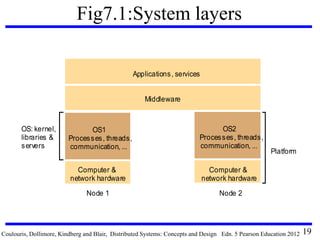
Fig7.1:System layers
Applications, services
Computer &
Platform
Middleware
OS: kernel,
libraries &
servers
network hardware
OS1
Computer &
network hardware
Node 1 Node 2
Processes, threads,
communication, ...
OS2
Processes, threads,
communication, ...
19
Fig7.2:Core OS functionality
Communication
manager
Thread manager Memory manager
Supervisor
Process manager
Fig7.3:Address space
Stack
Text
Heap
Auxiliary
regions
0
2N
20
Fig7.4:Copy-on-write
a) Before write b) After write
Shared
frame
A's page
table
B's page
table
Process A’s address space Process B’s address space
Kernel
RA RB
RB copied
from RA
21
Fig7.5:Client and server with threads
Server
N threads
Input-output
Client
Thread 2 makes
T1
Thread 1
requests to server
generates
results
Requests
Receipt &
queuing
22
Fig7.6:Alternative server threading
architectures (see also Fig7.5)
a. Thread-per-request b. Thread-per-connection c. Thread-per-object
remote
workers
I/O remoteremote I/O
per-connection threads per-objectthreads
objects objects objects
23
Fig7.7:State associated with execution
environments and threads
Execution environment Thread
Address space tables Saved processor registers
Communication interfaces, open files Priority and execution state (such as
BLOCKED)
Semaphores, other synchronization
objects
Software interrupt handling information
List of thread identifiers Execution environment identifier
Pages of address space resident in memory; hardware cache entries
24
Fig7.8:Java thread constructor and
management methods
Thread(ThreadGroup group, Runnable target, String name)
Creates a new thread in the SUSPENDED state, which will belong to group and be
identified as name; the thread will execute the run() method of target.
setPriority(int newPriority), getPriority()
Set and return the thread’s priority.
run()
A thread executes the run() method of its target object, if it has one, and otherwise its
own run() method (Thread implements Runnable).
start()
Change the state of the thread from SUSPENDED to RUNNABLE.
sleep(int millisecs)
Cause the thread to enter the SUSPENDED state for the specified time.
yield()
Causes the thread to enter the READY state and invoke the scheduler.
destroy()
Destroy the thread.
25
Fig7.9:Java thread synchronization calls
thread.join(int millisecs)
Blocks the calling thread for up to the specified time until thread has
terminated.
thread.interrupt()
Interrupts thread: causes it to return from a blocking method call such as
sleep().
object.wait(long millisecs, int nanosecs)
Blocks the calling thread until a call made to notify() or notifyAll() on object
wakes the thread, or the thread is interrupted, or the specified time has
elapsed.
object.notify(), object.notifyAll()
Wakes, respectively, one or all of any threads that have called wait() on object.
26
27
Resource Management in
Distributed Systems
28
Introduction
Distributed systems contain a set of resources
interconnected by a network
Processes are migrated to fulfill their resource
requirements
Resource manager are to control the
assignment of resources to processes
Resources can be logical (shared file) or
physical (CPU)
We consider a resource to be a processor
29
Types of process scheduling techniques
Task assignment approach
User processes are collections of related tasks
Tasks are scheduled to improve performance
Load-balancing approach
Tasks are distributed among nodes so as to
equalize the workload of nodes of the system
Load-sharing approach
Simply attempts to avoid idle nodes while
processes wait for being processed
30
Desirable features of a scheduling algorithm
No A Priori Knowledge about Processes
User does not want to specify information about characteristic and
requirements
Dynamic in nature
Decision should be based on the changing load of nodes and not on
fixed static policy
Quick decision-making capability
Algorithm must make quick decision about the assignment of task
to nodes of system
Balanced system performance and scheduling overhead
Great amount of information gives more intelligent decision, but
increases overhead
31
Desirable features of a scheduling algorithm
 Stability
Unstable when all processes are migrating without accomplishing any
useful work
It occurs when the nodes turn from lightly-loaded to heavily-loaded state
and vice versa
 Scalability
A scheduling algorithm should be capable of handling small as well as
large networks
 Fault tolerance
Should be capable of working after the crash of one or more nodes of the
system
 Fairness of Service
More users initiating equivalent processes expect to receive the same
quality of service
32
Task assignment approach
Main assumptions
Processes have been split into tasks
Computation requirement of tasks and speed of
processors are known
Cost of processing tasks on nodes are known
Communication cost between every pair of tasks are
known
Resource requirements and available resources on
node are known
Reassignment of tasks are not possible
33
Task assignment approach
Basic idea: Finding an optimal
assignment to achieve goals such as the
following:
Minimization of IPC costs
Quick turnaround time of process
High degree of parallelism
Efficient utilization of resources
34
A Taxonomy of Load-Balancing Algorithms
Load-balancing approach
Load-balancing algorithms
DynamicStatic
Deterministic Probabilistic Centralized Distributed
Cooperative Noncooperative
35
Load-balancing approach
Type of load-balancing algorithms
Static versus Dynamic
Static algorithms use only information about the
average behavior of the system
Static algorithms ignore the current state or load of
the nodes in the system
Dynamic algorithms collect state information and
react to system state if it changed
Static algorithms are much more simpler
Dynamic algorithms are able to give significantly
better performance
36
Load-balancing approach
Type of static load-balancing algorithms
Deterministic versus Probabilistic
Deterministic algorithms use the information about the
properties of the nodes and the characteristic of
processes to be scheduled
Probabilistic algorithms use information of static
attributes of the system (e.g. number of nodes,
processing capability, topology) to formulate simple
process placement rules
Deterministic approach is difficult to optimize
Probabilistic approach has poor performance
37
Load-balancing approach
Type of dynamic load-balancing algorithms
Centralized versus Distributed
Centralized approach collects information to server
node and makes assignment decision
Distributed approach contains entities to make
decisions on a predefined set of nodes
Centralized algorithms can make efficient decisions,
have lower fault-tolerance
Distributed algorithms avoid the bottleneck of
collecting state information and react faster
38
Load-balancing approach
Type of distributed load-balancing algorithms
Cooperative versus Noncooperative
In Noncooperative algorithms entities act as
autonomous ones and make scheduling decisions
independently from other entities
In Cooperative algorithms distributed entities
cooperatewith each other
Cooperative algorithms are more complex and
involve larger overhead
Stability of Cooperative algorithms are better
39
Issues in designing Load-balancing
algorithms
 Load estimation policy
 determines how to estimate the workload of a node
 Process transfer policy
 determines whether to execute a process locally or remote
 State information exchange policy
 determines how to exchange load information among nodes
 Location policy
 determines to which node the transferable process should be sent
 Priority assignment policy
 determines the priority of execution of local and remote processes
 Migration limiting policy
 determines the total number of times a process can migrate
40
Load estimation policy I.
for Load-balancing algorithms
To balance the workload on all the nodes of the system,
it is necessary to decide how to measure the workload
of a particular node
Some measurable parameters (with time and node
dependent factor) can be the following:
Total number of processes on the node
Resource demands of these processes
Instruction mixes of these processes
Architecture and speed of the node’s processor
Several load-balancing algorithms use the total number
of processes to achieve big efficiency
41
Load estimation policy II.
for Load-balancing algorithms
In some cases the true load could vary widely
depending on the remaining service time, which can
be measured in several way:
Memoryless method assumes that all processes have the
same expected remaining service time, independent of the
time used so far
Pastrepeats assumes that the remaining service time is
equal to the time used so far
Distribution method states that if the distribution service
times is known, the associated process’s remaining service
time is the expected remaining time conditioned by the
time already used
42
Load estimation policy III.
for Load-balancing algorithms
None of the previous methods can be used in modern
systems because of periodically running processes
and daemons
An acceptable method for use as the load estimation
policy in these systems would be to measure the CPU
utilization of the nodes
Central Processing Unit utilization is defined as the
number of CPU cycles actually executed per unit of
real time
It can be measured by setting up a timer to
periodically check the CPU state (idle/busy)
43
Process transfer policy I.
for Load-balancing algorithms
Most of the algorithms use the threshold policy to decide on
whether the node is lightly-loaded or heavily-loaded
Threshold value is a limiting value of the workload of node
which can be determined by
Static policy: predefined threshold value for each node depending
on processing capability
Dynamic policy: threshold value is calculated from average
workload and a predefined constant
Below threshold value node accepts processes to execute,
above threshold value node tries to transfer processes to a
lightly-loaded node
44
 Single-threshold policy may lead to unstable algorithm because
underloaded node could turn to be overloaded right after a process
migration
 To reduce instability double-threshold policy has been proposed
which is also known as high-low policy
Process transfer policy II.
for Load-balancing algorithms
Overloaded
Underloaded
Threshold
Single-threshold policy
Overloaded
Normal
Underloaded
Low mark
High mark
Double-threshold policy
45
Process transfer policy III.
for Load-balancing algorithms
Double threshold policy
When node is in overloaded region new local
processes are sent to run remotely, requests to accept
remote processes are rejected
When node is in normal region new local processes
run locally, requests to accept remote processes are
rejected
When node is in underloaded region new local
processes run locally, requests to accept remote
processes are accepted
46
Location policy I.
for Load-balancing algorithms
Threshold method
Policy selects a random node, checks whether the node is able
to receive the process, then transfers the process. If node
rejects, another node is selected randomly. This continues until
probe limit is reached.
Shortest method
L distinct nodes are chosen at random, each is polled to
determine its load. The process is transferred to the node having
the minimum value unless its workload value prohibits to
accept the process.
Simple improvement is to discontinue probing whenever a node
with zero load is encountered.
47
Location policy II.
for Load-balancing algorithms
Bidding method
Nodes contain managers (to send processes) and contractors (to
receive processes)
Managers broadcast a request for bid, contractors respond with
bids (prices based on capacity of the contractor node) and
manager selects the best offer
Winning contractor is notified and asked whether it accepts the
process for execution or not
Full autonomy for the nodes regarding scheduling
Big communication overhead
Difficult to decide a good pricing policy
48
Location policy III.
for Load-balancing algorithms
Pairing
Contrary to the former methods the pairing policy is to reduce
the variance of load only between pairs
Each node asks some randomly chosen node to form a pair
with it
If it receives a rejection it randomly selects another node and
tries to pair again
Two nodes that differ greatly in load are temporarily paired
with each other and migration starts
The pair is broken as soon as the migration is over
A node only tries to find a partner if it has at least two
processes
49
State information exchange policy I
for Load-balancing algorithms
Dynamic policies require frequent exchange of state
information, but these extra messages arise two
opposite impacts:
Increasing the number of messages gives more accurate
scheduling decision
Increasing the number of messages raises the queuing time of
messages
State information policies can be the following:
Periodic broadcast
Broadcast when state changes
On-demand exchange
Exchange by polling
50
State information exchange policy II.
for Load-balancing algorithms
Periodic broadcast
Each node broadcasts its state information after the elapse
of every T units of time
Problem: heavy traffic, fruitless messages, poor scalability
since information exchange is too large for networks
having many nodes
Broadcast when state changes
Avoids fruitless messages by broadcasting the state only
when a process arrives or departures
Further improvement is to broadcast only when state
switches to another region (double-threshold policy)
51
State information exchange policy III.
for Load-balancing algorithms
On-demand exchange
In this method a node broadcast a State-Information-Request
message when its state switches from normal to either
underloaded or overloaded region.
On receiving this message other nodes reply with their own
state information to the requesting node
Further improvement can be that only those nodes reply which
are useful to the requesting node
Exchange by polling
To avoid poor scalability (coming from broadcast messages)
the partner node is searched by polling the other nodes on by
one, until poll limit is reached
52
Priority assignment policy
for Load-balancing algorithms
 Selfish
 Local processes are given higher priority than remote processes. Worst
response time performance of the three policies.
 Altruistic
 Remote processes are given higher priority than local processes. Best
response time performance of the three policies.
 Intermediate
 When the number of local processes is greater or equal to the number of
remote processes, local processes are given higher priority than remote
processes. Otherwise, remote processes are given higher priority than local
processes.
53
Migration limiting policy
for Load-balancing algorithms
This policy determines the total number of times a process
can migrate
Uncontrolled
A remote process arriving at a node is treated just as a process originating
at a node, so a process may be migrated any number of times
Controlled
Avoids the instability of the uncontrolled policy
Use a migration count parameter to fix a limit on the number of time a
process can migrate
Irrevocable migration policy: migration count is fixed to 1
For long execution processes migration count must be greater than 1 to
adapt for dynamically changing states
54
Load-sharing approach
 Drawbacks of Load-balancing approach
 Load balancing technique with attempting equalizing the workload on all
the nodes is not an appropriate object since big overhead is generated by
gathering exact state information
 Load balancing is not achievable since number of processes in a node is
always fluctuating and temporal unbalance among the nodes exists every
moment
 Basic ideas for Load-sharing approach
 It is necessary and sufficient to prevent nodes from being idle while some
other nodes have more than two processes
 Load-sharing is much simpler than load-balancing since it only attempts to
ensure that no node is idle when heavily node exists
 Priority assignment policy and migration limiting policy are the same as that
for the load-balancing algorithms
55
Load estimation policies
for Load-sharing algorithms
Since load-sharing algorithms simply attempt to
avoid idle nodes, it is sufficient to know whether a
node is busy or idle
Thus these algorithms normally employ the simplest
load estimation policy of counting the total number of
processes
In modern systems where permanent existence of
several processes on an idle node is possible,
algorithms measure CPU utilization to estimate the
load of a node
56
Process transfer policies
for Load-sharing algorithms
Algorithms normally use all-or-nothing strategy
This strategy uses the threshold value of all the nodes
fixed to 1
Nodes become receiver node when it has no process, and
become sender node when it has more than 1 process
To avoid processing power on nodes having zero process
load-sharing algorithms use a threshold value of 2 instead
of 1
When CPU utilization is used as the load estimation
policy, the double-threshold policy should be used as the
process transfer policy
57
Location policies I.
for Load-sharing algorithms
Location policy decides whether the sender node or
the receiver node of the process takes the initiative to
search for suitable node in the system, and this policy
can be the following:
Sender-initiated location policy
Sender node decides where to send the process
Heavily loaded nodes search for lightly loaded nodes
Receiver-initiated location policy
Receiver node decides from where to get the process
Lightly loaded nodes search for heavily loaded nodes
58
Location policies II.
for Load-sharing algorithms
 Sender-initiated location policy
 Node becomes overloaded, it either broadcasts or randomly probes the other
nodes one by one to find a node that is able to receive remote processes
 When broadcasting, suitable node is known as soon as reply arrives
 Receiver-initiated location policy
 Nodes becomes underloaded, it either broadcast or randomly probes the
other nodes one by one to indicate its willingness to receive remote
processes
 Receiver-initiated policy require preemptive process migration
facility since scheduling decisions are usually made at process
departure epochs
59
Location policies III.
for Load-sharing algorithms
Experiences with location policies
Both policies gives substantial performance advantages
over the situation in which no load-sharing is attempted
Sender-initiated policy is preferable at light to moderate
system loads
Receiver-initiated policy is preferable at high system loads
Sender-initiated policy provide better performance for the
case when process transfer cost significantly more at
receiver-initiated than at sender-initiated policy due to the
preemptive transfer of processes
60
State information exchange policies
for Load-sharing algorithms
 In load-sharing algorithms it is not necessary for the nodes to periodically
exchange state information, but needs to know the state of other nodes
when it is either underloaded or overloaded
 Broadcast when state changes
 In sender-initiated/receiver-initiated location policy a node broadcasts State
Information Request when it becomes overloaded/underloaded
 It is called broadcast-when-idle policy when receiver-initiated policy is used
with fixed threshold value value of 1
 Poll when state changes
 In large networks polling mechanism is used
 Polling mechanism randomly asks different nodes for state information until
find an appropriate one or probe limit is reached
 It is called poll-when-idle policy when receiver-initiated policy is used with
fixed threshold value value of 1
Questions?

CS6601 DISTRIBUTED SYSTEMS

  • 1.
    CS6601 DISTRIBUTED SYSTEMS UNIT– V Dr.A.Kathirvel, Professor, Computer Science and Engg. M N M Jain Engineering College, Chennai
  • 2.
    Unit - V PROCESS& RESOURCE MANAGEMENT Process Management: Process Migration: Features, Mechanism – Threads: Models, Issues, Implementation. Resource Management: Introduction- Features of Scheduling Algorithms –Task Assignment Approach – Load Balancing Approach – Load Sharing Approach. Pradeep K Sinha, “Distributed Operating Systems: Concepts and Design”, Prentice Hall of India, 2007.
  • 3.
    Concept of Process Process:An operating system abstraction representing an instance of a running computer program Consists of data, stack, register contents, and the state specific to the underlying OS Can have one or more threads of control Consists of their own stack and register contents, but share a process’s address space and signals. 3
  • 4.
    Process management Conventional OS:deals with the mechanisms and policies for sharing the processor of the system among all processes Distributed operating system: To make best possible use of the processing resources of the entire system by sharing them among all processes Three concepts to achieve this goal: Processor allocation: Deals with the process of deciding which process should be assigned to which processor Process migration: Deals with the movement of a process from its current location to the processor to which it has been assigned Threads: Deals with fine-grained parallelism for better utilization of the processing capability of the system 4
  • 5.
    Process Migration  ProcessMigration  The act of transferring a process between two machines during its execution  Relocation of a process from its current location (the source node) to another node (the destination node)  Problems with Process Migration  Lack of compelling commercial argument for OS venders to support process migration  Complexity of adding transparent migration  Goals of Process Migration  Dynamic load distribution  Fault resilience  Improved system administration  Data access locality 5
  • 6.
    Process Migration Two types: Preemptiveprocess migration Process may be migrated during the course of its execution Non preemptive process migration Process may be migrated before it starts executing on its source node Involves three steps: Selection of a process that should be migrated Selection of the destination node to which the selected process should be migrated Actual transfer of the selected process to the destination node 6
  • 7.
    Desirable Features  Transparency Object class level  System call and interprocess communication level  Minimal interference  Can be done by minimizing freezing time  Freezing time: a time for which the execution of the process is stopped for transferring its information to the destination node  Minimal residual dependencies  Migrated process should not continue to depend on its previous node once it has started executing on new node  Efficiency  Time required of migrating a process  The cost of locating an object  The cost of supporting remote execution once the process is migrated  Robustness  The failure of a node other than the one on which a process is currently running should not affect the execution of that process  Communication between coprocesses of a job 7
  • 8.
    Process Migration Mechanisms Fourmajor sub activities Freezing and restarting the process Transfer of process’s address space Forwarding messages meant for the migrant process Handling communication between cooperating processes 8
  • 9.
    Process Migration Mechanisms Mechanismsfor freezing and restarting a process Immediate and Delayed blocking of the process may be blocked immediately or delayed if the process is not executing a system call if the process is executing a system call but is sleeping at an interruptible priority waiting for a kernel event to occur, it can be immediately blocked from further execution Do and sleeping at non interruptible priority waiting for a kernel event to occur, it can not be blocked Fast and Slow I/O operation frozen after the completion of all fast I/O operations What about slow I/O operations??? 9
  • 10.
    Process Migration Mechanisms Mechanisms for freezing and restarting a process  Information about the open files No problem for network transparent execution environment What about UNIX like systems??? creation of link Reconstruction of file’s path when required What about frequently used files like commands??? What about temporary files?  Reinstating the process on its destination node Creation of a new process Process identifier What about the process which was blocked while executing a slow system call???? 10
  • 11.
    Process Migration Mechanisms Address Space Transfer Mechanisms  Information to be transferred from source node to destination node:  Process’s state information  Process’s address space  Difference between the size of process’s state information and address space  Possible to transfer the address space without stopping its execution  Not possible to resume execution until the state information is fully transferred  Three methods for address space transfer  Total Freezing  Pretransferring  Transfer on reference 11
  • 12.
    Process Migration Mechanisms TotalFreezing Execution is stopped while its address space is being transferred Process is suspended for a long time during migration Simple and easy to implement Not suitable for interactive process 12 Sourcenode destinationnode made Execution suspended Migration decision Transfer of address space Execution resumed Time Freezing Time
  • 13.
    Process Migration Mechanisms Pretransferring (precopying)  Address space is transferred while the process is still running on the source node  Initial transfer of the complete address space followed by repeated transfers of the pages modified during previous transfer  Remaining modified pages are retransferred after the process is frozen for transferring its state information 13 Sourcenode destinationnode Migrationdecision made Execution suspended Transfer of address space Execution resumed Time Freezing Time freezing time is reduced Pretransfer operation is executed at a higher priority than all other programs on the source node Total time of migration is increased due to the possibility of redundant page transfers
  • 14.
    Process Migration Mechanisms Transfer on reference  Based on the assumption that the process tends to use only a relatively small part of their address space while executing.  A page of the address space is transferred from its source node to destination node only when referenced  Demand driven copy on reference approach 14 Switching time is very short and independent of the size of the address space Not efficient in terms of cost Imposes continued load on process’s source node Results in failure if source node fails or reboots Source node destination node Migration decision made Execution suspended On demand Transfer of address space Execution resumed Time Freezing Time
  • 15.
    Process Migration Mechanisms Message forwarding mechanisms  Ensures that all pending, en-route and future messages arrive at the process’s new location  Classification of the messages to be forwarded  Type 1: Messages received at the source node after the process’s execution has been stopped on its source node and process’s execution has not yet been started on its destination node  Type 2: Message received at the source node after the  process’s execution has started on its destination node  Type 3: Messages that are to be sent to the migrant process from any other node after it has started executing on the destination node  Mechanism of Resending the Message  Messages of type 1 and 2 are returned to the sender as not deliverable or are simply dropped  Locating a process is required upon the receipt of the nonnegative reply (messages of type 3)  Drawback: nontransparent to the processes interacting with the migrant process 15
  • 16.
    Process Migration Mechanisms Message forwarding mechanisms: Origin Site Mechanism  Process identifier has the process’s origin site(or home node) embedded in it  Each site is responsible for keeping information about the current location of all the processes created on it  Messages are sent to the origin site first and from there  they are forwarded to the current location  Drawbacks:1. not good from reliability point of view 2. continuous load on migrant process’s original site  Link Traversal mechanism  Uses message queue for storing messages of type 1  Use of link (a forwarding address) for messages of type 2 and 3  Link has two components: process identifier and last known location of the process  Migrated process is located by traversing a series of links  Drawbacks: 1. poor efficiency 2. poor reliability  Link Update mechanism  Processes communicate via location independent links  During the transfer phase, the source node sends link update message to all relevant kernels 16
  • 17.
    Process Migration Mechanisms Mechanismsfor handling coprocesses  Communication between a process and its subprocesses  Two different mechanisms Disallowing separation of Coprocesses By disallowing the migration of processes that wait for one or more of their children to complete. By ensuring that when a parent process migrates, its children processes will be migrated along with it Concept of logical host Process id is structured as {logical host-id, local-index} pair Drawback :1. Does not allow parallelism within jobs 2. Overhead is large when logical host contains several processes home node or origin site concept Complete freedom of migrating a process or its subprocesses independently and executing them on different nodes Drawback:Message traffic and communication cost is significant 17
  • 18.
    Advantages of processmigration  Reducing average response time of processes  Speeding up individual jobs  Execute tasks of a job concurrently  To migrate a job to a node having faster CPU  Gaining higher throughput  Using suitable load balancing policy  Utilizing resources effectively  Depending on the nature of the process, it can be migrated to the most suitable node  Reducing network traffic  Migrate the process closer to the resources it is using most heavily  To migrate and cluster two or more processes which frequently communicate with each other, on the same node  improving system reliability  Migrating critical process to more reliable node  Improving system security  A sensitive process may be migrated and run on the secure node 18
  • 19.
    Coulouris, Dollimore, Kindbergand Blair, Distributed Systems: Concepts and Design Edn. 5 Pearson Education 2012 Fig7.1:System layers Applications, services Computer & Platform Middleware OS: kernel, libraries & servers network hardware OS1 Computer & network hardware Node 1 Node 2 Processes, threads, communication, ... OS2 Processes, threads, communication, ... 19
  • 20.
    Fig7.2:Core OS functionality Communication manager Threadmanager Memory manager Supervisor Process manager Fig7.3:Address space Stack Text Heap Auxiliary regions 0 2N 20
  • 21.
    Fig7.4:Copy-on-write a) Before writeb) After write Shared frame A's page table B's page table Process A’s address space Process B’s address space Kernel RA RB RB copied from RA 21
  • 22.
    Fig7.5:Client and serverwith threads Server N threads Input-output Client Thread 2 makes T1 Thread 1 requests to server generates results Requests Receipt & queuing 22
  • 23.
    Fig7.6:Alternative server threading architectures(see also Fig7.5) a. Thread-per-request b. Thread-per-connection c. Thread-per-object remote workers I/O remoteremote I/O per-connection threads per-objectthreads objects objects objects 23
  • 24.
    Fig7.7:State associated withexecution environments and threads Execution environment Thread Address space tables Saved processor registers Communication interfaces, open files Priority and execution state (such as BLOCKED) Semaphores, other synchronization objects Software interrupt handling information List of thread identifiers Execution environment identifier Pages of address space resident in memory; hardware cache entries 24
  • 25.
    Fig7.8:Java thread constructorand management methods Thread(ThreadGroup group, Runnable target, String name) Creates a new thread in the SUSPENDED state, which will belong to group and be identified as name; the thread will execute the run() method of target. setPriority(int newPriority), getPriority() Set and return the thread’s priority. run() A thread executes the run() method of its target object, if it has one, and otherwise its own run() method (Thread implements Runnable). start() Change the state of the thread from SUSPENDED to RUNNABLE. sleep(int millisecs) Cause the thread to enter the SUSPENDED state for the specified time. yield() Causes the thread to enter the READY state and invoke the scheduler. destroy() Destroy the thread. 25
  • 26.
    Fig7.9:Java thread synchronizationcalls thread.join(int millisecs) Blocks the calling thread for up to the specified time until thread has terminated. thread.interrupt() Interrupts thread: causes it to return from a blocking method call such as sleep(). object.wait(long millisecs, int nanosecs) Blocks the calling thread until a call made to notify() or notifyAll() on object wakes the thread, or the thread is interrupted, or the specified time has elapsed. object.notify(), object.notifyAll() Wakes, respectively, one or all of any threads that have called wait() on object. 26
  • 27.
  • 28.
    28 Introduction Distributed systems containa set of resources interconnected by a network Processes are migrated to fulfill their resource requirements Resource manager are to control the assignment of resources to processes Resources can be logical (shared file) or physical (CPU) We consider a resource to be a processor
  • 29.
    29 Types of processscheduling techniques Task assignment approach User processes are collections of related tasks Tasks are scheduled to improve performance Load-balancing approach Tasks are distributed among nodes so as to equalize the workload of nodes of the system Load-sharing approach Simply attempts to avoid idle nodes while processes wait for being processed
  • 30.
    30 Desirable features ofa scheduling algorithm No A Priori Knowledge about Processes User does not want to specify information about characteristic and requirements Dynamic in nature Decision should be based on the changing load of nodes and not on fixed static policy Quick decision-making capability Algorithm must make quick decision about the assignment of task to nodes of system Balanced system performance and scheduling overhead Great amount of information gives more intelligent decision, but increases overhead
  • 31.
    31 Desirable features ofa scheduling algorithm  Stability Unstable when all processes are migrating without accomplishing any useful work It occurs when the nodes turn from lightly-loaded to heavily-loaded state and vice versa  Scalability A scheduling algorithm should be capable of handling small as well as large networks  Fault tolerance Should be capable of working after the crash of one or more nodes of the system  Fairness of Service More users initiating equivalent processes expect to receive the same quality of service
  • 32.
    32 Task assignment approach Mainassumptions Processes have been split into tasks Computation requirement of tasks and speed of processors are known Cost of processing tasks on nodes are known Communication cost between every pair of tasks are known Resource requirements and available resources on node are known Reassignment of tasks are not possible
  • 33.
    33 Task assignment approach Basicidea: Finding an optimal assignment to achieve goals such as the following: Minimization of IPC costs Quick turnaround time of process High degree of parallelism Efficient utilization of resources
  • 34.
    34 A Taxonomy ofLoad-Balancing Algorithms Load-balancing approach Load-balancing algorithms DynamicStatic Deterministic Probabilistic Centralized Distributed Cooperative Noncooperative
  • 35.
    35 Load-balancing approach Type ofload-balancing algorithms Static versus Dynamic Static algorithms use only information about the average behavior of the system Static algorithms ignore the current state or load of the nodes in the system Dynamic algorithms collect state information and react to system state if it changed Static algorithms are much more simpler Dynamic algorithms are able to give significantly better performance
  • 36.
    36 Load-balancing approach Type ofstatic load-balancing algorithms Deterministic versus Probabilistic Deterministic algorithms use the information about the properties of the nodes and the characteristic of processes to be scheduled Probabilistic algorithms use information of static attributes of the system (e.g. number of nodes, processing capability, topology) to formulate simple process placement rules Deterministic approach is difficult to optimize Probabilistic approach has poor performance
  • 37.
    37 Load-balancing approach Type ofdynamic load-balancing algorithms Centralized versus Distributed Centralized approach collects information to server node and makes assignment decision Distributed approach contains entities to make decisions on a predefined set of nodes Centralized algorithms can make efficient decisions, have lower fault-tolerance Distributed algorithms avoid the bottleneck of collecting state information and react faster
  • 38.
    38 Load-balancing approach Type ofdistributed load-balancing algorithms Cooperative versus Noncooperative In Noncooperative algorithms entities act as autonomous ones and make scheduling decisions independently from other entities In Cooperative algorithms distributed entities cooperatewith each other Cooperative algorithms are more complex and involve larger overhead Stability of Cooperative algorithms are better
  • 39.
    39 Issues in designingLoad-balancing algorithms  Load estimation policy  determines how to estimate the workload of a node  Process transfer policy  determines whether to execute a process locally or remote  State information exchange policy  determines how to exchange load information among nodes  Location policy  determines to which node the transferable process should be sent  Priority assignment policy  determines the priority of execution of local and remote processes  Migration limiting policy  determines the total number of times a process can migrate
  • 40.
    40 Load estimation policyI. for Load-balancing algorithms To balance the workload on all the nodes of the system, it is necessary to decide how to measure the workload of a particular node Some measurable parameters (with time and node dependent factor) can be the following: Total number of processes on the node Resource demands of these processes Instruction mixes of these processes Architecture and speed of the node’s processor Several load-balancing algorithms use the total number of processes to achieve big efficiency
  • 41.
    41 Load estimation policyII. for Load-balancing algorithms In some cases the true load could vary widely depending on the remaining service time, which can be measured in several way: Memoryless method assumes that all processes have the same expected remaining service time, independent of the time used so far Pastrepeats assumes that the remaining service time is equal to the time used so far Distribution method states that if the distribution service times is known, the associated process’s remaining service time is the expected remaining time conditioned by the time already used
  • 42.
    42 Load estimation policyIII. for Load-balancing algorithms None of the previous methods can be used in modern systems because of periodically running processes and daemons An acceptable method for use as the load estimation policy in these systems would be to measure the CPU utilization of the nodes Central Processing Unit utilization is defined as the number of CPU cycles actually executed per unit of real time It can be measured by setting up a timer to periodically check the CPU state (idle/busy)
  • 43.
    43 Process transfer policyI. for Load-balancing algorithms Most of the algorithms use the threshold policy to decide on whether the node is lightly-loaded or heavily-loaded Threshold value is a limiting value of the workload of node which can be determined by Static policy: predefined threshold value for each node depending on processing capability Dynamic policy: threshold value is calculated from average workload and a predefined constant Below threshold value node accepts processes to execute, above threshold value node tries to transfer processes to a lightly-loaded node
  • 44.
    44  Single-threshold policymay lead to unstable algorithm because underloaded node could turn to be overloaded right after a process migration  To reduce instability double-threshold policy has been proposed which is also known as high-low policy Process transfer policy II. for Load-balancing algorithms Overloaded Underloaded Threshold Single-threshold policy Overloaded Normal Underloaded Low mark High mark Double-threshold policy
  • 45.
    45 Process transfer policyIII. for Load-balancing algorithms Double threshold policy When node is in overloaded region new local processes are sent to run remotely, requests to accept remote processes are rejected When node is in normal region new local processes run locally, requests to accept remote processes are rejected When node is in underloaded region new local processes run locally, requests to accept remote processes are accepted
  • 46.
    46 Location policy I. forLoad-balancing algorithms Threshold method Policy selects a random node, checks whether the node is able to receive the process, then transfers the process. If node rejects, another node is selected randomly. This continues until probe limit is reached. Shortest method L distinct nodes are chosen at random, each is polled to determine its load. The process is transferred to the node having the minimum value unless its workload value prohibits to accept the process. Simple improvement is to discontinue probing whenever a node with zero load is encountered.
  • 47.
    47 Location policy II. forLoad-balancing algorithms Bidding method Nodes contain managers (to send processes) and contractors (to receive processes) Managers broadcast a request for bid, contractors respond with bids (prices based on capacity of the contractor node) and manager selects the best offer Winning contractor is notified and asked whether it accepts the process for execution or not Full autonomy for the nodes regarding scheduling Big communication overhead Difficult to decide a good pricing policy
  • 48.
    48 Location policy III. forLoad-balancing algorithms Pairing Contrary to the former methods the pairing policy is to reduce the variance of load only between pairs Each node asks some randomly chosen node to form a pair with it If it receives a rejection it randomly selects another node and tries to pair again Two nodes that differ greatly in load are temporarily paired with each other and migration starts The pair is broken as soon as the migration is over A node only tries to find a partner if it has at least two processes
  • 49.
    49 State information exchangepolicy I for Load-balancing algorithms Dynamic policies require frequent exchange of state information, but these extra messages arise two opposite impacts: Increasing the number of messages gives more accurate scheduling decision Increasing the number of messages raises the queuing time of messages State information policies can be the following: Periodic broadcast Broadcast when state changes On-demand exchange Exchange by polling
  • 50.
    50 State information exchangepolicy II. for Load-balancing algorithms Periodic broadcast Each node broadcasts its state information after the elapse of every T units of time Problem: heavy traffic, fruitless messages, poor scalability since information exchange is too large for networks having many nodes Broadcast when state changes Avoids fruitless messages by broadcasting the state only when a process arrives or departures Further improvement is to broadcast only when state switches to another region (double-threshold policy)
  • 51.
    51 State information exchangepolicy III. for Load-balancing algorithms On-demand exchange In this method a node broadcast a State-Information-Request message when its state switches from normal to either underloaded or overloaded region. On receiving this message other nodes reply with their own state information to the requesting node Further improvement can be that only those nodes reply which are useful to the requesting node Exchange by polling To avoid poor scalability (coming from broadcast messages) the partner node is searched by polling the other nodes on by one, until poll limit is reached
  • 52.
    52 Priority assignment policy forLoad-balancing algorithms  Selfish  Local processes are given higher priority than remote processes. Worst response time performance of the three policies.  Altruistic  Remote processes are given higher priority than local processes. Best response time performance of the three policies.  Intermediate  When the number of local processes is greater or equal to the number of remote processes, local processes are given higher priority than remote processes. Otherwise, remote processes are given higher priority than local processes.
  • 53.
    53 Migration limiting policy forLoad-balancing algorithms This policy determines the total number of times a process can migrate Uncontrolled A remote process arriving at a node is treated just as a process originating at a node, so a process may be migrated any number of times Controlled Avoids the instability of the uncontrolled policy Use a migration count parameter to fix a limit on the number of time a process can migrate Irrevocable migration policy: migration count is fixed to 1 For long execution processes migration count must be greater than 1 to adapt for dynamically changing states
  • 54.
    54 Load-sharing approach  Drawbacksof Load-balancing approach  Load balancing technique with attempting equalizing the workload on all the nodes is not an appropriate object since big overhead is generated by gathering exact state information  Load balancing is not achievable since number of processes in a node is always fluctuating and temporal unbalance among the nodes exists every moment  Basic ideas for Load-sharing approach  It is necessary and sufficient to prevent nodes from being idle while some other nodes have more than two processes  Load-sharing is much simpler than load-balancing since it only attempts to ensure that no node is idle when heavily node exists  Priority assignment policy and migration limiting policy are the same as that for the load-balancing algorithms
  • 55.
    55 Load estimation policies forLoad-sharing algorithms Since load-sharing algorithms simply attempt to avoid idle nodes, it is sufficient to know whether a node is busy or idle Thus these algorithms normally employ the simplest load estimation policy of counting the total number of processes In modern systems where permanent existence of several processes on an idle node is possible, algorithms measure CPU utilization to estimate the load of a node
  • 56.
    56 Process transfer policies forLoad-sharing algorithms Algorithms normally use all-or-nothing strategy This strategy uses the threshold value of all the nodes fixed to 1 Nodes become receiver node when it has no process, and become sender node when it has more than 1 process To avoid processing power on nodes having zero process load-sharing algorithms use a threshold value of 2 instead of 1 When CPU utilization is used as the load estimation policy, the double-threshold policy should be used as the process transfer policy
  • 57.
    57 Location policies I. forLoad-sharing algorithms Location policy decides whether the sender node or the receiver node of the process takes the initiative to search for suitable node in the system, and this policy can be the following: Sender-initiated location policy Sender node decides where to send the process Heavily loaded nodes search for lightly loaded nodes Receiver-initiated location policy Receiver node decides from where to get the process Lightly loaded nodes search for heavily loaded nodes
  • 58.
    58 Location policies II. forLoad-sharing algorithms  Sender-initiated location policy  Node becomes overloaded, it either broadcasts or randomly probes the other nodes one by one to find a node that is able to receive remote processes  When broadcasting, suitable node is known as soon as reply arrives  Receiver-initiated location policy  Nodes becomes underloaded, it either broadcast or randomly probes the other nodes one by one to indicate its willingness to receive remote processes  Receiver-initiated policy require preemptive process migration facility since scheduling decisions are usually made at process departure epochs
  • 59.
    59 Location policies III. forLoad-sharing algorithms Experiences with location policies Both policies gives substantial performance advantages over the situation in which no load-sharing is attempted Sender-initiated policy is preferable at light to moderate system loads Receiver-initiated policy is preferable at high system loads Sender-initiated policy provide better performance for the case when process transfer cost significantly more at receiver-initiated than at sender-initiated policy due to the preemptive transfer of processes
  • 60.
    60 State information exchangepolicies for Load-sharing algorithms  In load-sharing algorithms it is not necessary for the nodes to periodically exchange state information, but needs to know the state of other nodes when it is either underloaded or overloaded  Broadcast when state changes  In sender-initiated/receiver-initiated location policy a node broadcasts State Information Request when it becomes overloaded/underloaded  It is called broadcast-when-idle policy when receiver-initiated policy is used with fixed threshold value value of 1  Poll when state changes  In large networks polling mechanism is used  Polling mechanism randomly asks different nodes for state information until find an appropriate one or probe limit is reached  It is called poll-when-idle policy when receiver-initiated policy is used with fixed threshold value value of 1
  • 61.