Operating Systems: SEng 3207
Chapter Two
Process Synchronization
ASTU
Department of CSE
January 4, 2023 1
Operating Systems
Lecture 5: Introduction to Process Synchronization
Content
• Background
• The Critical-Section Problem
• Two process solutions
• Peterson’s Solution
• Synchronization Hardware
• Mutex Locks
• Semaphores
• Classic Problems of Synchronization
• Monitors
• Synchronization Examples
• Alternative Approaches
Background
 The cooperating processes in an operating system can execute concurrently, they
can be interrupted at any time during their execution, or they may be partially
executed.
 During interleaved execution process may communicate to each other in terms of
shared data or a shared location in memory.
 Also processes may need to share the access of a resource such as a files, tables
etc.
 In both cases, the concurrent access of the shared resource may result in
inconsistency in data unless the operation of read/ write to the shared resources
are not managed centrally and ordered properly.
 In process synchronization we will study the consequences of shared access of
resources and how to coordinate these access using some kind of operating
system level synchronization protocols.
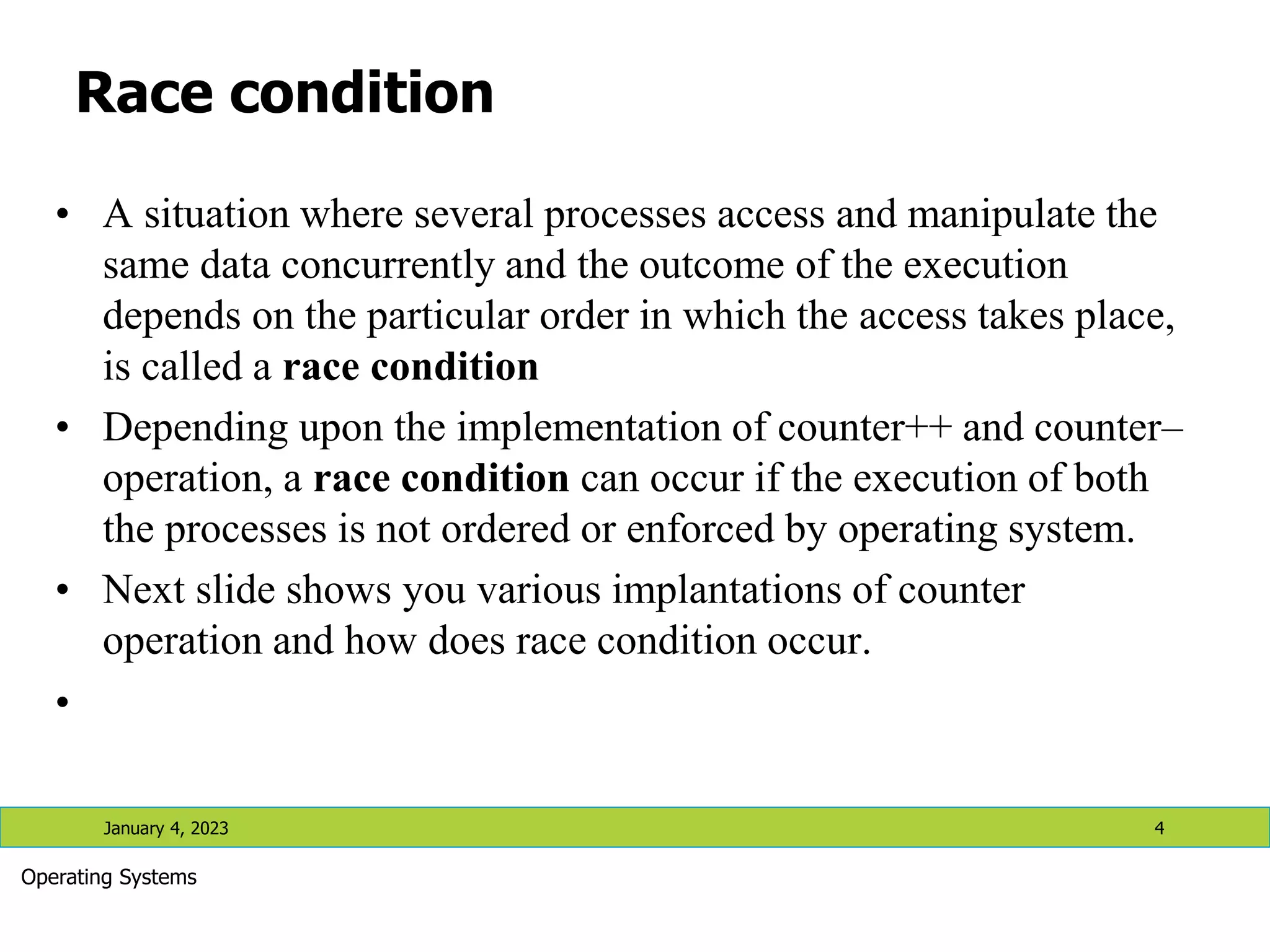
Race condition
• A situation where several processes access and manipulate the
same data concurrently and the outcome of the execution
depends on the particular order in which the access takes place,
is called a race condition
• Depending upon the implementation of counter++ and counter–
operation, a race condition can occur if the execution of both
the processes is not ordered or enforced by operating system.
• Next slide shows you various implantations of counter
operation and how does race condition occur.
•
January 4, 2023 4
Operating Systems
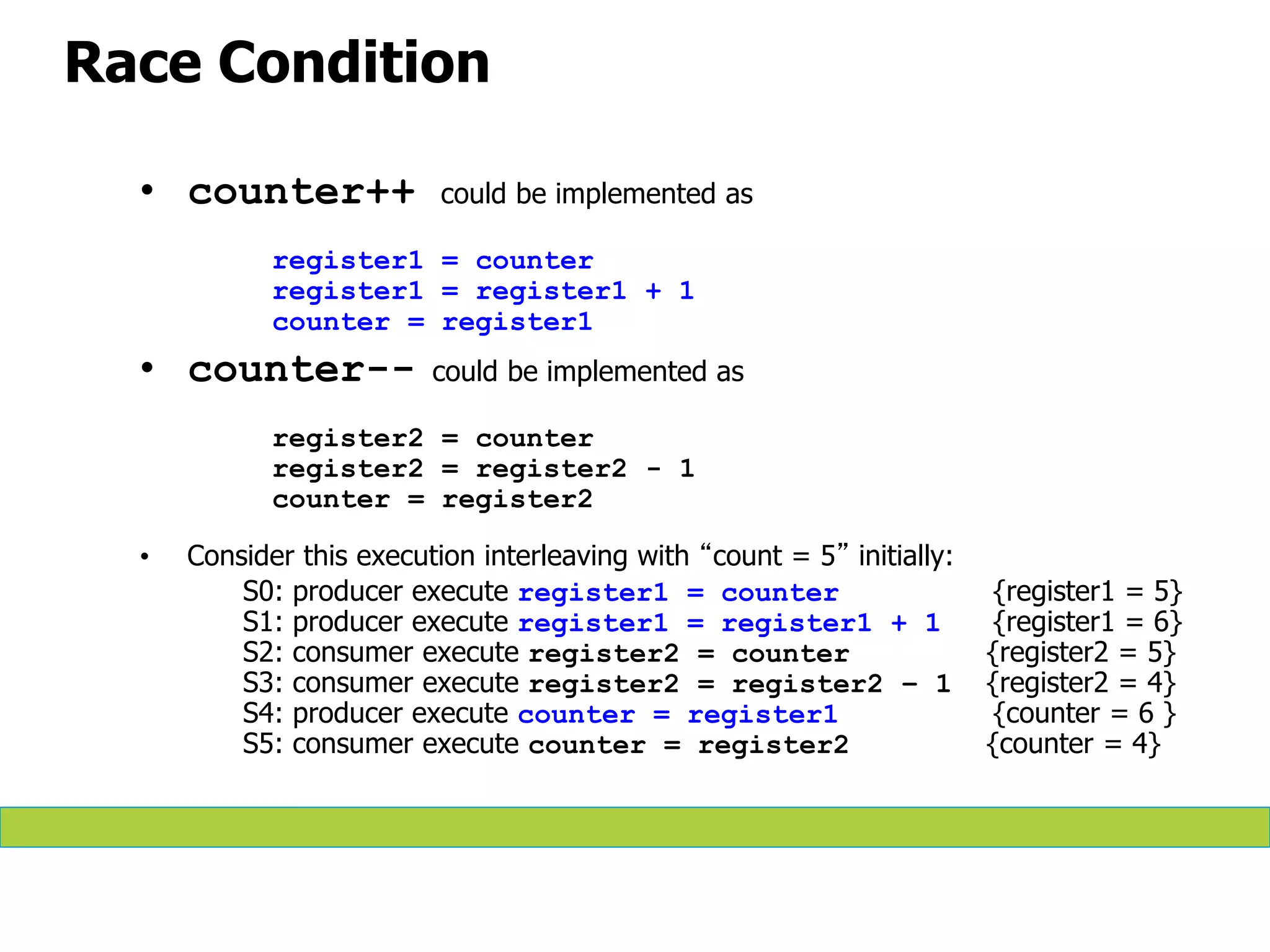
Race Condition
• counter++ could be implemented as
register1 = counter
register1 = register1 + 1
counter = register1
• counter-- could be implemented as
register2 = counter
register2 = register2 - 1
counter = register2
• Consider this execution interleaving with “count = 5” initially:
S0: producer execute register1 = counter {register1 = 5}
S1: producer execute register1 = register1 + 1 {register1 = 6}
S2: consumer execute register2 = counter {register2 = 5}
S3: consumer execute register2 = register2 – 1 {register2 = 4}
S4: producer execute counter = register1 {counter = 6 }
S5: consumer execute counter = register2 {counter = 4}
Critical Section problem
• Inconsistency in the state of data, files or tables being
accessed by the multiple process at the same time can be
attributed to a specific section of code which we call as
critical section.
• Critical section is that part of code executing which in
concurrent fashion, two process may come in the state of
confusion or inconsistency.
• Critical section problem is how to allow to enter and to
execute critical section code to different cooperating
processes, so that they are able to execute this code in
synchronized fashion, as well as they maintain the
consistency
January 4, 2023 6
Operating Systems
Solution to critical section problem
• In general only one process should be allowed to execute the
critical section code.
• Operating system shall enforce a protocol that every
participating process should follow in order to enter and exit
from the critical section.
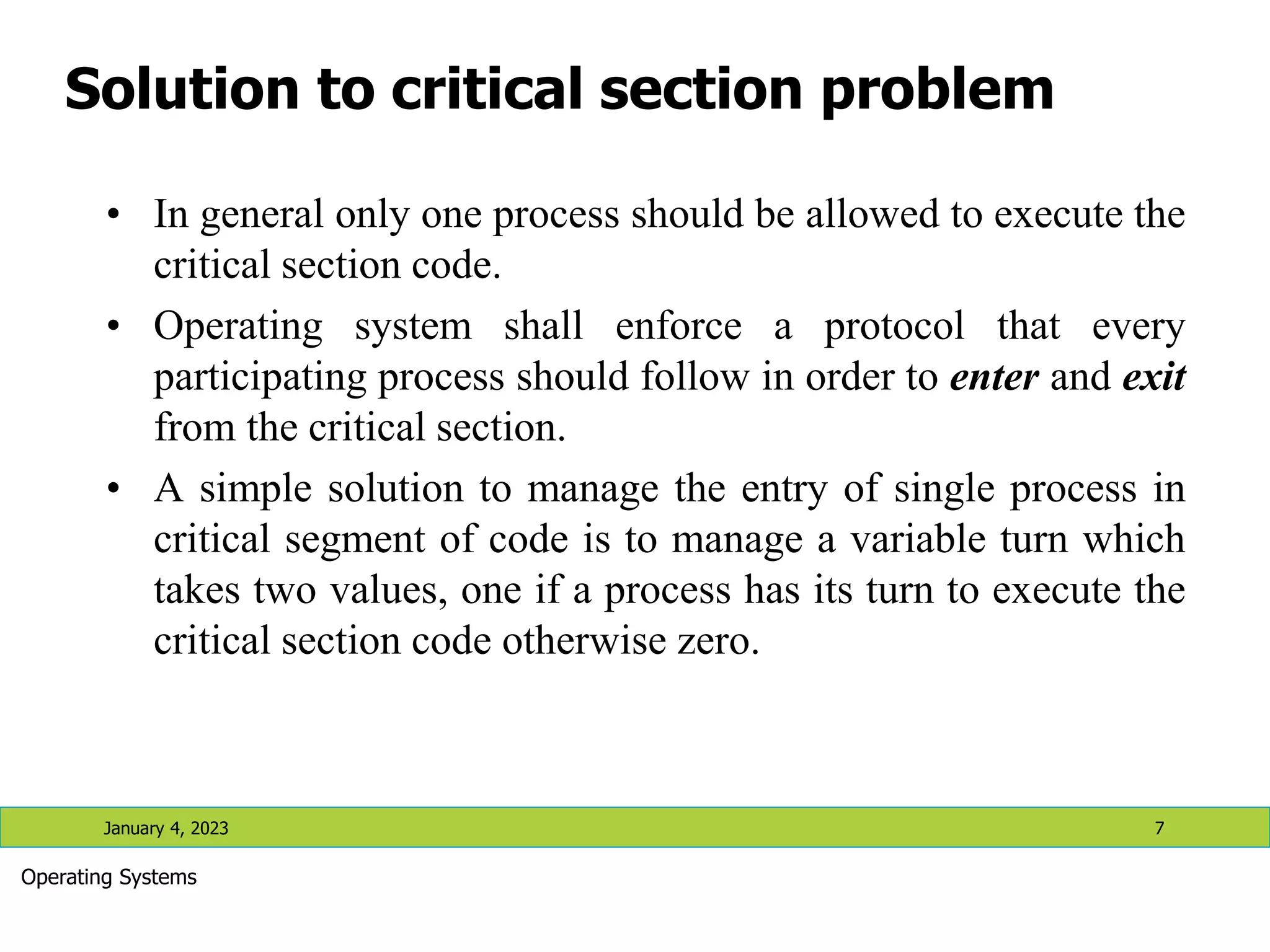
• A simple solution to manage the entry of single process in
critical segment of code is to manage a variable turn which
takes two values, one if a process has its turn to execute the
critical section code otherwise zero.
January 4, 2023 7
Operating Systems
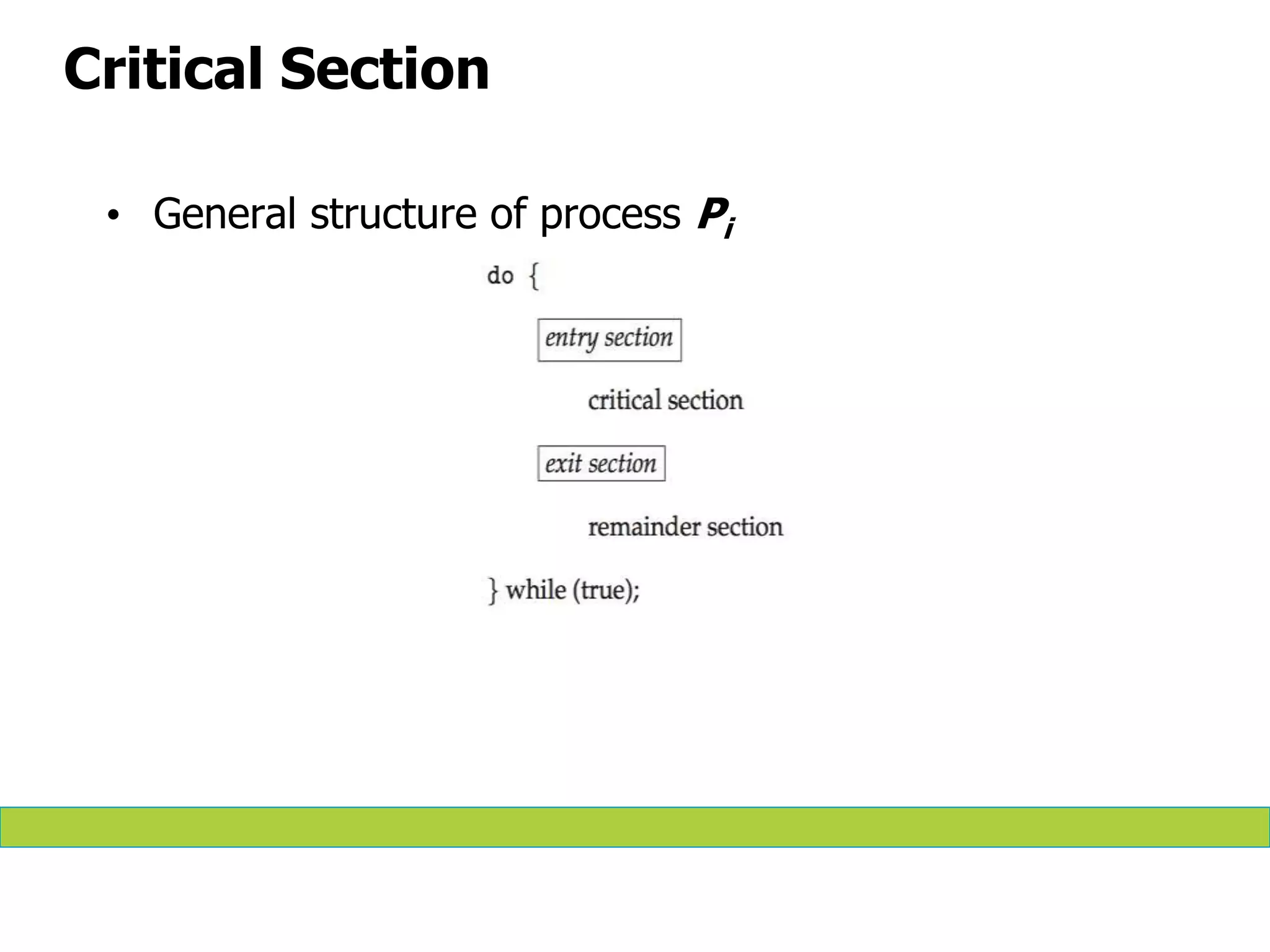
Critical Section
• General structure of process Pi
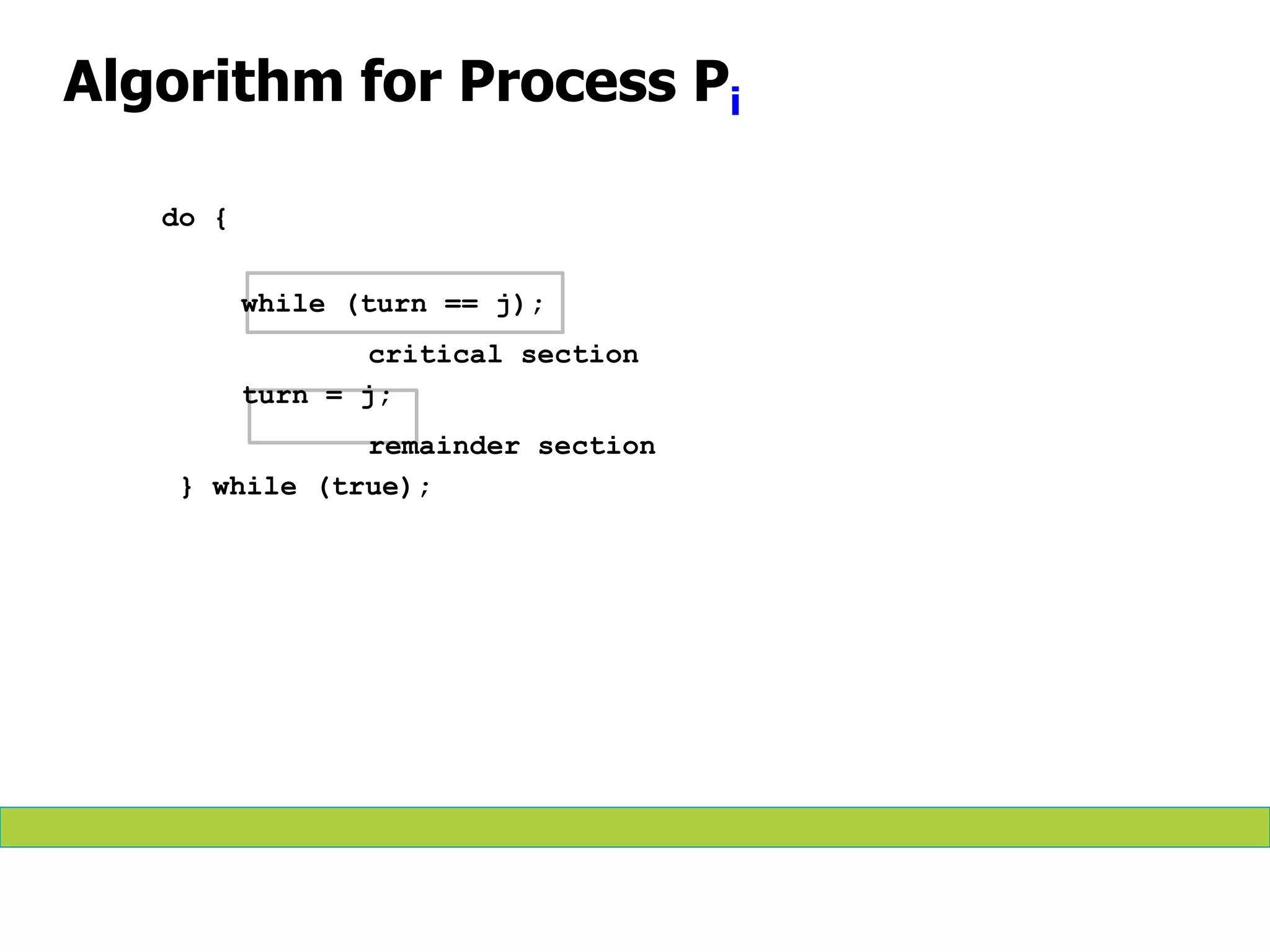
Algorithm for Process Pi
do {
while (turn == j);
critical section
turn = j;
remainder section
} while (true);
Properties of a valid Solution to Critical-Section
Problem
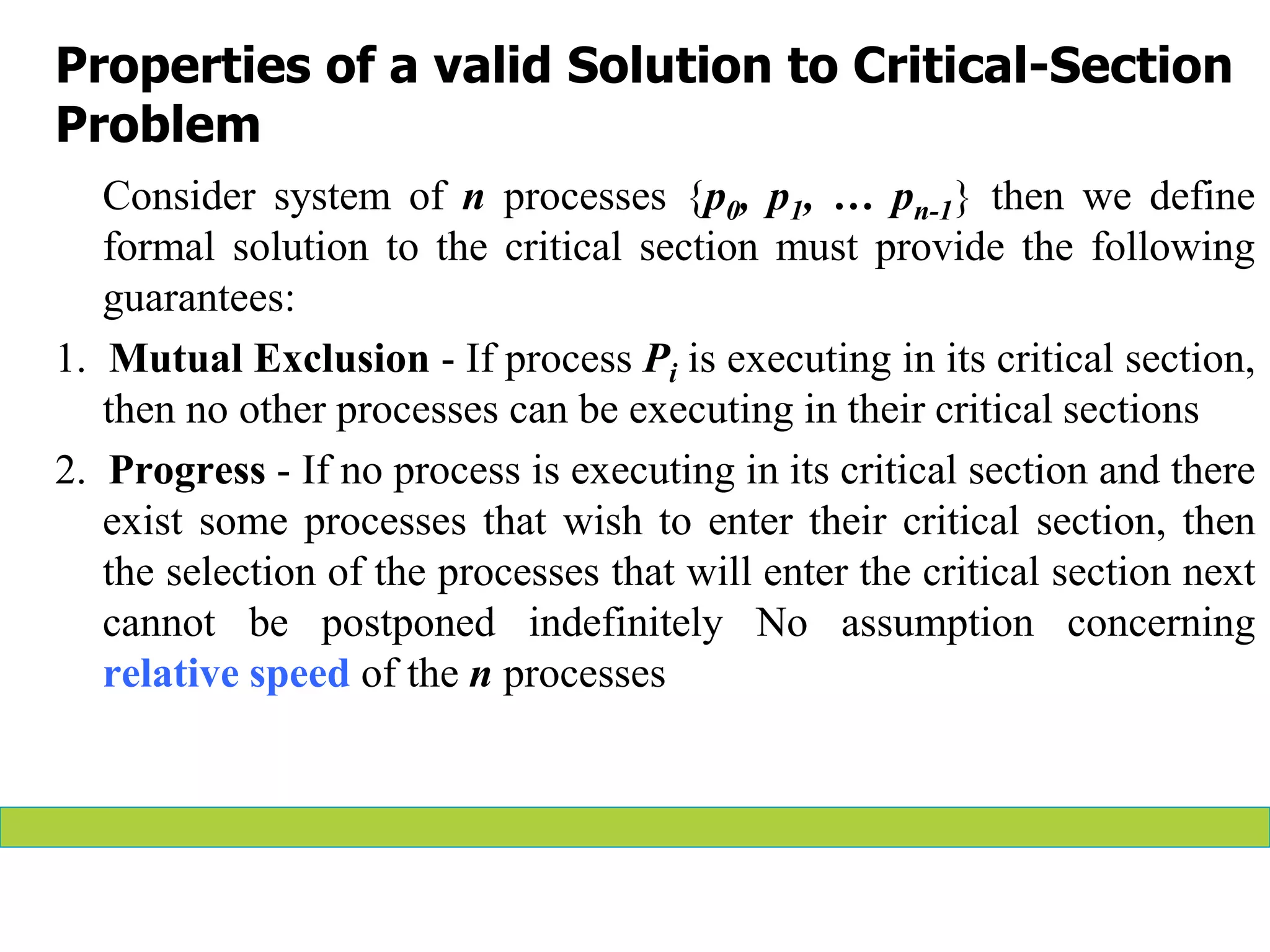
Consider system of n processes {p0, p1, … pn-1} then we define
formal solution to the critical section must provide the following
guarantees:
1. Mutual Exclusion - If process Pi is executing in its critical section,
then no other processes can be executing in their critical sections
2. Progress - If no process is executing in its critical section and there
exist some processes that wish to enter their critical section, then
the selection of the processes that will enter the critical section next
cannot be postponed indefinitely No assumption concerning
relative speed of the n processes
Critical-Section Handling in OS
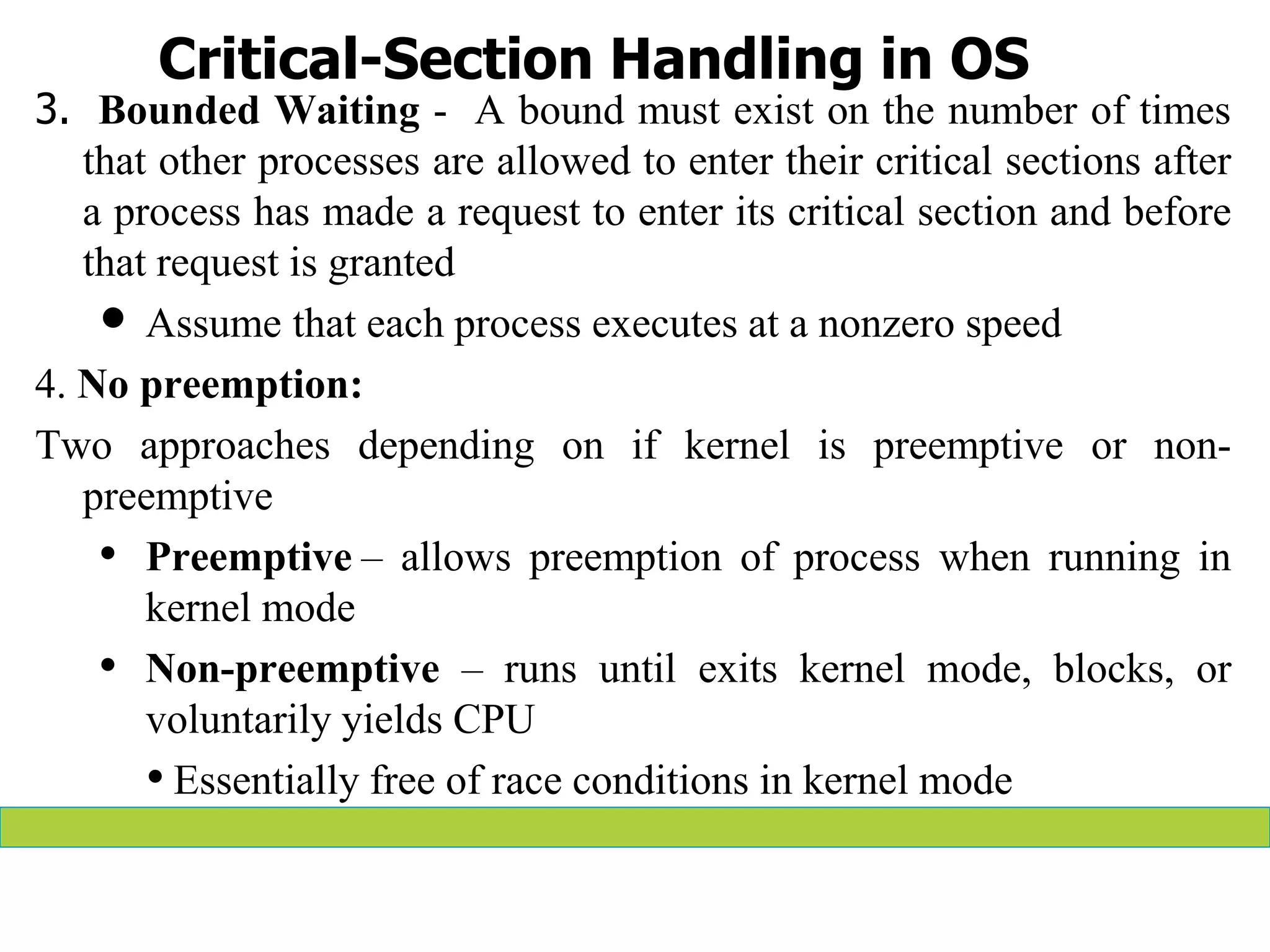
3. Bounded Waiting - A bound must exist on the number of times
that other processes are allowed to enter their critical sections after
a process has made a request to enter its critical section and before
that request is granted
 Assume that each process executes at a nonzero speed
4. No preemption:
Two approaches depending on if kernel is preemptive or non-
preemptive
• Preemptive – allows preemption of process when running in
kernel mode
• Non-preemptive – runs until exits kernel mode, blocks, or
voluntarily yields CPU
• Essentially free of race conditions in kernel mode
Peterson’s Solution
This solution provide an algorithmic description of solving the
problem of critical section, this is a two process solution.
• Assume that the load and store machine-language instructions
are atomic; that is, cannot be interrupted
• The two processes share two variables:
• int turn;
• Boolean flag[2]
• The variable turn indicates whose turn it is to enter the critical
section
• The flag array is used to indicate if a process is ready to enter
the critical section. flag[i] = true implies that process Pi is ready!
Algorithm
• To enter the critical section, process Pi first sets flag[i] to be true
and then sets turn to the value j, thereby asserting that if the
other process wishes to enter the critical section, it can do so.
• If both processes try to enter at the same time, turn will be set to
both i and j at roughly the same time. Only one of these
assignments will last; the other will occur but will be overwritten
immediately.
• The eventual value of turn determines which of the two
processes is allowed to enter its critical section first.
January 4, 2023 13
Operating Systems
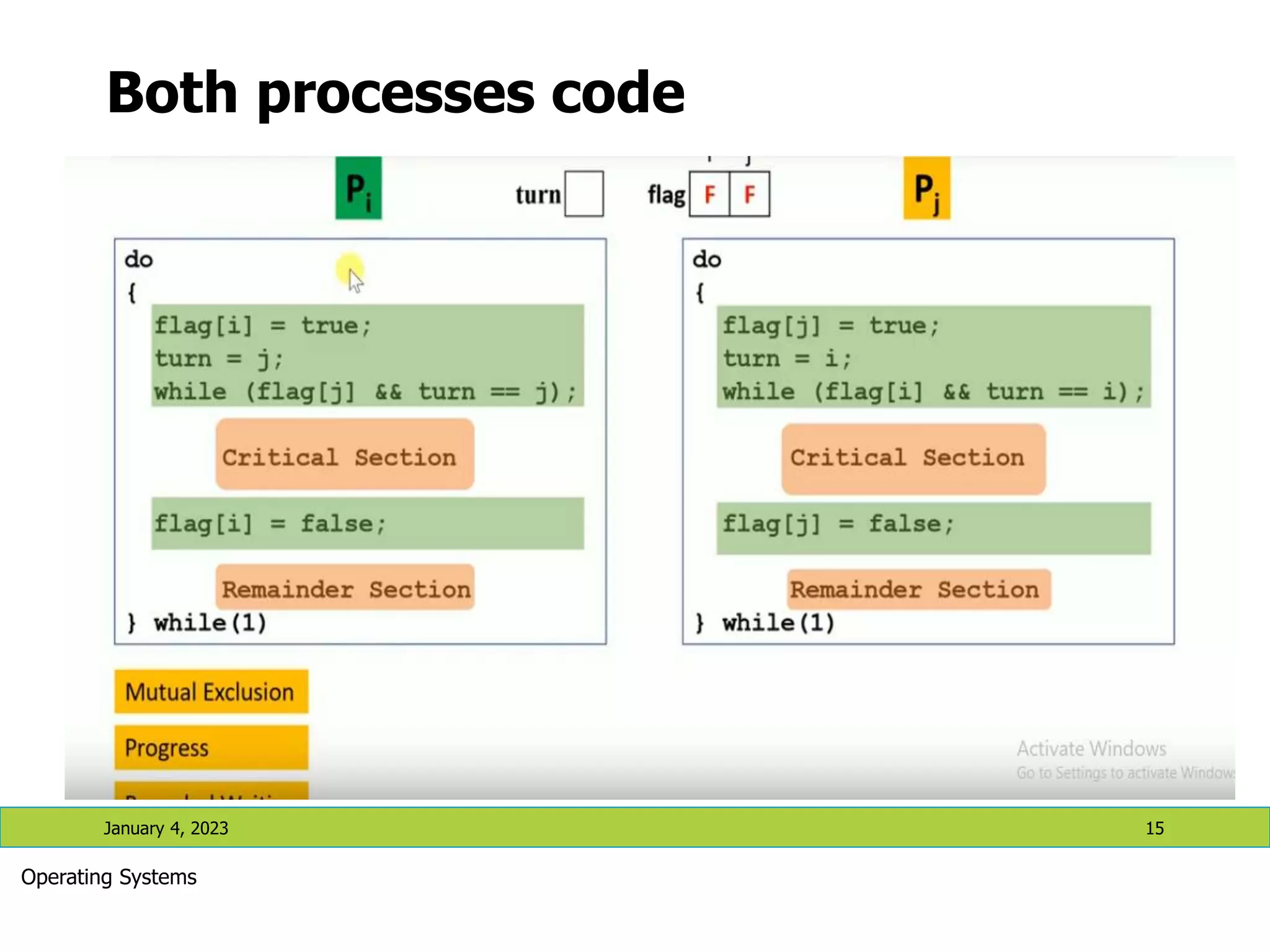
Algorithm for Process Pi
do {
flag[i] = true;
turn = j;
while (flag[j] && turn = = j);
critical section
flag[i] = false;
remainder section
} while (true);
Both processes code
January 4, 2023 15
Operating Systems
Cross check the guarantees
• In the Peterson’s Algorithm it can be Proved that the three
Critical Section requirement are fulfilled by this algorithm:
1. Mutual exclusion is preserved
Pi enters CS only if:
either flag[j] = false or turn = i
2. Progress requirement is satisfied
3. Bounded-waiting requirement is met
Limitation: All the algorithms discussed till now don’t work for N process critical section
problem. That’s why we design hardware based solutions to guarantee n process
synchronization.
Synchronization Hardware
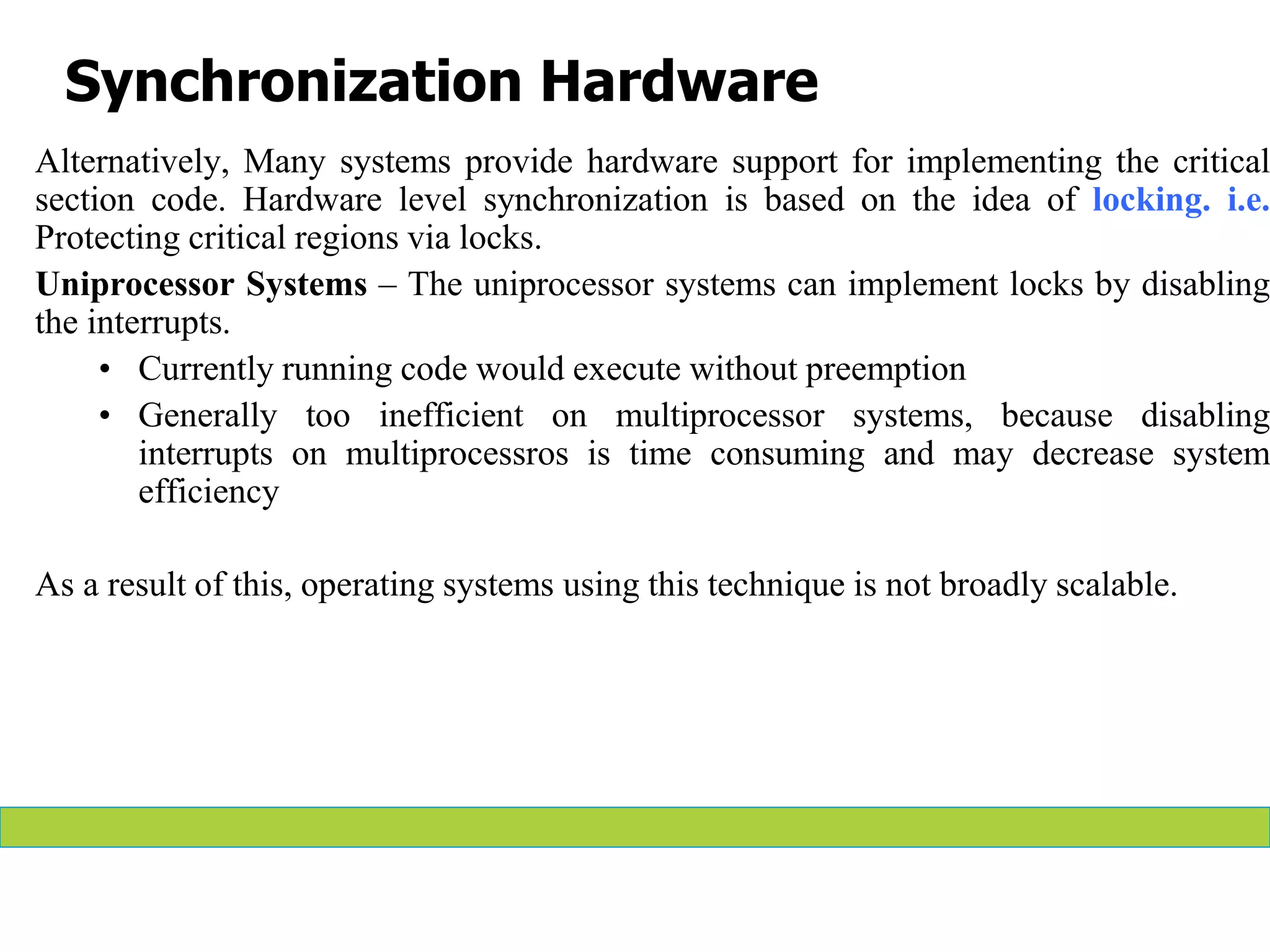
Alternatively, Many systems provide hardware support for implementing the critical
section code. Hardware level synchronization is based on the idea of locking. i.e.
Protecting critical regions via locks.
Uniprocessor Systems – The uniprocessor systems can implement locks by disabling
the interrupts.
• Currently running code would execute without preemption
• Generally too inefficient on multiprocessor systems, because disabling
interrupts on multiprocessros is time consuming and may decrease system
efficiency
As a result of this, operating systems using this technique is not broadly scalable.
Atomic instructions
• Modern machines provide special atomic hardware
instructions
• Atomic = non-interruptible
These atomic instructions either test and set the value of a
memory word, or they can swap the content of two memory
locations without being interrupted.
January 4, 2023 18
Operating Systems
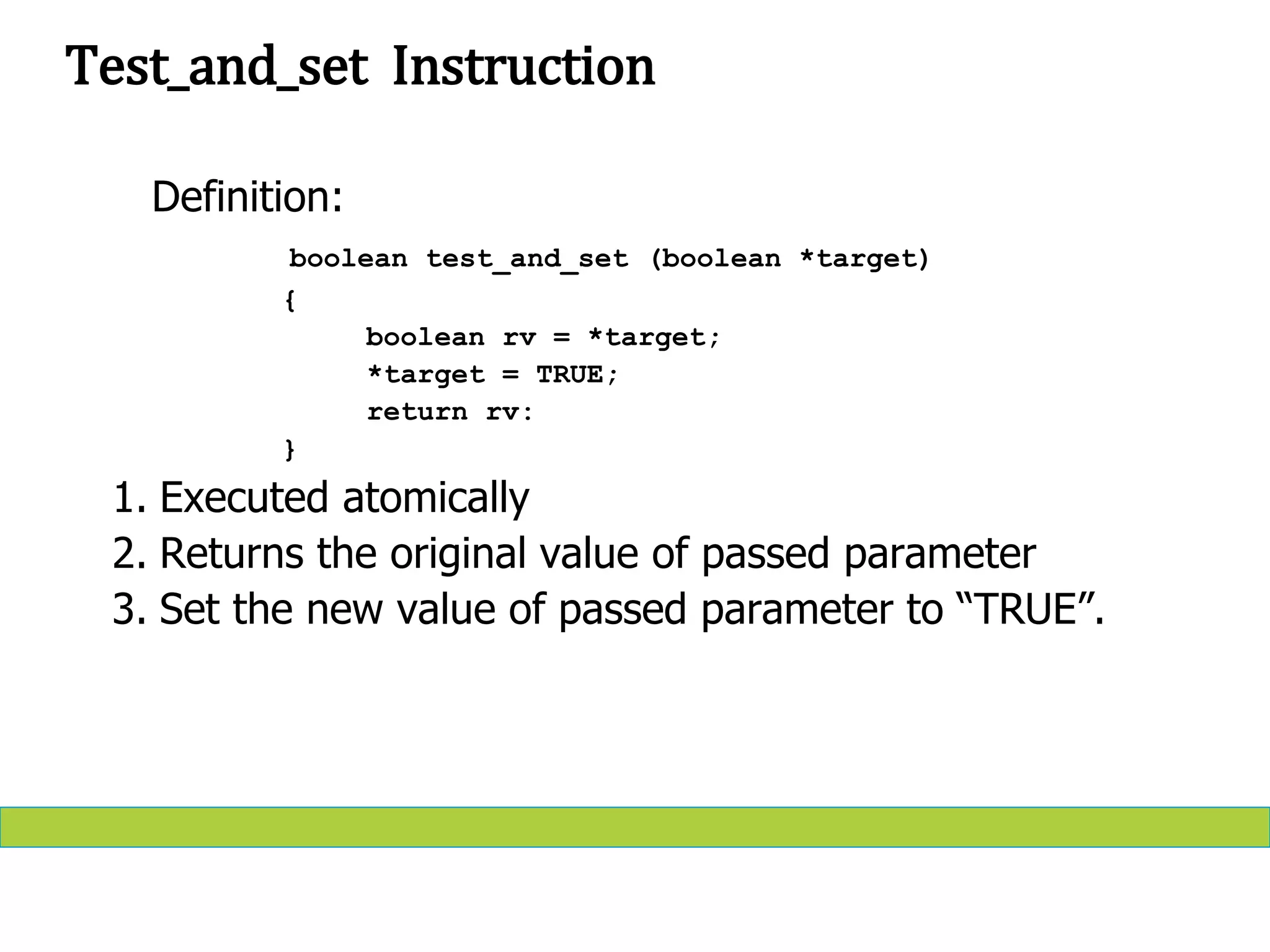
Test_and_set Instruction
Definition:
boolean test_and_set (boolean *target)
{
boolean rv = *target;
*target = TRUE;
return rv:
}
1. Executed atomically
2. Returns the original value of passed parameter
3. Set the new value of passed parameter to “TRUE”.
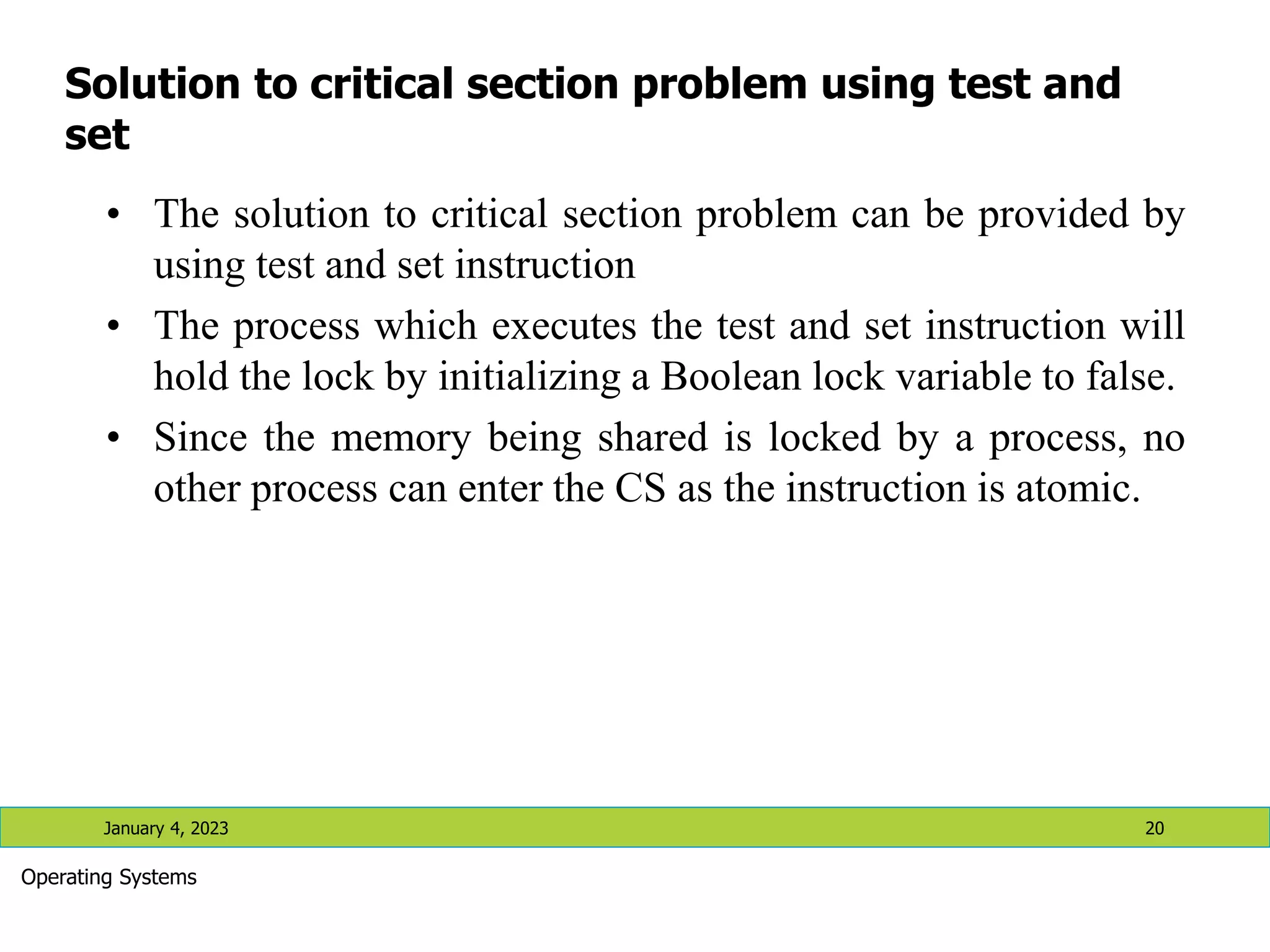
Solution to critical section problem using test and
set
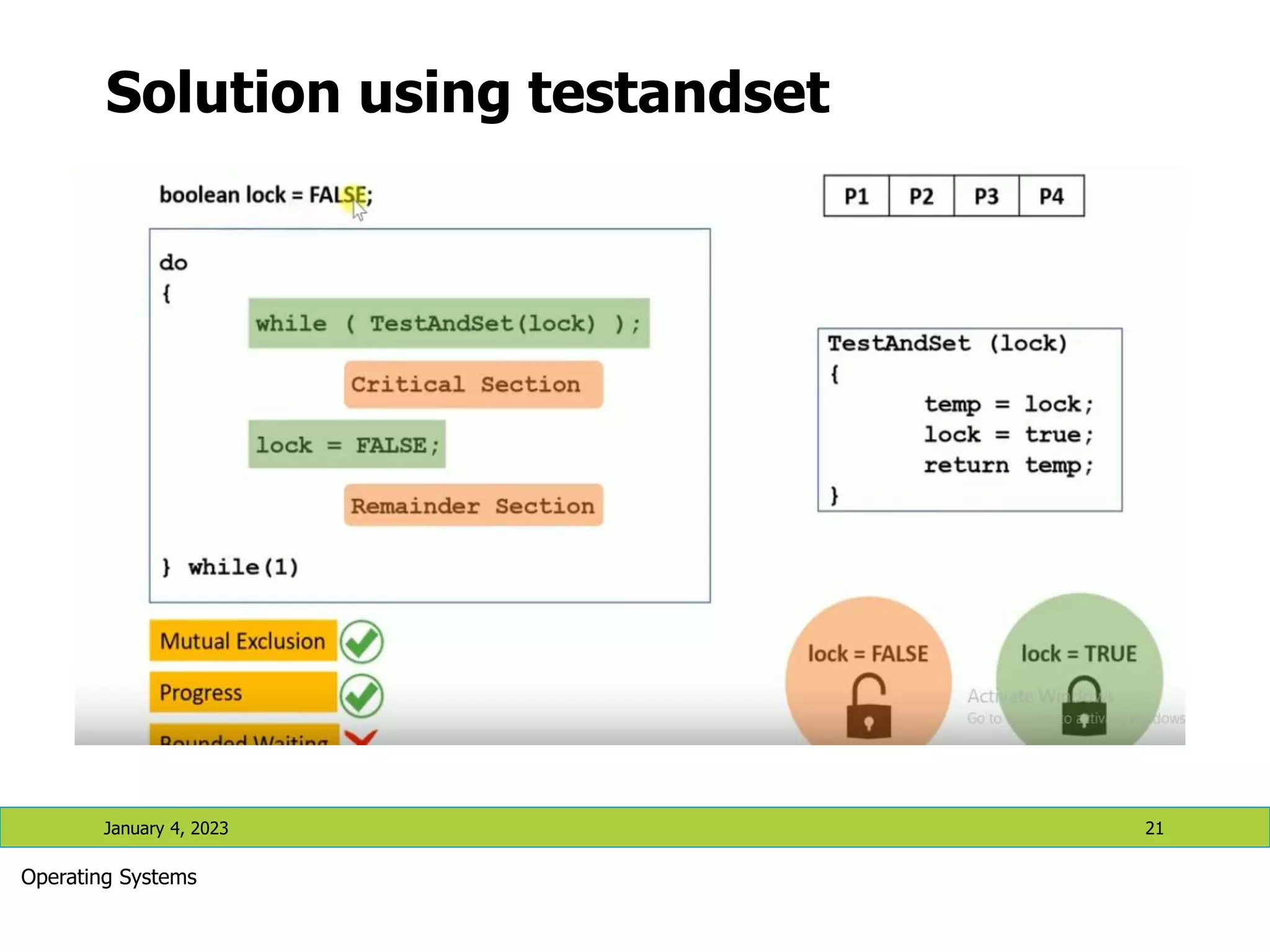
• The solution to critical section problem can be provided by
using test and set instruction
• The process which executes the test and set instruction will
hold the lock by initializing a Boolean lock variable to false.
• Since the memory being shared is locked by a process, no
other process can enter the CS as the instruction is atomic.
January 4, 2023 20
Operating Systems
Solution using testandset
January 4, 2023 21
Operating Systems
Solution to critical section problem using compare
and swap
• Compare and swap operation is atomic in nature and can be used to
implement a solution of critical section problem.
• Mutual exclusion can be provided as follows: a global
variable (lock) is declared and is initialized to 0. The first process
that invokes compare and swap() will set lock to 1. It will then enter
its critical section, because the original value of lock was equal to
the expected value of 0. Subsequent calls to compare and swap()
will not succeed, because lock now is not equal to the expected
value of 0. When a process exits its critical section, it sets lock back
to 0, which allows another process to enter its critical section. The
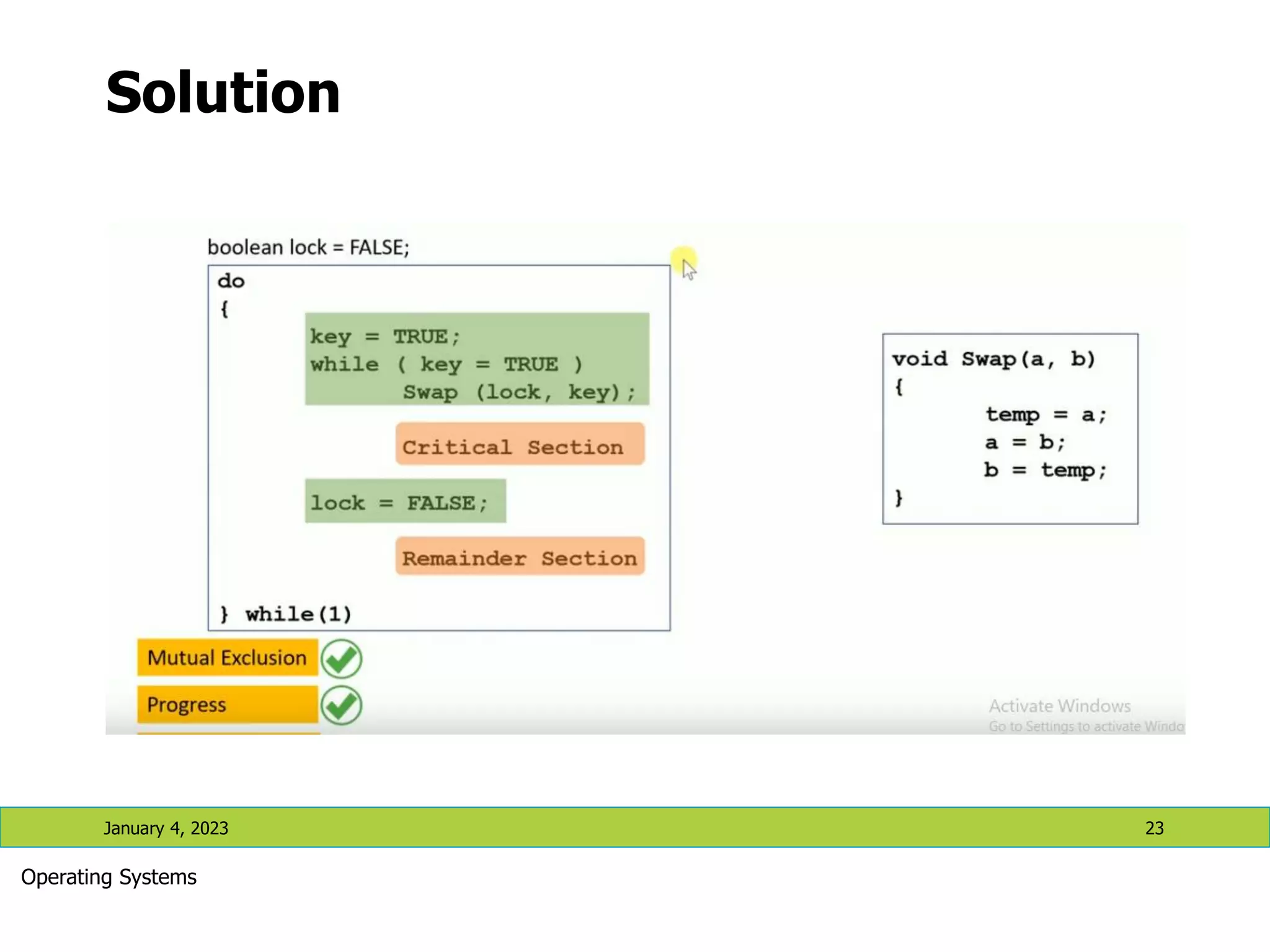
structure of process Pi is shown in Figure (5.6 page no. 211 Galvin)
• This method do not satisfy bounded wait condition, next we provide
a solution with test and set instruction that satisfies all the CS
conditions.
January 4, 2023 22
Operating Systems
Solution
January 4, 2023 23
Operating Systems
Mutex Locks
 Previous solutions are complicated and generally inaccessible to
application programmers
 OS designers build software tools to solve critical section problem
 Simplest is mutex lock
 Protect a critical section by first acquire() a lock then release() the lock
 Boolean variable indicating if lock is available or not
 Calls to acquire() and release() must be atomic
 Usually implemented via hardware atomic instructions
 But this solution requires busy waiting
 This lock therefore called a spinlock
Semaphore
• A semaphore is another way of implementing synchronization
among various processes.
• A semaphore is an integer variable S,
• Values of S are used by processes to make decisions to enter
the critical section and to wait for other processes to exit their
critical section.
• Semaphore uses two functions called wait(S) and Signal(S) in
order to communicate the status of critical section among
cooperating processes.
• Wait operation simply decrement the current value of S and
goes in busy wait loop
• Signal operation increment the value of S by one.
January 4, 2023 25
Operating Systems
Semaphore
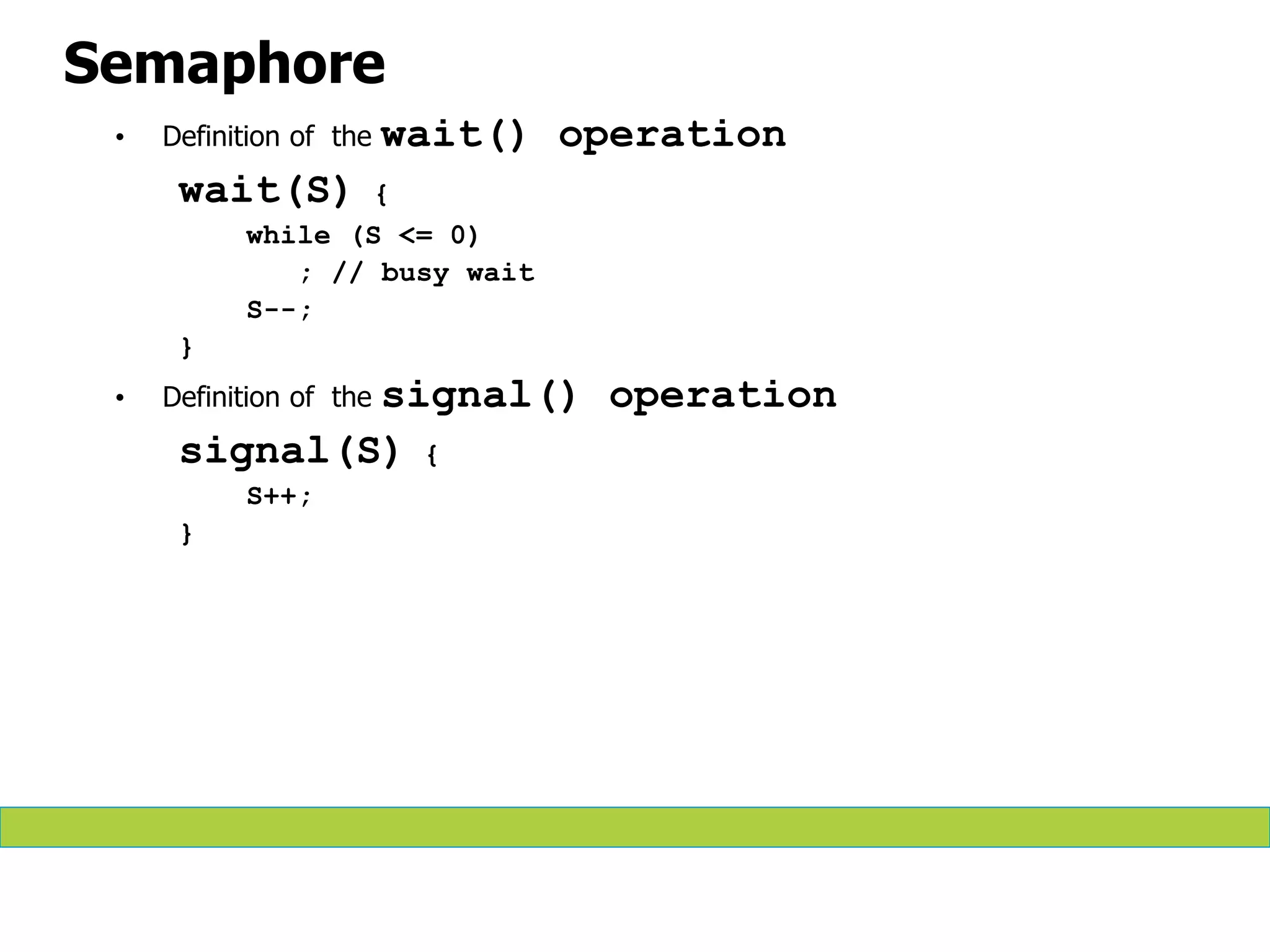
• Definition of the wait() operation
wait(S) {
while (S <= 0)
; // busy wait
S--;
}
• Definition of the signal() operation
signal(S) {
S++;
}
CS solution using semaphore
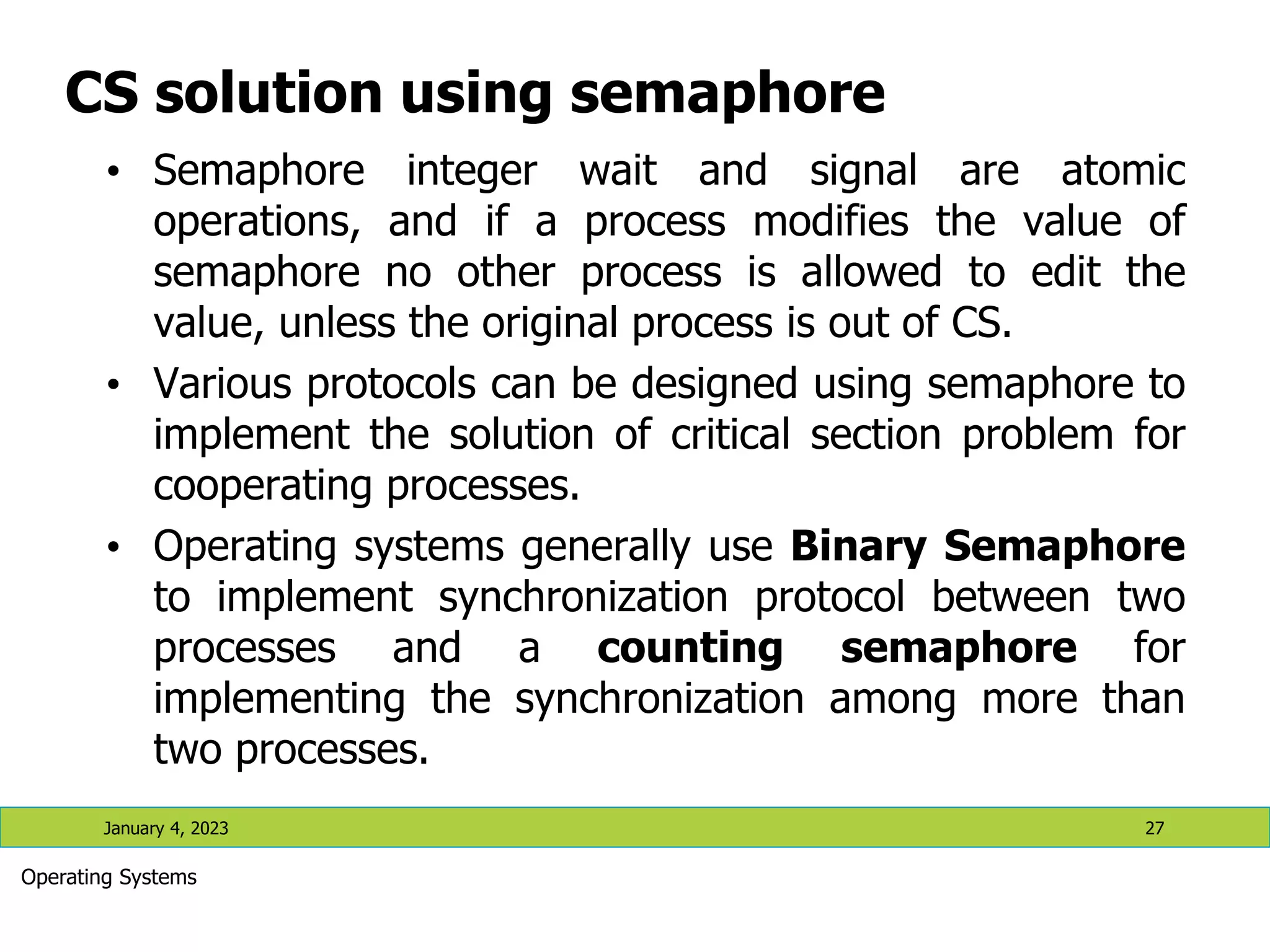
• Semaphore integer wait and signal are atomic
operations, and if a process modifies the value of
semaphore no other process is allowed to edit the
value, unless the original process is out of CS.
• Various protocols can be designed using semaphore to
implement the solution of critical section problem for
cooperating processes.
• Operating systems generally use Binary Semaphore
to implement synchronization protocol between two
processes and a counting semaphore for
implementing the synchronization among more than
two processes.
January 4, 2023 27
Operating Systems
Semaphore Usage
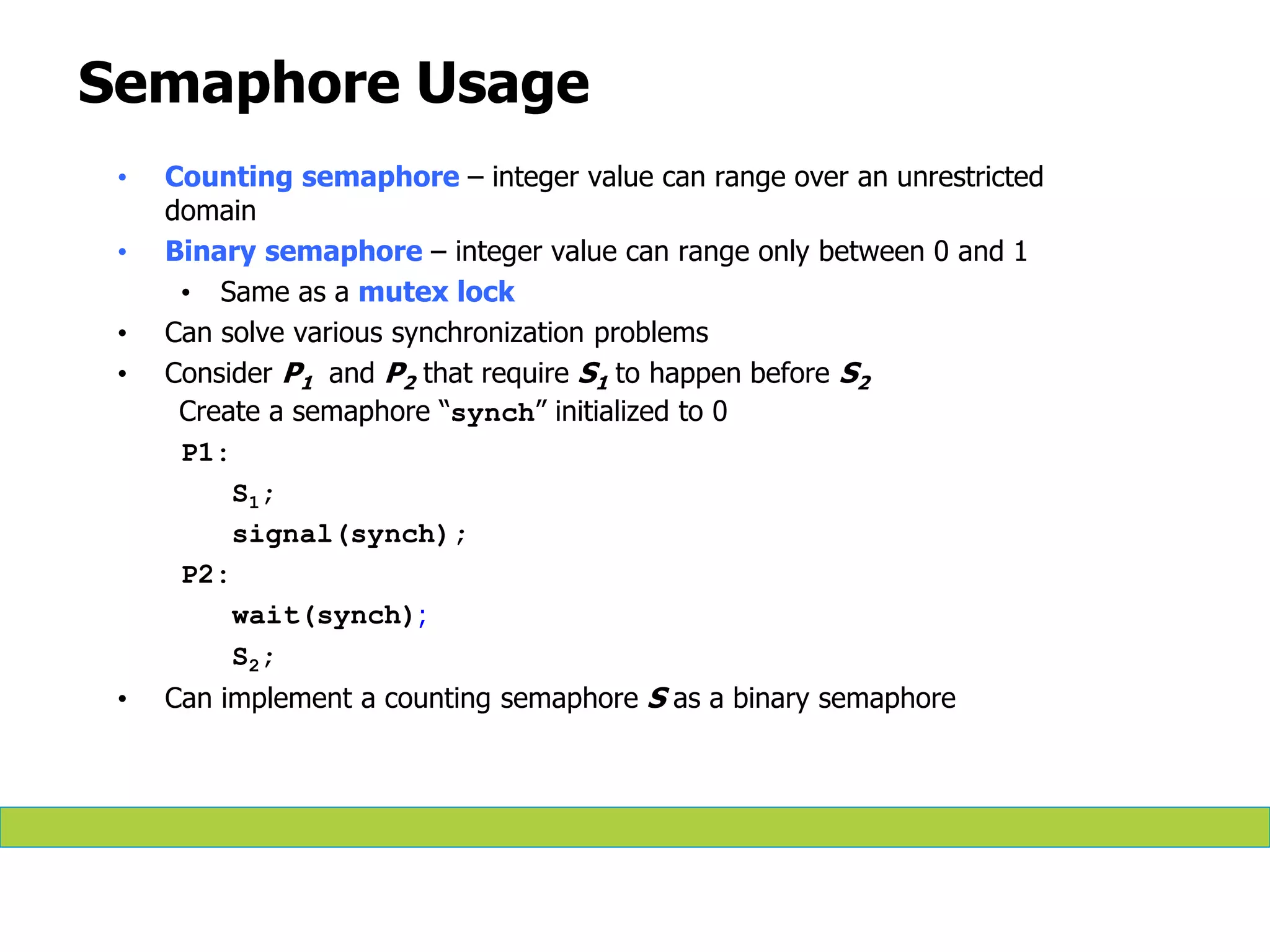
• Counting semaphore – integer value can range over an unrestricted
domain
• Binary semaphore – integer value can range only between 0 and 1
• Same as a mutex lock
• Can solve various synchronization problems
• Consider P1 and P2 that require S1 to happen before S2
Create a semaphore “synch” initialized to 0
P1:
S1;
signal(synch);
P2:
wait(synch);
S2;
• Can implement a counting semaphore S as a binary semaphore
Semaphore Implementation
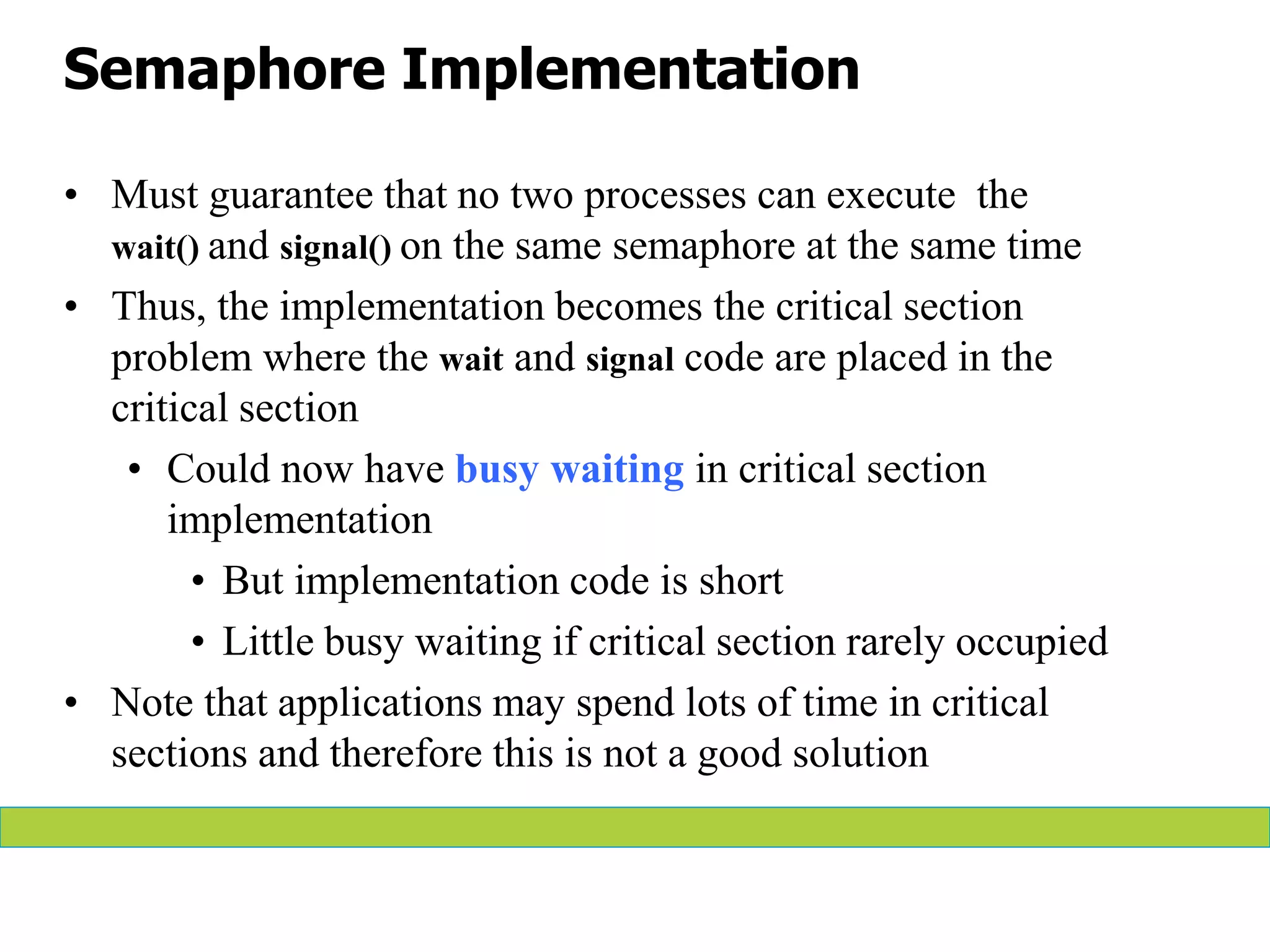
• Must guarantee that no two processes can execute the
wait() and signal() on the same semaphore at the same time
• Thus, the implementation becomes the critical section
problem where the wait and signal code are placed in the
critical section
• Could now have busy waiting in critical section
implementation
• But implementation code is short
• Little busy waiting if critical section rarely occupied
• Note that applications may spend lots of time in critical
sections and therefore this is not a good solution
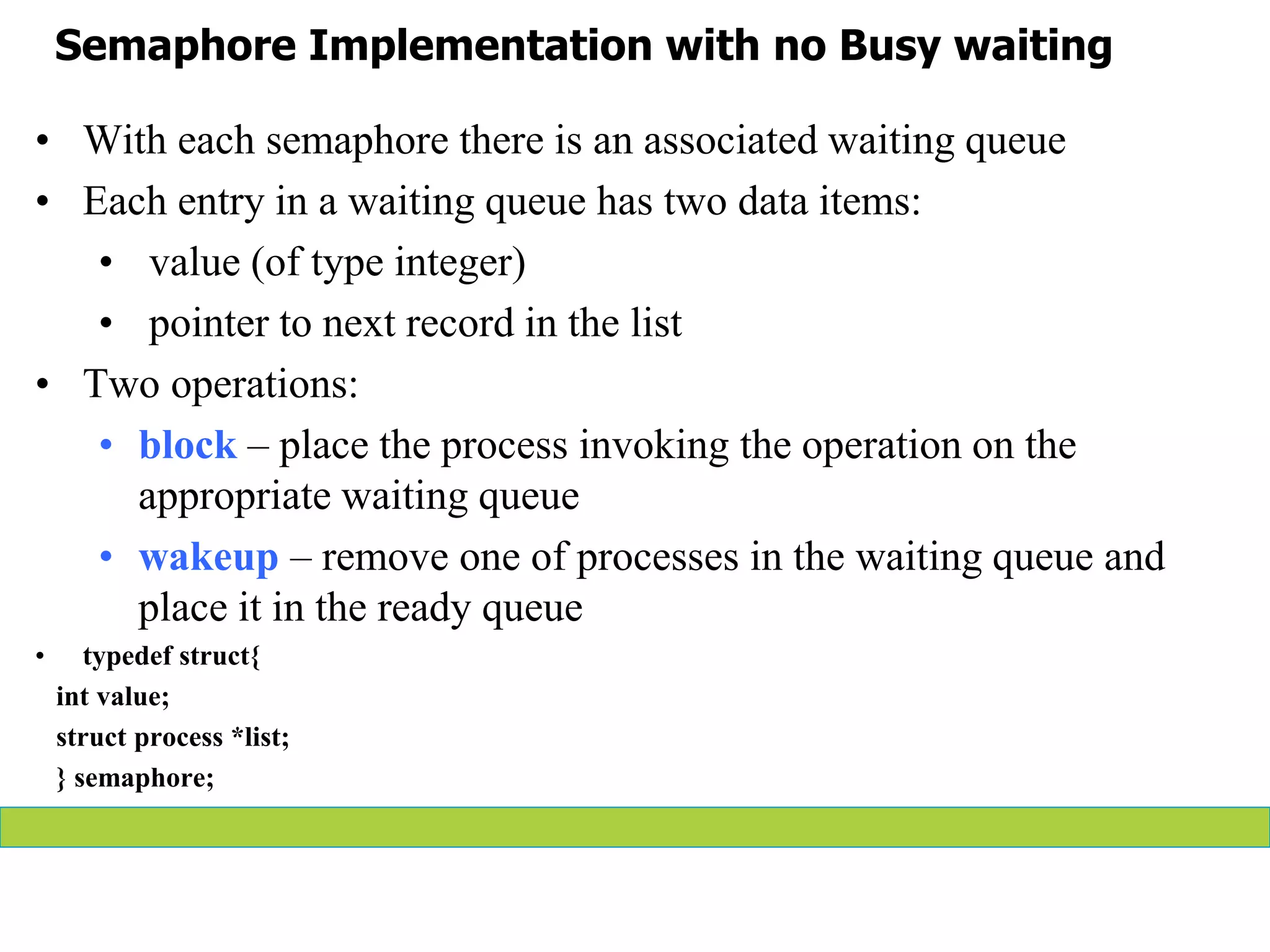
Semaphore Implementation with no Busy waiting
• With each semaphore there is an associated waiting queue
• Each entry in a waiting queue has two data items:
• value (of type integer)
• pointer to next record in the list
• Two operations:
• block – place the process invoking the operation on the
appropriate waiting queue
• wakeup – remove one of processes in the waiting queue and
place it in the ready queue
• typedef struct{
int value;
struct process *list;
} semaphore;
Solution using semaphore
January 4, 2023 31
Operating Systems
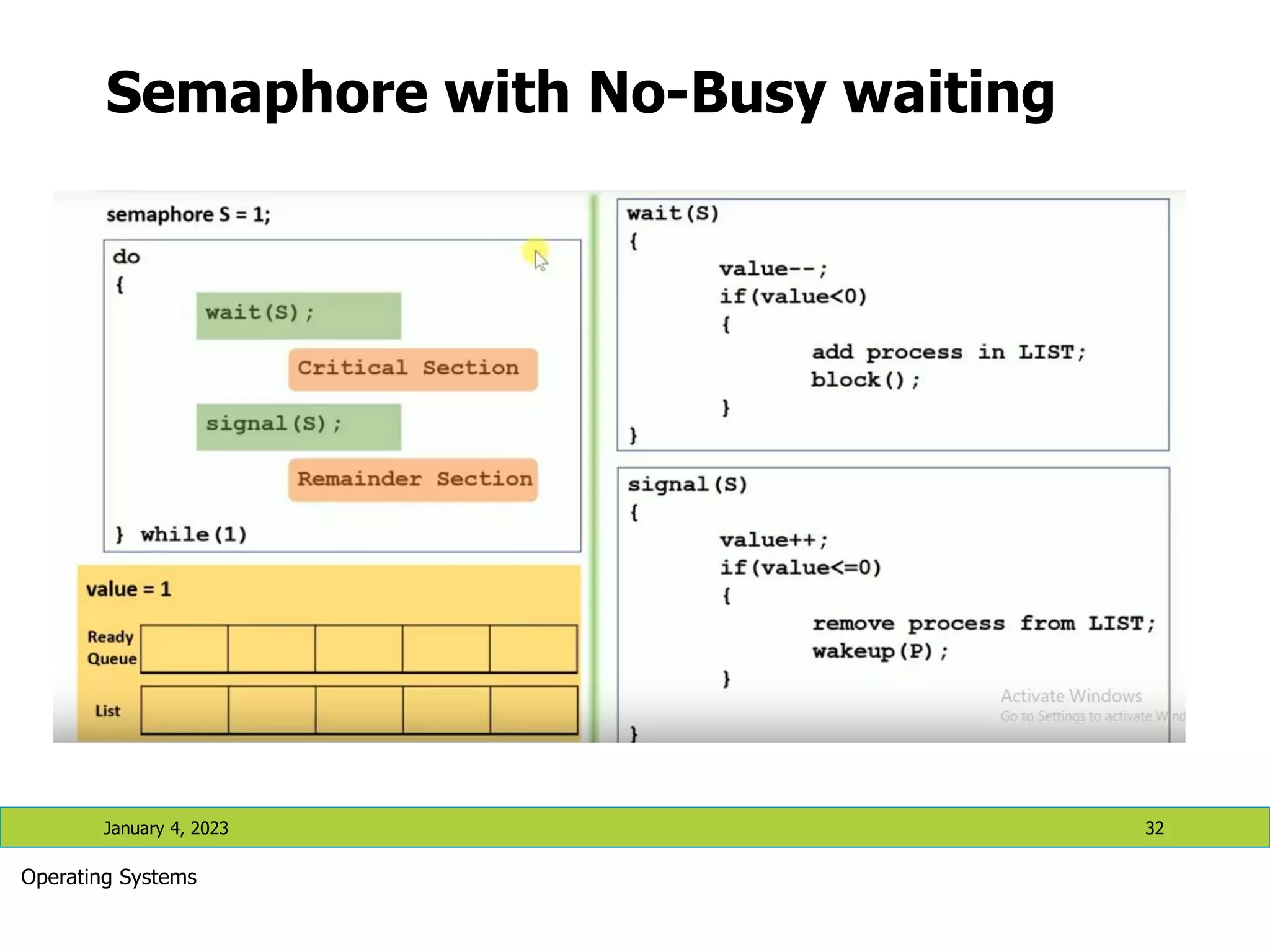
Semaphore with No-Busy waiting
January 4, 2023 32
Operating Systems
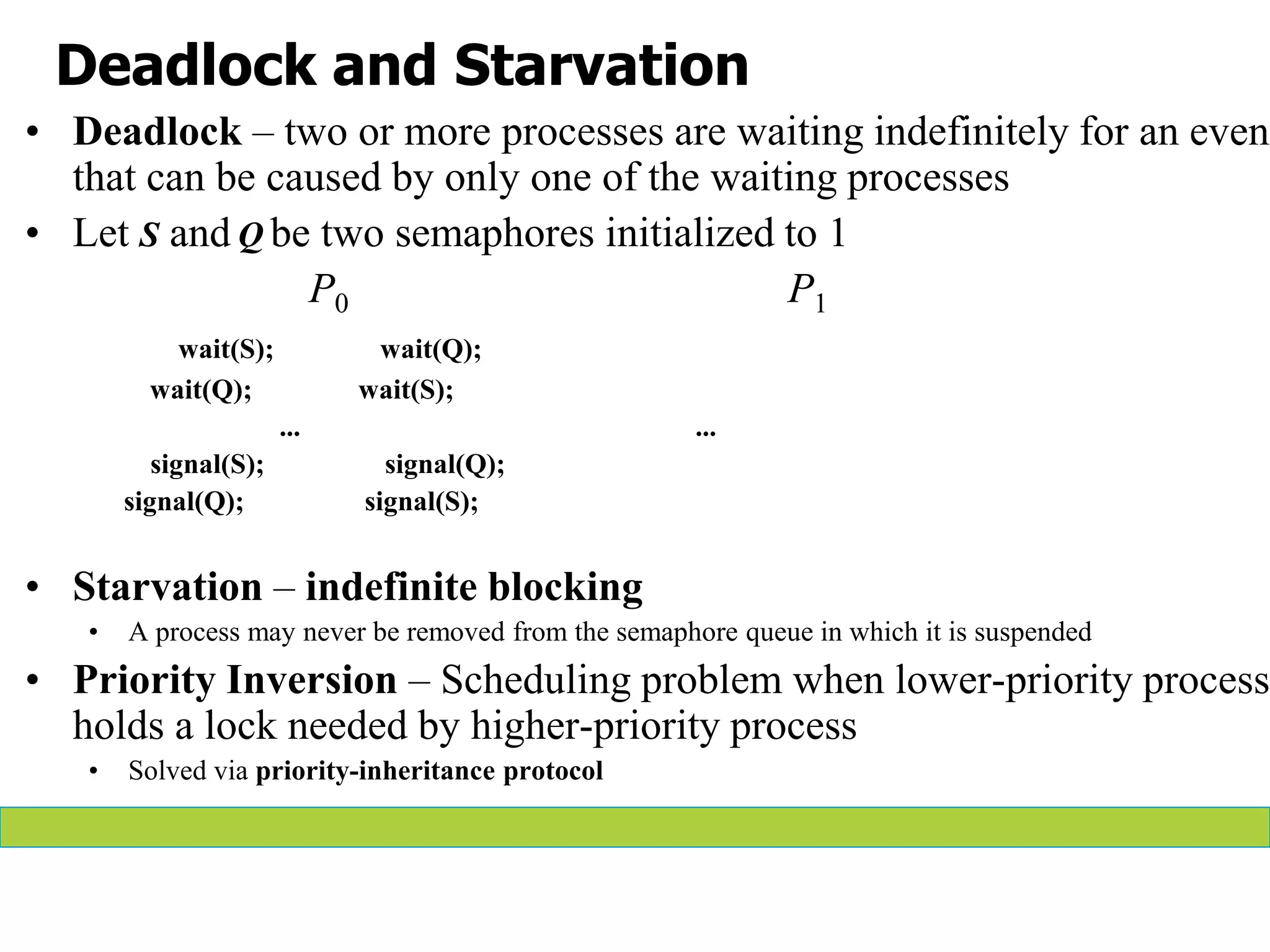
Deadlock and Starvation
• Deadlock – two or more processes are waiting indefinitely for an event
that can be caused by only one of the waiting processes
• Let S and Q be two semaphores initialized to 1
P0 P1
wait(S); wait(Q);
wait(Q); wait(S);
... ...
signal(S); signal(Q);
signal(Q); signal(S);
• Starvation – indefinite blocking
• A process may never be removed from the semaphore queue in which it is suspended
• Priority Inversion – Scheduling problem when lower-priority process
holds a lock needed by higher-priority process
• Solved via priority-inheritance protocol
Classical Problems of Synchronization
• Following classical problems are used to test newly-
proposed synchronization schemes
• Bounded-Buffer Problem
• Producer Consumer
• Readers and Writers Problem
• Dining-Philosophers Problem
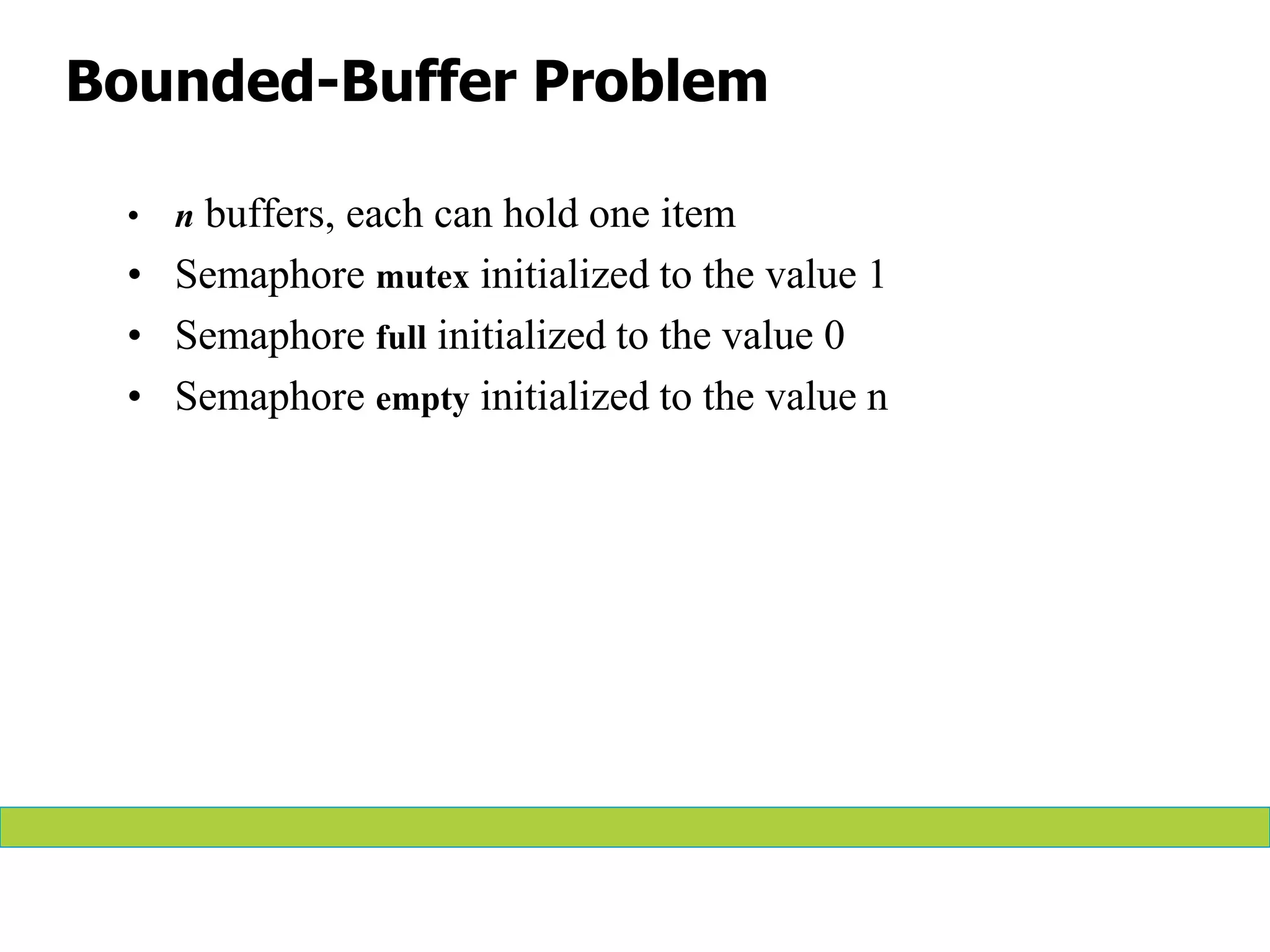
Bounded-Buffer Problem
• n buffers, each can hold one item
• Semaphore mutex initialized to the value 1
• Semaphore full initialized to the value 0
• Semaphore empty initialized to the value n
Bounded Buffer Problem (Cont.)
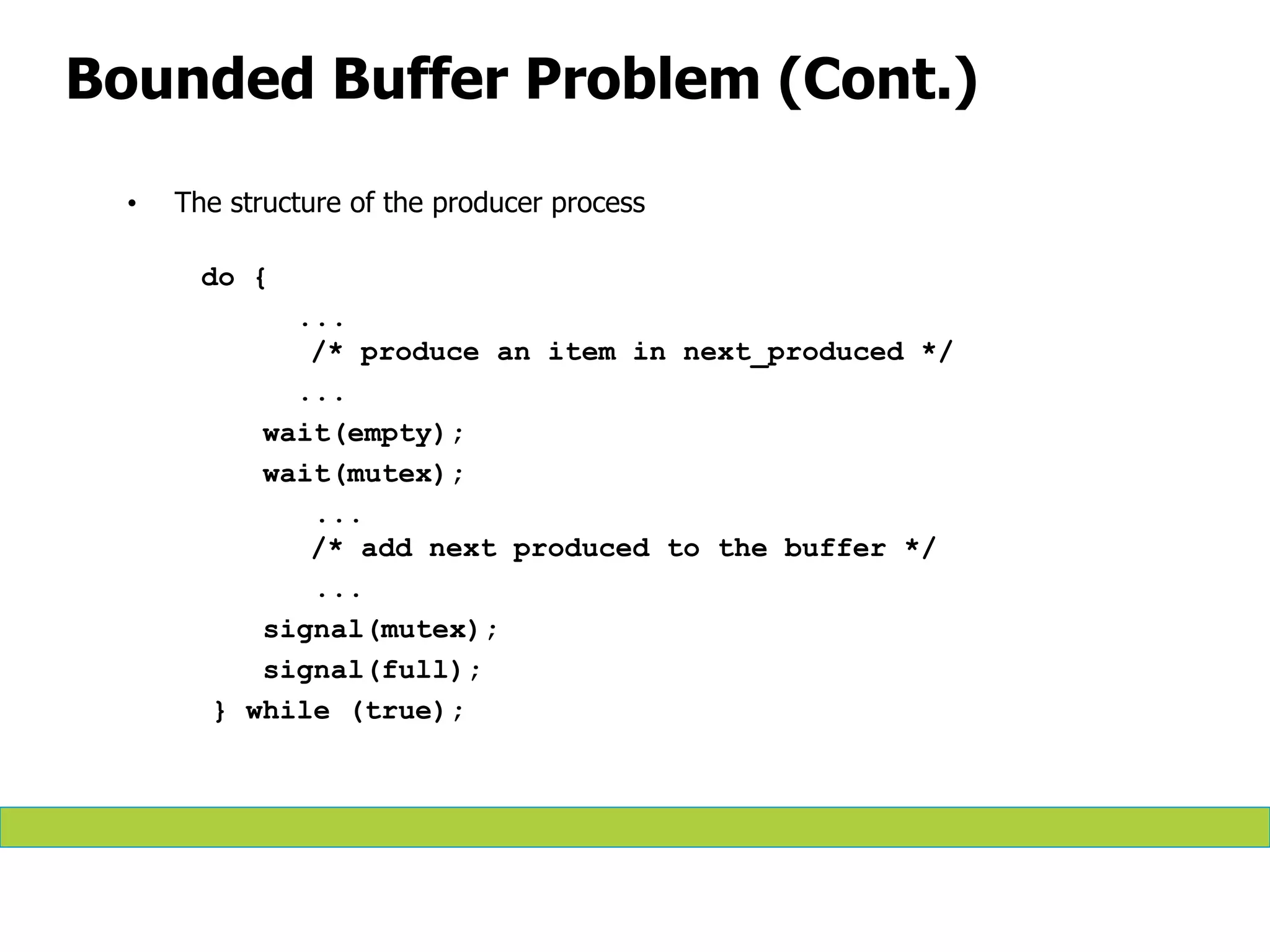
• The structure of the producer process
do {
...
/* produce an item in next_produced */
...
wait(empty);
wait(mutex);
...
/* add next produced to the buffer */
...
signal(mutex);
signal(full);
} while (true);
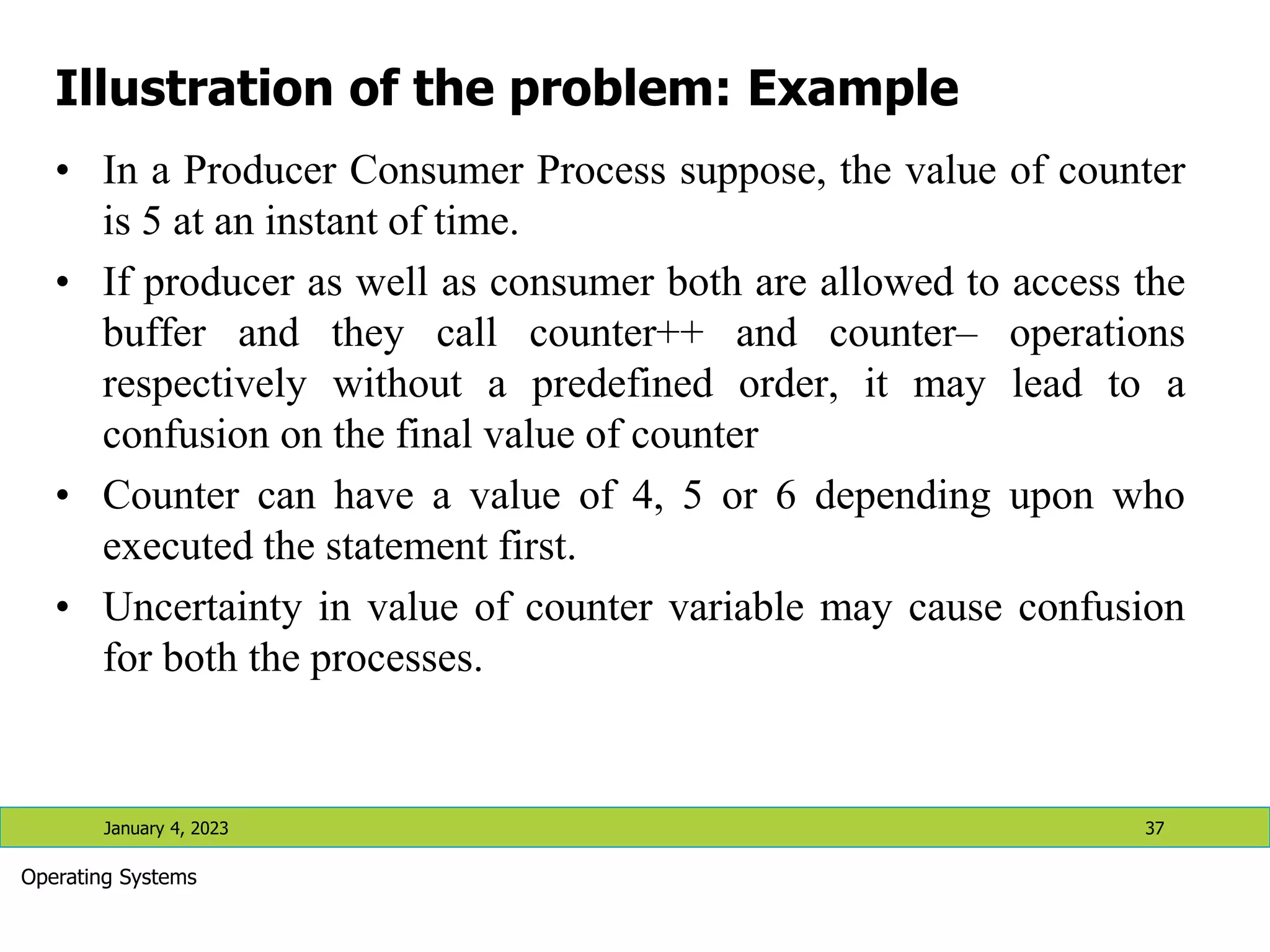
Illustration of the problem: Example
• In a Producer Consumer Process suppose, the value of counter
is 5 at an instant of time.
• If producer as well as consumer both are allowed to access the
buffer and they call counter++ and counter– operations
respectively without a predefined order, it may lead to a
confusion on the final value of counter
• Counter can have a value of 4, 5 or 6 depending upon who
executed the statement first.
• Uncertainty in value of counter variable may cause confusion
for both the processes.
January 4, 2023 37
Operating Systems
Producer
while (true) {
/* produce an item in next produced */
while (counter == BUFFER_SIZE) ;
/* do nothing */
buffer[in] = next_produced;
in = (in + 1) % BUFFER_SIZE;
counter++;
}
Consumer
while (true) {
while (counter == 0)
; /* do nothing */
next_consumed = buffer[out];
out = (out + 1) % BUFFER_SIZE;
counter--;
/* consume the item in next consumed */
}
Bounded Buffer Problem (Cont.)
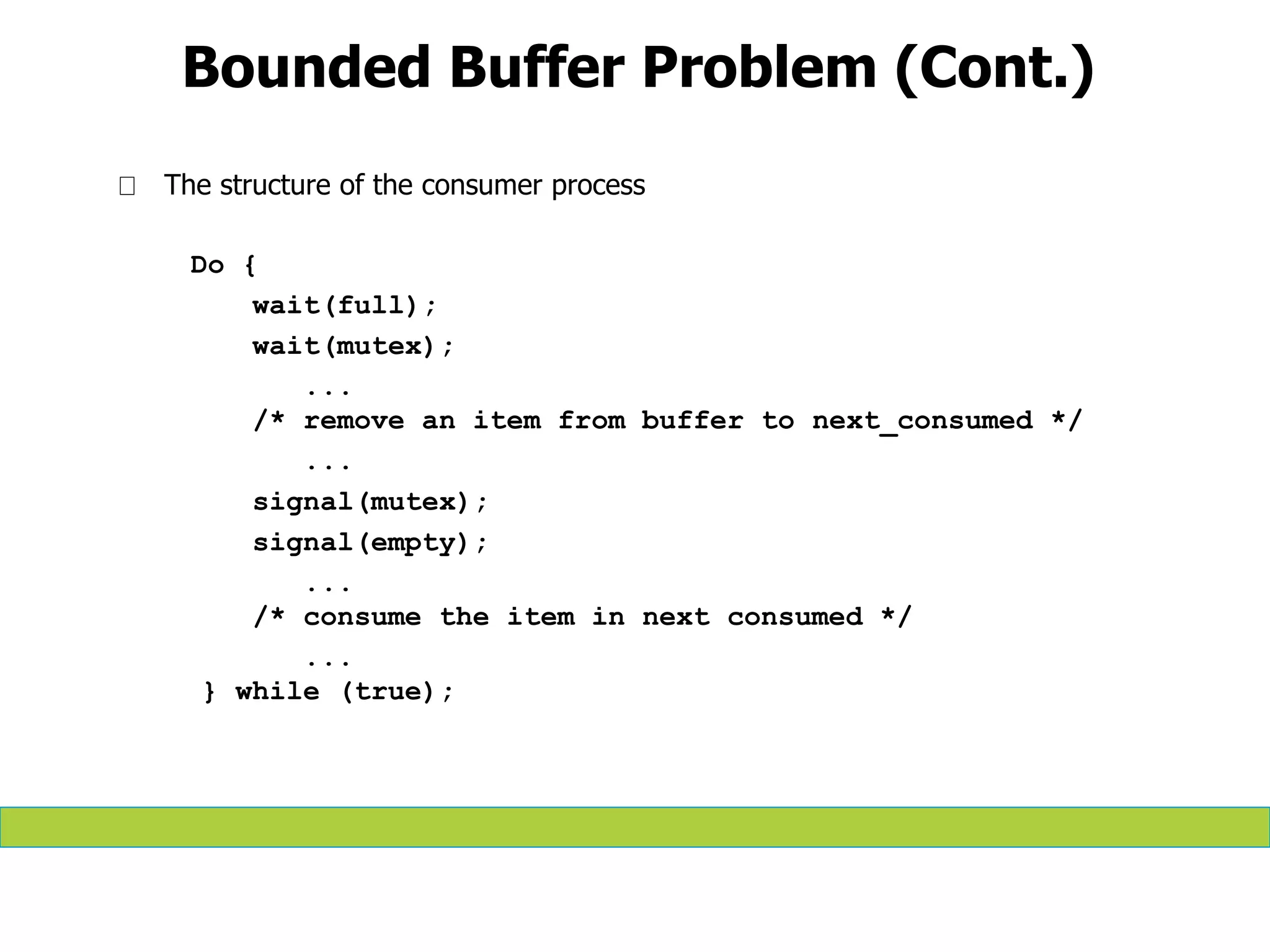
The structure of the consumer process
Do {
wait(full);
wait(mutex);
...
/* remove an item from buffer to next_consumed */
...
signal(mutex);
signal(empty);
...
/* consume the item in next consumed */
...
} while (true);
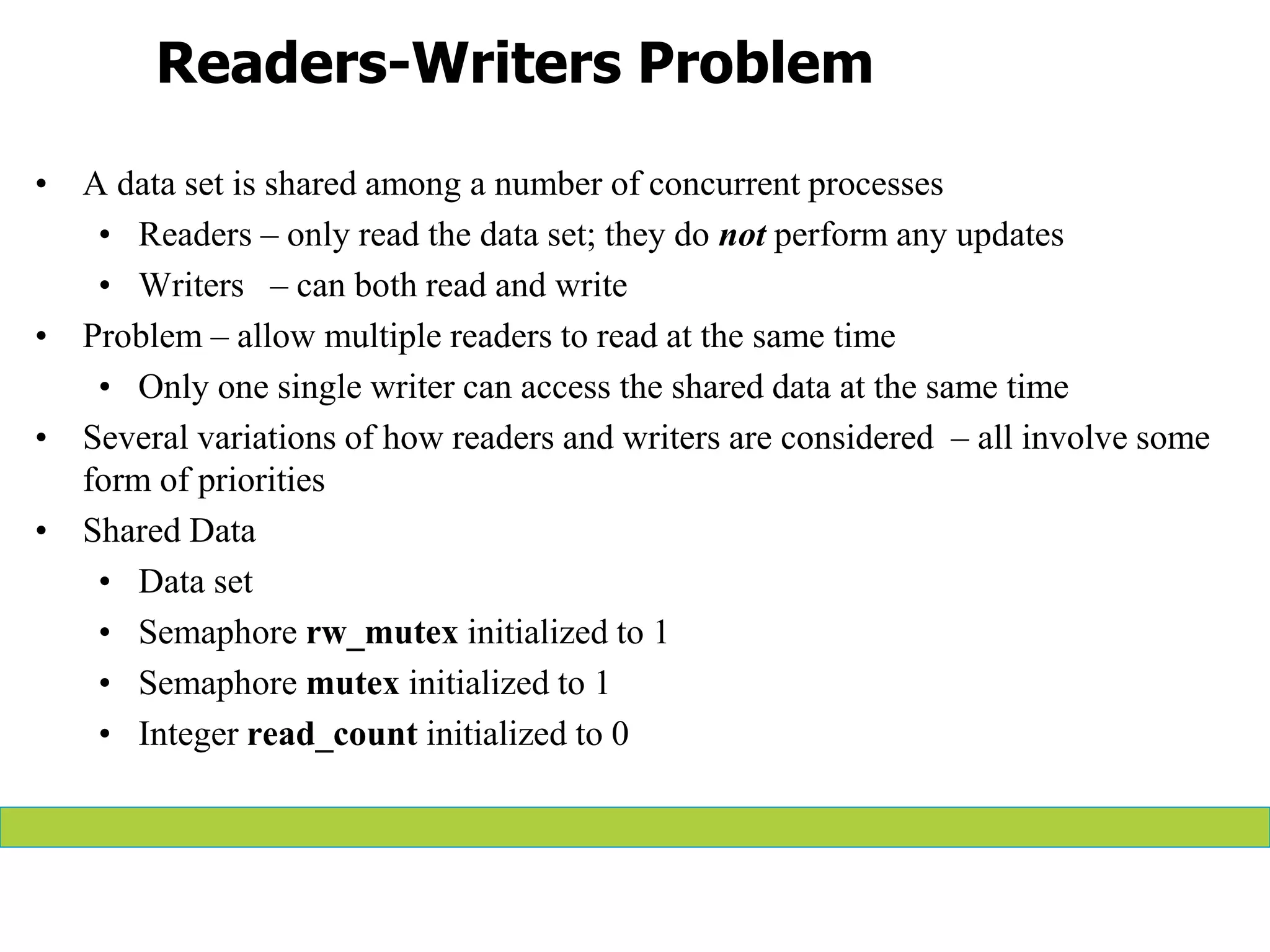
Readers-Writers Problem
• A data set is shared among a number of concurrent processes
• Readers – only read the data set; they do not perform any updates
• Writers – can both read and write
• Problem – allow multiple readers to read at the same time
• Only one single writer can access the shared data at the same time
• Several variations of how readers and writers are considered – all involve some
form of priorities
• Shared Data
• Data set
• Semaphore rw_mutex initialized to 1
• Semaphore mutex initialized to 1
• Integer read_count initialized to 0
Readers-Writers Problem (Cont.)
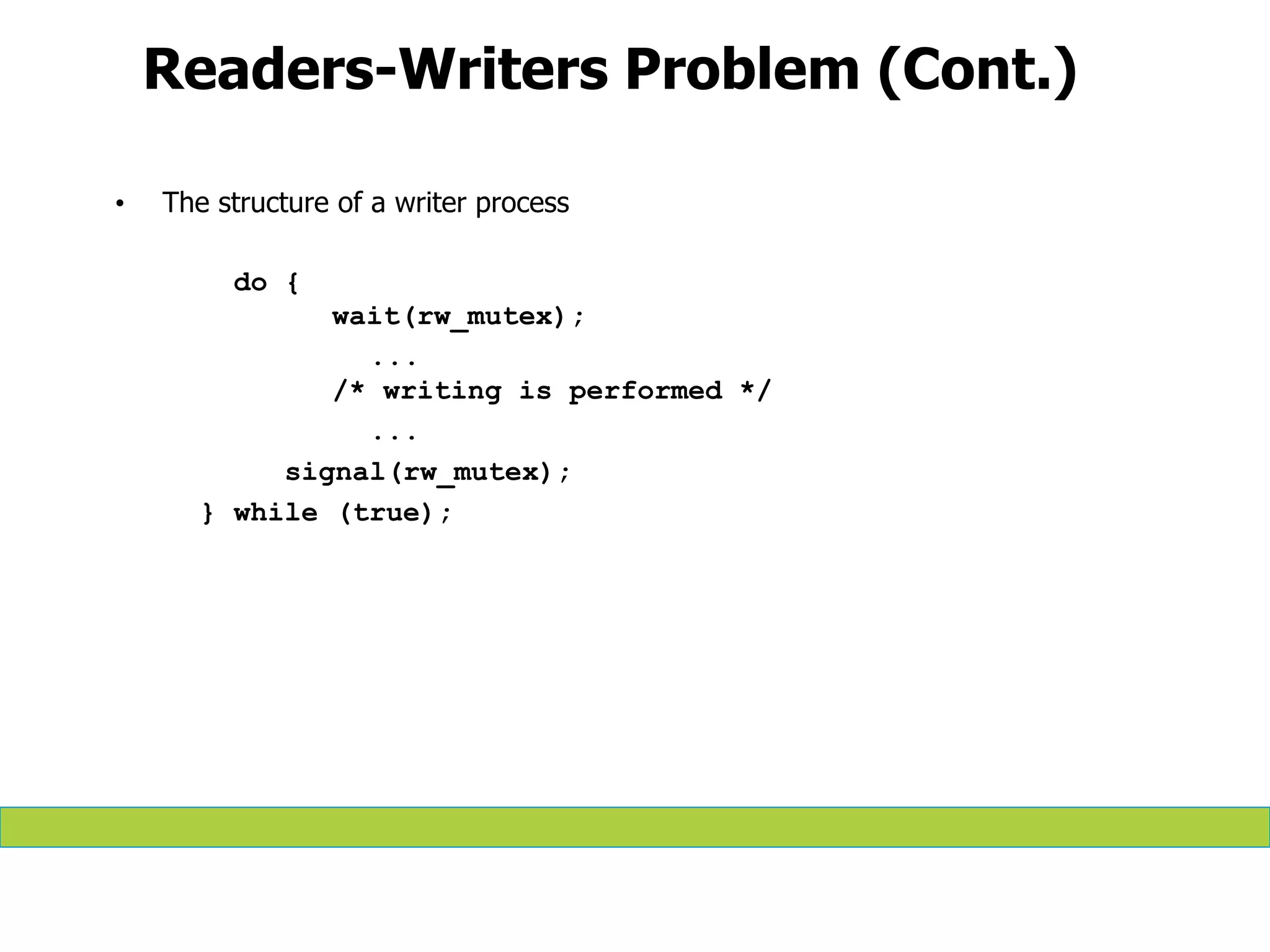
• The structure of a writer process
do {
wait(rw_mutex);
...
/* writing is performed */
...
signal(rw_mutex);
} while (true);
Readers-Writers Problem (Cont.)
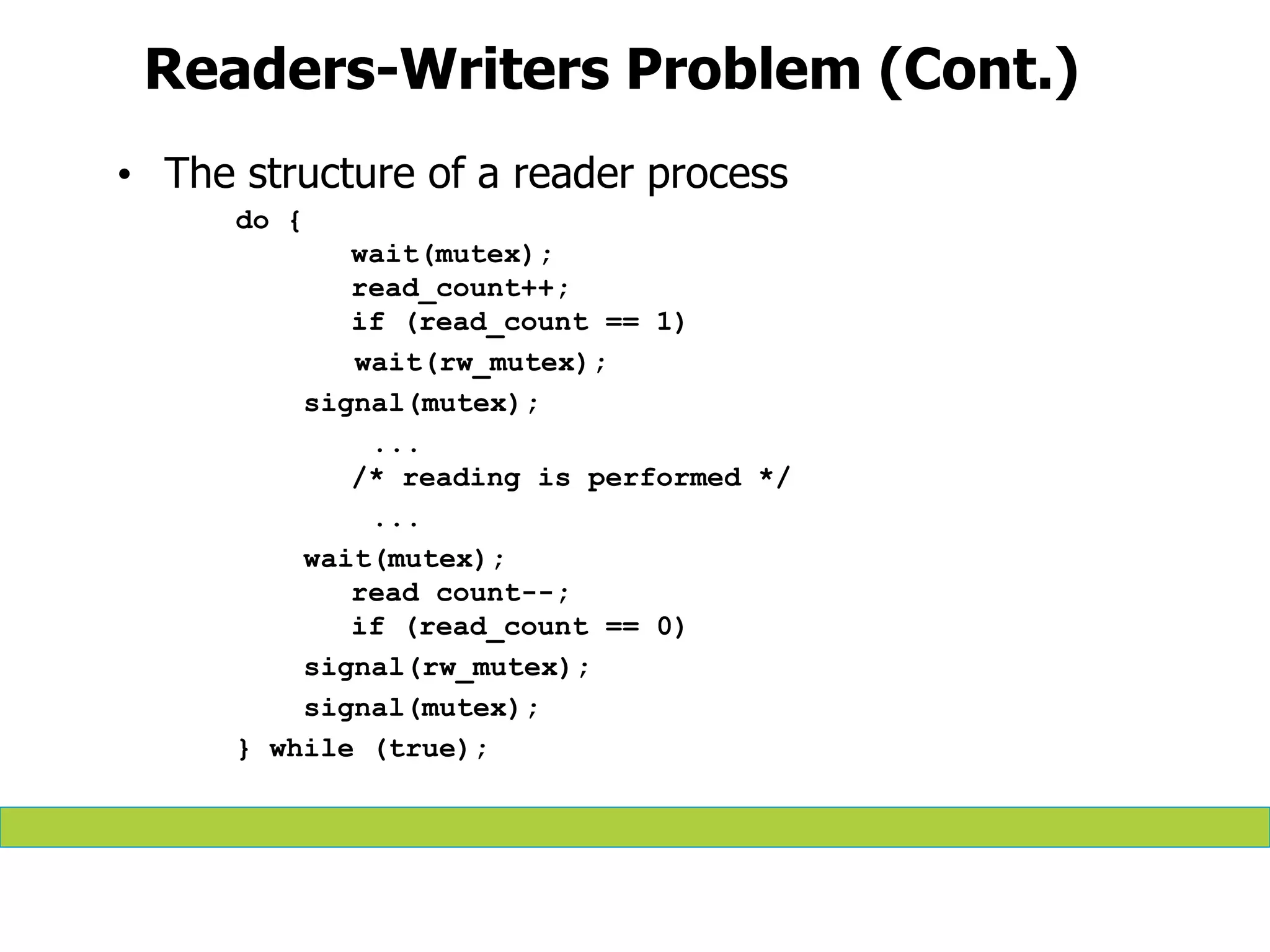
• The structure of a reader process
do {
wait(mutex);
read_count++;
if (read_count == 1)
wait(rw_mutex);
signal(mutex);
...
/* reading is performed */
...
wait(mutex);
read count--;
if (read_count == 0)
signal(rw_mutex);
signal(mutex);
} while (true);
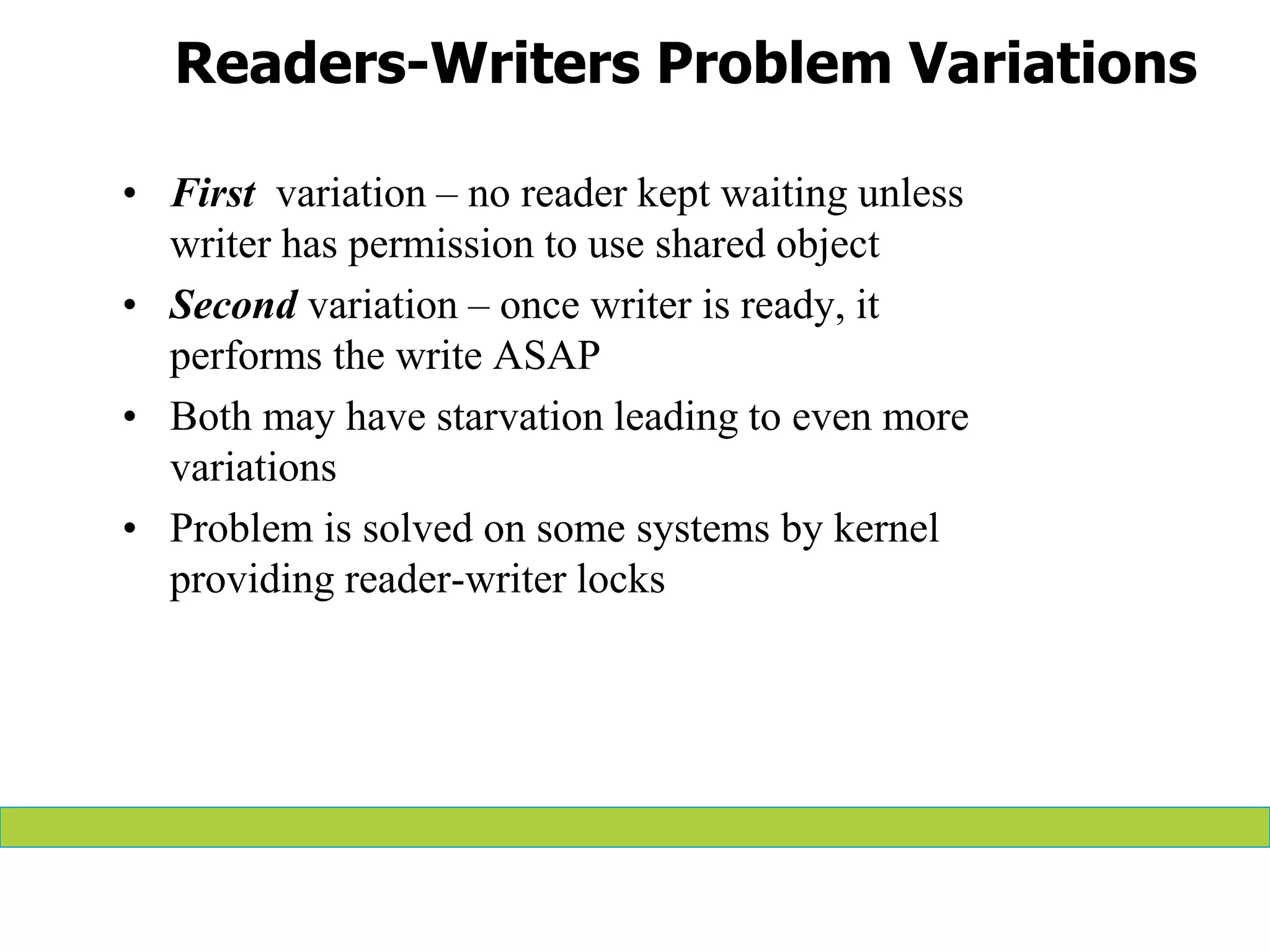
Readers-Writers Problem Variations
• First variation – no reader kept waiting unless
writer has permission to use shared object
• Second variation – once writer is ready, it
performs the write ASAP
• Both may have starvation leading to even more
variations
• Problem is solved on some systems by kernel
providing reader-writer locks
Dining-Philosophers Problem
• Philosophers spend their lives alternating thinking and eating
• Don’t interact with their neighbors, occasionally try to pick up 2
chopsticks (one at a time) to eat from bowl
• Need both to eat, then release both when done
• In the case of 5 philosophers
• Shared data
• Bowl of rice (data set)
• Semaphore chopstick [5] initialized to 1
Dining-Philosophers Problem Algorithm
• The structure of Philosopher i:
do {
wait (chopstick[i] );
wait (chopStick[ (i + 1) % 5] );
// eat
signal (chopstick[i] );
signal (chopstick[ (i + 1) % 5] );
// think
} while (TRUE);
• What is the problem with this algorithm?
Dining-Philosophers Problem Algorithm (Cont.)
• Deadlock handling
• Allow at most 4 philosophers to be sitting
simultaneously at the table.
• Allow a philosopher to pick up the forks
only if both are available (picking must be
done in a critical section.
• Use an asymmetric solution -- an odd-
numbered philosopher picks up first the left
chopstick and then the right chopstick. Even-
numbered philosopher picks up first the right
chopstick and then the left chopstick.
Problems with Semaphores
• Incorrect use of semaphore operations:
• signal (mutex) …. wait (mutex)
• wait (mutex) … wait (mutex)
• Omitting of wait (mutex) or signal (mutex)
(or both)
• Deadlock and starvation are possible.
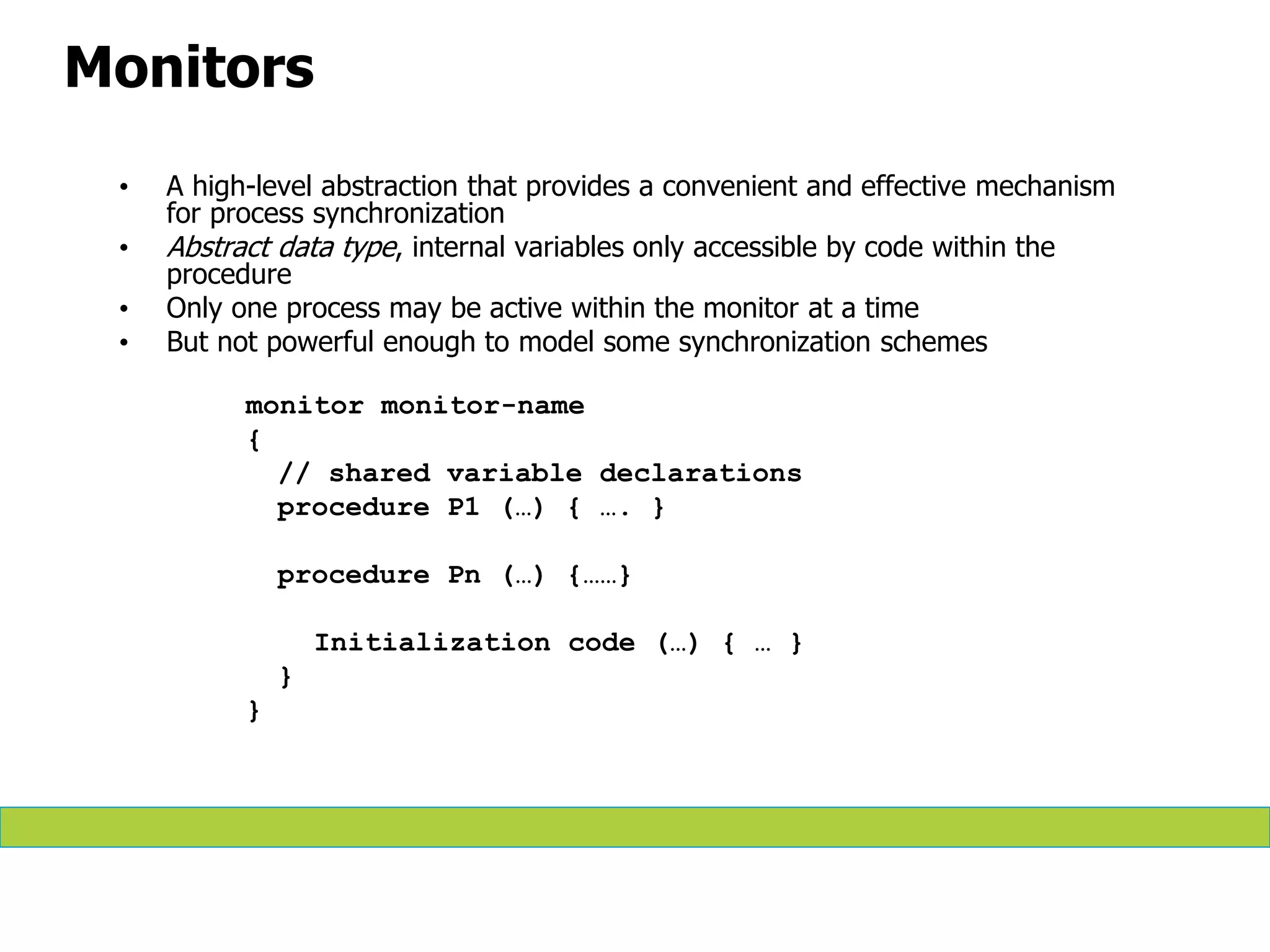
Monitors
• A high-level abstraction that provides a convenient and effective mechanism
for process synchronization
• Abstract data type, internal variables only accessible by code within the
procedure
• Only one process may be active within the monitor at a time
• But not powerful enough to model some synchronization schemes
monitor monitor-name
{
// shared variable declarations
procedure P1 (…) { …. }
procedure Pn (…) {……}
Initialization code (…) { … }
}
}
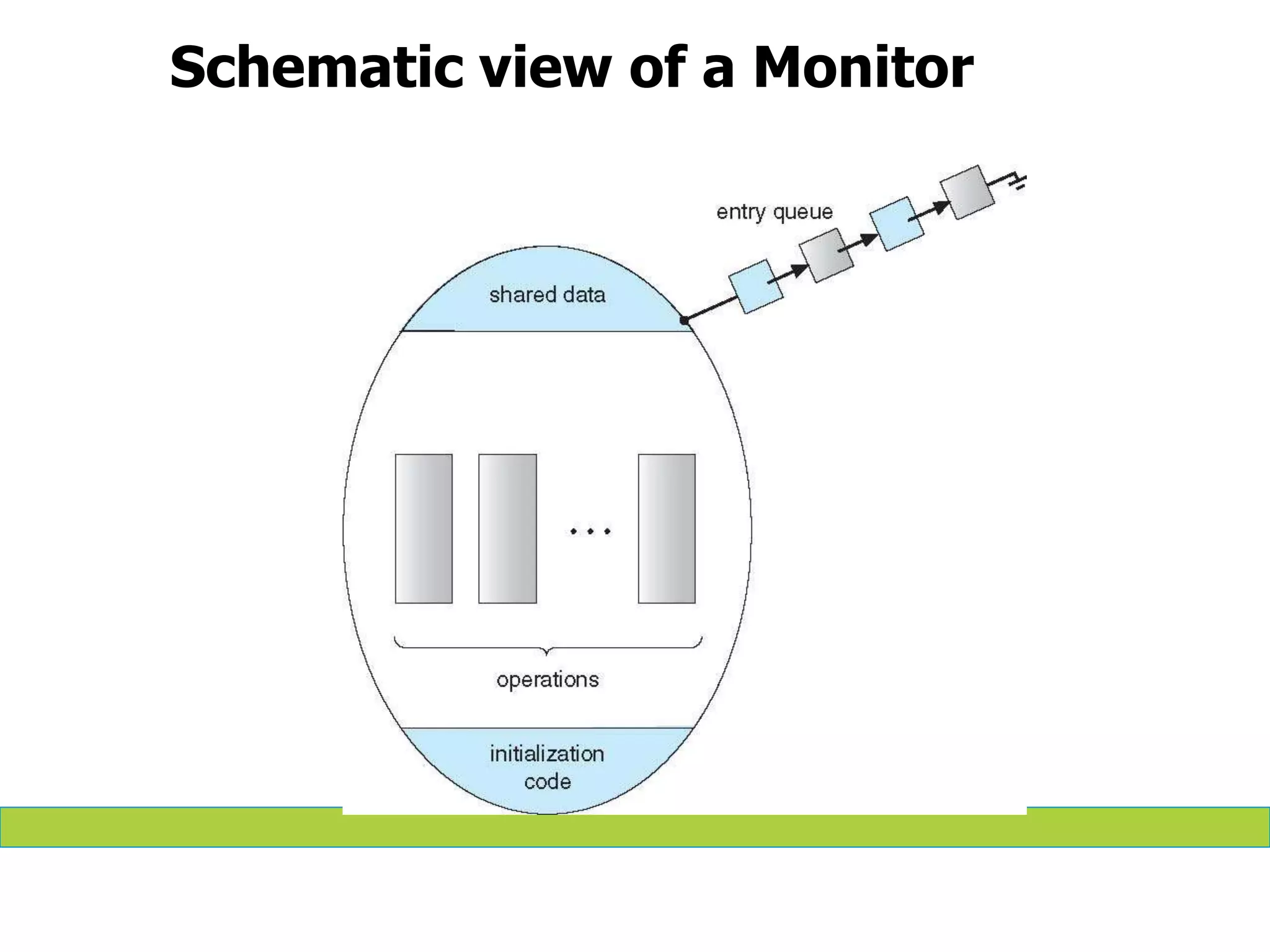
Schematic view of a Monitor
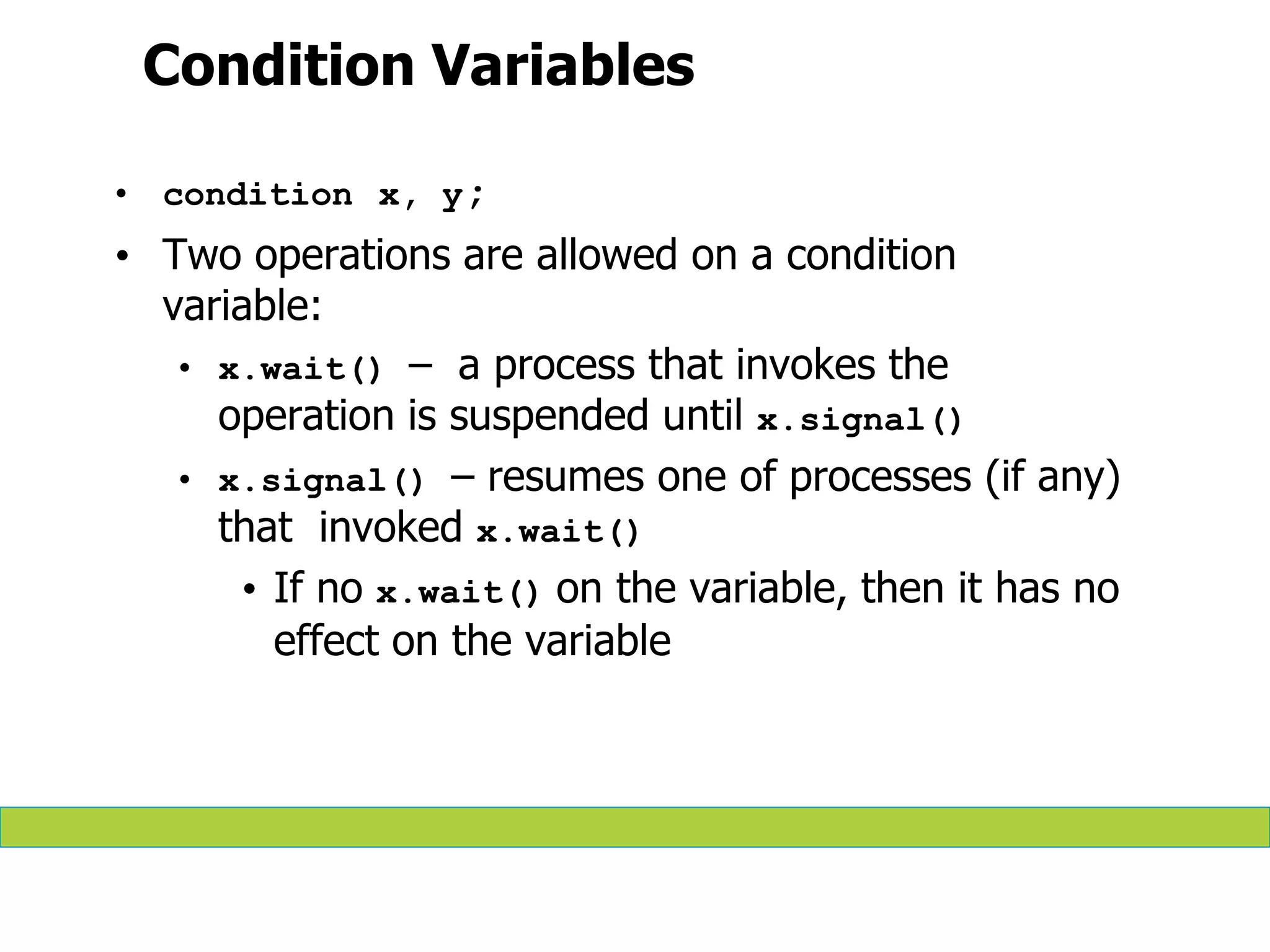
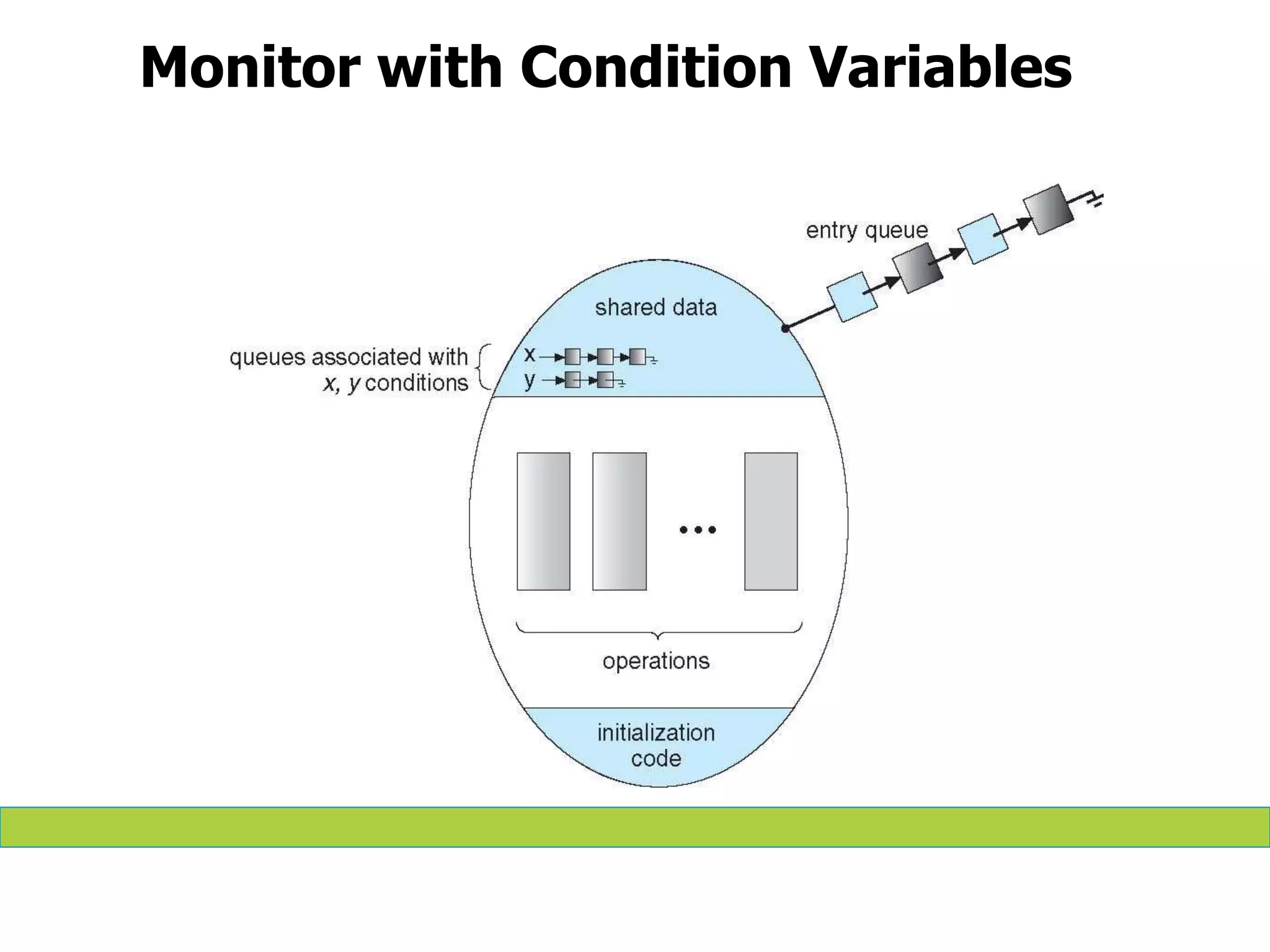
Condition Variables
• condition x, y;
• Two operations are allowed on a condition
variable:
• x.wait() – a process that invokes the
operation is suspended until x.signal()
• x.signal() – resumes one of processes (if any)
that invoked x.wait()
• If no x.wait() on the variable, then it has no
effect on the variable
Monitor with Condition Variables
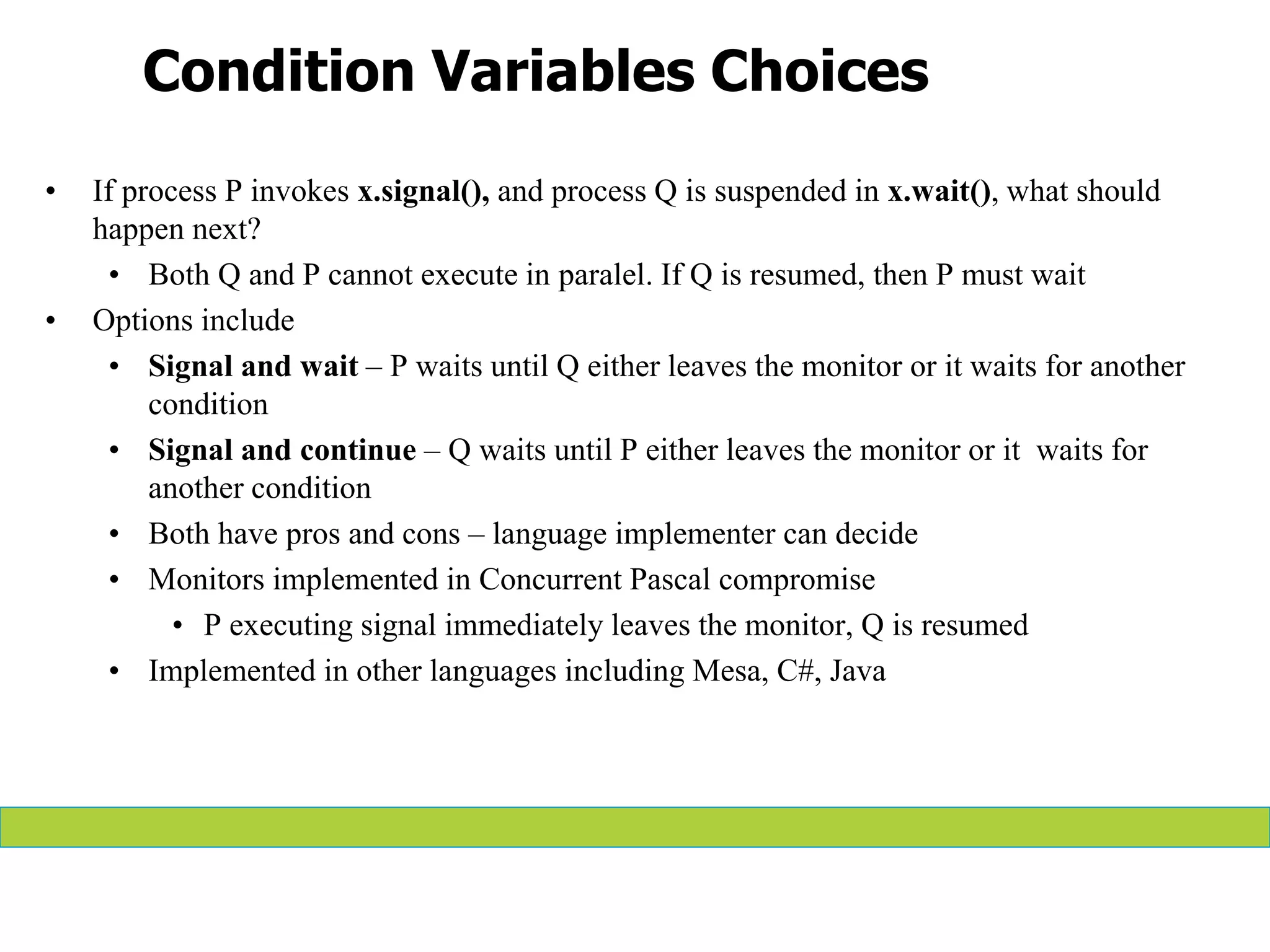
Condition Variables Choices
• If process P invokes x.signal(), and process Q is suspended in x.wait(), what should
happen next?
• Both Q and P cannot execute in paralel. If Q is resumed, then P must wait
• Options include
• Signal and wait – P waits until Q either leaves the monitor or it waits for another
condition
• Signal and continue – Q waits until P either leaves the monitor or it waits for
another condition
• Both have pros and cons – language implementer can decide
• Monitors implemented in Concurrent Pascal compromise
• P executing signal immediately leaves the monitor, Q is resumed
• Implemented in other languages including Mesa, C#, Java
Monitor Solution to Dining Philosophers
monitor DiningPhilosophers
{
enum { THINKING; HUNGRY, EATING) state [5] ;
condition self [5];
void pickup (int i) {
state[i] = HUNGRY;
test(i);
if (state[i] != EATING) self[i].wait;
}
void putdown (int i) {
state[i] = THINKING;
// test left and right neighbors
test((i + 4) % 5);
test((i + 1) % 5);
}
Solution to Dining Philosophers
(Cont.)
void test (int i) {
if ((state[(i + 4) % 5] != EATING) &&
(state[i] == HUNGRY) &&
(state[(i + 1) % 5] != EATING) ) {
state[i] = EATING ;
self[i].signal () ;
}
}
initialization_code() {
for (int i = 0; i < 5; i++)
state[i] = THINKING;
}
}
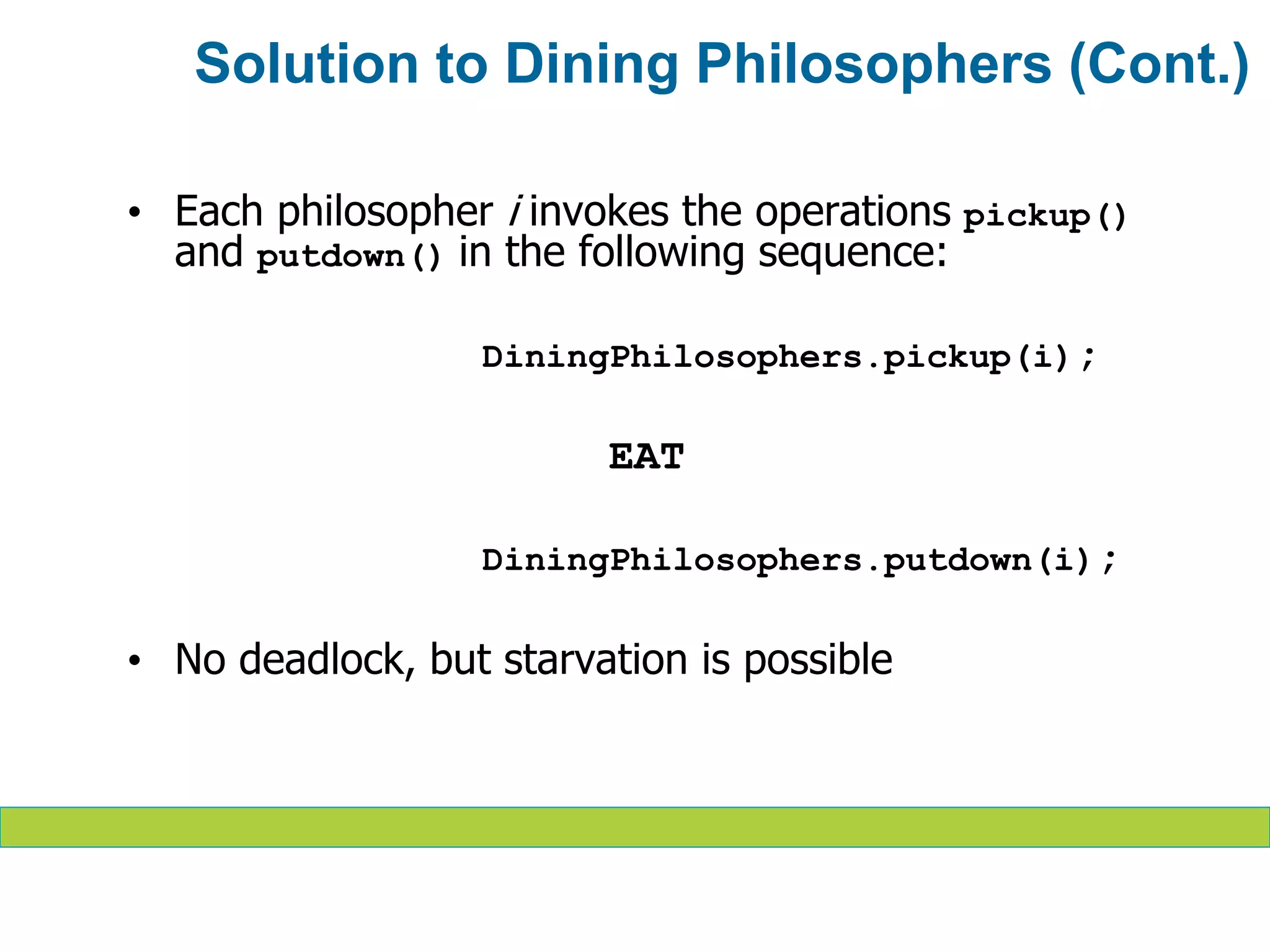
• Each philosopher i invokes the operations pickup()
and putdown() in the following sequence:
DiningPhilosophers.pickup(i);
EAT
DiningPhilosophers.putdown(i);
• No deadlock, but starvation is possible
Solution to Dining Philosophers (Cont.)
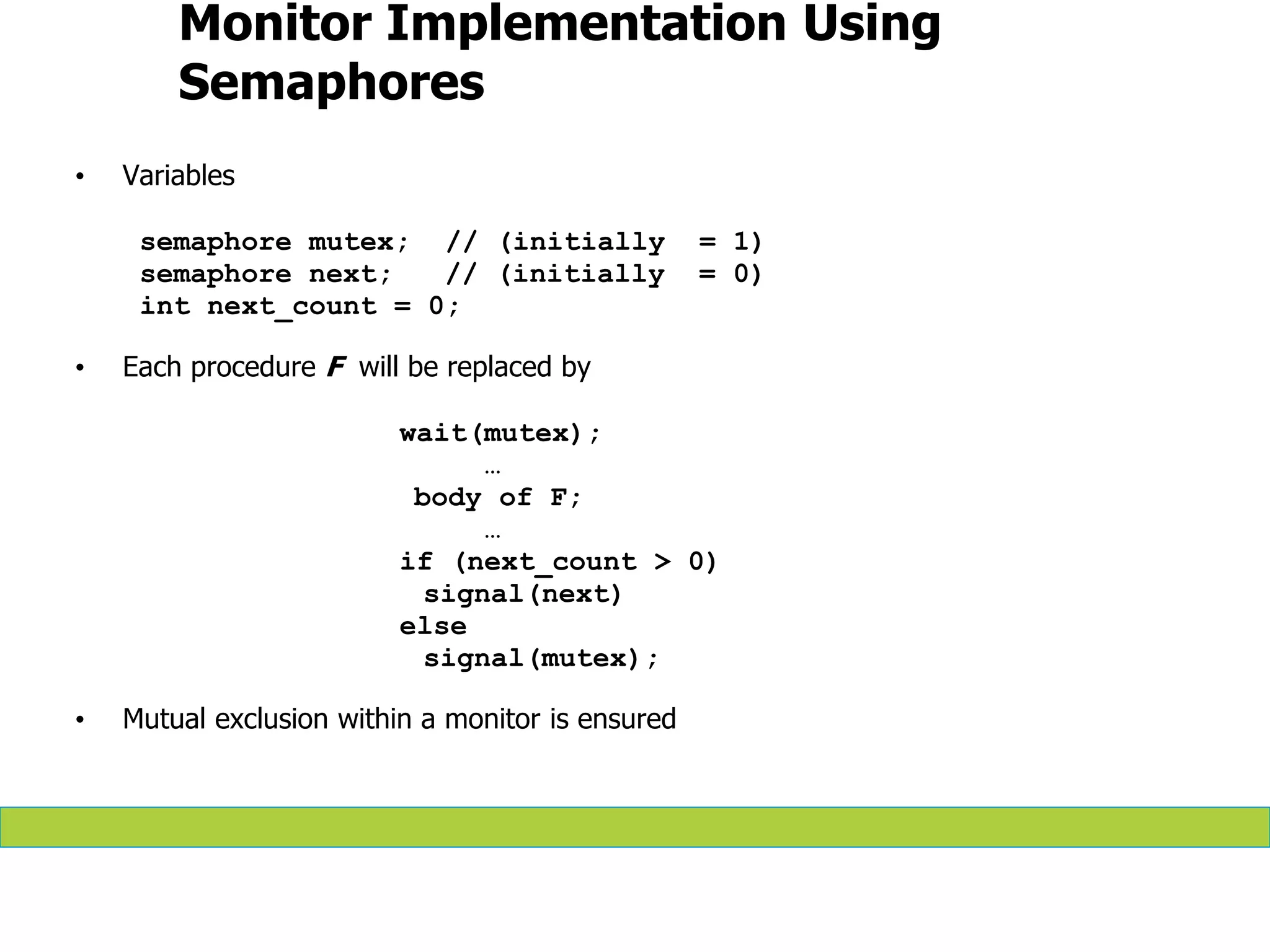
Monitor Implementation Using
Semaphores
• Variables
semaphore mutex; // (initially = 1)
semaphore next; // (initially = 0)
int next_count = 0;
• Each procedure F will be replaced by
wait(mutex);
…
body of F;
…
if (next_count > 0)
signal(next)
else
signal(mutex);
• Mutual exclusion within a monitor is ensured
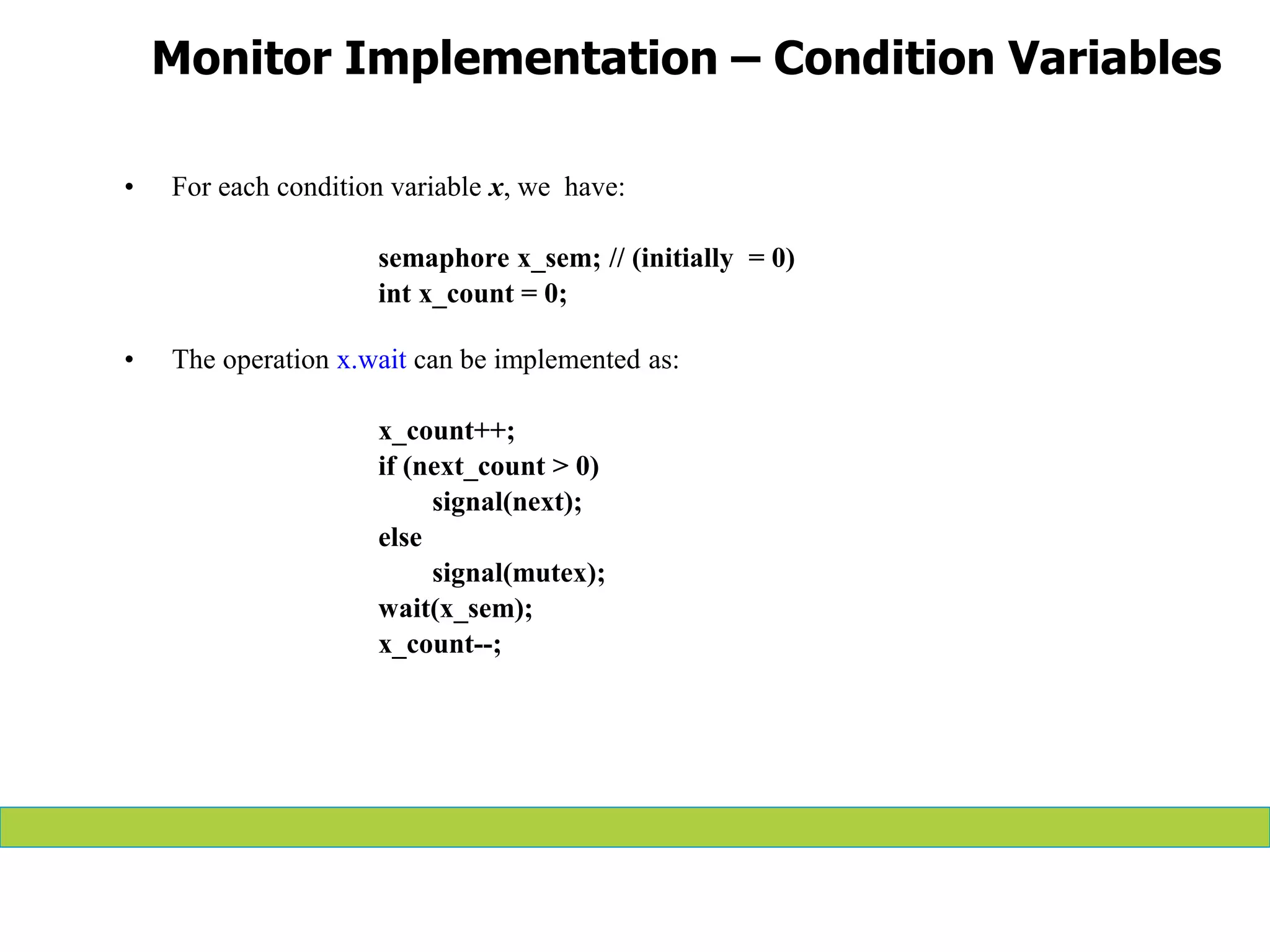
Monitor Implementation – Condition Variables
• For each condition variable x, we have:
semaphore x_sem; // (initially = 0)
int x_count = 0;
• The operation x.wait can be implemented as:
x_count++;
if (next_count > 0)
signal(next);
else
signal(mutex);
wait(x_sem);
x_count--;
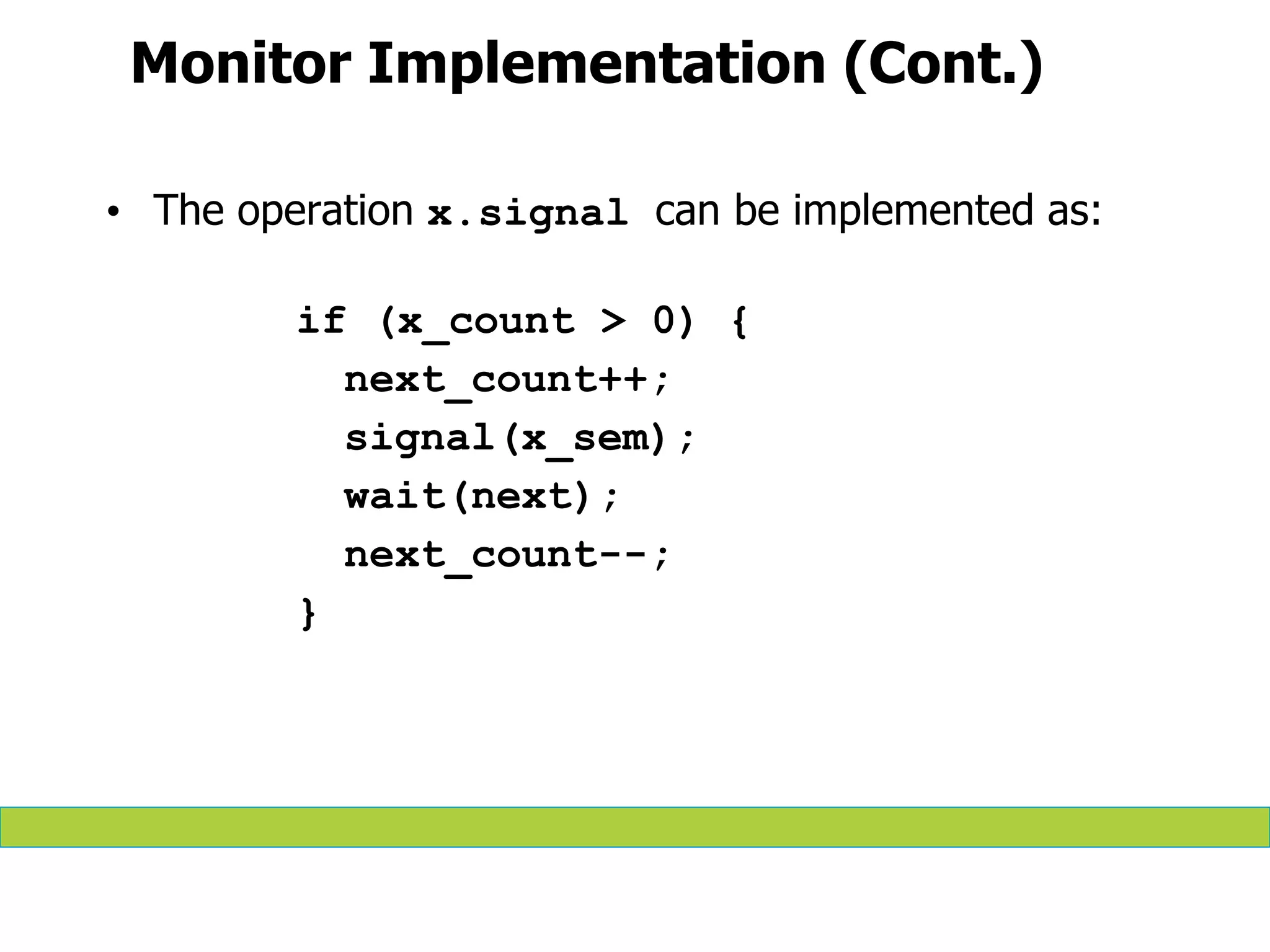
Monitor Implementation (Cont.)
• The operation x.signal can be implemented as:
if (x_count > 0) {
next_count++;
signal(x_sem);
wait(next);
next_count--;
}
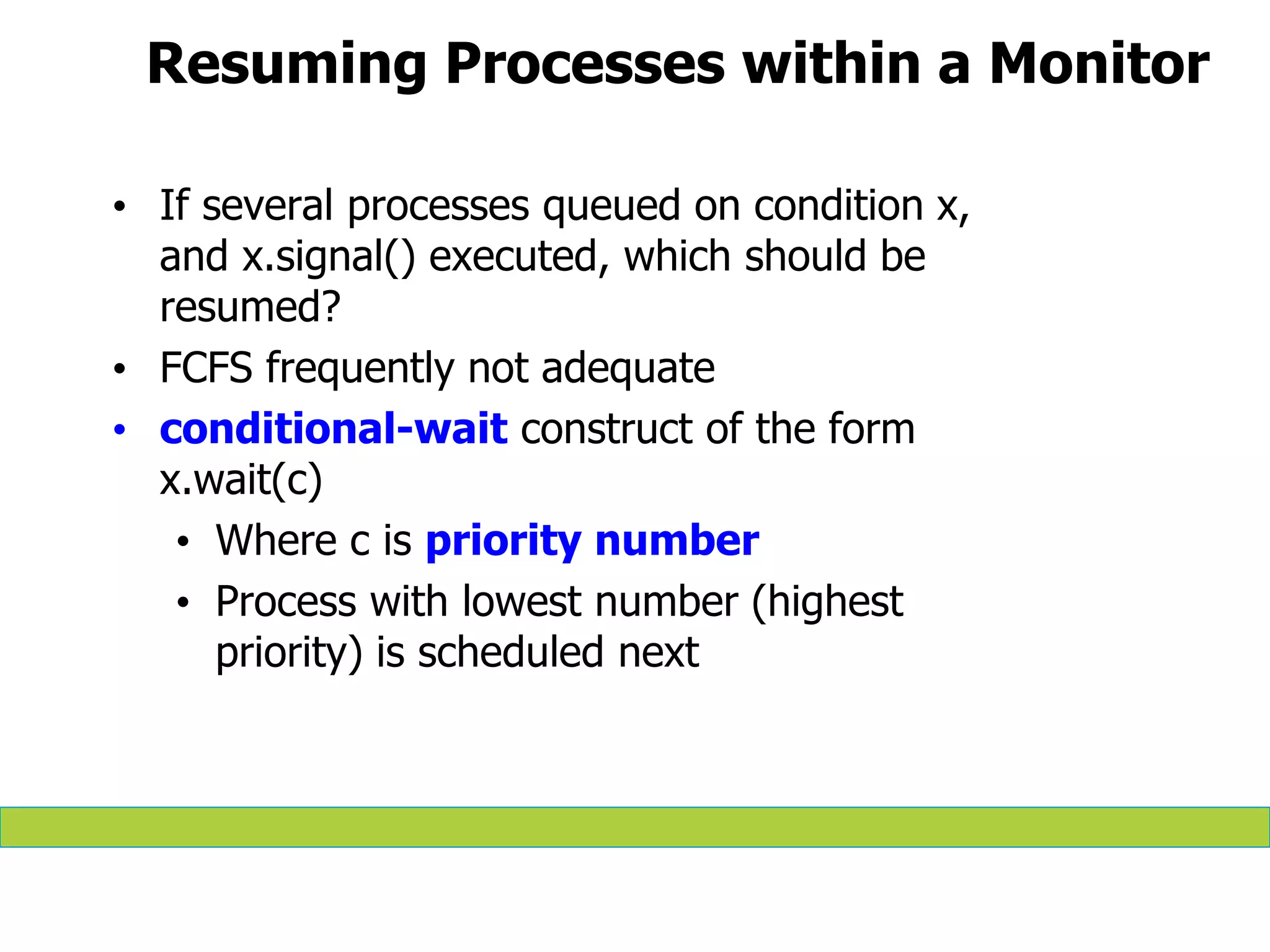
Resuming Processes within a Monitor
• If several processes queued on condition x,
and x.signal() executed, which should be
resumed?
• FCFS frequently not adequate
• conditional-wait construct of the form
x.wait(c)
• Where c is priority number
• Process with lowest number (highest
priority) is scheduled next
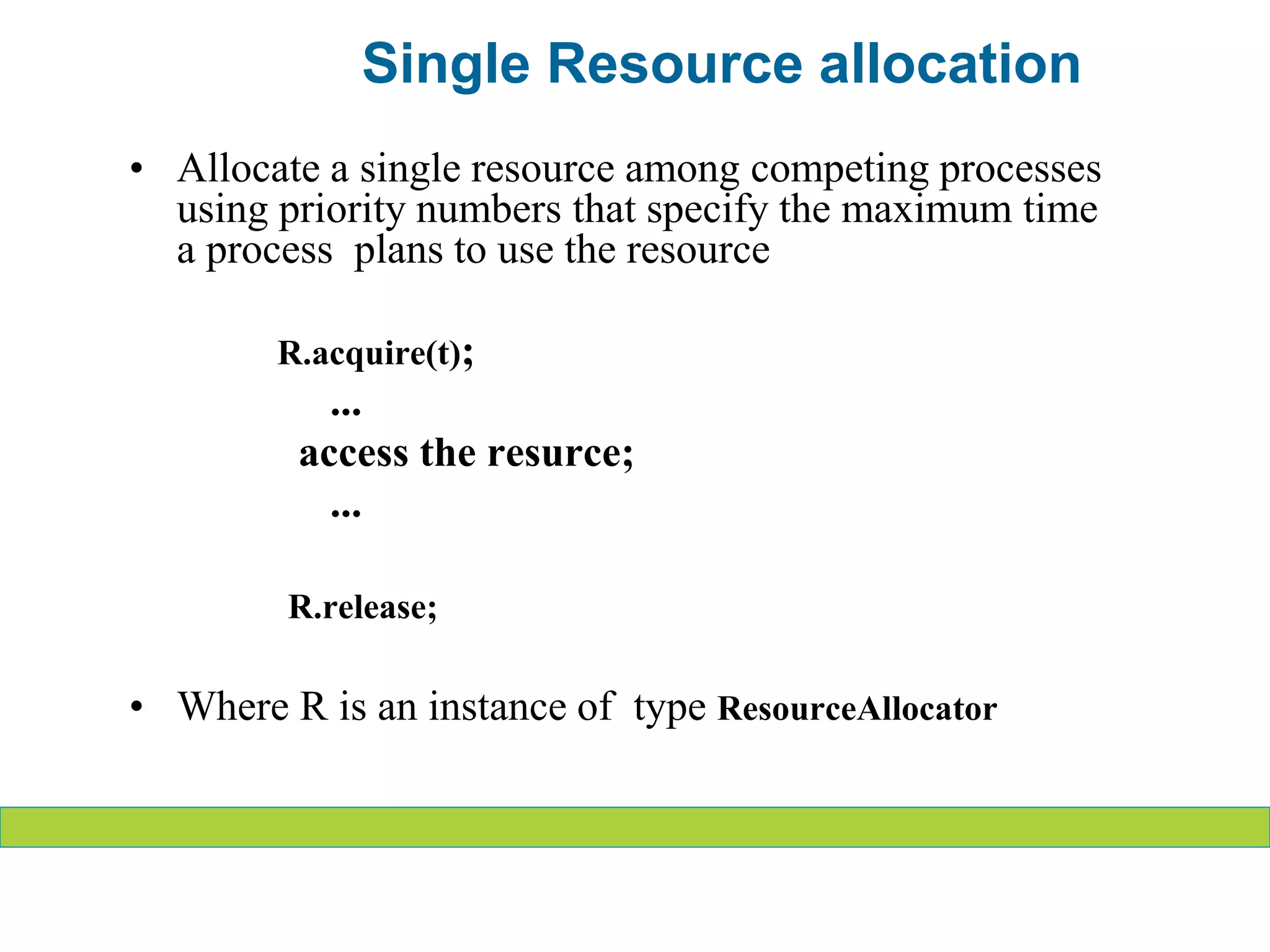
• Allocate a single resource among competing processes
using priority numbers that specify the maximum time
a process plans to use the resource
R.acquire(t);
...
access the resurce;
...
R.release;
• Where R is an instance of type ResourceAllocator
Single Resource allocation
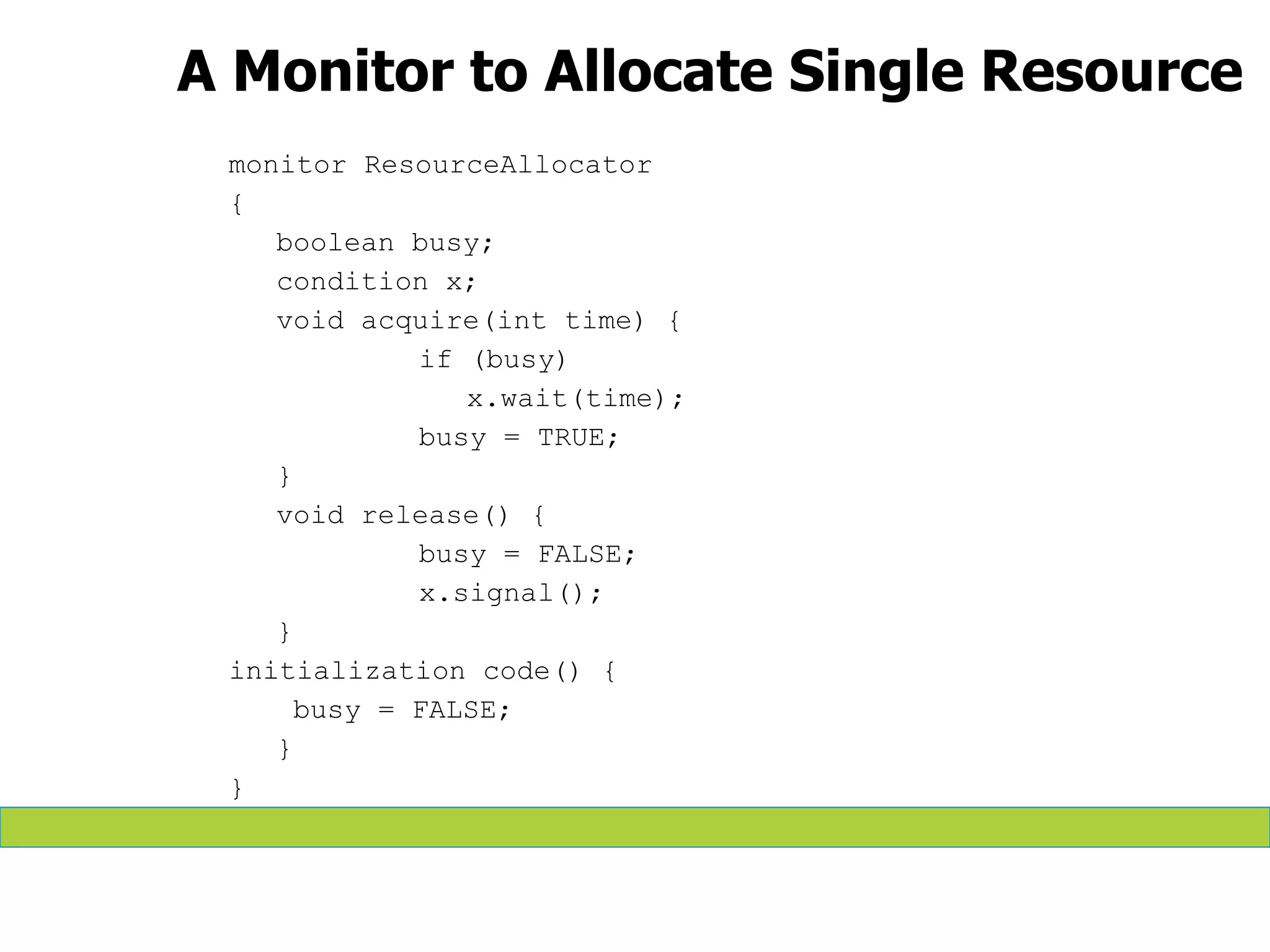
A Monitor to Allocate Single Resource
monitor ResourceAllocator
{
boolean busy;
condition x;
void acquire(int time) {
if (busy)
x.wait(time);
busy = TRUE;
}
void release() {
busy = FALSE;
x.signal();
}
initialization code() {
busy = FALSE;
}
}
Self reading
• Read About classical synchronization problems from book.
• Implementation of monitors from book in details.
• Write a program for implementation of semaphore in C++
and test that program on two or more processes.
January 4, 2023 63
Operating Systems

Lecture 5- Process Synchronization (1).pptx

  • 1.
    Operating Systems: SEng3207 Chapter Two Process Synchronization ASTU Department of CSE January 4, 2023 1 Operating Systems Lecture 5: Introduction to Process Synchronization
  • 2.
    Content • Background • TheCritical-Section Problem • Two process solutions • Peterson’s Solution • Synchronization Hardware • Mutex Locks • Semaphores • Classic Problems of Synchronization • Monitors • Synchronization Examples • Alternative Approaches
  • 3.
    Background  The cooperatingprocesses in an operating system can execute concurrently, they can be interrupted at any time during their execution, or they may be partially executed.  During interleaved execution process may communicate to each other in terms of shared data or a shared location in memory.  Also processes may need to share the access of a resource such as a files, tables etc.  In both cases, the concurrent access of the shared resource may result in inconsistency in data unless the operation of read/ write to the shared resources are not managed centrally and ordered properly.  In process synchronization we will study the consequences of shared access of resources and how to coordinate these access using some kind of operating system level synchronization protocols.
  • 4.
    Race condition • Asituation where several processes access and manipulate the same data concurrently and the outcome of the execution depends on the particular order in which the access takes place, is called a race condition • Depending upon the implementation of counter++ and counter– operation, a race condition can occur if the execution of both the processes is not ordered or enforced by operating system. • Next slide shows you various implantations of counter operation and how does race condition occur. • January 4, 2023 4 Operating Systems
  • 5.
    Race Condition • counter++could be implemented as register1 = counter register1 = register1 + 1 counter = register1 • counter-- could be implemented as register2 = counter register2 = register2 - 1 counter = register2 • Consider this execution interleaving with “count = 5” initially: S0: producer execute register1 = counter {register1 = 5} S1: producer execute register1 = register1 + 1 {register1 = 6} S2: consumer execute register2 = counter {register2 = 5} S3: consumer execute register2 = register2 – 1 {register2 = 4} S4: producer execute counter = register1 {counter = 6 } S5: consumer execute counter = register2 {counter = 4}
  • 6.
    Critical Section problem •Inconsistency in the state of data, files or tables being accessed by the multiple process at the same time can be attributed to a specific section of code which we call as critical section. • Critical section is that part of code executing which in concurrent fashion, two process may come in the state of confusion or inconsistency. • Critical section problem is how to allow to enter and to execute critical section code to different cooperating processes, so that they are able to execute this code in synchronized fashion, as well as they maintain the consistency January 4, 2023 6 Operating Systems
  • 7.
    Solution to criticalsection problem • In general only one process should be allowed to execute the critical section code. • Operating system shall enforce a protocol that every participating process should follow in order to enter and exit from the critical section. • A simple solution to manage the entry of single process in critical segment of code is to manage a variable turn which takes two values, one if a process has its turn to execute the critical section code otherwise zero. January 4, 2023 7 Operating Systems
  • 8.
    Critical Section • Generalstructure of process Pi
  • 9.
    Algorithm for ProcessPi do { while (turn == j); critical section turn = j; remainder section } while (true);
  • 10.
    Properties of avalid Solution to Critical-Section Problem Consider system of n processes {p0, p1, … pn-1} then we define formal solution to the critical section must provide the following guarantees: 1. Mutual Exclusion - If process Pi is executing in its critical section, then no other processes can be executing in their critical sections 2. Progress - If no process is executing in its critical section and there exist some processes that wish to enter their critical section, then the selection of the processes that will enter the critical section next cannot be postponed indefinitely No assumption concerning relative speed of the n processes
  • 11.
    Critical-Section Handling inOS 3. Bounded Waiting - A bound must exist on the number of times that other processes are allowed to enter their critical sections after a process has made a request to enter its critical section and before that request is granted  Assume that each process executes at a nonzero speed 4. No preemption: Two approaches depending on if kernel is preemptive or non- preemptive • Preemptive – allows preemption of process when running in kernel mode • Non-preemptive – runs until exits kernel mode, blocks, or voluntarily yields CPU • Essentially free of race conditions in kernel mode
  • 12.
    Peterson’s Solution This solutionprovide an algorithmic description of solving the problem of critical section, this is a two process solution. • Assume that the load and store machine-language instructions are atomic; that is, cannot be interrupted • The two processes share two variables: • int turn; • Boolean flag[2] • The variable turn indicates whose turn it is to enter the critical section • The flag array is used to indicate if a process is ready to enter the critical section. flag[i] = true implies that process Pi is ready!
  • 13.
    Algorithm • To enterthe critical section, process Pi first sets flag[i] to be true and then sets turn to the value j, thereby asserting that if the other process wishes to enter the critical section, it can do so. • If both processes try to enter at the same time, turn will be set to both i and j at roughly the same time. Only one of these assignments will last; the other will occur but will be overwritten immediately. • The eventual value of turn determines which of the two processes is allowed to enter its critical section first. January 4, 2023 13 Operating Systems
  • 14.
    Algorithm for ProcessPi do { flag[i] = true; turn = j; while (flag[j] && turn = = j); critical section flag[i] = false; remainder section } while (true);
  • 15.
    Both processes code January4, 2023 15 Operating Systems
  • 16.
    Cross check theguarantees • In the Peterson’s Algorithm it can be Proved that the three Critical Section requirement are fulfilled by this algorithm: 1. Mutual exclusion is preserved Pi enters CS only if: either flag[j] = false or turn = i 2. Progress requirement is satisfied 3. Bounded-waiting requirement is met Limitation: All the algorithms discussed till now don’t work for N process critical section problem. That’s why we design hardware based solutions to guarantee n process synchronization.
  • 17.
    Synchronization Hardware Alternatively, Manysystems provide hardware support for implementing the critical section code. Hardware level synchronization is based on the idea of locking. i.e. Protecting critical regions via locks. Uniprocessor Systems – The uniprocessor systems can implement locks by disabling the interrupts. • Currently running code would execute without preemption • Generally too inefficient on multiprocessor systems, because disabling interrupts on multiprocessros is time consuming and may decrease system efficiency As a result of this, operating systems using this technique is not broadly scalable.
  • 18.
    Atomic instructions • Modernmachines provide special atomic hardware instructions • Atomic = non-interruptible These atomic instructions either test and set the value of a memory word, or they can swap the content of two memory locations without being interrupted. January 4, 2023 18 Operating Systems
  • 19.
    Test_and_set Instruction Definition: boolean test_and_set(boolean *target) { boolean rv = *target; *target = TRUE; return rv: } 1. Executed atomically 2. Returns the original value of passed parameter 3. Set the new value of passed parameter to “TRUE”.
  • 20.
    Solution to criticalsection problem using test and set • The solution to critical section problem can be provided by using test and set instruction • The process which executes the test and set instruction will hold the lock by initializing a Boolean lock variable to false. • Since the memory being shared is locked by a process, no other process can enter the CS as the instruction is atomic. January 4, 2023 20 Operating Systems
  • 21.
    Solution using testandset January4, 2023 21 Operating Systems
  • 22.
    Solution to criticalsection problem using compare and swap • Compare and swap operation is atomic in nature and can be used to implement a solution of critical section problem. • Mutual exclusion can be provided as follows: a global variable (lock) is declared and is initialized to 0. The first process that invokes compare and swap() will set lock to 1. It will then enter its critical section, because the original value of lock was equal to the expected value of 0. Subsequent calls to compare and swap() will not succeed, because lock now is not equal to the expected value of 0. When a process exits its critical section, it sets lock back to 0, which allows another process to enter its critical section. The structure of process Pi is shown in Figure (5.6 page no. 211 Galvin) • This method do not satisfy bounded wait condition, next we provide a solution with test and set instruction that satisfies all the CS conditions. January 4, 2023 22 Operating Systems
  • 23.
    Solution January 4, 202323 Operating Systems
  • 24.
    Mutex Locks  Previoussolutions are complicated and generally inaccessible to application programmers  OS designers build software tools to solve critical section problem  Simplest is mutex lock  Protect a critical section by first acquire() a lock then release() the lock  Boolean variable indicating if lock is available or not  Calls to acquire() and release() must be atomic  Usually implemented via hardware atomic instructions  But this solution requires busy waiting  This lock therefore called a spinlock
  • 25.
    Semaphore • A semaphoreis another way of implementing synchronization among various processes. • A semaphore is an integer variable S, • Values of S are used by processes to make decisions to enter the critical section and to wait for other processes to exit their critical section. • Semaphore uses two functions called wait(S) and Signal(S) in order to communicate the status of critical section among cooperating processes. • Wait operation simply decrement the current value of S and goes in busy wait loop • Signal operation increment the value of S by one. January 4, 2023 25 Operating Systems
  • 26.
    Semaphore • Definition ofthe wait() operation wait(S) { while (S <= 0) ; // busy wait S--; } • Definition of the signal() operation signal(S) { S++; }
  • 27.
    CS solution usingsemaphore • Semaphore integer wait and signal are atomic operations, and if a process modifies the value of semaphore no other process is allowed to edit the value, unless the original process is out of CS. • Various protocols can be designed using semaphore to implement the solution of critical section problem for cooperating processes. • Operating systems generally use Binary Semaphore to implement synchronization protocol between two processes and a counting semaphore for implementing the synchronization among more than two processes. January 4, 2023 27 Operating Systems
  • 28.
    Semaphore Usage • Countingsemaphore – integer value can range over an unrestricted domain • Binary semaphore – integer value can range only between 0 and 1 • Same as a mutex lock • Can solve various synchronization problems • Consider P1 and P2 that require S1 to happen before S2 Create a semaphore “synch” initialized to 0 P1: S1; signal(synch); P2: wait(synch); S2; • Can implement a counting semaphore S as a binary semaphore
  • 29.
    Semaphore Implementation • Mustguarantee that no two processes can execute the wait() and signal() on the same semaphore at the same time • Thus, the implementation becomes the critical section problem where the wait and signal code are placed in the critical section • Could now have busy waiting in critical section implementation • But implementation code is short • Little busy waiting if critical section rarely occupied • Note that applications may spend lots of time in critical sections and therefore this is not a good solution
  • 30.
    Semaphore Implementation withno Busy waiting • With each semaphore there is an associated waiting queue • Each entry in a waiting queue has two data items: • value (of type integer) • pointer to next record in the list • Two operations: • block – place the process invoking the operation on the appropriate waiting queue • wakeup – remove one of processes in the waiting queue and place it in the ready queue • typedef struct{ int value; struct process *list; } semaphore;
  • 31.
    Solution using semaphore January4, 2023 31 Operating Systems
  • 32.
    Semaphore with No-Busywaiting January 4, 2023 32 Operating Systems
  • 33.
    Deadlock and Starvation •Deadlock – two or more processes are waiting indefinitely for an event that can be caused by only one of the waiting processes • Let S and Q be two semaphores initialized to 1 P0 P1 wait(S); wait(Q); wait(Q); wait(S); ... ... signal(S); signal(Q); signal(Q); signal(S); • Starvation – indefinite blocking • A process may never be removed from the semaphore queue in which it is suspended • Priority Inversion – Scheduling problem when lower-priority process holds a lock needed by higher-priority process • Solved via priority-inheritance protocol
  • 34.
    Classical Problems ofSynchronization • Following classical problems are used to test newly- proposed synchronization schemes • Bounded-Buffer Problem • Producer Consumer • Readers and Writers Problem • Dining-Philosophers Problem
  • 35.
    Bounded-Buffer Problem • nbuffers, each can hold one item • Semaphore mutex initialized to the value 1 • Semaphore full initialized to the value 0 • Semaphore empty initialized to the value n
  • 36.
    Bounded Buffer Problem(Cont.) • The structure of the producer process do { ... /* produce an item in next_produced */ ... wait(empty); wait(mutex); ... /* add next produced to the buffer */ ... signal(mutex); signal(full); } while (true);
  • 37.
    Illustration of theproblem: Example • In a Producer Consumer Process suppose, the value of counter is 5 at an instant of time. • If producer as well as consumer both are allowed to access the buffer and they call counter++ and counter– operations respectively without a predefined order, it may lead to a confusion on the final value of counter • Counter can have a value of 4, 5 or 6 depending upon who executed the statement first. • Uncertainty in value of counter variable may cause confusion for both the processes. January 4, 2023 37 Operating Systems
  • 38.
    Producer while (true) { /*produce an item in next produced */ while (counter == BUFFER_SIZE) ; /* do nothing */ buffer[in] = next_produced; in = (in + 1) % BUFFER_SIZE; counter++; }
  • 39.
    Consumer while (true) { while(counter == 0) ; /* do nothing */ next_consumed = buffer[out]; out = (out + 1) % BUFFER_SIZE; counter--; /* consume the item in next consumed */ }
  • 40.
    Bounded Buffer Problem(Cont.) The structure of the consumer process Do { wait(full); wait(mutex); ... /* remove an item from buffer to next_consumed */ ... signal(mutex); signal(empty); ... /* consume the item in next consumed */ ... } while (true);
  • 41.
    Readers-Writers Problem • Adata set is shared among a number of concurrent processes • Readers – only read the data set; they do not perform any updates • Writers – can both read and write • Problem – allow multiple readers to read at the same time • Only one single writer can access the shared data at the same time • Several variations of how readers and writers are considered – all involve some form of priorities • Shared Data • Data set • Semaphore rw_mutex initialized to 1 • Semaphore mutex initialized to 1 • Integer read_count initialized to 0
  • 42.
    Readers-Writers Problem (Cont.) •The structure of a writer process do { wait(rw_mutex); ... /* writing is performed */ ... signal(rw_mutex); } while (true);
  • 43.
    Readers-Writers Problem (Cont.) •The structure of a reader process do { wait(mutex); read_count++; if (read_count == 1) wait(rw_mutex); signal(mutex); ... /* reading is performed */ ... wait(mutex); read count--; if (read_count == 0) signal(rw_mutex); signal(mutex); } while (true);
  • 44.
    Readers-Writers Problem Variations •First variation – no reader kept waiting unless writer has permission to use shared object • Second variation – once writer is ready, it performs the write ASAP • Both may have starvation leading to even more variations • Problem is solved on some systems by kernel providing reader-writer locks
  • 45.
    Dining-Philosophers Problem • Philosophersspend their lives alternating thinking and eating • Don’t interact with their neighbors, occasionally try to pick up 2 chopsticks (one at a time) to eat from bowl • Need both to eat, then release both when done • In the case of 5 philosophers • Shared data • Bowl of rice (data set) • Semaphore chopstick [5] initialized to 1
  • 46.
    Dining-Philosophers Problem Algorithm •The structure of Philosopher i: do { wait (chopstick[i] ); wait (chopStick[ (i + 1) % 5] ); // eat signal (chopstick[i] ); signal (chopstick[ (i + 1) % 5] ); // think } while (TRUE); • What is the problem with this algorithm?
  • 47.
    Dining-Philosophers Problem Algorithm(Cont.) • Deadlock handling • Allow at most 4 philosophers to be sitting simultaneously at the table. • Allow a philosopher to pick up the forks only if both are available (picking must be done in a critical section. • Use an asymmetric solution -- an odd- numbered philosopher picks up first the left chopstick and then the right chopstick. Even- numbered philosopher picks up first the right chopstick and then the left chopstick.
  • 48.
    Problems with Semaphores •Incorrect use of semaphore operations: • signal (mutex) …. wait (mutex) • wait (mutex) … wait (mutex) • Omitting of wait (mutex) or signal (mutex) (or both) • Deadlock and starvation are possible.
  • 49.
    Monitors • A high-levelabstraction that provides a convenient and effective mechanism for process synchronization • Abstract data type, internal variables only accessible by code within the procedure • Only one process may be active within the monitor at a time • But not powerful enough to model some synchronization schemes monitor monitor-name { // shared variable declarations procedure P1 (…) { …. } procedure Pn (…) {……} Initialization code (…) { … } } }
  • 50.
  • 51.
    Condition Variables • conditionx, y; • Two operations are allowed on a condition variable: • x.wait() – a process that invokes the operation is suspended until x.signal() • x.signal() – resumes one of processes (if any) that invoked x.wait() • If no x.wait() on the variable, then it has no effect on the variable
  • 52.
  • 53.
    Condition Variables Choices •If process P invokes x.signal(), and process Q is suspended in x.wait(), what should happen next? • Both Q and P cannot execute in paralel. If Q is resumed, then P must wait • Options include • Signal and wait – P waits until Q either leaves the monitor or it waits for another condition • Signal and continue – Q waits until P either leaves the monitor or it waits for another condition • Both have pros and cons – language implementer can decide • Monitors implemented in Concurrent Pascal compromise • P executing signal immediately leaves the monitor, Q is resumed • Implemented in other languages including Mesa, C#, Java
  • 54.
    Monitor Solution toDining Philosophers monitor DiningPhilosophers { enum { THINKING; HUNGRY, EATING) state [5] ; condition self [5]; void pickup (int i) { state[i] = HUNGRY; test(i); if (state[i] != EATING) self[i].wait; } void putdown (int i) { state[i] = THINKING; // test left and right neighbors test((i + 4) % 5); test((i + 1) % 5); }
  • 55.
    Solution to DiningPhilosophers (Cont.) void test (int i) { if ((state[(i + 4) % 5] != EATING) && (state[i] == HUNGRY) && (state[(i + 1) % 5] != EATING) ) { state[i] = EATING ; self[i].signal () ; } } initialization_code() { for (int i = 0; i < 5; i++) state[i] = THINKING; } }
  • 56.
    • Each philosopheri invokes the operations pickup() and putdown() in the following sequence: DiningPhilosophers.pickup(i); EAT DiningPhilosophers.putdown(i); • No deadlock, but starvation is possible Solution to Dining Philosophers (Cont.)
  • 57.
    Monitor Implementation Using Semaphores •Variables semaphore mutex; // (initially = 1) semaphore next; // (initially = 0) int next_count = 0; • Each procedure F will be replaced by wait(mutex); … body of F; … if (next_count > 0) signal(next) else signal(mutex); • Mutual exclusion within a monitor is ensured
  • 58.
    Monitor Implementation –Condition Variables • For each condition variable x, we have: semaphore x_sem; // (initially = 0) int x_count = 0; • The operation x.wait can be implemented as: x_count++; if (next_count > 0) signal(next); else signal(mutex); wait(x_sem); x_count--;
  • 59.
    Monitor Implementation (Cont.) •The operation x.signal can be implemented as: if (x_count > 0) { next_count++; signal(x_sem); wait(next); next_count--; }
  • 60.
    Resuming Processes withina Monitor • If several processes queued on condition x, and x.signal() executed, which should be resumed? • FCFS frequently not adequate • conditional-wait construct of the form x.wait(c) • Where c is priority number • Process with lowest number (highest priority) is scheduled next
  • 61.
    • Allocate asingle resource among competing processes using priority numbers that specify the maximum time a process plans to use the resource R.acquire(t); ... access the resurce; ... R.release; • Where R is an instance of type ResourceAllocator Single Resource allocation
  • 62.
    A Monitor toAllocate Single Resource monitor ResourceAllocator { boolean busy; condition x; void acquire(int time) { if (busy) x.wait(time); busy = TRUE; } void release() { busy = FALSE; x.signal(); } initialization code() { busy = FALSE; } }
  • 63.
    Self reading • ReadAbout classical synchronization problems from book. • Implementation of monitors from book in details. • Write a program for implementation of semaphore in C++ and test that program on two or more processes. January 4, 2023 63 Operating Systems