1 
Distributed Systems 
IT-601 
Instructor: Prof. Mayank Jain 
IT Deparment 
Lecture Note: Unit-1,2
2 
Introduction to Distributed Systems 
 Why do we develop distributed systems? 
 availability of powerful yet cheap microprocessors (PCs, 
workstations), continuing advances in communication technology, 
 What is a distributed system? 
 A distributed system is a collection of independent computers that 
appear to the users of the system as a single system. 
 Examples: 
 Network of workstations 
 Distributed manufacturing system (e.g., automated assembly line) 
 Network of branch office computers
3 
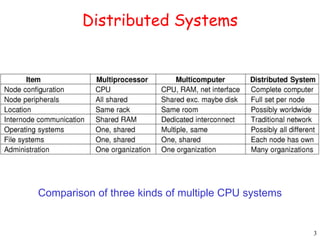
Distributed Systems 
Comparison of three kinds of multiple CPU systems
4 
Advantages of Distributed Systems 
over Centralized Systems 
• Economics: a collection of microprocessors offer a better 
price/performance than mainframes. Low price/performance ratio: cost 
effective way to increase computing power. 
• Speed: a distributed system may have more total computing power 
than a mainframe. Ex. 10,000 CPU chips, each running at 50 MIPS. 
Not possible to build 500,000 MIPS single processor since it would 
require 0.002 nsec instruction cycle. Enhanced performance through 
load distributing. 
• Inherent distribution: Some applications are inherently distributed. Ex. 
a supermarket chain. 
• Reliability: If one machine crashes, the system as a whole can still 
survive. Higher availability and improved reliability. 
• Incremental growth: Computing power can be added in small 
increments. Modular expandability 
• Another deriving force: the existence of large number of personal 
computers, the need for people to collaborate and share information.
5 
Advantages of Distributed Systems 
over Independent PCs 
 Data sharing: allow many users to access to a 
common data base 
 Resource Sharing: expensive peripherals like 
color printers 
 Communication: enhance human-to-human 
communication, e.g., email, chat 
 Flexibility: spread the workload over the 
available machines
6 
Disadvantages of Distributed Systems 
 Software: difficult to develop software for 
distributed systems 
 Network: saturation, lossy transmissions 
 Security: easy access also applies to secrete 
data
7 
Software Concepts 
• Software more important for users 
• Two types: 
1. Network Operating Systems 
2. (True) Distributed Systems
8 
Network Operating Systems 
 loosely-coupled software on loosely-coupled hardware 
 A network of workstations connected by LAN 
 each machine has a high degree of autonomy 
o rlogin machine 
o rcp machine1:file1 machine2:file2 
 Files servers: client and server model 
 Clients mount directories on file servers 
 Best known network OS: 
o Sun’s NFS (network file servers) for shared file systems (Fig. 
9-11) 
 a few system-wide requirements: format and meaning 
of all the messages exchanged
9 
NFS (Network File System) 
 NFS Architecture 
 Server exports directories 
 Clients mount exported directories 
 NSF Protocols 
 For handling mounting 
 For read/write: no open/close, stateless 
 NSF Implementation
10 
(True) Distributed Systems 
 tightly-coupled software on loosely-coupled hardware 
 provide a single-system image or a virtual uniprocessor 
 a single, global interprocess communication 
mechanism, process management, file system; the 
same system call interface everywhere 
 Ideal definition: 
“ A distributed system runs on a collection of computers that do 
not have shared memory, yet looks like a single computer to its 
users.”
11 
Design Issues of Distributed Systems 
• Transparency 
• Flexibility 
• Reliability 
• Performance 
• Scalability
12 
1. Transparency 
• How to achieve the single-system image, i.e., how to 
make a collection of computers appear as a single 
computer. 
• Hiding all the distribution from the users as well as 
the application programs can be achieved at two 
levels: 
1) hide the distribution from users 
2) at a lower level, make the system look transparent to 
programs. 
1) and 2) requires uniform interfaces such as access to 
files, communication.
13 
2. Flexibility 
• Make it easier to change 
• Monolithic Kernel: systems calls are trapped and 
executed by the kernel. All system calls are served 
by the kernel, e.g., UNIX. 
• Microkernel: provides minimal services. 
• IPC 
• some memory management 
• some low-level process management and scheduling 
• low-level i/o (E.g., Mach can support multiple file 
systems, multiple system interfaces.)
14 
3. Reliability 
• Distributed system should be more reliable than 
single system. Example: 3 machines with .95 
probability of being up. 1-.05**3 probability of being 
up. 
– Availability: fraction of time the system is usable. 
Redundancy improves it. 
– Need to maintain consistency 
– Need to be secure 
– Fault tolerance: need to mask failures, recover from 
errors.
15 
4. Performance 
• Without gain on this, why bother with distributed 
systems. 
• Performance loss due to communication delays: 
– fine-grain parallelism: high degree of interaction 
– coarse-grain parallelism 
• Performance loss due to making the system fault 
tolerant.
16 
5. Scalability 
• Systems grow with time or become obsolete. 
• Techniques that require resources linearly in terms of 
the size of the system are not scalable. (e.g., 
broadcast based query won't work for large 
distributed systems.) 
• Examples of bottlenecks 
o Centralized components: a single mail server 
o Centralized tables: a single URL address book 
o Centralized algorithms: routing based on complete information
17 
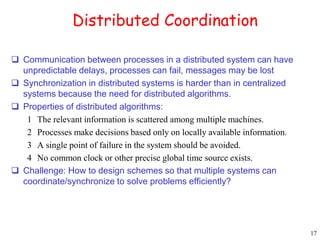
Distributed Coordination 
 Communication between processes in a distributed system can have 
unpredictable delays, processes can fail, messages may be lost 
 Synchronization in distributed systems is harder than in centralized 
systems because the need for distributed algorithms. 
 Properties of distributed algorithms: 
1 The relevant information is scattered among multiple machines. 
2 Processes make decisions based only on locally available information. 
3 A single point of failure in the system should be avoided. 
4 No common clock or other precise global time source exists. 
 Challenge: How to design schemes so that multiple systems can 
coordinate/synchronize to solve problems efficiently?
Local clock time 
18 
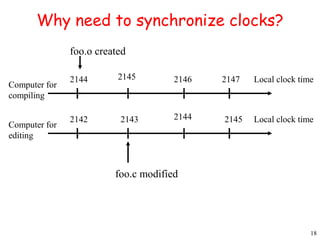
Why need to synchronize clocks? 
foo.o created 
2144 
2145 2146 2147 
2142 2143 2144 2145 
foo.c modified 
Computer for 
compiling 
Computer for 
editing 
Local clock time
19 
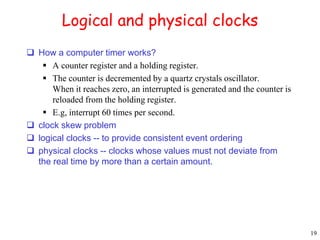
Logical and physical clocks 
 How a computer timer works? 
 A counter register and a holding register. 
 The counter is decremented by a quartz crystals oscillator. 
When it reaches zero, an interrupted is generated and the counter is 
reloaded from the holding register. 
 E.g, interrupt 60 times per second. 
 clock skew problem 
 logical clocks -- to provide consistent event ordering 
 physical clocks -- clocks whose values must not deviate from 
the real time by more than a certain amount.
20 
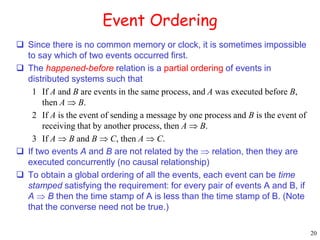
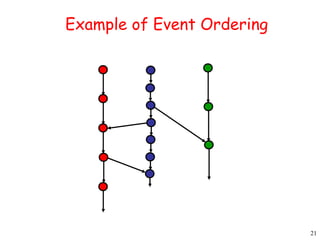
Event Ordering 
 Since there is no common memory or clock, it is sometimes impossible 
to say which of two events occurred first. 
 The happened-before relation is a partial ordering of events in 
distributed systems such that 
1 If A and B are events in the same process, and A was executed before B, 
then A  B. 
2 If A is the event of sending a message by one process and B is the event of 
receiving that by another process, then A  B. 
3 If A  B and B  C, then A  C. 
 If two events A and B are not related by the  relation, then they are 
executed concurrently (no causal relationship) 
 To obtain a global ordering of all the events, each event can be time 
stamped satisfying the requirement: for every pair of events A and B, if 
A  B then the time stamp of A is less than the time stamp of B. (Note 
that the converse need not be true.)
21 
Example of Event Ordering
22 
Global ordering 
 How do we enforce the global ordering requirement 
in a distributed environment (without a common 
clock)? 
1 For each process Pi , a logical clock LCi assign a unique 
value to every event in that process. 
2 If process Pi receives a message (event B) with time 
stamp t and LCi(B) < t, then advance its clock so that 
LCi(B) = t+1. 
3 Use processor ids to break ties to create a total ordering.
23 
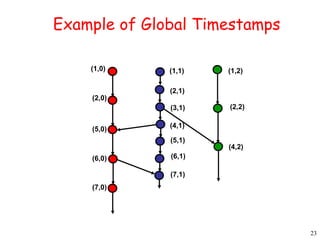
Example of Global Timestamps 
(1,0) (1,1) 
(2,1) 
(3,1) 
(4,1) 
(2,0) 
(5,0) 
(6,0) 
(7,0) 
(5,1) 
(6,1) 
(7,1) 
(1,2) 
(2,2) 
(4,2)
24 
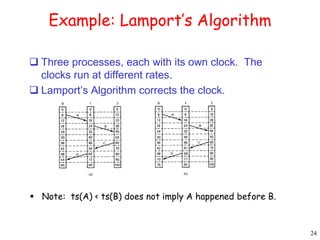
Example: Lamport’s Algorithm 
 Three processes, each with its own clock. The 
clocks run at different rates. 
 Lamport’s Algorithm corrects the clock. 
 Note: ts(A) < ts(B) does not imply A happened before B.
25 
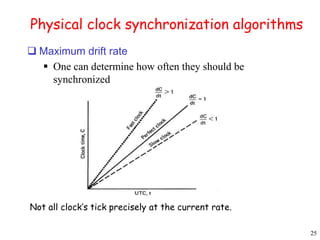
Physical clock synchronization algorithms 
 Maximum drift rate 
 One can determine how often they should be 
synchronized 
Not all clock’s tick precisely at the current rate.
26 
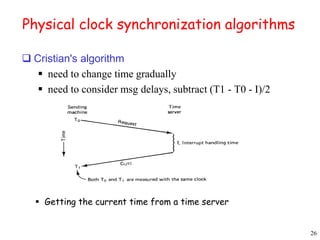
Physical clock synchronization algorithms 
 Cristian's algorithm 
 need to change time gradually 
 need to consider msg delays, subtract (T1 - T0 - I)/2 
 Getting the current time from a time server
27 
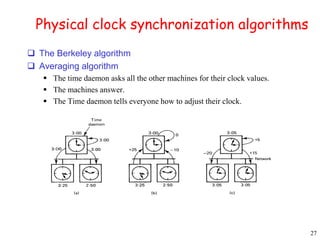
Physical clock synchronization algorithms 
 The Berkeley algorithm 
 Averaging algorithm 
 The time daemon asks all the other machines for their clock values. 
 The machines answer. 
 The Time daemon tells everyone how to adjust their clock.
28 
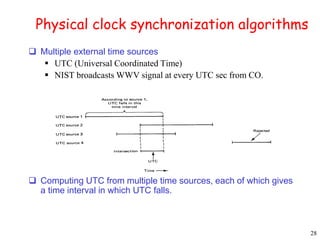
Physical clock synchronization algorithms 
 Multiple external time sources 
 UTC (Universal Coordinated Time) 
 NIST broadcasts WWV signal at every UTC sec from CO. 
 Computing UTC from multiple time sources, each of which gives 
a time interval in which UTC falls.
29 
Reaching Agreement 
 How can processes reach consensus in a distributed system 
 Messages can be delayed 
 Messages can be lost 
 Processes can fail (or even malignant) 
 Messages can be corrupted 
 Each process starts with a bit (0 or 1) and Non-faulty 
processes should eventually agree on common value 
 No solution is possible 
 Note: solutions such as computing majority do not work. Why? 
 Two generals problem (unreliable communications) 
 Byzantine generals problem (faulty processes)
30 
Two generals’ problem 
 Two generals on opposite sides of a valley have to agree on whether to 
attack or not (at a pre-agreed time) 
 Goal: Each must be sure that the other one has made the same decision 
 Communicate by sending messenger who may get captured 
 Can never be sure whether the last messenger reached the other side 
(every message needs an ack), so no perfect solution 
 Impossibility of consensus is as fundamental as undecidability of the 
halting problem ! 
 In practice: probability of losing a repeatedly sent message decreases 
(so agreement with high probability possible)
31 
Impossibility Proof 
Theorem. If any message can be lost, it is not possible for two 
processes to agree on non-trivial outcome using only messages 
for communication. 
Proof. Suppose it is possible. Let m[1],…,m[k] be a finite 
sequence of messages that allowed them to decide. 
Furthermore, let’s assume that it is a minimal sequence, that is, it 
has the least number of messages among all such sequences. 
However, since any message can be lost, the last message m[k] 
could have been lost. So, the sender of m[k] must be able to 
decide without having to send it (since the sender knows that it 
may not be delivered) and the receiver of m[k] must be able to 
decide without receiving it. That is, m[k] is not necessary for 
reaching agreement. That is, m[1],…,m[k-1] should have been 
enough for the agreement. This is a contradiction to that the 
sequence m[1],…,m[k] was minimum.
32 
Mutual Exclusion and Synchronization 
 To solve synchronization problems in a distributed 
system, we need to provide distributed semaphores. 
 Schemes for implementation : 
1 A Centralized Algorithm 
2 A Distributed Algorithm 
3 A Token Ring Algorithm
33 
A Centralized Algorithm 
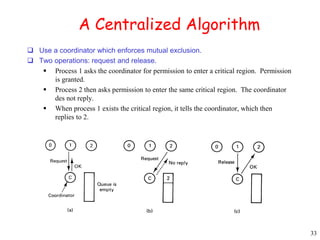
 Use a coordinator which enforces mutual exclusion. 
 Two operations: request and release. 
 Process 1 asks the coordinator for permission to enter a critical region. Permission 
is granted. 
 Process 2 then asks permission to enter the same critical region. The coordinator 
des not reply. 
 When process 1 exists the critical region, it tells the coordinator, which then 
replies to 2.
34 
A Centralized Algorithm (continued) 
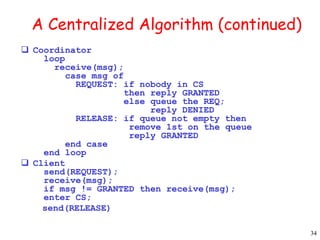
 Coordinator 
loop 
receive(msg); 
case msg of 
REQUEST: if nobody in CS 
then reply GRANTED 
else queue the REQ; 
reply DENIED 
RELEASE: if queue not empty then 
remove 1st on the queue 
reply GRANTED 
end case 
end loop 
 Client 
send(REQUEST); 
receive(msg); 
if msg != GRANTED then receive(msg); 
enter CS; 
send(RELEASE)
35 
A Centralized Algorithm 
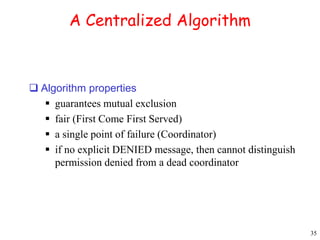
 Algorithm properties 
 guarantees mutual exclusion 
 fair (First Come First Served) 
 a single point of failure (Coordinator) 
 if no explicit DENIED message, then cannot distinguish 
permission denied from a dead coordinator
36 
A Decentralized Algorithm 
Decision making is distributed across the entire system 
a) Two processes want to enter the same critical region at the 
same moment. 
b) Both send request messages to all processes 
c) All events are time-stamped by the global ordering 
algorithm 
d) The process whose request event has smaller time-stamp 
wins 
e) Every process must respond to request messages
37 
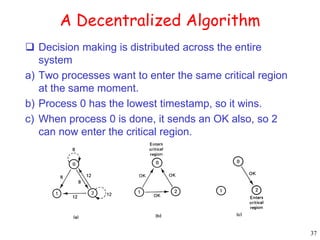
A Decentralized Algorithm 
 Decision making is distributed across the entire 
system 
a) Two processes want to enter the same critical region 
at the same moment. 
b) Process 0 has the lowest timestamp, so it wins. 
c) When process 0 is done, it sends an OK also, so 2 
can now enter the critical region.
38 
Decentralized Algorithm (continued) 
1 When a process wants to enter its critical section, it 
generates a new time stamp, TS, and sends the msg 
request(p,TS) to all other processes in the system (recall 
algorithm for global ordering of events) 
2 A process, which receives reply msgs from all other 
processes, can enter its critical section. 
3 When a process receives a request message, 
(A) if it is in CS, defers its answer; 
(B) if it does not want to enter its CS, reply immediately; 
(C) if it also wants to enter its CS, it maintains a queue of 
requests (including its own request) and sends a reply to the 
request with the minimum time-stamp
39 
Correctness 
Theorem. The Algorithm achieves mutual exclusion. 
Proof: 
By contradiction. 
Suppose two processes Pi and Pj are in CS concurrently. 
WLOG, assume that Pi’s request has earlier timestamp than 
Pj. That is, Pi received Pj's request after Pi made its own 
request. 
Thus, Pj can concurrently execute the CS with Pi only if Pi 
returns a REPLY to Pj before Pi exits the CS. 
But, this is impossible since Pj has a later timestamp than Pi.
40 
Properties 
1 mutual exclusion is guaranteed 
2 deadlock free 
3 no starvation, assuming total ordering on msgs 
4 2(N-1) msgs: (N-1) request and (N-1) reply msgs 
5 n points of failure (i.e., each process becomes a point of failure) can 
use explicit ack and timeout to detect failed processes 
6 each process needs to maintain group membership; (i.e. IDs of all 
active processes) non-trivial for large and/or dynamically changing 
memberships 
7 n bottlenecks since all processes involved in all decisions 
8 may use majority votes to improve the performance
41 
A Token Passing Algorithm 
 A token is circulated in a logical ring. 
 A process enters its CS if it has the token. 
 Issues: 
– If the token is lost, it needs to be regenerated. 
– Detection of the lost token is difficult since there is no 
bound on how long a process should wait for the token. 
– If a process can fail, it needs to be detected and then by-passed. 
– When nobody wants to enter, processes keep on 
exchanging messages to circulate the token
42 
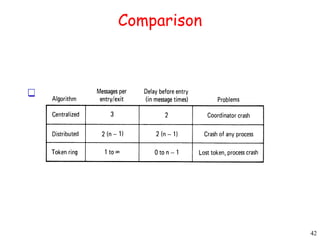
Comparison 
 A comparison of three mutual exclusion algorithms
43 
Leader Election 
 In many distributed applications, particularly the 
centralized solutions, some process needs to be 
declared the central coordinator 
 Electing the leader also may be necessary when the 
central coordinator crashes 
 Election algorithms allow processes to elect a unique 
leader in a decentralized manner
44 
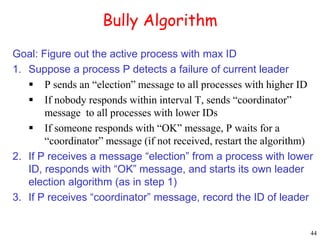
Bully Algorithm 
Goal: Figure out the active process with max ID 
1. Suppose a process P detects a failure of current leader 
 P sends an “election” message to all processes with higher ID 
 If nobody responds within interval T, sends “coordinator” 
message to all processes with lower IDs 
 If someone responds with “OK” message, P waits for a 
“coordinator” message (if not received, restart the algorithm) 
2. If P receives a message “election” from a process with lower 
ID, responds with “OK” message, and starts its own leader 
election algorithm (as in step 1) 
3. If P receives “coordinator” message, record the ID of leader
45 
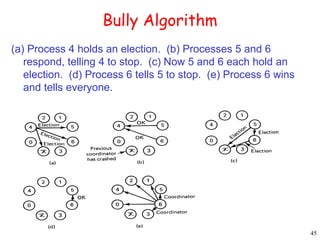
Bully Algorithm 
(a) Process 4 holds an election. (b) Processes 5 and 6 
respond, telling 4 to stop. (c) Now 5 and 6 each hold an 
election. (d) Process 6 tells 5 to stop. (e) Process 6 wins 
and tells everyone.
46 
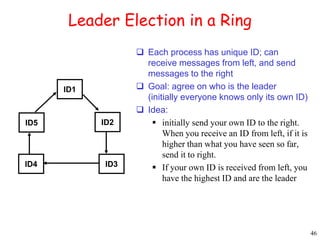
Leader Election in a Ring 
ID1 
ID2 
ID5 
ID4 ID3 
 Each process has unique ID; can 
receive messages from left, and send 
messages to the right 
 Goal: agree on who is the leader 
(initially everyone knows only its own ID) 
 Idea: 
 initially send your own ID to the right. 
When you receive an ID from left, if it is 
higher than what you have seen so far, 
send it to right. 
 If your own ID is received from left, you 
have the highest ID and are the leader
47 
Distributed Deadlock 
 A deadlock occurs when a set of processes in a 
system are blocked waiting for requests that can 
never be satisfied. 
 Approaches: 
 Detection (& Recovery) 
 Prevention 
 Avoidance - not practical in distributed setting 
 Difficulties: 
 resource allocation information is distributed 
 gathering information requires messages. Since 
messages have non-zero delays, it is difficult to have an 
accurate and current view of resource allocation.
48 
Deadlock Detection Recall 
 Suppose following information is available: 
 For each process, the resources it currently holds 
 For each process, the request that it is waiting for 
 Then, one can check if the current system state is 
deadlocked, or not 
 In single-processor systems, OS can maintain this 
information, and periodically execute deadlock 
detection algorithm 
 What to do if a deadlock is detected? 
 Kill a process involved in the deadlocked set 
 Inform the users, etc.
49 
Wait For Graph (WFG) 
 Definition. A resource graph is a bipartite directed graph (N,E), 
where 
– N = P U R, 
– P = {p1, ... pn} , R = {r1 , ... rn} 
– (r1 , ... rn) available unit vector, 
– An edge (pi , rj) a request edge, and 
– An edge (ri , pj) an allocation edge. 
 Definition: Wait For Graph (WFG) is a directed graph, where 
nodes are processes and a directed edge from P  Q 
represents that P is blocked waiting for Q to release a resource. 
 So, there is an edge from process P to process Q if P needs a 
resource currently held by Q.
50 
Definitions 
 Def: A node Y is reachable from a node X, X  Y, if 
there is a path (i.e., a sequence of directed edges) 
from node X to node Y. 
 Def: A cycle in a graph is a path that starts and ends 
on the same node. If a set C of nodes is a cycle, then 
for all X in C : X  X 
 Def: A knot K in a graph is a non-empty set of nodes 
such that, for each X in K, all nodes in K and only the 
nodes in K are reachable from X. That is, 
– (for every X for every Y in K, X  Y) and 
– (for every X in K, there exists Z s.t. X  Z implies Z is 
in K)
51 
Sufficient Conditions for Deadlock 
 Resource Model 
1 reusable resource 
2 exclusive access 
 Three Request Models 
1 Single-unit request model: 
• a cycle in WFG 
2 AND request model : simultaneous requests 
• blocked until all of them granted 
• a cycle in WFG 
• a process can be in more than one cycle 
3 OR request model : any one, e.g., reading a replicated data object 
• a cycle in WFG not a sufficient condition (but necessary) 
• a knot in WFG is a sufficient condition (but not necessary)
52 
Deadlock Detection Algorithms 
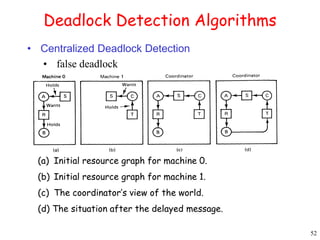
• Centralized Deadlock Detection 
• false deadlock 
(a) Initial resource graph for machine 0. 
(b) Initial resource graph for machine 1. 
(c) The coordinator’s view of the world. 
(d) The situation after the delayed message.
53 
Wait-for Graph for Detection 
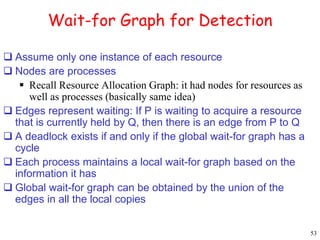
 Assume only one instance of each resource 
 Nodes are processes 
 Recall Resource Allocation Graph: it had nodes for resources as 
well as processes (basically same idea) 
 Edges represent waiting: If P is waiting to acquire a resource 
that is currently held by Q, then there is an edge from P to Q 
 A deadlock exists if and only if the global wait-for graph has a 
cycle 
 Each process maintains a local wait-for graph based on the 
information it has 
 Global wait-for graph can be obtained by the union of the 
edges in all the local copies
54 
Distributed Cycle Detection 
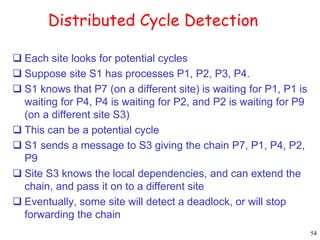
 Each site looks for potential cycles 
 Suppose site S1 has processes P1, P2, P3, P4. 
 S1 knows that P7 (on a different site) is waiting for P1, P1 is 
waiting for P4, P4 is waiting for P2, and P2 is waiting for P9 
(on a different site S3) 
 This can be a potential cycle 
 S1 sends a message to S3 giving the chain P7, P1, P4, P2, 
P9 
 Site S3 knows the local dependencies, and can extend the 
chain, and pass it on to a different site 
 Eventually, some site will detect a deadlock, or will stop 
forwarding the chain
55 
Deadlock Detection Algorithms 
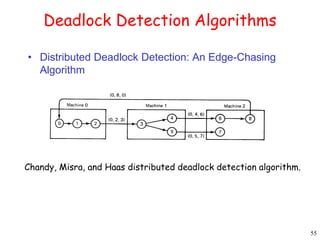
• Distributed Deadlock Detection: An Edge-Chasing 
Algorithm 
Chandy, Misra, and Haas distributed deadlock detection algorithm.
56 
Deadlock Prevention 
 Hierarchical ordering of resources avoids cycles 
 Time-stamp ordering approach: 
Prevent the circular waiting condition by preempting resources if 
necessary. 
– The basic idea is to assign a unique priority to each process and use 
these priorities to decide whether process P should wait for process Q. 
– Let P wait for Q if P has a higher priority than Q; Otherwise, P is 
rolled back. 
– This prevents deadlocks since for every edge (P ,Q) in the wait-for 
graph, P has a higher priority than Q. 
Thus, a cycle cannot exist.
57 
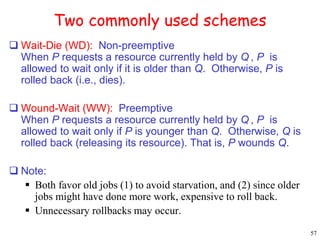
Two commonly used schemes 
 Wait-Die (WD): Non-preemptive 
When P requests a resource currently held by Q, P is 
allowed to wait only if it is older than Q. Otherwise, P is 
rolled back (i.e., dies). 
 Wound-Wait (WW): Preemptive 
When P requests a resource currently held by Q, P is 
allowed to wait only if P is younger than Q. Otherwise, Q is 
rolled back (releasing its resource). That is, P wounds Q. 
 Note: 
 Both favor old jobs (1) to avoid starvation, and (2) since older 
jobs might have done more work, expensive to roll back. 
 Unnecessary rollbacks may occur.
58 
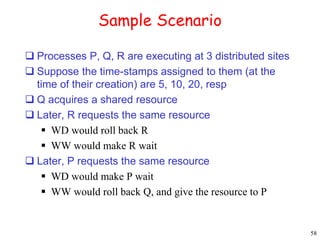
Sample Scenario 
 Processes P, Q, R are executing at 3 distributed sites 
 Suppose the time-stamps assigned to them (at the 
time of their creation) are 5, 10, 20, resp 
 Q acquires a shared resource 
 Later, R requests the same resource 
 WD would roll back R 
 WW would make R wait 
 Later, P requests the same resource 
 WD would make P wait 
 WW would roll back Q, and give the resource to P
59 
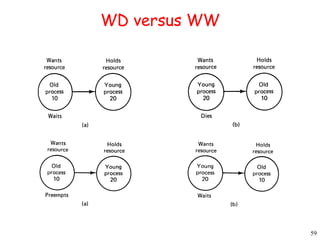
WD versus WW
60 
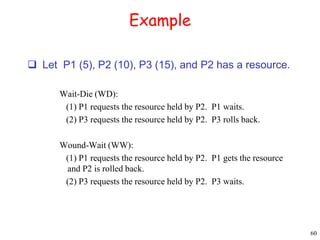
Example 
 Let P1 (5), P2 (10), P3 (15), and P2 has a resource. 
Wait-Die (WD): 
(1) P1 requests the resource held by P2. P1 waits. 
(2) P3 requests the resource held by P2. P3 rolls back. 
Wound-Wait (WW): 
(1) P1 requests the resource held by P2. P1 gets the resource 
and P2 is rolled back. 
(2) P3 requests the resource held by P2. P3 waits.
61 
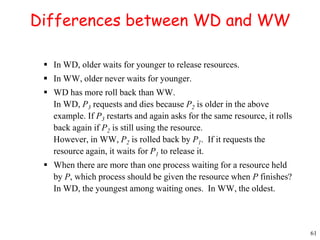
Differences between WD and WW 
 In WD, older waits for younger to release resources. 
 In WW, older never waits for younger. 
 WD has more roll back than WW. 
In WD, P3 requests and dies because P2 is older in the above 
example. If P3 restarts and again asks for the same resource, it rolls 
back again if P2 is still using the resource. 
However, in WW, P2 is rolled back by P1. If it requests the 
resource again, it waits for P1 to release it. 
 When there are more than one process waiting for a resource held 
by P, which process should be given the resource when P finishes? 
In WD, the youngest among waiting ones. In WW, the oldest.
62 
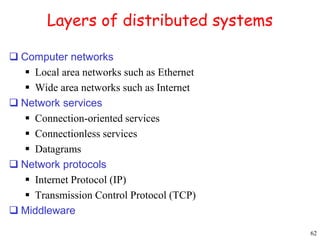
Layers of distributed systems 
 Computer networks 
 Local area networks such as Ethernet 
 Wide area networks such as Internet 
 Network services 
 Connection-oriented services 
 Connectionless services 
 Datagrams 
 Network protocols 
 Internet Protocol (IP) 
 Transmission Control Protocol (TCP) 
 Middleware
63 
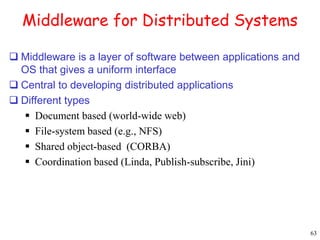
Middleware for Distributed Systems 
 Middleware is a layer of software between applications and 
OS that gives a uniform interface 
 Central to developing distributed applications 
 Different types 
 Document based (world-wide web) 
 File-system based (e.g., NFS) 
 Shared object-based (CORBA) 
 Coordination based (Linda, Publish-subscribe, Jini)

Ds ppt imp.

  • 1.
    1 Distributed Systems IT-601 Instructor: Prof. Mayank Jain IT Deparment Lecture Note: Unit-1,2
  • 2.
    2 Introduction toDistributed Systems  Why do we develop distributed systems?  availability of powerful yet cheap microprocessors (PCs, workstations), continuing advances in communication technology,  What is a distributed system?  A distributed system is a collection of independent computers that appear to the users of the system as a single system.  Examples:  Network of workstations  Distributed manufacturing system (e.g., automated assembly line)  Network of branch office computers
  • 3.
    3 Distributed Systems Comparison of three kinds of multiple CPU systems
  • 4.
    4 Advantages ofDistributed Systems over Centralized Systems • Economics: a collection of microprocessors offer a better price/performance than mainframes. Low price/performance ratio: cost effective way to increase computing power. • Speed: a distributed system may have more total computing power than a mainframe. Ex. 10,000 CPU chips, each running at 50 MIPS. Not possible to build 500,000 MIPS single processor since it would require 0.002 nsec instruction cycle. Enhanced performance through load distributing. • Inherent distribution: Some applications are inherently distributed. Ex. a supermarket chain. • Reliability: If one machine crashes, the system as a whole can still survive. Higher availability and improved reliability. • Incremental growth: Computing power can be added in small increments. Modular expandability • Another deriving force: the existence of large number of personal computers, the need for people to collaborate and share information.
  • 5.
    5 Advantages ofDistributed Systems over Independent PCs  Data sharing: allow many users to access to a common data base  Resource Sharing: expensive peripherals like color printers  Communication: enhance human-to-human communication, e.g., email, chat  Flexibility: spread the workload over the available machines
  • 6.
    6 Disadvantages ofDistributed Systems  Software: difficult to develop software for distributed systems  Network: saturation, lossy transmissions  Security: easy access also applies to secrete data
  • 7.
    7 Software Concepts • Software more important for users • Two types: 1. Network Operating Systems 2. (True) Distributed Systems
  • 8.
    8 Network OperatingSystems  loosely-coupled software on loosely-coupled hardware  A network of workstations connected by LAN  each machine has a high degree of autonomy o rlogin machine o rcp machine1:file1 machine2:file2  Files servers: client and server model  Clients mount directories on file servers  Best known network OS: o Sun’s NFS (network file servers) for shared file systems (Fig. 9-11)  a few system-wide requirements: format and meaning of all the messages exchanged
  • 9.
    9 NFS (NetworkFile System)  NFS Architecture  Server exports directories  Clients mount exported directories  NSF Protocols  For handling mounting  For read/write: no open/close, stateless  NSF Implementation
  • 10.
    10 (True) DistributedSystems  tightly-coupled software on loosely-coupled hardware  provide a single-system image or a virtual uniprocessor  a single, global interprocess communication mechanism, process management, file system; the same system call interface everywhere  Ideal definition: “ A distributed system runs on a collection of computers that do not have shared memory, yet looks like a single computer to its users.”
  • 11.
    11 Design Issuesof Distributed Systems • Transparency • Flexibility • Reliability • Performance • Scalability
  • 12.
    12 1. Transparency • How to achieve the single-system image, i.e., how to make a collection of computers appear as a single computer. • Hiding all the distribution from the users as well as the application programs can be achieved at two levels: 1) hide the distribution from users 2) at a lower level, make the system look transparent to programs. 1) and 2) requires uniform interfaces such as access to files, communication.
  • 13.
    13 2. Flexibility • Make it easier to change • Monolithic Kernel: systems calls are trapped and executed by the kernel. All system calls are served by the kernel, e.g., UNIX. • Microkernel: provides minimal services. • IPC • some memory management • some low-level process management and scheduling • low-level i/o (E.g., Mach can support multiple file systems, multiple system interfaces.)
  • 14.
    14 3. Reliability • Distributed system should be more reliable than single system. Example: 3 machines with .95 probability of being up. 1-.05**3 probability of being up. – Availability: fraction of time the system is usable. Redundancy improves it. – Need to maintain consistency – Need to be secure – Fault tolerance: need to mask failures, recover from errors.
  • 15.
    15 4. Performance • Without gain on this, why bother with distributed systems. • Performance loss due to communication delays: – fine-grain parallelism: high degree of interaction – coarse-grain parallelism • Performance loss due to making the system fault tolerant.
  • 16.
    16 5. Scalability • Systems grow with time or become obsolete. • Techniques that require resources linearly in terms of the size of the system are not scalable. (e.g., broadcast based query won't work for large distributed systems.) • Examples of bottlenecks o Centralized components: a single mail server o Centralized tables: a single URL address book o Centralized algorithms: routing based on complete information
  • 17.
    17 Distributed Coordination  Communication between processes in a distributed system can have unpredictable delays, processes can fail, messages may be lost  Synchronization in distributed systems is harder than in centralized systems because the need for distributed algorithms.  Properties of distributed algorithms: 1 The relevant information is scattered among multiple machines. 2 Processes make decisions based only on locally available information. 3 A single point of failure in the system should be avoided. 4 No common clock or other precise global time source exists.  Challenge: How to design schemes so that multiple systems can coordinate/synchronize to solve problems efficiently?
  • 18.
    Local clock time 18 Why need to synchronize clocks? foo.o created 2144 2145 2146 2147 2142 2143 2144 2145 foo.c modified Computer for compiling Computer for editing Local clock time
  • 19.
    19 Logical andphysical clocks  How a computer timer works?  A counter register and a holding register.  The counter is decremented by a quartz crystals oscillator. When it reaches zero, an interrupted is generated and the counter is reloaded from the holding register.  E.g, interrupt 60 times per second.  clock skew problem  logical clocks -- to provide consistent event ordering  physical clocks -- clocks whose values must not deviate from the real time by more than a certain amount.
  • 20.
    20 Event Ordering  Since there is no common memory or clock, it is sometimes impossible to say which of two events occurred first.  The happened-before relation is a partial ordering of events in distributed systems such that 1 If A and B are events in the same process, and A was executed before B, then A  B. 2 If A is the event of sending a message by one process and B is the event of receiving that by another process, then A  B. 3 If A  B and B  C, then A  C.  If two events A and B are not related by the  relation, then they are executed concurrently (no causal relationship)  To obtain a global ordering of all the events, each event can be time stamped satisfying the requirement: for every pair of events A and B, if A  B then the time stamp of A is less than the time stamp of B. (Note that the converse need not be true.)
  • 21.
    21 Example ofEvent Ordering
  • 22.
    22 Global ordering  How do we enforce the global ordering requirement in a distributed environment (without a common clock)? 1 For each process Pi , a logical clock LCi assign a unique value to every event in that process. 2 If process Pi receives a message (event B) with time stamp t and LCi(B) < t, then advance its clock so that LCi(B) = t+1. 3 Use processor ids to break ties to create a total ordering.
  • 23.
    23 Example ofGlobal Timestamps (1,0) (1,1) (2,1) (3,1) (4,1) (2,0) (5,0) (6,0) (7,0) (5,1) (6,1) (7,1) (1,2) (2,2) (4,2)
  • 24.
    24 Example: Lamport’sAlgorithm  Three processes, each with its own clock. The clocks run at different rates.  Lamport’s Algorithm corrects the clock.  Note: ts(A) < ts(B) does not imply A happened before B.
  • 25.
    25 Physical clocksynchronization algorithms  Maximum drift rate  One can determine how often they should be synchronized Not all clock’s tick precisely at the current rate.
  • 26.
    26 Physical clocksynchronization algorithms  Cristian's algorithm  need to change time gradually  need to consider msg delays, subtract (T1 - T0 - I)/2  Getting the current time from a time server
  • 27.
    27 Physical clocksynchronization algorithms  The Berkeley algorithm  Averaging algorithm  The time daemon asks all the other machines for their clock values.  The machines answer.  The Time daemon tells everyone how to adjust their clock.
  • 28.
    28 Physical clocksynchronization algorithms  Multiple external time sources  UTC (Universal Coordinated Time)  NIST broadcasts WWV signal at every UTC sec from CO.  Computing UTC from multiple time sources, each of which gives a time interval in which UTC falls.
  • 29.
    29 Reaching Agreement  How can processes reach consensus in a distributed system  Messages can be delayed  Messages can be lost  Processes can fail (or even malignant)  Messages can be corrupted  Each process starts with a bit (0 or 1) and Non-faulty processes should eventually agree on common value  No solution is possible  Note: solutions such as computing majority do not work. Why?  Two generals problem (unreliable communications)  Byzantine generals problem (faulty processes)
  • 30.
    30 Two generals’problem  Two generals on opposite sides of a valley have to agree on whether to attack or not (at a pre-agreed time)  Goal: Each must be sure that the other one has made the same decision  Communicate by sending messenger who may get captured  Can never be sure whether the last messenger reached the other side (every message needs an ack), so no perfect solution  Impossibility of consensus is as fundamental as undecidability of the halting problem !  In practice: probability of losing a repeatedly sent message decreases (so agreement with high probability possible)
  • 31.
    31 Impossibility Proof Theorem. If any message can be lost, it is not possible for two processes to agree on non-trivial outcome using only messages for communication. Proof. Suppose it is possible. Let m[1],…,m[k] be a finite sequence of messages that allowed them to decide. Furthermore, let’s assume that it is a minimal sequence, that is, it has the least number of messages among all such sequences. However, since any message can be lost, the last message m[k] could have been lost. So, the sender of m[k] must be able to decide without having to send it (since the sender knows that it may not be delivered) and the receiver of m[k] must be able to decide without receiving it. That is, m[k] is not necessary for reaching agreement. That is, m[1],…,m[k-1] should have been enough for the agreement. This is a contradiction to that the sequence m[1],…,m[k] was minimum.
  • 32.
    32 Mutual Exclusionand Synchronization  To solve synchronization problems in a distributed system, we need to provide distributed semaphores.  Schemes for implementation : 1 A Centralized Algorithm 2 A Distributed Algorithm 3 A Token Ring Algorithm
  • 33.
    33 A CentralizedAlgorithm  Use a coordinator which enforces mutual exclusion.  Two operations: request and release.  Process 1 asks the coordinator for permission to enter a critical region. Permission is granted.  Process 2 then asks permission to enter the same critical region. The coordinator des not reply.  When process 1 exists the critical region, it tells the coordinator, which then replies to 2.
  • 34.
    34 A CentralizedAlgorithm (continued)  Coordinator loop receive(msg); case msg of REQUEST: if nobody in CS then reply GRANTED else queue the REQ; reply DENIED RELEASE: if queue not empty then remove 1st on the queue reply GRANTED end case end loop  Client send(REQUEST); receive(msg); if msg != GRANTED then receive(msg); enter CS; send(RELEASE)
  • 35.
    35 A CentralizedAlgorithm  Algorithm properties  guarantees mutual exclusion  fair (First Come First Served)  a single point of failure (Coordinator)  if no explicit DENIED message, then cannot distinguish permission denied from a dead coordinator
  • 36.
    36 A DecentralizedAlgorithm Decision making is distributed across the entire system a) Two processes want to enter the same critical region at the same moment. b) Both send request messages to all processes c) All events are time-stamped by the global ordering algorithm d) The process whose request event has smaller time-stamp wins e) Every process must respond to request messages
  • 37.
    37 A DecentralizedAlgorithm  Decision making is distributed across the entire system a) Two processes want to enter the same critical region at the same moment. b) Process 0 has the lowest timestamp, so it wins. c) When process 0 is done, it sends an OK also, so 2 can now enter the critical region.
  • 38.
    38 Decentralized Algorithm(continued) 1 When a process wants to enter its critical section, it generates a new time stamp, TS, and sends the msg request(p,TS) to all other processes in the system (recall algorithm for global ordering of events) 2 A process, which receives reply msgs from all other processes, can enter its critical section. 3 When a process receives a request message, (A) if it is in CS, defers its answer; (B) if it does not want to enter its CS, reply immediately; (C) if it also wants to enter its CS, it maintains a queue of requests (including its own request) and sends a reply to the request with the minimum time-stamp
  • 39.
    39 Correctness Theorem.The Algorithm achieves mutual exclusion. Proof: By contradiction. Suppose two processes Pi and Pj are in CS concurrently. WLOG, assume that Pi’s request has earlier timestamp than Pj. That is, Pi received Pj's request after Pi made its own request. Thus, Pj can concurrently execute the CS with Pi only if Pi returns a REPLY to Pj before Pi exits the CS. But, this is impossible since Pj has a later timestamp than Pi.
  • 40.
    40 Properties 1mutual exclusion is guaranteed 2 deadlock free 3 no starvation, assuming total ordering on msgs 4 2(N-1) msgs: (N-1) request and (N-1) reply msgs 5 n points of failure (i.e., each process becomes a point of failure) can use explicit ack and timeout to detect failed processes 6 each process needs to maintain group membership; (i.e. IDs of all active processes) non-trivial for large and/or dynamically changing memberships 7 n bottlenecks since all processes involved in all decisions 8 may use majority votes to improve the performance
  • 41.
    41 A TokenPassing Algorithm  A token is circulated in a logical ring.  A process enters its CS if it has the token.  Issues: – If the token is lost, it needs to be regenerated. – Detection of the lost token is difficult since there is no bound on how long a process should wait for the token. – If a process can fail, it needs to be detected and then by-passed. – When nobody wants to enter, processes keep on exchanging messages to circulate the token
  • 42.
    42 Comparison A comparison of three mutual exclusion algorithms
  • 43.
    43 Leader Election  In many distributed applications, particularly the centralized solutions, some process needs to be declared the central coordinator  Electing the leader also may be necessary when the central coordinator crashes  Election algorithms allow processes to elect a unique leader in a decentralized manner
  • 44.
    44 Bully Algorithm Goal: Figure out the active process with max ID 1. Suppose a process P detects a failure of current leader  P sends an “election” message to all processes with higher ID  If nobody responds within interval T, sends “coordinator” message to all processes with lower IDs  If someone responds with “OK” message, P waits for a “coordinator” message (if not received, restart the algorithm) 2. If P receives a message “election” from a process with lower ID, responds with “OK” message, and starts its own leader election algorithm (as in step 1) 3. If P receives “coordinator” message, record the ID of leader
  • 45.
    45 Bully Algorithm (a) Process 4 holds an election. (b) Processes 5 and 6 respond, telling 4 to stop. (c) Now 5 and 6 each hold an election. (d) Process 6 tells 5 to stop. (e) Process 6 wins and tells everyone.
  • 46.
    46 Leader Electionin a Ring ID1 ID2 ID5 ID4 ID3  Each process has unique ID; can receive messages from left, and send messages to the right  Goal: agree on who is the leader (initially everyone knows only its own ID)  Idea:  initially send your own ID to the right. When you receive an ID from left, if it is higher than what you have seen so far, send it to right.  If your own ID is received from left, you have the highest ID and are the leader
  • 47.
    47 Distributed Deadlock  A deadlock occurs when a set of processes in a system are blocked waiting for requests that can never be satisfied.  Approaches:  Detection (& Recovery)  Prevention  Avoidance - not practical in distributed setting  Difficulties:  resource allocation information is distributed  gathering information requires messages. Since messages have non-zero delays, it is difficult to have an accurate and current view of resource allocation.
  • 48.
    48 Deadlock DetectionRecall  Suppose following information is available:  For each process, the resources it currently holds  For each process, the request that it is waiting for  Then, one can check if the current system state is deadlocked, or not  In single-processor systems, OS can maintain this information, and periodically execute deadlock detection algorithm  What to do if a deadlock is detected?  Kill a process involved in the deadlocked set  Inform the users, etc.
  • 49.
    49 Wait ForGraph (WFG)  Definition. A resource graph is a bipartite directed graph (N,E), where – N = P U R, – P = {p1, ... pn} , R = {r1 , ... rn} – (r1 , ... rn) available unit vector, – An edge (pi , rj) a request edge, and – An edge (ri , pj) an allocation edge.  Definition: Wait For Graph (WFG) is a directed graph, where nodes are processes and a directed edge from P  Q represents that P is blocked waiting for Q to release a resource.  So, there is an edge from process P to process Q if P needs a resource currently held by Q.
  • 50.
    50 Definitions Def: A node Y is reachable from a node X, X  Y, if there is a path (i.e., a sequence of directed edges) from node X to node Y.  Def: A cycle in a graph is a path that starts and ends on the same node. If a set C of nodes is a cycle, then for all X in C : X  X  Def: A knot K in a graph is a non-empty set of nodes such that, for each X in K, all nodes in K and only the nodes in K are reachable from X. That is, – (for every X for every Y in K, X  Y) and – (for every X in K, there exists Z s.t. X  Z implies Z is in K)
  • 51.
    51 Sufficient Conditionsfor Deadlock  Resource Model 1 reusable resource 2 exclusive access  Three Request Models 1 Single-unit request model: • a cycle in WFG 2 AND request model : simultaneous requests • blocked until all of them granted • a cycle in WFG • a process can be in more than one cycle 3 OR request model : any one, e.g., reading a replicated data object • a cycle in WFG not a sufficient condition (but necessary) • a knot in WFG is a sufficient condition (but not necessary)
  • 52.
    52 Deadlock DetectionAlgorithms • Centralized Deadlock Detection • false deadlock (a) Initial resource graph for machine 0. (b) Initial resource graph for machine 1. (c) The coordinator’s view of the world. (d) The situation after the delayed message.
  • 53.
    53 Wait-for Graphfor Detection  Assume only one instance of each resource  Nodes are processes  Recall Resource Allocation Graph: it had nodes for resources as well as processes (basically same idea)  Edges represent waiting: If P is waiting to acquire a resource that is currently held by Q, then there is an edge from P to Q  A deadlock exists if and only if the global wait-for graph has a cycle  Each process maintains a local wait-for graph based on the information it has  Global wait-for graph can be obtained by the union of the edges in all the local copies
  • 54.
    54 Distributed CycleDetection  Each site looks for potential cycles  Suppose site S1 has processes P1, P2, P3, P4.  S1 knows that P7 (on a different site) is waiting for P1, P1 is waiting for P4, P4 is waiting for P2, and P2 is waiting for P9 (on a different site S3)  This can be a potential cycle  S1 sends a message to S3 giving the chain P7, P1, P4, P2, P9  Site S3 knows the local dependencies, and can extend the chain, and pass it on to a different site  Eventually, some site will detect a deadlock, or will stop forwarding the chain
  • 55.
    55 Deadlock DetectionAlgorithms • Distributed Deadlock Detection: An Edge-Chasing Algorithm Chandy, Misra, and Haas distributed deadlock detection algorithm.
  • 56.
    56 Deadlock Prevention  Hierarchical ordering of resources avoids cycles  Time-stamp ordering approach: Prevent the circular waiting condition by preempting resources if necessary. – The basic idea is to assign a unique priority to each process and use these priorities to decide whether process P should wait for process Q. – Let P wait for Q if P has a higher priority than Q; Otherwise, P is rolled back. – This prevents deadlocks since for every edge (P ,Q) in the wait-for graph, P has a higher priority than Q. Thus, a cycle cannot exist.
  • 57.
    57 Two commonlyused schemes  Wait-Die (WD): Non-preemptive When P requests a resource currently held by Q, P is allowed to wait only if it is older than Q. Otherwise, P is rolled back (i.e., dies).  Wound-Wait (WW): Preemptive When P requests a resource currently held by Q, P is allowed to wait only if P is younger than Q. Otherwise, Q is rolled back (releasing its resource). That is, P wounds Q.  Note:  Both favor old jobs (1) to avoid starvation, and (2) since older jobs might have done more work, expensive to roll back.  Unnecessary rollbacks may occur.
  • 58.
    58 Sample Scenario  Processes P, Q, R are executing at 3 distributed sites  Suppose the time-stamps assigned to them (at the time of their creation) are 5, 10, 20, resp  Q acquires a shared resource  Later, R requests the same resource  WD would roll back R  WW would make R wait  Later, P requests the same resource  WD would make P wait  WW would roll back Q, and give the resource to P
  • 59.
  • 60.
    60 Example Let P1 (5), P2 (10), P3 (15), and P2 has a resource. Wait-Die (WD): (1) P1 requests the resource held by P2. P1 waits. (2) P3 requests the resource held by P2. P3 rolls back. Wound-Wait (WW): (1) P1 requests the resource held by P2. P1 gets the resource and P2 is rolled back. (2) P3 requests the resource held by P2. P3 waits.
  • 61.
    61 Differences betweenWD and WW  In WD, older waits for younger to release resources.  In WW, older never waits for younger.  WD has more roll back than WW. In WD, P3 requests and dies because P2 is older in the above example. If P3 restarts and again asks for the same resource, it rolls back again if P2 is still using the resource. However, in WW, P2 is rolled back by P1. If it requests the resource again, it waits for P1 to release it.  When there are more than one process waiting for a resource held by P, which process should be given the resource when P finishes? In WD, the youngest among waiting ones. In WW, the oldest.
  • 62.
    62 Layers ofdistributed systems  Computer networks  Local area networks such as Ethernet  Wide area networks such as Internet  Network services  Connection-oriented services  Connectionless services  Datagrams  Network protocols  Internet Protocol (IP)  Transmission Control Protocol (TCP)  Middleware
  • 63.
    63 Middleware forDistributed Systems  Middleware is a layer of software between applications and OS that gives a uniform interface  Central to developing distributed applications  Different types  Document based (world-wide web)  File-system based (e.g., NFS)  Shared object-based (CORBA)  Coordination based (Linda, Publish-subscribe, Jini)