Resource Management
By
Benay Kumar Ray,
Central University of South Bihar
 Every distributed system consists of a number of resources interconnected by a
network.
 Besides providing communication facilities, the network facilitates resource sharing
by migrating a local process and executing it at a remote node of the network.
 A process may be migrated because the local node does not have the required
resources or the local node has to be shut down.
 From a user's point of view, the set of available resources in a distributed system
acts like a single virtual system.
 Hence, when a user submits a process for execution,
 It becomes the responsibility of the resource manager of the distributed operating
system to control the assignment of resources to processes and to route the
processes to suitable nodes of the system according to these assignments.
 A resource can be logical, such as a shared file, or physical, such as a CPU.
 Currently resource is referred to be a processor of the system and assume that each
processor forms a node of the distributed system.
Resource Management
 A resource manager schedules the processes in a distributed system to make use of
the system resources in such a manner that resource usage, response time, network
congestion, and scheduling overhead are optimized.
 A variety of widely differing techniques and methodologies for scheduling processes
of a distributed system have been proposed.
 These techniques can be broadly classified into three types:
 Task assignment approach: In which each process submitted by a user for
processing is viewed as a collection of related tasks and these tasks are
scheduled to suitable nodes so as to improve performance.
 Load-balancing approach: In which all the processes submitted by the users are
distributed among the nodes of the system so as to equalize the workload among
the nodes.
 Load-sharing approach: Which simply attempts to conserve the ability of the
system to perform work by assuring that no node is idle while processes wait for
being processed.
Resource Management
No A Priori Knowledge about the Processes
 A good process scheduling algorithm should operate with absolutely no a
priori knowledge about the processes to be executed.
 Scheduling algorithms that operate based on the information about the
resource requirements of the processes:
 normally pose an extra burden upon the users who must specify this
information while submitting their processes for execution.
Dynamic In Nature
 It is intended that a good process-scheduling algorithm should be able to
take care of the dynamically changing load (or status) of the various nodes
of the system.
 That is, process assignment decisions should be based on the current load
of the system and not on some fixed static policy.
Desirable Features of a Good Global Scheduling Algorithm
Quick Decision-Making Capability
 A good process-scheduling algorithm must make quick decisions about the
assignment of processes to processors.
 Heuristic methods requiring less computational effort while providing near-optimal
results are therefore normally preferable to exhaustive (optimal) solution methods.
Balanced System Performance and Scheduling Overhead
 Several global scheduling algorithms collect global state information and use this
information in making process assignment decisions.
 A common intuition is that greater amounts of information describing global system
state allow more intelligent process assignment decisions to be made that have a
positive affect on the system as a whole.
 In a distributed environment, however, information regarding the state of the system
is typically gathered at a higher cost than in a centralized system.
 The general observation is that, as overhead is increased in an attempt to obtain
more information regarding the global state of the system:
 The usefulness of that information is decreased due to both the aging of the
information being gathered and the low scheduling frequency.
 Hence algorithms that provide near optimal system performance with a minimum of global state
information gathering overhead are desirable.
Desirable Features of a Good Global Scheduling Algorithm
Stability
 A scheduling algorithm is said to be unstable if it can enter a state in which all the
nodes of the system are spending all of their time migrating processes without
accomplishing any useful work in an attempt to properly schedule the processes for
better performance.
 This form of fruitless migration of processes is known as processor thrashing
Example
 It may happen that nodes n1 and n2 both observe that node n3 is idle
 Then both offload a portion of their work to node n3 without being aware of the
offloading decision made by the other.
 Now if node n3 becomes overloaded due to the processes received from both nodes
n1 and n2 then it may again start transferring its processes to other nodes.
 This entire cycle may be repeated again and again, resulting in an unstable state.
 This is certainly not desirable for a good scheduling algorithm.
Desirable Features of a Good Global Scheduling Algorithm
Scalability
 A scheduling algorithm should be capable of handling small as well as large
networks.
 An algorithm that makes scheduling decisions by first inquiring the workload
from all the nodes and then selecting the most lightly loaded node as the
candidate for receiving the process(es) has poor scalability factor.
 Such an algorithm may work fine for small networks but gets crippled when
applied to large networks.
 This is because the inquirer receives a very large number of replies almost
simultaneously, and the time required to process the reply messages for
making a host selection is normally too long.
 A simple approach to make an algorithm scalable is to probe only m of N
nodes for selecting a host.
 The value of m can be dynamically adjusted depending upon the value of N.
Desirable Features of a Good Global Scheduling Algorithm
Fault Tolerance
 A good scheduling algorithm should not be disabled by the crash of one or
more nodes of the system.
 At any instance of time, it should continue functioning for nodes that are up
at that time.
 Moreover, if the nodes are partitioned into two or more groups due to link
failures, the algorithm should be capable of functioning properly for the
nodes within a group.
Desirable Features of a Good Global Scheduling Algorithm
 In this approach, a process is considered to be composed of multiple tasks and the
goal is to find an optimal assignment policy for the tasks of an individual process.
Assumptions found in task assignment work are as follows:
1. A process has already been split into pieces called tasks.
 This split occurs along natural boundaries, so that each task will have integrity
in itself and data transfers among the tasks will be minimized.
2. The amount of computation required by each task and the speed of each processor
are known.
3. The cost of processing each task on every node of the system is known.
 This cost is usually derived based on the information about the speed of each
processor and the amount of computation required by each task.
4. The interprocess communication (IPC) costs between every pair of tasks is known.
 The IPC cost is considered zero (negligible) for tasks assigned to the same
node.
5. Other constraints, such as resource requirements of the tasks and the available
resources at each node, precedence relationships among the tasks, and so on, are
also known.
6. Reassignment of the tasks is generally not possible.
TASK ASSIGNMENT APPROACH
 With these assumptions, the task assignment algorithms seek to assign the tasks of
a process to the nodes of the distributed system in such a manner so as to achieve
goals such as the following:
1. Minimization of IPC costs
2. Quick turnaround time for the complete process
3. A high degree of parallelism
4. Efficient utilization of system resources in general
NOTE
These goals often conflict with each other.
 While minimizing IPC tends to assign all the tasks of a process to a single
node
 Efficient utilization of system resources tries to distribute the tasks evenly among
the nodes.
 Quick turnaround time and a high degree of parallelism encourage
parallel execution of the tasks
 However, the precedence relationship among the tasks limits their parallel
execution.
TASK ASSIGNMENT APPROACH
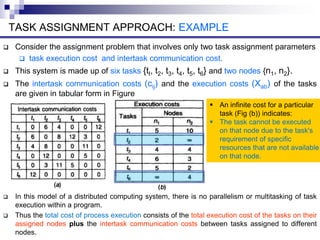
 Consider the assignment problem that involves only two task assignment parameters
 task execution cost and intertask communication cost.
 This system is made up of six tasks {tI, t2, t3, t4, t5, t6} and two nodes {n1, n2}.
 The intertask communication costs (cij) and the execution costs (Xab) of the tasks
are given in tabular form in Figure
 In this model of a distributed computing system, there is no parallelism or multitasking of task
execution within a program.
 Thus the total cost of process execution consists of the total execution cost of the tasks on their
assigned nodes plus the intertask communication costs between tasks assigned to different
nodes.
TASK ASSIGNMENT APPROACH: EXAMPLE
 An infinite cost for a particular
task (Fig (b)) indicates:
 The task cannot be executed
on that node due to the task's
requirement of specific
resources that are not available
on that node.
TASK ASSIGNMENT APPROACH: EXAMPLE
 These algorithms are based on the intuition that, for better resource utilization, it is
desirable for the load in a distributed system to be balanced evenly.
 A load-balancing algorithm tries to balance the total system load by transparently
transferring the workload from heavily loaded nodes to lightly loaded nodes
Issues In Designing Load-Balancing Algorithms
 Load estimation policy: determines how to estimate the workload of a
particular node of the system
 Process transfer policy: determines whether to execute a process locally or
remotely
 State information exchange policy: determines how to exchange the system
load information among the nodes
 Location policy: determines to which node a process selected for transfer
should be sent
 Priority assignment policy: which determines the priority of execution of local
and remote processes at a particular node
 Migration limiting policy: which determines the total number of times a
process can migrate from one node to another
LOAD-BALANCING APPROACH

Resource management

  • 1.
    Resource Management By Benay KumarRay, Central University of South Bihar
  • 2.
     Every distributedsystem consists of a number of resources interconnected by a network.  Besides providing communication facilities, the network facilitates resource sharing by migrating a local process and executing it at a remote node of the network.  A process may be migrated because the local node does not have the required resources or the local node has to be shut down.  From a user's point of view, the set of available resources in a distributed system acts like a single virtual system.  Hence, when a user submits a process for execution,  It becomes the responsibility of the resource manager of the distributed operating system to control the assignment of resources to processes and to route the processes to suitable nodes of the system according to these assignments.  A resource can be logical, such as a shared file, or physical, such as a CPU.  Currently resource is referred to be a processor of the system and assume that each processor forms a node of the distributed system. Resource Management
  • 3.
     A resourcemanager schedules the processes in a distributed system to make use of the system resources in such a manner that resource usage, response time, network congestion, and scheduling overhead are optimized.  A variety of widely differing techniques and methodologies for scheduling processes of a distributed system have been proposed.  These techniques can be broadly classified into three types:  Task assignment approach: In which each process submitted by a user for processing is viewed as a collection of related tasks and these tasks are scheduled to suitable nodes so as to improve performance.  Load-balancing approach: In which all the processes submitted by the users are distributed among the nodes of the system so as to equalize the workload among the nodes.  Load-sharing approach: Which simply attempts to conserve the ability of the system to perform work by assuring that no node is idle while processes wait for being processed. Resource Management
  • 4.
    No A PrioriKnowledge about the Processes  A good process scheduling algorithm should operate with absolutely no a priori knowledge about the processes to be executed.  Scheduling algorithms that operate based on the information about the resource requirements of the processes:  normally pose an extra burden upon the users who must specify this information while submitting their processes for execution. Dynamic In Nature  It is intended that a good process-scheduling algorithm should be able to take care of the dynamically changing load (or status) of the various nodes of the system.  That is, process assignment decisions should be based on the current load of the system and not on some fixed static policy. Desirable Features of a Good Global Scheduling Algorithm
  • 5.
    Quick Decision-Making Capability A good process-scheduling algorithm must make quick decisions about the assignment of processes to processors.  Heuristic methods requiring less computational effort while providing near-optimal results are therefore normally preferable to exhaustive (optimal) solution methods. Balanced System Performance and Scheduling Overhead  Several global scheduling algorithms collect global state information and use this information in making process assignment decisions.  A common intuition is that greater amounts of information describing global system state allow more intelligent process assignment decisions to be made that have a positive affect on the system as a whole.  In a distributed environment, however, information regarding the state of the system is typically gathered at a higher cost than in a centralized system.  The general observation is that, as overhead is increased in an attempt to obtain more information regarding the global state of the system:  The usefulness of that information is decreased due to both the aging of the information being gathered and the low scheduling frequency.  Hence algorithms that provide near optimal system performance with a minimum of global state information gathering overhead are desirable. Desirable Features of a Good Global Scheduling Algorithm
  • 6.
    Stability  A schedulingalgorithm is said to be unstable if it can enter a state in which all the nodes of the system are spending all of their time migrating processes without accomplishing any useful work in an attempt to properly schedule the processes for better performance.  This form of fruitless migration of processes is known as processor thrashing Example  It may happen that nodes n1 and n2 both observe that node n3 is idle  Then both offload a portion of their work to node n3 without being aware of the offloading decision made by the other.  Now if node n3 becomes overloaded due to the processes received from both nodes n1 and n2 then it may again start transferring its processes to other nodes.  This entire cycle may be repeated again and again, resulting in an unstable state.  This is certainly not desirable for a good scheduling algorithm. Desirable Features of a Good Global Scheduling Algorithm
  • 7.
    Scalability  A schedulingalgorithm should be capable of handling small as well as large networks.  An algorithm that makes scheduling decisions by first inquiring the workload from all the nodes and then selecting the most lightly loaded node as the candidate for receiving the process(es) has poor scalability factor.  Such an algorithm may work fine for small networks but gets crippled when applied to large networks.  This is because the inquirer receives a very large number of replies almost simultaneously, and the time required to process the reply messages for making a host selection is normally too long.  A simple approach to make an algorithm scalable is to probe only m of N nodes for selecting a host.  The value of m can be dynamically adjusted depending upon the value of N. Desirable Features of a Good Global Scheduling Algorithm
  • 8.
    Fault Tolerance  Agood scheduling algorithm should not be disabled by the crash of one or more nodes of the system.  At any instance of time, it should continue functioning for nodes that are up at that time.  Moreover, if the nodes are partitioned into two or more groups due to link failures, the algorithm should be capable of functioning properly for the nodes within a group. Desirable Features of a Good Global Scheduling Algorithm
  • 9.
     In thisapproach, a process is considered to be composed of multiple tasks and the goal is to find an optimal assignment policy for the tasks of an individual process. Assumptions found in task assignment work are as follows: 1. A process has already been split into pieces called tasks.  This split occurs along natural boundaries, so that each task will have integrity in itself and data transfers among the tasks will be minimized. 2. The amount of computation required by each task and the speed of each processor are known. 3. The cost of processing each task on every node of the system is known.  This cost is usually derived based on the information about the speed of each processor and the amount of computation required by each task. 4. The interprocess communication (IPC) costs between every pair of tasks is known.  The IPC cost is considered zero (negligible) for tasks assigned to the same node. 5. Other constraints, such as resource requirements of the tasks and the available resources at each node, precedence relationships among the tasks, and so on, are also known. 6. Reassignment of the tasks is generally not possible. TASK ASSIGNMENT APPROACH
  • 10.
     With theseassumptions, the task assignment algorithms seek to assign the tasks of a process to the nodes of the distributed system in such a manner so as to achieve goals such as the following: 1. Minimization of IPC costs 2. Quick turnaround time for the complete process 3. A high degree of parallelism 4. Efficient utilization of system resources in general NOTE These goals often conflict with each other.  While minimizing IPC tends to assign all the tasks of a process to a single node  Efficient utilization of system resources tries to distribute the tasks evenly among the nodes.  Quick turnaround time and a high degree of parallelism encourage parallel execution of the tasks  However, the precedence relationship among the tasks limits their parallel execution. TASK ASSIGNMENT APPROACH
  • 11.
     Consider theassignment problem that involves only two task assignment parameters  task execution cost and intertask communication cost.  This system is made up of six tasks {tI, t2, t3, t4, t5, t6} and two nodes {n1, n2}.  The intertask communication costs (cij) and the execution costs (Xab) of the tasks are given in tabular form in Figure  In this model of a distributed computing system, there is no parallelism or multitasking of task execution within a program.  Thus the total cost of process execution consists of the total execution cost of the tasks on their assigned nodes plus the intertask communication costs between tasks assigned to different nodes. TASK ASSIGNMENT APPROACH: EXAMPLE  An infinite cost for a particular task (Fig (b)) indicates:  The task cannot be executed on that node due to the task's requirement of specific resources that are not available on that node.
  • 12.
  • 13.
  • 14.
     These algorithmsare based on the intuition that, for better resource utilization, it is desirable for the load in a distributed system to be balanced evenly.  A load-balancing algorithm tries to balance the total system load by transparently transferring the workload from heavily loaded nodes to lightly loaded nodes Issues In Designing Load-Balancing Algorithms  Load estimation policy: determines how to estimate the workload of a particular node of the system  Process transfer policy: determines whether to execute a process locally or remotely  State information exchange policy: determines how to exchange the system load information among the nodes  Location policy: determines to which node a process selected for transfer should be sent  Priority assignment policy: which determines the priority of execution of local and remote processes at a particular node  Migration limiting policy: which determines the total number of times a process can migrate from one node to another LOAD-BALANCING APPROACH