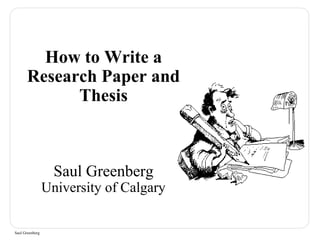
How to Write a 
Research Paper and 
Saul Greenberg 
Thesis 
Saul Greenberg 
University of Calgary
How to write a research paper and thesis 
The Messages: 
• Write to communicate and contribute information you feel is important 
• Papers and theses have typical structures and contents 
• A thesis gives more room to develop arguments 
• To write well: write often (with a mentor), and review papers 
Outline 
Motivation 
When you should write a paper? 
Types of papers 
How referees evaluate papers 
Paper structure 
Thesis structure 
Saul Greenberg
Motivation: Why write? 
Science includes the dissemination of knowledge 
Purpose of a scientific paper: 
• to communicate to the community 
• to contribute to the advancement of knowledge 
Saul Greenberg
Motivation: Why write? 
Writing 
• the product of research 
• audience: 
- gives you a potentially wide audience 
- reaches specialists/peers in your area 
- but depends on where you publish 
• archival: 
- always available 
- snapshot of your research work a given time 
• vehicle for clarification 
- for developing sound arguments, messages... 
The downside: 
• risky! 
- months of work can be rejected 
Saul Greenberg
When you should write a paper 
You should have something important enough to share with others 
• new ideas 
• new facts or data 
• intelligent reviews of old facts and ideas 
Mature results 
• research milestone completed 
• can articulate the research 
- clear problem statement, solution, and contribution to discipline 
Saul Greenberg 
never published
When you should NOT write a paper 
Wrong reasons 
• want or need publications 
- increase publication count 
- fame 
- publish or perish 
• peer pressure 
• want to go to a conference 
Bad papers/work will reflect badly on you! 
• should always be proud of your paper 
Saul Greenberg 
never published
Types of papers 
Breakthrough 
• solves an open problem that many people have worked on 
• rare (one per conference, if lucky!) 
Ground-breaking 
• opens up a field/area that is not well explored 
• places it on a firm foundation 
Saul Greenberg
Types of papers (continued) 
Inventions 
• clever variations/innovations that are appealing in their elegance 
Progress 
• solves open problems that have arisen from recent work 
• typical conference/journal paper 
Survey 
• surveys and unifies a specialized subject 
• contains added value (frameworks, taxonomies) 
• brings together disparate work 
Saul Greenberg
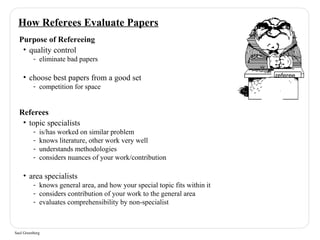
How Referees Evaluate Papers 
Purpose of Refereeing 
• quality control 
- eliminate bad papers 
• choose best papers from a good set 
- competition for space 
Referees 
• topic specialists 
- is/has worked on similar problem 
- knows literature, other work very well 
- understands methodologies 
- considers nuances of your work/contribution 
• area specialists 
- knows general area, and how your special topic fits within it 
- considers contribution of your work to the general area 
- evaluates comprehensibility by non-specialist 
Saul Greenberg 
referee
Typical Questions on a Referee Form 
Briefly summarize the paper (2-3 lines) 
• can they extract a main message from your paper? 
• “If you can’t, there is probably something wrong with the paper” 
Saul Greenberg 
--- CHI FAQ 
What is new and significant in the work reported? 
• New: 
- has it been done before? 
- is it a rehash / republication of old stuff (yours or others)? 
• Significance 
- in five years time, would the work have an identifiable impact? (rare) 
• Would it stimulate further work in this area? 
- is it a reasonable increment that keeps the research area going (frequent)? 
- does it have innovations? 
- is it interesting? 
- is it timely to the community?
Questions on the referee form 
How does it relate to existing work? 
• bibliographies, background, important omissions... 
How reliable are the methods used? 
• are they adequate to support the conclusions 
• is it correct? 
- are there any errors (math, loopholes...) 
How reasonable are the interpretations? 
• good arguments 
• alternative interpretations explored/left out 
Can an experienced practitioner in the field duplicate the results from the paper 
and the references? 
• unethical to publish something that can’t be reproduced 
Saul Greenberg
Questions on referee form 
Is the subject relevant to the publication? 
• domain 
• depth of treatment 
• degree of specialization 
Describe the quality of the writing 
• is the message clear? 
• is the paper easy to follow and understand? 
• is its style exciting or boring? 
• good flow of logic/argumentation? 
• is it well organized? 
• is it grammatically correct? 
• is it accessible to the audience of the publication? 
Saul Greenberg
Paper Structure 
Title 
• clearly describes the subject of the paper 
- “Recognizing hand-written text” 
Saul Greenberg 
vs 
- “DETENTE: Practical Support for Practical Action” 
• can be catchy, but not at the cost of clarity 
- “Bringing Icons to Life” 
- “User Interface Design in the Trenches: Some Tips on Shooting from the Hip” 
- “Virtual Reality on Five Dollars a Day” 
A paper 
by 
Me
Paper Structure 
Abstract 
• Communicates results of paper 
• Completely self-contained 
- bibliographies, on-line databases... 
Saul Greenberg
Example abstract structure 
• Background/setting the scene: 
Icons are used increasingly in interfaces because they are compact "universal" 
pictographic representations of computer functionality and processing. 
• The focus and innovation: 
Animated icons can bring to life symbols representing complete applications or functions 
within an application, thereby clarifying their meaning, demonstrating their capabilities, 
and even explaining their method of use. 
• The problem: 
To test this hypothesis, we carried out an iterative design of a set of animated painting 
icons that appear in the HyperCard tool palette. 
• The method: 
The design discipline restricted the animations to 10 to 20 second sequences of 22x20 pixel 
bit maps. User testing was carried out on two interfaces - one with the static icons, one 
with the animated icons. 
• The results: 
The results showed significant benefit from the animations in clarifying the purpose and 
functionality of the icons. 
Saul Greenberg
Paper Structure 
Introductory Section (s) 
• Sets the scene 
• Gives background 
• Motivates 
• Defines general terms/concepts 
• Describes problem and argues for the approach taking 
• Relates to other work 
• Summarizes the structure of the paper 
- “The next section details the experimental methodology, which is a 2x2 Anova design. The 
subsequent section describes the results, the most notable being...” 
Saul Greenberg
Paper Structure (continued) 
Main body 
• Section organization reflects how your argument unfolds 
• Each section should have a main point 
• Each paragraph should have a main point 
• Look at “exemplars” in your field 
Summary/Conclusions 
• Tell them what you’ve told them 
- some people only read abstract, intro and conclusions 
• Relate back to general area 
• Introduce future work 
Saul Greenberg
Paper Structure (continued) 
Figures and Tables 
• should assist the reader 
• tables: 
- summarizes data 
- collects main points described in text 
• figures 
- system snapshots 
- conceptual diagrams 
- should be legible, instructive, adequately labeled and titled 
Saul Greenberg
Using Figures and Tables 
• should always refer to both in text 
- make the reader look at it 
- bad: 
Saul Greenberg 
“...animated icons contain movies ( Figure 1).” 
- better: 
“... The several images in Figure 1 illustrates an example of an animated 
icon, which represents a printer. Each image is actually a key frame of a 
“movie” that, when played, would show the user what would happened if the 
icon were selected. We see a document being moved on top of the printer, and 
the printer putting out some paper...” 
Examples and Scenarios 
• excellent to clarify and to apply your ideas 
• should be detailed enough to illustrate the concept, but not to the point of tedium
Paper Structure 
Citations and References 
• contains only the papers cited in your work 
- use the best and most up to date literature 
- make sure its relevant 
- don’t overdo it 
- avoid self-glorification 
• must be correct and complete citation information 
- can they find it from your information? 
- prefer archival works to hard-to-get technical reports/obscure publications 
• should conform to style of publication 
- most publications are strict about this 
Saul Greenberg
The Thesis 
Format 
• strictly set by Faculty of Grad Studies 
- violations are grounds for rejection by the Faculty 
- see “Thesis/Dissertation Guidelines” reading 
• typesetting 
- a “supported” LateX thesis style is available 
- Microsoft Word style sheets 
• do drafts in thesis format 
- gives feeling for length, typographic structure 
• length (MSc) 
- 100 pages, +/- 10 (MSc) 
- balance: 
Saul Greenberg 
Thesis 
drafts 
chapters should be of similar length 
(excepting intro and conclusions) 
- appendices: 
could be “extra” to length 
lesser material 
excluded from microfilm record (?)
The Thesis 
Examiner’s Report 
• thesis should usually cover/display 
- use of relevant literature and techniques 
- good organization 
- literary competence 
- good logic of inquiry in research and interpretation of results 
- sound argumentation leading to conclusions 
- sophistication 
- originality 
- contribution to the discipline 
• thesis compared to other theses examined 
• statement on author’s ability to do independent research 
- see “Final Thesis Examination—Examiner’s Report” reading 
Saul Greenberg
The Thesis: Typical Structure 
Abstract: 
forms the steps of an argument 
each sentence outlines contents of thesis chapter 
should reflect the main thesis message 
describes: 
Saul Greenberg 
problem, motivation, current state of the art, what you did, results, 
significance, future work 
1: Introduction 
sets the scene, motivates, describes problem, chapter by chapter outline of thesis 
2: Related work 
current state of the art, synthesis of literature, frameworks for thinking about the area, 
describes parts of the problem that you will and won’t do (focus)
3, 4: Heart of thesis 
develops logic of inquiry 
has clear and sound arguments 
interprets specific results 
discusses implications of results back to general area 
5 Conclusions/Further work 
summarize results and illustrate how they contribute to the discipline 
summarize original aspects of the work 
discuss future work that you or others could do 
6 References 
use standard formats, include all information 
See: The Researchers Bible, p 17-20 
Saul Greenberg
Other readings 
• Knuth: Mathematical Writing 
• Langley: Advice to Machine Learning Authors 
• Greenberg: How to Structure Reports on Experiments in HCI 
• Parberry: A Guide for New Referee in Theoretical Computer Science 
• Forscher: Rules for Referees 
• Exemplar papers in your area 
• References to writing good English 
To help you get your thesis done: 
• write, write, write 
• tell your supervisor you would like to review papers 
• work with others 
- as co-authour 
- as reviewer/commenter 
• have your supervisor review your writing 
- begin writing now! 
Saul Greenberg
Conclusions 
Write to communicate and contribute information you feel is important 
Papers and theses have typical structures and contents that you should follow 
A thesis gives more room to develop arguments 
You should write to convince referees to accept your paper 
A good way to write well is to: 
• write, write, write 
• review papers so you are familiar with how others will review yours 
• work with an associate or mentor 
Saul Greenberg

How to-write-a-research-paper

  • 1.
    How to Writea Research Paper and Saul Greenberg Thesis Saul Greenberg University of Calgary
  • 2.
    How to writea research paper and thesis The Messages: • Write to communicate and contribute information you feel is important • Papers and theses have typical structures and contents • A thesis gives more room to develop arguments • To write well: write often (with a mentor), and review papers Outline Motivation When you should write a paper? Types of papers How referees evaluate papers Paper structure Thesis structure Saul Greenberg
  • 3.
    Motivation: Why write? Science includes the dissemination of knowledge Purpose of a scientific paper: • to communicate to the community • to contribute to the advancement of knowledge Saul Greenberg
  • 4.
    Motivation: Why write? Writing • the product of research • audience: - gives you a potentially wide audience - reaches specialists/peers in your area - but depends on where you publish • archival: - always available - snapshot of your research work a given time • vehicle for clarification - for developing sound arguments, messages... The downside: • risky! - months of work can be rejected Saul Greenberg
  • 5.
    When you shouldwrite a paper You should have something important enough to share with others • new ideas • new facts or data • intelligent reviews of old facts and ideas Mature results • research milestone completed • can articulate the research - clear problem statement, solution, and contribution to discipline Saul Greenberg never published
  • 6.
    When you shouldNOT write a paper Wrong reasons • want or need publications - increase publication count - fame - publish or perish • peer pressure • want to go to a conference Bad papers/work will reflect badly on you! • should always be proud of your paper Saul Greenberg never published
  • 7.
    Types of papers Breakthrough • solves an open problem that many people have worked on • rare (one per conference, if lucky!) Ground-breaking • opens up a field/area that is not well explored • places it on a firm foundation Saul Greenberg
  • 8.
    Types of papers(continued) Inventions • clever variations/innovations that are appealing in their elegance Progress • solves open problems that have arisen from recent work • typical conference/journal paper Survey • surveys and unifies a specialized subject • contains added value (frameworks, taxonomies) • brings together disparate work Saul Greenberg
  • 9.
    How Referees EvaluatePapers Purpose of Refereeing • quality control - eliminate bad papers • choose best papers from a good set - competition for space Referees • topic specialists - is/has worked on similar problem - knows literature, other work very well - understands methodologies - considers nuances of your work/contribution • area specialists - knows general area, and how your special topic fits within it - considers contribution of your work to the general area - evaluates comprehensibility by non-specialist Saul Greenberg referee
  • 10.
    Typical Questions ona Referee Form Briefly summarize the paper (2-3 lines) • can they extract a main message from your paper? • “If you can’t, there is probably something wrong with the paper” Saul Greenberg --- CHI FAQ What is new and significant in the work reported? • New: - has it been done before? - is it a rehash / republication of old stuff (yours or others)? • Significance - in five years time, would the work have an identifiable impact? (rare) • Would it stimulate further work in this area? - is it a reasonable increment that keeps the research area going (frequent)? - does it have innovations? - is it interesting? - is it timely to the community?
  • 11.
    Questions on thereferee form How does it relate to existing work? • bibliographies, background, important omissions... How reliable are the methods used? • are they adequate to support the conclusions • is it correct? - are there any errors (math, loopholes...) How reasonable are the interpretations? • good arguments • alternative interpretations explored/left out Can an experienced practitioner in the field duplicate the results from the paper and the references? • unethical to publish something that can’t be reproduced Saul Greenberg
  • 12.
    Questions on refereeform Is the subject relevant to the publication? • domain • depth of treatment • degree of specialization Describe the quality of the writing • is the message clear? • is the paper easy to follow and understand? • is its style exciting or boring? • good flow of logic/argumentation? • is it well organized? • is it grammatically correct? • is it accessible to the audience of the publication? Saul Greenberg
  • 13.
    Paper Structure Title • clearly describes the subject of the paper - “Recognizing hand-written text” Saul Greenberg vs - “DETENTE: Practical Support for Practical Action” • can be catchy, but not at the cost of clarity - “Bringing Icons to Life” - “User Interface Design in the Trenches: Some Tips on Shooting from the Hip” - “Virtual Reality on Five Dollars a Day” A paper by Me
  • 14.
    Paper Structure Abstract • Communicates results of paper • Completely self-contained - bibliographies, on-line databases... Saul Greenberg
  • 15.
    Example abstract structure • Background/setting the scene: Icons are used increasingly in interfaces because they are compact "universal" pictographic representations of computer functionality and processing. • The focus and innovation: Animated icons can bring to life symbols representing complete applications or functions within an application, thereby clarifying their meaning, demonstrating their capabilities, and even explaining their method of use. • The problem: To test this hypothesis, we carried out an iterative design of a set of animated painting icons that appear in the HyperCard tool palette. • The method: The design discipline restricted the animations to 10 to 20 second sequences of 22x20 pixel bit maps. User testing was carried out on two interfaces - one with the static icons, one with the animated icons. • The results: The results showed significant benefit from the animations in clarifying the purpose and functionality of the icons. Saul Greenberg
  • 16.
    Paper Structure IntroductorySection (s) • Sets the scene • Gives background • Motivates • Defines general terms/concepts • Describes problem and argues for the approach taking • Relates to other work • Summarizes the structure of the paper - “The next section details the experimental methodology, which is a 2x2 Anova design. The subsequent section describes the results, the most notable being...” Saul Greenberg
  • 17.
    Paper Structure (continued) Main body • Section organization reflects how your argument unfolds • Each section should have a main point • Each paragraph should have a main point • Look at “exemplars” in your field Summary/Conclusions • Tell them what you’ve told them - some people only read abstract, intro and conclusions • Relate back to general area • Introduce future work Saul Greenberg
  • 18.
    Paper Structure (continued) Figures and Tables • should assist the reader • tables: - summarizes data - collects main points described in text • figures - system snapshots - conceptual diagrams - should be legible, instructive, adequately labeled and titled Saul Greenberg
  • 19.
    Using Figures andTables • should always refer to both in text - make the reader look at it - bad: Saul Greenberg “...animated icons contain movies ( Figure 1).” - better: “... The several images in Figure 1 illustrates an example of an animated icon, which represents a printer. Each image is actually a key frame of a “movie” that, when played, would show the user what would happened if the icon were selected. We see a document being moved on top of the printer, and the printer putting out some paper...” Examples and Scenarios • excellent to clarify and to apply your ideas • should be detailed enough to illustrate the concept, but not to the point of tedium
  • 20.
    Paper Structure Citationsand References • contains only the papers cited in your work - use the best and most up to date literature - make sure its relevant - don’t overdo it - avoid self-glorification • must be correct and complete citation information - can they find it from your information? - prefer archival works to hard-to-get technical reports/obscure publications • should conform to style of publication - most publications are strict about this Saul Greenberg
  • 21.
    The Thesis Format • strictly set by Faculty of Grad Studies - violations are grounds for rejection by the Faculty - see “Thesis/Dissertation Guidelines” reading • typesetting - a “supported” LateX thesis style is available - Microsoft Word style sheets • do drafts in thesis format - gives feeling for length, typographic structure • length (MSc) - 100 pages, +/- 10 (MSc) - balance: Saul Greenberg Thesis drafts chapters should be of similar length (excepting intro and conclusions) - appendices: could be “extra” to length lesser material excluded from microfilm record (?)
  • 22.
    The Thesis Examiner’sReport • thesis should usually cover/display - use of relevant literature and techniques - good organization - literary competence - good logic of inquiry in research and interpretation of results - sound argumentation leading to conclusions - sophistication - originality - contribution to the discipline • thesis compared to other theses examined • statement on author’s ability to do independent research - see “Final Thesis Examination—Examiner’s Report” reading Saul Greenberg
  • 23.
    The Thesis: TypicalStructure Abstract: forms the steps of an argument each sentence outlines contents of thesis chapter should reflect the main thesis message describes: Saul Greenberg problem, motivation, current state of the art, what you did, results, significance, future work 1: Introduction sets the scene, motivates, describes problem, chapter by chapter outline of thesis 2: Related work current state of the art, synthesis of literature, frameworks for thinking about the area, describes parts of the problem that you will and won’t do (focus)
  • 24.
    3, 4: Heartof thesis develops logic of inquiry has clear and sound arguments interprets specific results discusses implications of results back to general area 5 Conclusions/Further work summarize results and illustrate how they contribute to the discipline summarize original aspects of the work discuss future work that you or others could do 6 References use standard formats, include all information See: The Researchers Bible, p 17-20 Saul Greenberg
  • 25.
    Other readings •Knuth: Mathematical Writing • Langley: Advice to Machine Learning Authors • Greenberg: How to Structure Reports on Experiments in HCI • Parberry: A Guide for New Referee in Theoretical Computer Science • Forscher: Rules for Referees • Exemplar papers in your area • References to writing good English To help you get your thesis done: • write, write, write • tell your supervisor you would like to review papers • work with others - as co-authour - as reviewer/commenter • have your supervisor review your writing - begin writing now! Saul Greenberg
  • 26.
    Conclusions Write tocommunicate and contribute information you feel is important Papers and theses have typical structures and contents that you should follow A thesis gives more room to develop arguments You should write to convince referees to accept your paper A good way to write well is to: • write, write, write • review papers so you are familiar with how others will review yours • work with an associate or mentor Saul Greenberg