Research
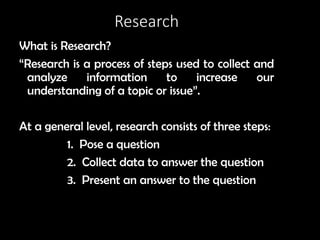
What is Research?
“Researchis a process of steps used to collect and
analyze information to increase our
understanding of a topic or issue”.
At a general level, research consists of three steps:
1. Pose a question
2. Collect data to answer the question
3. Present an answer to the question
3.
THE SIX STEPSIN THE
PROCESS OF RESEARCH
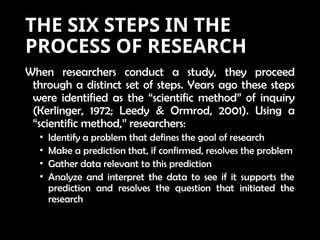
When researchers conduct a study, they proceed
through a distinct set of steps. Years ago these steps
were identified as the “scientific method” of inquiry
(Kerlinger, 1972; Leedy & Ormrod, 2001). Using a
“scientific method,” researchers:
• Identify a problem that defines the goal of research
• Make a prediction that, if confirmed, resolves the problem
• Gather data relevant to this prediction
• Analyze and interpret the data to see if it supports the
prediction and resolves the question that initiated the
research
4.
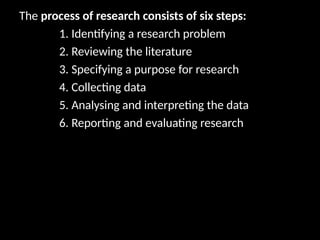
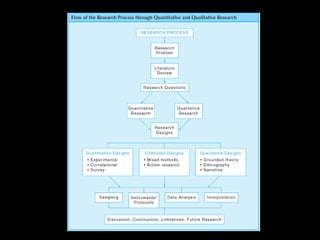
The process ofresearch consists of six steps:
1. Identifying a research problem
2. Reviewing the literature
3. Specifying a purpose for research
4. Collecting data
5. Analysing and interpreting the data
6. Reporting and evaluating research
7.
Quantitative Research Methods
QuantitativeResearch is an approach for testing
objective theories by examining the relationship
among variables.
These variables, in turn, can be measured, typically
on instruments, so that numbered data can be
analysed using statistical procedures.
The final written report has a set structure consisting
of introduction, literature and theory, methods,
results, and discussion.
The researcher in this form of inquiry have
assumptions about testing theories deductively,
building in protections against bias, controlling for
alternative explanations, and being able to
generalize and replicate the findings.
8.
Quantitative Research characteristics
Themajor characteristics of quantitative research are:
Describing a research problem through a description of trends or a need for
an explanation of the relationship among variables
Providing a major role for the literature through suggesting the research
questions to be asked and justifying the research problem and creating a
need for the direction(purpose statement and research questions or
hypotheses) of the study
Creating purpose statements, research questions, and hypotheses that are
specific, narrow, measurable, and observable
Collecting numeric data from a large number of people using instruments
with preset questions and responses
Analyzing trends, comparing groups, or relating variables using statistical
analysis, and interpreting results by comparing them with prior
predictions and past research
Writing the research report using standard, fixed structures and evaluation
criteria, and taking an objective, unbiased approach
9.
Qualitative Research Method
QualitativeResearch is an approach for exploring and
understanding the meaning individuals or groups
ascribe to a social or human problem.
The process of research involves emerging questions
and procedures, data typically collected in the
participant‘s setting, data analysis inductively
building from particulars to general themes.
The researcher making interpretations of the meaning
of the data.
The final written report has a flexible structure. The
researcher in this form of inquiry support a way of
looking at research that honors an inductive style, a
focus on individual meaning, and the importance of
rendering the complexity of a situation.
10.
Qualitative Research Characteristics
Inqualitative research, we see different major characteristics
at each stage of the research process:
• Exploring a problem and developing a detailed
understanding of a central phenomenon
• Having the literature review play a minor role but justify
the problem
• Stating the purpose and research questions in a general
and broad way so as to the participants’ experiences
• Collecting data based on words from a small number of
individuals so that the participants’ views are obtained
• Analyzing the data for description and themes using text
analysis and interpreting the larger meaning of the findings
• Writing the report using flexible, emerging structures and
evaluative criteria, and including the researchers’
subjective reflexivity and bias
11.
Mixed Methods Research
MixedMethods Research is an approach to
inquiry involving collecting both quantitative and
qualitative data, integrating the two forms of
data, and using distinct designs that may involve
philosophical assumptions and theoretical
frameworks.
The core assumption of this form of inquiry is that
the combination of qualitative and quantitative
approaches provides a more complete
understanding of a research problem than either
approach alone.
12.
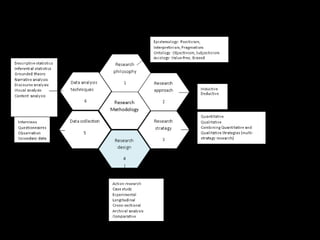
What is aresearch design?
• A research design is a plan, structure and strategy
of investigation so conceived as to obtain answers
to research questions or problems. It includes an
outline of what the investigator will do from writing
the hypotheses and their operational implications
to the final analysis of data. (Kerlinger, 1986)
• According to Selltiz, Deutsch and Cook(1962), ‘A
research design is the arrangement of conditions
for collection and analysis of data in a manner that
aims to combine relevance to the research purpose
with economy in procedure’.
• Research designs are the specific procedures
involved in the research process: data collection,
data analysis, and report writing.
Quantitative Research Designs
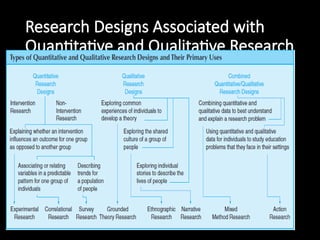
ExperimentalDesigns: Some quantitative researchers
seek to test whether an educational practice or idea
makes a difference for individuals. Experimental
research procedures are ideally suited for this study.
Experimental designs (also called intervention studies or
group comparison studies) are procedures in
quantitative research in which the investigator
determines whether an activity or materials make a
difference in results for participants. You assess this
impact by giving one group one set of activities (called
an intervention) and withholding the set from another
group.
15.
Correlational Designs: Insome studies, you may be
unable to provide an intervention or to assign
individuals to groups. Moreover, you focus more on
examining the association or relation of one or more
variables than in testing the impact of activities or
materials. Correlational designs are procedures in
quantitative research in which investigators measure
the degree of association (or relation) between two
or more variables using the statistical procedure of
correlational analysis. This degree of association,
expressed as a number, indicates whether the two
variables are related or whether one can predict
another. To accomplish this, you study a single group
of individuals rather than two or more groups as in
an experiment.
16.
Survey Designs: Inanother form of quantitative
research, you may not want to test an activity or
materials or may not be interested in the association
among variables. Instead, you seek to describe
trends in a large population of individuals. In this
case, a survey is a good procedure to use. Survey
designs are procedures in quantitative research in
which you administer a survey or questionnaire to a
small group of people (called the sample) to identify
trends in attitudes, opinions, behaviors, or
characteristics of a large group of people(called the
population).
17.
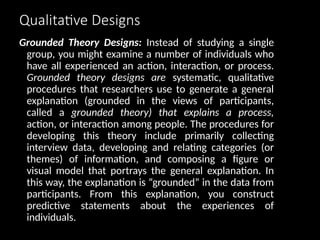
Qualitative Designs
Grounded TheoryDesigns: Instead of studying a single
group, you might examine a number of individuals who
have all experienced an action, interaction, or process.
Grounded theory designs are systematic, qualitative
procedures that researchers use to generate a general
explanation (grounded in the views of participants,
called a grounded theory) that explains a process,
action, or interaction among people. The procedures for
developing this theory include primarily collecting
interview data, developing and relating categories (or
themes) of information, and composing a figure or
visual model that portrays the general explanation. In
this way, the explanation is “grounded” in the data from
participants. From this explanation, you construct
predictive statements about the experiences of
individuals.
18.
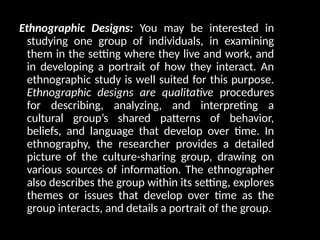
Ethnographic Designs: Youmay be interested in
studying one group of individuals, in examining
them in the setting where they live and work, and
in developing a portrait of how they interact. An
ethnographic study is well suited for this purpose.
Ethnographic designs are qualitative procedures
for describing, analyzing, and interpreting a
cultural group’s shared patterns of behavior,
beliefs, and language that develop over time. In
ethnography, the researcher provides a detailed
picture of the culture-sharing group, drawing on
various sources of information. The ethnographer
also describes the group within its setting, explores
themes or issues that develop over time as the
group interacts, and details a portrait of the group.
19.
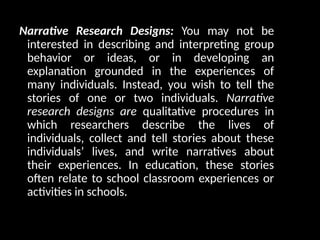
Narrative Research Designs:You may not be
interested in describing and interpreting group
behavior or ideas, or in developing an
explanation grounded in the experiences of
many individuals. Instead, you wish to tell the
stories of one or two individuals. Narrative
research designs are qualitative procedures in
which researchers describe the lives of
individuals, collect and tell stories about these
individuals’ lives, and write narratives about
their experiences. In education, these stories
often relate to school classroom experiences or
activities in schools.
20.
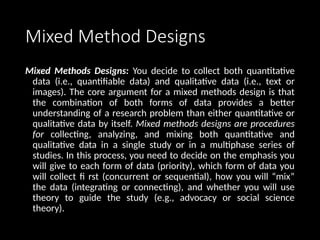
Mixed Method Designs
MixedMethods Designs: You decide to collect both quantitative
data (i.e., quantifiable data) and qualitative data (i.e., text or
images). The core argument for a mixed methods design is that
the combination of both forms of data provides a better
understanding of a research problem than either quantitative or
qualitative data by itself. Mixed methods designs are procedures
for collecting, analyzing, and mixing both quantitative and
qualitative data in a single study or in a multiphase series of
studies. In this process, you need to decide on the emphasis you
will give to each form of data (priority), which form of data you
will collect fi rst (concurrent or sequential), how you will “mix”
the data (integrating or connecting), and whether you will use
theory to guide the study (e.g., advocacy or social science
theory).
21.
Action Research Designs:Like mixed methods
research, action research designs often utilize both
quantitative and qualitative data, but they focus
more on procedures useful in addressing practical
problems. Action research designs are systematic
procedures used by researcher to gather quantitative
and qualitative data to address the problems. In case
of educational research, they are focused on
improvements in their educational setting, their
teaching, and the learning of their students. In some
action research designs, you seek to address and
solve local, practical problems, such as a classroom-
discipline issue for a teacher. In other studies, your
objective might be to empower, transform, and
emancipate individuals in educational settings.