HOW TO WRITE A
RESEARCH PROPOSAL
What Makes a Good Proposal?
A good idea or a significant problem, a clear
description on the idea or problem, then
finally a funding agency’s priorities.
Factors We Can’t Control
 Internal politics within the funding agency
 Stiff competition from other applicants
 Limited availability of funds for certain
program areas within funding agency
Factors We Can Control
 Quality of our own proposal
 Requires careful research and planning
 Requires meticulous execution
What is a research proposal?
 A research proposal is your plan
 It describes in detail your study
 Decisions about your study are based on the
quality of the proposal
 Research funding
 Approvals to proceed by the Institutional Review
Board
Any research /study should have a
proper proposal in written form before
it is actually carried out
It is like a blue print of a building plan
before the construction starts
Writing a research proposal is both
science and art
A good research proposal is based on
scientific facts and on the art of clear
communication
 Writing a formal research proposal should be started by
the time one has decided on the topic for the study
 Objective
 Justification
 Introduction
 Background /Review of literature
 Methodology
 Time frame and work schedule/Gantt chart
 Personnel needed / available
 Facilities needed / available
 Budget
Objectives
• This is a very important and pivotal section
and everything else in the study is centered
around it
• The objective of the proposed study should
be stated very clearly
• The objective stated should be specific,
achievable and measurable
• Too many objectives to be avoided
• Even just one clearly stated relevant objective for a
study would be good enough
• If there is more than one objective the objectives
can be presented in the appropriate order of
importance
Sections of the Proposal
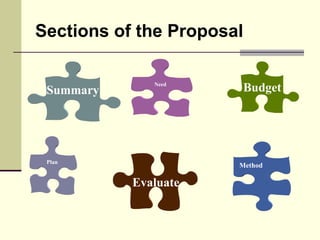
Summary
Need
Budget
Plan
Evaluate
Method
Budget Your Time
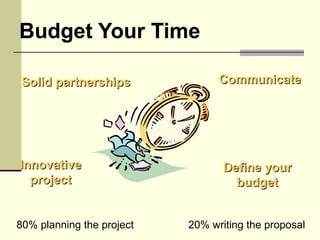
80% planning the project 20% writing the proposal
Solid partnershipsSolid partnerships
InnovativeInnovative
projectproject
CommunicateCommunicate
Define yourDefine your
budgetbudget
Cover/Title Page
 Use sponsor agency form if applicable
 Use required guidelines (MLA, APA, EEE,
for title page
 Project title
 Organization name
 Sponsor agency name (if applicable)
 Submission date
Project Summary / Abstract
 One page
 State problem
 Propose solution
 State project objectives and significance
 NSF requires statement of intellectual merit and
broader impacts
Introduction
 The problem proposed to be studied is introduced in
this section
 It should help the reader to acquaint with the topic
 Introduction should be short about one or two pages
 The problem should be stated in such a way that it’s
importance and relevance is realized by any one who
reads it
 The research should be clear, concise &
understandable
Introduction
 What specific need or problem does
your research address?
 How was the need identified and its
significance?
 Who will benefit from the proposed
research project?
 What are the research questions and/or
objectives of the proposal
Review of the Literature
 Literature review should relate to:
 The topic
 Methodology
 Know the facts & issues
 Interest on the topic
 Identify the gaps
 Justify your study
Background
(Review of Literature)
 This section reflects extensive review of literature done by the
investigator
 In this section what is already known about the topic is written
including the lacunae
 Just quoting the literature verbatim will not serve the purpose
 It is important to make it coherent, relevant and easily readable
knowledge
 It helps the investigator to gain good knowledge in that field of
inquiry
 It also helps the investigator to have insight on different
methodologies that could be applied
Research methodology
 Research methodology is a way to systematically
solve the research problem. It may be understood as
a science of studying how research is done
scientifically
 It is necessary for the researcher to know not only
the research methods/techniques but also the
methodology.
 Researchers not only need to know how to develop
certain indices or tests and how to calculate the
mean, the mode, the median or the standard
deviation or chi-square etc.,
It is essential to discuss procedures clearly
and completely with considerable amount
of details
Study design
Study population / Sampling specifications
Sample size needed
Instrumentation
Specific procedures
Study design
Definition: A study design is a specific
plan or protocol for conducting the study,
which allows the investigator to translate
the conceptual hypothesis into an
operational one.
The study design should be clearly stated
The study design to be used should be
appropriate for achieving the objective of
the study
Study population / Sample specifications
It is important to describe which would be
the study population
How study subjects would be selected,
randomization process and other details
should be given
Sample size
  It is important to mention in the protocol what
    would be the minimum  sample required and how it is  
arrived 
 Determination of sample size is a bargain between 
precision and the price (Resources & expenses 
involved)
Description of process 
 Proposal should include the details of all process
to be adopted in the study
 How exposures, outcome variables and other 
variables are going to be measured  should be described in
detail 
 A brief description of how the data will be processed 
and use of statistical package if any should be given
 What statistical tests of significance   would be used?
Time Frame & Work Schedule
 The proposal should include the sequence of tasks to 
be performed, the anticipated length of time required 
for its completion and the personnel required 
 It can be presented in tabular or graphic form (Gantt 
chart)
 Flow charts and other diagrams are often useful for 
highlighting the sequencing and interrelationship of 
different activities in the study
 Illustrate each phase of implementation
 Show when results will be achieved
 
Facilities
The proposal should also include the
 important facilities required / available 
for the study namely computers, laboratories, 
special equipment etc 
Personnel
Proposal should include who are the 
primary  investigators and co- investigators, 
their  qualifications, research experience etc 
The proposal may also include the Major
 roles to be taken up by different investigators 
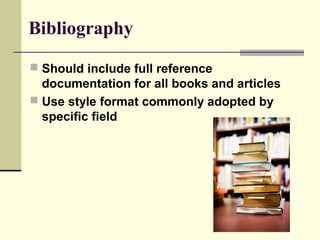
Bibliography
 Should include full reference
documentation for all books and articles
 Use style format commonly adopted by
specific field
Project Description and Plan of
Operation
 Describe activities to be undertaken
 Identify person responsible for each
 Describe oversight and management
of project
 Describe qualifications of key
personnel
Organizational Capability
 Describe your organization, its history,
and its mission
 Describe organization’s strengths in terms
of staff, facilities, resources
 Describe prior experience relevant to the
proposed project
Budget and Cost-Effectiveness
 Make sure budget coincides with narrative
 Make sure sponsor will support budget
categories you propose
 Some sponsors may disallow equipment,
overhead or other costs
Budget and Cost-Effectiveness
 The budget translates project activities into monetary 
terms
 It is a statement of how much money  will be  required 
to accomplish the  various tasks
Major items
 Salary for staff
 Travel
 Purchase of equipment
 Printing / Xeroxing
 Consultancy charges
 Institutional overheads
Budget and Cost-Effectiveness
 Be realistic about your budget
 Inflating budget may hurt your chances of
being funded
 Budgeting too low may make the project
impossible to do with funds provided
 Estimate costs as accurately as possible
Budget and Cost-Effectiveness
 Cost-sharing
 Sometimes required by sponsor
 Can be cash or in-kind
 Be careful: don’t cost-share items you can’t
document
 Check both sponsor’s and your own
organization’s guidelines regarding cost-sharing
 Overhead/Indirect costs
 Usually a percentage of total budget (45%)
 Check sponsor’s allowed overhead rate, if any
Budget and Cost-Effectiveness
 Demonstrate that project is cost-effective: it will have a
significant impact for a reasonable cost
 Describe organizational resources (staff support,
facilities, equipment) not funded by the sponsor
 Provide a budget narrative
 Explain how you arrived at figures in each category
 How fringe benefits are calculated
 How you calculated travel costs
 How you estimated equipment costs
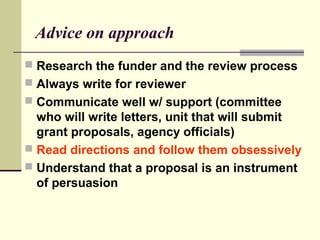
Advice on approach
 Research the funder and the review process
 Always write for reviewer
 Communicate well w/ support (committee
who will write letters, unit that will submit
grant proposals, agency officials)
 Read directions and follow them obsessively
 Understand that a proposal is an instrument
of persuasion
Common, easy-to-avoid mistakes
 Don’t follow directions (font, margins, pages,
appended material, etc.)
 Format
 Not allowing enough time
 Careless criticism of other scholars in field
 Don’t include all who, what, where, when,
why, and how info., up front
Other common problems w/ predoc
proposals (more difficult to remedy):
 Research problem itself
 Scholarly background to the problem—uneven
or inadequate or erroneous
 Writing unclear—too much jargon, not
accessible, or not well organized
 Methods and work plan unclear or undefended
 Lack of specificity
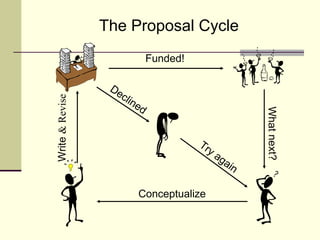
Funded!
Conceptualize
Declined
Try again
Whatnext?
Write
The Proposal Cycle
&Revise
PI/
Institution
Central
Processing
Program
Manager
Division
Director
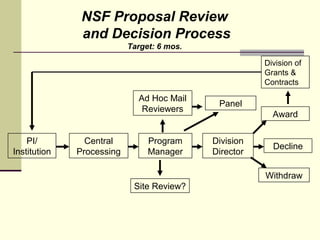
Ad Hoc Mail
Reviewers
Panel
Award
Decline
Withdraw
NSF Proposal Review
and Decision Process
Target: 6 mos.
Division of
Grants &
Contracts
Site Review?

Research proposal

  • 1.
    HOW TO WRITEA RESEARCH PROPOSAL
  • 2.
    What Makes aGood Proposal? A good idea or a significant problem, a clear description on the idea or problem, then finally a funding agency’s priorities.
  • 3.
    Factors We Can’tControl  Internal politics within the funding agency  Stiff competition from other applicants  Limited availability of funds for certain program areas within funding agency
  • 4.
    Factors We CanControl  Quality of our own proposal  Requires careful research and planning  Requires meticulous execution
  • 5.
    What is aresearch proposal?  A research proposal is your plan  It describes in detail your study  Decisions about your study are based on the quality of the proposal  Research funding  Approvals to proceed by the Institutional Review Board
  • 6.
    Any research /studyshould have a proper proposal in written form before it is actually carried out It is like a blue print of a building plan before the construction starts Writing a research proposal is both science and art A good research proposal is based on scientific facts and on the art of clear communication
  • 7.
     Writing aformal research proposal should be started by the time one has decided on the topic for the study  Objective  Justification  Introduction  Background /Review of literature  Methodology  Time frame and work schedule/Gantt chart  Personnel needed / available  Facilities needed / available  Budget
  • 8.
    Objectives • This isa very important and pivotal section and everything else in the study is centered around it • The objective of the proposed study should be stated very clearly • The objective stated should be specific, achievable and measurable • Too many objectives to be avoided • Even just one clearly stated relevant objective for a study would be good enough • If there is more than one objective the objectives can be presented in the appropriate order of importance
  • 9.
    Sections of theProposal Summary Need Budget Plan Evaluate Method
  • 10.
    Budget Your Time 80%planning the project 20% writing the proposal Solid partnershipsSolid partnerships InnovativeInnovative projectproject CommunicateCommunicate Define yourDefine your budgetbudget
  • 11.
    Cover/Title Page  Usesponsor agency form if applicable  Use required guidelines (MLA, APA, EEE, for title page  Project title  Organization name  Sponsor agency name (if applicable)  Submission date
  • 12.
    Project Summary /Abstract  One page  State problem  Propose solution  State project objectives and significance  NSF requires statement of intellectual merit and broader impacts
  • 13.
    Introduction  The problemproposed to be studied is introduced in this section  It should help the reader to acquaint with the topic  Introduction should be short about one or two pages  The problem should be stated in such a way that it’s importance and relevance is realized by any one who reads it  The research should be clear, concise & understandable
  • 14.
    Introduction  What specificneed or problem does your research address?  How was the need identified and its significance?  Who will benefit from the proposed research project?  What are the research questions and/or objectives of the proposal
  • 15.
    Review of theLiterature  Literature review should relate to:  The topic  Methodology  Know the facts & issues  Interest on the topic  Identify the gaps  Justify your study
  • 16.
    Background (Review of Literature) This section reflects extensive review of literature done by the investigator  In this section what is already known about the topic is written including the lacunae  Just quoting the literature verbatim will not serve the purpose  It is important to make it coherent, relevant and easily readable knowledge  It helps the investigator to gain good knowledge in that field of inquiry  It also helps the investigator to have insight on different methodologies that could be applied
  • 17.
    Research methodology  Researchmethodology is a way to systematically solve the research problem. It may be understood as a science of studying how research is done scientifically  It is necessary for the researcher to know not only the research methods/techniques but also the methodology.  Researchers not only need to know how to develop certain indices or tests and how to calculate the mean, the mode, the median or the standard deviation or chi-square etc.,
  • 18.
    It is essentialto discuss procedures clearly and completely with considerable amount of details Study design Study population / Sampling specifications Sample size needed Instrumentation Specific procedures
  • 19.
    Study design Definition: Astudy design is a specific plan or protocol for conducting the study, which allows the investigator to translate the conceptual hypothesis into an operational one. The study design should be clearly stated The study design to be used should be appropriate for achieving the objective of the study
  • 20.
    Study population /Sample specifications It is important to describe which would be the study population How study subjects would be selected, randomization process and other details should be given
  • 21.
    Sample size   It is important to mention in the protocol what     would be the minimum  sample required and how it is   arrived  Determination of sample size is a bargain between  precision and the price (Resources & expenses  involved)
  • 22.
    Description of process  Proposal should include the details of all process to be adopted in the study  How exposures, outcome variables and other  variables are going to be measured  should be described in detail   A brief description of how the data will be processed  and use of statistical package if any should be given  What statistical tests of significance   would be used?
  • 23.
    Time Frame &Work Schedule  The proposal should include the sequence of tasks to  be performed, the anticipated length of time required  for its completion and the personnel required   It can be presented in tabular or graphic form (Gantt  chart)  Flow charts and other diagrams are often useful for  highlighting the sequencing and interrelationship of  different activities in the study  Illustrate each phase of implementation  Show when results will be achieved  
  • 24.
  • 25.
  • 26.
    Bibliography  Should includefull reference documentation for all books and articles  Use style format commonly adopted by specific field
  • 27.
    Project Description andPlan of Operation  Describe activities to be undertaken  Identify person responsible for each  Describe oversight and management of project  Describe qualifications of key personnel
  • 28.
    Organizational Capability  Describeyour organization, its history, and its mission  Describe organization’s strengths in terms of staff, facilities, resources  Describe prior experience relevant to the proposed project
  • 29.
    Budget and Cost-Effectiveness Make sure budget coincides with narrative  Make sure sponsor will support budget categories you propose  Some sponsors may disallow equipment, overhead or other costs
  • 30.
    Budget and Cost-Effectiveness The budget translates project activities into monetary  terms  It is a statement of how much money  will be  required  to accomplish the  various tasks Major items  Salary for staff  Travel  Purchase of equipment  Printing / Xeroxing  Consultancy charges  Institutional overheads
  • 31.
    Budget and Cost-Effectiveness Be realistic about your budget  Inflating budget may hurt your chances of being funded  Budgeting too low may make the project impossible to do with funds provided  Estimate costs as accurately as possible
  • 32.
    Budget and Cost-Effectiveness Cost-sharing  Sometimes required by sponsor  Can be cash or in-kind  Be careful: don’t cost-share items you can’t document  Check both sponsor’s and your own organization’s guidelines regarding cost-sharing  Overhead/Indirect costs  Usually a percentage of total budget (45%)  Check sponsor’s allowed overhead rate, if any
  • 33.
    Budget and Cost-Effectiveness Demonstrate that project is cost-effective: it will have a significant impact for a reasonable cost  Describe organizational resources (staff support, facilities, equipment) not funded by the sponsor  Provide a budget narrative  Explain how you arrived at figures in each category  How fringe benefits are calculated  How you calculated travel costs  How you estimated equipment costs
  • 34.
    Advice on approach Research the funder and the review process  Always write for reviewer  Communicate well w/ support (committee who will write letters, unit that will submit grant proposals, agency officials)  Read directions and follow them obsessively  Understand that a proposal is an instrument of persuasion
  • 35.
    Common, easy-to-avoid mistakes Don’t follow directions (font, margins, pages, appended material, etc.)  Format  Not allowing enough time  Careless criticism of other scholars in field  Don’t include all who, what, where, when, why, and how info., up front
  • 36.
    Other common problemsw/ predoc proposals (more difficult to remedy):  Research problem itself  Scholarly background to the problem—uneven or inadequate or erroneous  Writing unclear—too much jargon, not accessible, or not well organized  Methods and work plan unclear or undefended  Lack of specificity
  • 37.
  • 38.
    PI/ Institution Central Processing Program Manager Division Director Ad Hoc Mail Reviewers Panel Award Decline Withdraw NSFProposal Review and Decision Process Target: 6 mos. Division of Grants & Contracts Site Review?

Editor's Notes

  • #2 Introduction and background re: grants (ESC, RFF) This presentation will be online on Grants Office page Speaks generally about proposals; can follow up about specifics later
  • #11 Have your ducks in a row BEFORE you write a proposal – have your partnerships and budget as close to final as possible…and remember that Innovative projects will catch their attention