Research Design: Using
Quantitative Methods
Objectives
By the end of this session you will be able
to:
• Describe the experimental and quasi-
experimental research approaches.
• Formulate appropriate questions and
hypotheses.
• Identify populations and samples.
• Describe the principles of research tool
design (validity and reliability).
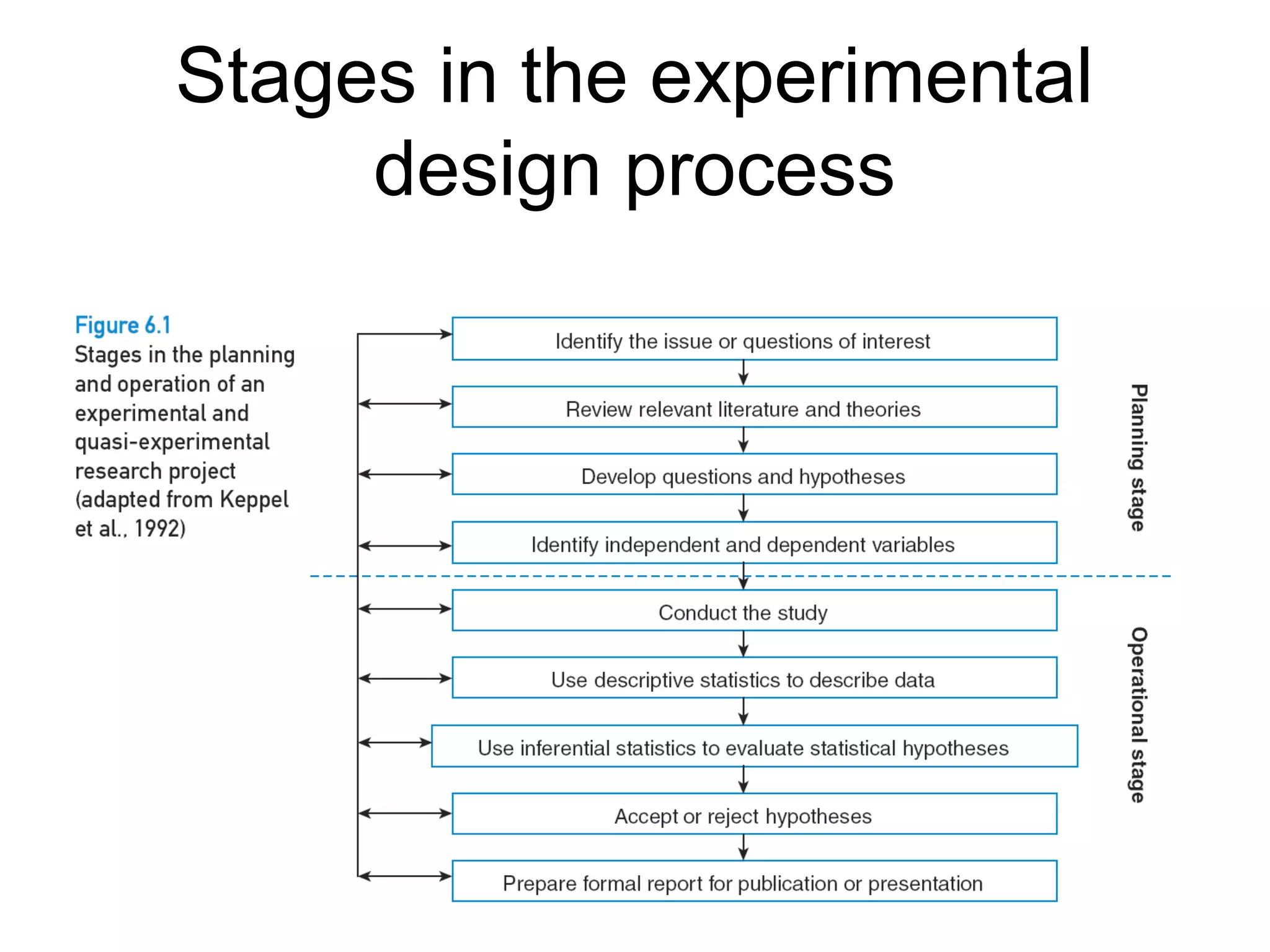
Stages in the experimental
design process
Identifying issues
‘Good’ research topics might emerge:
• From the literature.
• Within workplace settings.
• From previous projects/assignments.
• From a sponsor.
Review the literature
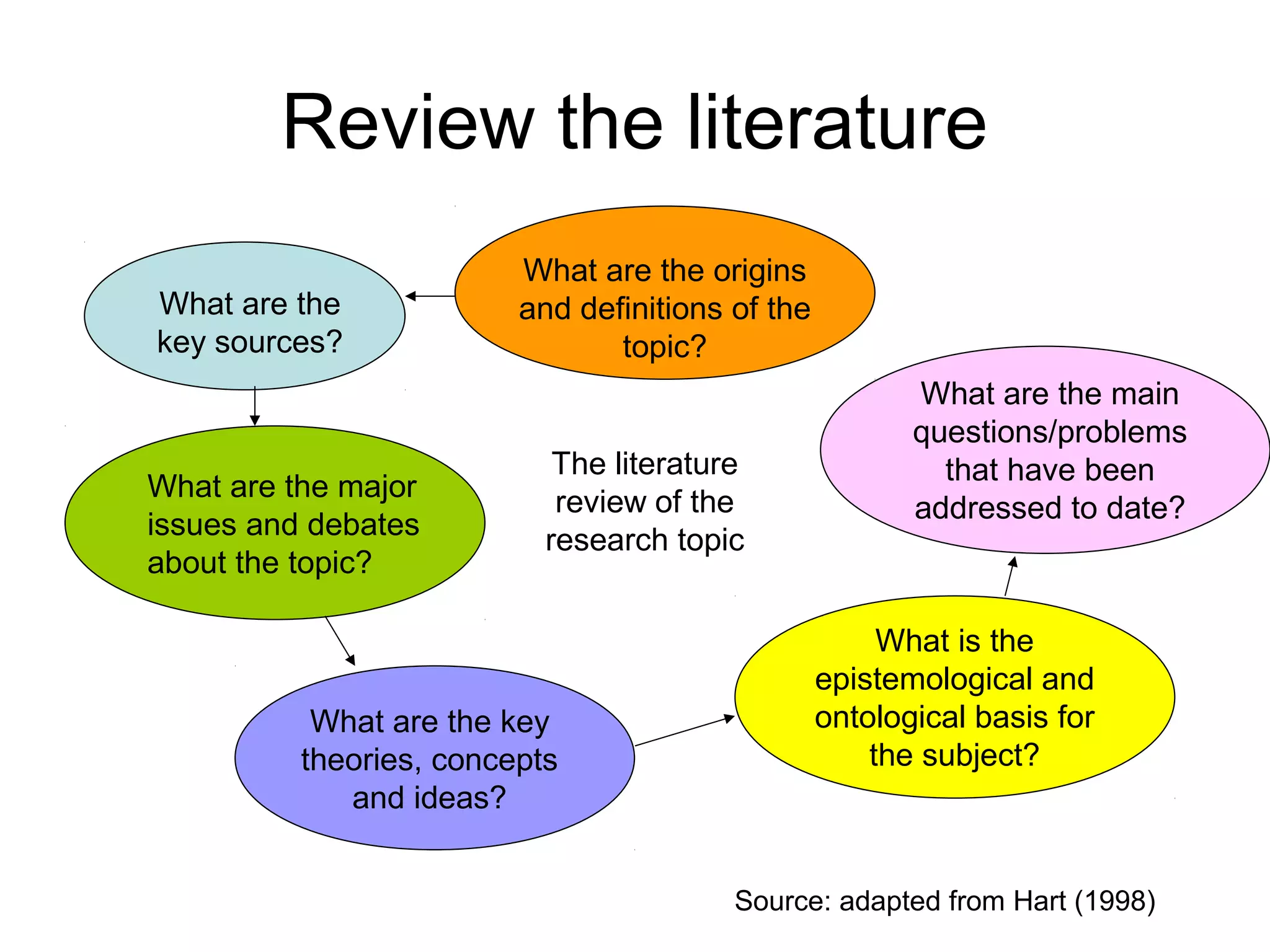
The literature
review of the
research topic
What are the
key sources?
What are the major
issues and debates
about the topic?
What are the origins
and definitions of the
topic?
What are the key
theories, concepts
and ideas?
What is the
epistemological and
ontological basis for
the subject?
What are the main
questions/problems
that have been
addressed to date?
Source: adapted from Hart (1998)
Develop questions/hypotheses
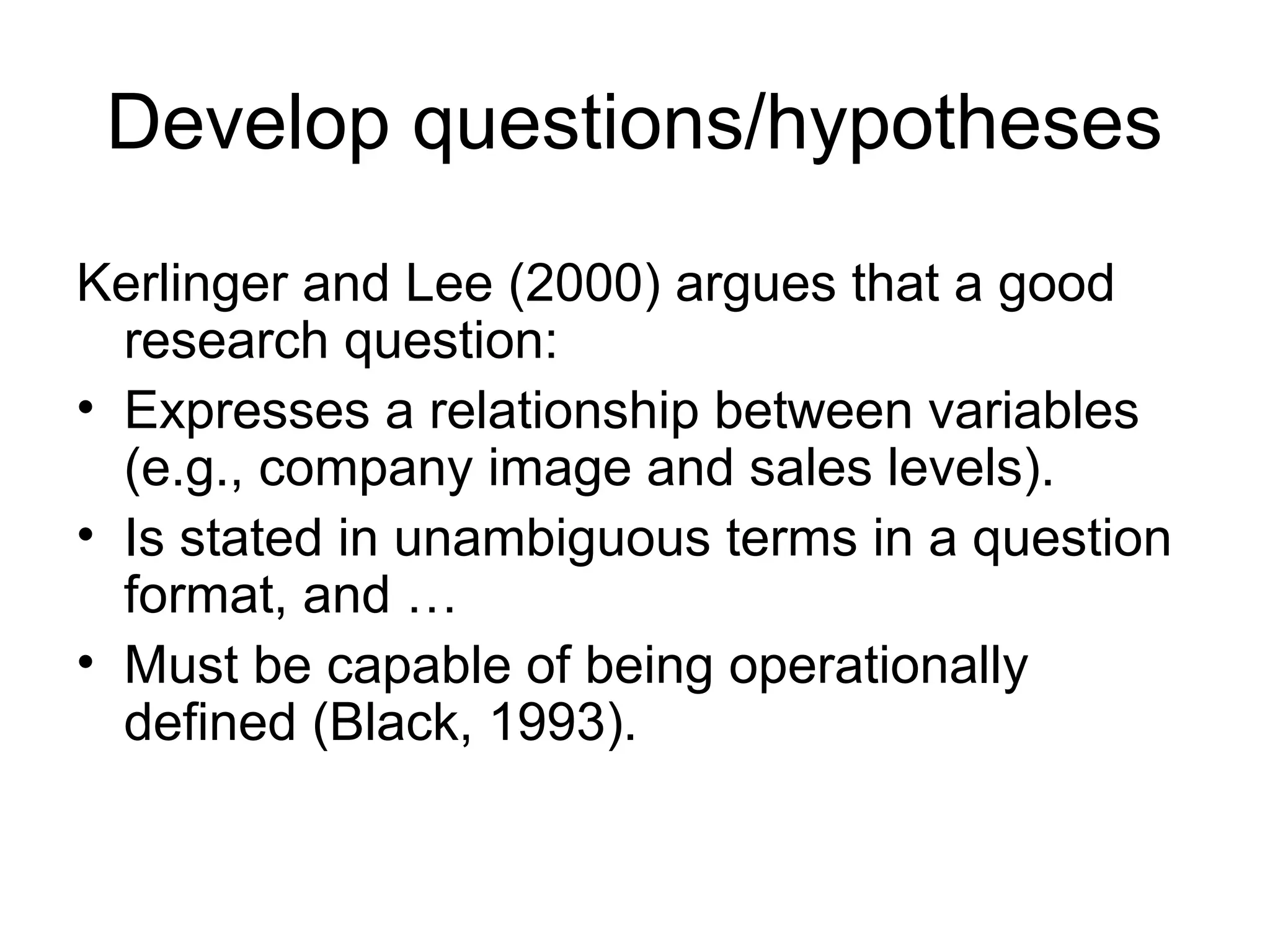
Kerlinger and Lee (2000) argues that a good
research question:
• Expresses a relationship between variables
(e.g., company image and sales levels).
• Is stated in unambiguous terms in a question
format, and …
• Must be capable of being operationally
defined (Black, 1993).
Types of applied research
questions – with examples
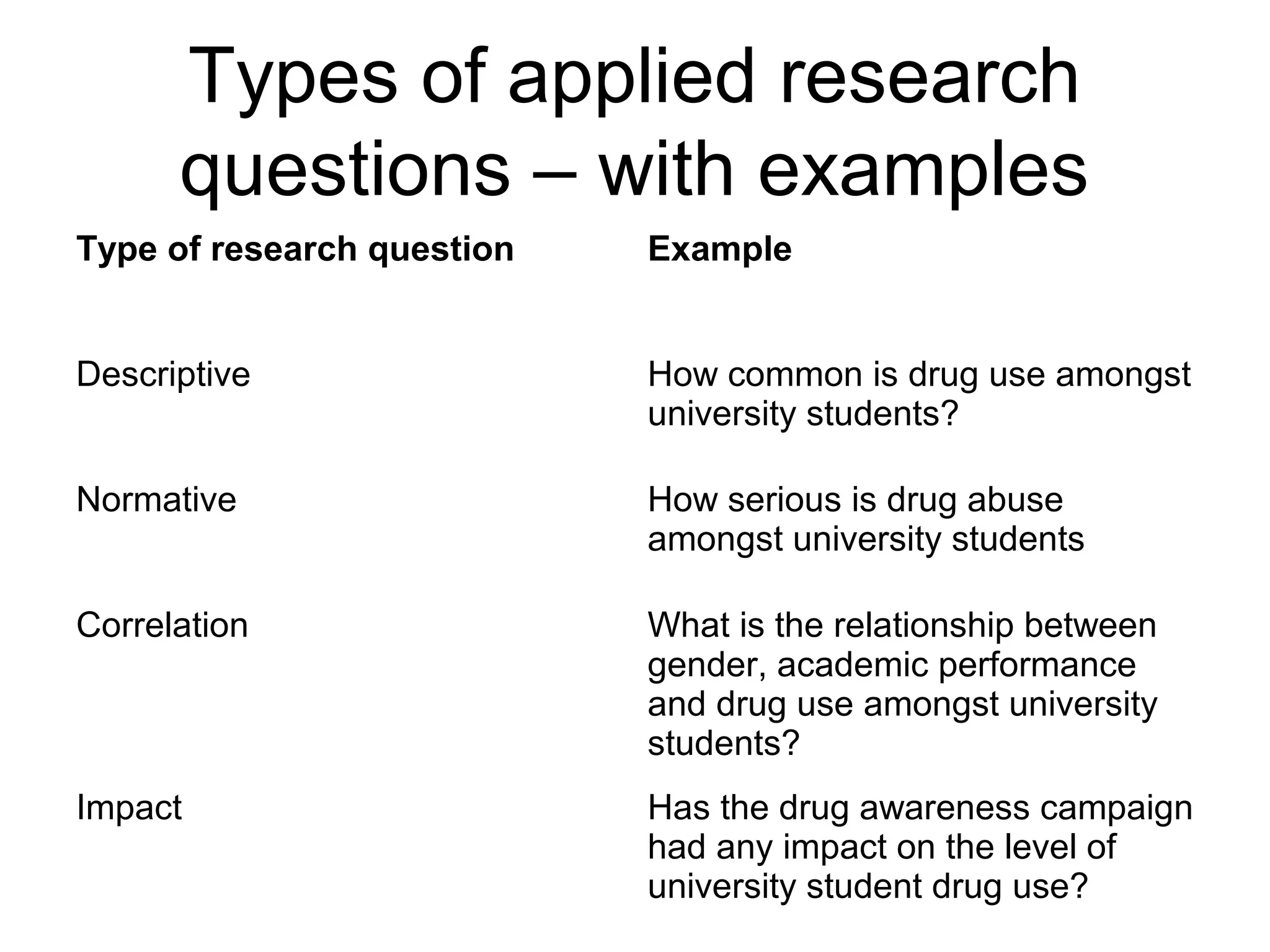
Type of research question Example
Descriptive How common is drug use amongst
university students?
Normative How serious is drug abuse
amongst university students
Correlation What is the relationship between
gender, academic performance
and drug use amongst university
students?
Impact Has the drug awareness campaign
had any impact on the level of
university student drug use?
A hypothesis
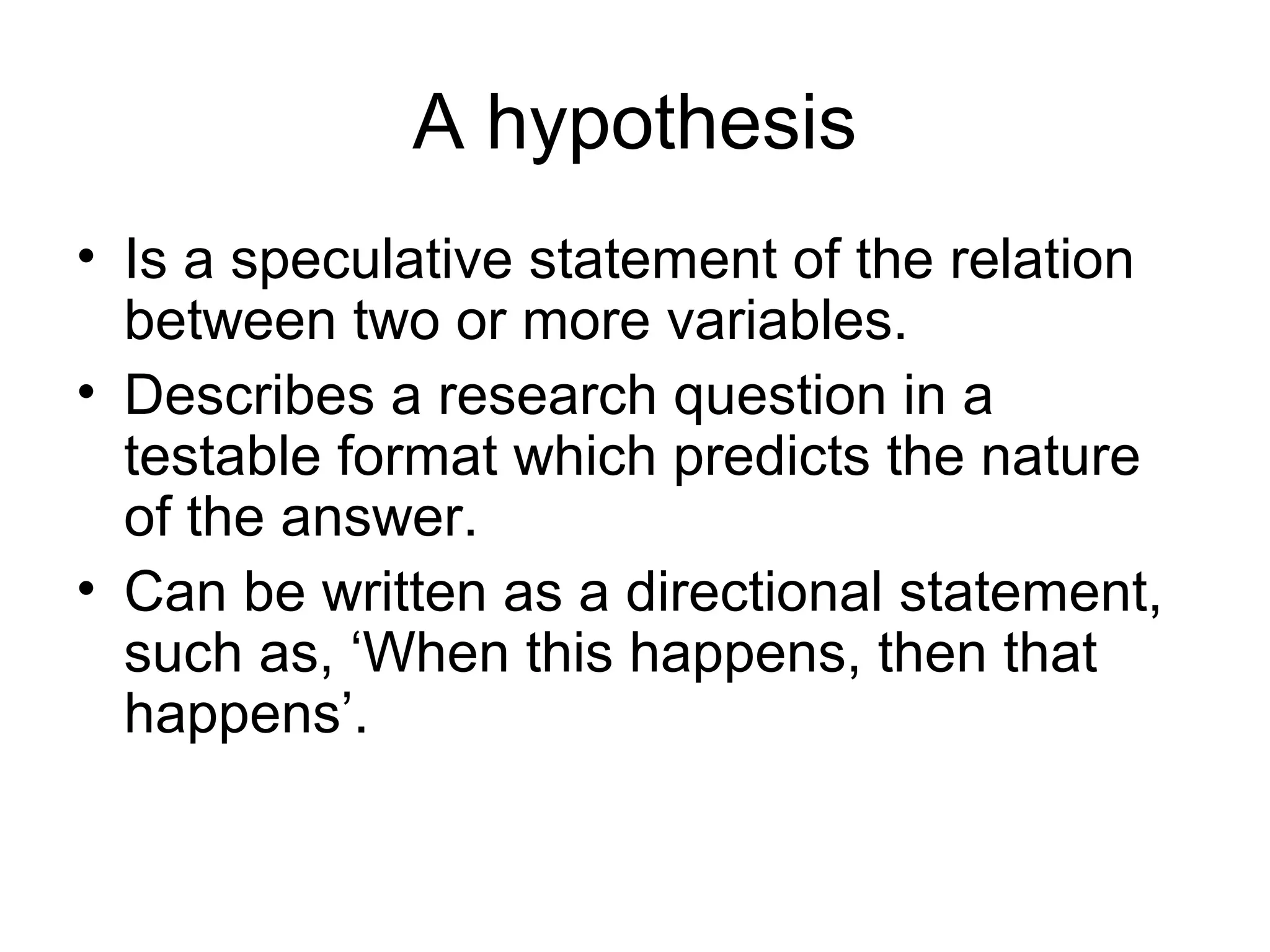
• Is a speculative statement of the relation
between two or more variables.
• Describes a research question in a
testable format which predicts the nature
of the answer.
• Can be written as a directional statement,
such as, ‘When this happens, then that
happens’.
Identifying independent and
dependent variables
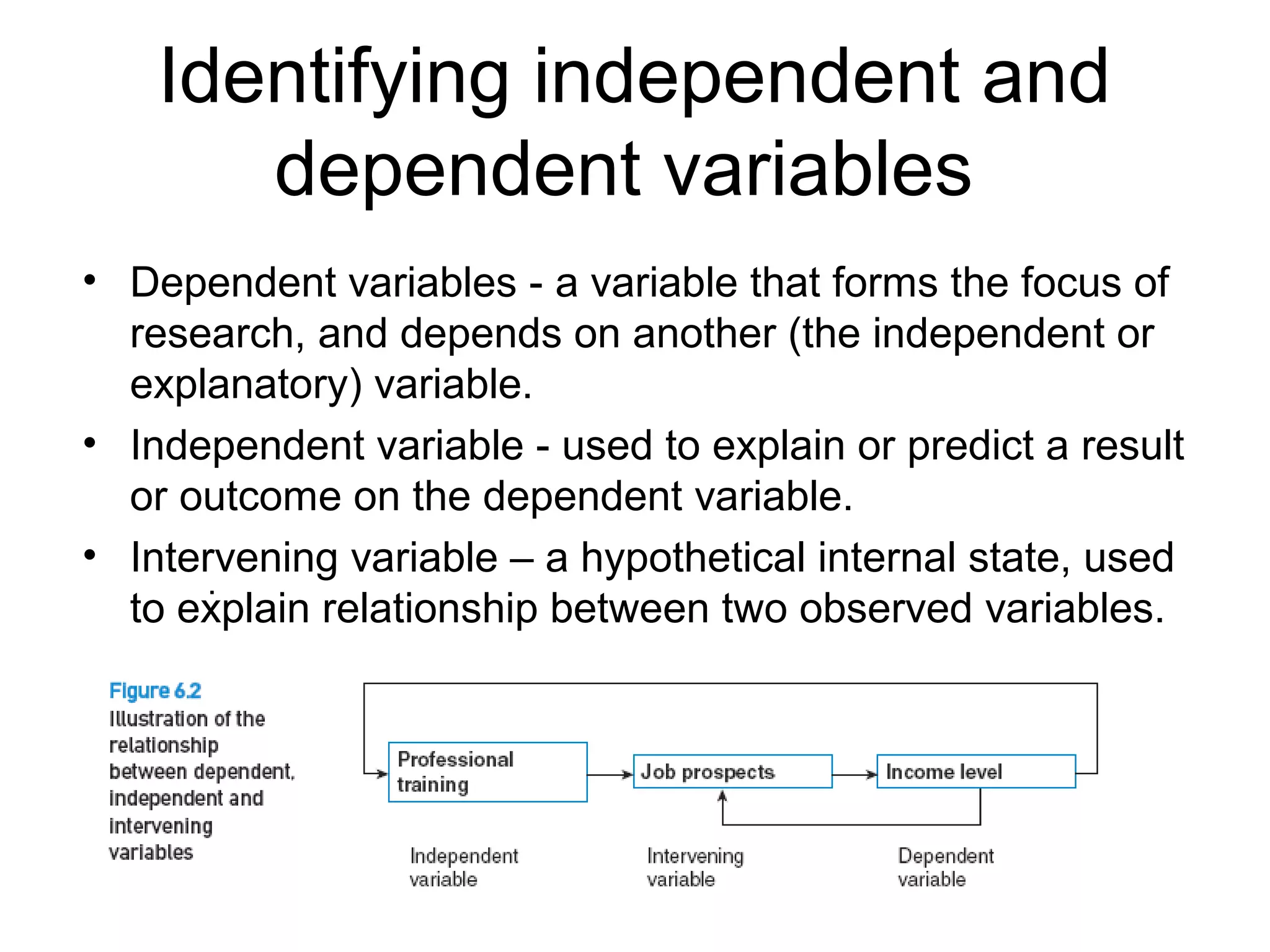
• Dependent variables - a variable that forms the focus of
research, and depends on another (the independent or
explanatory) variable.
• Independent variable - used to explain or predict a result
or outcome on the dependent variable.
• Intervening variable – a hypothetical internal state, used
to explain relationship between two observed variables.
.
Conducting the study
• Planning the design.
• Gathering data.
• Storing data.
• Observing ethical
guidelines.
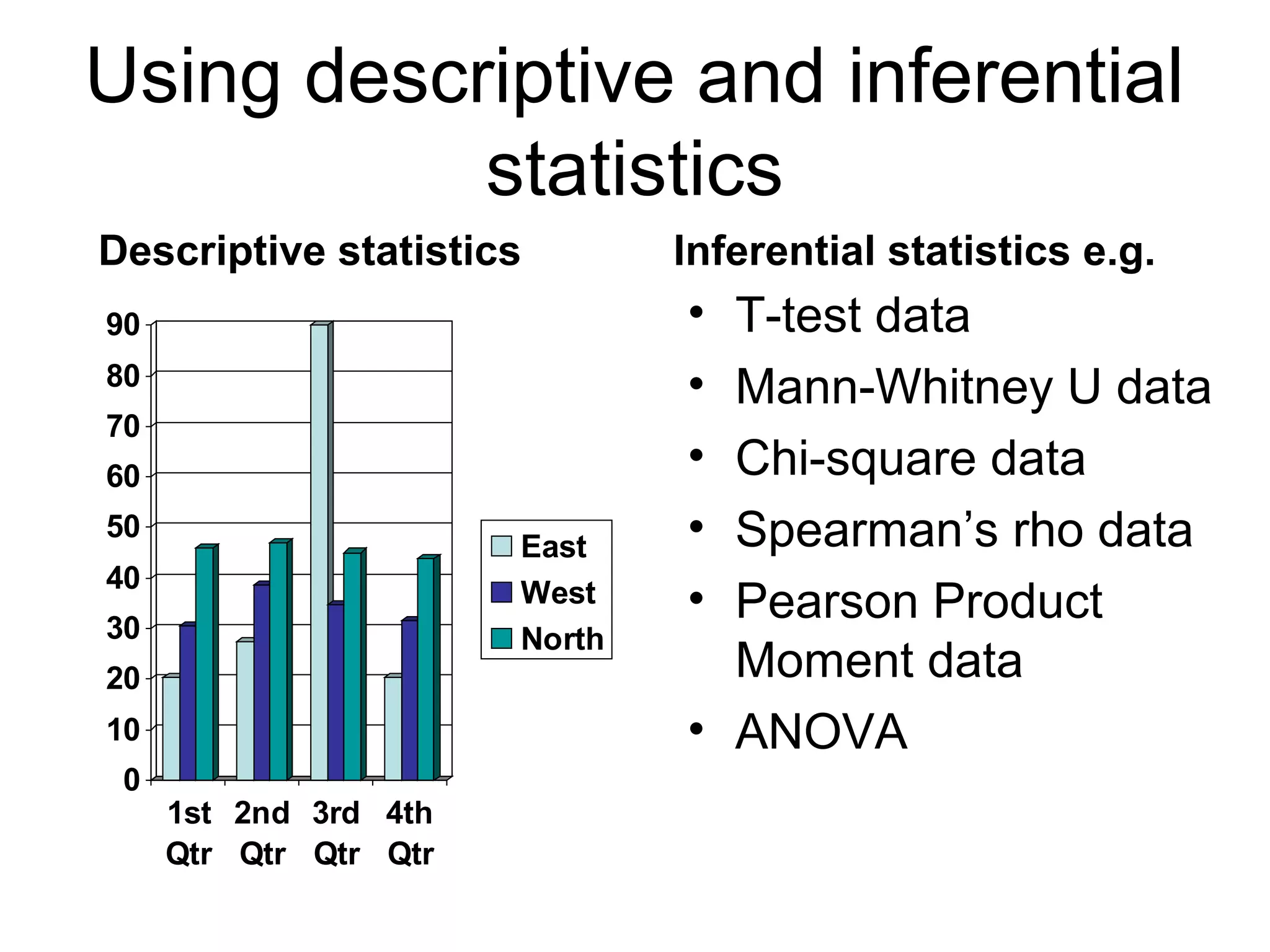
Using descriptive and inferential
statistics
0
10
20
30
40
50
60
70
80
90
1st
Qtr
2nd
Qtr
3rd
Qtr
4th
Qtr
East
West
North
• T-test data
• Mann-Whitney U data
• Chi-square data
• Spearman’s rho data
• Pearson Product
Moment data
• ANOVA
Descriptive statistics Inferential statistics e.g.
Accept or reject the hypothesis
• A hypothesis cannot be ‘proved’ to be right
– all theories are provisional/tentative
(until disproved).
• Acceptance or rejection of the hypothesis
based upon the weight of statistical
evidence and probability entails:
– The risk of accepting the hypothesis as true
(when it is in fact false).
– The risk of rejecting the hypothesis as false
(when it is in fact true).
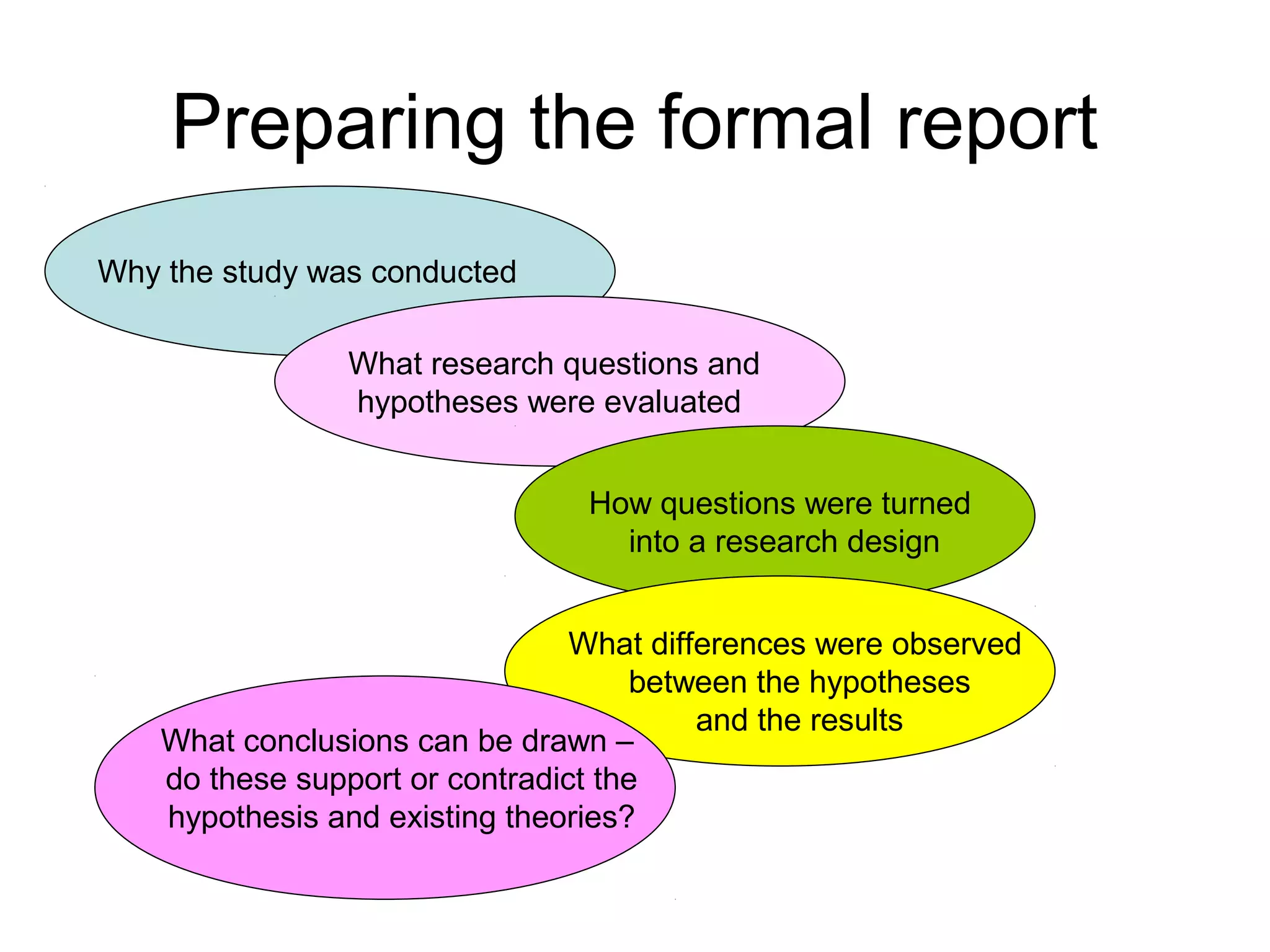
Preparing the formal report
Why the study was conducted
What research questions and
hypotheses were evaluated
How questions were turned
into a research design
What differences were observed
between the hypotheses
and the results
What conclusions can be drawn –
do these support or contradict the
hypothesis and existing theories?
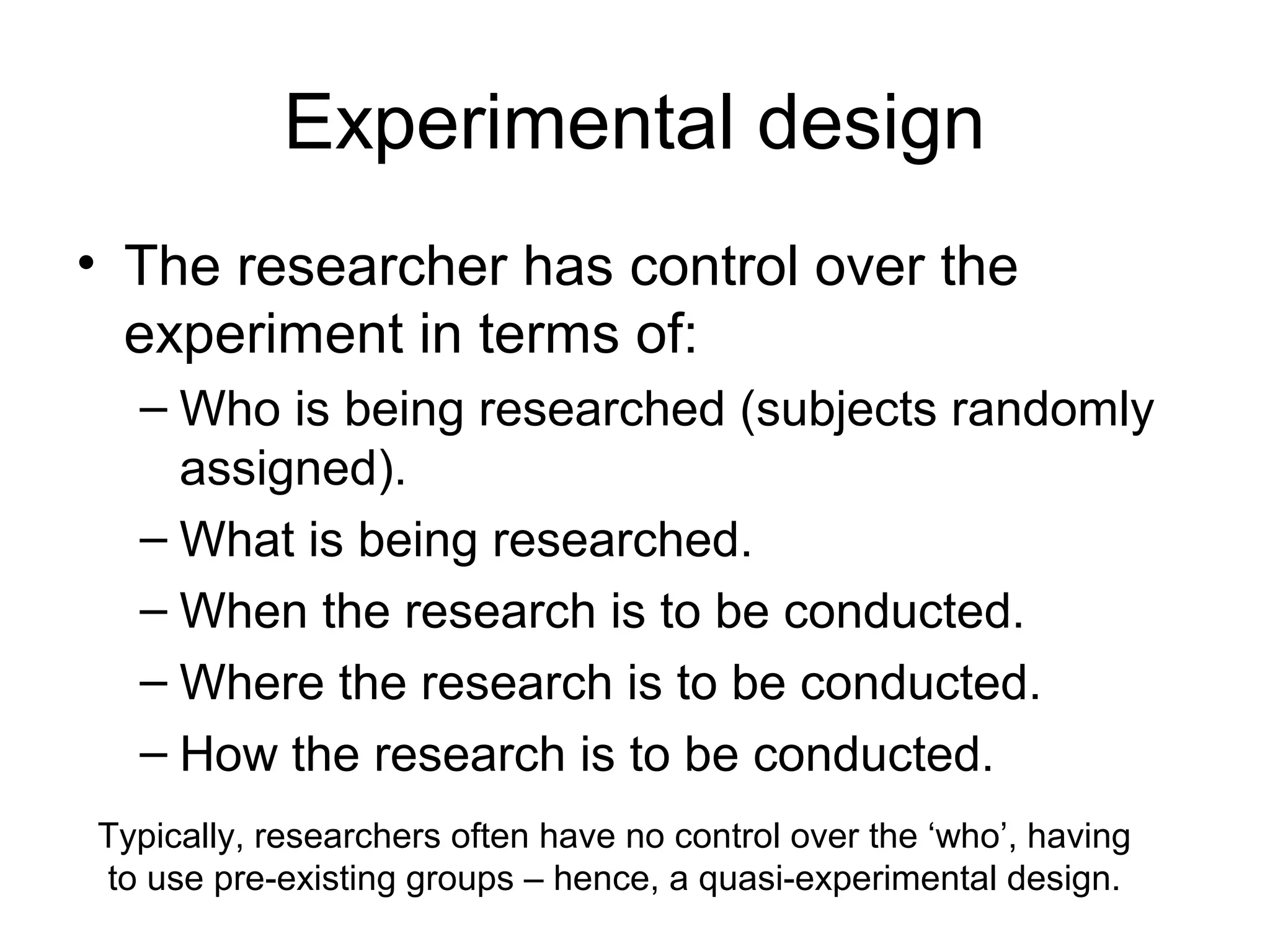
Experimental design
• The researcher has control over the
experiment in terms of:
– Who is being researched (subjects randomly
assigned).
– What is being researched.
– When the research is to be conducted.
– Where the research is to be conducted.
– How the research is to be conducted.
Typically, researchers often have no control over the ‘who’, having
to use pre-existing groups – hence, a quasi-experimental design.
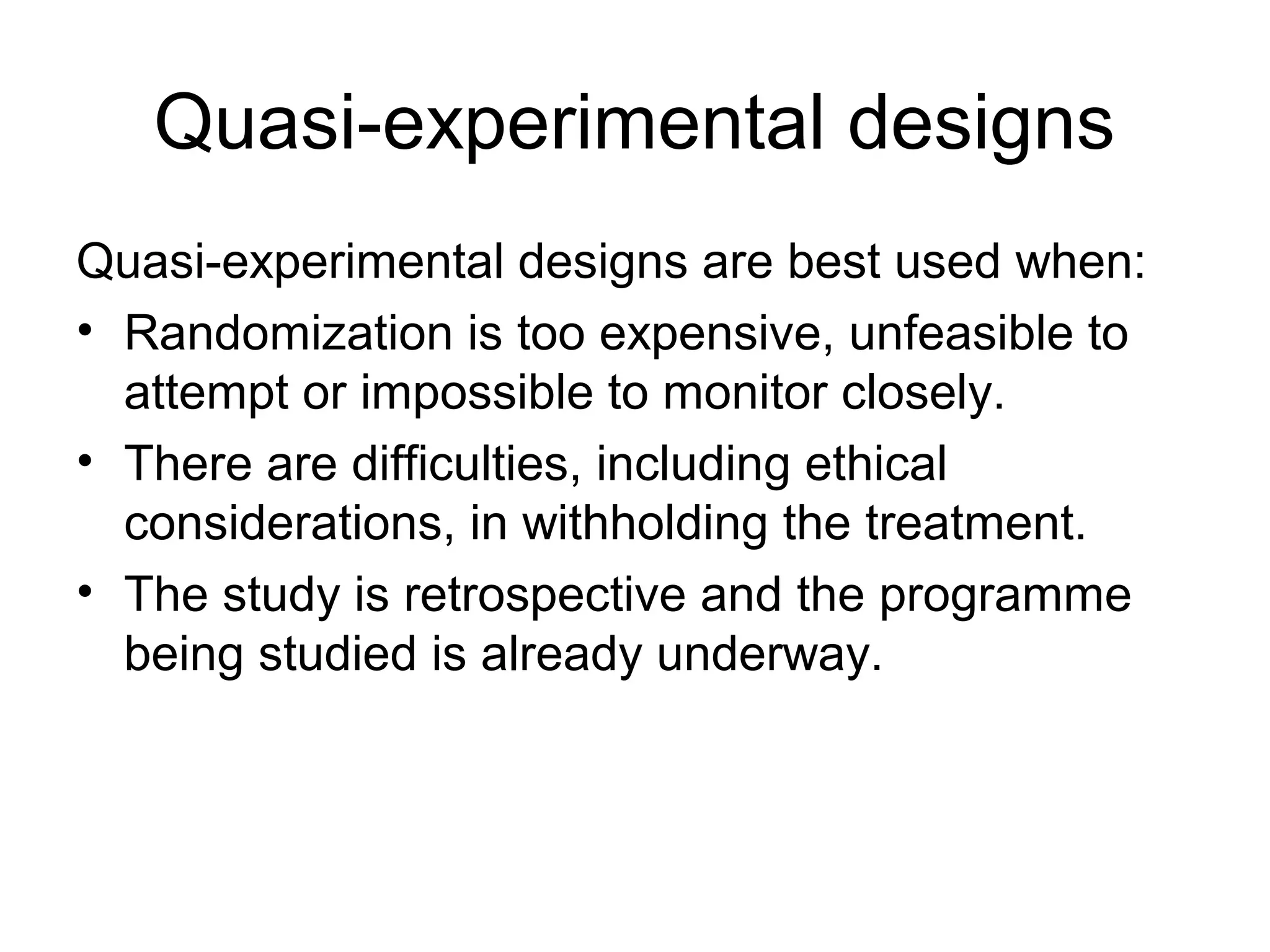
Quasi-experimental designs
Quasi-experimental designs are best used when:
• Randomization is too expensive, unfeasible to
attempt or impossible to monitor closely.
• There are difficulties, including ethical
considerations, in withholding the treatment.
• The study is retrospective and the programme
being studied is already underway.
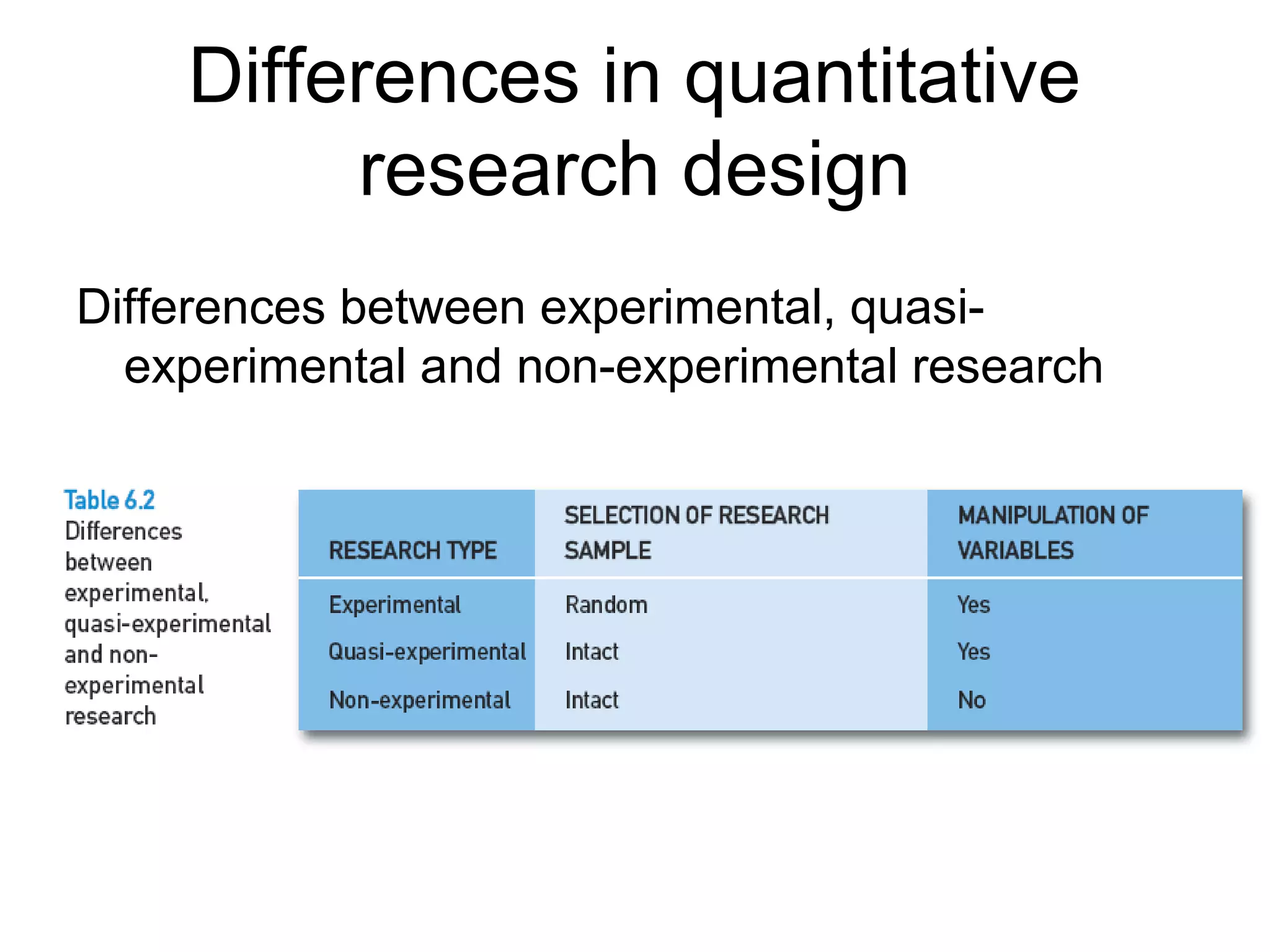
Differences in quantitative
research design
Differences between experimental, quasi-
experimental and non-experimental research
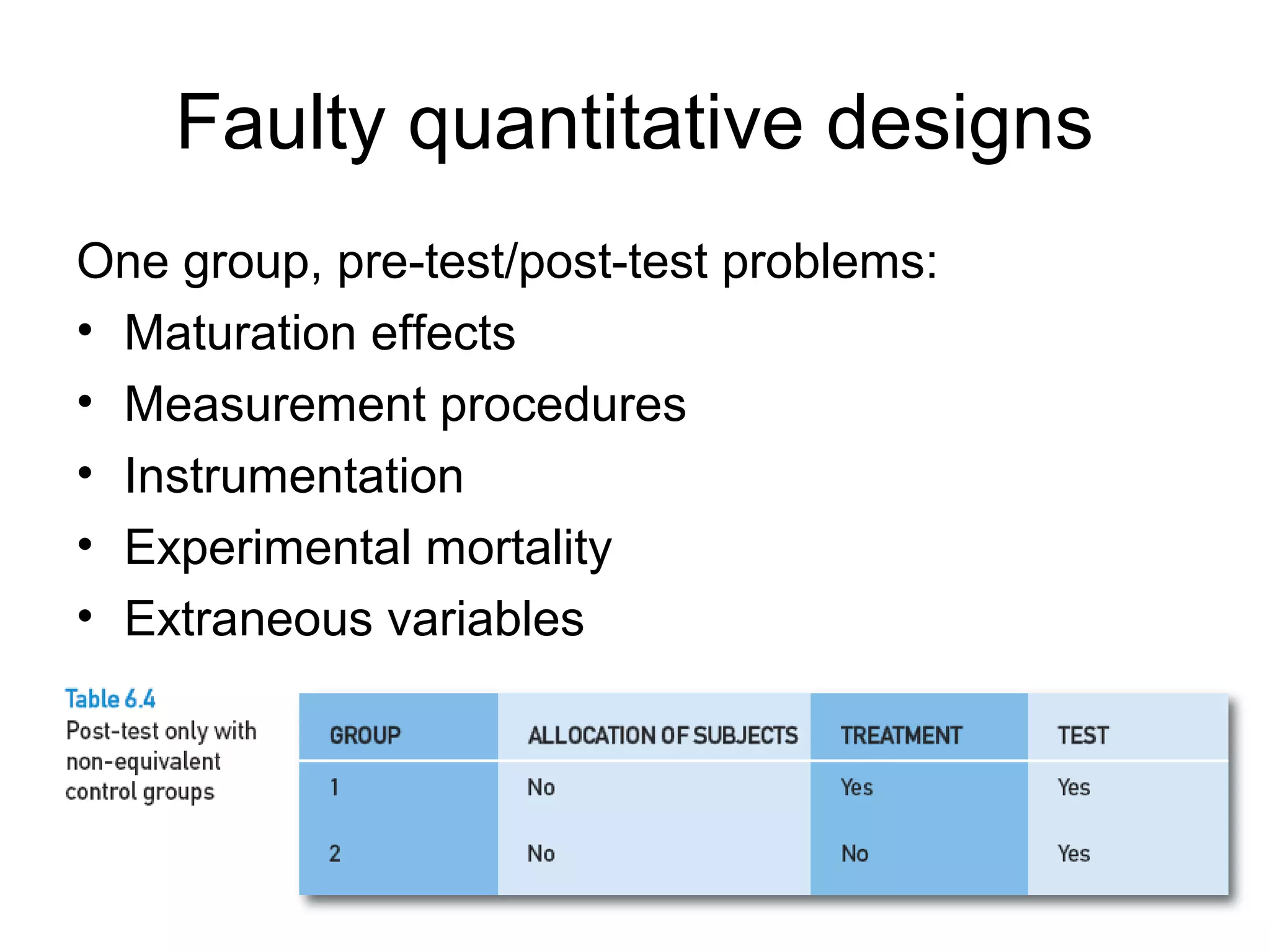
Faulty quantitative designs
One group, pre-test/post-test problems:
• Maturation effects
• Measurement procedures
• Instrumentation
• Experimental mortality
• Extraneous variables
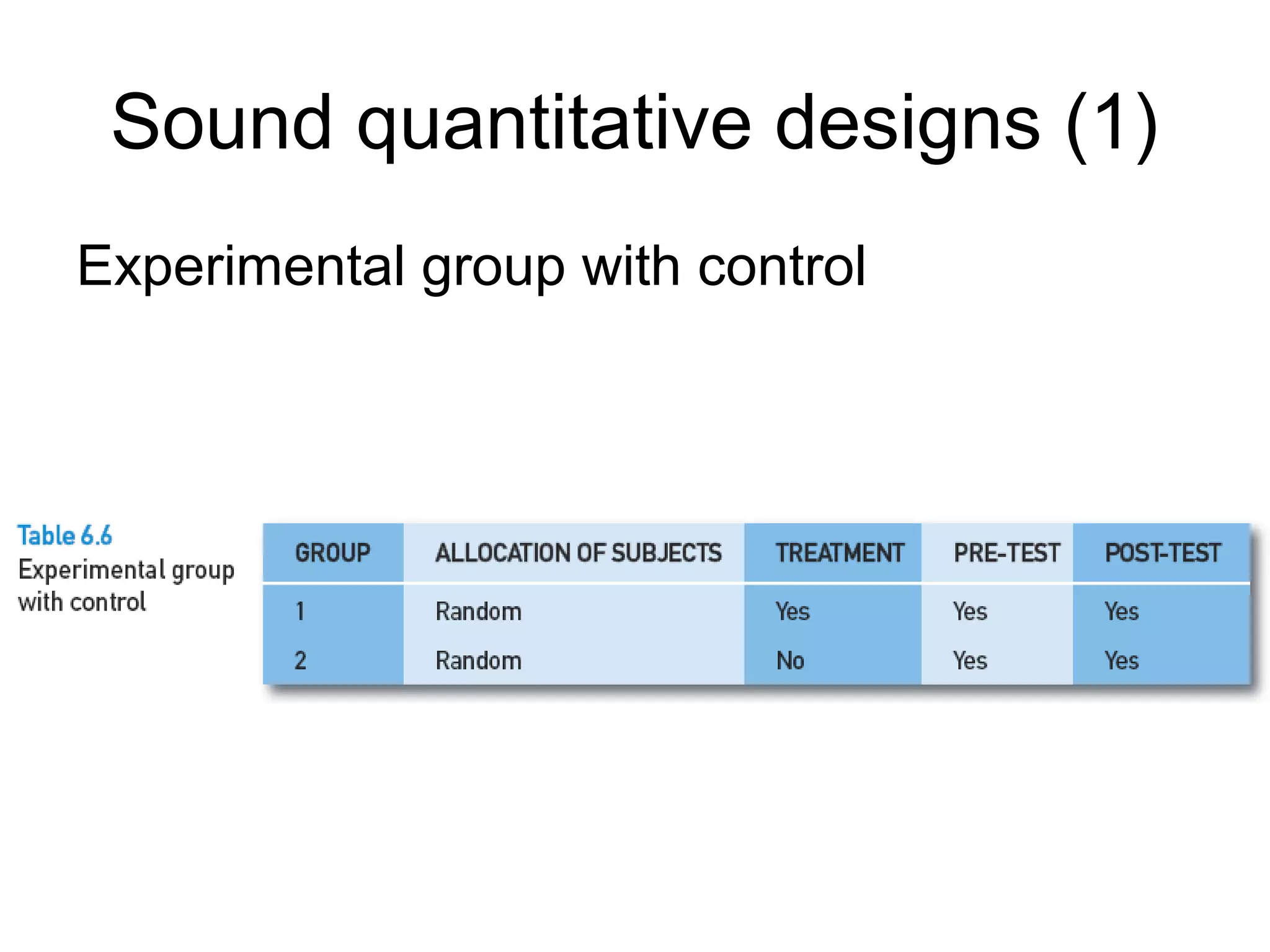
Sound quantitative designs (1)
Experimental group with control
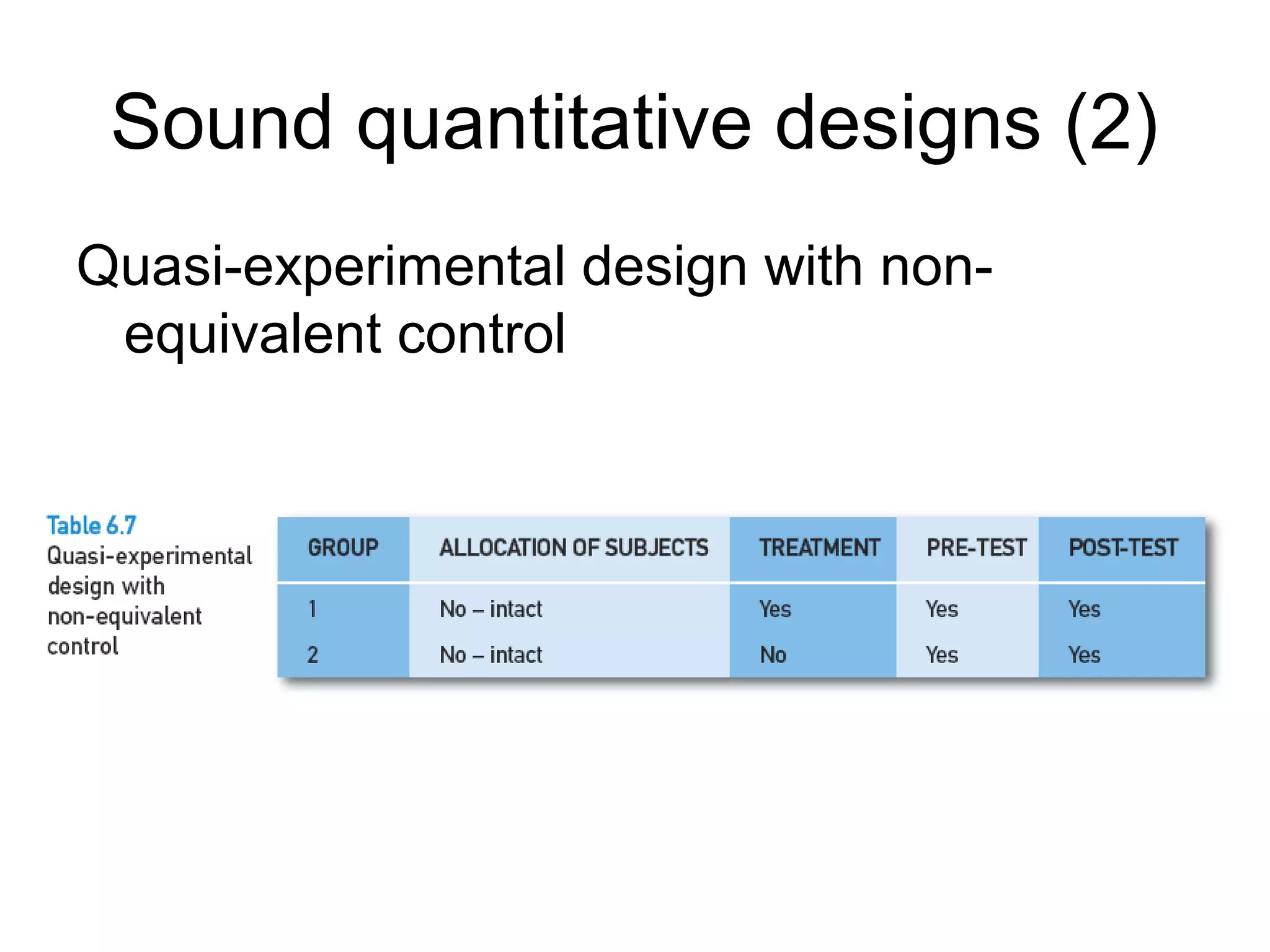
Sound quantitative designs (2)
Quasi-experimental design with non-
equivalent control
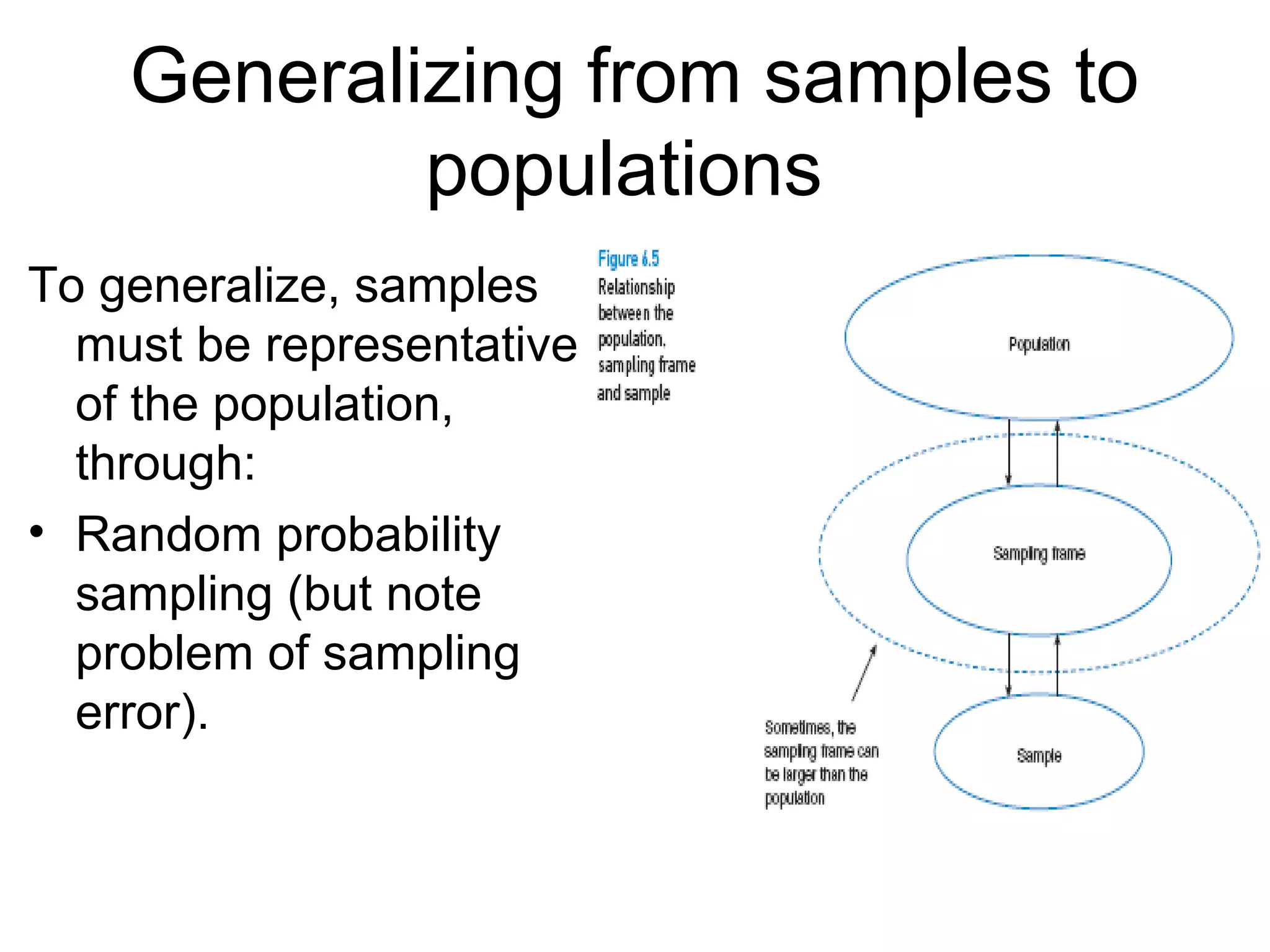
Generalizing from samples to
populations
To generalize, samples
must be representative
of the population,
through:
• Random probability
sampling (but note
problem of sampling
error).
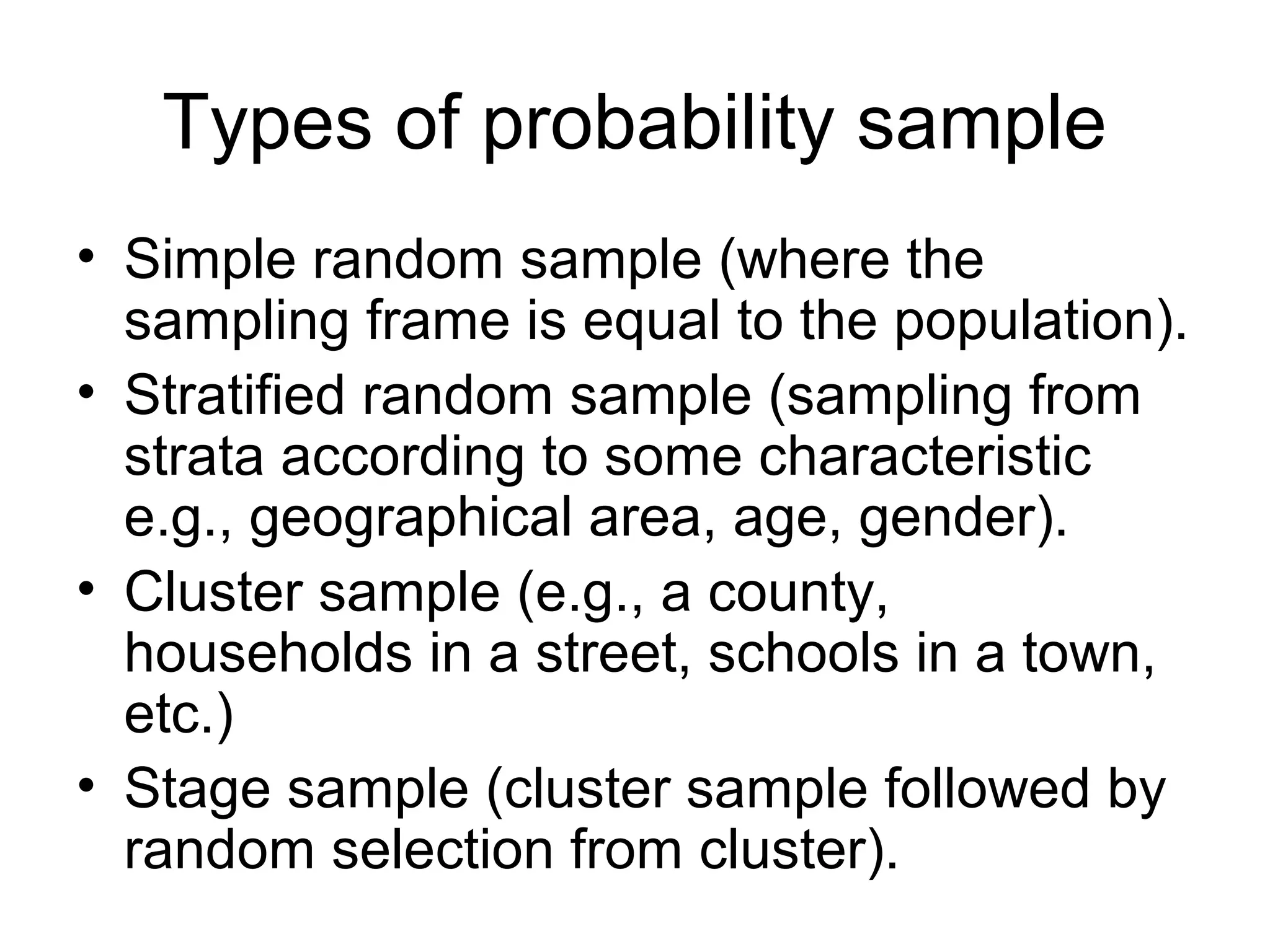
Types of probability sample
• Simple random sample (where the
sampling frame is equal to the population).
• Stratified random sample (sampling from
strata according to some characteristic
e.g., geographical area, age, gender).
• Cluster sample (e.g., a county,
households in a street, schools in a town,
etc.)
• Stage sample (cluster sample followed by
random selection from cluster).
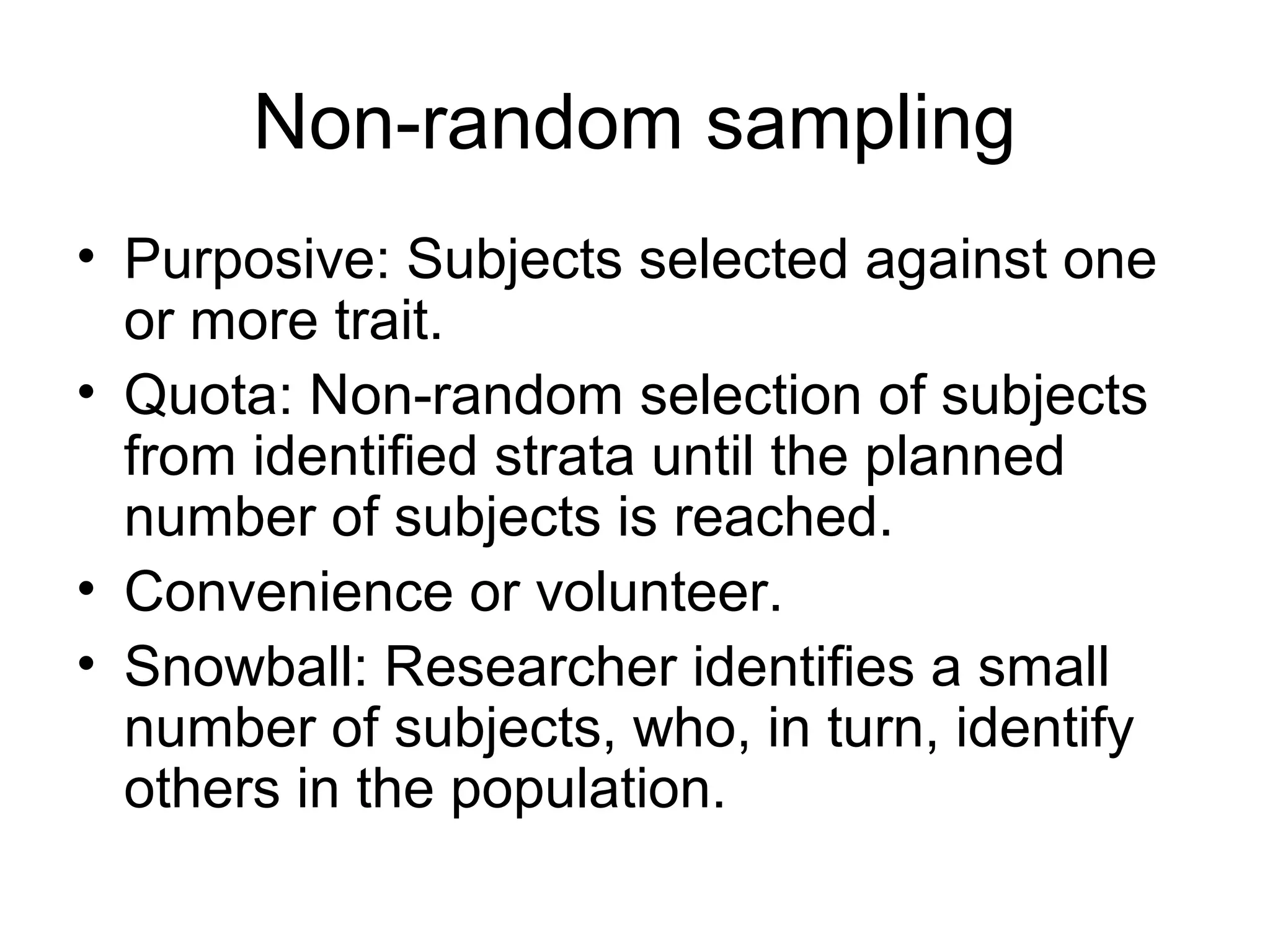
Non-random sampling
• Purposive: Subjects selected against one
or more trait.
• Quota: Non-random selection of subjects
from identified strata until the planned
number of subjects is reached.
• Convenience or volunteer.
• Snowball: Researcher identifies a small
number of subjects, who, in turn, identify
others in the population.
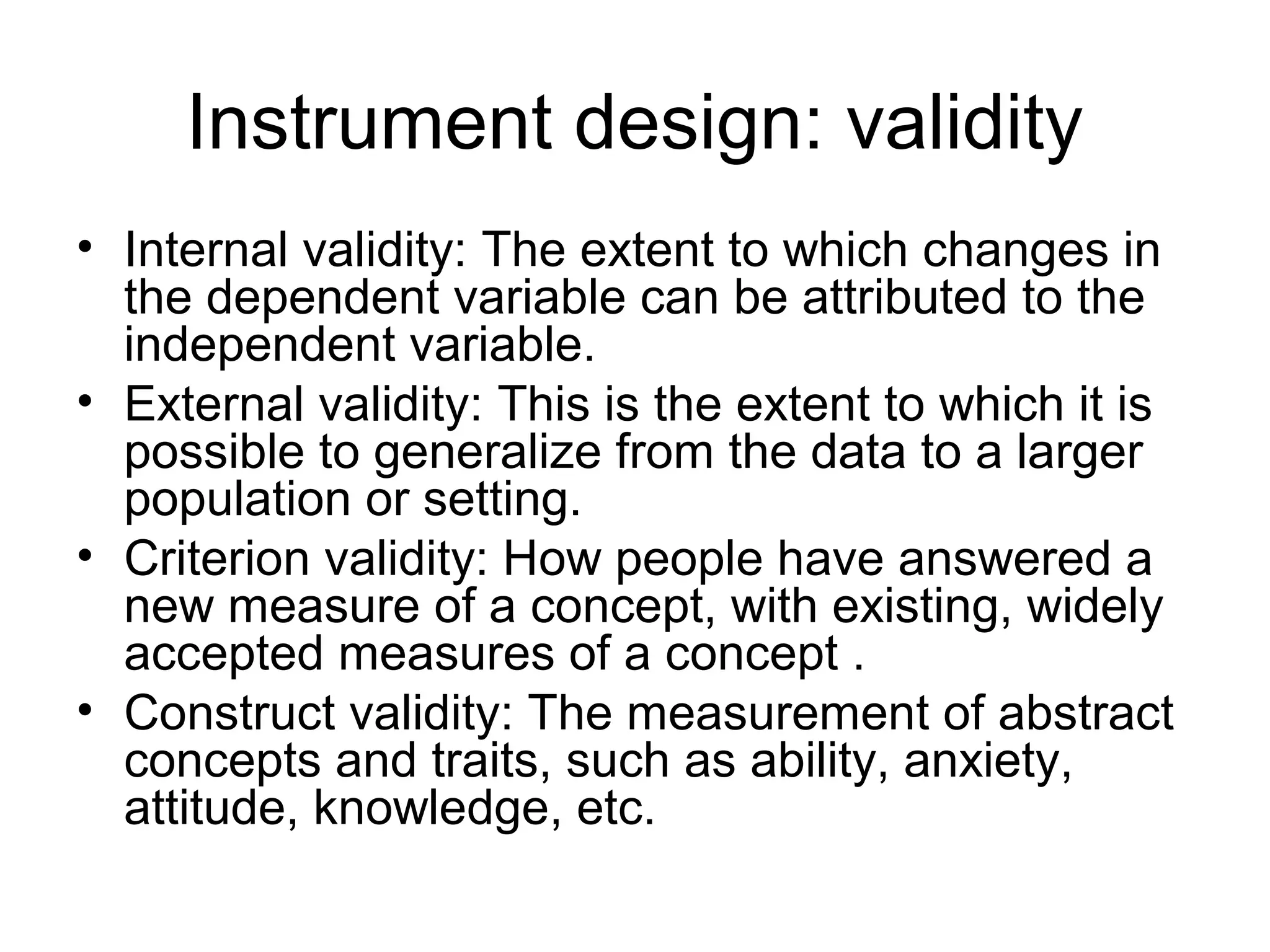
Instrument design: validity
• Internal validity: The extent to which changes in
the dependent variable can be attributed to the
independent variable.
• External validity: This is the extent to which it is
possible to generalize from the data to a larger
population or setting.
• Criterion validity: How people have answered a
new measure of a concept, with existing, widely
accepted measures of a concept .
• Construct validity: The measurement of abstract
concepts and traits, such as ability, anxiety,
attitude, knowledge, etc.
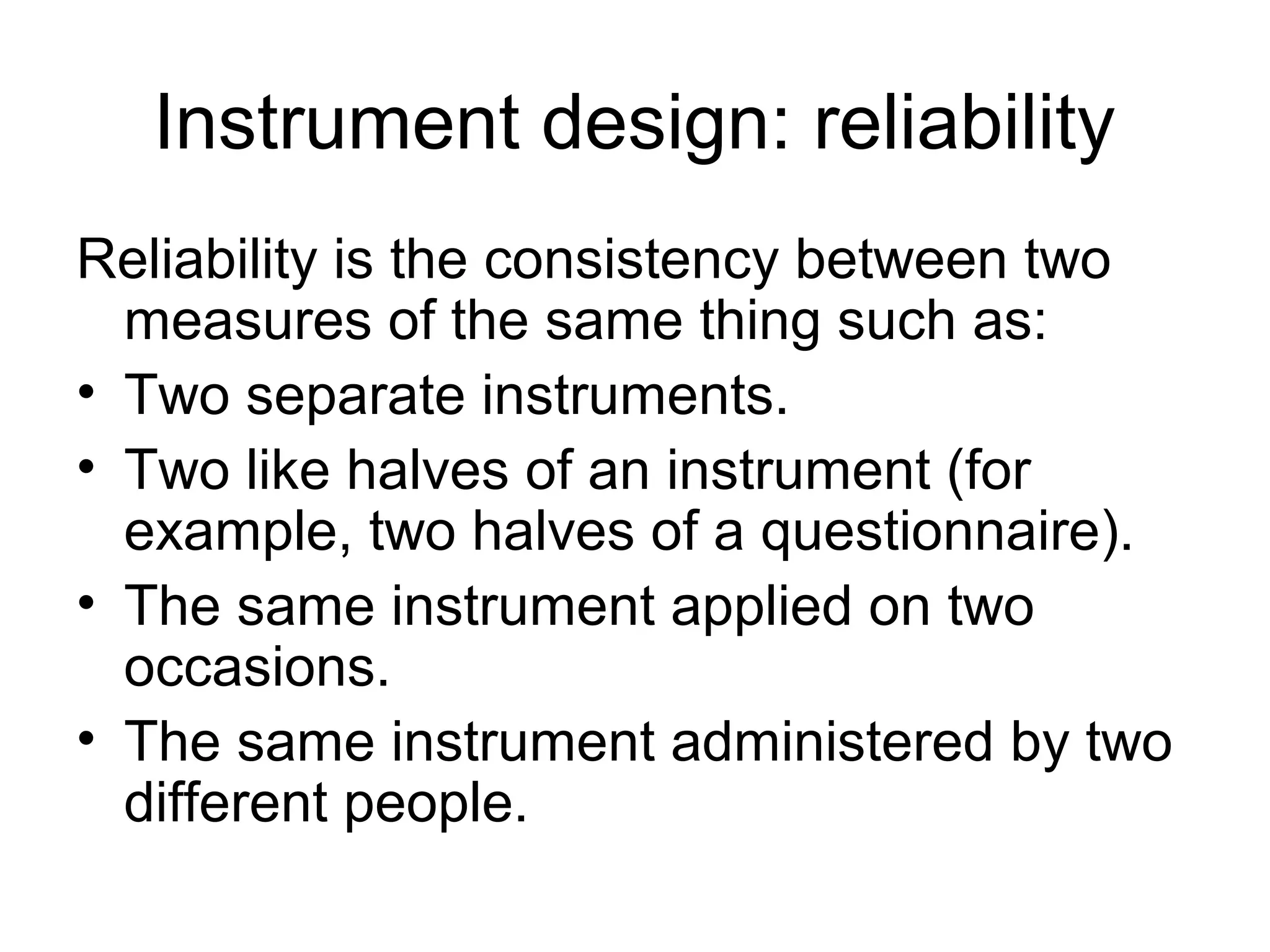
Instrument design: reliability
Reliability is the consistency between two
measures of the same thing such as:
• Two separate instruments.
• Two like halves of an instrument (for
example, two halves of a questionnaire).
• The same instrument applied on two
occasions.
• The same instrument administered by two
different people.
Summary
• Experimental research generally comprises two stages: the planning stage
and the operational stage.
• Experimental research begins from a priori questions or hypotheses that the
research is designed to test.
• Research questions should express a relationship between variables. A
hypothesis is predictive and capable of being tested.
• Dependent variables are what experimental research designs are meant to
affect through the manipulation of one or more independent variables.
• In a true experimental design the researcher has control over the
experiment: who, what, when, where and how the experiment is to be
conducted. This includes control over the who of the experiment – that is,
subjects are assigned to conditions randomly.
• Where any of these elements of control is either weak or lacking, the study
is said to be a quasi-experiment.
• In true experiments, it is possible to assign subjects to conditions, whereas
in quasi-experiments subjects are selected from previously existing groups.
• Research instruments need to be both valid and reliable. Validity means that
an instrument measures what it is intended to measure. Reliability means
that an instrument is consistent in this measurement

Powerpoint Presentation: research design using quantitative method

  • 1.
  • 2.
    Objectives By the endof this session you will be able to: • Describe the experimental and quasi- experimental research approaches. • Formulate appropriate questions and hypotheses. • Identify populations and samples. • Describe the principles of research tool design (validity and reliability).
  • 3.
    Stages in theexperimental design process
  • 4.
    Identifying issues ‘Good’ researchtopics might emerge: • From the literature. • Within workplace settings. • From previous projects/assignments. • From a sponsor.
  • 5.
    Review the literature Theliterature review of the research topic What are the key sources? What are the major issues and debates about the topic? What are the origins and definitions of the topic? What are the key theories, concepts and ideas? What is the epistemological and ontological basis for the subject? What are the main questions/problems that have been addressed to date? Source: adapted from Hart (1998)
  • 6.
    Develop questions/hypotheses Kerlinger andLee (2000) argues that a good research question: • Expresses a relationship between variables (e.g., company image and sales levels). • Is stated in unambiguous terms in a question format, and … • Must be capable of being operationally defined (Black, 1993).
  • 7.
    Types of appliedresearch questions – with examples Type of research question Example Descriptive How common is drug use amongst university students? Normative How serious is drug abuse amongst university students Correlation What is the relationship between gender, academic performance and drug use amongst university students? Impact Has the drug awareness campaign had any impact on the level of university student drug use?
  • 8.
    A hypothesis • Isa speculative statement of the relation between two or more variables. • Describes a research question in a testable format which predicts the nature of the answer. • Can be written as a directional statement, such as, ‘When this happens, then that happens’.
  • 9.
    Identifying independent and dependentvariables • Dependent variables - a variable that forms the focus of research, and depends on another (the independent or explanatory) variable. • Independent variable - used to explain or predict a result or outcome on the dependent variable. • Intervening variable – a hypothetical internal state, used to explain relationship between two observed variables. .
  • 10.
    Conducting the study •Planning the design. • Gathering data. • Storing data. • Observing ethical guidelines.
  • 11.
    Using descriptive andinferential statistics 0 10 20 30 40 50 60 70 80 90 1st Qtr 2nd Qtr 3rd Qtr 4th Qtr East West North • T-test data • Mann-Whitney U data • Chi-square data • Spearman’s rho data • Pearson Product Moment data • ANOVA Descriptive statistics Inferential statistics e.g.
  • 12.
    Accept or rejectthe hypothesis • A hypothesis cannot be ‘proved’ to be right – all theories are provisional/tentative (until disproved). • Acceptance or rejection of the hypothesis based upon the weight of statistical evidence and probability entails: – The risk of accepting the hypothesis as true (when it is in fact false). – The risk of rejecting the hypothesis as false (when it is in fact true).
  • 13.
    Preparing the formalreport Why the study was conducted What research questions and hypotheses were evaluated How questions were turned into a research design What differences were observed between the hypotheses and the results What conclusions can be drawn – do these support or contradict the hypothesis and existing theories?
  • 14.
    Experimental design • Theresearcher has control over the experiment in terms of: – Who is being researched (subjects randomly assigned). – What is being researched. – When the research is to be conducted. – Where the research is to be conducted. – How the research is to be conducted. Typically, researchers often have no control over the ‘who’, having to use pre-existing groups – hence, a quasi-experimental design.
  • 15.
    Quasi-experimental designs Quasi-experimental designsare best used when: • Randomization is too expensive, unfeasible to attempt or impossible to monitor closely. • There are difficulties, including ethical considerations, in withholding the treatment. • The study is retrospective and the programme being studied is already underway.
  • 16.
    Differences in quantitative researchdesign Differences between experimental, quasi- experimental and non-experimental research
  • 17.
    Faulty quantitative designs Onegroup, pre-test/post-test problems: • Maturation effects • Measurement procedures • Instrumentation • Experimental mortality • Extraneous variables
  • 18.
    Sound quantitative designs(1) Experimental group with control
  • 19.
    Sound quantitative designs(2) Quasi-experimental design with non- equivalent control
  • 20.
    Generalizing from samplesto populations To generalize, samples must be representative of the population, through: • Random probability sampling (but note problem of sampling error).
  • 21.
    Types of probabilitysample • Simple random sample (where the sampling frame is equal to the population). • Stratified random sample (sampling from strata according to some characteristic e.g., geographical area, age, gender). • Cluster sample (e.g., a county, households in a street, schools in a town, etc.) • Stage sample (cluster sample followed by random selection from cluster).
  • 22.
    Non-random sampling • Purposive:Subjects selected against one or more trait. • Quota: Non-random selection of subjects from identified strata until the planned number of subjects is reached. • Convenience or volunteer. • Snowball: Researcher identifies a small number of subjects, who, in turn, identify others in the population.
  • 23.
    Instrument design: validity •Internal validity: The extent to which changes in the dependent variable can be attributed to the independent variable. • External validity: This is the extent to which it is possible to generalize from the data to a larger population or setting. • Criterion validity: How people have answered a new measure of a concept, with existing, widely accepted measures of a concept . • Construct validity: The measurement of abstract concepts and traits, such as ability, anxiety, attitude, knowledge, etc.
  • 24.
    Instrument design: reliability Reliabilityis the consistency between two measures of the same thing such as: • Two separate instruments. • Two like halves of an instrument (for example, two halves of a questionnaire). • The same instrument applied on two occasions. • The same instrument administered by two different people.
  • 25.
    Summary • Experimental researchgenerally comprises two stages: the planning stage and the operational stage. • Experimental research begins from a priori questions or hypotheses that the research is designed to test. • Research questions should express a relationship between variables. A hypothesis is predictive and capable of being tested. • Dependent variables are what experimental research designs are meant to affect through the manipulation of one or more independent variables. • In a true experimental design the researcher has control over the experiment: who, what, when, where and how the experiment is to be conducted. This includes control over the who of the experiment – that is, subjects are assigned to conditions randomly. • Where any of these elements of control is either weak or lacking, the study is said to be a quasi-experiment. • In true experiments, it is possible to assign subjects to conditions, whereas in quasi-experiments subjects are selected from previously existing groups. • Research instruments need to be both valid and reliable. Validity means that an instrument measures what it is intended to measure. Reliability means that an instrument is consistent in this measurement