……..
METHODOLOGY and
RESEARCH DESIGN
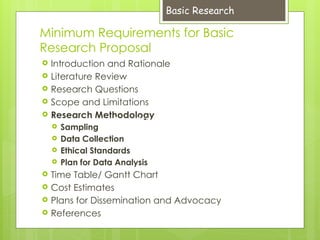
Minimum Requirements for Basic
Research Proposal
 Introduction and Rationale
 Literature Review
 Research Questions
 Scope and Limitations
 Research Methodology
 Sampling
 Data Collection
 Ethical Standards
 Plan for Data Analysis
 Time Table/ Gantt Chart
 Cost Estimates
 Plans for Dissemination and Advocacy
 References
Basic & Action Research
Basic Research
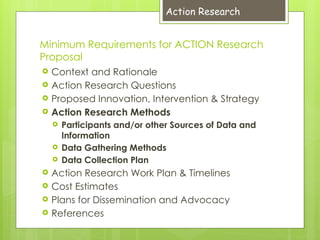
Minimum Requirements for ACTION Research
Proposal
 Context and Rationale
 Action Research Questions
 Proposed Innovation, Intervention & Strategy
 Action Research Methods
 Participants and/or other Sources of Data and
Information
 Data Gathering Methods
 Data Collection Plan
 Action Research Work Plan & Timelines
 Cost Estimates
 Plans for Dissemination and Advocacy
 References
Action Research
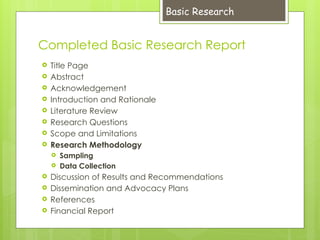
Completed Basic Research Report
 Title Page
 Abstract
 Acknowledgement
 Introduction and Rationale
 Literature Review
 Research Questions
 Scope and Limitations
 Research Methodology
 Sampling
 Data Collection
 Discussion of Results and Recommendations
 Dissemination and Advocacy Plans
 References
 Financial Report
Basic Research
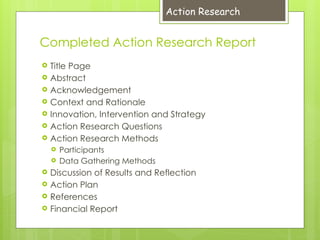
Completed Action Research Report
 Title Page
 Abstract
 Acknowledgement
 Context and Rationale
 Innovation, Intervention and Strategy
 Action Research Questions
 Action Research Methods
 Participants
 Data Gathering Methods
 Discussion of Results and Reflection
 Action Plan
 References
 Financial Report
Action Research
Design & Methods
Research Methodology
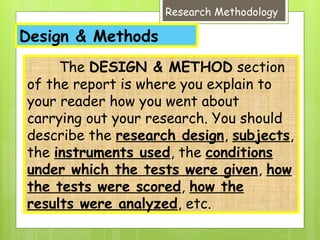
The DESIGN & METHOD section
of the report is where you explain to
your reader how you went about
carrying out your research. You should
describe the research design, subjects,
the instruments used, the conditions
under which the tests were given, how
the tests were scored, how the
results were analyzed, etc.
Design & Methods
Research Methodology
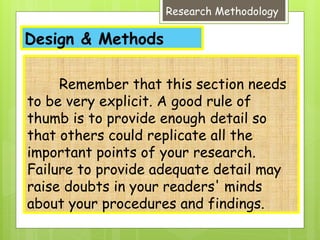
Remember that this section needs
to be very explicit. A good rule of
thumb is to provide enough detail so
that others could replicate all the
important points of your research.
Failure to provide adequate detail may
raise doubts in your readers' minds
about your procedures and findings.
Design & Methods
Research Methodology
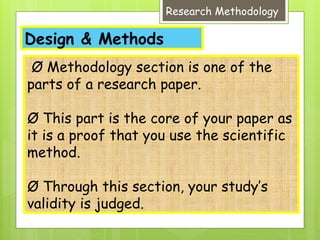
Ø Methodology section is one of the
parts of a research paper.
Ø This part is the core of your paper as
it is a proof that you use the scientific
method.
Ø Through this section, your study’s
validity is judged.
Design & Methods
Research Methodology
While writing this section, be direct and
precise. Write it in the future tense
(proposal) and past tense (when research is
completed/reporting results).
Include enough information so that:
• others could repeat the experiment
and evaluate whether the results are
reproducible.
• the audience can judge whether the
results and conclusions are valid.
Design & Methods
Research Methodology
Your methodology answers two main
questions:
• How did you collect or generate the
data?
• How did you analyze the data?
Design & Methods
Research Methodology
Provide sufficient information of the
whole process so that others could
replicate your study. You can do this by:
• giving a completely accurate
description of the data collection
equipments and the techniques.
• explaining how you collected the data
and analyzed them.
Research Methodology
Design & Methods
Research design is a plan to answer
your research question
A research method is a strategy used to
implement that plan
Research design and methods are
different but closely related, because
good research design ensures that the
data you obtain will help you answer
your research question more effectively
Research Methodology
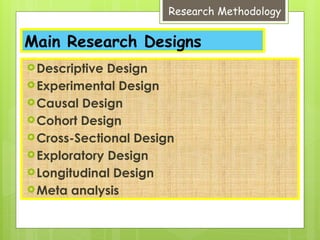
Main Research Designs
Descriptive Design
Experimental Design
Causal Design
Cohort Design
Cross-Sectional Design
Exploratory Design
Longitudinal Design
Meta analysis
Research Methodology
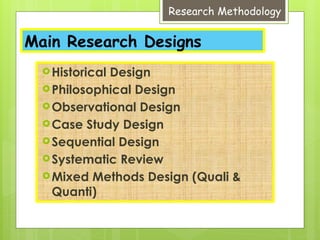
Main Research Designs
Historical Design
Philosophical Design
Observational Design
Case Study Design
Sequential Design
Systematic Review
Mixed Methods Design (Quali &
Quanti)
Research Methodology
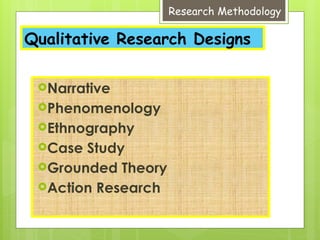
Qualitative Research Designs
Narrative
Phenomenology
Ethnography
Case Study
Grounded Theory
Action Research
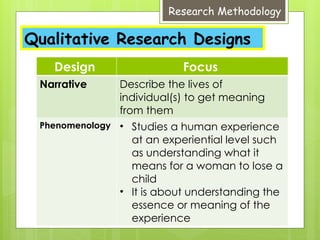
Design Focus
Narrative Describe the lives of
individual(s) to get meaning
from them
Phenomenology • Studies a human experience
at an experiential level such
as understanding what it
means for a woman to lose a
child
• It is about understanding the
essence or meaning of the
experience
Qualitative Research Designs
Research Methodology
Design Focus
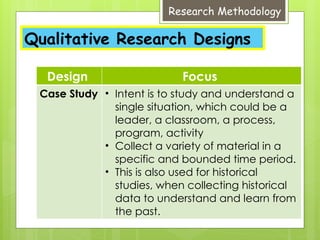
Case Study • Intent is to study and understand a
single situation, which could be a
leader, a classroom, a process,
program, activity
• Collect a variety of material in a
specific and bounded time period.
• This is also used for historical
studies, when collecting historical
data to understand and learn from
the past.
Research Methodology
Qualitative Research Designs
Design Focus
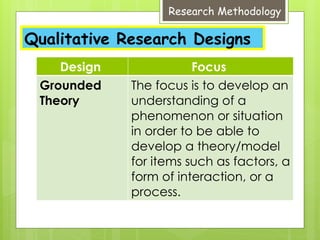
Grounded
Theory
The focus is to develop an
understanding of a
phenomenon or situation
in order to be able to
develop a theory/model
for items such as factors, a
form of interaction, or a
process.
Research Methodology
Qualitative Research Designs
Research Methodology
Qualitative Research Methods
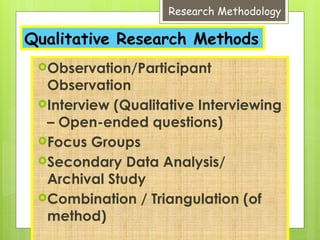
Observation/Participant
Observation
Interview (Qualitative Interviewing
– Open-ended questions)
Focus Groups
Secondary Data Analysis/
Archival Study
Combination / Triangulation (of
method)
Design Focus
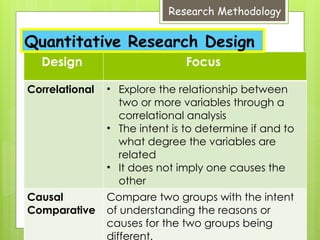
Correlational • Explore the relationship between
two or more variables through a
correlational analysis
• The intent is to determine if and to
what degree the variables are
related
• It does not imply one causes the
other
Causal
Comparative
Compare two groups with the intent
of understanding the reasons or
causes for the two groups being
different.
Research Methodology
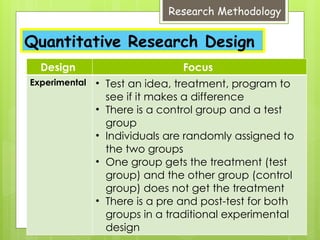
Quantitative Research Design
Design Focus
Experimental • Test an idea, treatment, program to
see if it makes a difference
• There is a control group and a test
group
• Individuals are randomly assigned to
the two groups
• One group gets the treatment (test
group) and the other group (control
group) does not get the treatment
• There is a pre and post-test for both
groups in a traditional experimental
design
Quantitative Research Design
Research Methodology
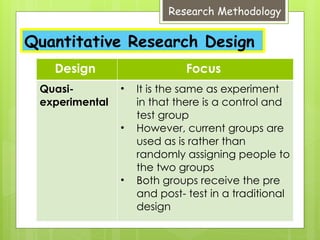
Design Focus
Quasi-
experimental
• It is the same as experiment
in that there is a control and
test group
• However, current groups are
used as is rather than
randomly assigning people to
the two groups
• Both groups receive the pre
and post- test in a traditional
design
Research Methodology
Quantitative Research Design
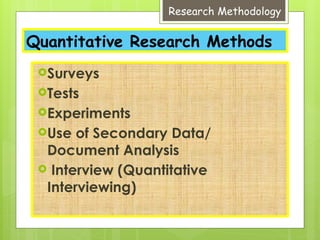
Quantitative Research Methods
Surveys
Tests
Experiments
Use of Secondary Data/
Document Analysis
 Interview (Quantitative
Interviewing)
Research Methodology
Design & Methods
Research Methodology
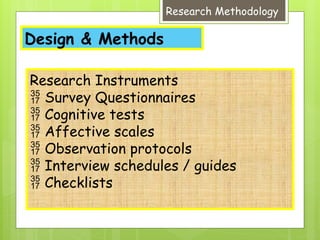
Research Instruments
 Survey Questionnaires
 Cognitive tests
 Affective scales
 Observation protocols
 Interview schedules / guides
 Checklists
Design & Methods
Research Methodology
Sampling – details should be provided
about who will participate in the
research; number of people and the
characteristics of those who will
participate in the research; and how will
the sample be selected or recruited.
Data Collection – the various instruments
and procedures for data collection should
be outlined and extensively discussed.
Design & Methods
Sampling
Who?
How many? (sample size)
How will the sample be selected?
(Sampling Techniques)
Random Sampling (Probability
Sampling)
Non-Random Sampling (Non-
probability Sampling)
Research Methodology
Design & Methods
Random Sampling Methods
 Simple Random Technique
 Stratified Random Technique
 Systematic Sampling
 Multistage
Non-Random Sampling Methods
 Purposive Sampling
 Quota Sampling
 Convenience Sampling
Statistics
Research Methodology
Frequency Count, Percentages, Rank,
Measure of Central Tendency,
Standard Deviation
Encoding data
 Quantitative vs. Qualitative
 Use of spreadsheet or SPSS
 Coding
Statistics
Research Methodology
Analyzing Data
 Statistical methods
 Comparing same group, measured
different times
 Comparing two groups, measured at
the same time
 Comparing more than two groups
Statistics
Research Methodology
Plan for Data Analysis – indicates how
the data will be analyzed and reported;
it should specify the qualitative and/or
quantitative methods that will be used
in analyzing the data gathered for the
research.
Research Methodology
Statistics
 Some statistical tools
commonly used
Descriptive
Mean
Arithmetic mean
Weighted mean
Standard Deviation
Research Methodology
Statistics
 Some statistical tools commonly
used
Inferential
Differences
T-test (for independent,
dependent/correlated)
ANOVA
Relationship/Association
Pearson r
Chi-Square/Contingency
Coefficient
Design & Methods
Research Methodology
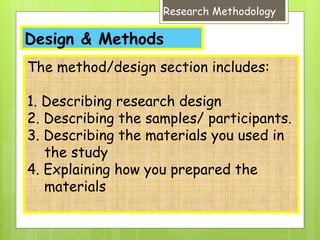
The method/design section includes:
1. Describing research design
2. Describing the samples/ participants.
3. Describing the materials you used in
the study
4. Explaining how you prepared the
materials
Design & Methods
Research Methodology
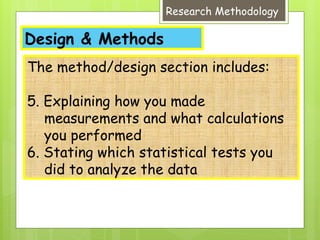
The method/design section includes:
5. Explaining how you made
measurements and what calculations
you performed
6. Stating which statistical tests you
did to analyze the data
Thank You for
Listening….
Research Methodology

(3) Methodology & Design.pptx.Research po

  • 1.
  • 2.
    Minimum Requirements forBasic Research Proposal  Introduction and Rationale  Literature Review  Research Questions  Scope and Limitations  Research Methodology  Sampling  Data Collection  Ethical Standards  Plan for Data Analysis  Time Table/ Gantt Chart  Cost Estimates  Plans for Dissemination and Advocacy  References Basic & Action Research Basic Research
  • 3.
    Minimum Requirements forACTION Research Proposal  Context and Rationale  Action Research Questions  Proposed Innovation, Intervention & Strategy  Action Research Methods  Participants and/or other Sources of Data and Information  Data Gathering Methods  Data Collection Plan  Action Research Work Plan & Timelines  Cost Estimates  Plans for Dissemination and Advocacy  References Action Research
  • 4.
    Completed Basic ResearchReport  Title Page  Abstract  Acknowledgement  Introduction and Rationale  Literature Review  Research Questions  Scope and Limitations  Research Methodology  Sampling  Data Collection  Discussion of Results and Recommendations  Dissemination and Advocacy Plans  References  Financial Report Basic Research
  • 5.
    Completed Action ResearchReport  Title Page  Abstract  Acknowledgement  Context and Rationale  Innovation, Intervention and Strategy  Action Research Questions  Action Research Methods  Participants  Data Gathering Methods  Discussion of Results and Reflection  Action Plan  References  Financial Report Action Research
  • 6.
    Design & Methods ResearchMethodology The DESIGN & METHOD section of the report is where you explain to your reader how you went about carrying out your research. You should describe the research design, subjects, the instruments used, the conditions under which the tests were given, how the tests were scored, how the results were analyzed, etc.
  • 7.
    Design & Methods ResearchMethodology Remember that this section needs to be very explicit. A good rule of thumb is to provide enough detail so that others could replicate all the important points of your research. Failure to provide adequate detail may raise doubts in your readers' minds about your procedures and findings.
  • 8.
    Design & Methods ResearchMethodology Ø Methodology section is one of the parts of a research paper. Ø This part is the core of your paper as it is a proof that you use the scientific method. Ø Through this section, your study’s validity is judged.
  • 9.
    Design & Methods ResearchMethodology While writing this section, be direct and precise. Write it in the future tense (proposal) and past tense (when research is completed/reporting results). Include enough information so that: • others could repeat the experiment and evaluate whether the results are reproducible. • the audience can judge whether the results and conclusions are valid.
  • 10.
    Design & Methods ResearchMethodology Your methodology answers two main questions: • How did you collect or generate the data? • How did you analyze the data?
  • 11.
    Design & Methods ResearchMethodology Provide sufficient information of the whole process so that others could replicate your study. You can do this by: • giving a completely accurate description of the data collection equipments and the techniques. • explaining how you collected the data and analyzed them.
  • 12.
    Research Methodology Design &Methods Research design is a plan to answer your research question A research method is a strategy used to implement that plan Research design and methods are different but closely related, because good research design ensures that the data you obtain will help you answer your research question more effectively
  • 13.
    Research Methodology Main ResearchDesigns Descriptive Design Experimental Design Causal Design Cohort Design Cross-Sectional Design Exploratory Design Longitudinal Design Meta analysis
  • 14.
    Research Methodology Main ResearchDesigns Historical Design Philosophical Design Observational Design Case Study Design Sequential Design Systematic Review Mixed Methods Design (Quali & Quanti)
  • 15.
    Research Methodology Qualitative ResearchDesigns Narrative Phenomenology Ethnography Case Study Grounded Theory Action Research
  • 16.
    Design Focus Narrative Describethe lives of individual(s) to get meaning from them Phenomenology • Studies a human experience at an experiential level such as understanding what it means for a woman to lose a child • It is about understanding the essence or meaning of the experience Qualitative Research Designs Research Methodology
  • 17.
    Design Focus Case Study• Intent is to study and understand a single situation, which could be a leader, a classroom, a process, program, activity • Collect a variety of material in a specific and bounded time period. • This is also used for historical studies, when collecting historical data to understand and learn from the past. Research Methodology Qualitative Research Designs
  • 18.
    Design Focus Grounded Theory The focusis to develop an understanding of a phenomenon or situation in order to be able to develop a theory/model for items such as factors, a form of interaction, or a process. Research Methodology Qualitative Research Designs
  • 19.
    Research Methodology Qualitative ResearchMethods Observation/Participant Observation Interview (Qualitative Interviewing – Open-ended questions) Focus Groups Secondary Data Analysis/ Archival Study Combination / Triangulation (of method)
  • 20.
    Design Focus Correlational •Explore the relationship between two or more variables through a correlational analysis • The intent is to determine if and to what degree the variables are related • It does not imply one causes the other Causal Comparative Compare two groups with the intent of understanding the reasons or causes for the two groups being different. Research Methodology Quantitative Research Design
  • 21.
    Design Focus Experimental •Test an idea, treatment, program to see if it makes a difference • There is a control group and a test group • Individuals are randomly assigned to the two groups • One group gets the treatment (test group) and the other group (control group) does not get the treatment • There is a pre and post-test for both groups in a traditional experimental design Quantitative Research Design Research Methodology
  • 22.
    Design Focus Quasi- experimental • Itis the same as experiment in that there is a control and test group • However, current groups are used as is rather than randomly assigning people to the two groups • Both groups receive the pre and post- test in a traditional design Research Methodology Quantitative Research Design
  • 23.
    Quantitative Research Methods Surveys Tests Experiments Useof Secondary Data/ Document Analysis  Interview (Quantitative Interviewing) Research Methodology
  • 24.
    Design & Methods ResearchMethodology Research Instruments  Survey Questionnaires  Cognitive tests  Affective scales  Observation protocols  Interview schedules / guides  Checklists
  • 25.
    Design & Methods ResearchMethodology Sampling – details should be provided about who will participate in the research; number of people and the characteristics of those who will participate in the research; and how will the sample be selected or recruited. Data Collection – the various instruments and procedures for data collection should be outlined and extensively discussed.
  • 26.
    Design & Methods Sampling Who? Howmany? (sample size) How will the sample be selected? (Sampling Techniques) Random Sampling (Probability Sampling) Non-Random Sampling (Non- probability Sampling) Research Methodology
  • 27.
    Research Methodology Design &Methods Random Sampling Methods  Simple Random Technique  Stratified Random Technique  Systematic Sampling  Multistage Non-Random Sampling Methods  Purposive Sampling  Quota Sampling  Convenience Sampling
  • 28.
    Statistics Research Methodology Frequency Count,Percentages, Rank, Measure of Central Tendency, Standard Deviation Encoding data  Quantitative vs. Qualitative  Use of spreadsheet or SPSS  Coding
  • 29.
    Statistics Research Methodology Analyzing Data Statistical methods  Comparing same group, measured different times  Comparing two groups, measured at the same time  Comparing more than two groups
  • 30.
    Statistics Research Methodology Plan forData Analysis – indicates how the data will be analyzed and reported; it should specify the qualitative and/or quantitative methods that will be used in analyzing the data gathered for the research.
  • 31.
    Research Methodology Statistics  Somestatistical tools commonly used Descriptive Mean Arithmetic mean Weighted mean Standard Deviation
  • 32.
    Research Methodology Statistics  Somestatistical tools commonly used Inferential Differences T-test (for independent, dependent/correlated) ANOVA Relationship/Association Pearson r Chi-Square/Contingency Coefficient
  • 33.
    Design & Methods ResearchMethodology The method/design section includes: 1. Describing research design 2. Describing the samples/ participants. 3. Describing the materials you used in the study 4. Explaining how you prepared the materials
  • 34.
    Design & Methods ResearchMethodology The method/design section includes: 5. Explaining how you made measurements and what calculations you performed 6. Stating which statistical tests you did to analyze the data
  • 35.