
Quantitative Research Design


                 Ken N. Meadows, Ph.D.
                 Educational Researcher
          Teaching and Learning Services
Outline
   Defining quantitative research design
   Non-Experimental designs
       Descriptive
       Correlational

   Experimental designs
       Experiments
       Quasi-experiments

   Conclusions…

                                            2
Definitions

   Research design: the framework used to
    conduct the research

   Research method: data collection techniques
    (e.g., document analysis, interview, survey)


                                                   3
Definitions
   Quantitative research2,6:
   Assumptions:
       Reality - objective & singular
       Researcher - independent from research
       Research - value-free, unbiased
       Research process – deductive (generate
        hypotheses from theory), emphasize cause/effect,
        isolation of variables, context-free, prediction,
        generalizability
                                                        4
Definitions
   Quantitative research2,6:

   Methods: larger scale (e.g., survey)
   Data: quantitative (numbers)
   Analysis: statistical


                                           5
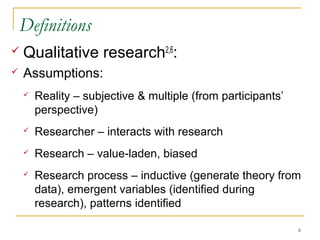
Definitions
   Qualitative research2,6:
   Assumptions:
       Reality – subjective & multiple (from participants’
        perspective)
       Researcher – interacts with research
       Research – value-laden, biased
       Research process – inductive (generate theory from
        data), emergent variables (identified during
        research), patterns identified

                                                              6
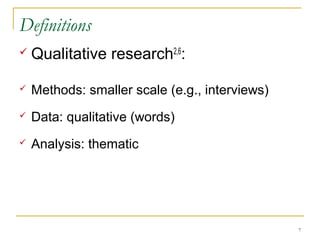
Definitions
   Qualitative research2,6:

   Methods: smaller scale (e.g., interviews)
   Data: qualitative (words)
   Analysis: thematic


                                                7
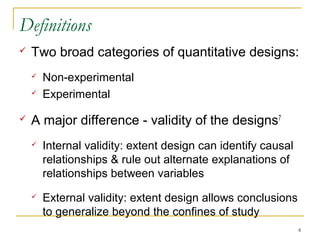
Definitions
   Two broad categories of quantitative designs:
       Non-experimental
       Experimental

   A major difference - validity of the designs7
       Internal validity: extent design can identify causal
        relationships & rule out alternate explanations of
        relationships between variables
       External validity: extent design allows conclusions
        to generalize beyond the confines of study
                                                               8
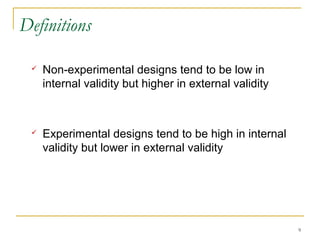
Definitions

    Non-experimental designs tend to be low in
     internal validity but higher in external validity


    Experimental designs tend to be high in internal
     validity but lower in external validity


                                                         9
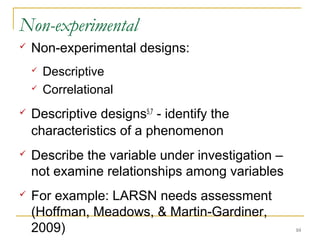
Non-experimental
   Non-experimental designs:
       Descriptive
       Correlational
   Descriptive designs5,7 - identify the
    characteristics of a phenomenon
   Describe the variable under investigation –
    not examine relationships among variables
   For example: LARSN needs assessment
    (Hoffman, Meadows, & Martin-Gardiner,
    2009)                                         10
Non-experimental

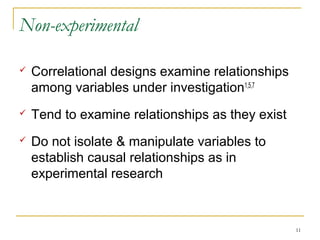
   Correlational designs examine relationships
    among variables under investigation1,5,7
   Tend to examine relationships as they exist
   Do not isolate & manipulate variables to
    establish causal relationships as in
    experimental research


                                                  11
Non-experimental


   For example, Eron, Huesmann, Lefkowitz, &
    Walder (1972) examined relationship
    between preferences for violent television &
    aggressive behaviour


                                                   12
Non-experimental

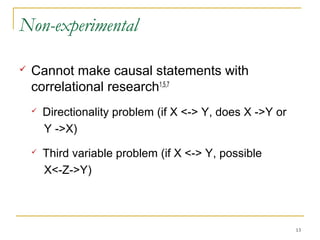
   Cannot make causal statements with
    correlational research1,5,7
       Directionality problem (if X <-> Y, does X ->Y or
        Y ->X)
       Third variable problem (if X <-> Y, possible
        X<-Z->Y)


                                                            13
Non-experimental
   More complex correlational designs can
    suggest direction of causality
   E.g., Cross-lagged panel correlation design

   Eron and colleagues (1972) – collected data
    at grade 3 &13 and correlated variables
    between years – found moderate correlation
    between grade 3 preference for violent tv &
    grade 13 aggressive behaviour

                                                  14
Non-experimental
   In groups of 3, please discuss:

       Research question you would be interested in
        researching
       Design of your research (i.e., descriptive or
        correlational)
    


       Data sources for that project
       Research methods you would use


                                                        15
Experimental

   Experimental designs:
       Experimental
       Quasi-experimental

   Experiment1,3,5,7 - variable is systematically
    manipulated (independent variable; IV) to
    observe effect of manipulation on another
    variable (dependent variable; DV)

                                                     16
Experimental

   Experimental control1,3,5,7 – hold extraneous
    variables constant in experiment to isolate
    effect of IV on DV

   For example, Hopkins & Wilson (2009)


                                                    17
Experimental
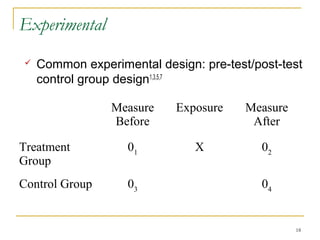
   Common experimental design: pre-test/post-test
    control group design1,3,5,7

                Measure     Exposure    Measure
                Before                   After

Treatment          01          X          02
Group
Control Group      03                     04


                                                  18
Experimental
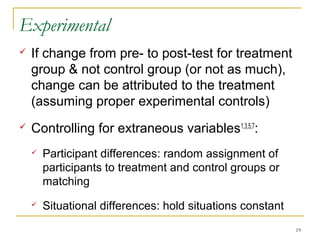
   If change from pre- to post-test for treatment
    group & not control group (or not as much),
    change can be attributed to the treatment
    (assuming proper experimental controls)
   Controlling for extraneous variables1,3,5,7:
       Participant differences: random assignment of
        participants to treatment and control groups or
        matching
       Situational differences: hold situations constant
                                                            19
Experimental
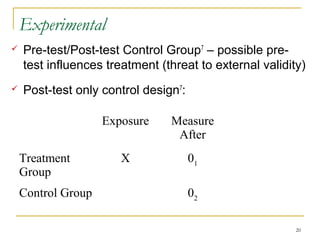
   Pre-test/Post-test Control Group7 – possible pre-
    test influences treatment (threat to external validity)
   Post-test only control design7:

                    Exposure    Measure
                                 After
    Treatment          X              01
    Group
    Control Group                     02

                                                         20
Experimental
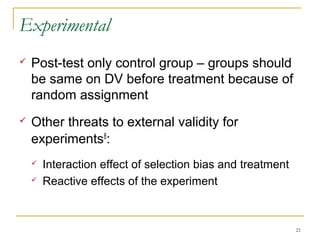
   Post-test only control group – groups should
    be same on DV before treatment because of
    random assignment
   Other threats to external validity for
    experiments8:
       Interaction effect of selection bias and treatment
       Reactive effects of the experiment


                                                             21
Experimental
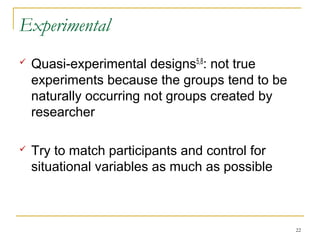
   Quasi-experimental designs5,8: not true
    experiments because the groups tend to be
    naturally occurring not groups created by
    researcher

   Try to match participants and control for
    situational variables as much as possible


                                                22
Experimental
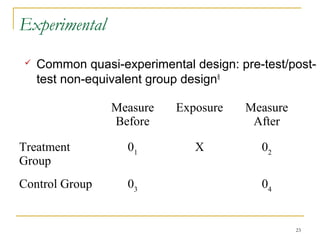
   Common quasi-experimental design: pre-test/post-
    test non-equivalent group design8

                Measure    Exposure    Measure
                Before                  After

Treatment          01          X          02
Group
Control Group      03                     04


                                                 23
Experimental
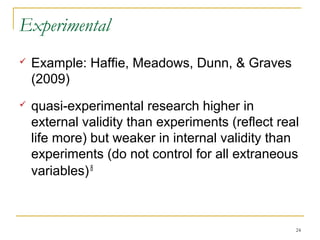
   Example: Haffie, Meadows, Dunn, & Graves
    (2009)
   quasi-experimental research higher in
    external validity than experiments (reflect real
    life more) but weaker in internal validity than
    experiments (do not control for all extraneous
    variables) 8


                                                   24
Experimental

   In groups of 3, please discuss:

       New research question you would be interested in
        researching
       Design of your research (i.e., experimental or quasi-
        experimental)
    


       Data sources for that project
       Research methods you would use


                                                                25
Questions, comments…


           kmeadow2@uwo.ca

                         26
References
1. Bordens, K. S. & Abbott, B. B. (2008). Research design and
    methods: A process approach (7th ed.). Boston: McGraw-Hill.

2. Creswell, J. W. (1994). Research design: Qualitative and
    quantitative approaches. Thousand Oaks, CA: Sage Publications.


3. Elmes, D. G., Kantowitz, B. H., Roediger III, H. L. (1999).
    Research methods in psychology (6th ed.). Pacific Grove, CA:
    Brooks/Cole Publishing Company.

4. Eron, L. D., Huesmann, L. R., Lefkowitz, M. M. & Walder, L. O.
    (1972). Does television violence cause aggression? American
    Psychologist, 27, 253-263.
                                                                    27
References
5. Leedy, P. D., & Ormrod, J. E. (2001). Practical research: Planning
   and design (7th ed.). Upper Saddle River, N.J.: Merrill Prentice
   Hall.

6. O'Leary, Z. (2004). The essential guide to doing research. London:
   Sage.

7. Powell, R. R., & Connaway, L. S. (2004). Basic research methods
   for librarians (4th ed.). Westport, Conn.: Libraries Unlimited.


                                                                   28

Meadows quant res dese

  • 1.
    Quantitative Research Design Ken N. Meadows, Ph.D. Educational Researcher Teaching and Learning Services
  • 2.
    Outline  Defining quantitative research design  Non-Experimental designs  Descriptive  Correlational  Experimental designs  Experiments  Quasi-experiments  Conclusions… 2
  • 3.
    Definitions  Research design: the framework used to conduct the research  Research method: data collection techniques (e.g., document analysis, interview, survey) 3
  • 4.
    Definitions  Quantitative research2,6:  Assumptions:  Reality - objective & singular  Researcher - independent from research  Research - value-free, unbiased  Research process – deductive (generate hypotheses from theory), emphasize cause/effect, isolation of variables, context-free, prediction, generalizability 4
  • 5.
    Definitions  Quantitative research2,6:  Methods: larger scale (e.g., survey)  Data: quantitative (numbers)  Analysis: statistical 5
  • 6.
    Definitions  Qualitative research2,6:  Assumptions:  Reality – subjective & multiple (from participants’ perspective)  Researcher – interacts with research  Research – value-laden, biased  Research process – inductive (generate theory from data), emergent variables (identified during research), patterns identified 6
  • 7.
    Definitions  Qualitative research2,6:  Methods: smaller scale (e.g., interviews)  Data: qualitative (words)  Analysis: thematic 7
  • 8.
    Definitions  Two broad categories of quantitative designs:  Non-experimental  Experimental  A major difference - validity of the designs7  Internal validity: extent design can identify causal relationships & rule out alternate explanations of relationships between variables  External validity: extent design allows conclusions to generalize beyond the confines of study 8
  • 9.
    Definitions  Non-experimental designs tend to be low in internal validity but higher in external validity  Experimental designs tend to be high in internal validity but lower in external validity 9
  • 10.
    Non-experimental  Non-experimental designs:  Descriptive  Correlational  Descriptive designs5,7 - identify the characteristics of a phenomenon  Describe the variable under investigation – not examine relationships among variables  For example: LARSN needs assessment (Hoffman, Meadows, & Martin-Gardiner, 2009) 10
  • 11.
    Non-experimental  Correlational designs examine relationships among variables under investigation1,5,7  Tend to examine relationships as they exist  Do not isolate & manipulate variables to establish causal relationships as in experimental research 11
  • 12.
    Non-experimental  For example, Eron, Huesmann, Lefkowitz, & Walder (1972) examined relationship between preferences for violent television & aggressive behaviour 12
  • 13.
    Non-experimental  Cannot make causal statements with correlational research1,5,7  Directionality problem (if X <-> Y, does X ->Y or Y ->X)  Third variable problem (if X <-> Y, possible X<-Z->Y) 13
  • 14.
    Non-experimental  More complex correlational designs can suggest direction of causality  E.g., Cross-lagged panel correlation design  Eron and colleagues (1972) – collected data at grade 3 &13 and correlated variables between years – found moderate correlation between grade 3 preference for violent tv & grade 13 aggressive behaviour 14
  • 15.
    Non-experimental  In groups of 3, please discuss:  Research question you would be interested in researching  Design of your research (i.e., descriptive or correlational)   Data sources for that project  Research methods you would use 15
  • 16.
    Experimental  Experimental designs:  Experimental  Quasi-experimental  Experiment1,3,5,7 - variable is systematically manipulated (independent variable; IV) to observe effect of manipulation on another variable (dependent variable; DV) 16
  • 17.
    Experimental  Experimental control1,3,5,7 – hold extraneous variables constant in experiment to isolate effect of IV on DV  For example, Hopkins & Wilson (2009) 17
  • 18.
    Experimental  Common experimental design: pre-test/post-test control group design1,3,5,7 Measure Exposure Measure Before After Treatment 01 X 02 Group Control Group 03 04 18
  • 19.
    Experimental  If change from pre- to post-test for treatment group & not control group (or not as much), change can be attributed to the treatment (assuming proper experimental controls)  Controlling for extraneous variables1,3,5,7:  Participant differences: random assignment of participants to treatment and control groups or matching  Situational differences: hold situations constant 19
  • 20.
    Experimental  Pre-test/Post-test Control Group7 – possible pre- test influences treatment (threat to external validity)  Post-test only control design7: Exposure Measure After Treatment X 01 Group Control Group 02 20
  • 21.
    Experimental  Post-test only control group – groups should be same on DV before treatment because of random assignment  Other threats to external validity for experiments8:  Interaction effect of selection bias and treatment  Reactive effects of the experiment 21
  • 22.
    Experimental  Quasi-experimental designs5,8: not true experiments because the groups tend to be naturally occurring not groups created by researcher  Try to match participants and control for situational variables as much as possible 22
  • 23.
    Experimental  Common quasi-experimental design: pre-test/post- test non-equivalent group design8 Measure Exposure Measure Before After Treatment 01 X 02 Group Control Group 03 04 23
  • 24.
    Experimental  Example: Haffie, Meadows, Dunn, & Graves (2009)  quasi-experimental research higher in external validity than experiments (reflect real life more) but weaker in internal validity than experiments (do not control for all extraneous variables) 8 24
  • 25.
    Experimental  In groups of 3, please discuss:  New research question you would be interested in researching  Design of your research (i.e., experimental or quasi- experimental)   Data sources for that project  Research methods you would use 25
  • 26.
    Questions, comments… kmeadow2@uwo.ca 26
  • 27.
    References 1. Bordens, K.S. & Abbott, B. B. (2008). Research design and methods: A process approach (7th ed.). Boston: McGraw-Hill. 2. Creswell, J. W. (1994). Research design: Qualitative and quantitative approaches. Thousand Oaks, CA: Sage Publications. 3. Elmes, D. G., Kantowitz, B. H., Roediger III, H. L. (1999). Research methods in psychology (6th ed.). Pacific Grove, CA: Brooks/Cole Publishing Company. 4. Eron, L. D., Huesmann, L. R., Lefkowitz, M. M. & Walder, L. O. (1972). Does television violence cause aggression? American Psychologist, 27, 253-263. 27
  • 28.
    References 5. Leedy, P.D., & Ormrod, J. E. (2001). Practical research: Planning and design (7th ed.). Upper Saddle River, N.J.: Merrill Prentice Hall. 6. O'Leary, Z. (2004). The essential guide to doing research. London: Sage. 7. Powell, R. R., & Connaway, L. S. (2004). Basic research methods for librarians (4th ed.). Westport, Conn.: Libraries Unlimited. 28