AIM: TO INTRODUCE THE PRINCIPLES OF
A FACTORIAL EXPERIMENT
F A C T O R I A L E X P E R I M E N T S 2
Factorial
Experiments
Example 1 Overview Example 2
Other
designs
EXAMPLE
Bushman et al (1971):
Do adults feel more violent after seeing
violence?
Do males generally feel more violent then
females?
Are males affected more by seeing violence
than females?
F A C T O R I A L E X P E R I M E N T S 3
EXAMPLE
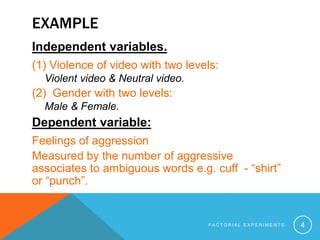
Independent variables.
(1) Violence of video with two levels:
Violent video & Neutral video.
(2) Gender with two levels:
Male & Female.
Dependent variable:
Feelings of aggression
Measured by the number of aggressive
associates to ambiguous words e.g. cuff - “shirt”
or “punch”.
F A C T O R I A L E X P E R I M E N T S 4
EXAMPLE
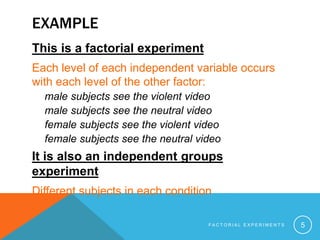
This is a factorial experiment
Each level of each independent variable occurs
with each level of the other factor:
male subjects see the violent video
male subjects see the neutral video
female subjects see the violent video
female subjects see the neutral video
It is also an independent groups
experiment
Different subjects in each condition
F A C T O R I A L E X P E R I M E N T S 5
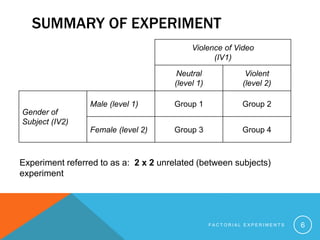
SUMMARY OF EXPERIMENT
Violence of Video
(IV1)
Neutral
(level 1)
Violent
(level 2)
Gender of
Subject (IV2)
Male (level 1) Group 1 Group 2
Female (level 2) Group 3 Group 4
F A C T O R I A L E X P E R I M E N T S 6
Experiment referred to as a: 2 x 2 unrelated (between subjects)
experiment
EXAMPLE
Design permits three hypotheses:
1 Main effect
The effect of type of video on aggression
Seeing a violent video will produce more feelings of
aggression than seeing a neutral video
2 Main effect
The effect of gender on aggression
Males will generally feel more aggressive then
females, regardless of video
F A C T O R I A L E X P E R I M E N T S 7
EXAMPLE
3 Interaction effect
The interaction of type of video and
gender
Relative to the neutral video, violent
video affects males more than
females.
F A C T O R I A L E X P E R I M E N T S 8
EXAMPLE
Type of Video
neutral
video
violent
video
Condition
Means
(gender)
Gende
r
Male 6.2 7.7 6.95
Female 5.1 6.5 5.80
Condition
Means
(video)
5.65 7.10
F A C T O R I A L E X P E R I M E N T S 9
EXAMPLE
Result 1 – Main effect
The effect of type of
video on aggression
• 5.65 (neutral) vs 7.1
(violent)
• The violent video
produces a higher
aggression score than
the neutral video
• This result needs to be
confirmed with a
statistical test
5.65
7.10
0
1
2
3
4
5
6
7
8
9
10
Aggression
score
Video type
Neutral
Violent
F A C T O R I A L E X P E R I M E N T S 10
EXAMPLE
Result 2 – Main effect
• The effect of gender on
aggression
• 6.95 (male) vs 5.80
(female)
• Males produce higher
aggression scores than
females
• This result needs to be
confirmed with a
statistical test
6.95
5.8
0
1
2
3
4
5
6
7
8
9
10
Aggression
score
Gender
male
female
F A C T O R I A L E X P E R I M E N T S 11
EXAMPLE
Result 3 – Interaction
The interaction of type of
video and gender
There seems to be no
interaction effect (if lines are
parallel usually the case)
i.e. The violent video doesn’t
seem to have a greater effect on
males than females
0
1
2
3
4
5
6
7
8
Neutral Violent
Aggression
Score
Video Type
Figure 1. Effect of video type
and gender on aggression
scores
Male
Female
F A C T O R I A L E X P E R I M E N T S 12
PROGRESSION POINT
F A C T O R I A L E X P E R I M E N T S 13
Factorial
Experiments
Example 1 Overview Example 2
Other
designs
FACTORIAL DESIGNS
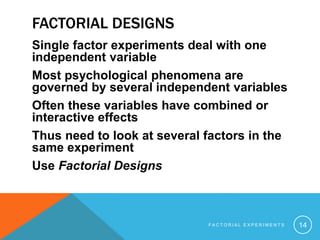
Single factor experiments deal with one
independent variable
Most psychological phenomena are
governed by several independent variables
Often these variables have combined or
interactive effects
Thus need to look at several factors in the
same experiment
Use Factorial Designs
F A C T O R I A L E X P E R I M E N T S 14
FACTORIAL DESIGNS
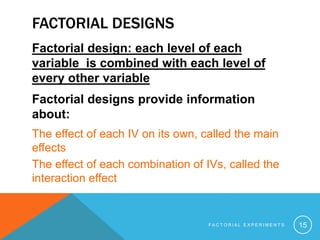
Factorial design: each level of each
variable is combined with each level of
every other variable
Factorial designs provide information
about:
The effect of each IV on its own, called the main
effects
The effect of each combination of IVs, called the
interaction effect
F A C T O R I A L E X P E R I M E N T S 15
FACTORIAL DESIGNS
Complexity can vary in (1) number of
independent variables and (2) number of
levels of each independent variable
Describing a factorial design:
m x n – two Independent variables, one with m
levels, the other with n levels
l x m x n – three independent variables, one with
l levels, one with m levels and one with n levels
See over for examples
F A C T O R I A L E X P E R I M E N T S 16
FACTORIAL DESIGNS
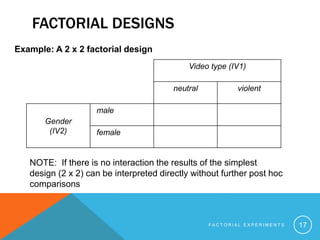
Video type (IV1)
neutral violent
Gender
(IV2)
male
female
F A C T O R I A L E X P E R I M E N T S 17
NOTE: If there is no interaction the results of the simplest
design (2 x 2) can be interpreted directly without further post hoc
comparisons
Example: A 2 x 2 factorial design
FACTORIAL DESIGNS
F A C T O R I A L E X P E R I M E N T S 18
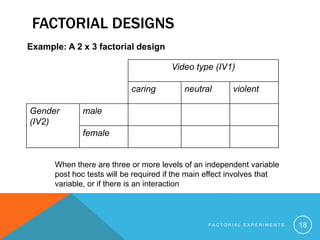
Video type (IV1)
caring neutral violent
Gender
(IV2)
male
female
Example: A 2 x 3 factorial design
When there are three or more levels of an independent variable
post hoc tests will be required if the main effect involves that
variable, or if there is an interaction
FACTORIAL DESIGNS
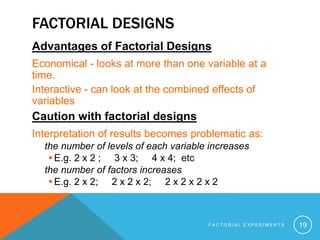
Advantages of Factorial Designs
Economical - looks at more than one variable at a
time.
Interactive - can look at the combined effects of
variables
Caution with factorial designs
Interpretation of results becomes problematic as:
the number of levels of each variable increases
E.g. 2 x 2 ; 3 x 3; 4 x 4; etc
the number of factors increases
E.g. 2 x 2; 2 x 2 x 2; 2 x 2 x 2 x 2
F A C T O R I A L E X P E R I M E N T S 19
PROGRESSION POINT
F A C T O R I A L E X P E R I M E N T S 20
Factorial
Experiments
Example 1 Overview Example 2
Other
designs
EXAMPLE 2 (WITH SIGNIFICANT
INTERACTION)
Hypothetical experiment:
Effects of alcohol and sleep deprivation on
driving performance
Independent variables
1. Amount of alcohol: 0 mls. vs 50 mls.
2. Amount of sleep deprivation: 4 hrs vs 12 hrs
Dependent variable
Number of mistakes on simulator
F A C T O R I A L E X P E R I M E N T S 21
EXAMPLE
Sleep deprivation
4 hrs 12 hrs Condition
Means
(alcohol)
Amount
of
Alcohol
zero millilitres 10.67 12.67 11.67
50 millilitres 15.00 26.00 20.50
Condition Means
(sleep
deprivation)
12.84 19.34
F A C T O R I A L E X P E R I M E N T S 22
EXAMPLE
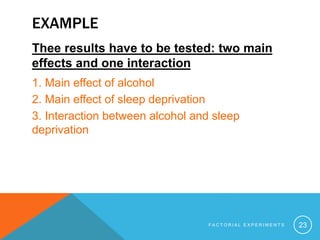
Thee results have to be tested: two main
effects and one interaction
1. Main effect of alcohol
2. Main effect of sleep deprivation
3. Interaction between alcohol and sleep
deprivation
F A C T O R I A L E X P E R I M E N T S 23
EXAMPLE 2: MAIN EFFECT OF ALCOHOL
11.67
20.5
0
5
10
15
20
25
0 mls 50 mls
Number of
errors
Amount of alcohol
F A C T O R I A L E X P E R I M E N T S 24
Figure 1: Effect of amount of alcohol on number of errors
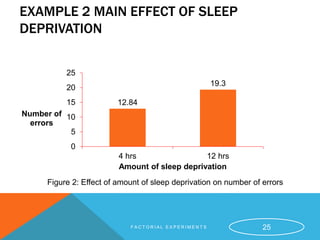
EXAMPLE 2 MAIN EFFECT OF SLEEP
DEPRIVATION
12.84
19.3
0
5
10
15
20
25
4 hrs 12 hrs
Number of
errors
Amount of sleep deprivation
F A C T O R I A L E X P E R I M E N T S 25
Figure 2: Effect of amount of sleep deprivation on number of errors
EXAMPLE 2 INTERACTION
10.67
12.67
15
26
0
5
10
15
20
25
30
4 hrs 24 hrs
Number of
errors
Amount of sleep deprivation
0 mls
50 mls
F A C T O R I A L E X P E R I M E N T S 26
Figure 3: Effect of the interaction of amount of alcohol and amount
of sleep deprivation on number of errors
PROGRESSION POINT
F A C T O R I A L E X P E R I M E N T S 27
Factorial
Experiments
Example 1 Overview Example 2
Other
designs
OTHER FACTORIAL DESIGNS: MORE
LEVELS
Sleep deprivation
4 hrs 12 hrs 24 hrs
Amount
of alcohol
0 mls Group 1 Group 2 Group 3
25 mls Group 4 Group 5 Group 6
50 mls Group 7 Group 8 Group 9
F A C T O R I A L E X P E R I M E N T S 28
This is a 3 x 3 unrelated (between subjects) design
Yields: Two main effects and one interaction effect . Post hoc comparisons are
needed to see where the differences lie because one variable has three levels
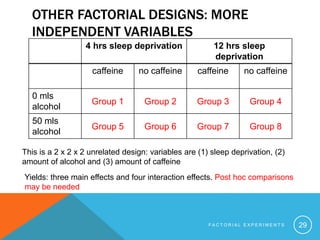
OTHER FACTORIAL DESIGNS: MORE
INDEPENDENT VARIABLES
4 hrs sleep deprivation 12 hrs sleep
deprivation
caffeine no caffeine caffeine no caffeine
0 mls
alcohol
Group 1 Group 2 Group 3 Group 4
50 mls
alcohol
Group 5 Group 6 Group 7 Group 8
F A C T O R I A L E X P E R I M E N T S 29
This is a 2 x 2 x 2 unrelated design: variables are (1) sleep deprivation, (2)
amount of alcohol and (3) amount of caffeine
Yields: three main effects and four interaction effects. Post hoc comparisons
may be needed
OTHER FACTORIAL DESIGNS: MIXED
Sleep deprivation
4 hrs 24 hrs
Amount
of
Alcohol
0 millilitres Group 1 Group1
50 millilitres Group 2 Group 2
F A C T O R I A L E X P E R I M E N T S 30
This is a 2 x 2 mixed design: same subjects for one variable; different
subjects for the other variable
Yields two main effects and one interaction effect but analysis is different
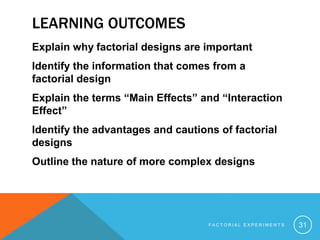
LEARNING OUTCOMES
Explain why factorial designs are important
Identify the information that comes from a
factorial design
Explain the terms “Main Effects” and “Interaction
Effect”
Identify the advantages and cautions of factorial
designs
Outline the nature of more complex designs
F A C T O R I A L E X P E R I M E N T S 31
READING
Howitt, D & Cramer, D (1997) An Introduction to
Statistics in Psychology. Chapter 22 (two-way
analysis of variance for unrelated scores) and
chapter 24 (More complex designs).
Howitt, D & Cramer, D (1999) Introduction to SPSS
in Psychology. Chapter 22 (two-way analysis of
variance for unrelated) and (optional) chapter 24
(analysis of covariance and two-way mixed
designs).
F A C T O R I A L E X P E R I M E N T S 32

Factorial_Designs (1).pptx

  • 2.
    AIM: TO INTRODUCETHE PRINCIPLES OF A FACTORIAL EXPERIMENT F A C T O R I A L E X P E R I M E N T S 2 Factorial Experiments Example 1 Overview Example 2 Other designs
  • 3.
    EXAMPLE Bushman et al(1971): Do adults feel more violent after seeing violence? Do males generally feel more violent then females? Are males affected more by seeing violence than females? F A C T O R I A L E X P E R I M E N T S 3
  • 4.
    EXAMPLE Independent variables. (1) Violenceof video with two levels: Violent video & Neutral video. (2) Gender with two levels: Male & Female. Dependent variable: Feelings of aggression Measured by the number of aggressive associates to ambiguous words e.g. cuff - “shirt” or “punch”. F A C T O R I A L E X P E R I M E N T S 4
  • 5.
    EXAMPLE This is afactorial experiment Each level of each independent variable occurs with each level of the other factor: male subjects see the violent video male subjects see the neutral video female subjects see the violent video female subjects see the neutral video It is also an independent groups experiment Different subjects in each condition F A C T O R I A L E X P E R I M E N T S 5
  • 6.
    SUMMARY OF EXPERIMENT Violenceof Video (IV1) Neutral (level 1) Violent (level 2) Gender of Subject (IV2) Male (level 1) Group 1 Group 2 Female (level 2) Group 3 Group 4 F A C T O R I A L E X P E R I M E N T S 6 Experiment referred to as a: 2 x 2 unrelated (between subjects) experiment
  • 7.
    EXAMPLE Design permits threehypotheses: 1 Main effect The effect of type of video on aggression Seeing a violent video will produce more feelings of aggression than seeing a neutral video 2 Main effect The effect of gender on aggression Males will generally feel more aggressive then females, regardless of video F A C T O R I A L E X P E R I M E N T S 7
  • 8.
    EXAMPLE 3 Interaction effect Theinteraction of type of video and gender Relative to the neutral video, violent video affects males more than females. F A C T O R I A L E X P E R I M E N T S 8
  • 9.
    EXAMPLE Type of Video neutral video violent video Condition Means (gender) Gende r Male6.2 7.7 6.95 Female 5.1 6.5 5.80 Condition Means (video) 5.65 7.10 F A C T O R I A L E X P E R I M E N T S 9
  • 10.
    EXAMPLE Result 1 –Main effect The effect of type of video on aggression • 5.65 (neutral) vs 7.1 (violent) • The violent video produces a higher aggression score than the neutral video • This result needs to be confirmed with a statistical test 5.65 7.10 0 1 2 3 4 5 6 7 8 9 10 Aggression score Video type Neutral Violent F A C T O R I A L E X P E R I M E N T S 10
  • 11.
    EXAMPLE Result 2 –Main effect • The effect of gender on aggression • 6.95 (male) vs 5.80 (female) • Males produce higher aggression scores than females • This result needs to be confirmed with a statistical test 6.95 5.8 0 1 2 3 4 5 6 7 8 9 10 Aggression score Gender male female F A C T O R I A L E X P E R I M E N T S 11
  • 12.
    EXAMPLE Result 3 –Interaction The interaction of type of video and gender There seems to be no interaction effect (if lines are parallel usually the case) i.e. The violent video doesn’t seem to have a greater effect on males than females 0 1 2 3 4 5 6 7 8 Neutral Violent Aggression Score Video Type Figure 1. Effect of video type and gender on aggression scores Male Female F A C T O R I A L E X P E R I M E N T S 12
  • 13.
    PROGRESSION POINT F AC T O R I A L E X P E R I M E N T S 13 Factorial Experiments Example 1 Overview Example 2 Other designs
  • 14.
    FACTORIAL DESIGNS Single factorexperiments deal with one independent variable Most psychological phenomena are governed by several independent variables Often these variables have combined or interactive effects Thus need to look at several factors in the same experiment Use Factorial Designs F A C T O R I A L E X P E R I M E N T S 14
  • 15.
    FACTORIAL DESIGNS Factorial design:each level of each variable is combined with each level of every other variable Factorial designs provide information about: The effect of each IV on its own, called the main effects The effect of each combination of IVs, called the interaction effect F A C T O R I A L E X P E R I M E N T S 15
  • 16.
    FACTORIAL DESIGNS Complexity canvary in (1) number of independent variables and (2) number of levels of each independent variable Describing a factorial design: m x n – two Independent variables, one with m levels, the other with n levels l x m x n – three independent variables, one with l levels, one with m levels and one with n levels See over for examples F A C T O R I A L E X P E R I M E N T S 16
  • 17.
    FACTORIAL DESIGNS Video type(IV1) neutral violent Gender (IV2) male female F A C T O R I A L E X P E R I M E N T S 17 NOTE: If there is no interaction the results of the simplest design (2 x 2) can be interpreted directly without further post hoc comparisons Example: A 2 x 2 factorial design
  • 18.
    FACTORIAL DESIGNS F AC T O R I A L E X P E R I M E N T S 18 Video type (IV1) caring neutral violent Gender (IV2) male female Example: A 2 x 3 factorial design When there are three or more levels of an independent variable post hoc tests will be required if the main effect involves that variable, or if there is an interaction
  • 19.
    FACTORIAL DESIGNS Advantages ofFactorial Designs Economical - looks at more than one variable at a time. Interactive - can look at the combined effects of variables Caution with factorial designs Interpretation of results becomes problematic as: the number of levels of each variable increases E.g. 2 x 2 ; 3 x 3; 4 x 4; etc the number of factors increases E.g. 2 x 2; 2 x 2 x 2; 2 x 2 x 2 x 2 F A C T O R I A L E X P E R I M E N T S 19
  • 20.
    PROGRESSION POINT F AC T O R I A L E X P E R I M E N T S 20 Factorial Experiments Example 1 Overview Example 2 Other designs
  • 21.
    EXAMPLE 2 (WITHSIGNIFICANT INTERACTION) Hypothetical experiment: Effects of alcohol and sleep deprivation on driving performance Independent variables 1. Amount of alcohol: 0 mls. vs 50 mls. 2. Amount of sleep deprivation: 4 hrs vs 12 hrs Dependent variable Number of mistakes on simulator F A C T O R I A L E X P E R I M E N T S 21
  • 22.
    EXAMPLE Sleep deprivation 4 hrs12 hrs Condition Means (alcohol) Amount of Alcohol zero millilitres 10.67 12.67 11.67 50 millilitres 15.00 26.00 20.50 Condition Means (sleep deprivation) 12.84 19.34 F A C T O R I A L E X P E R I M E N T S 22
  • 23.
    EXAMPLE Thee results haveto be tested: two main effects and one interaction 1. Main effect of alcohol 2. Main effect of sleep deprivation 3. Interaction between alcohol and sleep deprivation F A C T O R I A L E X P E R I M E N T S 23
  • 24.
    EXAMPLE 2: MAINEFFECT OF ALCOHOL 11.67 20.5 0 5 10 15 20 25 0 mls 50 mls Number of errors Amount of alcohol F A C T O R I A L E X P E R I M E N T S 24 Figure 1: Effect of amount of alcohol on number of errors
  • 25.
    EXAMPLE 2 MAINEFFECT OF SLEEP DEPRIVATION 12.84 19.3 0 5 10 15 20 25 4 hrs 12 hrs Number of errors Amount of sleep deprivation F A C T O R I A L E X P E R I M E N T S 25 Figure 2: Effect of amount of sleep deprivation on number of errors
  • 26.
    EXAMPLE 2 INTERACTION 10.67 12.67 15 26 0 5 10 15 20 25 30 4hrs 24 hrs Number of errors Amount of sleep deprivation 0 mls 50 mls F A C T O R I A L E X P E R I M E N T S 26 Figure 3: Effect of the interaction of amount of alcohol and amount of sleep deprivation on number of errors
  • 27.
    PROGRESSION POINT F AC T O R I A L E X P E R I M E N T S 27 Factorial Experiments Example 1 Overview Example 2 Other designs
  • 28.
    OTHER FACTORIAL DESIGNS:MORE LEVELS Sleep deprivation 4 hrs 12 hrs 24 hrs Amount of alcohol 0 mls Group 1 Group 2 Group 3 25 mls Group 4 Group 5 Group 6 50 mls Group 7 Group 8 Group 9 F A C T O R I A L E X P E R I M E N T S 28 This is a 3 x 3 unrelated (between subjects) design Yields: Two main effects and one interaction effect . Post hoc comparisons are needed to see where the differences lie because one variable has three levels
  • 29.
    OTHER FACTORIAL DESIGNS:MORE INDEPENDENT VARIABLES 4 hrs sleep deprivation 12 hrs sleep deprivation caffeine no caffeine caffeine no caffeine 0 mls alcohol Group 1 Group 2 Group 3 Group 4 50 mls alcohol Group 5 Group 6 Group 7 Group 8 F A C T O R I A L E X P E R I M E N T S 29 This is a 2 x 2 x 2 unrelated design: variables are (1) sleep deprivation, (2) amount of alcohol and (3) amount of caffeine Yields: three main effects and four interaction effects. Post hoc comparisons may be needed
  • 30.
    OTHER FACTORIAL DESIGNS:MIXED Sleep deprivation 4 hrs 24 hrs Amount of Alcohol 0 millilitres Group 1 Group1 50 millilitres Group 2 Group 2 F A C T O R I A L E X P E R I M E N T S 30 This is a 2 x 2 mixed design: same subjects for one variable; different subjects for the other variable Yields two main effects and one interaction effect but analysis is different
  • 31.
    LEARNING OUTCOMES Explain whyfactorial designs are important Identify the information that comes from a factorial design Explain the terms “Main Effects” and “Interaction Effect” Identify the advantages and cautions of factorial designs Outline the nature of more complex designs F A C T O R I A L E X P E R I M E N T S 31
  • 32.
    READING Howitt, D &Cramer, D (1997) An Introduction to Statistics in Psychology. Chapter 22 (two-way analysis of variance for unrelated scores) and chapter 24 (More complex designs). Howitt, D & Cramer, D (1999) Introduction to SPSS in Psychology. Chapter 22 (two-way analysis of variance for unrelated) and (optional) chapter 24 (analysis of covariance and two-way mixed designs). F A C T O R I A L E X P E R I M E N T S 32