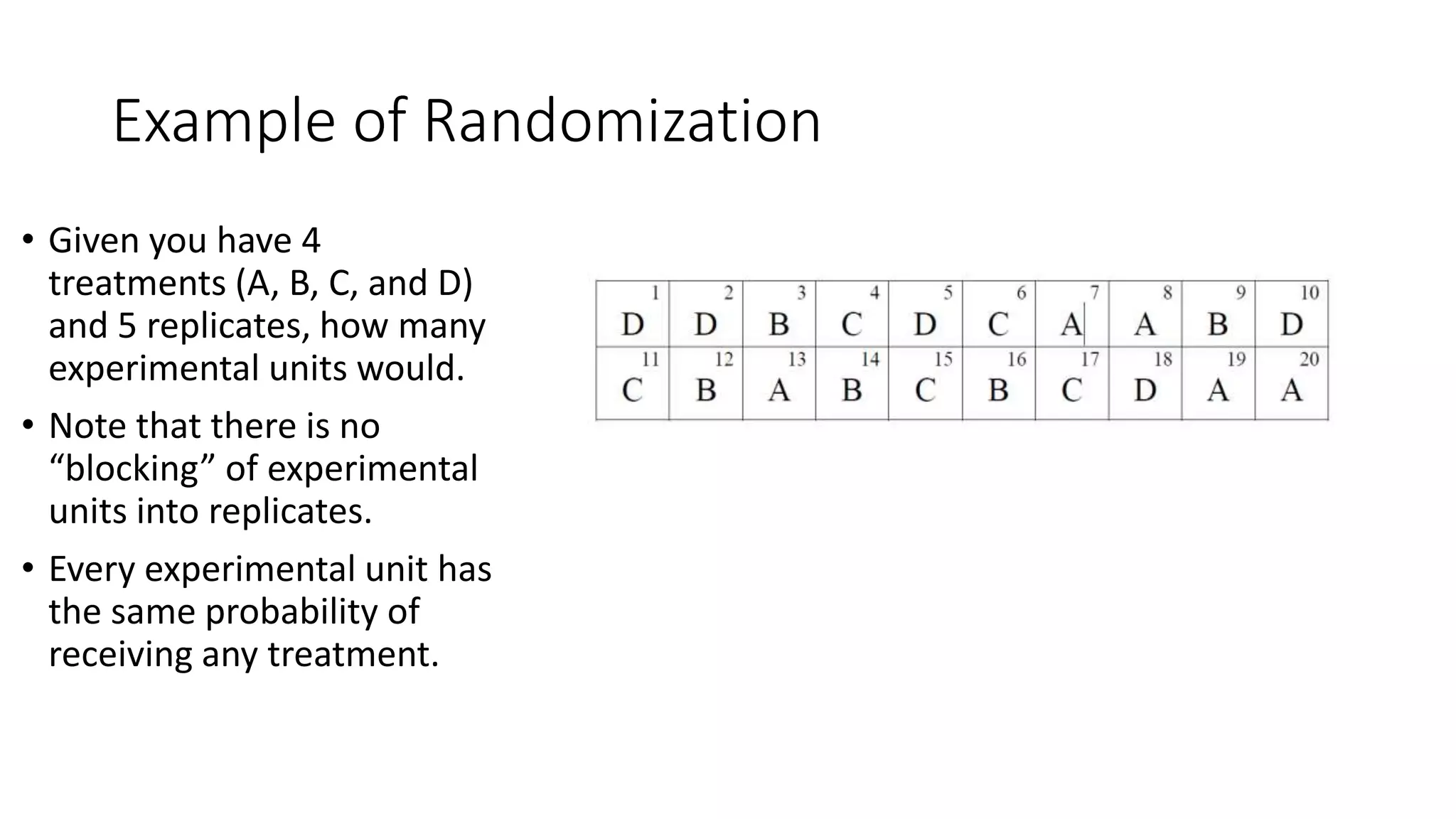
The document describes a completely randomized design (CRD) experiment. A CRD is the simplest experimental design where treatments are assigned to experimental units completely at random. Each unit has an equal chance of receiving any treatment. A CRD is best for small numbers of treatments on homogeneous units. Randomization, advantages like flexibility and simple analysis, and disadvantages like potential loss of precision are discussed. The key differences between fixed and random effects in how inferences can be drawn are also outlined.