DESIGN OF
EXPERIMENT
SOME DEFINITIONS
Choice of treatments, method of assigning treatments to experimental units and
arrangement of experimental units in different patterns are known as Designing
an experiment.
Variable whose change we wish to study is known as Response variable.
Variable whose effect on the response variable we wish to study is known as
Factor.
Treatment: Objects of comparison in an experiment are defined as treatments.
Examples are Varieties tried in a trail and different chemicals.
Experimental unit: The object to which treatments are applied or basic
objects on which the experiment is conducted is known as experimental unit.
Example: piece of land, an animal, etc.
Experimental error: Response from all experimental units receiving
the same treatment may not be same even under similar conditions.
These variations in responses may be due to various reasons. Other
factors like heterogeneity of soil, climatic factors and genetic
differences, etc. also may cause variations (known as Extraneous
factors). The variations in response caused by extraneous factors are
known as Experimental error.
Our aim of designing an experiment will be to minimize the
experimental error
BASIC PRINCIPLES
To reduce the experimental error we adopt certain principles known as
Basic principles of experimental design.
The basic principles are
Replication
Randomization
Local control
Replication
Repeated application of the treatments is known as replication.
When the treatment is applied only once we have no means of
knowing about the variation in the results of a treatment. Only when
we repeat several times we can estimate the experimental error.
With the help of experimental error we can determine whether the
obtained differences between treatment means are real or not.
When the number of replications is increased, experimental error
reduces.
Randomization
When all the treatments have equal chance of being allocated to
different experimental units it is known as randomization.
If our conclusions are to be valid, treatment means and differences
among treatment means should be estimated without any bias.
For this purpose we use the technique of randomization.
Local Control
Experimental error is based on the variations from experimental unit
to experimental unit. This suggests that if we group the homogenous
experimental units into blocks, the experimental error will be reduced
considerably. Grouping of homogenous experimental units into blocks
is known as local control of error.
In order to have valid estimate of experimental error the principles of
replication and randomization are used.
In order to reduce the experimental error, the principles of replication
and local control are used.
In general to have precise, valid and accurate result we adopt the basic
principles.
Completely Randomized Design
(CRD)
CRD is the basic single factor design. In this design the treatments are
assigned completely at random so that each experimental unit has the
same chance of receiving any one treatment.
But CRD is appropriate only when the experimental material is
homogeneous. As there is generally large variation among
experimental plots due to many factors CRD is not preferred in field
experiments.
In laboratory experiments and greenhouse studies it is easy to achieve
homogeneity of experimental materials and therefore CRD is most
useful in such experiments.
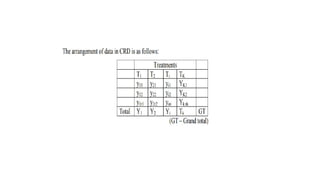
Layout of CRD
Completely randomized Design is the one in which all the experimental units are
taken in a single group which are homogeneous as far as possible. The
randomization procedure for allotting the treatments to various units will be as
follows.
Step 1: Determine the total number of experimental units.
Step 2: Assign a plot number to each of the experimental units starting from left
to right for all rows.
Step 3: Assign the treatments to the experimental units by using random numbers.
The statistical model for CRD with one observation per unit
Yij = µ + ti + eij µ = overall mean effect
ti = true effect of the i treatment
eij = error term of the jth unit receiving ith treatment
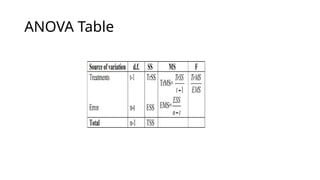
ANOVA Table
Advantages of a CRD
• Its layout is very easy.
• There is complete flexibility in this design i.e. any number of
treatments and replications for each treatment can be tried.
• Whole experimental material can be utilized in this design.
• This design yields maximum degrees of freedom for experimental
error.
• The analysis of data is simplest as compared to any other design.
• Even if some values are missing the analysis can be done.
Disadvantages of a CRD
1. It is difficult to find homogeneous experimental units in all respects
and hence CRD is seldom suitable for field experiments as compared to
other experimental designs.
2. It is less accurate than other designs.
Randomized Blocks Design (RBD)
When the experimental material is heterogeneous, the experimental material is
grouped into homogenous sub-groups called Blocks. As each block consists of
the entire set of treatments a block is equivalent to a replication.
 If the fertility gradient runs in one direction say from north to south or east to
west then the blocks are formed in the opposite direction. Such an arrangement
of grouping the heterogeneous units into homogenous blocks is known as
Randomized blocks design.
Each block consists of as many experimental units as the number of treatments.
The treatments are allocated randomly to the experimental units within each
block independently such that each treatment occurs once.
 The number of blocks is chosen to be equal to the number of replications for
the treatments.
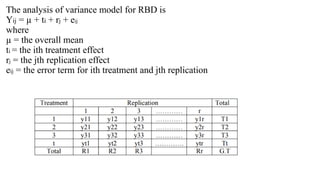
The analysis of variance model for RBD is
Yij = µ + ti + rj + eij
where
µ = the overall mean
ti = the ith treatment effect
rj = the jth replication effect
eij = the error term for ith treatment and jth replication
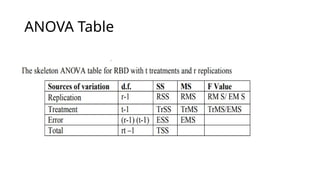
ANOVA Table
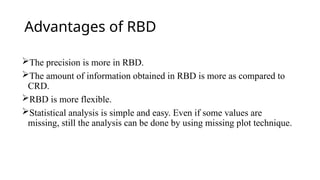
Advantages of RBD
The precision is more in RBD.
The amount of information obtained in RBD is more as compared to
CRD.
RBD is more flexible.
Statistical analysis is simple and easy. Even if some values are
missing, still the analysis can be done by using missing plot technique.
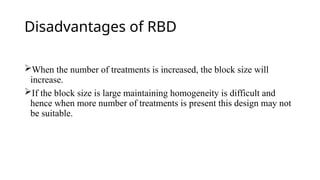
Disadvantages of RBD
When the number of treatments is increased, the block size will
increase.
If the block size is large maintaining homogeneity is difficult and
hence when more number of treatments is present this design may not
be suitable.
Latin Square Design
When the experimental material is divided into rows and columns and
the treatments are allocated such that each treatment occurs only once
in each row and each column, the design is known as LSD.
In LSD the treatments are usually denoted by A B C D etc.
For a 5 x 5 LSD the arrangements may
be
A
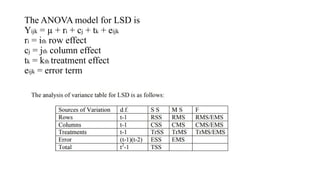
The ANOVA model for LSD is
Yijk = µ + ri + cj + tk + eijk
ri = ith row effect
cj = jth column effect
tk = kth treatment effect
eijk = error term
Advantages
LSD is more efficient than RBD or CRD. This is because of double
grouping that will result in small experimental error.
When missing values are present, missing plot technique can be used
and analysed.
Disadvantages
• This design is not as flexible as RBD or CRD as the number of
treatments is limited to the number of rows and columns.
• LSD is seldom used when the number of treatments is more than 12.
• LSD is not suitable for treatments less t.
THANK YOU

Design experiment ASSIGNMENT detailed.pptx

  • 1.
  • 2.
    SOME DEFINITIONS Choice oftreatments, method of assigning treatments to experimental units and arrangement of experimental units in different patterns are known as Designing an experiment. Variable whose change we wish to study is known as Response variable. Variable whose effect on the response variable we wish to study is known as Factor. Treatment: Objects of comparison in an experiment are defined as treatments. Examples are Varieties tried in a trail and different chemicals. Experimental unit: The object to which treatments are applied or basic objects on which the experiment is conducted is known as experimental unit. Example: piece of land, an animal, etc.
  • 3.
    Experimental error: Responsefrom all experimental units receiving the same treatment may not be same even under similar conditions. These variations in responses may be due to various reasons. Other factors like heterogeneity of soil, climatic factors and genetic differences, etc. also may cause variations (known as Extraneous factors). The variations in response caused by extraneous factors are known as Experimental error. Our aim of designing an experiment will be to minimize the experimental error
  • 4.
    BASIC PRINCIPLES To reducethe experimental error we adopt certain principles known as Basic principles of experimental design. The basic principles are Replication Randomization Local control
  • 5.
    Replication Repeated application ofthe treatments is known as replication. When the treatment is applied only once we have no means of knowing about the variation in the results of a treatment. Only when we repeat several times we can estimate the experimental error. With the help of experimental error we can determine whether the obtained differences between treatment means are real or not. When the number of replications is increased, experimental error reduces.
  • 6.
    Randomization When all thetreatments have equal chance of being allocated to different experimental units it is known as randomization. If our conclusions are to be valid, treatment means and differences among treatment means should be estimated without any bias. For this purpose we use the technique of randomization.
  • 7.
    Local Control Experimental erroris based on the variations from experimental unit to experimental unit. This suggests that if we group the homogenous experimental units into blocks, the experimental error will be reduced considerably. Grouping of homogenous experimental units into blocks is known as local control of error. In order to have valid estimate of experimental error the principles of replication and randomization are used. In order to reduce the experimental error, the principles of replication and local control are used. In general to have precise, valid and accurate result we adopt the basic principles.
  • 8.
    Completely Randomized Design (CRD) CRDis the basic single factor design. In this design the treatments are assigned completely at random so that each experimental unit has the same chance of receiving any one treatment. But CRD is appropriate only when the experimental material is homogeneous. As there is generally large variation among experimental plots due to many factors CRD is not preferred in field experiments. In laboratory experiments and greenhouse studies it is easy to achieve homogeneity of experimental materials and therefore CRD is most useful in such experiments.
  • 9.
    Layout of CRD Completelyrandomized Design is the one in which all the experimental units are taken in a single group which are homogeneous as far as possible. The randomization procedure for allotting the treatments to various units will be as follows. Step 1: Determine the total number of experimental units. Step 2: Assign a plot number to each of the experimental units starting from left to right for all rows. Step 3: Assign the treatments to the experimental units by using random numbers. The statistical model for CRD with one observation per unit Yij = µ + ti + eij µ = overall mean effect ti = true effect of the i treatment eij = error term of the jth unit receiving ith treatment
  • 11.
  • 12.
    Advantages of aCRD • Its layout is very easy. • There is complete flexibility in this design i.e. any number of treatments and replications for each treatment can be tried. • Whole experimental material can be utilized in this design. • This design yields maximum degrees of freedom for experimental error. • The analysis of data is simplest as compared to any other design. • Even if some values are missing the analysis can be done.
  • 13.
    Disadvantages of aCRD 1. It is difficult to find homogeneous experimental units in all respects and hence CRD is seldom suitable for field experiments as compared to other experimental designs. 2. It is less accurate than other designs.
  • 14.
    Randomized Blocks Design(RBD) When the experimental material is heterogeneous, the experimental material is grouped into homogenous sub-groups called Blocks. As each block consists of the entire set of treatments a block is equivalent to a replication.  If the fertility gradient runs in one direction say from north to south or east to west then the blocks are formed in the opposite direction. Such an arrangement of grouping the heterogeneous units into homogenous blocks is known as Randomized blocks design. Each block consists of as many experimental units as the number of treatments. The treatments are allocated randomly to the experimental units within each block independently such that each treatment occurs once.  The number of blocks is chosen to be equal to the number of replications for the treatments.
  • 15.
    The analysis ofvariance model for RBD is Yij = µ + ti + rj + eij where µ = the overall mean ti = the ith treatment effect rj = the jth replication effect eij = the error term for ith treatment and jth replication
  • 16.
  • 17.
    Advantages of RBD Theprecision is more in RBD. The amount of information obtained in RBD is more as compared to CRD. RBD is more flexible. Statistical analysis is simple and easy. Even if some values are missing, still the analysis can be done by using missing plot technique.
  • 18.
    Disadvantages of RBD Whenthe number of treatments is increased, the block size will increase. If the block size is large maintaining homogeneity is difficult and hence when more number of treatments is present this design may not be suitable.
  • 19.
    Latin Square Design Whenthe experimental material is divided into rows and columns and the treatments are allocated such that each treatment occurs only once in each row and each column, the design is known as LSD. In LSD the treatments are usually denoted by A B C D etc.
  • 20.
    For a 5x 5 LSD the arrangements may be A
  • 21.
    The ANOVA modelfor LSD is Yijk = µ + ri + cj + tk + eijk ri = ith row effect cj = jth column effect tk = kth treatment effect eijk = error term
  • 22.
    Advantages LSD is moreefficient than RBD or CRD. This is because of double grouping that will result in small experimental error. When missing values are present, missing plot technique can be used and analysed.
  • 23.
    Disadvantages • This designis not as flexible as RBD or CRD as the number of treatments is limited to the number of rows and columns. • LSD is seldom used when the number of treatments is more than 12. • LSD is not suitable for treatments less t.
  • 24.