HAROON AKHTAR
2016-MPHILLMS-05
12/13/2018 UVAS BUSINESS SCHOOL 1
Presented To»
Dr. Sir Ammanulllah
Presented By»
PRESENTATIONOUTLINE
 Case Study Research Design
 Importance of the Context in Case Study Research Designs
 Usage of Theory in Case Study Research Design
 Theory Building
 Research Methodology Used in Case Study
 Data Gathering Sources
 Primary Data Source
 Secondary Data Source
 Primary & Secondary Data Source Diagram
 Composition of Case Study
 Summary of Research Methodologies of Case Studies
12/13/2018 UVAS BUSINESS SCHOOL 2
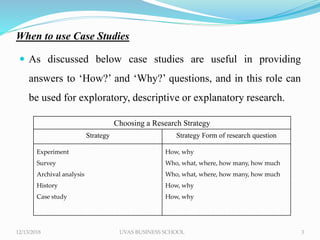
When to use Case Studies
 As discussed below case studies are useful in providing
answers to ‘How?’ and ‘Why?’ questions, and in this role can
be used for exploratory, descriptive or explanatory research.
12/13/2018 UVAS BUSINESS SCHOOL 3
Choosing a Research Strategy
Strategy Strategy Form of research question
Experiment
Survey
Archival analysis
History
Case study
How, why
Who, what, where, how many, how much
How, why
How, why
Importance of the Context in Case Study Research Designs
 A case study is a detailed investigation of one or more
organizations, or groups within organizations, conducted to
analyze the processes of a phenomenon within the context under
study. (Hartley, 1994)
 EXAMPLE:
 The explanation of the phenomenon (e.g., a closure) is done
within its context (e.g., the particular organization that is closing
down) and is of interest in relation to its context.
12/13/2018 UVAS BUSINESS SCHOOL 4
Usage of Theory in Case Study Research Design
 Case studies are used in management research to
generate theory or to Test existing theory
 The purpose of a case study is to find/ understand
How or Why Phenomena occur ?? And
Not to just identify the problem rather assessing
the condition surrounding the phenomena and
its casual linkage to its consequences.
(McCutcheon &Meredith, 1993)
12/13/2018 UVAS BUSINESS SCHOOL 5
Usage of Theory in Case Study Research Design
Theory Building
 Case studies often apply an inductive approach to
theory building, deriving it from detailed
observation of the situation.
 Without a theory, a case study would be little more
than a story about a unique situation. With a theory,
however, case studies can explain fundamental
organizational or other processes. (Hartley, 1994).
12/13/2018 UVAS BUSINESS SCHOOL 6
 A single instance is insufficient to support a theory, but a
positive finding encourages confidence in a theory’s
predictive power. (Sommer & Sommer, 1991)
 Therefore, case studies can be used to support, expand, or
raise doubts concerning existing theories, case studies
designed to determine ‘how’ or ‘why’ events occur, as
explanatory studies. (McCutcheon & Meredith, 1993) Yin (2003)
12/13/2018 UVAS BUSINESS SCHOOL 7
Usage of Theory in Case Study Research Design
Theory Building
RESEARCH METHODOLGY USED IN CS
(Eisenhardt, 1989; Yin, 2003)
12/13/2018 UVAS BUSINESS SCHOOL 8
RESEARCH METHODOLGY USED IN CS
Data Gathering Sources
 For clearing the picture and adequate understanding
researcher may gather data from
 Primary sources: such as direct observations or interviews of
people involved
 Secondary sources: such as documents or records
Examination of a single situation
Multiple case studies, several related situations
McCutcheon and Meredith (1993)
12/13/2018 UVAS BUSINESS SCHOOL 9
Primary & Secondary Data Sources
12/13/2018 UVAS BUSINESS SCHOOL 10
RESEARCH METHODOLGY USED IN CASE STUDY
Researcher choice
 The researcher may examine up to a dozen cases and may
carefully match pairs of cases. In this way, multiple case
studies permit both within-case and cross-case analysis.
(Yin, 2003).
 Alternatively, contrasts can be developed within a particular
case; for example, comparing groups or departments within a
case to explain the same phenomenon (Hartley, 1994).
12/13/2018 UVAS BUSINESS SCHOOL 11
Composition of Case Studies
12/13/2018 UVAS BUSINESS SCHOOL 12
Research
questions
These usually focus on ‘how’ and ‘why’ organizational
phenomena occur.
Theoretical
propositions
Theory is either induced from the case study
or tested. If tested, the tested theory should clarify specific
research questions.
Units of
analysis
In theory generation, one purpose of the study is to
determine most meaningful unit.
Logic &
Evaluation
linking data to these theoretical propositions and
evaluating these proposition.
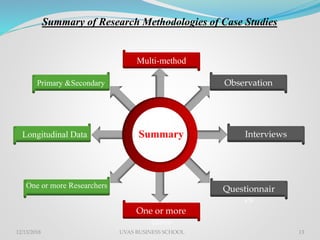
Multi-method
Interviews
One or more
cases
Longitudinal Data
Observation
One or more Researchers
Primary &Secondary
Questionnair
es
Summary
Summary of Research Methodologies of Case Studies
12/13/2018 UVAS BUSINESS SCHOOL 13
Data Collection References
 Hartley, 1994.
 Lee (1999)
 Yin, 2003.
 McCutcheon & Meredith, 1993.
 Sommer & Sommer, 1991
 Lectures of Sir Ammanullah
 www. Jstore.com
 Book published by Umme Sekran of Research Methodology
 Easton, G. (1992) Learning from case studies. 2nd edition, Hemel Hempstead:
Prentice Hall.
12/13/2018 UVAS BUSINESS SCHOOL 14
FEEL FREE TO RAISE ANY QUERY ………………………….
12/13/2018 UVAS BUSINESS SCHOOL 15

Case Study Research Design

  • 1.
    HAROON AKHTAR 2016-MPHILLMS-05 12/13/2018 UVASBUSINESS SCHOOL 1 Presented To» Dr. Sir Ammanulllah Presented By»
  • 2.
    PRESENTATIONOUTLINE  Case StudyResearch Design  Importance of the Context in Case Study Research Designs  Usage of Theory in Case Study Research Design  Theory Building  Research Methodology Used in Case Study  Data Gathering Sources  Primary Data Source  Secondary Data Source  Primary & Secondary Data Source Diagram  Composition of Case Study  Summary of Research Methodologies of Case Studies 12/13/2018 UVAS BUSINESS SCHOOL 2
  • 3.
    When to useCase Studies  As discussed below case studies are useful in providing answers to ‘How?’ and ‘Why?’ questions, and in this role can be used for exploratory, descriptive or explanatory research. 12/13/2018 UVAS BUSINESS SCHOOL 3 Choosing a Research Strategy Strategy Strategy Form of research question Experiment Survey Archival analysis History Case study How, why Who, what, where, how many, how much Who, what, where, how many, how much How, why How, why
  • 4.
    Importance of theContext in Case Study Research Designs  A case study is a detailed investigation of one or more organizations, or groups within organizations, conducted to analyze the processes of a phenomenon within the context under study. (Hartley, 1994)  EXAMPLE:  The explanation of the phenomenon (e.g., a closure) is done within its context (e.g., the particular organization that is closing down) and is of interest in relation to its context. 12/13/2018 UVAS BUSINESS SCHOOL 4
  • 5.
    Usage of Theoryin Case Study Research Design  Case studies are used in management research to generate theory or to Test existing theory  The purpose of a case study is to find/ understand How or Why Phenomena occur ?? And Not to just identify the problem rather assessing the condition surrounding the phenomena and its casual linkage to its consequences. (McCutcheon &Meredith, 1993) 12/13/2018 UVAS BUSINESS SCHOOL 5
  • 6.
    Usage of Theoryin Case Study Research Design Theory Building  Case studies often apply an inductive approach to theory building, deriving it from detailed observation of the situation.  Without a theory, a case study would be little more than a story about a unique situation. With a theory, however, case studies can explain fundamental organizational or other processes. (Hartley, 1994). 12/13/2018 UVAS BUSINESS SCHOOL 6
  • 7.
     A singleinstance is insufficient to support a theory, but a positive finding encourages confidence in a theory’s predictive power. (Sommer & Sommer, 1991)  Therefore, case studies can be used to support, expand, or raise doubts concerning existing theories, case studies designed to determine ‘how’ or ‘why’ events occur, as explanatory studies. (McCutcheon & Meredith, 1993) Yin (2003) 12/13/2018 UVAS BUSINESS SCHOOL 7 Usage of Theory in Case Study Research Design Theory Building
  • 8.
    RESEARCH METHODOLGY USEDIN CS (Eisenhardt, 1989; Yin, 2003) 12/13/2018 UVAS BUSINESS SCHOOL 8
  • 9.
    RESEARCH METHODOLGY USEDIN CS Data Gathering Sources  For clearing the picture and adequate understanding researcher may gather data from  Primary sources: such as direct observations or interviews of people involved  Secondary sources: such as documents or records Examination of a single situation Multiple case studies, several related situations McCutcheon and Meredith (1993) 12/13/2018 UVAS BUSINESS SCHOOL 9
  • 10.
    Primary & SecondaryData Sources 12/13/2018 UVAS BUSINESS SCHOOL 10
  • 11.
    RESEARCH METHODOLGY USEDIN CASE STUDY Researcher choice  The researcher may examine up to a dozen cases and may carefully match pairs of cases. In this way, multiple case studies permit both within-case and cross-case analysis. (Yin, 2003).  Alternatively, contrasts can be developed within a particular case; for example, comparing groups or departments within a case to explain the same phenomenon (Hartley, 1994). 12/13/2018 UVAS BUSINESS SCHOOL 11
  • 12.
    Composition of CaseStudies 12/13/2018 UVAS BUSINESS SCHOOL 12 Research questions These usually focus on ‘how’ and ‘why’ organizational phenomena occur. Theoretical propositions Theory is either induced from the case study or tested. If tested, the tested theory should clarify specific research questions. Units of analysis In theory generation, one purpose of the study is to determine most meaningful unit. Logic & Evaluation linking data to these theoretical propositions and evaluating these proposition.
  • 13.
    Multi-method Interviews One or more cases LongitudinalData Observation One or more Researchers Primary &Secondary Questionnair es Summary Summary of Research Methodologies of Case Studies 12/13/2018 UVAS BUSINESS SCHOOL 13
  • 14.
    Data Collection References Hartley, 1994.  Lee (1999)  Yin, 2003.  McCutcheon & Meredith, 1993.  Sommer & Sommer, 1991  Lectures of Sir Ammanullah  www. Jstore.com  Book published by Umme Sekran of Research Methodology  Easton, G. (1992) Learning from case studies. 2nd edition, Hemel Hempstead: Prentice Hall. 12/13/2018 UVAS BUSINESS SCHOOL 14
  • 15.
    FEEL FREE TORAISE ANY QUERY …………………………. 12/13/2018 UVAS BUSINESS SCHOOL 15

Editor's Notes

  • #16 You can remove this slide if you need. But we will strongly appreciate that you help us to spread the voice and let your colleagues and audience to download our free templates. Here are a free resources: Prepare your presentations: SlideHunter.com lets you download free templates for your presentations. Share online: SlideOnline.com lets you upload presentations for free.