exploratory research design
Prepared By
Rashida Hameed
EXPLORATORY RESEARCH DESIGN
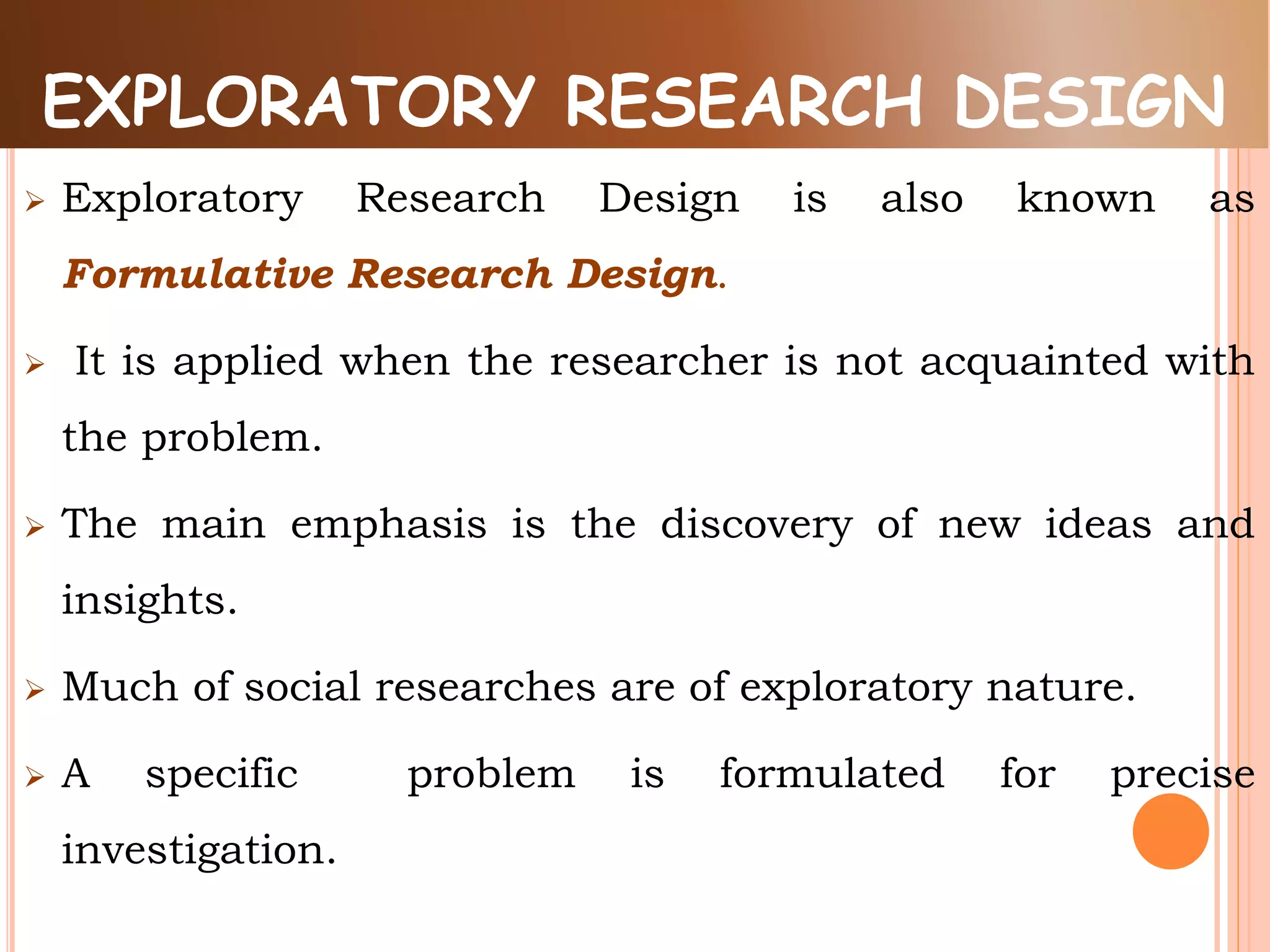
 Exploratory Research Design is also known as
Formulative Research Design.
 It is applied when the researcher is not acquainted with
the problem.
 The main emphasis is the discovery of new ideas and
insights.
 Much of social researches are of exploratory nature.
 A specific problem is formulated for precise
investigation.
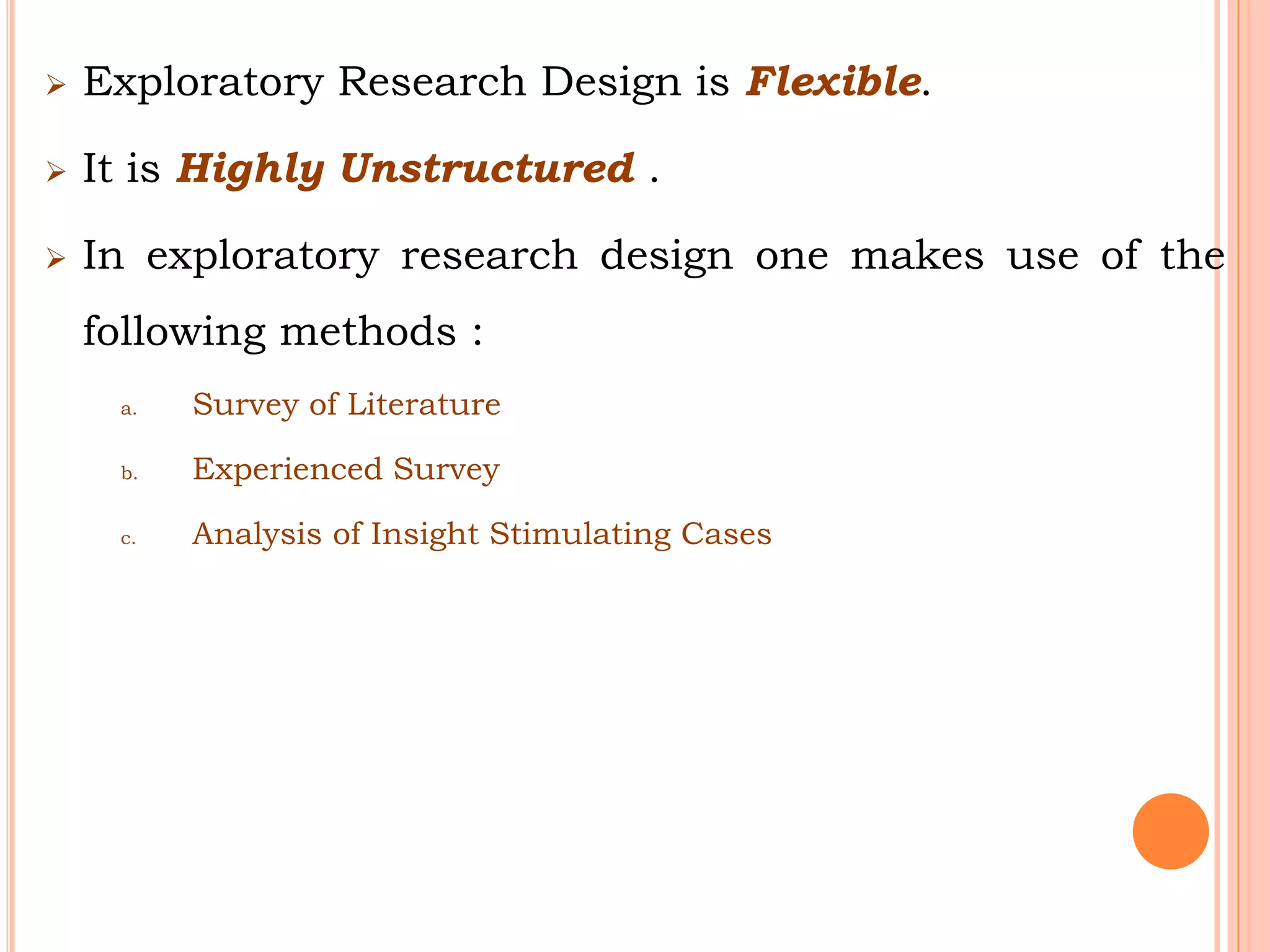
 Exploratory Research Design is Flexible.
 It is Highly Unstructured .
 In exploratory research design one makes use of the
following methods :
a. Survey of Literature
b. Experienced Survey
c. Analysis of Insight Stimulating Cases
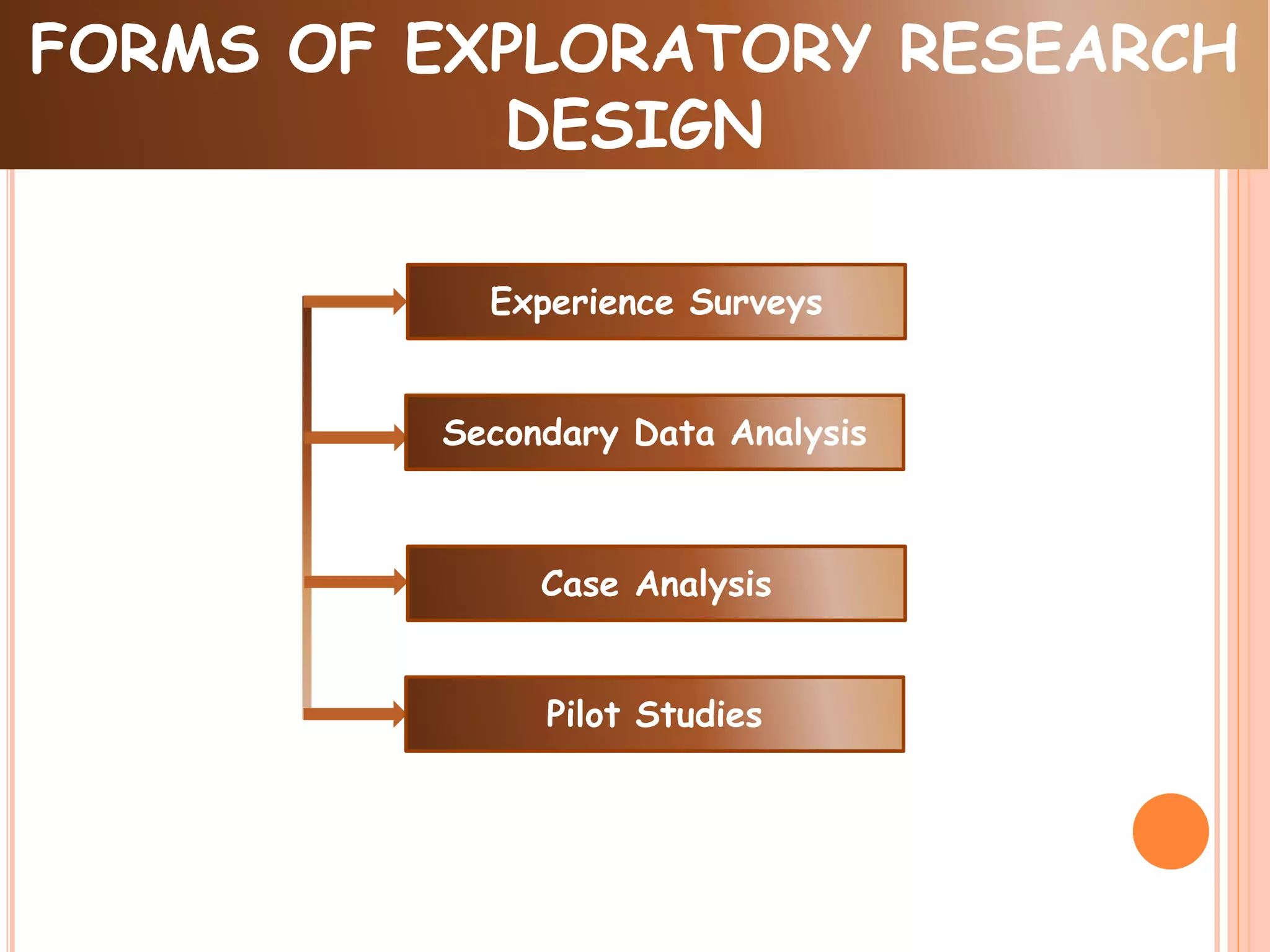
FORMS OF EXPLORATORY RESEARCH
DESIGN
Experience Surveys
Secondary Data Analysis
Case Analysis
Pilot Studies
EXPERIENCE SURVEYS
 Experience survey means the survey of people who have had
practical experience with the problem.
 It rarely include formal questionnaire, instead the researcher
may simply have a list of topics to be discussed.
 In an experience survey, should enquire their ideas about
important issues, and try to find out what is important.
 Helps in the formulation of hypothesis.
SECONDARY DATA ANALYSIS
 Secondary data is a type of data that has already been
collected in the past.
 Secondary data are in the form of finished products.
 Economic survey of the government of India, economic
reviews published by various state governments, census
data, data relating to agriculture, industry, forestry,
education, etc. by the government are the examples of
secondary data.
 Researcher has to modify such data for their
individual requirements.
 Secondary Data Analysis involves a researcher
using the information that someone else has
gathered for his or her own purposes.
 Secondary Data Analysis helps to define the
business research problem.
 Obtains information from one or a few situations that are
similar to the problem situation.
 This method is suitable for areas where there are few or no
experienced persons to provide necessary information for
development of insights and hypothesis for specific
research.
 This method consists of the intensive study of selected
instance of the phenomenon in which one is interested.
For this , existing records if any may be examined and the
unstructured interview may be conducted.
Case Analysis
 This method will be fruitful only if the attitude of
the researcher is seeking greater and greater
amount of knowledge rather than of testing specific
hypothesis.
 It is also referred as Case Histories.
 Case study is a powerful research methodology that
combines individual and group interviews with
record analysis and observation.
PILOT STUDIES
 It is the small scale preliminary study conducted before the
main research, in order to check the feasibility or to improve
the design of the research.
 Pilot studies are surveys using a limited number of
respondents and often employing less accurate sampling
techniques than are employed in large, quantitative research.
 Pilot Studies are used in different types of designs. - Within
the context of exploratory research it covers some part of the
research on a small scale. Major categories of pilot study
include focus group interviews, projective techniques, and
depth interviews.
Exploratory Research Design

Exploratory Research Design

  • 1.
  • 2.
    EXPLORATORY RESEARCH DESIGN Exploratory Research Design is also known as Formulative Research Design.  It is applied when the researcher is not acquainted with the problem.  The main emphasis is the discovery of new ideas and insights.  Much of social researches are of exploratory nature.  A specific problem is formulated for precise investigation.
  • 3.
     Exploratory ResearchDesign is Flexible.  It is Highly Unstructured .  In exploratory research design one makes use of the following methods : a. Survey of Literature b. Experienced Survey c. Analysis of Insight Stimulating Cases
  • 4.
    FORMS OF EXPLORATORYRESEARCH DESIGN Experience Surveys Secondary Data Analysis Case Analysis Pilot Studies
  • 5.
    EXPERIENCE SURVEYS  Experiencesurvey means the survey of people who have had practical experience with the problem.  It rarely include formal questionnaire, instead the researcher may simply have a list of topics to be discussed.  In an experience survey, should enquire their ideas about important issues, and try to find out what is important.  Helps in the formulation of hypothesis.
  • 6.
    SECONDARY DATA ANALYSIS Secondary data is a type of data that has already been collected in the past.  Secondary data are in the form of finished products.  Economic survey of the government of India, economic reviews published by various state governments, census data, data relating to agriculture, industry, forestry, education, etc. by the government are the examples of secondary data.
  • 7.
     Researcher hasto modify such data for their individual requirements.  Secondary Data Analysis involves a researcher using the information that someone else has gathered for his or her own purposes.  Secondary Data Analysis helps to define the business research problem.
  • 8.
     Obtains informationfrom one or a few situations that are similar to the problem situation.  This method is suitable for areas where there are few or no experienced persons to provide necessary information for development of insights and hypothesis for specific research.  This method consists of the intensive study of selected instance of the phenomenon in which one is interested. For this , existing records if any may be examined and the unstructured interview may be conducted. Case Analysis
  • 9.
     This methodwill be fruitful only if the attitude of the researcher is seeking greater and greater amount of knowledge rather than of testing specific hypothesis.  It is also referred as Case Histories.  Case study is a powerful research methodology that combines individual and group interviews with record analysis and observation.
  • 10.
    PILOT STUDIES  Itis the small scale preliminary study conducted before the main research, in order to check the feasibility or to improve the design of the research.  Pilot studies are surveys using a limited number of respondents and often employing less accurate sampling techniques than are employed in large, quantitative research.  Pilot Studies are used in different types of designs. - Within the context of exploratory research it covers some part of the research on a small scale. Major categories of pilot study include focus group interviews, projective techniques, and depth interviews.