Identifying an Empirical Research Article Veronica Bielat, Information Services Librarian, Wayne State University Library System Navaz Bhavnagri, PhD, Associate Professor, Wayne State University College of Education, Teacher Education Division September 2008
What is Empirical Research? Empirical means  experience  or data derived from  observation  or  experiment . Empirical research  articles  are published in scholarly, peer-reviewed (or refereed) journals. Most empirical research articles include the following five components:  Introduction and Literature Review Method Results Discussion or Conclusion References
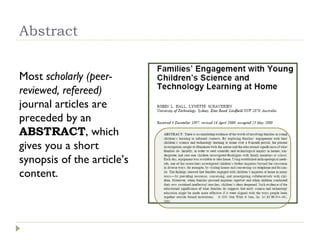
Abstract Most  scholarly (peer-reviewed, refereed)  journal articles are preceded by an  ABSTRACT , which gives you a short synopsis of the article’s content.
Look for  5 Introduction and Literature Review Method Results Conclusion References
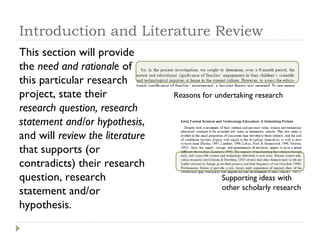
Introduction and Literature Review This section will provide the  need and rationale  of this particular research project, state their  research question, research statement and/or hypothesis , and will  review the literature  that supports (or contradicts) their research question, research statement and/or hypothesis. Supporting ideas with other scholarly research Reasons for undertaking research
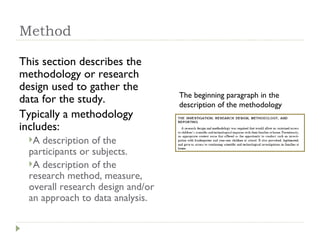
Method This section describes the methodology or research design used to gather the data for the study.  Typically a methodology includes: A description of the participants or subjects.  A description of the research method, measure, overall research design and/or an approach to data analysis. The beginning paragraph in the description of the methodology
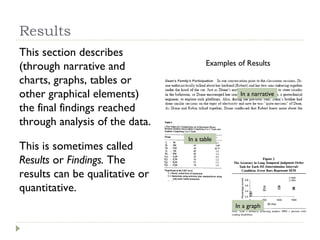
Results This section describes (through narrative and charts, graphs, tables or other graphical elements) the final findings reached through analysis of the data.  This is sometimes called  Results  or  Findings.  The results can be qualitative or quantitative. Examples of Results In a narrative In a table In a graph
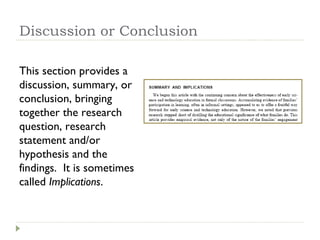
Discussion or Conclusion This section provides a discussion, summary, or conclusion, bringing together the research question, research statement and/or hypothesis and the findings.  It is sometimes called  Implications .
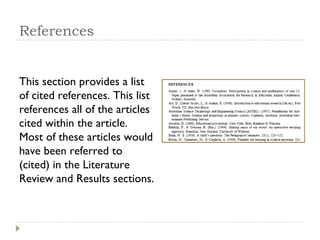
References This section provides a list of cited references. This list references all of the articles cited within the article. Most of these articles would have been referred to (cited) in the Literature Review and Results sections.

Identifying An Empirical Research Article

  • 1.
    Identifying an EmpiricalResearch Article Veronica Bielat, Information Services Librarian, Wayne State University Library System Navaz Bhavnagri, PhD, Associate Professor, Wayne State University College of Education, Teacher Education Division September 2008
  • 2.
    What is EmpiricalResearch? Empirical means experience or data derived from observation or experiment . Empirical research articles are published in scholarly, peer-reviewed (or refereed) journals. Most empirical research articles include the following five components: Introduction and Literature Review Method Results Discussion or Conclusion References
  • 3.
    Abstract Most scholarly (peer-reviewed, refereed) journal articles are preceded by an ABSTRACT , which gives you a short synopsis of the article’s content.
  • 4.
    Look for 5 Introduction and Literature Review Method Results Conclusion References
  • 5.
    Introduction and LiteratureReview This section will provide the need and rationale of this particular research project, state their research question, research statement and/or hypothesis , and will review the literature that supports (or contradicts) their research question, research statement and/or hypothesis. Supporting ideas with other scholarly research Reasons for undertaking research
  • 6.
    Method This sectiondescribes the methodology or research design used to gather the data for the study. Typically a methodology includes: A description of the participants or subjects. A description of the research method, measure, overall research design and/or an approach to data analysis. The beginning paragraph in the description of the methodology
  • 7.
    Results This sectiondescribes (through narrative and charts, graphs, tables or other graphical elements) the final findings reached through analysis of the data. This is sometimes called Results or Findings. The results can be qualitative or quantitative. Examples of Results In a narrative In a table In a graph
  • 8.
    Discussion or ConclusionThis section provides a discussion, summary, or conclusion, bringing together the research question, research statement and/or hypothesis and the findings. It is sometimes called Implications .
  • 9.
    References This sectionprovides a list of cited references. This list references all of the articles cited within the article. Most of these articles would have been referred to (cited) in the Literature Review and Results sections.