







ETHICS IN RESEARCH
Dr. Anuradha Sunil
Royal Dental College, Chalissery, Kerala,India
CONTENTS
ď‚› INTRODUCTION
ď‚› DEFINITION AND MEANING
ď‚› IMPORTANCE OF RESEARCH ETHICS
ď‚› GENERAL BASIC PRINCIPALS OF ETHICS
ď‚› AUTHORSHIP
ď‚› PLAGIARISM
ď‚› PEER REVIEW
ď‚› CONFLICTS OF INTERESTS
ď‚› RESEARCH WITH ANIMALS
ď‚› RESEARCH WITH HUMAN SUBJECTS
ď‚› RESEARCH MISCONDUCT
ď‚› RESEARCH ETHICS IN INDIA
ď‚› CONCLUSION
INTRODUCTION
ď‚›When most people think of ethics (or
morals) they think of rules for
distinguishing between right and wrong.
Most commonly “ethics” are: norms of
conduct that distinguish between
acceptable and unacceptable behavior.
DEFINITION AND MEANING
Ethics in research
It should be applied on all stages of research
such as planning, conducting and evaluating
a research project.
Thus research ethics educates and monitors a
scientist conducting a research to ensure high
ethical standards.
IMPORTANCE OF RESEARCH
ETHICS
ď‚› Promotes the aims of research (such as knowledge
,truth ,and avoidance of error)
ď‚› Promotes the values that are essential to
collaborative work (such as trust, accountability
,mutual respect ,and fairness)
ď‚› Help to ensure that researchers can be held
accountable to public
ď‚› Help to build public support for research (as people
more likely to fund research projects if they trust
the quality and integrity of research)
ď‚› Promotes moral and social values( such as social
responsibility, human rights , animal welfare etc.)
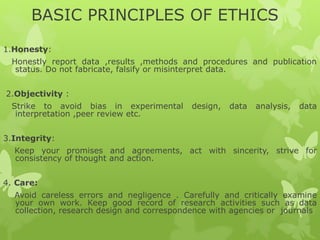
BASIC PRINCIPLES OF ETHICS
1.Honesty:
Honestly report data ,results ,methods and procedures and publication
status. Do not fabricate, falsify or misinterpret data.
2.Objectivity :
Strike to avoid bias in experimental design, data analysis, data
interpretation ,peer review etc.
3.Integrity:
Keep your promises and agreements, act with sincerity, strive for
consistency of thought and action.
4. Care:
Avoid careless errors and negligence . Carefully and critically examine
your own work. Keep good record of research activities such as data
collection, research design and correspondence with agencies or journals
5. Openness:
Share data, results, ideas, tools, resources
Be open to criticism and new ideas
6. Respect for intellectual property:
i) Honor patents, copyright and other forms of intellectual property.
ii) Do not use unpublished data , methods or results without permission
iii) Never plagiarise
7. Confidentiality:
Protect confidential communication such as paper or grants submitted for
publication, personnel records, trade or military secrets and patient records
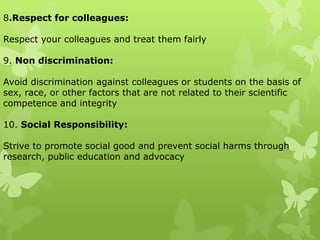
8.Respect for colleagues:
Respect your colleagues and treat them fairly
9. Non discrimination:
Avoid discrimination against colleagues or students on the basis of
sex, race, or other factors that are not related to their scientific
competence and integrity
10. Social Responsibility:
Strive to promote social good and prevent social harms through
research, public education and advocacy
AUTHORSHIP
Definition and importance:
Process of deciding who names belongs on a research paper in many
cases research evolves from collaboration and assistance between
experts and colleagues
It decides which colleagues should be listed as authors or co-authors and
which should receive acknowledgments
Ethical guidelines:-
Each person listed as an author on an articles should have significantly
contributed to both research and writing as well as must be prepared to
accept full responsibility for the content of research articles
Who can be co-author ?
i) Contributed substantially to the research
ii) Wrote or revised all or part of the manuscript.
iii) Approved the final version of the entire article
PLAGIARISM
Definition and importance:
Act of passing of somebody else ideas,
thoughts, pictures, theories, words or
stories as your own
If a researcher plagiarizes the work of
others they are bringing into question,
the integrity , ethics and trust
worthiness of some total of his or her
research.
Whether intentional or unintentional,
plagiarism is not tolerated by the
scientific community
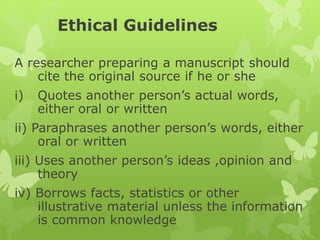
Ethical Guidelines
A researcher preparing a manuscript should
cite the original source if he or she
i) Quotes another person’s actual words,
either oral or written
ii) Paraphrases another person’s words, either
oral or written
iii) Uses another person’s ideas ,opinion and
theory
iv) Borrows facts, statistics or other
illustrative material unless the information
is common knowledge
PEER REVIEW
Definition and importance:-
ď‚› Process in which an author submits a written manuscript
or article to a journal for publication and journal editor
distributes the article to the experts
ď‚› experts- as reviewers
ď‚› editor- then enters the peer reviewed process.
PEER REVIEW PROCESS:
ď‚› Reviewers and editors read and evaluate the article
ď‚› Reviewers submit their reviews back to the journal editor
ď‚› Journal editor takes all comments including their own and
communicates back to the original author
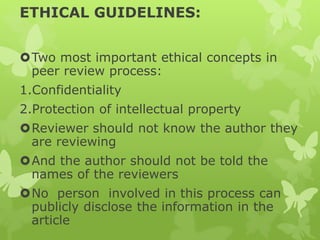
ETHICAL GUIDELINES:
ď‚›Two most important ethical concepts in
peer review process:
1.Confidentiality
2.Protection of intellectual property
ď‚›Reviewer should not know the author they
are reviewing
ď‚›And the author should not be told the
names of the reviewers
ď‚›No person involved in this process can
publicly disclose the information in the
article
REASEARCH WITH ANIMALS
Animals play a significant role in research
i) Used in testing new pharmaceuticals
ii) As teaching tools for medical students
iii) As experimental subjects for new
surgical procedures
* Research projects that use animals
have to be reviewed
ETHICAL GUIDELINES IN TREATMENT OF ANIMALS
ď‚› To ensure that animals intended for use in
research facilities or for exhibition
purposes or for use as pets are provided
human care and treatment
ď‚› To assure that humane treatment of
animals during transportation in
commerce
ď‚› To protect the owners of animals from
theft of their animals by preventing the
sale or use of animals which have been
stolen
RESEARCH WITH HUMAN SUBJECTS
Definition and importance :-
ď‚›The issues concerning research with
human subjects involves topics
ranging from voluntary participation
in research to fair selection and
justice. This variety makes the
topics surroundings research ethics
with human subject a challenging
one.
Respect for persons- Informed consent
Involves voluntary participation by subjects who understand
what participation entails
Research for persons- privacy confidentiality
People have right to protect themselves and information
gathered during research participation could harm a person by
violating their right to keep information about themselves about
private
Risk benefit and beneficence-
It means doing good.
Biomedical research strives to do good by studying disease and
health data to uncover information that may be used to help
others
ETHICAL GUIDELINES:
ď‚› Human subject must voluntarily consent to
research and be allowed to discontinue participation
at any time
ď‚› Research involving human subjects must be
valuable to society
ď‚› Research participant must be protected and safe
ď‚› Researches must avoid harm, injury and death of
research subjects and discontinue research.
ď‚› Research must be conducted by responsible and
qualified researchers
RESEARCH MISCONDUCT
Definition and importance:
ď‚›It is the process of identifying and
reporting unethical or unsound
research
ď‚›It is defined as fabrication,
falsification or plagiarism in
proposing, performing or reviewing
research or in reporting research
results
ď‚›Fabrication- making up data or results
and recording or reporting them
ď‚›Falsification- manipulating research
material, equipment or process or
changing, omitting data such that research
is not accurately represented in research
record
ď‚›Plagiarism- appropriation of another
persons ideas, process, results or words
without giving appropriate credit
ETHICAL GUIDELINES:
ď‚›When someone suspected of committing
research misconduct, the proper
procedure is to first launch an inquiry. If
the inquiry reveals a potential research
misconduct situation then
ď‚›Conduct a full scale investigation
Finally the institution uses the information
collected during full scale investigation to
make decision concerning the presence of
misconduct and its severity and what
appropriate corrective action should be
taken if needed.
RESEARCH ETHICS IN INDIA
ď‚› Mostly occurs locally
 ICMR released- “Ethical guidelines for biomedical
research” in 2000.
ď‚› CIOMS- Council for International Organization of
Medical Sciences laid down principles of biomedical
research
ď‚› Research involving human subjects is reviewed by
REC (Research/Institutional Ethics Committee) at the
institution in which the proposed research is
conducted
ď‚› If there is no REC at the institution a protocol can be
reviewed for ethical approval either by central ethic
committee of ICMR or research for national bioethics
committee
CONCLUSION
ď‚› Pellegrino, a well known biomedical ethicist
stated that
“When no one is watching, it is the
character of the investigator that
determines the moral quality or research
and if research integrity is problematic
we must start and end with the
investigator.
Thus,
All the basic principles of ethics are derived
from the concept that we as individuals
should treat others as we wish them to
treat us.
REFERENCES
ď‚› A guide to research ethics- University of Minnesota.
Centre for bio ethics 2003.
ď‚› Shamoo A.E. and Dunigan- Ethics and research,
Experimental Biology, 2000, New York.
ď‚› Resnik David B. National institute of Enviormental Health
Sciences
ď‚› www.niehs.nih.gov/research/resources/bioetics/whatis.cf
m.
Ethics in Research.ppt

Ethics in Research.ppt

  • 1.
    ETHICS IN RESEARCH Dr.Anuradha Sunil Royal Dental College, Chalissery, Kerala,India
  • 2.
    CONTENTS ď‚› INTRODUCTION ď‚› DEFINITIONAND MEANING ď‚› IMPORTANCE OF RESEARCH ETHICS ď‚› GENERAL BASIC PRINCIPALS OF ETHICS ď‚› AUTHORSHIP ď‚› PLAGIARISM ď‚› PEER REVIEW ď‚› CONFLICTS OF INTERESTS ď‚› RESEARCH WITH ANIMALS ď‚› RESEARCH WITH HUMAN SUBJECTS ď‚› RESEARCH MISCONDUCT ď‚› RESEARCH ETHICS IN INDIA ď‚› CONCLUSION
  • 3.
    INTRODUCTION When most peoplethink of ethics (or morals) they think of rules for distinguishing between right and wrong. Most commonly “ethics” are: norms of conduct that distinguish between acceptable and unacceptable behavior.
  • 4.
    DEFINITION AND MEANING Ethicsin research It should be applied on all stages of research such as planning, conducting and evaluating a research project. Thus research ethics educates and monitors a scientist conducting a research to ensure high ethical standards.
  • 5.
    IMPORTANCE OF RESEARCH ETHICS ď‚›Promotes the aims of research (such as knowledge ,truth ,and avoidance of error) ď‚› Promotes the values that are essential to collaborative work (such as trust, accountability ,mutual respect ,and fairness) ď‚› Help to ensure that researchers can be held accountable to public ď‚› Help to build public support for research (as people more likely to fund research projects if they trust the quality and integrity of research) ď‚› Promotes moral and social values( such as social responsibility, human rights , animal welfare etc.)
  • 6.
    BASIC PRINCIPLES OFETHICS 1.Honesty: Honestly report data ,results ,methods and procedures and publication status. Do not fabricate, falsify or misinterpret data. 2.Objectivity : Strike to avoid bias in experimental design, data analysis, data interpretation ,peer review etc. 3.Integrity: Keep your promises and agreements, act with sincerity, strive for consistency of thought and action. 4. Care: Avoid careless errors and negligence . Carefully and critically examine your own work. Keep good record of research activities such as data collection, research design and correspondence with agencies or journals
  • 7.
    5. Openness: Share data,results, ideas, tools, resources Be open to criticism and new ideas 6. Respect for intellectual property: i) Honor patents, copyright and other forms of intellectual property. ii) Do not use unpublished data , methods or results without permission iii) Never plagiarise 7. Confidentiality: Protect confidential communication such as paper or grants submitted for publication, personnel records, trade or military secrets and patient records
  • 8.
    8.Respect for colleagues: Respectyour colleagues and treat them fairly 9. Non discrimination: Avoid discrimination against colleagues or students on the basis of sex, race, or other factors that are not related to their scientific competence and integrity 10. Social Responsibility: Strive to promote social good and prevent social harms through research, public education and advocacy
  • 9.
    AUTHORSHIP Definition and importance: Processof deciding who names belongs on a research paper in many cases research evolves from collaboration and assistance between experts and colleagues It decides which colleagues should be listed as authors or co-authors and which should receive acknowledgments Ethical guidelines:- Each person listed as an author on an articles should have significantly contributed to both research and writing as well as must be prepared to accept full responsibility for the content of research articles Who can be co-author ? i) Contributed substantially to the research ii) Wrote or revised all or part of the manuscript. iii) Approved the final version of the entire article
  • 10.
    PLAGIARISM Definition and importance: Actof passing of somebody else ideas, thoughts, pictures, theories, words or stories as your own If a researcher plagiarizes the work of others they are bringing into question, the integrity , ethics and trust worthiness of some total of his or her research. Whether intentional or unintentional, plagiarism is not tolerated by the scientific community
  • 11.
    Ethical Guidelines A researcherpreparing a manuscript should cite the original source if he or she i) Quotes another person’s actual words, either oral or written ii) Paraphrases another person’s words, either oral or written iii) Uses another person’s ideas ,opinion and theory iv) Borrows facts, statistics or other illustrative material unless the information is common knowledge
  • 12.
    PEER REVIEW Definition andimportance:- ď‚› Process in which an author submits a written manuscript or article to a journal for publication and journal editor distributes the article to the experts ď‚› experts- as reviewers ď‚› editor- then enters the peer reviewed process.
  • 13.
    PEER REVIEW PROCESS: ď‚›Reviewers and editors read and evaluate the article ď‚› Reviewers submit their reviews back to the journal editor ď‚› Journal editor takes all comments including their own and communicates back to the original author
  • 14.
    ETHICAL GUIDELINES: ď‚›Two mostimportant ethical concepts in peer review process: 1.Confidentiality 2.Protection of intellectual property ď‚›Reviewer should not know the author they are reviewing ď‚›And the author should not be told the names of the reviewers ď‚›No person involved in this process can publicly disclose the information in the article
  • 15.
    REASEARCH WITH ANIMALS Animalsplay a significant role in research i) Used in testing new pharmaceuticals ii) As teaching tools for medical students iii) As experimental subjects for new surgical procedures * Research projects that use animals have to be reviewed
  • 16.
    ETHICAL GUIDELINES INTREATMENT OF ANIMALS ď‚› To ensure that animals intended for use in research facilities or for exhibition purposes or for use as pets are provided human care and treatment ď‚› To assure that humane treatment of animals during transportation in commerce ď‚› To protect the owners of animals from theft of their animals by preventing the sale or use of animals which have been stolen
  • 17.
    RESEARCH WITH HUMANSUBJECTS Definition and importance :- ď‚›The issues concerning research with human subjects involves topics ranging from voluntary participation in research to fair selection and justice. This variety makes the topics surroundings research ethics with human subject a challenging one.
  • 18.
    Respect for persons-Informed consent Involves voluntary participation by subjects who understand what participation entails Research for persons- privacy confidentiality People have right to protect themselves and information gathered during research participation could harm a person by violating their right to keep information about themselves about private Risk benefit and beneficence- It means doing good. Biomedical research strives to do good by studying disease and health data to uncover information that may be used to help others
  • 19.
    ETHICAL GUIDELINES: ď‚› Humansubject must voluntarily consent to research and be allowed to discontinue participation at any time ď‚› Research involving human subjects must be valuable to society ď‚› Research participant must be protected and safe ď‚› Researches must avoid harm, injury and death of research subjects and discontinue research. ď‚› Research must be conducted by responsible and qualified researchers
  • 20.
    RESEARCH MISCONDUCT Definition andimportance: ď‚›It is the process of identifying and reporting unethical or unsound research ď‚›It is defined as fabrication, falsification or plagiarism in proposing, performing or reviewing research or in reporting research results
  • 21.
    ď‚›Fabrication- making updata or results and recording or reporting them ď‚›Falsification- manipulating research material, equipment or process or changing, omitting data such that research is not accurately represented in research record ď‚›Plagiarism- appropriation of another persons ideas, process, results or words without giving appropriate credit
  • 22.
    ETHICAL GUIDELINES: ď‚›When someonesuspected of committing research misconduct, the proper procedure is to first launch an inquiry. If the inquiry reveals a potential research misconduct situation then ď‚›Conduct a full scale investigation Finally the institution uses the information collected during full scale investigation to make decision concerning the presence of misconduct and its severity and what appropriate corrective action should be taken if needed.
  • 23.
    RESEARCH ETHICS ININDIA  Mostly occurs locally  ICMR released- “Ethical guidelines for biomedical research” in 2000.  CIOMS- Council for International Organization of Medical Sciences laid down principles of biomedical research  Research involving human subjects is reviewed by REC (Research/Institutional Ethics Committee) at the institution in which the proposed research is conducted  If there is no REC at the institution a protocol can be reviewed for ethical approval either by central ethic committee of ICMR or research for national bioethics committee
  • 24.
    CONCLUSION  Pellegrino, awell known biomedical ethicist stated that “When no one is watching, it is the character of the investigator that determines the moral quality or research and if research integrity is problematic we must start and end with the investigator. Thus, All the basic principles of ethics are derived from the concept that we as individuals should treat others as we wish them to treat us.
  • 26.
    REFERENCES ď‚› A guideto research ethics- University of Minnesota. Centre for bio ethics 2003. ď‚› Shamoo A.E. and Dunigan- Ethics and research, Experimental Biology, 2000, New York. ď‚› Resnik David B. National institute of Enviormental Health Sciences ď‚› www.niehs.nih.gov/research/resources/bioetics/whatis.cf m.