The ‘Laundry’ can be defined as a place
where the washing & finishing of clothes
are carried out.
THE LAUNDRY
1 Dr Chef Sunil Kumar
TYPES OF LAUNDRY
Commercial laundry
On-premises laundry
2 Dr Chef Sunil Kumar
COMMERCIAL LAUNDRIES
 These are also known as off site laundry or
contracted laundries.
 These cater to hotel on a contract basis.
 Usually the soiled linen are laundered & delivered
back to the hotel within 24-48 hours.
3 Dr Chef Sunil Kumar
ON-PREMISES LAUNDARIES (OPL)
 These are also known as on-site laundry or in-
house laundry.
 It is the hotel’s own laundry situated on its
premises.
 It may be run by the management or managed on
a contract.
 Services are faster (maximum of 8 hours), hence
the stocks are reduced.
 There is better control, better supervisor, and
hence a long life for linen.
4 Dr Chef Sunil Kumar
PLANNING AN OPL
 Location
 Size
 Ventilation
 Equipment selection
 Labour
 Other cost
5 Dr Chef Sunil Kumar
Chemical
room
Steam
iron
sink
Dry cleaning
machine
Laundry
manager
room
Soiled
linen area
WM 1 WM 2 D 1 D 2
Wor
-
king
tabl
e
Shelves
Flat bed
iron
Calen
daring
machi
ne
LAYOUT OF AN OPL
6 Dr Chef Sunil Kumar
LAUNDRY EQUIPMENTS
 Washing machine
 Washer-cum-extracting machine
 Dry cleaning tumbler/ drying machine
 Flat bed pressure
 Steam iron
 Calendaring machine
 linen trolleys
 Working table
 Hangers
7 Dr Chef Sunil Kumar
LAUNDRY PROCESS
8 Dr Chef Sunil Kumar
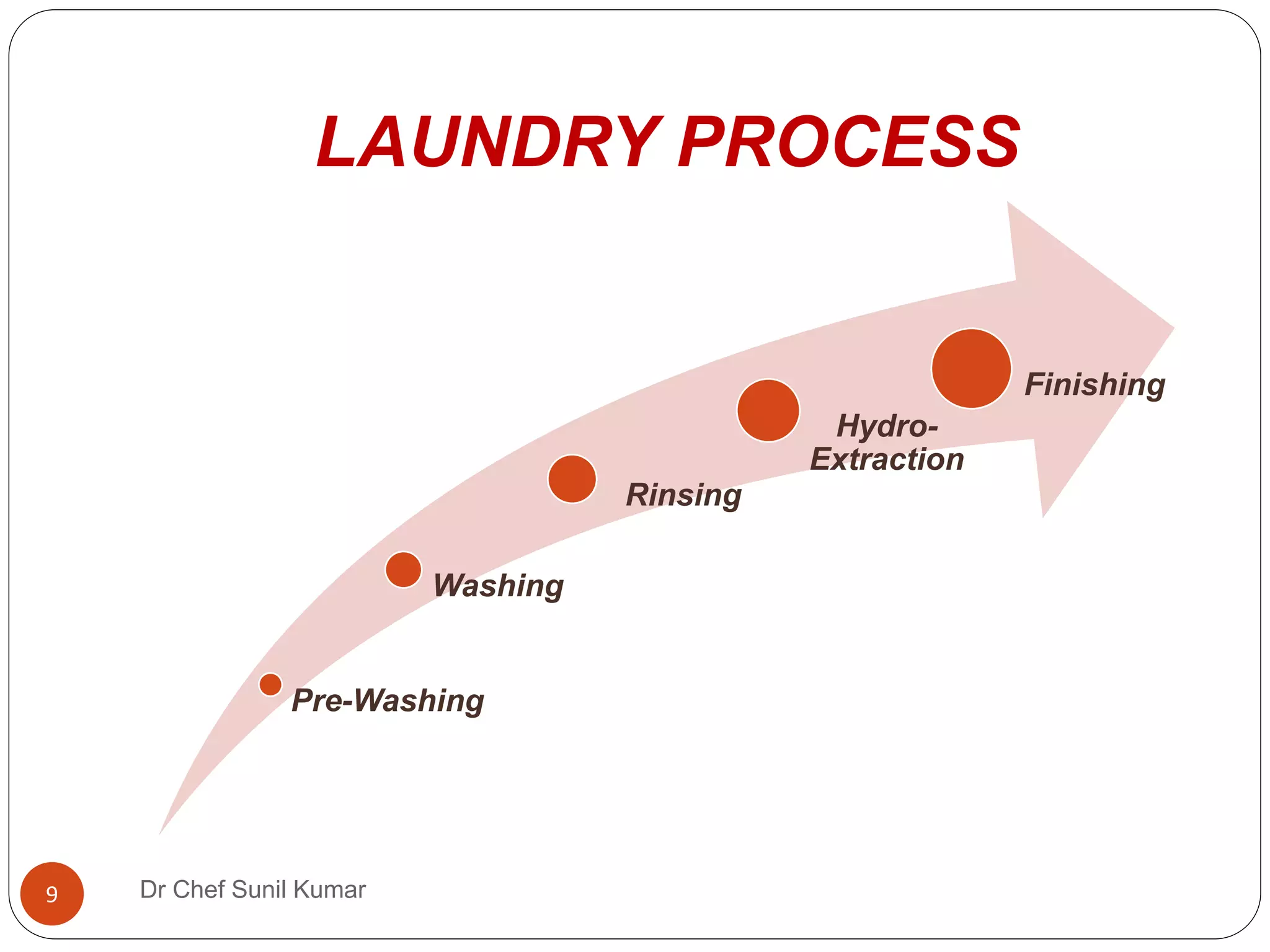
LAUNDRY PROCESS
Pre-Washing
Washing
Rinsing
Hydro-
Extraction
Finishing
9 Dr Chef Sunil Kumar
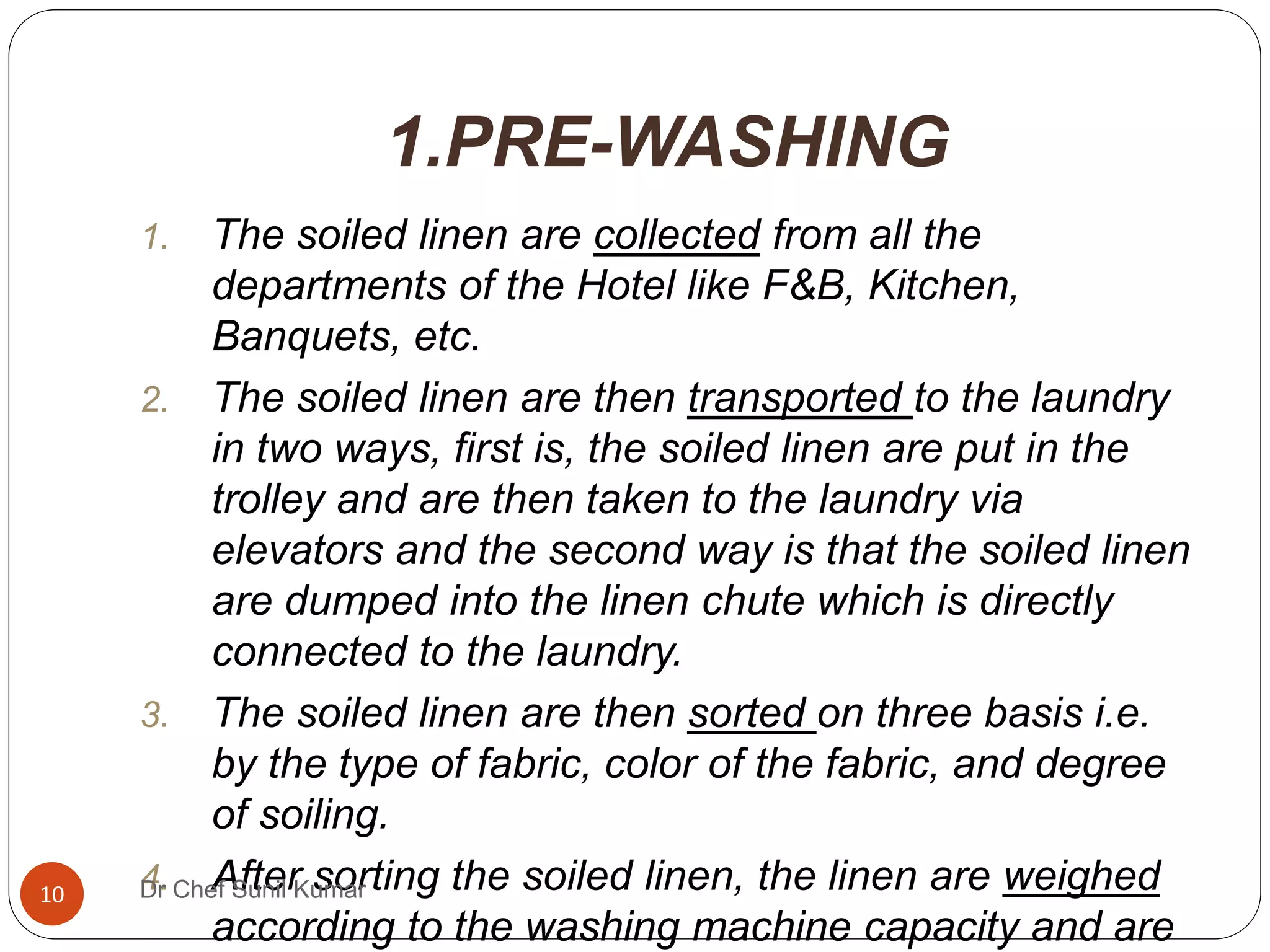
1.PRE-WASHING
1. The soiled linen are collected from all the
departments of the Hotel like F&B, Kitchen,
Banquets, etc.
2. The soiled linen are then transported to the laundry
in two ways, first is, the soiled linen are put in the
trolley and are then taken to the laundry via
elevators and the second way is that the soiled linen
are dumped into the linen chute which is directly
connected to the laundry.
3. The soiled linen are then sorted on three basis i.e.
by the type of fabric, color of the fabric, and degree
of soiling.
4. After sorting the soiled linen, the linen are weighed
according to the washing machine capacity and are
10 Dr Chef Sunil Kumar
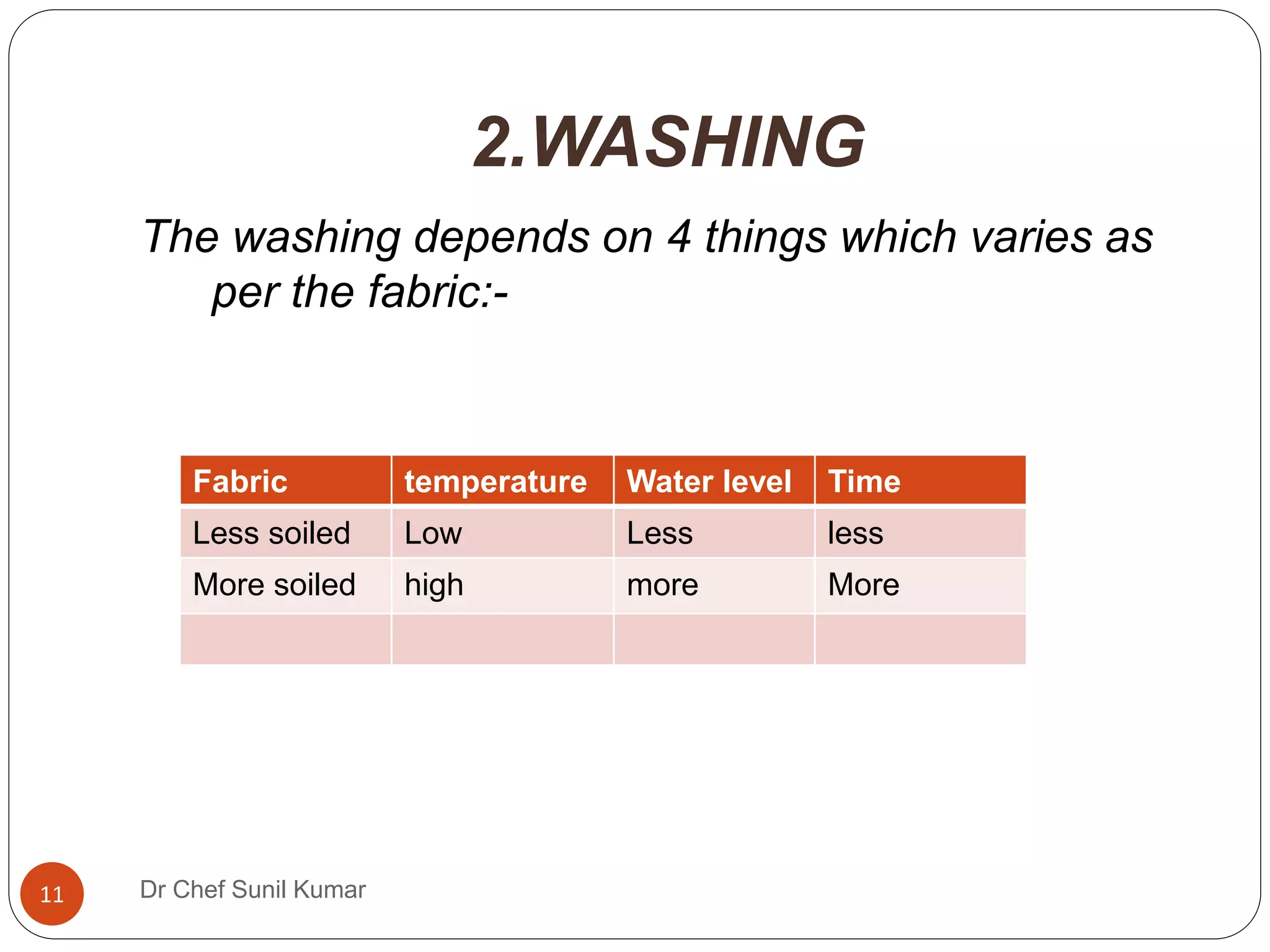
2.WASHING
The washing depends on 4 things which varies as
per the fabric:-
Fabric temperature Water level Time
Less soiled Low Less less
More soiled high more More
11 Dr Chef Sunil Kumar
This is done by using hot and cold water,
which are usually recovered 7 recycled
from earlier steps during the last rinse in
order to save water.
3.RINSING
12 Dr Chef Sunil Kumar
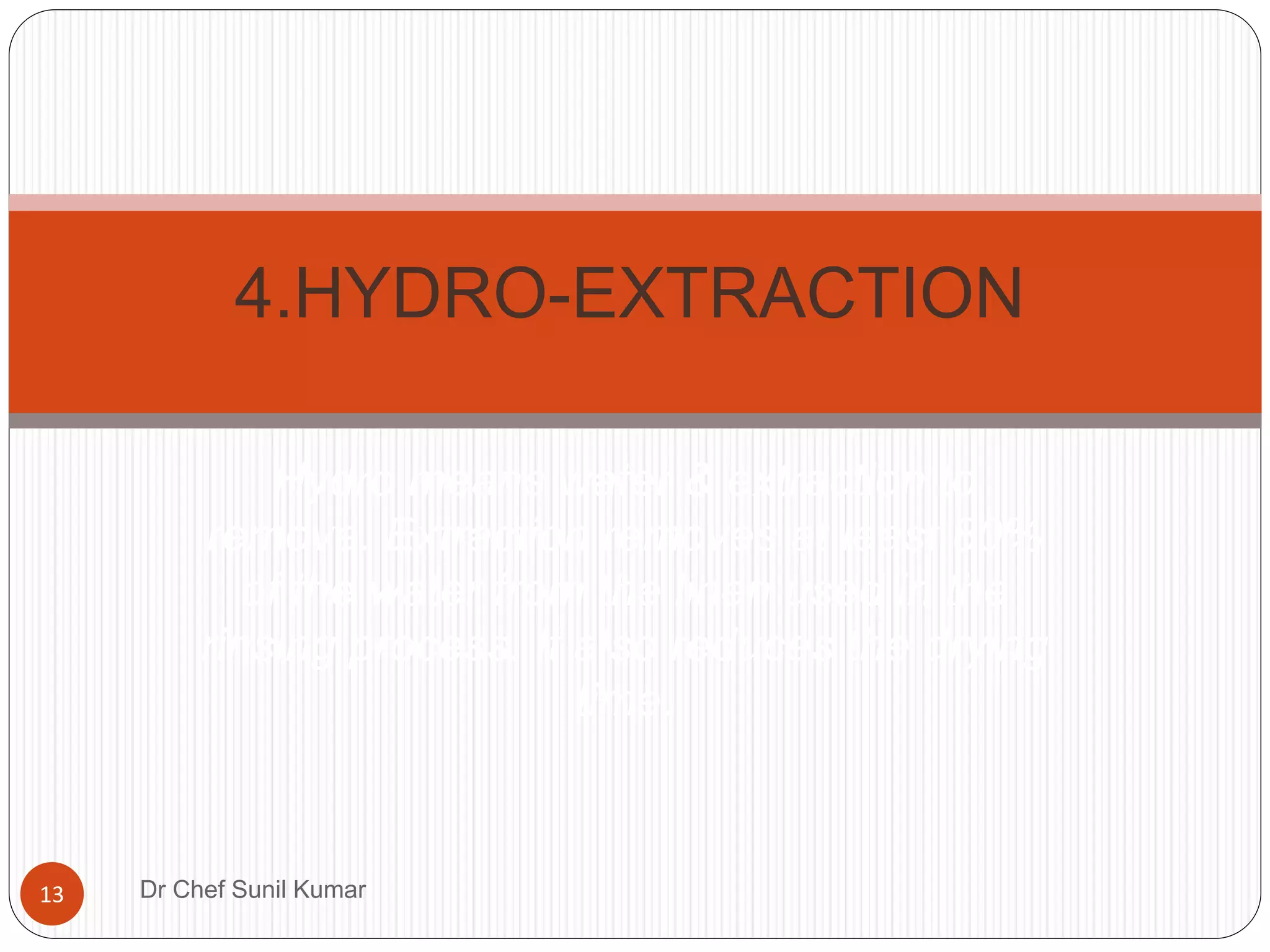
Hydro means water & extraction to
remove. Extraction removes at least 80%
of the water from the linen used in the
rinsing process. It also reduces the drying
time.
4.HYDRO-EXTRACTION
13 Dr Chef Sunil Kumar
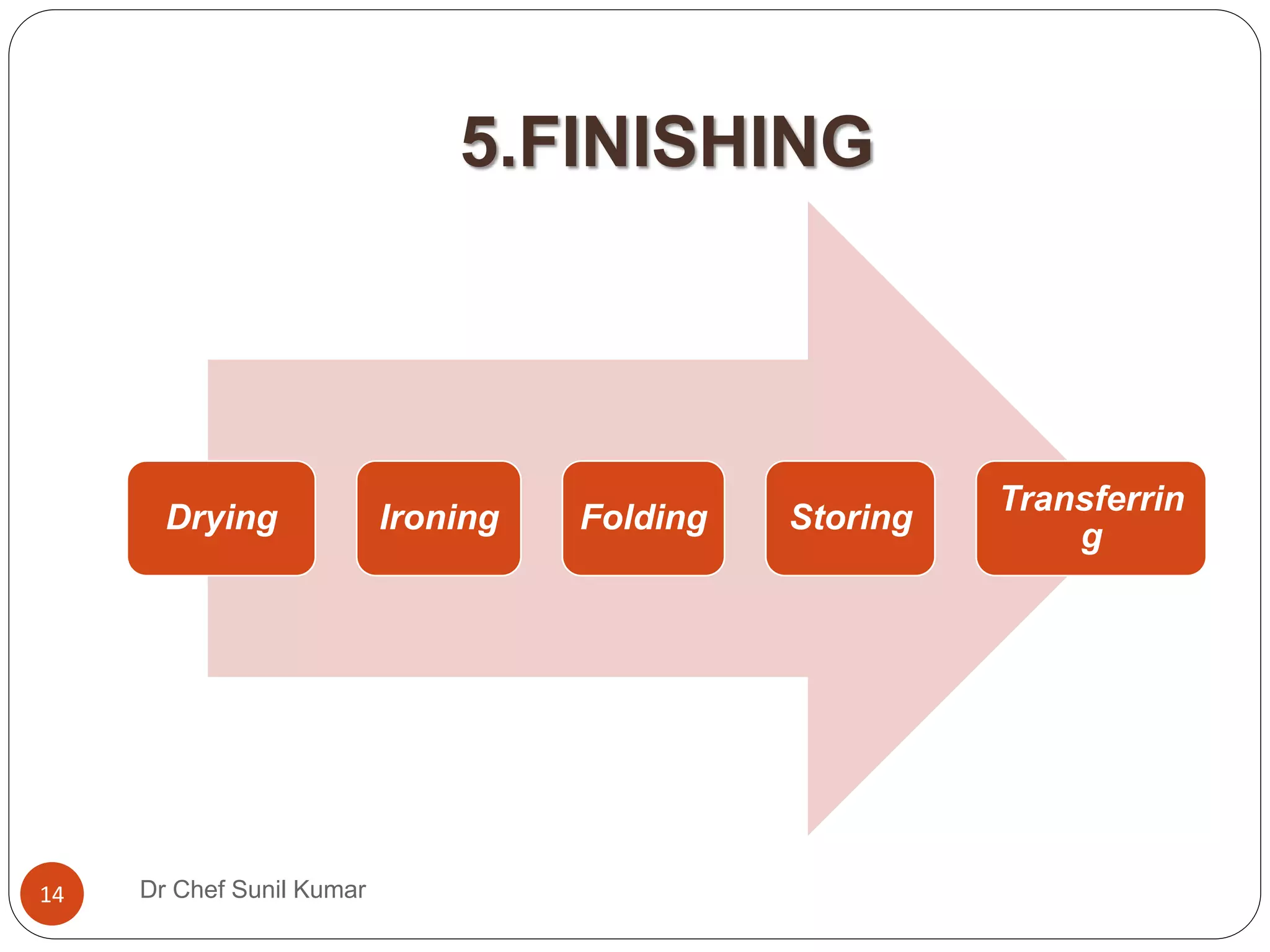
5.FINISHING
Drying Ironing Folding Storing
Transferrin
g
14 Dr Chef Sunil Kumar
WASH - CYCLE
15 Dr Chef Sunil Kumar
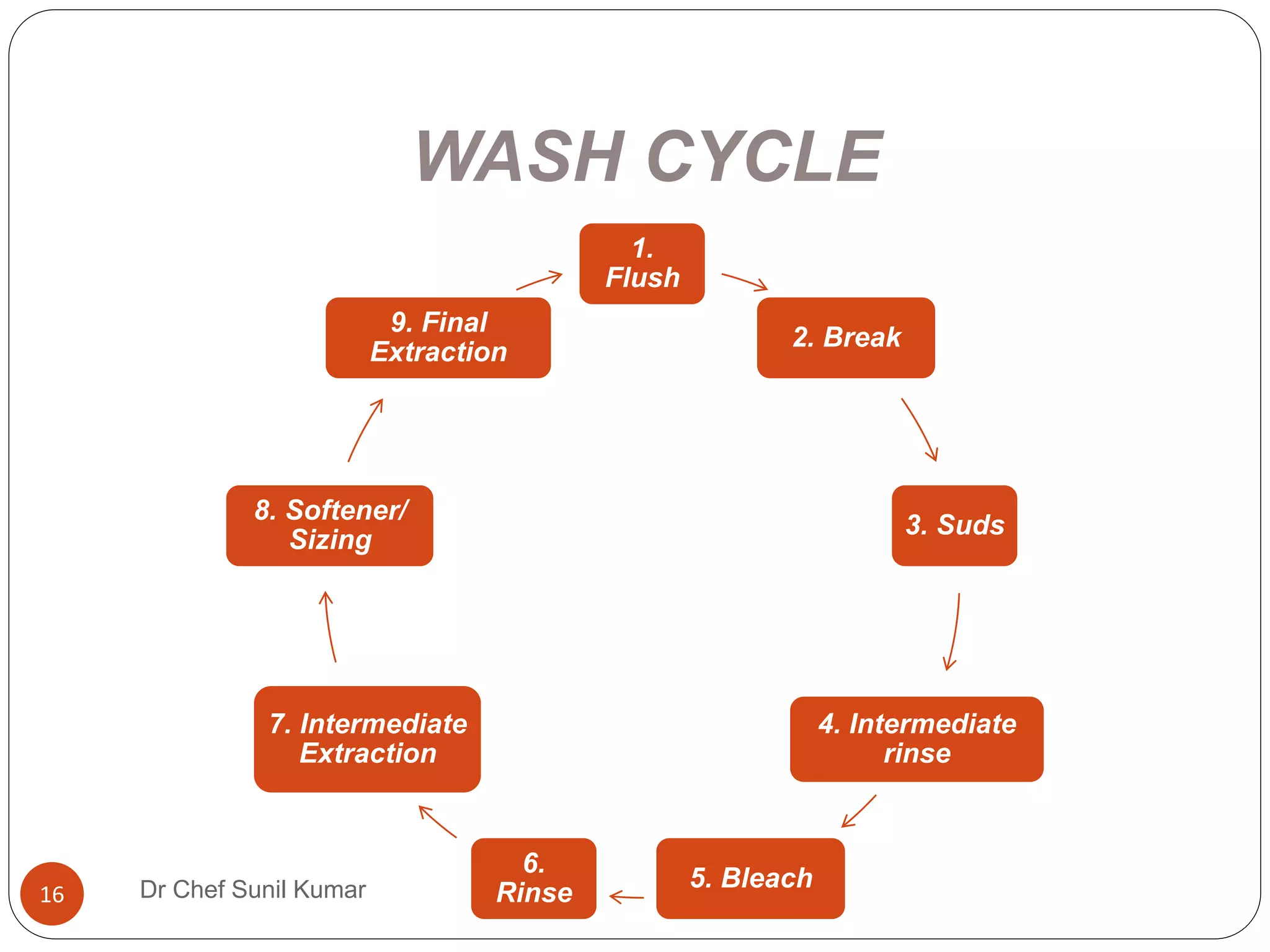
WASH CYCLE
1.
Flush
2. Break
3. Suds
4. Intermediate
rinse
5. Bleach
6.
Rinse
7. Intermediate
Extraction
8. Softener/
Sizing
9. Final
Extraction
16 Dr Chef Sunil Kumar
In this process, the washing machine
automatically sucks the high level of water in
which the soiled linen are added at medium
temperature to reduce the soil load for the
upcoming suds flushes.
FLUSH
17 Dr Chef Sunil Kumar
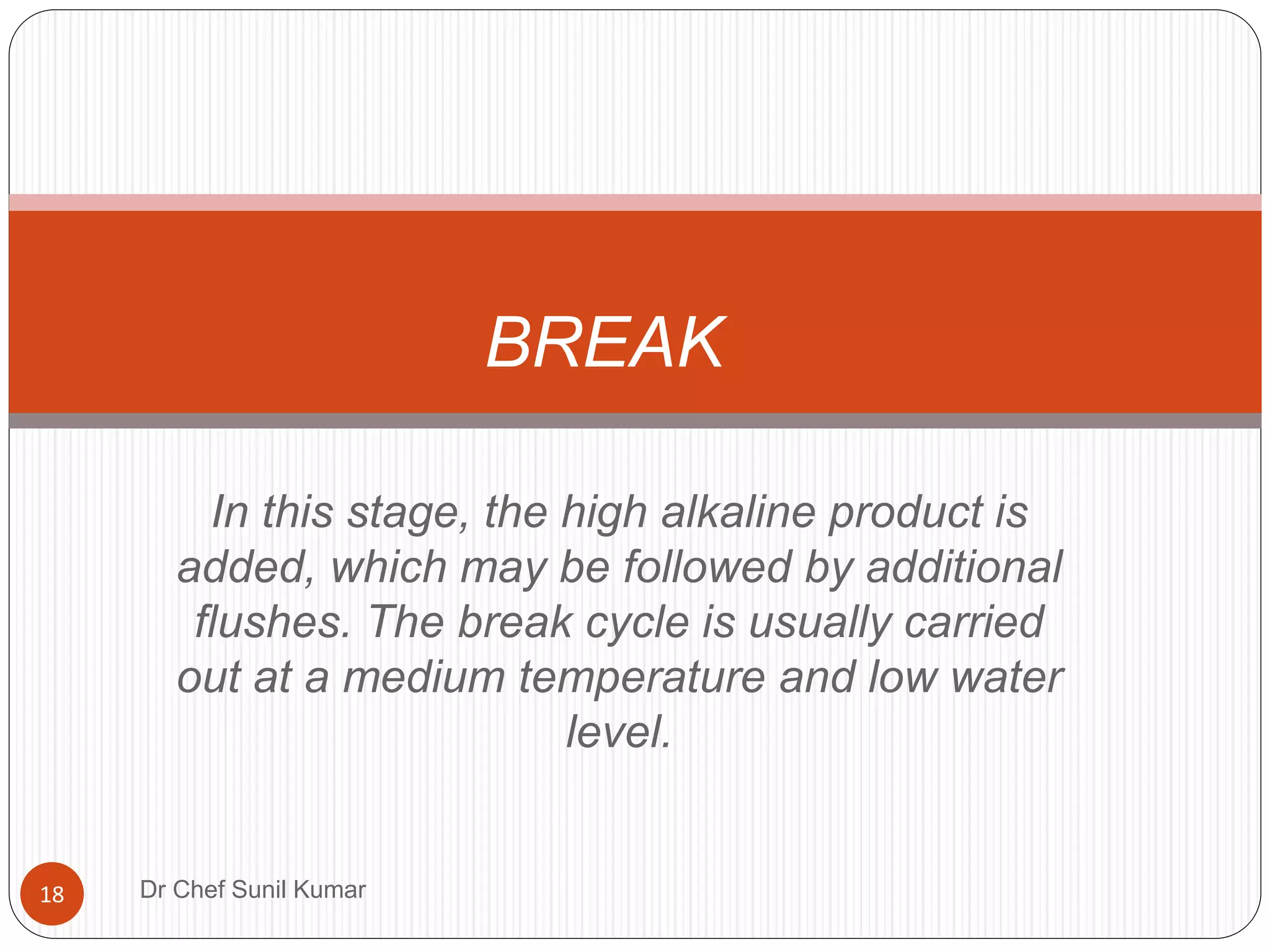
In this stage, the high alkaline product is
added, which may be followed by additional
flushes. The break cycle is usually carried
out at a medium temperature and low water
level.
BREAK
18 Dr Chef Sunil Kumar
This is the actual wash cycle in which acid
part of the hoppers is sucked by the
machine. It takes place in hot water at low
water level.
SUDS
19 Dr Chef Sunil Kumar
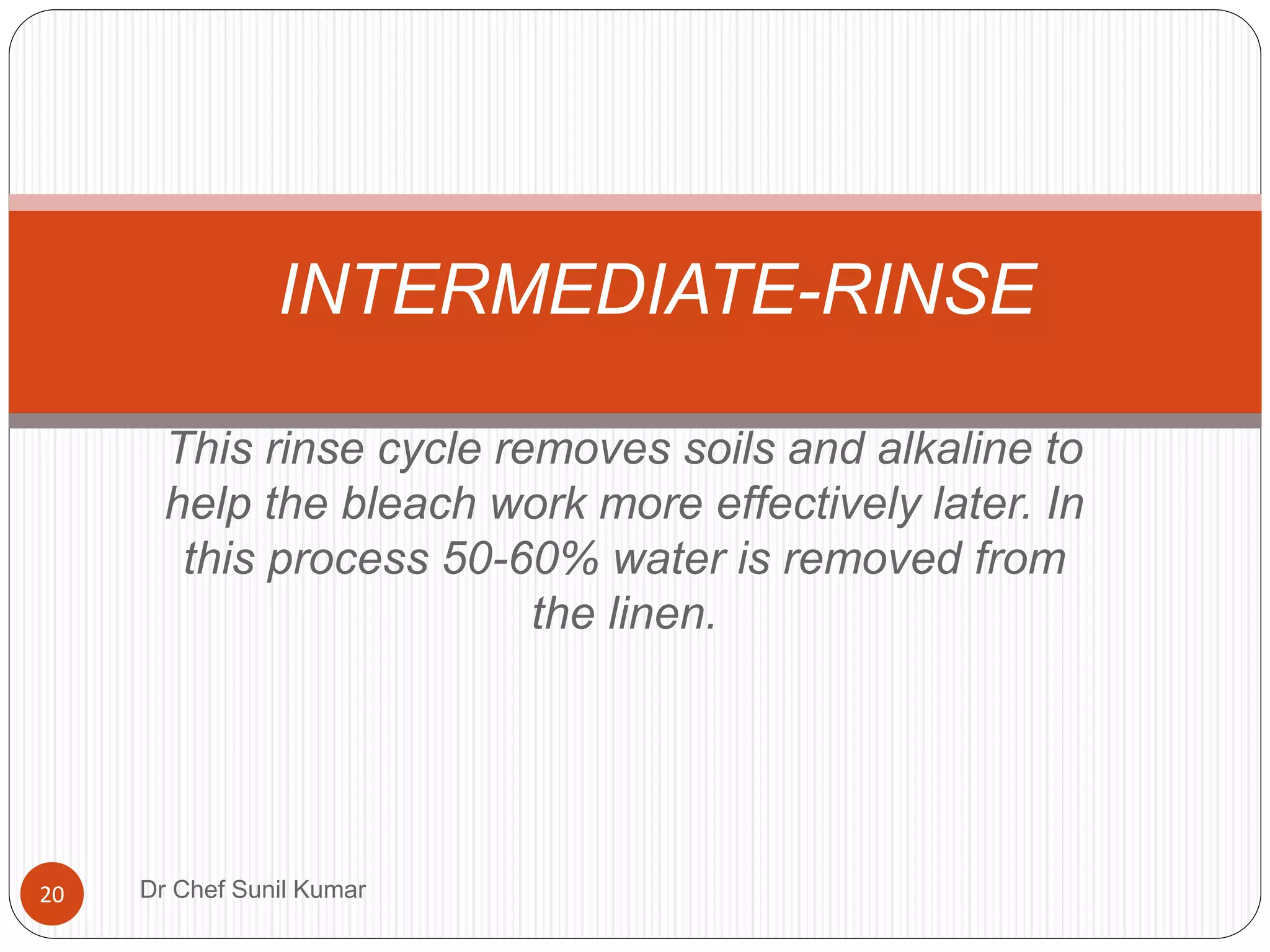
This rinse cycle removes soils and alkaline to
help the bleach work more effectively later. In
this process 50-60% water is removed from
the linen.
INTERMEDIATE-RINSE
20 Dr Chef Sunil Kumar
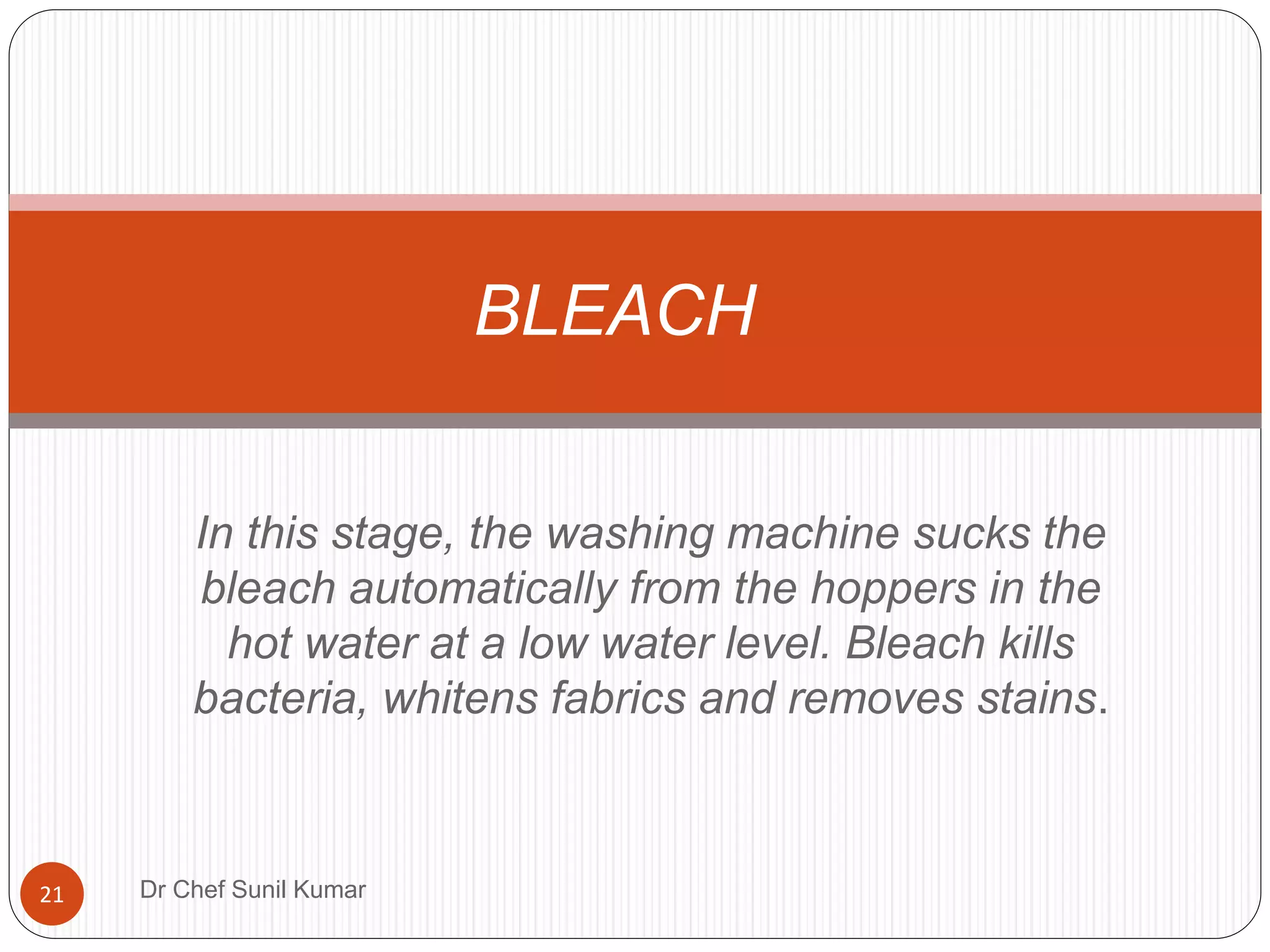
In this stage, the washing machine sucks the
bleach automatically from the hoppers in the
hot water at a low water level. Bleach kills
bacteria, whitens fabrics and removes stains.
BLEACH
21 Dr Chef Sunil Kumar
The washing machine sucks the high level of
water and remove detergent and soils from
the linen.
RINSE
22 Dr Chef Sunil Kumar
This high speed spin removes left over detergent
and soil from the linen, usually after the first rinse
step. It removes 70% of water from the linen. The
washing machine spins at 200 RPM.
INTERMEDIATE-EXTRACT
23 Dr Chef Sunil Kumar
Softener and sours are added to condition
fabric. This cycle is run at a medium
temperature and at low water level. Starches
are added to stiffen cotton fabrics. Sizing
may also replace the sour/softener step.
SOFTENER/SIZING
24 Dr Chef Sunil Kumar
A high speed spin removes most of the
moisture from the linen. The length of the
spin depends on the fabric type, extractor
capacity, and extractor spend. Around 95%
of water is removed in this stage.
FINAL EXTRACT
25 Dr Chef Sunil Kumar
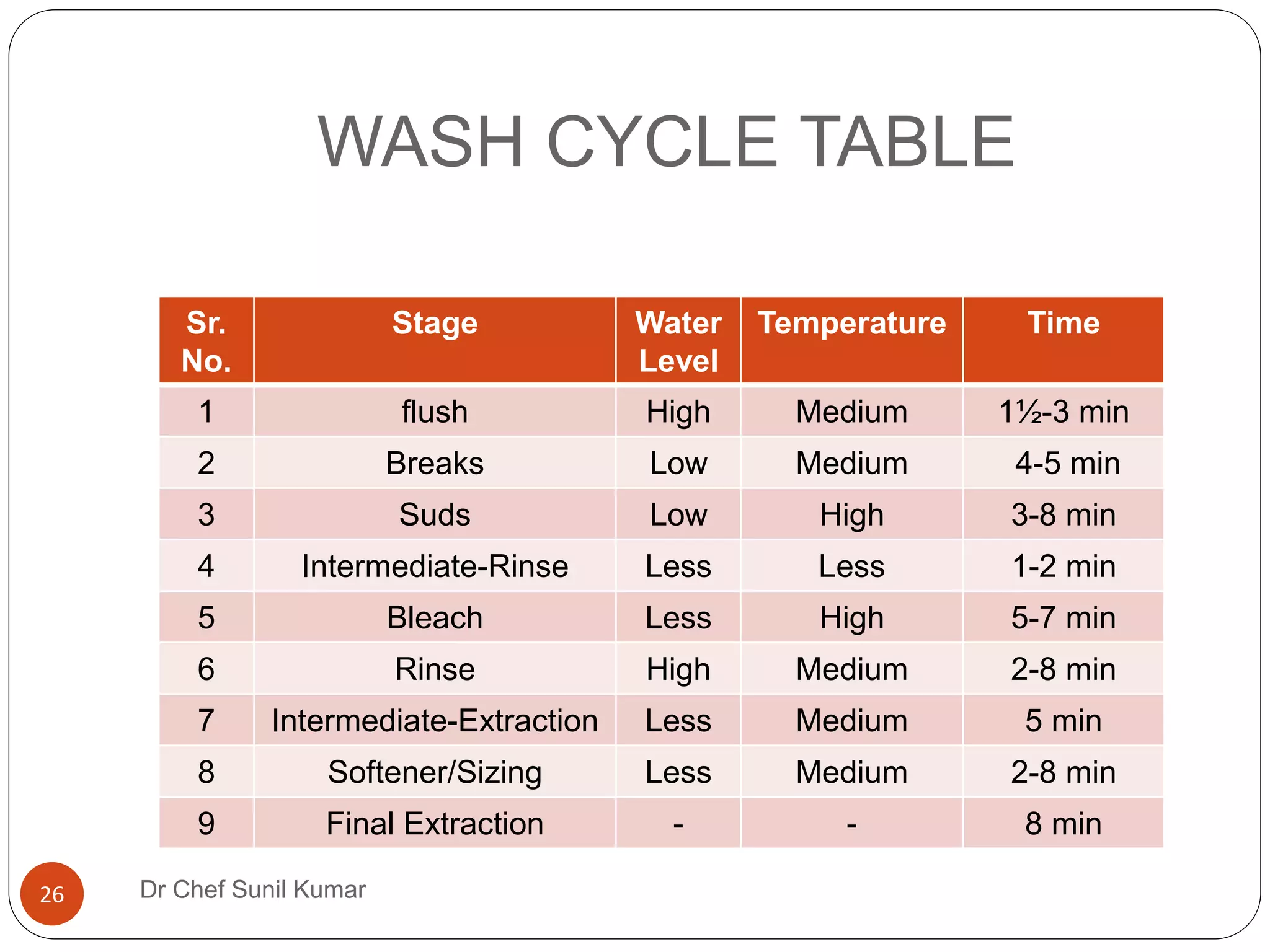
WASH CYCLE TABLE
Sr.
No.
Stage Water
Level
Temperature Time
1 flush High Medium 1½-3 min
2 Breaks Low Medium 4-5 min
3 Suds Low High 3-8 min
4 Intermediate-Rinse Less Less 1-2 min
5 Bleach Less High 5-7 min
6 Rinse High Medium 2-8 min
7 Intermediate-Extraction Less Medium 5 min
8 Softener/Sizing Less Medium 2-8 min
9 Final Extraction - - 8 min
26 Dr Chef Sunil Kumar
DRY CLEANING
27 Dr Chef Sunil Kumar
DRY CLEANING
 This is the cleaning of fabrics in substantially non-
aqueous liquid medium.
 Dry cleaning removes oils as well as many water soluble
& some insoluble materials with the help of detergents &
various other agents.
 It is done by using dry powder, liquid such as petrol,
benzene, & so on.
 Unlike laundry, dry cleaning does not cause swelling of
the fibers, & so does not lead to shrinkage , wrinkle, &
bleeding of color of the fabric and thus it is a safe method
for cleaning delicate textiles.
 It was earlier known as ‘French Cleaning’ or ‘Chemical
Cleaning’.
28 Dr Chef Sunil Kumar
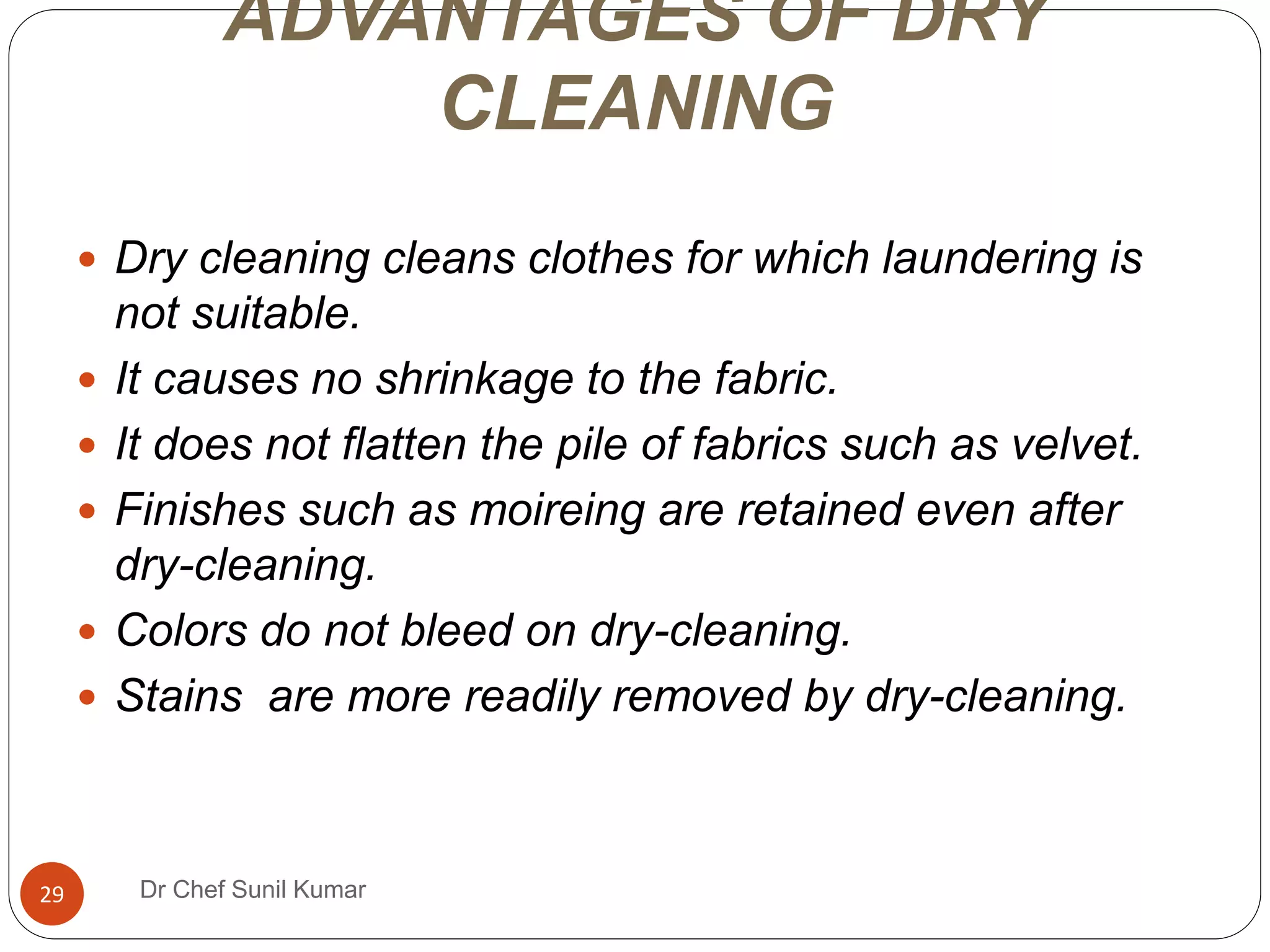
ADVANTAGES OF DRY
CLEANING
 Dry cleaning cleans clothes for which laundering is
not suitable.
 It causes no shrinkage to the fabric.
 It does not flatten the pile of fabrics such as velvet.
 Finishes such as moireing are retained even after
dry-cleaning.
 Colors do not bleed on dry-cleaning.
 Stains are more readily removed by dry-cleaning.
29 Dr Chef Sunil Kumar
DISADVANTAGES OF DRY-
CLEANING
 Dry-cleaning is expensive as compare to the
laundering.
 Many dry-cleaning solvents are harmful to health if
inhaled for long duration.
 After cleaning with solvents, a certain unpleasant
smell tends to be retained by the articles.
30 Dr Chef Sunil Kumar
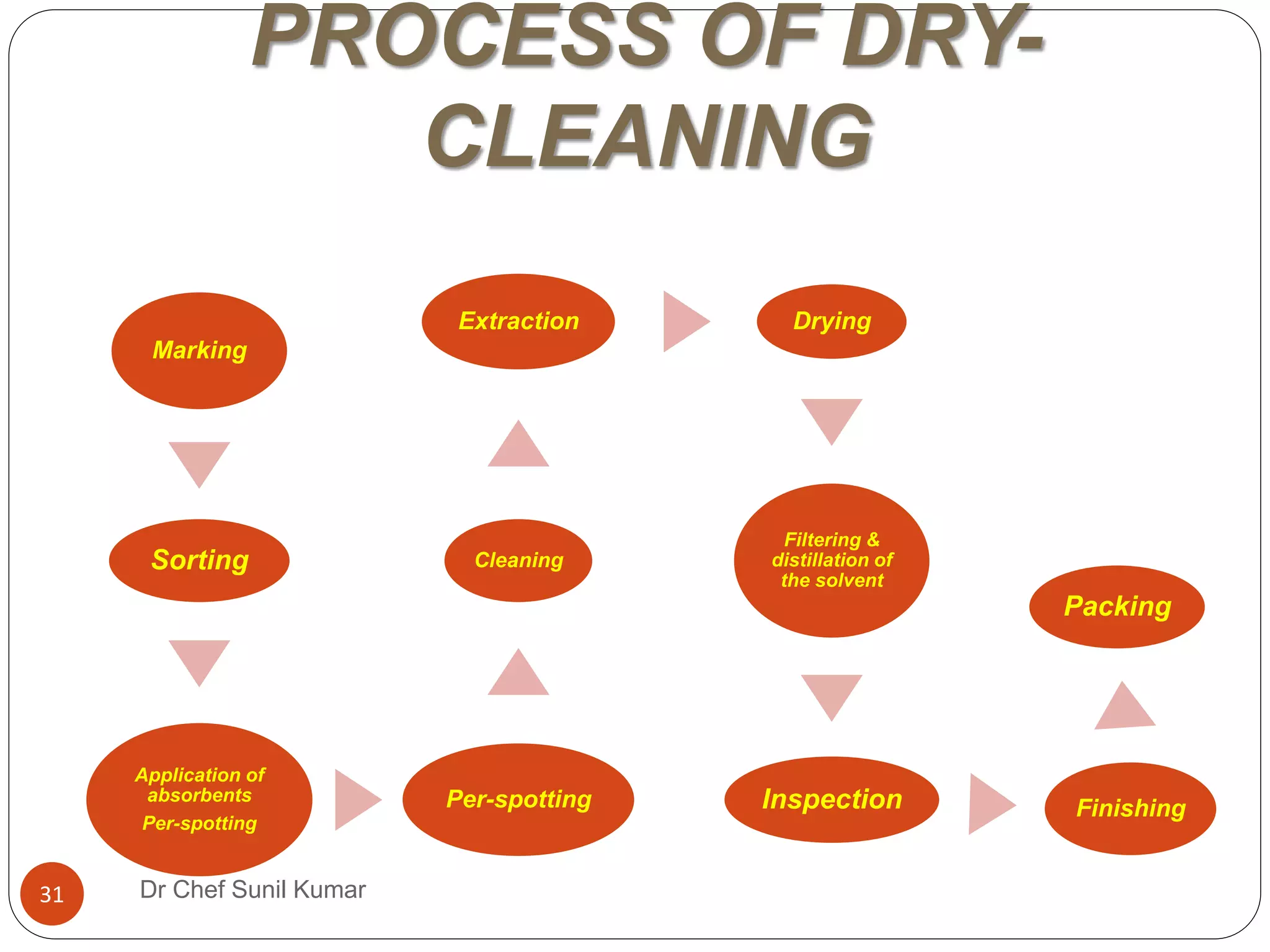
PROCESS OF DRY-
CLEANING
Marking
Sorting
Application of
absorbents
Per-spotting
Per-spotting
Cleaning
Extraction Drying
Filtering &
distillation of
the solvent
Inspection Finishing
Packing
31 Dr Chef Sunil Kumar
When soiled linen garments are delivered for dry-
cleaning, they are first sent to the marking areas.
Here, a piece of white fabric with a number or some
other code stamped on it with indelible marking ink
is securely attached to the garments. Every article is
marked individually to facilitate identification.
MARKING
32 Dr Chef Sunil Kumar
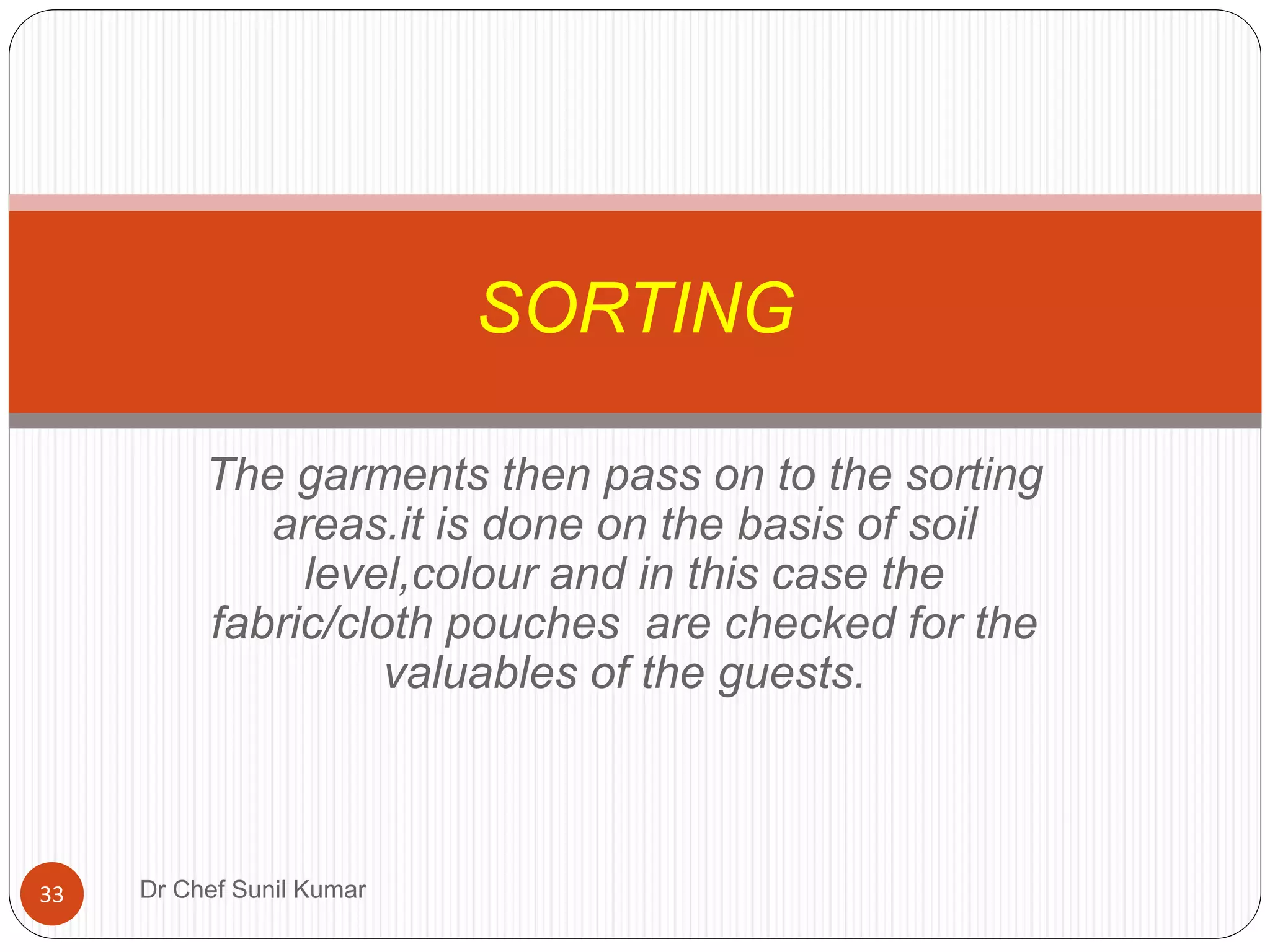
The garments then pass on to the sorting
areas.it is done on the basis of soil
level,colour and in this case the
fabric/cloth pouches are checked for the
valuables of the guests.
SORTING
33 Dr Chef Sunil Kumar
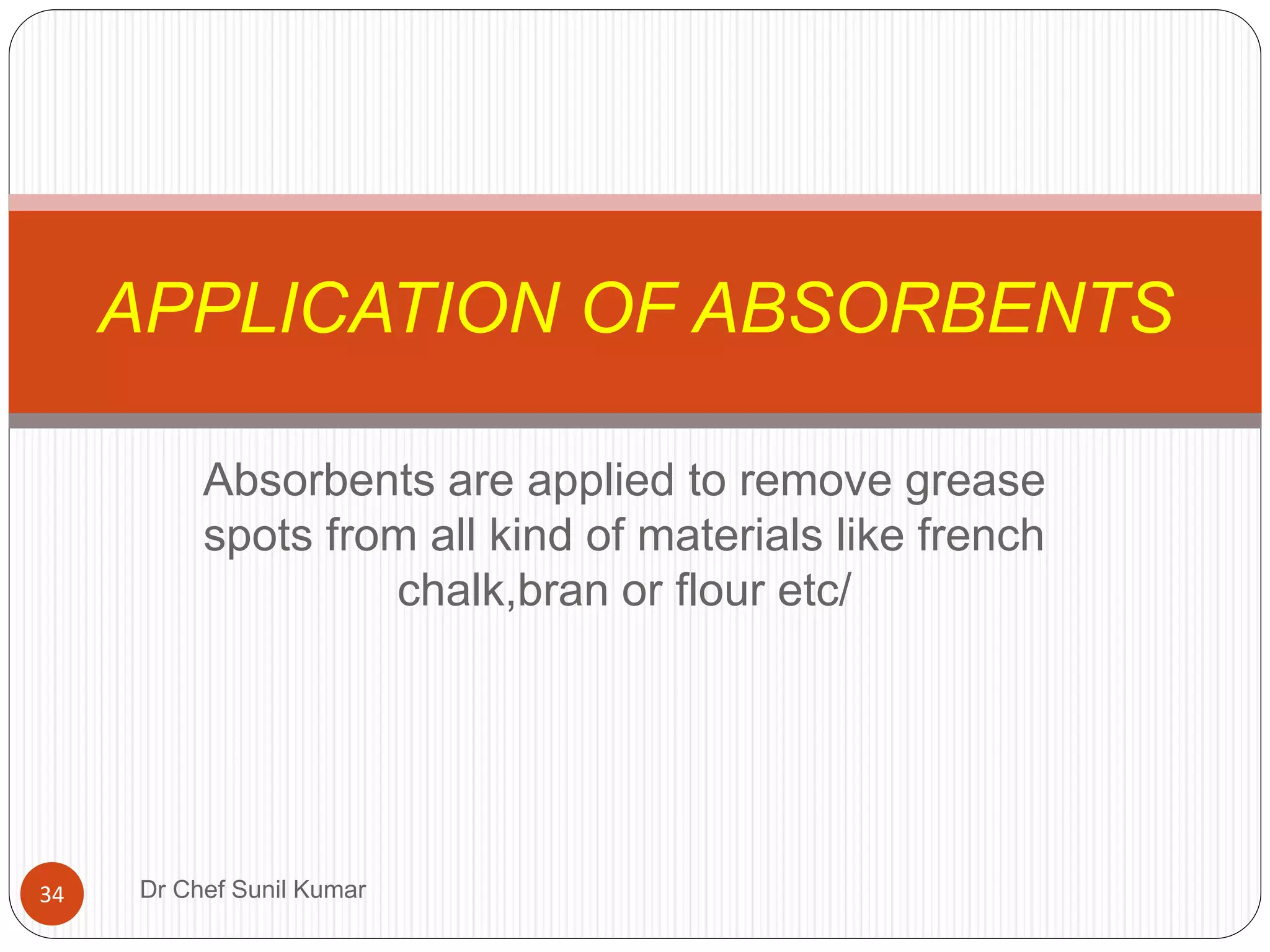
Absorbents are applied to remove grease
spots from all kind of materials like french
chalk,bran or flour etc/
APPLICATION OF ABSORBENTS
34 Dr Chef Sunil Kumar
Heavily soiled areas of the garments are
treated with solvents. Volatile dry solvents
such as amyl acetate to remove oil-borne
stains, while non-volatile solvents are used on
paint and varnish stains.
PRE-SPOTTING
35 Dr Chef Sunil Kumar
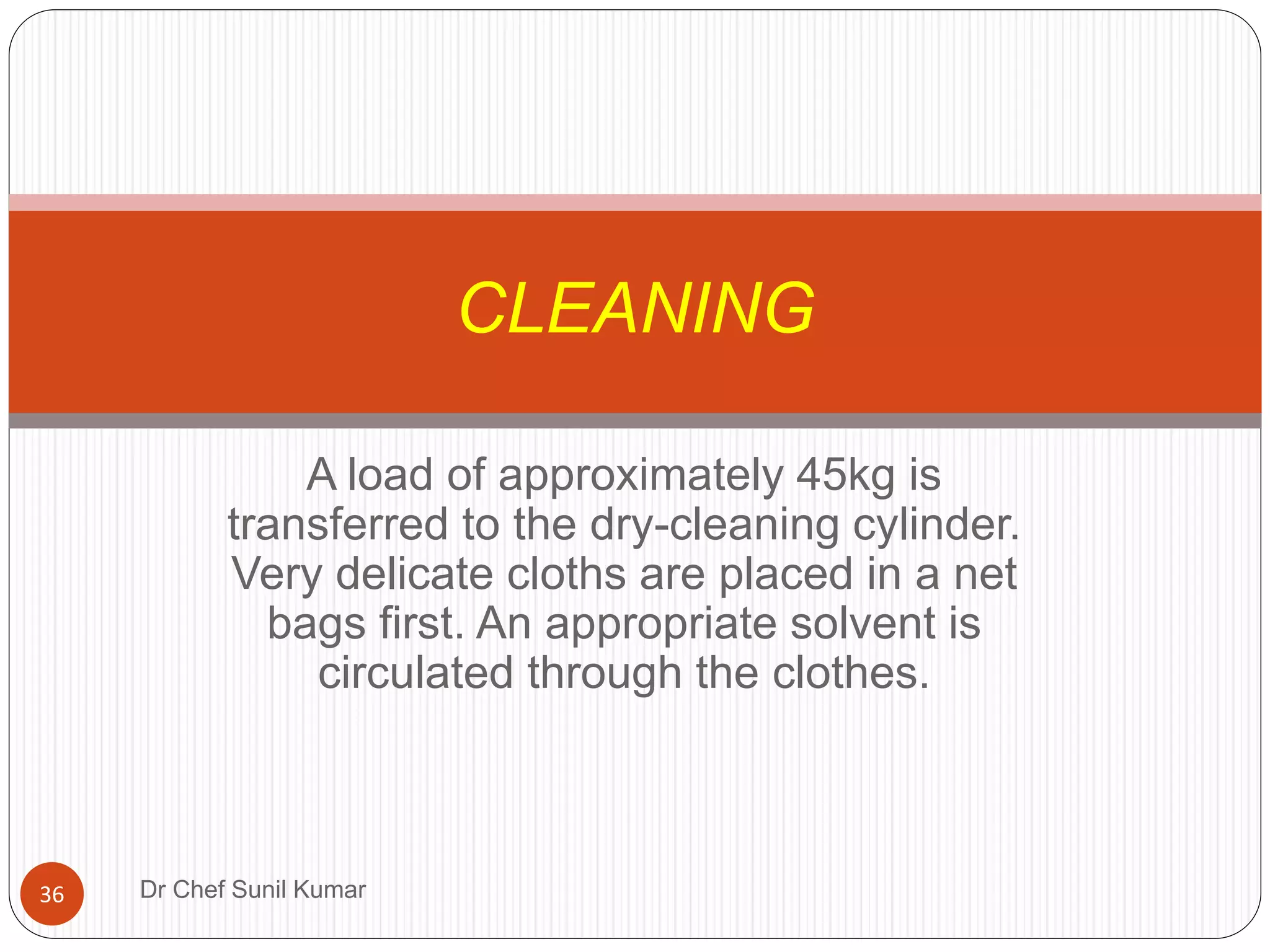
A load of approximately 45kg is
transferred to the dry-cleaning cylinder.
Very delicate cloths are placed in a net
bags first. An appropriate solvent is
circulated through the clothes.
CLEANING
36 Dr Chef Sunil Kumar
Excess solvent is removed from the
garments by centrafugal action in a
revolving perforated cylinder contained in
a tumbler.
EXTRACTION
37 Dr Chef Sunil Kumar
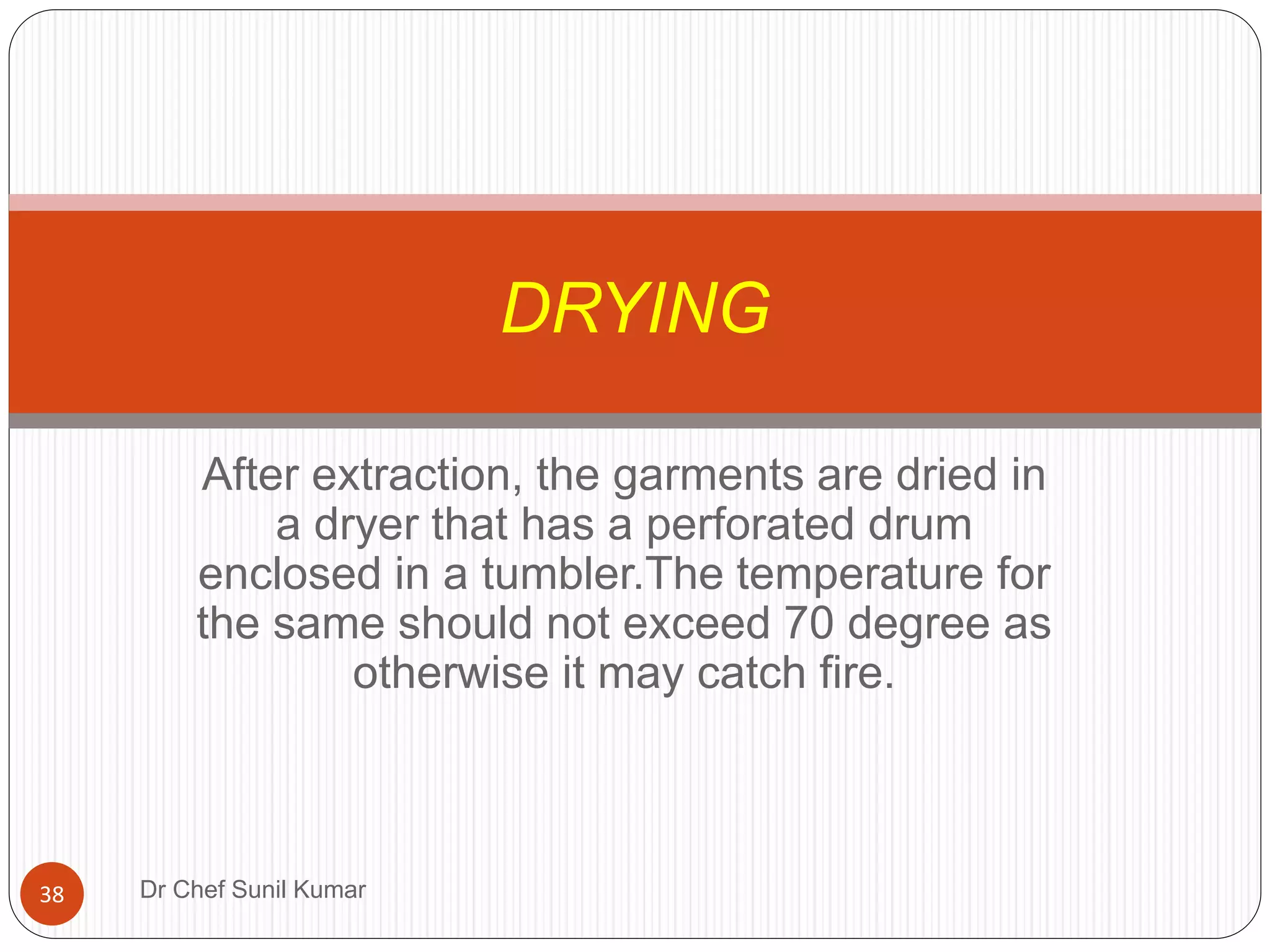
After extraction, the garments are dried in
a dryer that has a perforated drum
enclosed in a tumbler.The temperature for
the same should not exceed 70 degree as
otherwise it may catch fire.
DRYING
38 Dr Chef Sunil Kumar
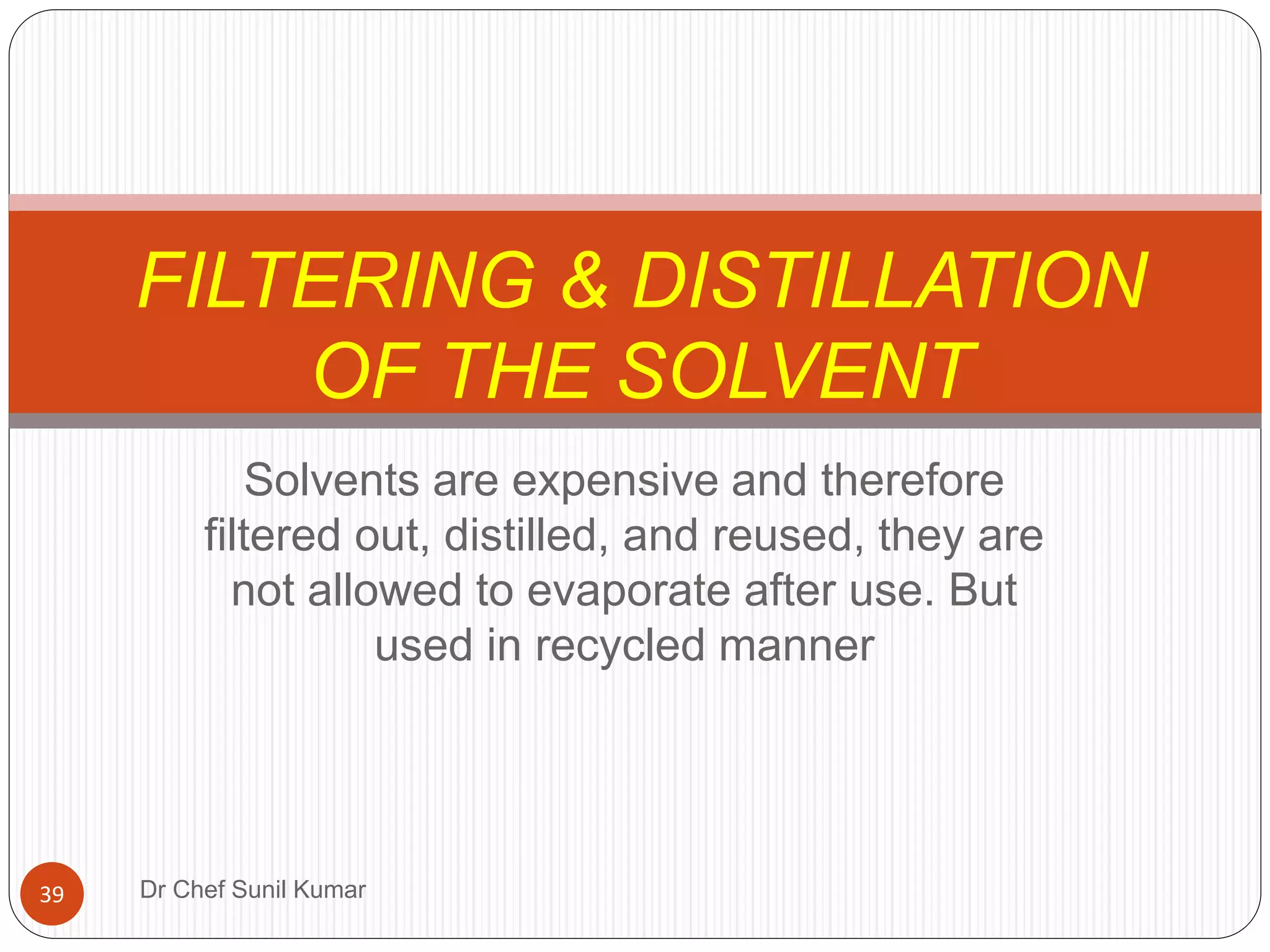
Solvents are expensive and therefore
filtered out, distilled, and reused, they are
not allowed to evaporate after use. But
used in recycled manner
FILTERING & DISTILLATION
OF THE SOLVENT
39 Dr Chef Sunil Kumar
Dried garments are inspected to check
that they are perfectly clean. If necessary,
they are spot-cleaned a second time.
INSPECTION
40 Dr Chef Sunil Kumar
In this process, the garments are restored
as nearly as possible to its original size,
shape, feel, and appearance.
FINISHING
41 Dr Chef Sunil Kumar
Buttons and buckles that had been removed
are stitched back on. Finally the garments are
packed in a paper or suspended from clothes
hangers covered with polythene bags. They
are now ready for delivery
PACKING
42 Dr Chef Sunil Kumar
DRY-CLEANING
MATERIALS
1. Dry-cleaning detergents
2. Absorbents
3. Solvents
4. Petroleum solvents
5. Halogenated hydrocarbons
43 Dr Chef Sunil Kumar
STAIN REMOVAL
44 Dr Chef Sunil Kumar
A stain is a spot or localized discolouration
left on fabric by reaction of a foreign
substance or absorption or adsorption of
any unwanted colour,liquid etc
STAIN
45 Dr Chef Sunil Kumar
Stain removal or spot cleaning is a skill that
demands special attraction, special techniques, and
long experience.
STAIN REMOVAL
46 Dr Chef Sunil Kumar
TYPES OF STAINS
 Animal stains
 Vegetable stains
 Grease
 Mineral stains
 Metalloid stains
 Acidic stains
 Basic/alkaline stains
 Natural dyes & pigments
 Synthetic dyes &pigments
 Sugar solution with colouring matter
 miscellaneous
47 Dr Chef Sunil Kumar
RECOGNISATION OF STAINS
COLOUR
TEXTURE
SMELL
48 Dr Chef Sunil Kumar
PROCEDURE FOR STAIN
REMOVAL
 Soak in cold water
 Soak in warm water
 Allow it to get open air bleach.
 Apply cold alkaline solution.
 Apply hot alkaline solution
 Apply cold acidic solution.
 Apply an oxidizing bleach.
 Treat with reducing bleach.
 Repeat the procedure if stain is still there.
 Soak it in the glycerin for ½ an hour.
49 Dr Chef Sunil Kumar
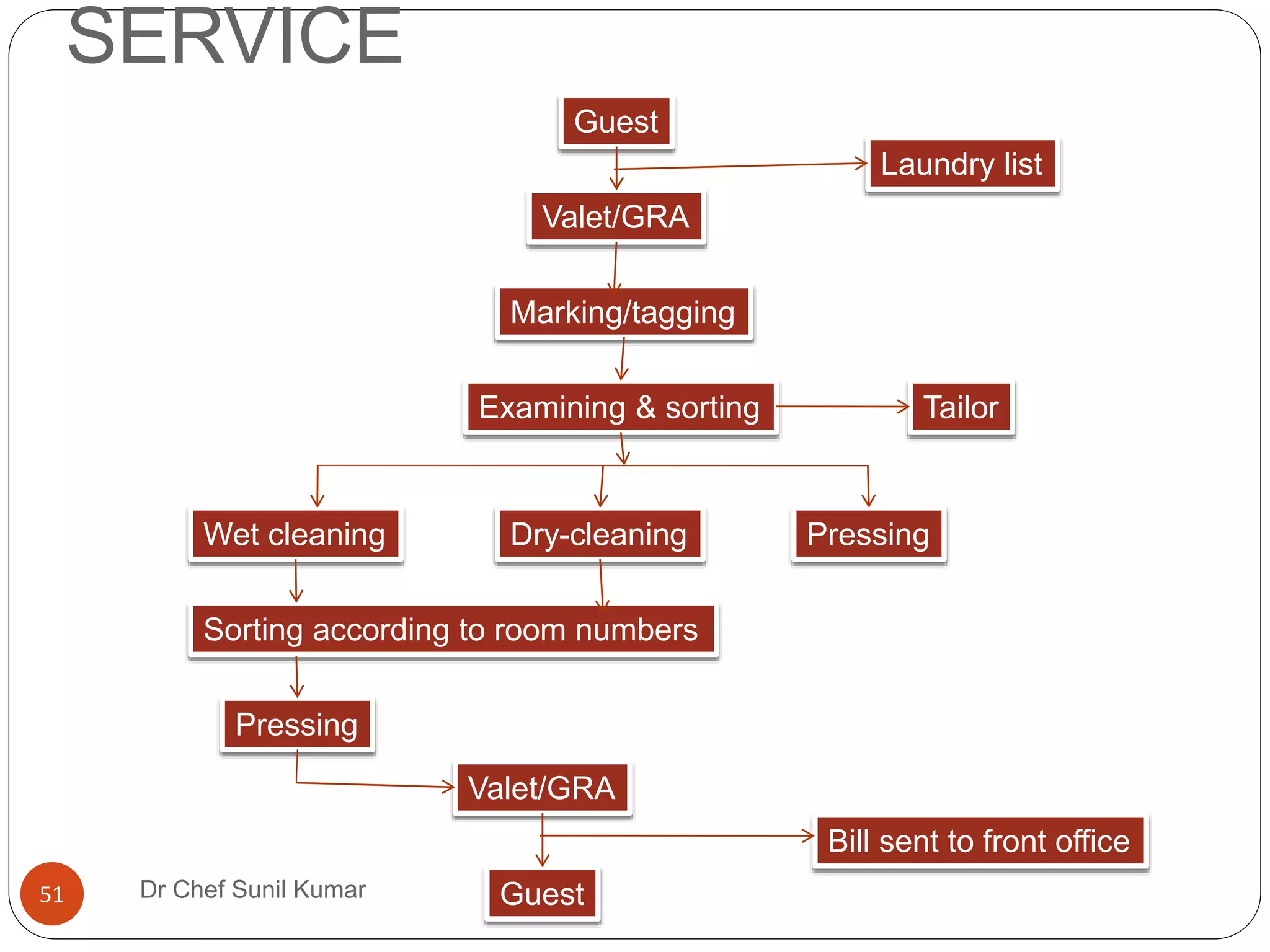
VALET SERVICE
 It is the service given by housekeeping to guests in
which the guest clothes are taken and returned back
from the room. It is chargeable service.
50 Dr Chef Sunil Kumar
SERVICE
Guest
Valet/GRA
Marking/tagging
Laundry list
Examining & sorting Tailor
Wet cleaning Dry-cleaning Pressing
Sorting according to room numbers
Pressing
Valet/GRA
Guest
Bill sent to front office
51 Dr Chef Sunil Kumar
52 Dr Chef Sunil Kumar