Research Design
Presented to Dr Mainmul Ahsan Khan
Professor of Law
Presented by Sadiya Sultana Silvee
Program: LL.M
ID: 153012021
Batch: 1503
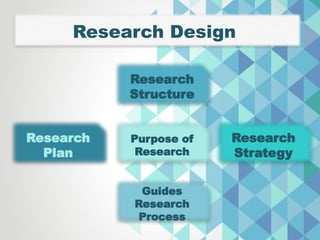
Research
Strategy
Research
Structure
Research
Plan
Guides
Research
Process
Purpose of
Research
Research Design
Making Choice
Sources
Time
Limitations
Purpose of
Research
Research Plan
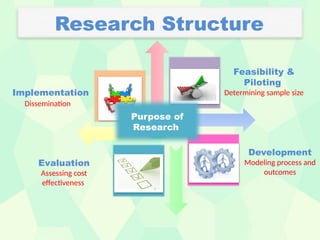
Development
Modeling process and
outcomes
Implementation
Dissemination
Feasibility &
Piloting
Determining sample size
Evaluation
Assessing cost
effectiveness
Purpose of
Research
Research Structure
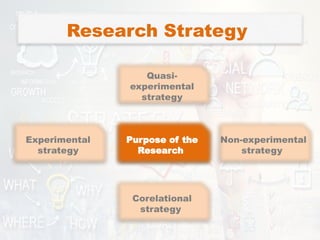
Non-experimental
strategy
Quasi-
experimental
strategy
Experimental
strategy
Corelational
strategy
Descriptive
strategy
Purpose of the
Research
Research Strategy
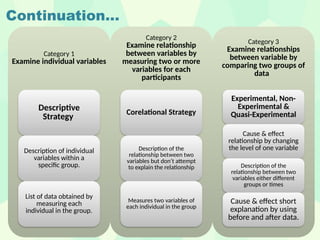
Continuation…
Category 1
Examine individual variables
Descriptive
Strategy
Description of individual
variables within a
specific group.
List of data obtained by
measuring each
individual in the group.
Category 2
Examine relationship
between variables by
measuring two or more
variables for each
participants
Corelational Strategy
Description of the
relationship between two
variables but don’t attempt
to explain the relationship
Measures two variables of
each individual in the group
Category 3
Examine relationships
between variable by
comparing two groups of
data
Experimental, Non-
Experimental &
Quasi-Experimental
Cause & effect
relationship by changing
the level of one variable
Description of the
relationship between two
variables either different
groups or times
Cause & effect short
explanation by using
before and after data.
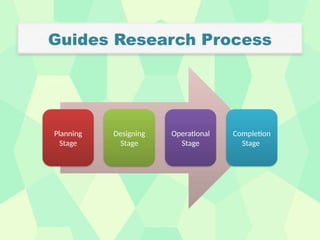
Guides Research Process
Planning
Stage
Designing
Stage
Operational
Stage
Completion
Stage
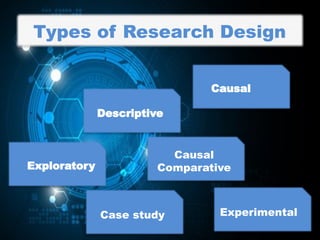
Types of Research Design
Exploratory
Descriptive
Causal
Causal
Comparative
Case study Experimental
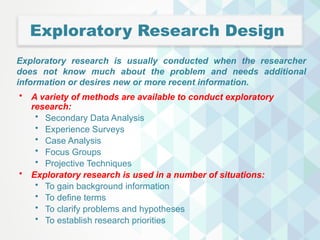
Exploratory Research Design
Exploratory research is usually conducted when the researcher
does not know much about the problem and needs additional
information or desires new or more recent information.
• A variety of methods are available to conduct exploratory
research:
• Secondary Data Analysis
• Experience Surveys
• Case Analysis
• Focus Groups
• Projective Techniques
• Exploratory research is used in a number of situations:
• To gain background information
• To define terms
• To clarify problems and hypotheses
• To establish research priorities
Descriptive Research Design
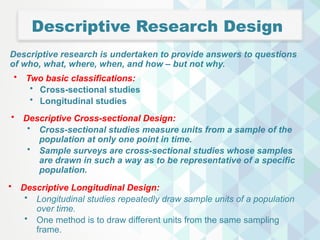
Descriptive research is undertaken to provide answers to questions
of who, what, where, when, and how – but not why.
• Two basic classifications:
• Cross-sectional studies
• Longitudinal studies
• Descriptive Cross-sectional Design:
• Cross-sectional studies measure units from a sample of the
population at only one point in time.
• Sample surveys are cross-sectional studies whose samples
are drawn in such a way as to be representative of a specific
population.
• Descriptive Longitudinal Design:
• Longitudinal studies repeatedly draw sample units of a population
over time.
• One method is to draw different units from the same sampling
frame.
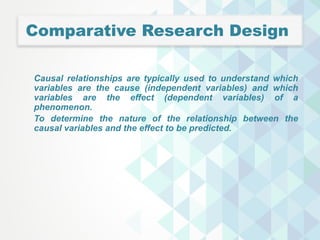
Comparative Research Design
Causal relationships are typically used to understand which
variables are the cause (independent variables) and which
variables are the effect (dependent variables) of a
phenomenon.
To determine the nature of the relationship between the
causal variables and the effect to be predicted.
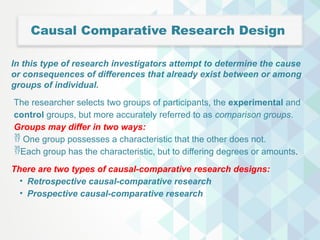
Causal Comparative Research Design
In this type of research investigators attempt to determine the cause
or consequences of differences that already exist between or among
groups of individual.
The researcher selects two groups of participants, the experimental and
control groups, but more accurately referred to as comparison groups.
Groups may differ in two ways:
 One group possesses a characteristic that the other does not.
Each group has the characteristic, but to differing degrees or amounts.
There are two types of causal-comparative research designs:
• Retrospective causal-comparative research
• Prospective causal-comparative research
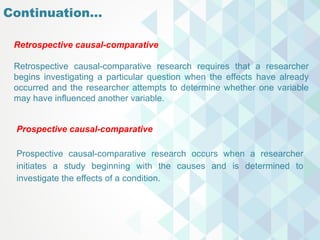
Continuation…
Retrospective causal-comparative
Retrospective causal-comparative research requires that a researcher
begins investigating a particular question when the effects have already
occurred and the researcher attempts to determine whether one variable
may have influenced another variable.
Prospective causal-comparative
Prospective causal-comparative research occurs when a researcher
initiates a study beginning with the causes and is determined to
investigate the effects of a condition.
Case Study Research Design
A case study is an empirical enquiry that investigates a
contemporary phenomenon in depth and within its real-life context,
especially when the boundaries between phenomenon and context
are not clearly evident. It is a systematic inquiry into an event or a
set of related events which aims to describe and explain the
phenomenon of interest.
Experimental Research Design
Experimental research is defined as “OBSERVATIONS UNDER CONTROLLED
CONDITIONS”.
Experimental designs are concerned with examination of the effect of an
independent variable on dependent variable, where the independent variable
is manipulated through treatment or intervention(s).
True experimental designs consists of three cardinal feature:
• RANDOMIZATION,
• CONTROL &
• MANIPULATION or TRIAL.
Continuation….
• RANDOMIZATION:
Means that every subject has an equal chance of being assigned to
experimental or control group.
• CONTROL:
Control refers to the use of control group and controlling the effects of
extraneous variables on the dependent variable in which the researcher is
interested.
• MANIPULATION:
Manipulation refers to conscious control of the independent variable by
the researcher through treatment or intervention to observe it’s effect on
the dependent variable.
Importance of Research Design
• It may result in the desired type of study with useful conclusions.
• It may lead to reduced inaccuracy.
• It may give optimum efficiency and reliability.
• It may minimize the uncertainty, confusion and practical hazards
associated with any research problem.
• It may be helpful for the collection of research material, required
data, and testing of hypothesis.
• It may operate as a ‘guide post’ for giving research a ‘right
direction’.
• It may minimize the wastage of time and beating around the bush.
Any Questions
The best design Research_Design_pptx.pptx

The best design Research_Design_pptx.pptx

  • 1.
    Research Design Presented toDr Mainmul Ahsan Khan Professor of Law Presented by Sadiya Sultana Silvee Program: LL.M ID: 153012021 Batch: 1503
  • 2.
  • 3.
  • 4.
    Development Modeling process and outcomes Implementation Dissemination Feasibility& Piloting Determining sample size Evaluation Assessing cost effectiveness Purpose of Research Research Structure
  • 5.
  • 6.
    Continuation… Category 1 Examine individualvariables Descriptive Strategy Description of individual variables within a specific group. List of data obtained by measuring each individual in the group. Category 2 Examine relationship between variables by measuring two or more variables for each participants Corelational Strategy Description of the relationship between two variables but don’t attempt to explain the relationship Measures two variables of each individual in the group Category 3 Examine relationships between variable by comparing two groups of data Experimental, Non- Experimental & Quasi-Experimental Cause & effect relationship by changing the level of one variable Description of the relationship between two variables either different groups or times Cause & effect short explanation by using before and after data.
  • 7.
  • 8.
    Types of ResearchDesign Exploratory Descriptive Causal Causal Comparative Case study Experimental
  • 9.
    Exploratory Research Design Exploratoryresearch is usually conducted when the researcher does not know much about the problem and needs additional information or desires new or more recent information. • A variety of methods are available to conduct exploratory research: • Secondary Data Analysis • Experience Surveys • Case Analysis • Focus Groups • Projective Techniques • Exploratory research is used in a number of situations: • To gain background information • To define terms • To clarify problems and hypotheses • To establish research priorities
  • 10.
    Descriptive Research Design Descriptiveresearch is undertaken to provide answers to questions of who, what, where, when, and how – but not why. • Two basic classifications: • Cross-sectional studies • Longitudinal studies • Descriptive Cross-sectional Design: • Cross-sectional studies measure units from a sample of the population at only one point in time. • Sample surveys are cross-sectional studies whose samples are drawn in such a way as to be representative of a specific population. • Descriptive Longitudinal Design: • Longitudinal studies repeatedly draw sample units of a population over time. • One method is to draw different units from the same sampling frame.
  • 11.
    Comparative Research Design Causalrelationships are typically used to understand which variables are the cause (independent variables) and which variables are the effect (dependent variables) of a phenomenon. To determine the nature of the relationship between the causal variables and the effect to be predicted.
  • 12.
    Causal Comparative ResearchDesign In this type of research investigators attempt to determine the cause or consequences of differences that already exist between or among groups of individual. The researcher selects two groups of participants, the experimental and control groups, but more accurately referred to as comparison groups. Groups may differ in two ways:  One group possesses a characteristic that the other does not. Each group has the characteristic, but to differing degrees or amounts. There are two types of causal-comparative research designs: • Retrospective causal-comparative research • Prospective causal-comparative research
  • 13.
    Continuation… Retrospective causal-comparative Retrospective causal-comparativeresearch requires that a researcher begins investigating a particular question when the effects have already occurred and the researcher attempts to determine whether one variable may have influenced another variable. Prospective causal-comparative Prospective causal-comparative research occurs when a researcher initiates a study beginning with the causes and is determined to investigate the effects of a condition.
  • 14.
    Case Study ResearchDesign A case study is an empirical enquiry that investigates a contemporary phenomenon in depth and within its real-life context, especially when the boundaries between phenomenon and context are not clearly evident. It is a systematic inquiry into an event or a set of related events which aims to describe and explain the phenomenon of interest.
  • 15.
    Experimental Research Design Experimentalresearch is defined as “OBSERVATIONS UNDER CONTROLLED CONDITIONS”. Experimental designs are concerned with examination of the effect of an independent variable on dependent variable, where the independent variable is manipulated through treatment or intervention(s). True experimental designs consists of three cardinal feature: • RANDOMIZATION, • CONTROL & • MANIPULATION or TRIAL.
  • 16.
    Continuation…. • RANDOMIZATION: Means thatevery subject has an equal chance of being assigned to experimental or control group. • CONTROL: Control refers to the use of control group and controlling the effects of extraneous variables on the dependent variable in which the researcher is interested. • MANIPULATION: Manipulation refers to conscious control of the independent variable by the researcher through treatment or intervention to observe it’s effect on the dependent variable.
  • 17.
    Importance of ResearchDesign • It may result in the desired type of study with useful conclusions. • It may lead to reduced inaccuracy. • It may give optimum efficiency and reliability. • It may minimize the uncertainty, confusion and practical hazards associated with any research problem. • It may be helpful for the collection of research material, required data, and testing of hypothesis. • It may operate as a ‘guide post’ for giving research a ‘right direction’. • It may minimize the wastage of time and beating around the bush.
  • 18.