CHAPTER FOUR
RESEARCH DESIGN
(PLANNING RESEARCH
PROJECT)
SUB-CONTENT
♣Meaning of research design
♣Need for research design
♣Characteristics of a good research design
Meaning of research design
♠A research design is the arrangement of conditions for collection
and analysis of data in a manner that aims to combine relevance
to the research purpose with economy in procedure.
♠A research design is a logical and systematic plan prepared for
directing a research study.
♠A research design may be defined as a master plan specifying,
the methodology and techniques to be adopted for achieving the
objectives.
♠It constitutes the blueprint for the collection, measurement and
analysis of data.
CONTI…
A research design is the program that guides the
investigator in the process of collecting, analyzing
and interpreting observations.
It “provides a systematic plan of procedure for
the researcher to follow.”
As such the design includes an outline of what
the researcher will do from writing the hypothesis
and its operational implications to the final
analysis of data.
Characteristics of A Good Research Design
Flexible, appropriate, efficient, and economical
A design which minimizes bias about data
A design which maximizes the reliability of the data
collected and analyzed
A design which gives the smallest experimental error
A design which yields maximal information
A design which provides an opportunity for considering
many different aspects of a problem
Types of Research Designs
Researchers choose among different types of
possible research designs depending on such
dimensions as purpose of the research,
method of data collection, control of
variables, the time dimension, the research
environment, depth of the research, and the
like.
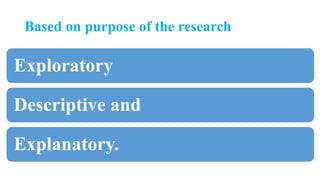
Based on purpose of the research
Exploratory
Descriptive and
Explanatory.
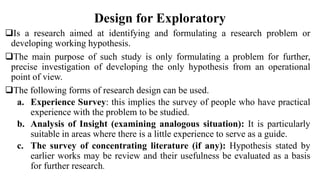
Design for Exploratory
Is a research aimed at identifying and formulating a research problem or
developing working hypothesis.
The main purpose of such study is only formulating a problem for further,
precise investigation of developing the only hypothesis from an operational
point of view.
The following forms of research design can be used.
a. Experience Survey: this implies the survey of people who have practical
experience with the problem to be studied.
b. Analysis of Insight (examining analogous situation): It is particularly
suitable in areas where there is a little experience to serve as a guide.
c. The survey of concentrating literature (if any): Hypothesis stated by
earlier works may be review and their usefulness be evaluated as a basis
for further research.
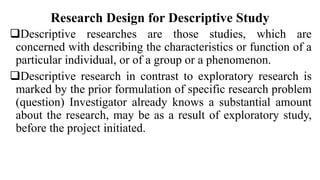
Research Design for Descriptive Study
Descriptive researches are those studies, which are
concerned with describing the characteristics or function of a
particular individual, or of a group or a phenomenon.
Descriptive research in contrast to exploratory research is
marked by the prior formulation of specific research problem
(question) Investigator already knows a substantial amount
about the research, may be as a result of exploratory study,
before the project initiated.
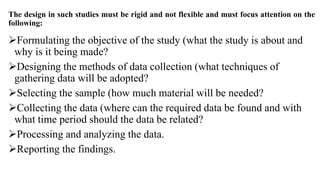
The design in such studies must be rigid and not flexible and must focus attention on the
following:
Formulating the objective of the study (what the study is about and
why is it being made?
Designing the methods of data collection (what techniques of
gathering data will be adopted?
Selecting the sample (how much material will be needed?
Collecting the data (where can the required data be found and with
what time period should the data be related?
Processing and analyzing the data.
Reporting the findings.
Research Design for Experimental Research
Hypothesis-testing research studies (generally
known as experimental studies) are those where the
researcher tests the hypotheses of causal
relationships between variables.
Experimental studies are those in which the
researcher can control and manipulate at least
one of the independent variable and test the
hypothesis of causal relationship between
variable.
Basic Principles of Experimental Research
1. The Principle of Replication : The experiment should be
repeated more than once.
Suppose the researcher wants to examine the effect of new
teaching method on student’s performance. The researcher
can divide students’ population in to two groups, and one
treatment (old teaching method) will be given to one group
and the new teaching method to another group. After
treatment the result is compared in both groups. Applying
this principle implies the students population is divided in to
more than one group and each treatment is given more than
once.
2. The Principle of Randomization
This principle of experiment is applied in order to
reduce the effect of extraneous factor by randomizing
the application of treatments.
Referring to the above example, To reduce the effect of
extraneous variable, which is intelligence, a researcher can
randomly assign students in different groups or we can
apply different treatments randomly.
3. The Principle of Local Control
This is used to measure and eliminate the variability
caused by extraneous variable.
Here the researcher will try to fix the extraneous
variable. The students are divided on the basis of their
IQ. Students in each IQ level are divided in to two
groups and each group is given different treatment and
results are compared. By doing so the effect of
extraneous variable (intelligence) is controlled.
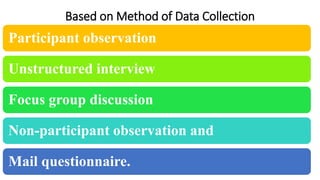
Based on Method of Data Collection
Participant observation
Unstructured interview
Focus group discussion
Non-participant observation and
Mail questionnaire.
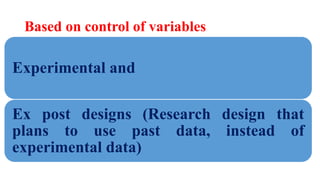
Based on control of variables
Experimental and
Ex post designs (Research design that
plans to use past data, instead of
experimental data)
Based on the time dimension
Cross-sectional and
longitudinal designs.
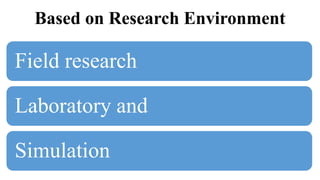
Based on Research Environment
Field research
Laboratory and
Simulation
Depth of Research
Qualitative research designs are usually
meant for researches that require depth
instead of breadth
Quantitative research designs are
commonly used in research projects
aiming at generalization.
Important Concepts Relevant to Research Design
Dependent Variable: If one variable depends upon or a consequence
of the other variable that variable is called a dependent variable. It is
variable that is to predicted or explained.
Independent variable: is a variable that is expected to influence the
dependent variable.
Extraneous variable: Independent variables that are not related to
the purpose of a study, but may affect the dependent variable are
termed as extraneous variable.
Cont…
Control: a good research design has to
minimize the influences of extraneous variable.
Confounded relationship: when dependent variable is not free
from the influence of extraneous variable, then the relationship
between dependent and independent variables is said to be
confounded extraneous variable.
Experimental and control groups: In experimental research when a
group it is exposed to usual condition is called control group, but
when a group is exposed to special condition is called experimental
group.
Conti…
Experiment: the process of examining the truth of a
statistical hypothesis, relating to some problem, is known as
an experiment.
Experimental Unit: the pre-determined plots (or blocks or
group) where different treatments are used are known
experimental units.
Treatments: the different conditions under which
experimental and control groups are put referred to as
treatment.
Scales of measurement
Scales of measurement is how
variables are defined and
categorized.
Psychologist Stanley Stevens
developed the four common scales of
measurement:
nominal, ordinal, interval and ratio.
Properties of Measurement
♠Identity: Identity refers to each value having a unique
meaning.
♠Magnitude: values have an ordered relationship to one
another, so there is a specific order to the variables.
♠Equal intervals: mean that data points along the scale are
equal, so the difference between data points one and two will
be the same as the difference between data points five and
six.
♠A minimum value of zero: means the scale has a true zero
point. Degrees, for example, can fall below zero and still
have meaning. But if you weigh nothing, you don’t exist.
• There are 4 levels of measurement scales or methods of
assigning numbers.
1. Nominal scale/Categorizing/Attributes are only named- Gender
Male = 1 Female = 2 or Religious Affiliation orthodox =1 Catholic = 2
Protestant = 3 Jewish = 4 Muslim = 5 Other = 6
• Categorical data are measured on nominal scales which merely
assign labels to distinguish categories
• used most often for qualitative variables in which observations
are classified into discrete groups.
“Nothing is right and wrong in research, research is an
addiction with an endless search for its drug” P.S. Jagadeesh
Kumar
25
2. Ordinal scale/ Ranking/Attributes can be ordered-Numbers are used to place
objects in order • But, there is no information regarding the differences
(intervals) between points on the scale. e.g. 1st , 2nd , 3rd
-for quantitative dimension
3. Interval scale/ -Determination of the size interval/Distance/ interval
differences/ is meaningful-
a scale on which equal intervals between objects, represent equal differences
• But, we can’t defend ratio relationship
A ratio scale has the property of equal intervals but also has a true 0 point. As a
result, one can multiply and divide as well as add and subtract using ratio
scales. 26
4. Ratio scale/- Determination of the size of ratios/Absolute zero
• Have a true zero point & are meaningful • Physical scales of time, length
and volume are ratio scales • We can say that 20 seconds is twice as long as
10 second
• represents the actual amounts of variables.
• Measures of physical dimensions such as weight, height, distance, etc.
27

RM CHAPTER FOUR.pdfUYTREDDSWABBVVCCFFDDMMKK

  • 1.
  • 2.
    SUB-CONTENT ♣Meaning of researchdesign ♣Need for research design ♣Characteristics of a good research design
  • 3.
    Meaning of researchdesign ♠A research design is the arrangement of conditions for collection and analysis of data in a manner that aims to combine relevance to the research purpose with economy in procedure. ♠A research design is a logical and systematic plan prepared for directing a research study. ♠A research design may be defined as a master plan specifying, the methodology and techniques to be adopted for achieving the objectives. ♠It constitutes the blueprint for the collection, measurement and analysis of data.
  • 4.
    CONTI… A research designis the program that guides the investigator in the process of collecting, analyzing and interpreting observations. It “provides a systematic plan of procedure for the researcher to follow.” As such the design includes an outline of what the researcher will do from writing the hypothesis and its operational implications to the final analysis of data.
  • 5.
    Characteristics of AGood Research Design Flexible, appropriate, efficient, and economical A design which minimizes bias about data A design which maximizes the reliability of the data collected and analyzed A design which gives the smallest experimental error A design which yields maximal information A design which provides an opportunity for considering many different aspects of a problem
  • 6.
    Types of ResearchDesigns Researchers choose among different types of possible research designs depending on such dimensions as purpose of the research, method of data collection, control of variables, the time dimension, the research environment, depth of the research, and the like.
  • 7.
    Based on purposeof the research Exploratory Descriptive and Explanatory.
  • 8.
    Design for Exploratory Isa research aimed at identifying and formulating a research problem or developing working hypothesis. The main purpose of such study is only formulating a problem for further, precise investigation of developing the only hypothesis from an operational point of view. The following forms of research design can be used. a. Experience Survey: this implies the survey of people who have practical experience with the problem to be studied. b. Analysis of Insight (examining analogous situation): It is particularly suitable in areas where there is a little experience to serve as a guide. c. The survey of concentrating literature (if any): Hypothesis stated by earlier works may be review and their usefulness be evaluated as a basis for further research.
  • 9.
    Research Design forDescriptive Study Descriptive researches are those studies, which are concerned with describing the characteristics or function of a particular individual, or of a group or a phenomenon. Descriptive research in contrast to exploratory research is marked by the prior formulation of specific research problem (question) Investigator already knows a substantial amount about the research, may be as a result of exploratory study, before the project initiated.
  • 10.
    The design insuch studies must be rigid and not flexible and must focus attention on the following: Formulating the objective of the study (what the study is about and why is it being made? Designing the methods of data collection (what techniques of gathering data will be adopted? Selecting the sample (how much material will be needed? Collecting the data (where can the required data be found and with what time period should the data be related? Processing and analyzing the data. Reporting the findings.
  • 11.
    Research Design forExperimental Research Hypothesis-testing research studies (generally known as experimental studies) are those where the researcher tests the hypotheses of causal relationships between variables. Experimental studies are those in which the researcher can control and manipulate at least one of the independent variable and test the hypothesis of causal relationship between variable.
  • 12.
    Basic Principles ofExperimental Research 1. The Principle of Replication : The experiment should be repeated more than once. Suppose the researcher wants to examine the effect of new teaching method on student’s performance. The researcher can divide students’ population in to two groups, and one treatment (old teaching method) will be given to one group and the new teaching method to another group. After treatment the result is compared in both groups. Applying this principle implies the students population is divided in to more than one group and each treatment is given more than once.
  • 13.
    2. The Principleof Randomization This principle of experiment is applied in order to reduce the effect of extraneous factor by randomizing the application of treatments. Referring to the above example, To reduce the effect of extraneous variable, which is intelligence, a researcher can randomly assign students in different groups or we can apply different treatments randomly.
  • 14.
    3. The Principleof Local Control This is used to measure and eliminate the variability caused by extraneous variable. Here the researcher will try to fix the extraneous variable. The students are divided on the basis of their IQ. Students in each IQ level are divided in to two groups and each group is given different treatment and results are compared. By doing so the effect of extraneous variable (intelligence) is controlled.
  • 15.
    Based on Methodof Data Collection Participant observation Unstructured interview Focus group discussion Non-participant observation and Mail questionnaire.
  • 16.
    Based on controlof variables Experimental and Ex post designs (Research design that plans to use past data, instead of experimental data)
  • 17.
    Based on thetime dimension Cross-sectional and longitudinal designs.
  • 18.
    Based on ResearchEnvironment Field research Laboratory and Simulation
  • 19.
    Depth of Research Qualitativeresearch designs are usually meant for researches that require depth instead of breadth Quantitative research designs are commonly used in research projects aiming at generalization.
  • 20.
    Important Concepts Relevantto Research Design Dependent Variable: If one variable depends upon or a consequence of the other variable that variable is called a dependent variable. It is variable that is to predicted or explained. Independent variable: is a variable that is expected to influence the dependent variable. Extraneous variable: Independent variables that are not related to the purpose of a study, but may affect the dependent variable are termed as extraneous variable.
  • 21.
    Cont… Control: a goodresearch design has to minimize the influences of extraneous variable. Confounded relationship: when dependent variable is not free from the influence of extraneous variable, then the relationship between dependent and independent variables is said to be confounded extraneous variable. Experimental and control groups: In experimental research when a group it is exposed to usual condition is called control group, but when a group is exposed to special condition is called experimental group.
  • 22.
    Conti… Experiment: the processof examining the truth of a statistical hypothesis, relating to some problem, is known as an experiment. Experimental Unit: the pre-determined plots (or blocks or group) where different treatments are used are known experimental units. Treatments: the different conditions under which experimental and control groups are put referred to as treatment.
  • 23.
    Scales of measurement Scalesof measurement is how variables are defined and categorized. Psychologist Stanley Stevens developed the four common scales of measurement: nominal, ordinal, interval and ratio.
  • 24.
    Properties of Measurement ♠Identity:Identity refers to each value having a unique meaning. ♠Magnitude: values have an ordered relationship to one another, so there is a specific order to the variables. ♠Equal intervals: mean that data points along the scale are equal, so the difference between data points one and two will be the same as the difference between data points five and six. ♠A minimum value of zero: means the scale has a true zero point. Degrees, for example, can fall below zero and still have meaning. But if you weigh nothing, you don’t exist.
  • 25.
    • There are4 levels of measurement scales or methods of assigning numbers. 1. Nominal scale/Categorizing/Attributes are only named- Gender Male = 1 Female = 2 or Religious Affiliation orthodox =1 Catholic = 2 Protestant = 3 Jewish = 4 Muslim = 5 Other = 6 • Categorical data are measured on nominal scales which merely assign labels to distinguish categories • used most often for qualitative variables in which observations are classified into discrete groups. “Nothing is right and wrong in research, research is an addiction with an endless search for its drug” P.S. Jagadeesh Kumar 25
  • 26.
    2. Ordinal scale/Ranking/Attributes can be ordered-Numbers are used to place objects in order • But, there is no information regarding the differences (intervals) between points on the scale. e.g. 1st , 2nd , 3rd -for quantitative dimension 3. Interval scale/ -Determination of the size interval/Distance/ interval differences/ is meaningful- a scale on which equal intervals between objects, represent equal differences • But, we can’t defend ratio relationship A ratio scale has the property of equal intervals but also has a true 0 point. As a result, one can multiply and divide as well as add and subtract using ratio scales. 26
  • 27.
    4. Ratio scale/-Determination of the size of ratios/Absolute zero • Have a true zero point & are meaningful • Physical scales of time, length and volume are ratio scales • We can say that 20 seconds is twice as long as 10 second • represents the actual amounts of variables. • Measures of physical dimensions such as weight, height, distance, etc. 27