Chapter I
Nature of Inquiry and
Research
I. Nature of Inquiry
• Inquiry is defined as “seeking for truth,
information or knowledge”.
• The information is sought through questioning.
• Individuals carry the process of inquiry from
birth till death.
• The process of inquiry begins with gathering
information and data through applying the
various human senses.
II. What is Research?
• It is the systematic investigation and study of
materials and sources to establish facts and reach
new conclusions.
• It is a process of inquiring.
Experience and Knowledge
Experience is a familiar and a
well-used source of knowledge.
Significance of Research
1. To gather necessary information
2. To make changes
3. To improve the standard of living
4. For a safer life
5. To know the truth
6. To explore our history
III. Characteristics,
Processes and
Ethics of Research
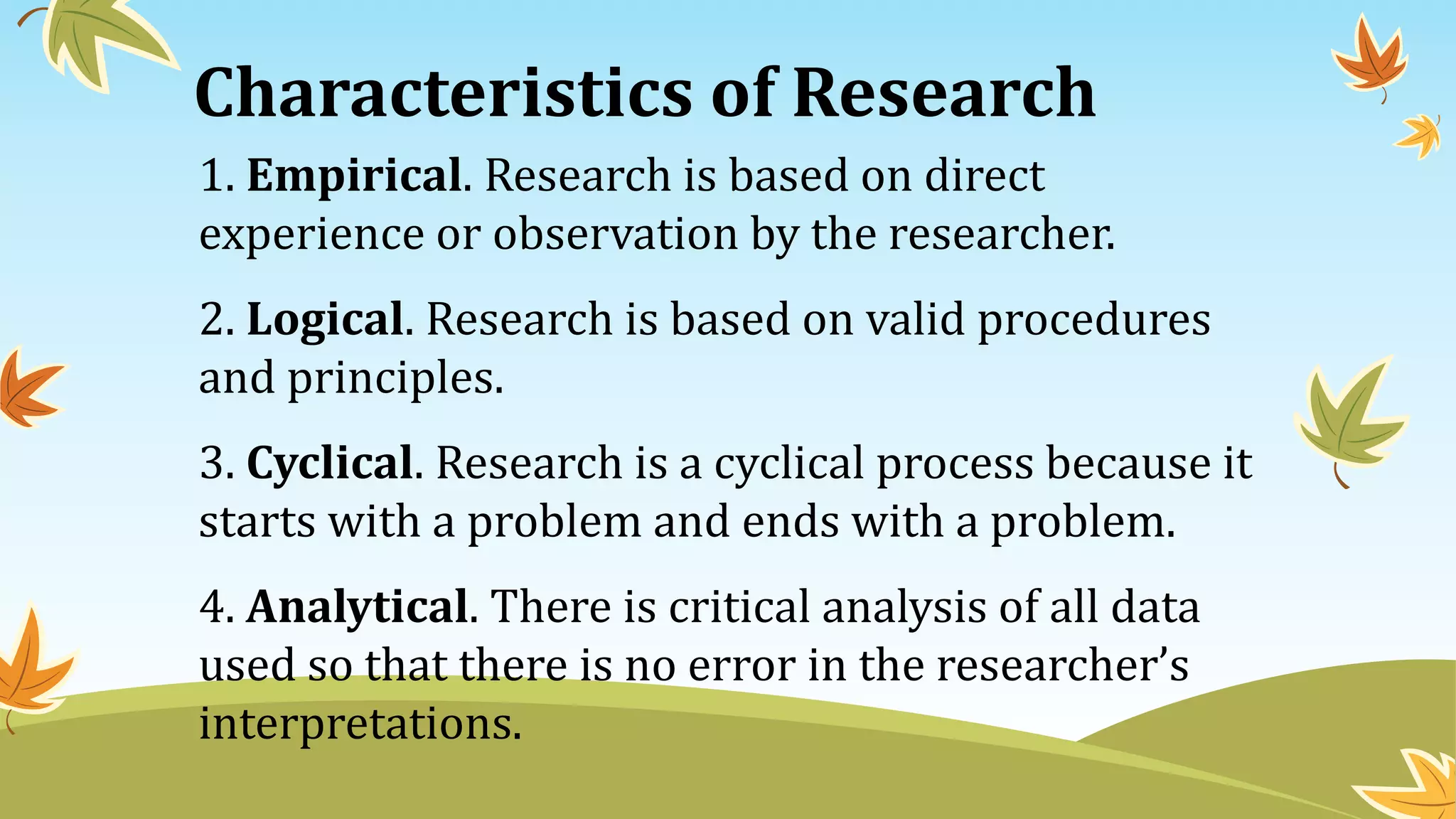
Characteristics of Research
1. Empirical. Research is based on direct
experience or observation by the researcher.
2. Logical. Research is based on valid procedures
and principles.
3. Cyclical. Research is a cyclical process because it
starts with a problem and ends with a problem.
4. Analytical. There is critical analysis of all data
used so that there is no error in the researcher’s
interpretations.
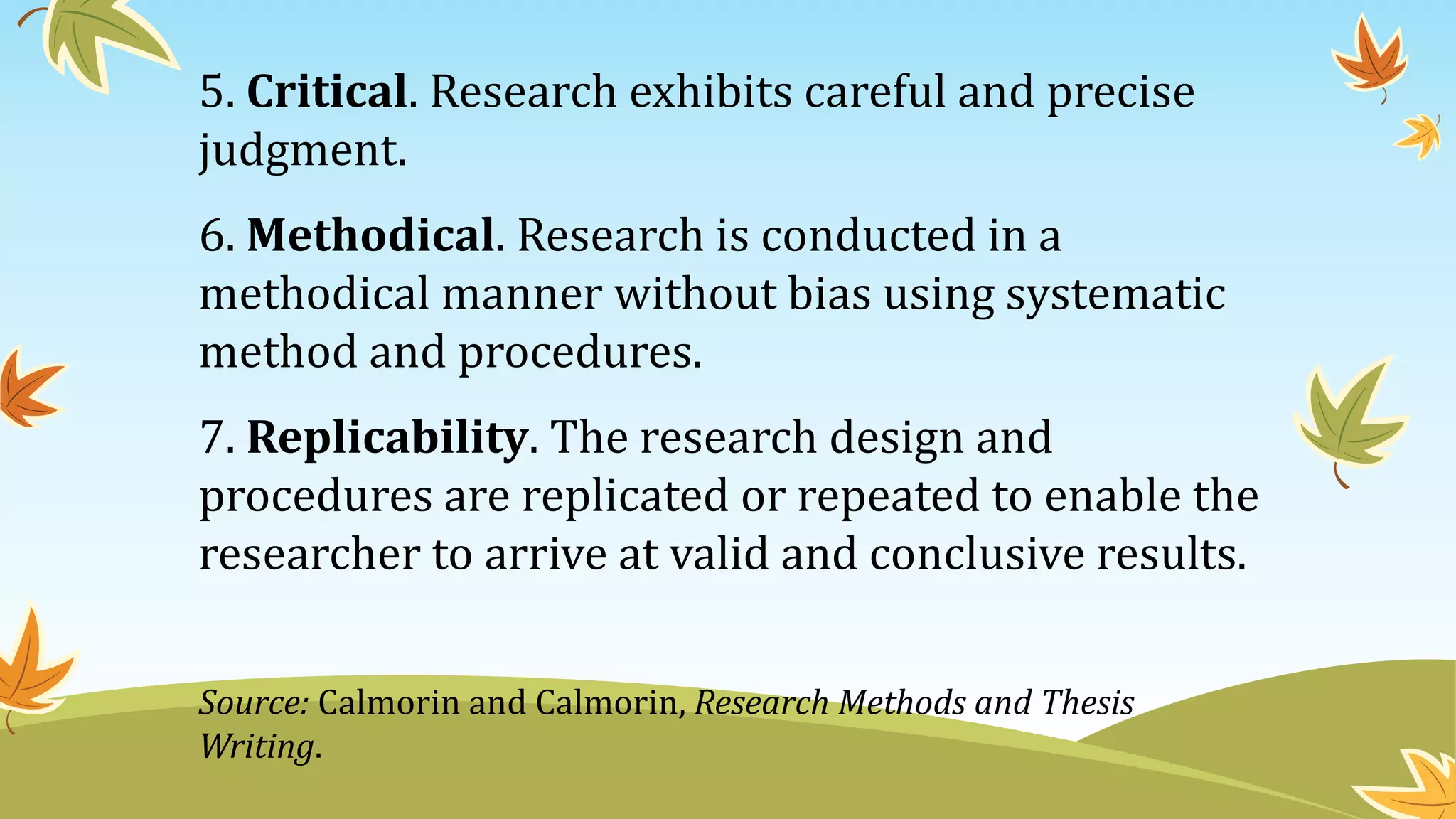
5. Critical. Research exhibits careful and precise
judgment.
6. Methodical. Research is conducted in a
methodical manner without bias using systematic
method and procedures.
7. Replicability. The research design and
procedures are replicated or repeated to enable the
researcher to arrive at valid and conclusive results.
Source: Calmorin and Calmorin, Research Methods and Thesis
Writing.
The Research
Process
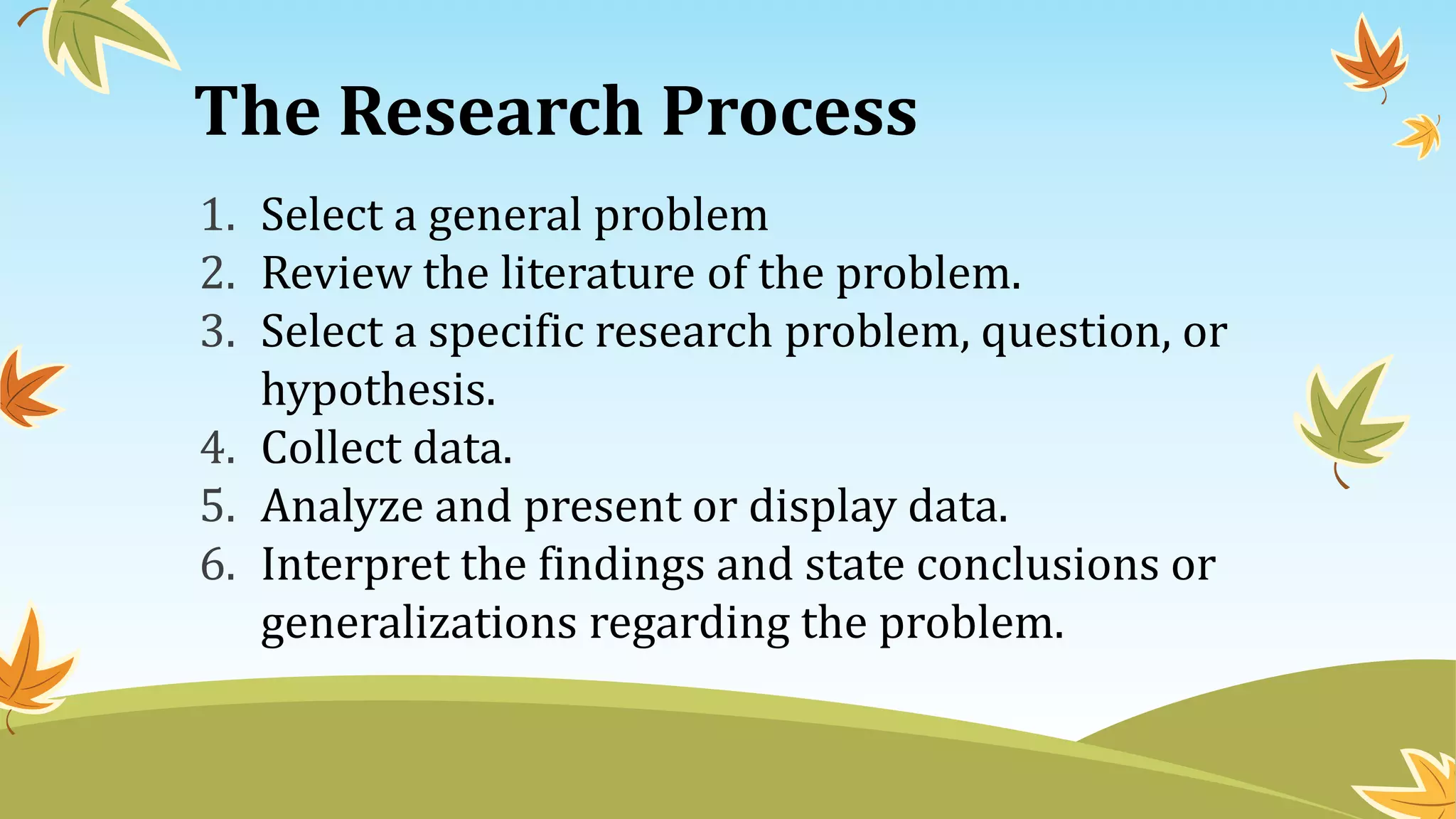
The Research Process
1. Select a general problem
2. Review the literature of the problem.
3. Select a specific research problem, question, or
hypothesis.
4. Collect data.
5. Analyze and present or display data.
6. Interpret the findings and state conclusions or
generalizations regarding the problem.
Types of Research
1. Library Research – done in the library where
answers to specific questions or problems are
available.
2. Field Research – done in the natural setting
such as barangay, school, or factory.
3. Laboratory Research – conducted in an
artificial or controlled conditions by doing the
study in a thoroughly specified and equipped
area.
Ethics in Research
Ethics in Research
Ethics generally is considered to deal with
beliefs about what is right or wrong, proper
or improper, good or bad.
According to a dictionary definition
(Webster‘s 1968), to be ethical is to conform
to accepted professional practice.
Ethical considerations in
conducting research
1. Objectivity and integrity
2. Respect of the research subjects‘ right to privacy
and dignity and protection of subjects from
personal harm
3. Presentation of research findings
4. Acknowledgement of research collaboration and
assistance
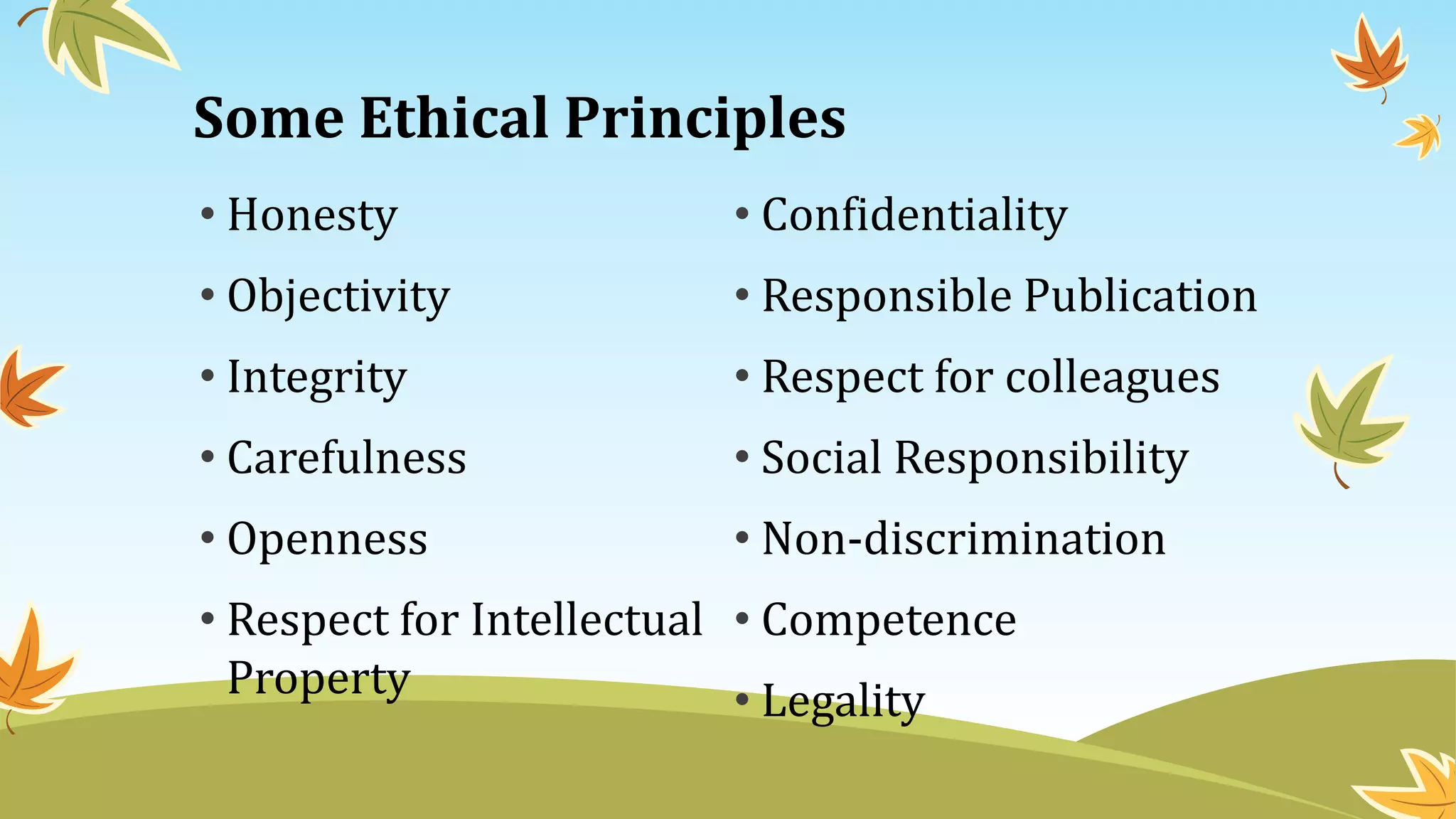
Some Ethical Principles
• Honesty
• Objectivity
• Integrity
• Carefulness
• Openness
• Respect for Intellectual
Property
• Confidentiality
• Responsible Publication
• Respect for colleagues
• Social Responsibility
• Non-discrimination
• Competence
• Legality
Unethical Practices in
Conducting Research
1. Deceiving a respondent about the true purpose
of a study
2. Asking a respondent questions that cause him or
her extreme embarrassment; guilt emotional
turmoil by remaining him or her of an unpleasant
experience
3. Invading the privacy of a respondent
Unethical Practices in
Conducting Research
4. Studying the respondents or research subjects
without their knowledge
5. When analyzing the data—revealing only part of
the facts, presenting facts out of context, falsifying
findings or offering misleading presentation such
as lying with statistics.
IV. Difference Between
Quantitative and
Qualitative Research
Broad Categories of Research
•Qualitative
•Quantitative
•Action Research
•Ethnographic Study
•Case Study
•Experimental Research
Qualitative Research
• It sees social reality as unique and therefore,
human behavior can only be understood by
focusing on the events based on their meanings
for the people involved.
• It is what people experience.
• It is associated with research methods used in
anthropology, history, and other social sciences.
Qualitative Research
• It is primarily an exploratory research.

• It is more flexible allowing more naturalness for
the interaction and collaboration between the
researcher and participant.
• It examines the why, where, when or who of a
given study.
• It has a strong basis in the field of sociology,
political science, social work and special
education.
Qualitative Research
• Qualitative research deals with designs,
techniques and measures that do not produce
discrete numerical data.
• It involves extensive narrative data in order to
gain insights into phenomena.
Quantitative Research
• It is often associated with hard data.
• It is used to quantify – that is to put numerical
equivalence to findings.
• It includes designs, techniques and measures that
produce numerical or quantitative data the
analysis of which, is mainly statistical.
• It is used to quantify the problem by way of
generating mathematical data or data that can be
transformed into usable statistics.
V. Types and Examples
of Research in Different
Areas/Fields
Types and Examples of Research
1. Applied Research is designed to solve practical
problems of the modern world, rather than to acquire
knowledge for knowledge’s sake; its goal is to improve
human condition.
2. Basic Research, also referred to as fundamental or
pure research, is driven by a scientist’s curiosity or
interest in a scientific question.
e.g. Basic science investigation probes for answers to questions
like the following:
• What is the possible cure for HIV?
• What is the genetic code of the fruit fly?
• How to mushrooms reproduce?
3. Correlational Research refers to the systematic
investigation or statistical study of relationships
among two variables, without necessarily
determining cause and effect.
4. Descriptive Research refers to research that
provides an accurate portrayal of a class or a
particular individual situation or group. It is also
known as statistical research.
5. Ethnographic Research refers to the
investigation of a culture through an in-depth study
of the members of the culture; it involves the
systematic collection, description, and analysis of
data for development of theories and cultural
behavior.
6. Experimental Research is an objective,
systematic, controlled investigation, for the
purpose of predicting and controlling phenomena
and examining causality among selected variables.
7. Exploratory Research is a type conducted for a
problem that has not been clearly defined. It helps
determine the best research design, data collection
method and selection of subjects.
8. Historical Research is one involving analysis of
events that occurred in the remote or recent past.
9. Phenomenological Research is an inductive
descriptive research developed from
phenomenological philosophy. Its aim is to
describe an experience as it is actually lived by the
person.
10. Action Research involves the application of
the steps of the scientific method in the classroom
problems. This type of research is done on a very
limited scope. The population to be studied is not
so big. This type of research is helpful to beginning
researchers.
Assignment: Individual
What to do:
Prepare a written report on the research
process. Use references (use citation) for a
substantial and detailed paper.
Where to write: 1 short bond paper (handwritten)
When to pass: November 12, 2019 (Tuesday)

Practical Research- Chapter 1.pptx

  • 1.
    Chapter I Nature ofInquiry and Research
  • 2.
    I. Nature ofInquiry • Inquiry is defined as “seeking for truth, information or knowledge”. • The information is sought through questioning. • Individuals carry the process of inquiry from birth till death. • The process of inquiry begins with gathering information and data through applying the various human senses.
  • 3.
    II. What isResearch? • It is the systematic investigation and study of materials and sources to establish facts and reach new conclusions. • It is a process of inquiring.
  • 4.
    Experience and Knowledge Experienceis a familiar and a well-used source of knowledge.
  • 5.
    Significance of Research 1.To gather necessary information 2. To make changes 3. To improve the standard of living 4. For a safer life 5. To know the truth 6. To explore our history
  • 6.
  • 7.
    Characteristics of Research 1.Empirical. Research is based on direct experience or observation by the researcher. 2. Logical. Research is based on valid procedures and principles. 3. Cyclical. Research is a cyclical process because it starts with a problem and ends with a problem. 4. Analytical. There is critical analysis of all data used so that there is no error in the researcher’s interpretations.
  • 8.
    5. Critical. Researchexhibits careful and precise judgment. 6. Methodical. Research is conducted in a methodical manner without bias using systematic method and procedures. 7. Replicability. The research design and procedures are replicated or repeated to enable the researcher to arrive at valid and conclusive results. Source: Calmorin and Calmorin, Research Methods and Thesis Writing.
  • 9.
  • 10.
    The Research Process 1.Select a general problem 2. Review the literature of the problem. 3. Select a specific research problem, question, or hypothesis. 4. Collect data. 5. Analyze and present or display data. 6. Interpret the findings and state conclusions or generalizations regarding the problem.
  • 11.
    Types of Research 1.Library Research – done in the library where answers to specific questions or problems are available. 2. Field Research – done in the natural setting such as barangay, school, or factory. 3. Laboratory Research – conducted in an artificial or controlled conditions by doing the study in a thoroughly specified and equipped area.
  • 12.
  • 13.
    Ethics in Research Ethicsgenerally is considered to deal with beliefs about what is right or wrong, proper or improper, good or bad. According to a dictionary definition (Webster‘s 1968), to be ethical is to conform to accepted professional practice.
  • 14.
    Ethical considerations in conductingresearch 1. Objectivity and integrity 2. Respect of the research subjects‘ right to privacy and dignity and protection of subjects from personal harm 3. Presentation of research findings 4. Acknowledgement of research collaboration and assistance
  • 15.
    Some Ethical Principles •Honesty • Objectivity • Integrity • Carefulness • Openness • Respect for Intellectual Property • Confidentiality • Responsible Publication • Respect for colleagues • Social Responsibility • Non-discrimination • Competence • Legality
  • 16.
    Unethical Practices in ConductingResearch 1. Deceiving a respondent about the true purpose of a study 2. Asking a respondent questions that cause him or her extreme embarrassment; guilt emotional turmoil by remaining him or her of an unpleasant experience 3. Invading the privacy of a respondent
  • 17.
    Unethical Practices in ConductingResearch 4. Studying the respondents or research subjects without their knowledge 5. When analyzing the data—revealing only part of the facts, presenting facts out of context, falsifying findings or offering misleading presentation such as lying with statistics.
  • 18.
    IV. Difference Between Quantitativeand Qualitative Research
  • 19.
    Broad Categories ofResearch •Qualitative •Quantitative •Action Research •Ethnographic Study •Case Study •Experimental Research
  • 20.
    Qualitative Research • Itsees social reality as unique and therefore, human behavior can only be understood by focusing on the events based on their meanings for the people involved. • It is what people experience. • It is associated with research methods used in anthropology, history, and other social sciences.
  • 21.
    Qualitative Research • Itis primarily an exploratory research. • It is more flexible allowing more naturalness for the interaction and collaboration between the researcher and participant. • It examines the why, where, when or who of a given study. • It has a strong basis in the field of sociology, political science, social work and special education.
  • 22.
    Qualitative Research • Qualitativeresearch deals with designs, techniques and measures that do not produce discrete numerical data. • It involves extensive narrative data in order to gain insights into phenomena.
  • 23.
    Quantitative Research • Itis often associated with hard data. • It is used to quantify – that is to put numerical equivalence to findings. • It includes designs, techniques and measures that produce numerical or quantitative data the analysis of which, is mainly statistical. • It is used to quantify the problem by way of generating mathematical data or data that can be transformed into usable statistics.
  • 24.
    V. Types andExamples of Research in Different Areas/Fields
  • 25.
    Types and Examplesof Research 1. Applied Research is designed to solve practical problems of the modern world, rather than to acquire knowledge for knowledge’s sake; its goal is to improve human condition. 2. Basic Research, also referred to as fundamental or pure research, is driven by a scientist’s curiosity or interest in a scientific question. e.g. Basic science investigation probes for answers to questions like the following: • What is the possible cure for HIV? • What is the genetic code of the fruit fly? • How to mushrooms reproduce?
  • 26.
    3. Correlational Researchrefers to the systematic investigation or statistical study of relationships among two variables, without necessarily determining cause and effect. 4. Descriptive Research refers to research that provides an accurate portrayal of a class or a particular individual situation or group. It is also known as statistical research.
  • 27.
    5. Ethnographic Researchrefers to the investigation of a culture through an in-depth study of the members of the culture; it involves the systematic collection, description, and analysis of data for development of theories and cultural behavior. 6. Experimental Research is an objective, systematic, controlled investigation, for the purpose of predicting and controlling phenomena and examining causality among selected variables.
  • 28.
    7. Exploratory Researchis a type conducted for a problem that has not been clearly defined. It helps determine the best research design, data collection method and selection of subjects. 8. Historical Research is one involving analysis of events that occurred in the remote or recent past. 9. Phenomenological Research is an inductive descriptive research developed from phenomenological philosophy. Its aim is to describe an experience as it is actually lived by the person.
  • 29.
    10. Action Researchinvolves the application of the steps of the scientific method in the classroom problems. This type of research is done on a very limited scope. The population to be studied is not so big. This type of research is helpful to beginning researchers.
  • 30.
    Assignment: Individual What todo: Prepare a written report on the research process. Use references (use citation) for a substantial and detailed paper. Where to write: 1 short bond paper (handwritten) When to pass: November 12, 2019 (Tuesday)