Unit - 1
Introduction to Research Methodology and
Sampling Design
1
Introduction
• Research in common parlance refers to a search for knowledge. Once can
also define research as a scientific and systematic search for pertinent
information on a specific topic. In fact, research is an art of scientific
investigation.
• The Advanced Learner’s Dictionary of Current English lays down the
meaning of research as “a careful investigation or inquiry specially
through search for new facts in any branch of knowledge.”
• Redman and Mory define research as a “systematized effort to gain new
knowledge.”
• Some people consider research as a movement, a movement from the
known to the unknown. It is actually a voyage of discovery.
2
Contd.
Introduction
• Research is an academic activity and as such the term should be used in
a technical sense.
• According to Clifford Woody research comprises defining and
redefining problems, formulating hypothesis or suggested solutions;
collecting, organizing and evaluating data; making deductions and
reaching conclusions; and at last carefully testing the conclusions to
determine whether they fit the formulating hypothesis.
• In short, the search for knowledge through objective and systematic
method of finding solution to a problem is research. The systematic
approach concerning generalization and the formulation of a theory is
also research.
3
OBJECTIVES OF RESEARCH
The purpose of research is to discover answers to questions through the application of
scientific procedures. The main aim of research is to find out the truth which is hidden and which
has not been discovered as yet. Though each research study has its own specific purpose, we may
think of research objectives as falling into a number of following broad groupings:
1. To gain familiarity with a phenomenon or to achieve new insights into it (studies with this object
in view are termed as exploratory or formulative research studies);
2. To portray accurately the characteristics of a particular individual, situation or a group (studies
with this object in view are known as descriptive research studies);
3. To determine the frequency with which something occurs or with which it is associated with
something else (studies with this object in view are known as diagnostic research studies);
4. To test a hypothesis of a causal relationship between variables (such studies are known as
hypothesis-testing research studies). 4
MOTIVATION IN RESEARCH
The possible motives for doing research may be either one or more of the following:
1. Desire to get a research degree along with its consequential benefits;
2. Desire to face the challenge in solving the unsolved problems, i.e., concern over practical
problems initiates research;
3. Desire to get intellectual joy of doing some creative work;
4. Desire to be of service to society;
5. Desire to get respectability.
However, this is not an exhaustive list of factors motivating people to undertake research
studies. Many more factors such as directives of government, employment conditions, curiosity
about new things, desire to understand causal relationships, social thinking and awakening, and
the like may as well motivate (or at times compel) people to perform research operations.
5
TYPES OF RESEARCH
The basic types of research are as follows:
(i) Descriptive vs. Analytical:
• Descriptive research includes surveys and fact-finding enquiries of different kinds. The major
purpose of descriptive research is description of the state of affairs as it exists at present.
• In social science and business research we quite often use the term Ex post facto research for
descriptive research studies. The main characteristic of this method is that the researcher has
no control over the variables; he can only report what has happened or what is happening.
• Most ex post facto research projects are used for descriptive studies in which the researcher
seeks to measure such items as, for example, frequency of shopping, preferences of people, or
similar data. Ex post facto studies also include attempts by researchers to discover causes even
when they cannot control the variables.
• The methods of research utilized in descriptive research are survey methods of all kinds,
including comparative and correlational methods. In analytical research, on the other hand,
the researcher has to use facts or information already available, and analyze these to make a
critical evaluation of the material. 6
Contd.
TYPES OF RESEARCH
(ii) Applied vs. Fundamental:
• Research can either be applied (or action) research or fundamental (to basic or pure) research. Applied
research aims at finding a solution for an immediate problem facing a society or an industrial/business
organization, whereas fundamental research is mainly concerned with generalizations and with the
formulation of a theory.
• “Gathering knowledge for knowledge’s sake is termed ‘pure’ or ‘basic’ research.” Research concerning
some natural phenomenon or relating to pure mathematics are examples of fundamental research.
• Similarly, research studies, concerning human behavior carried on with a view to make generalizations
about human behavior, are also examples of fundamental research, but research aimed at certain
conclusions facing a concrete social or business problem is an example of applied research. Research to
identify social, economic or political trends that may affect a particular institution or the copy research or
the marketing research or evaluation research are examples of applied research.
• Thus, the central aim of applied research is to discover a solution for some pressing practical problem,
whereas basic research is directed towards finding information that has a broad base of applications and
thus, adds to the already existing organized body of scientific knowledge.
7
Contd.
TYPES OF RESEARCH
iii) Quantitative vs. Qualitative:
• Quantitative research is based on the measurement of quantity or amount. It is applicable to phenomena
that can be expressed in terms of quantity.
• Qualitative research, on the other hand, is concerned with qualitative phenomenon, i.e., phenomena
relating to or involving quality or kind. For instance, when we are interested in investigating the reasons
for human behavior (i.e., why people think or do certain things), we quite often talk of ‘Motivation
Research’, an important type of qualitative research. This type of research aims at discovering the
underlying motives and desires, using in depth interviews for the purpose.
• Other techniques of such research are word association tests, sentence completion tests, story completion
tests and similar other projective techniques. Attitude or opinion research i.e., research designed to find
out how people feel or what they think about a particular subject or institution is also qualitative research.
• Qualitative research is specially important in the behavioral sciences where the aim is to discover the
underlying motives of human behavior. Through such research we can analyse the various factors which
motivate people to behave in a particular manner or which make people like or dislike a particular thing.
8
Contd.
TYPES OF RESEARCH
(iv) Conceptual vs. Empirical:
• Conceptual research is that related to some abstract idea(s) or theory. It is generally used by
philosophers and thinkers to develop new concepts or to reinterpret existing ones. On the
other hand, empirical research relies on experience or observation alone, often without due
regard for system and theory.
• It is data-based research, coming up with conclusions which are capable of being verified by
observation or experiment. We can also call it as experimental type of research. In such a
research it is necessary to get at facts firsthand, at their source, and actively to go about doing
certain things to stimulate the production of desired information.
• Such research is thus characterised by the experimenter’s control over the variables under
study and his deliberate manipulation of one of them to study its effects. Empirical research
is appropriate when proof is sought that certain variables affect other variables in some way.
Evidence gathered through experiments or empirical studies is today considered to be the
most powerful support possible for a given hypothesis.
9
Contd.
TYPES OF RESEARCH
(v) Some Other Types of Research:
• All other types of research are variations of one or more of the above stated approaches,
based on either the purpose of research, or the time required to accomplish research, on
the environment in which research is done, or on the basis of some other similar factor.
• Form the point of view of time, we can think of research either as one-time research or
longitudinal research. In the former case the research is confined to a single time-period,
whereas in the latter case the research is carried on over several time-periods.
• Research can be field-setting research or laboratory research or simulation research,
depending upon the environment in which it is to be carried out. Research can as well be
understood as clinical or diagnostic research. Such research follow case-study methods or
indepth approaches to reach the basic causal relations. Such studies usually go deep into
the causes of things or events that interest us, using very small samples and very deep
probing data gathering devices.
10
Contd.
TYPES OF RESEARCH
(v) Some Other Types of Research:
• The research may be exploratory or it may be formalized. The objective of exploratory research
is the development of hypotheses rather than their testing, whereas formalized research studies
are those with substantial structure and with specific hypotheses to be tested.
• Historical research is that which utilizes historical sources like documents, remains, etc. to study
events or ideas of the past, including the philosophy of persons and groups at any remote point
of time.
• Research can also be classified as conclusion-oriented and decision-oriented. While doing
conclusion oriented research, a researcher is free to pick up a problem, redesign the enquiry as
he proceeds and is prepared to conceptualize as he wishes.
• Decision-oriented research is always for the need of a decision maker and the researcher in this
case is not free to embark upon research according to his own inclination. Operations research is
an example of decision oriented research since it is a scientific method of providing executive
departments with a quantitative basis for decisions regarding operations under their control.
11
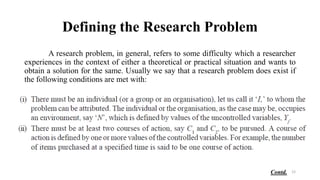
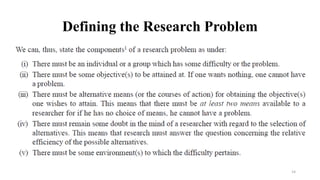
Defining the Research Problem
A research problem, in general, refers to some difficulty which a researcher
experiences in the context of either a theoretical or practical situation and wants to
obtain a solution for the same. Usually we say that a research problem does exist if
the following conditions are met with:
12
Contd.
Defining the Research Problem
Over and above these conditions, the individual or the organization can be said to have
the problem only if ‘I’ does not know what course of action is best, i.e., ‘I’, must be in doubt
about the solution. Thus, an individual or a group of persons can be said to have a problem which
can be technically described as a research problem, if they (individual or the group), having one
or more desired outcomes, are confronted with two or more courses of action that have some but
not equal efficiency for the desired objective(s) and are in doubt about which course of action is
best. 13
Contd.
Defining the Research Problem
14
Research Design
• The formidable problem that follows the task of defining the research problem is the
preparation of the design of the research project, popularly known as the “research
design”.
• Decisions regarding what, where, when, how much, by what means concerning an
inquiry or a research study constitute a research design.
• “A research design is the arrangement of conditions for collection and analysis of data
in a manner that aims to combine relevance to the research purpose with economy in
procedure.”
• In fact, the research design is the conceptual structure within which research is
conducted; it constitutes the blueprint for the collection, measurement and analysis of
data.
15
Contd.
Research Design
As such the design includes an outline of what the researcher will do from writing the
hypothesis and its operational implications to the final analysis of data. More explicitly, one may split
the overall research design into the following parts:
(a) the sampling design which deals with the method of selecting items to be observed for the given
study;
(b) the observational design which relates to the conditions under which the observations are to be
made;
(c) the statistical design which concerns with the question of how many items are to be observed and
how the information and data gathered are to be analysed; and
(d) the operational design which deals with the techniques by which the procedures specified in the
sampling, statistical and observational designs can be carried out.
16
Contd.
Research Design
From what has been stated above, we can state the important features of a research
design as under:
(i) It is a plan that specifies the sources and types of information relevant to the research
problem.
(ii) It is a strategy specifying which approach will be used for gathering and analyzing the
data.
(iii) It also includes the time and cost budgets since most studies are done under these two
constraints.
In brief, research design must, at least, contain — (a) a clear statement of the research
problem; (b) procedures and techniques to be used for gathering information; (c) the population
to be studied; and (d) methods to be used in processing and analysing data.
17
Need for Research Design
• Research design is needed because it facilitates the smooth sailing of the various research
operations, thereby making research as efficient as possible yielding maximal
information with minimal expenditure of effort, time and money.
• Just as for better, economical and attractive construction of a house, we need a blueprint
(or what is commonly called the map of the house) well thought out and prepared by an
expert architect, similarly we need a research design or a plan in advance of data
collection and analysis for our research project.
• Research design stands for advance planning of the methods to be adopted for collecting
the relevant data and the techniques to be used in their analysis, keeping in view the
objective of the research and the availability of staff, time and money.
18
Contd.
Need for Research Design
• Preparation of the research design should be done with great care as any error in it
may upset the entire project.
• Research design, in fact, has a great bearing on the reliability of the results arrived at
and as such constitutes the firm foundation of the entire edifice of the research work.
• Even then the need for a well thought out research design is at times not realized by
many. The importance which this problem deserves is not given to it. As a result
many researches do not serve the purpose for which they are undertaken.
• In fact, they may even give misleading conclusions. Thoughtlessness in designing the
research project may result in rendering the research exercise futile.
19
Contd.
Need for Research Design
• It is, therefore, imperative that an efficient and appropriate design must
be prepared before starting research operations.
• The design helps the researcher to organize his ideas in a form whereby it
will be possible for him to look for flaws and inadequacies.
• Such a design can even be given to others for their comments and critical
evaluation.
• In the absence of such a course of action, it will be difficult for the critic
to provide a comprehensive review of the proposed study.
20
Development of working Hypotheses
• After extensive literature survey, researcher should state in clear terms the working hypothesis
or hypotheses.
• Working hypothesis is tentative assumption made in order to draw out and test its logical or
empirical consequences. As such the manner in which research hypotheses are developed is
particularly important since they provide the focal point for research.
• They also affect the manner in which tests must be conducted in the analysis of data and
indirectly the quality of data which is required for the analysis. In most types of research, the
development of working hypothesis plays an important role. Hypothesis should be very specific
and limited to the piece of research in hand because it has to be tested.
• The role of the hypothesis is to guide the researcher by delimiting the area of research and to
keep him on the right track. It sharpens his thinking and focuses attention on the more
important facets of the problem. It also indicates the type of data required and the type of
methods of data analysis to be used.
21
Contd.
Development of working Hypotheses
How does one go about developing working hypotheses? The answer is by using the following approach:
(a) Discussions with colleagues and experts about the problem, its origin and the objectives in seeking a
solution;
(b) Examination of data and records, if available, concerning the problem for possible trends, peculiarities
and other clues;
(c) Review of similar studies in the area or of the studies on similar problems;
(d) Exploratory personal investigation which involves original field interviews on a limited scale with
interested parties and individuals with a view to secure greater insight into the practical aspects of the
problem.
Thus, working hypotheses arise as a result of a-priori thinking about the subject, examination of the
available data and material including related studies and the counsel of experts and interested parties.
Working hypotheses are more useful when stated in precise and clearly defined terms.
22
Testing of hypothesis
• Hypothesis is usually considered as the principal instrument in research.
• Its main function is to suggest new experiments and observations. In fact, many
experiments are carried out with the deliberate object of testing hypotheses.
• Decision-makers often face situations wherein they are interested in testing hypotheses
on the basis of available information and then take decisions on the basis of such testing.
• Ordinarily, when one talks about hypothesis, one simply means a mere assumption or
some supposition to be proved or disproved.
• But for a researcher hypothesis is a formal question that he intends to resolve.
• Thus a hypothesis may be defined as a proposition or a set of proposition set forth as an
explanation for the occurrence of some specified group of phenomena either asserted
merely as a provisional conjecture to guide some investigation or accepted as highly
probable in the light of established facts.
23
Contd.
Testing of hypothesis
• Quite often a research hypothesis is a predictive statement, capable of being tested by
scientific methods, that relates an independent variable to some dependent variable.
• For example, consider statements like the following ones:
“Students who receive counselling will show a greater increase in creativity than
students not receiving counselling”
Or
“the automobile A is performing as well as automobile B.”
These are hypotheses capable of being objectively verified and tested. Thus, we
may conclude that a hypothesis states what we are looking for and it is a proposition which
can be put to a test to determine its validity.
24
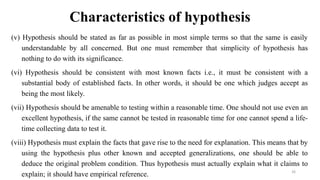
Characteristics of hypothesis
Hypothesis must possess the following characteristics:
(i) Hypothesis should be clear and precise. If the hypothesis is not clear and precise, the
inferences drawn on its basis cannot be taken as reliable.
(ii) Hypothesis should be capable of being tested. In a swamp of untestable hypotheses, many
a time the research programs have bogged down. Some prior study may be done by
researcher in order to make hypothesis a testable one. A hypothesis “is testable if other
deductions can be made from it which, in turn, can be confirmed or disproved by
observation”.
(iii) Hypothesis should state relationship between variables, if it happens to be a relational
hypothesis.
(iv) Hypothesis should be limited in scope and must be specific. A researcher must remember
that narrower hypotheses are generally more testable and he should develop such
hypotheses.
25
Contd.
Characteristics of hypothesis
(v) Hypothesis should be stated as far as possible in most simple terms so that the same is easily
understandable by all concerned. But one must remember that simplicity of hypothesis has
nothing to do with its significance.
(vi) Hypothesis should be consistent with most known facts i.e., it must be consistent with a
substantial body of established facts. In other words, it should be one which judges accept as
being the most likely.
(vii) Hypothesis should be amenable to testing within a reasonable time. One should not use even an
excellent hypothesis, if the same cannot be tested in reasonable time for one cannot spend a life-
time collecting data to test it.
(viii) Hypothesis must explain the facts that gave rise to the need for explanation. This means that by
using the hypothesis plus other known and accepted generalizations, one should be able to
deduce the original problem condition. Thus hypothesis must actually explain what it claims to
explain; it should have empirical reference. 26
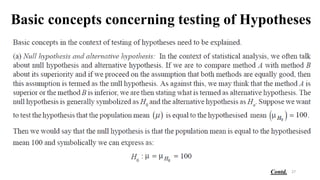
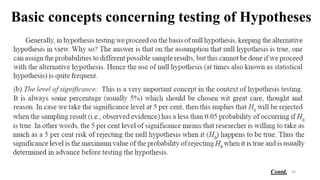
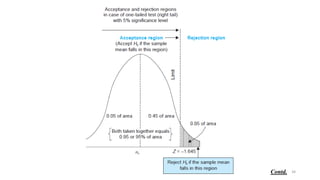
Basic concepts concerning testing of Hypotheses
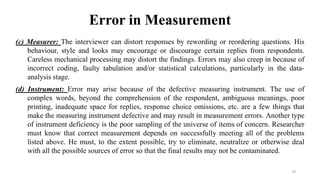
27
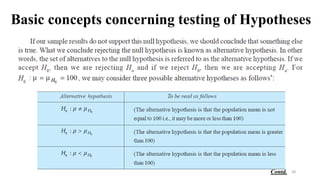
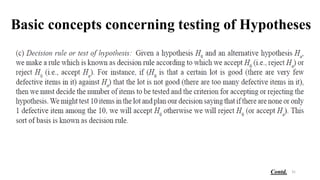
Contd.
Basic concepts concerning testing of Hypotheses
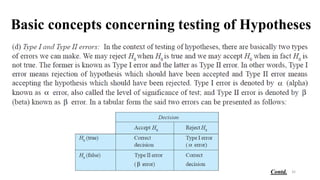
28
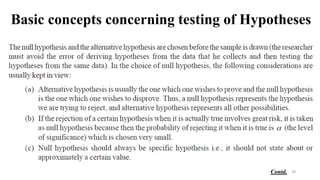
Contd.
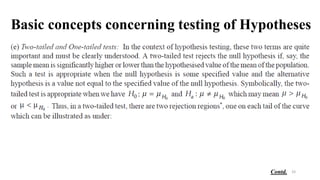
Basic concepts concerning testing of Hypotheses
29
Contd.
Basic concepts concerning testing of Hypotheses
30
Contd.
Basic concepts concerning testing of Hypotheses
31
Contd.
Basic concepts concerning testing of Hypotheses
32
Contd.
Basic concepts concerning testing of Hypotheses
33
Contd.
34
Contd.
Basic concepts concerning testing of Hypotheses
35
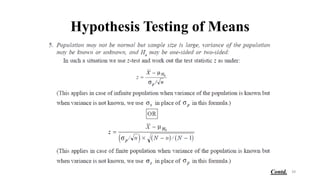
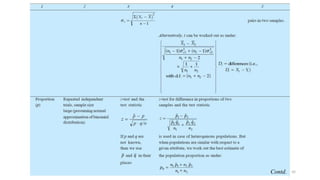
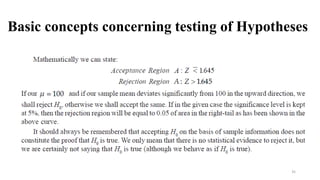
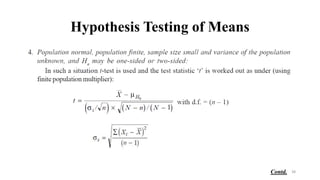
Hypothesis Testing of Means
36
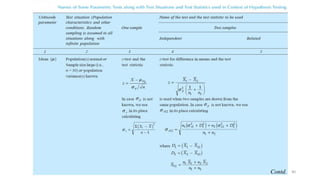
Contd.
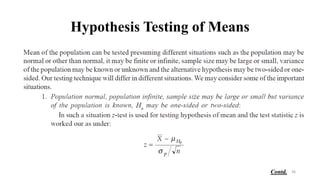
Hypothesis Testing of Means
37
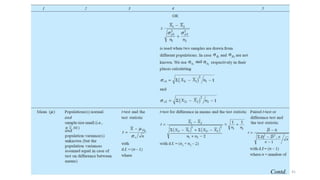
Contd.
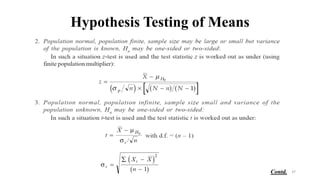
Hypothesis Testing of Means
38
Contd.
Hypothesis Testing of Means
39
Contd.
40
Contd.
41
Contd.
42
Contd.
43
Contd.
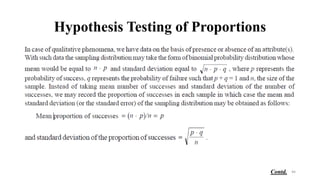
Hypothesis Testing of Proportions
44
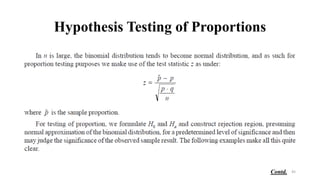
Contd.
Hypothesis Testing of Proportions
45
Contd.
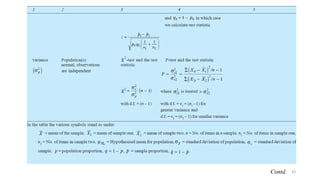
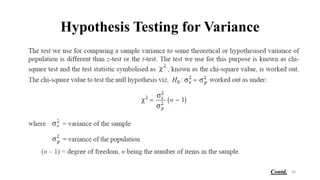
Hypothesis Testing for Variance
46
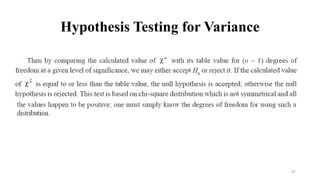
Contd.
Hypothesis Testing for Variance
47
Technique involved in defining a Problem
• Defining a research problem properly and clearly is a crucial part of a
research study and must in no case be accomplished hurriedly.
• However, in practice this a frequently overlooked which causes a lot of
problems later on. Hence, the research problem should be defined in a
systematic manner, giving due weightage to all relating points.
• The technique for the purpose involves the undertaking of the following
steps generally one after the other: (i) statement of the problem in a general
way; (ii) understanding the nature of the problem; (iii) surveying the
available literature (iv) developing the ideas through discussions; and (v)
rephrasing the research problem into a working proposition.
48
Contd.
Technique involved in defining a Problem
(i) Statement of the problem in a general way:
• First of all the problem should be stated in a broad general way, keeping in view either some practical
concern or some scientific or intellectual interest. For this purpose, the researcher must immerse himself
thoroughly in the subject matter concerning which he wishes to pose a problem.
• In case of social research, it is considered advisable to do some field observation and as such the
researcher may undertake some sort of preliminary survey or what is often called pilot survey. Then the
researcher can himself state the problem or he can seek the guidance of the guide or the subject expert in
accomplishing this task.
• Often, the guide puts forth the problem in general terms, and it is then up to the researcher to narrow it
down and phrase the problem in operational terms. In case there is some directive from an organizational
authority, the problem then can be stated accordingly.
• The problem stated in a broad general way may contain various ambiguities which must be resolved by
cool thinking and rethinking over the problem. At the same time the feasibility of a particular solution has
to be considered and the same should be kept in view while stating the problem.
49
Contd.
Technique involved in defining a Problem
(ii) Understanding the nature of the problem:
• The next step in defining the problem is to understand its origin and nature clearly. The
best way of understanding the problem is to discuss it with those who first raised it in
order to find out how the problem originally came about and with what objectives in
view.
• If the researcher has stated the problem himself, he should consider once again all those
points that induced him to make a general statement concerning the problem.
• For a better understanding of the nature of the problem involved, he can enter into
discussion with those who have a good knowledge of the problem concerned or similar
other problems. The researcher should also keep in view the environment within which
the problem is to be studied and understood.
50
Contd.
Technique involved in defining a Problem
(iii) Surveying the available literature:
• All available literature concerning the problem at hand must necessarily be surveyed and examined
before a definition of the research problem is given. This means that the researcher must be well-
conversant with relevant theories in the field, reports and records as also all other relevant literature.
• “Knowing what data are available often serves to narrow the problem itself as well as the technique that
might be used”. This would also help a researcher to know if there are certain gaps in the theories, or
whether the existing theories applicable to the problem under study are inconsistent with each other, or
whether the findings of the different studies do not follow a pattern consistent with the theoretical
expectations and so on.
• All this will enable a researcher to take new strides in the field for furtherance of knowledge i.e., he can
move up starting from the existing premise. Studies on related problems are useful for indicating the type
of difficulties that may be encountered in the present study as also the possible analytical shortcomings.
At times such studies may also suggest useful and even new lines of approach to the present problem.
51
Contd.
Technique involved in defining a Problem
(iv) Developing the ideas through discussions:
• Discussion concerning a problem often produces useful information. Various new ideas
can be developed through such an exercise.
• Hence, a researcher must discuss his problem with his colleagues and others who have
enough experience in the same area or in working on similar problems. This is quite often
known as an experience survey.
• People with rich experience are in a position to enlighten the researcher on different
aspects of his proposed study and their advice and comments are usually invaluable to the
researcher.
• They help him sharpen his focus of attention on specific aspects within the field.
Discussions with such persons should not only be confined to the formulation of the
specific problem at hand, but should also be concerned with the general approach to the
given problem, techniques that might be used, possible solutions, etc.
52
Contd.
Technique involved in defining a Problem
(v) Rephrasing the research problem:
• Finally, the researcher must sit to rephrase the research problem into a
working proposition.
• Once the nature of the problem has been clearly understood, the
environment has been defined, discussions over the problem have taken
place and the available literature has been surveyed and examined,
rephrasing the problem into analytical or operational terms is not a difficult
task.
• Through rephrasing, the researcher puts the research problem in as specific
terms as possible so that it may become operationally viable and may help
in the development of working hypotheses.
53
Contd.
Technique involved in defining a Problem
In addition to what has been stated above, the following points must also be observed while
defining a research problem:
(a) Technical terms and words or phrases, with special meanings used in the statement of the
problem, should be clearly defined.
(b) Basic assumptions or postulates (if any) relating to the research problem should be clearly
stated.
(c) A straight forward statement of the value of the investigation (i.e., the criteria for the
selection of the problem) should be provided.
(d) The suitability of the time-period and the sources of data available must also be
considered by the researcher in defining the problem.
(e) The scope of the investigation or the limits within which the problem is to be studied must
be mentioned explicitly in defining a research problem.
54
SAMPLING DESIGN –
Census and Sample Survey
• All items in any field of inquiry constitute a ‘Universe’ or ‘Population.’ A complete
enumeration of all items in the ‘population’ is known as a census inquiry. It can be
presumed that in such an inquiry, when all items are covered, no element of chance is
left and highest accuracy is obtained.
• But in practice this may not be true. Even the slightest element of bias in such an inquiry
will get larger and larger as the number of observation increases. Moreover, there is no
way of checking the element of bias or its extent except through a resurvey or use of
sample checks.
• Besides, this type of inquiry involves a great deal of time, money and energy. Therefore,
when the field of inquiry is large, this method becomes difficult to adopt because of the
resources involved. At times, this method is practically beyond the reach of ordinary
researchers. 55
Contd.
SAMPLING DESIGN –
Census and Sample Survey
• Perhaps, government is the only institution which can get the complete
enumeration carried out. Even the government adopts this in very rare cases
such as population census conducted once in a decade.
• Further, many a time it is not possible to examine every item in the
population, and sometimes it is possible to obtain sufficiently accurate
results by studying only a part of total population. In such cases there is no
utility of census surveys.
• However, it needs to be emphasised that when the universe is a small one, it
is no use resorting to a sample survey. When field studies are undertaken in
practical life, considerations of time and cost almost invariably lead to a
selection of respondents i.e., selection of only a few items.
56
Contd.
SAMPLING DESIGN –
Census and Sample Survey
57
• The respondents selected should be as representative of the total population as
possible in order to produce a miniature cross-section.
• The selected respondents constitute what is technically called a ‘sample’ and the
selection process is called ‘sampling technique.’ The survey so conducted is
known as ‘sample survey’.
• Algebraically, let the population size be N and if a part of size n (which is < N)
of this population is selected according to some rule for studying some
characteristic of the population, the group consisting of these n units is known as
‘sample’.
• Researcher must prepare a sample design for his study i.e., he must plan how a
sample should be selected and of what size such a sample would be.
MEASUREMENT AND SCALING TECHNIQUES -
Measurement in Research
• In our daily life we are said to measure when we use some yardstick to determine
weight, height, or some other feature of a physical object. We also measure when we
judge how well we like a song, a painting or the personalities of our friends.
• We, thus, measure physical objects as well as abstract concepts. Measurement is a
relatively complex and demanding task, specially so when it concerns qualitative or
abstract phenomena.
• By measurement we mean the process of assigning numbers to objects or
observations, the level of measurement being a function of the rules under which the
numbers are assigned.
• It is easy to assign numbers in respect of properties of some objects, but it is
relatively difficult in respect of others.
58
Contd.
Measurement in Research
• For instance, measuring such things as social conformity, intelligence, or
marital adjustment is much less obvious and requires much closer attention
than measuring physical weight, biological age or a person’s financial
assets.
• In other words, properties like weight, height, etc., can be measured directly
with some standard unit of measurement, but it is not that easy to measure
properties like motivation to succeed, ability to stand stress and the like.
• We can expect high accuracy in measuring the length of pipe with a yard
stick, but if the concept is abstract and the measurement tools are not
standardized, we are less confident about the accuracy of the results of
measurement.
59
Contd.
Measurement in Research
• Technically speaking, measurement is a process of mapping aspects of a domain onto other aspects of a
range according to some rule of correspondence.
• In measuring, we devise some form of scale in the range (in terms of set theory, range may refer to
some set) and then transform or map the properties of objects from the domain (in terms of set theory,
domain may refer to some other set) onto this scale.
• For example, in case we are to find the male to female attendance ratio while conducting a study of
persons who attend some show, then we may tabulate those who come to the show according to sex.
• In terms of set theory, this process is one of mapping the observed physical properties of those coming
to the show (the domain) on to a sex classification (the range).
• The rule of correspondence is: If the object in the domain appears to be male, assign to “0” and if
female assign to “1”.
• Similarly, we can record a person’s marital status as 1, 2, 3 or 4, depending on whether the person is
single, married, widowed or divorced. 60
Contd.
Measurement in Research
• We can as well record “Yes or No” answers to a question as “0” and “1” (or as 1 and 2 or perhaps as 59
and 60).
• In this artificial or nominal way, categorical data (qualitative or descriptive) can be made into numerical
data and if we thus code the various categories, we refer to the numbers we record as nominal data.
• Nominal data are numerical in name only, because they do not share any of the properties of the numbers
we deal in ordinary arithmetic.
• For instance if we record marital status as 1, 2, 3, or 4 as stated above, we cannot write 4 > 2 or 3 < 4 and
we cannot write 3 – 1 = 4 – 2, 1 + 3 = 4 or 4 ¸ 2 = 2.
• In those situations when we cannot do anything except set up inequalities, we refer to the data as ordinal
data.
• For instance, if one mineral can scratch another, it receives a higher hardness number and on Mohs’ scale
the numbers from 1 to 10 are assigned respectively to talc, gypsum, calcite, fluorite, apatite, feldspar,
quartz, topaz, sapphire and diamond.
61
Contd.
Measurement in Research
• With these numbers we can write 5 > 2 or 6 < 9 as apatite is harder than gypsum and
feldspar is softer than sapphire, but we cannot write for example 10 – 9 = 5 – 4,
because the difference in hardness between diamond and sapphire is actually much
greater than that between apatite and fluorite.
• It would also be meaningless to say that topaz is twice as hard as fluorite simply
because their respective hardness numbers on Mohs’ scale are 8 and 4.
• The greater than symbol (i.e., >) in connection with ordinal data may be used to
designate “happier than” “preferred to” and so on.
• When in addition to setting up inequalities we can also form differences, we refer to
the data as interval data.
62
Contd.
Measurement in Research
• When in addition to setting up inequalities and forming differences we can also
form quotients (i.e., when we can perform all the customary operations of
mathematics), we refer to such data as ratio data.
• In this sense, ratio data includes all the usual measurement (or determinations) of
length, height, money amounts, weight, volume, area, pressures etc.
• The above stated distinction between nominal, ordinal, interval and ratio data is
important for the nature of a set of data may suggest the use of particular statistical
techniques.
• A researcher has to be quite alert about this aspect while measuring properties of
objects or of abstract concepts.
63
Measurement Scales
From what has been stated above, we can write that scales of measurement can
be considered in terms of their mathematical properties. The most widely used
classification of measurement scales are: (a) nominal scale; (b) ordinal scale; (c)
interval scale; and (d) ratio scale.
(a) Nominal scale:
• Nominal scale is simply a system of assigning number symbols to events in order to
label them. The usual example of this is the assignment of numbers of basketball
players in order to identify them.
• Such numbers cannot be considered to be associated with an ordered scale for their
order is of no consequence; the numbers are just convenient labels for the particular
class of events and as such have no quantitative value.
• Nominal scales provide convenient ways of keeping track of people, objects and
events. One cannot do much with the numbers involved.
64
Contd.
Measurement Scales
• There is no generally used measure of dispersion for nominal scales. Chi-square test is the most
common test of statistical significance that can be utilized, and for the measures of correlation,
the contingency coefficient can be worked out.
• Nominal scale is the least powerful level of measurement. It indicates no order or distance
relationship and has no arithmetic origin.
• A nominal scale simply describes differences between things by assigning them to categories.
• Nominal data are, thus, counted data. The scale wastes any information that we may have about
varying degrees of attitude, skills, understandings, etc.
• In spite of all this, nominal scales are still very useful and are widely used in surveys and other
ex-post-facto research when data are being classified by major sub-groups of the population.
65
Contd.
Measurement Scales
66
(b) Ordinal scale:
• The lowest level of the ordered scale that is commonly used is the ordinal scale. The ordinal
scale places events in order, but there is no attempt to make the intervals of the scale equal in
terms of some rule.
• Rank orders represent ordinal scales and are frequently used in research relating to qualitative
phenomena. A student’s rank in his graduation class involves the use of an ordinal scale.
• One has to be very careful in making statement about scores based on ordinal scales. For
instance, if Ram’s position in his class is 10 and Mohan’s position is 40, it cannot be said that
Ram’s position is four times as good as that of Mohan. The statement would make no sense at
all.
• Ordinal scales only permit the ranking of items from highest to lowest. Ordinal measures have
no absolute values, and the real differences between adjacent ranks may not be equal.
• All that can be said is that one person is higher or lower on the scale than another, but more
precise comparisons cannot be made.
Contd.
Measurement Scales
(c) Interval scale:
• In the case of interval scale, the intervals are adjusted in terms of some rule that has been established as a
basis for making the units equal. The units are equal only in so far as one accepts the assumptions on which
the rule is based.
• Interval scales can have an arbitrary zero, but it is not possible to determine for them what may be called an
absolute zero or the unique origin. The primary limitation of the interval scale is the lack of a true zero; it
does not have the capacity to measure the complete absence of a trait or characteristic.
• The Fahrenheit scale is an example of an interval scale and shows similarities in what one can and cannot do
with it. One can say that an increase in temperature from 30° to 40° involves the same increase in
temperature as an increase from 60° to 70°, but one cannot say that the temperature of 60° is twice as warm
as the temperature of 30° because both numbers are dependent on the fact that the zero on the scale is set
arbitrarily at the temperature of the freezing point of water.
• The ratio of the two temperatures, 30° and 60°, means nothing because zero is an arbitrary point. Interval
scales provide more powerful measurement than ordinal scales for interval scale also incorporates the
concept of equality of interval. 67
Contd.
Measurement Scales
(d) Ratio scale:
• Ratio scales have an absolute or true zero of measurement. The term ‘absolute zero’ is not as precise as it
was once believed to be.
• We can conceive of an absolute zero of length and similarly we can conceive of an absolute zero of time.
• For example, the zero point on a centimeter scale indicates the complete absence of length or height. But
an absolute zero of temperature is theoretically unobtainable and it remains a concept existing only in the
scientist’s mind. The number of minor traffic-rule violations and the number of incorrect letters in a page
of type script represent scores on ratio scales.
• Both these scales have absolute zeros and as such all minor traffic violations and all typing errors can be
assumed to be equal in significance.
• With ratio scales involved one can make statements like “Jyoti’s” typing performance was twice as good as
that of “Reetu.”
• The ratio involved does have significance and facilitates a kind of comparison which is not possible in case
of an interval scale. 68
Error in Measurement
Measurement should be precise and unambiguous in an ideal research study. This
objective, however, is often not met with in entirety. As such the researcher must be aware
about the sources of error in measurement. The following are the possible sources of error
in measurement.
(a) Respondent: At times the respondent may be reluctant to express strong negative
feelings or it is just possible that he may have very little knowledge but may not admit
his ignorance. All this reluctance is likely to result in an interview of ‘guesses.’
Transient factors like fatigue, boredom, anxiety, etc. may limit the ability of the
respondent to respond accurately and fully.
(b) Situation: Situational factors may also come in the way of correct measurement. Any
condition which places a strain on interview can have serious effects on the
interviewer-respondent rapport. For instance, if someone else is present, he can distort
responses by joining in or merely by being present. If the respondent feels that
anonymity is not assured, he may be reluctant to express certain feelings.
69
Contd.
Error in Measurement
70
(c) Measurer: The interviewer can distort responses by rewording or reordering questions. His
behaviour, style and looks may encourage or discourage certain replies from respondents.
Careless mechanical processing may distort the findings. Errors may also creep in because of
incorrect coding, faulty tabulation and/or statistical calculations, particularly in the data-
analysis stage.
(d) Instrument: Error may arise because of the defective measuring instrument. The use of
complex words, beyond the comprehension of the respondent, ambiguous meanings, poor
printing, inadequate space for replies, response choice omissions, etc. are a few things that
make the measuring instrument defective and may result in measurement errors. Another type
of instrument deficiency is the poor sampling of the universe of items of concern. Researcher
must know that correct measurement depends on successfully meeting all of the problems
listed above. He must, to the extent possible, try to eliminate, neutralize or otherwise deal
with all the possible sources of error so that the final results may not be contaminated.

Research Methodology and Research Types discussion

  • 1.
    Unit - 1 Introductionto Research Methodology and Sampling Design 1
  • 2.
    Introduction • Research incommon parlance refers to a search for knowledge. Once can also define research as a scientific and systematic search for pertinent information on a specific topic. In fact, research is an art of scientific investigation. • The Advanced Learner’s Dictionary of Current English lays down the meaning of research as “a careful investigation or inquiry specially through search for new facts in any branch of knowledge.” • Redman and Mory define research as a “systematized effort to gain new knowledge.” • Some people consider research as a movement, a movement from the known to the unknown. It is actually a voyage of discovery. 2 Contd.
  • 3.
    Introduction • Research isan academic activity and as such the term should be used in a technical sense. • According to Clifford Woody research comprises defining and redefining problems, formulating hypothesis or suggested solutions; collecting, organizing and evaluating data; making deductions and reaching conclusions; and at last carefully testing the conclusions to determine whether they fit the formulating hypothesis. • In short, the search for knowledge through objective and systematic method of finding solution to a problem is research. The systematic approach concerning generalization and the formulation of a theory is also research. 3
  • 4.
    OBJECTIVES OF RESEARCH Thepurpose of research is to discover answers to questions through the application of scientific procedures. The main aim of research is to find out the truth which is hidden and which has not been discovered as yet. Though each research study has its own specific purpose, we may think of research objectives as falling into a number of following broad groupings: 1. To gain familiarity with a phenomenon or to achieve new insights into it (studies with this object in view are termed as exploratory or formulative research studies); 2. To portray accurately the characteristics of a particular individual, situation or a group (studies with this object in view are known as descriptive research studies); 3. To determine the frequency with which something occurs or with which it is associated with something else (studies with this object in view are known as diagnostic research studies); 4. To test a hypothesis of a causal relationship between variables (such studies are known as hypothesis-testing research studies). 4
  • 5.
    MOTIVATION IN RESEARCH Thepossible motives for doing research may be either one or more of the following: 1. Desire to get a research degree along with its consequential benefits; 2. Desire to face the challenge in solving the unsolved problems, i.e., concern over practical problems initiates research; 3. Desire to get intellectual joy of doing some creative work; 4. Desire to be of service to society; 5. Desire to get respectability. However, this is not an exhaustive list of factors motivating people to undertake research studies. Many more factors such as directives of government, employment conditions, curiosity about new things, desire to understand causal relationships, social thinking and awakening, and the like may as well motivate (or at times compel) people to perform research operations. 5
  • 6.
    TYPES OF RESEARCH Thebasic types of research are as follows: (i) Descriptive vs. Analytical: • Descriptive research includes surveys and fact-finding enquiries of different kinds. The major purpose of descriptive research is description of the state of affairs as it exists at present. • In social science and business research we quite often use the term Ex post facto research for descriptive research studies. The main characteristic of this method is that the researcher has no control over the variables; he can only report what has happened or what is happening. • Most ex post facto research projects are used for descriptive studies in which the researcher seeks to measure such items as, for example, frequency of shopping, preferences of people, or similar data. Ex post facto studies also include attempts by researchers to discover causes even when they cannot control the variables. • The methods of research utilized in descriptive research are survey methods of all kinds, including comparative and correlational methods. In analytical research, on the other hand, the researcher has to use facts or information already available, and analyze these to make a critical evaluation of the material. 6 Contd.
  • 7.
    TYPES OF RESEARCH (ii)Applied vs. Fundamental: • Research can either be applied (or action) research or fundamental (to basic or pure) research. Applied research aims at finding a solution for an immediate problem facing a society or an industrial/business organization, whereas fundamental research is mainly concerned with generalizations and with the formulation of a theory. • “Gathering knowledge for knowledge’s sake is termed ‘pure’ or ‘basic’ research.” Research concerning some natural phenomenon or relating to pure mathematics are examples of fundamental research. • Similarly, research studies, concerning human behavior carried on with a view to make generalizations about human behavior, are also examples of fundamental research, but research aimed at certain conclusions facing a concrete social or business problem is an example of applied research. Research to identify social, economic or political trends that may affect a particular institution or the copy research or the marketing research or evaluation research are examples of applied research. • Thus, the central aim of applied research is to discover a solution for some pressing practical problem, whereas basic research is directed towards finding information that has a broad base of applications and thus, adds to the already existing organized body of scientific knowledge. 7 Contd.
  • 8.
    TYPES OF RESEARCH iii)Quantitative vs. Qualitative: • Quantitative research is based on the measurement of quantity or amount. It is applicable to phenomena that can be expressed in terms of quantity. • Qualitative research, on the other hand, is concerned with qualitative phenomenon, i.e., phenomena relating to or involving quality or kind. For instance, when we are interested in investigating the reasons for human behavior (i.e., why people think or do certain things), we quite often talk of ‘Motivation Research’, an important type of qualitative research. This type of research aims at discovering the underlying motives and desires, using in depth interviews for the purpose. • Other techniques of such research are word association tests, sentence completion tests, story completion tests and similar other projective techniques. Attitude or opinion research i.e., research designed to find out how people feel or what they think about a particular subject or institution is also qualitative research. • Qualitative research is specially important in the behavioral sciences where the aim is to discover the underlying motives of human behavior. Through such research we can analyse the various factors which motivate people to behave in a particular manner or which make people like or dislike a particular thing. 8 Contd.
  • 9.
    TYPES OF RESEARCH (iv)Conceptual vs. Empirical: • Conceptual research is that related to some abstract idea(s) or theory. It is generally used by philosophers and thinkers to develop new concepts or to reinterpret existing ones. On the other hand, empirical research relies on experience or observation alone, often without due regard for system and theory. • It is data-based research, coming up with conclusions which are capable of being verified by observation or experiment. We can also call it as experimental type of research. In such a research it is necessary to get at facts firsthand, at their source, and actively to go about doing certain things to stimulate the production of desired information. • Such research is thus characterised by the experimenter’s control over the variables under study and his deliberate manipulation of one of them to study its effects. Empirical research is appropriate when proof is sought that certain variables affect other variables in some way. Evidence gathered through experiments or empirical studies is today considered to be the most powerful support possible for a given hypothesis. 9 Contd.
  • 10.
    TYPES OF RESEARCH (v)Some Other Types of Research: • All other types of research are variations of one or more of the above stated approaches, based on either the purpose of research, or the time required to accomplish research, on the environment in which research is done, or on the basis of some other similar factor. • Form the point of view of time, we can think of research either as one-time research or longitudinal research. In the former case the research is confined to a single time-period, whereas in the latter case the research is carried on over several time-periods. • Research can be field-setting research or laboratory research or simulation research, depending upon the environment in which it is to be carried out. Research can as well be understood as clinical or diagnostic research. Such research follow case-study methods or indepth approaches to reach the basic causal relations. Such studies usually go deep into the causes of things or events that interest us, using very small samples and very deep probing data gathering devices. 10 Contd.
  • 11.
    TYPES OF RESEARCH (v)Some Other Types of Research: • The research may be exploratory or it may be formalized. The objective of exploratory research is the development of hypotheses rather than their testing, whereas formalized research studies are those with substantial structure and with specific hypotheses to be tested. • Historical research is that which utilizes historical sources like documents, remains, etc. to study events or ideas of the past, including the philosophy of persons and groups at any remote point of time. • Research can also be classified as conclusion-oriented and decision-oriented. While doing conclusion oriented research, a researcher is free to pick up a problem, redesign the enquiry as he proceeds and is prepared to conceptualize as he wishes. • Decision-oriented research is always for the need of a decision maker and the researcher in this case is not free to embark upon research according to his own inclination. Operations research is an example of decision oriented research since it is a scientific method of providing executive departments with a quantitative basis for decisions regarding operations under their control. 11
  • 12.
    Defining the ResearchProblem A research problem, in general, refers to some difficulty which a researcher experiences in the context of either a theoretical or practical situation and wants to obtain a solution for the same. Usually we say that a research problem does exist if the following conditions are met with: 12 Contd.
  • 13.
    Defining the ResearchProblem Over and above these conditions, the individual or the organization can be said to have the problem only if ‘I’ does not know what course of action is best, i.e., ‘I’, must be in doubt about the solution. Thus, an individual or a group of persons can be said to have a problem which can be technically described as a research problem, if they (individual or the group), having one or more desired outcomes, are confronted with two or more courses of action that have some but not equal efficiency for the desired objective(s) and are in doubt about which course of action is best. 13 Contd.
  • 14.
  • 15.
    Research Design • Theformidable problem that follows the task of defining the research problem is the preparation of the design of the research project, popularly known as the “research design”. • Decisions regarding what, where, when, how much, by what means concerning an inquiry or a research study constitute a research design. • “A research design is the arrangement of conditions for collection and analysis of data in a manner that aims to combine relevance to the research purpose with economy in procedure.” • In fact, the research design is the conceptual structure within which research is conducted; it constitutes the blueprint for the collection, measurement and analysis of data. 15 Contd.
  • 16.
    Research Design As suchthe design includes an outline of what the researcher will do from writing the hypothesis and its operational implications to the final analysis of data. More explicitly, one may split the overall research design into the following parts: (a) the sampling design which deals with the method of selecting items to be observed for the given study; (b) the observational design which relates to the conditions under which the observations are to be made; (c) the statistical design which concerns with the question of how many items are to be observed and how the information and data gathered are to be analysed; and (d) the operational design which deals with the techniques by which the procedures specified in the sampling, statistical and observational designs can be carried out. 16 Contd.
  • 17.
    Research Design From whathas been stated above, we can state the important features of a research design as under: (i) It is a plan that specifies the sources and types of information relevant to the research problem. (ii) It is a strategy specifying which approach will be used for gathering and analyzing the data. (iii) It also includes the time and cost budgets since most studies are done under these two constraints. In brief, research design must, at least, contain — (a) a clear statement of the research problem; (b) procedures and techniques to be used for gathering information; (c) the population to be studied; and (d) methods to be used in processing and analysing data. 17
  • 18.
    Need for ResearchDesign • Research design is needed because it facilitates the smooth sailing of the various research operations, thereby making research as efficient as possible yielding maximal information with minimal expenditure of effort, time and money. • Just as for better, economical and attractive construction of a house, we need a blueprint (or what is commonly called the map of the house) well thought out and prepared by an expert architect, similarly we need a research design or a plan in advance of data collection and analysis for our research project. • Research design stands for advance planning of the methods to be adopted for collecting the relevant data and the techniques to be used in their analysis, keeping in view the objective of the research and the availability of staff, time and money. 18 Contd.
  • 19.
    Need for ResearchDesign • Preparation of the research design should be done with great care as any error in it may upset the entire project. • Research design, in fact, has a great bearing on the reliability of the results arrived at and as such constitutes the firm foundation of the entire edifice of the research work. • Even then the need for a well thought out research design is at times not realized by many. The importance which this problem deserves is not given to it. As a result many researches do not serve the purpose for which they are undertaken. • In fact, they may even give misleading conclusions. Thoughtlessness in designing the research project may result in rendering the research exercise futile. 19 Contd.
  • 20.
    Need for ResearchDesign • It is, therefore, imperative that an efficient and appropriate design must be prepared before starting research operations. • The design helps the researcher to organize his ideas in a form whereby it will be possible for him to look for flaws and inadequacies. • Such a design can even be given to others for their comments and critical evaluation. • In the absence of such a course of action, it will be difficult for the critic to provide a comprehensive review of the proposed study. 20
  • 21.
    Development of workingHypotheses • After extensive literature survey, researcher should state in clear terms the working hypothesis or hypotheses. • Working hypothesis is tentative assumption made in order to draw out and test its logical or empirical consequences. As such the manner in which research hypotheses are developed is particularly important since they provide the focal point for research. • They also affect the manner in which tests must be conducted in the analysis of data and indirectly the quality of data which is required for the analysis. In most types of research, the development of working hypothesis plays an important role. Hypothesis should be very specific and limited to the piece of research in hand because it has to be tested. • The role of the hypothesis is to guide the researcher by delimiting the area of research and to keep him on the right track. It sharpens his thinking and focuses attention on the more important facets of the problem. It also indicates the type of data required and the type of methods of data analysis to be used. 21 Contd.
  • 22.
    Development of workingHypotheses How does one go about developing working hypotheses? The answer is by using the following approach: (a) Discussions with colleagues and experts about the problem, its origin and the objectives in seeking a solution; (b) Examination of data and records, if available, concerning the problem for possible trends, peculiarities and other clues; (c) Review of similar studies in the area or of the studies on similar problems; (d) Exploratory personal investigation which involves original field interviews on a limited scale with interested parties and individuals with a view to secure greater insight into the practical aspects of the problem. Thus, working hypotheses arise as a result of a-priori thinking about the subject, examination of the available data and material including related studies and the counsel of experts and interested parties. Working hypotheses are more useful when stated in precise and clearly defined terms. 22
  • 23.
    Testing of hypothesis •Hypothesis is usually considered as the principal instrument in research. • Its main function is to suggest new experiments and observations. In fact, many experiments are carried out with the deliberate object of testing hypotheses. • Decision-makers often face situations wherein they are interested in testing hypotheses on the basis of available information and then take decisions on the basis of such testing. • Ordinarily, when one talks about hypothesis, one simply means a mere assumption or some supposition to be proved or disproved. • But for a researcher hypothesis is a formal question that he intends to resolve. • Thus a hypothesis may be defined as a proposition or a set of proposition set forth as an explanation for the occurrence of some specified group of phenomena either asserted merely as a provisional conjecture to guide some investigation or accepted as highly probable in the light of established facts. 23 Contd.
  • 24.
    Testing of hypothesis •Quite often a research hypothesis is a predictive statement, capable of being tested by scientific methods, that relates an independent variable to some dependent variable. • For example, consider statements like the following ones: “Students who receive counselling will show a greater increase in creativity than students not receiving counselling” Or “the automobile A is performing as well as automobile B.” These are hypotheses capable of being objectively verified and tested. Thus, we may conclude that a hypothesis states what we are looking for and it is a proposition which can be put to a test to determine its validity. 24
  • 25.
    Characteristics of hypothesis Hypothesismust possess the following characteristics: (i) Hypothesis should be clear and precise. If the hypothesis is not clear and precise, the inferences drawn on its basis cannot be taken as reliable. (ii) Hypothesis should be capable of being tested. In a swamp of untestable hypotheses, many a time the research programs have bogged down. Some prior study may be done by researcher in order to make hypothesis a testable one. A hypothesis “is testable if other deductions can be made from it which, in turn, can be confirmed or disproved by observation”. (iii) Hypothesis should state relationship between variables, if it happens to be a relational hypothesis. (iv) Hypothesis should be limited in scope and must be specific. A researcher must remember that narrower hypotheses are generally more testable and he should develop such hypotheses. 25 Contd.
  • 26.
    Characteristics of hypothesis (v)Hypothesis should be stated as far as possible in most simple terms so that the same is easily understandable by all concerned. But one must remember that simplicity of hypothesis has nothing to do with its significance. (vi) Hypothesis should be consistent with most known facts i.e., it must be consistent with a substantial body of established facts. In other words, it should be one which judges accept as being the most likely. (vii) Hypothesis should be amenable to testing within a reasonable time. One should not use even an excellent hypothesis, if the same cannot be tested in reasonable time for one cannot spend a life- time collecting data to test it. (viii) Hypothesis must explain the facts that gave rise to the need for explanation. This means that by using the hypothesis plus other known and accepted generalizations, one should be able to deduce the original problem condition. Thus hypothesis must actually explain what it claims to explain; it should have empirical reference. 26
  • 27.
    Basic concepts concerningtesting of Hypotheses 27 Contd.
  • 28.
    Basic concepts concerningtesting of Hypotheses 28 Contd.
  • 29.
    Basic concepts concerningtesting of Hypotheses 29 Contd.
  • 30.
    Basic concepts concerningtesting of Hypotheses 30 Contd.
  • 31.
    Basic concepts concerningtesting of Hypotheses 31 Contd.
  • 32.
    Basic concepts concerningtesting of Hypotheses 32 Contd.
  • 33.
    Basic concepts concerningtesting of Hypotheses 33 Contd.
  • 34.
  • 35.
    Basic concepts concerningtesting of Hypotheses 35
  • 36.
    Hypothesis Testing ofMeans 36 Contd.
  • 37.
    Hypothesis Testing ofMeans 37 Contd.
  • 38.
    Hypothesis Testing ofMeans 38 Contd.
  • 39.
    Hypothesis Testing ofMeans 39 Contd.
  • 40.
  • 41.
  • 42.
  • 43.
  • 44.
    Hypothesis Testing ofProportions 44 Contd.
  • 45.
    Hypothesis Testing ofProportions 45 Contd.
  • 46.
    Hypothesis Testing forVariance 46 Contd.
  • 47.
  • 48.
    Technique involved indefining a Problem • Defining a research problem properly and clearly is a crucial part of a research study and must in no case be accomplished hurriedly. • However, in practice this a frequently overlooked which causes a lot of problems later on. Hence, the research problem should be defined in a systematic manner, giving due weightage to all relating points. • The technique for the purpose involves the undertaking of the following steps generally one after the other: (i) statement of the problem in a general way; (ii) understanding the nature of the problem; (iii) surveying the available literature (iv) developing the ideas through discussions; and (v) rephrasing the research problem into a working proposition. 48 Contd.
  • 49.
    Technique involved indefining a Problem (i) Statement of the problem in a general way: • First of all the problem should be stated in a broad general way, keeping in view either some practical concern or some scientific or intellectual interest. For this purpose, the researcher must immerse himself thoroughly in the subject matter concerning which he wishes to pose a problem. • In case of social research, it is considered advisable to do some field observation and as such the researcher may undertake some sort of preliminary survey or what is often called pilot survey. Then the researcher can himself state the problem or he can seek the guidance of the guide or the subject expert in accomplishing this task. • Often, the guide puts forth the problem in general terms, and it is then up to the researcher to narrow it down and phrase the problem in operational terms. In case there is some directive from an organizational authority, the problem then can be stated accordingly. • The problem stated in a broad general way may contain various ambiguities which must be resolved by cool thinking and rethinking over the problem. At the same time the feasibility of a particular solution has to be considered and the same should be kept in view while stating the problem. 49 Contd.
  • 50.
    Technique involved indefining a Problem (ii) Understanding the nature of the problem: • The next step in defining the problem is to understand its origin and nature clearly. The best way of understanding the problem is to discuss it with those who first raised it in order to find out how the problem originally came about and with what objectives in view. • If the researcher has stated the problem himself, he should consider once again all those points that induced him to make a general statement concerning the problem. • For a better understanding of the nature of the problem involved, he can enter into discussion with those who have a good knowledge of the problem concerned or similar other problems. The researcher should also keep in view the environment within which the problem is to be studied and understood. 50 Contd.
  • 51.
    Technique involved indefining a Problem (iii) Surveying the available literature: • All available literature concerning the problem at hand must necessarily be surveyed and examined before a definition of the research problem is given. This means that the researcher must be well- conversant with relevant theories in the field, reports and records as also all other relevant literature. • “Knowing what data are available often serves to narrow the problem itself as well as the technique that might be used”. This would also help a researcher to know if there are certain gaps in the theories, or whether the existing theories applicable to the problem under study are inconsistent with each other, or whether the findings of the different studies do not follow a pattern consistent with the theoretical expectations and so on. • All this will enable a researcher to take new strides in the field for furtherance of knowledge i.e., he can move up starting from the existing premise. Studies on related problems are useful for indicating the type of difficulties that may be encountered in the present study as also the possible analytical shortcomings. At times such studies may also suggest useful and even new lines of approach to the present problem. 51 Contd.
  • 52.
    Technique involved indefining a Problem (iv) Developing the ideas through discussions: • Discussion concerning a problem often produces useful information. Various new ideas can be developed through such an exercise. • Hence, a researcher must discuss his problem with his colleagues and others who have enough experience in the same area or in working on similar problems. This is quite often known as an experience survey. • People with rich experience are in a position to enlighten the researcher on different aspects of his proposed study and their advice and comments are usually invaluable to the researcher. • They help him sharpen his focus of attention on specific aspects within the field. Discussions with such persons should not only be confined to the formulation of the specific problem at hand, but should also be concerned with the general approach to the given problem, techniques that might be used, possible solutions, etc. 52 Contd.
  • 53.
    Technique involved indefining a Problem (v) Rephrasing the research problem: • Finally, the researcher must sit to rephrase the research problem into a working proposition. • Once the nature of the problem has been clearly understood, the environment has been defined, discussions over the problem have taken place and the available literature has been surveyed and examined, rephrasing the problem into analytical or operational terms is not a difficult task. • Through rephrasing, the researcher puts the research problem in as specific terms as possible so that it may become operationally viable and may help in the development of working hypotheses. 53 Contd.
  • 54.
    Technique involved indefining a Problem In addition to what has been stated above, the following points must also be observed while defining a research problem: (a) Technical terms and words or phrases, with special meanings used in the statement of the problem, should be clearly defined. (b) Basic assumptions or postulates (if any) relating to the research problem should be clearly stated. (c) A straight forward statement of the value of the investigation (i.e., the criteria for the selection of the problem) should be provided. (d) The suitability of the time-period and the sources of data available must also be considered by the researcher in defining the problem. (e) The scope of the investigation or the limits within which the problem is to be studied must be mentioned explicitly in defining a research problem. 54
  • 55.
    SAMPLING DESIGN – Censusand Sample Survey • All items in any field of inquiry constitute a ‘Universe’ or ‘Population.’ A complete enumeration of all items in the ‘population’ is known as a census inquiry. It can be presumed that in such an inquiry, when all items are covered, no element of chance is left and highest accuracy is obtained. • But in practice this may not be true. Even the slightest element of bias in such an inquiry will get larger and larger as the number of observation increases. Moreover, there is no way of checking the element of bias or its extent except through a resurvey or use of sample checks. • Besides, this type of inquiry involves a great deal of time, money and energy. Therefore, when the field of inquiry is large, this method becomes difficult to adopt because of the resources involved. At times, this method is practically beyond the reach of ordinary researchers. 55 Contd.
  • 56.
    SAMPLING DESIGN – Censusand Sample Survey • Perhaps, government is the only institution which can get the complete enumeration carried out. Even the government adopts this in very rare cases such as population census conducted once in a decade. • Further, many a time it is not possible to examine every item in the population, and sometimes it is possible to obtain sufficiently accurate results by studying only a part of total population. In such cases there is no utility of census surveys. • However, it needs to be emphasised that when the universe is a small one, it is no use resorting to a sample survey. When field studies are undertaken in practical life, considerations of time and cost almost invariably lead to a selection of respondents i.e., selection of only a few items. 56 Contd.
  • 57.
    SAMPLING DESIGN – Censusand Sample Survey 57 • The respondents selected should be as representative of the total population as possible in order to produce a miniature cross-section. • The selected respondents constitute what is technically called a ‘sample’ and the selection process is called ‘sampling technique.’ The survey so conducted is known as ‘sample survey’. • Algebraically, let the population size be N and if a part of size n (which is < N) of this population is selected according to some rule for studying some characteristic of the population, the group consisting of these n units is known as ‘sample’. • Researcher must prepare a sample design for his study i.e., he must plan how a sample should be selected and of what size such a sample would be.
  • 58.
    MEASUREMENT AND SCALINGTECHNIQUES - Measurement in Research • In our daily life we are said to measure when we use some yardstick to determine weight, height, or some other feature of a physical object. We also measure when we judge how well we like a song, a painting or the personalities of our friends. • We, thus, measure physical objects as well as abstract concepts. Measurement is a relatively complex and demanding task, specially so when it concerns qualitative or abstract phenomena. • By measurement we mean the process of assigning numbers to objects or observations, the level of measurement being a function of the rules under which the numbers are assigned. • It is easy to assign numbers in respect of properties of some objects, but it is relatively difficult in respect of others. 58 Contd.
  • 59.
    Measurement in Research •For instance, measuring such things as social conformity, intelligence, or marital adjustment is much less obvious and requires much closer attention than measuring physical weight, biological age or a person’s financial assets. • In other words, properties like weight, height, etc., can be measured directly with some standard unit of measurement, but it is not that easy to measure properties like motivation to succeed, ability to stand stress and the like. • We can expect high accuracy in measuring the length of pipe with a yard stick, but if the concept is abstract and the measurement tools are not standardized, we are less confident about the accuracy of the results of measurement. 59 Contd.
  • 60.
    Measurement in Research •Technically speaking, measurement is a process of mapping aspects of a domain onto other aspects of a range according to some rule of correspondence. • In measuring, we devise some form of scale in the range (in terms of set theory, range may refer to some set) and then transform or map the properties of objects from the domain (in terms of set theory, domain may refer to some other set) onto this scale. • For example, in case we are to find the male to female attendance ratio while conducting a study of persons who attend some show, then we may tabulate those who come to the show according to sex. • In terms of set theory, this process is one of mapping the observed physical properties of those coming to the show (the domain) on to a sex classification (the range). • The rule of correspondence is: If the object in the domain appears to be male, assign to “0” and if female assign to “1”. • Similarly, we can record a person’s marital status as 1, 2, 3 or 4, depending on whether the person is single, married, widowed or divorced. 60 Contd.
  • 61.
    Measurement in Research •We can as well record “Yes or No” answers to a question as “0” and “1” (or as 1 and 2 or perhaps as 59 and 60). • In this artificial or nominal way, categorical data (qualitative or descriptive) can be made into numerical data and if we thus code the various categories, we refer to the numbers we record as nominal data. • Nominal data are numerical in name only, because they do not share any of the properties of the numbers we deal in ordinary arithmetic. • For instance if we record marital status as 1, 2, 3, or 4 as stated above, we cannot write 4 > 2 or 3 < 4 and we cannot write 3 – 1 = 4 – 2, 1 + 3 = 4 or 4 ¸ 2 = 2. • In those situations when we cannot do anything except set up inequalities, we refer to the data as ordinal data. • For instance, if one mineral can scratch another, it receives a higher hardness number and on Mohs’ scale the numbers from 1 to 10 are assigned respectively to talc, gypsum, calcite, fluorite, apatite, feldspar, quartz, topaz, sapphire and diamond. 61 Contd.
  • 62.
    Measurement in Research •With these numbers we can write 5 > 2 or 6 < 9 as apatite is harder than gypsum and feldspar is softer than sapphire, but we cannot write for example 10 – 9 = 5 – 4, because the difference in hardness between diamond and sapphire is actually much greater than that between apatite and fluorite. • It would also be meaningless to say that topaz is twice as hard as fluorite simply because their respective hardness numbers on Mohs’ scale are 8 and 4. • The greater than symbol (i.e., >) in connection with ordinal data may be used to designate “happier than” “preferred to” and so on. • When in addition to setting up inequalities we can also form differences, we refer to the data as interval data. 62 Contd.
  • 63.
    Measurement in Research •When in addition to setting up inequalities and forming differences we can also form quotients (i.e., when we can perform all the customary operations of mathematics), we refer to such data as ratio data. • In this sense, ratio data includes all the usual measurement (or determinations) of length, height, money amounts, weight, volume, area, pressures etc. • The above stated distinction between nominal, ordinal, interval and ratio data is important for the nature of a set of data may suggest the use of particular statistical techniques. • A researcher has to be quite alert about this aspect while measuring properties of objects or of abstract concepts. 63
  • 64.
    Measurement Scales From whathas been stated above, we can write that scales of measurement can be considered in terms of their mathematical properties. The most widely used classification of measurement scales are: (a) nominal scale; (b) ordinal scale; (c) interval scale; and (d) ratio scale. (a) Nominal scale: • Nominal scale is simply a system of assigning number symbols to events in order to label them. The usual example of this is the assignment of numbers of basketball players in order to identify them. • Such numbers cannot be considered to be associated with an ordered scale for their order is of no consequence; the numbers are just convenient labels for the particular class of events and as such have no quantitative value. • Nominal scales provide convenient ways of keeping track of people, objects and events. One cannot do much with the numbers involved. 64 Contd.
  • 65.
    Measurement Scales • Thereis no generally used measure of dispersion for nominal scales. Chi-square test is the most common test of statistical significance that can be utilized, and for the measures of correlation, the contingency coefficient can be worked out. • Nominal scale is the least powerful level of measurement. It indicates no order or distance relationship and has no arithmetic origin. • A nominal scale simply describes differences between things by assigning them to categories. • Nominal data are, thus, counted data. The scale wastes any information that we may have about varying degrees of attitude, skills, understandings, etc. • In spite of all this, nominal scales are still very useful and are widely used in surveys and other ex-post-facto research when data are being classified by major sub-groups of the population. 65 Contd.
  • 66.
    Measurement Scales 66 (b) Ordinalscale: • The lowest level of the ordered scale that is commonly used is the ordinal scale. The ordinal scale places events in order, but there is no attempt to make the intervals of the scale equal in terms of some rule. • Rank orders represent ordinal scales and are frequently used in research relating to qualitative phenomena. A student’s rank in his graduation class involves the use of an ordinal scale. • One has to be very careful in making statement about scores based on ordinal scales. For instance, if Ram’s position in his class is 10 and Mohan’s position is 40, it cannot be said that Ram’s position is four times as good as that of Mohan. The statement would make no sense at all. • Ordinal scales only permit the ranking of items from highest to lowest. Ordinal measures have no absolute values, and the real differences between adjacent ranks may not be equal. • All that can be said is that one person is higher or lower on the scale than another, but more precise comparisons cannot be made. Contd.
  • 67.
    Measurement Scales (c) Intervalscale: • In the case of interval scale, the intervals are adjusted in terms of some rule that has been established as a basis for making the units equal. The units are equal only in so far as one accepts the assumptions on which the rule is based. • Interval scales can have an arbitrary zero, but it is not possible to determine for them what may be called an absolute zero or the unique origin. The primary limitation of the interval scale is the lack of a true zero; it does not have the capacity to measure the complete absence of a trait or characteristic. • The Fahrenheit scale is an example of an interval scale and shows similarities in what one can and cannot do with it. One can say that an increase in temperature from 30° to 40° involves the same increase in temperature as an increase from 60° to 70°, but one cannot say that the temperature of 60° is twice as warm as the temperature of 30° because both numbers are dependent on the fact that the zero on the scale is set arbitrarily at the temperature of the freezing point of water. • The ratio of the two temperatures, 30° and 60°, means nothing because zero is an arbitrary point. Interval scales provide more powerful measurement than ordinal scales for interval scale also incorporates the concept of equality of interval. 67 Contd.
  • 68.
    Measurement Scales (d) Ratioscale: • Ratio scales have an absolute or true zero of measurement. The term ‘absolute zero’ is not as precise as it was once believed to be. • We can conceive of an absolute zero of length and similarly we can conceive of an absolute zero of time. • For example, the zero point on a centimeter scale indicates the complete absence of length or height. But an absolute zero of temperature is theoretically unobtainable and it remains a concept existing only in the scientist’s mind. The number of minor traffic-rule violations and the number of incorrect letters in a page of type script represent scores on ratio scales. • Both these scales have absolute zeros and as such all minor traffic violations and all typing errors can be assumed to be equal in significance. • With ratio scales involved one can make statements like “Jyoti’s” typing performance was twice as good as that of “Reetu.” • The ratio involved does have significance and facilitates a kind of comparison which is not possible in case of an interval scale. 68
  • 69.
    Error in Measurement Measurementshould be precise and unambiguous in an ideal research study. This objective, however, is often not met with in entirety. As such the researcher must be aware about the sources of error in measurement. The following are the possible sources of error in measurement. (a) Respondent: At times the respondent may be reluctant to express strong negative feelings or it is just possible that he may have very little knowledge but may not admit his ignorance. All this reluctance is likely to result in an interview of ‘guesses.’ Transient factors like fatigue, boredom, anxiety, etc. may limit the ability of the respondent to respond accurately and fully. (b) Situation: Situational factors may also come in the way of correct measurement. Any condition which places a strain on interview can have serious effects on the interviewer-respondent rapport. For instance, if someone else is present, he can distort responses by joining in or merely by being present. If the respondent feels that anonymity is not assured, he may be reluctant to express certain feelings. 69 Contd.
  • 70.
    Error in Measurement 70 (c)Measurer: The interviewer can distort responses by rewording or reordering questions. His behaviour, style and looks may encourage or discourage certain replies from respondents. Careless mechanical processing may distort the findings. Errors may also creep in because of incorrect coding, faulty tabulation and/or statistical calculations, particularly in the data- analysis stage. (d) Instrument: Error may arise because of the defective measuring instrument. The use of complex words, beyond the comprehension of the respondent, ambiguous meanings, poor printing, inadequate space for replies, response choice omissions, etc. are a few things that make the measuring instrument defective and may result in measurement errors. Another type of instrument deficiency is the poor sampling of the universe of items of concern. Researcher must know that correct measurement depends on successfully meeting all of the problems listed above. He must, to the extent possible, try to eliminate, neutralize or otherwise deal with all the possible sources of error so that the final results may not be contaminated.