Presentation of Research WorkHow to make an efficient presentation…?
ContentsThesis WritingHow to make a GOOD presentation
How to Write a Thesis
Tutorial of Two Parts
The Good NewsYou only have to write ONE thesisExcept you French and Germans who have to do a habilitation (highest academic qualification a person can achieve)At the end, you can add “Dr” to your nameGood for upgrades on planes
The Bad NewsWriting a thesis is hard, painful workYou’ve already done the fun part (the research)It’s unlike any other documentThesis writing is not a marketable skill
What is a thesis?An argumentAn exposition of an original piece of researchProbably the largest (most self-indulgent) piece of work you’ll ever doSomething that could be published:E.g. at least one paper in a scholarly journalbut you will probably never publish the whole thesis
Ok, when do I start?So I’m motivatedWhen do I actuallystart writing?6 months before the end of my grant?No, the day you start your  research work.Write it all down!Don’t worry, it’s never too late to start
How do I get started?Do this today:Decide your titleWrite your title pageStart a binderLook at some theses in your areaPlan your argument…You can change things laterBut you can’t change it unless you have something to change!I do really mean it today!Before you go to bed tonight.Tomorrow is too late….!
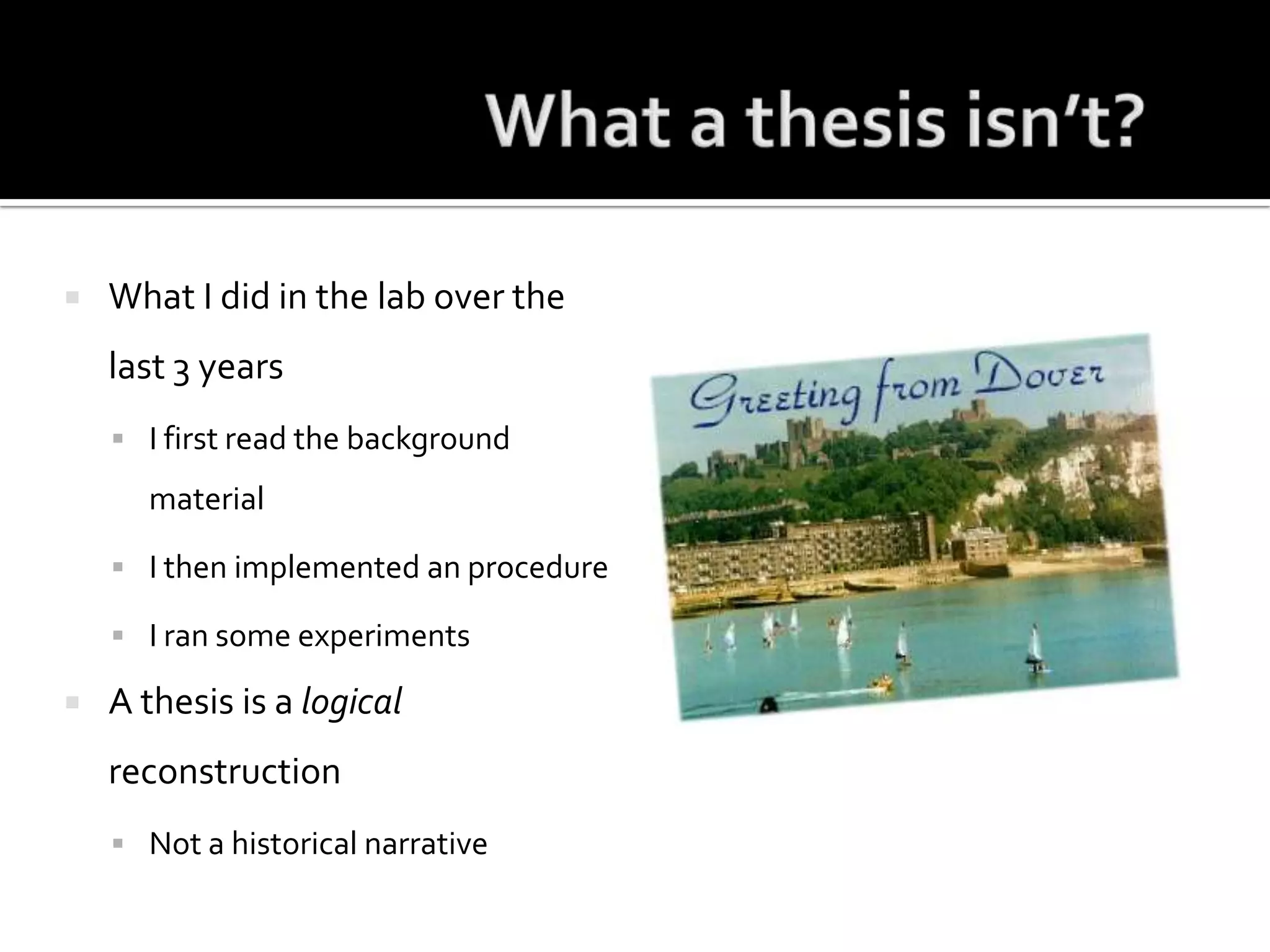
What a thesis isn’t?What I did in the lab over the last 3 yearsI first read the background materialI then implemented an procedureI ran some experiments A thesis is a logical reconstructionNot a historical narrative
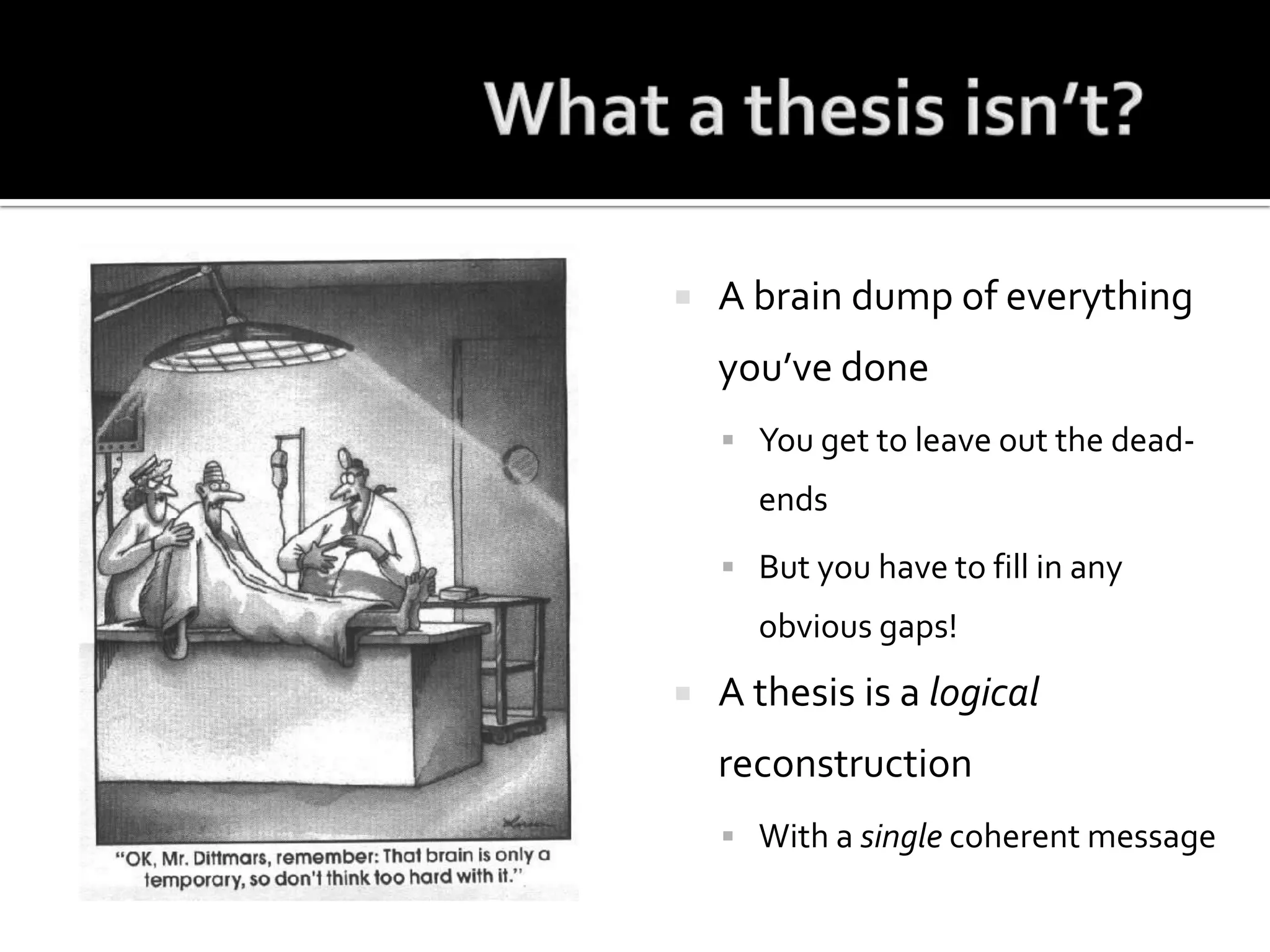
What a thesis isn’t?A brain dump of everything you’ve doneYou get to leave out the dead-endsBut you have to fill in any obvious gaps!A thesis is a logical reconstructionWith a single coherent message
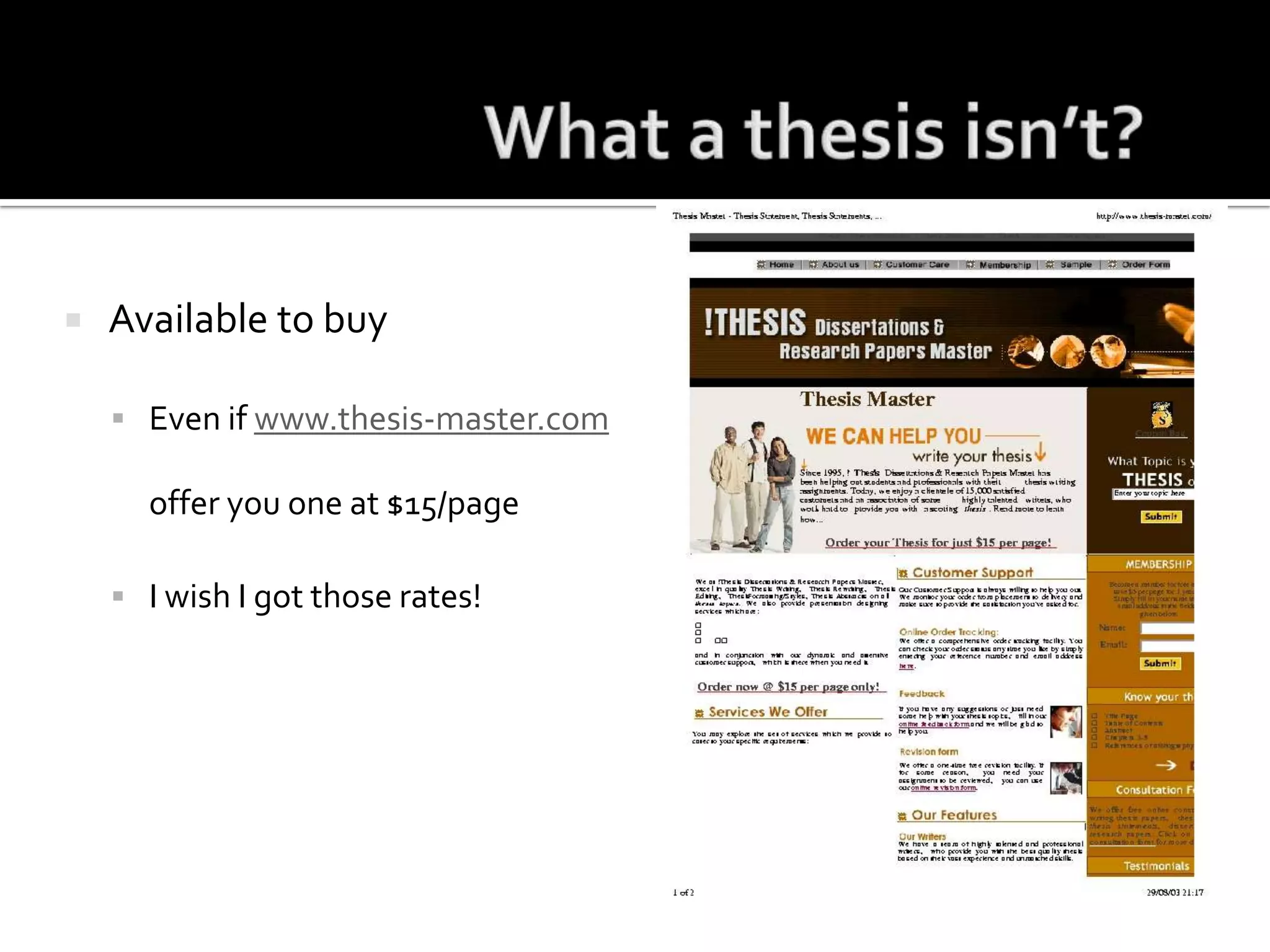
What a thesis isn’t?Available to buyEven if www.thesis-master.com offer you one at $15/pageI wish I got those rates!
What is a thesis?Demonstration of an understanding of the state of the artCritical appreciation of existing workA novel contributionEvaluated systematically
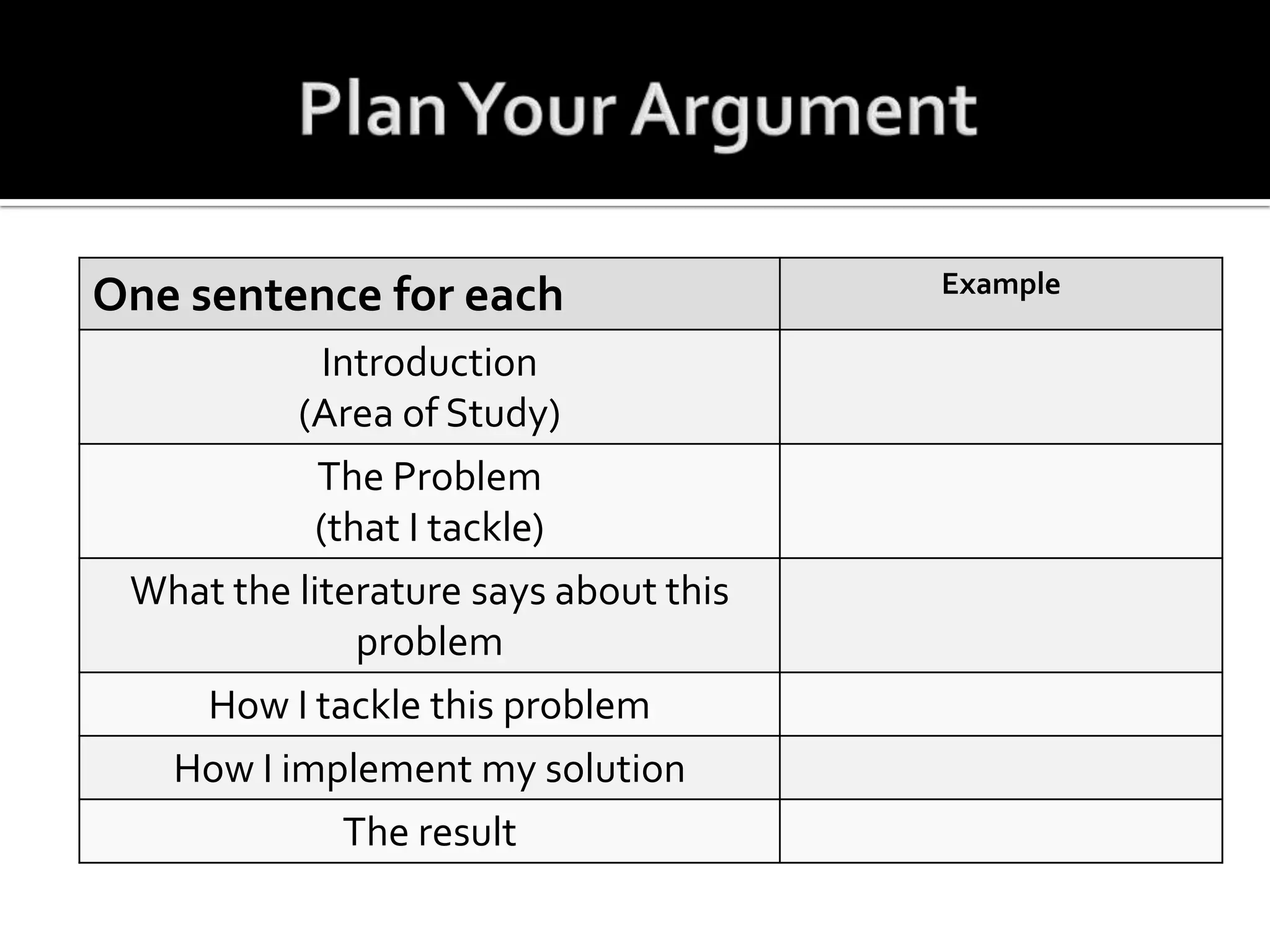
So, how do I start?Write a thesis message1 sentence1 paragraph1 pageEverything you write should be directed at thisThesis (noun). 1. A proposition maintained by argument2. A dissertation advancing original research
Thesis messageYou’re tackling an important research problemE.g. development of a methodYou’ve made an original contribution to its resolution
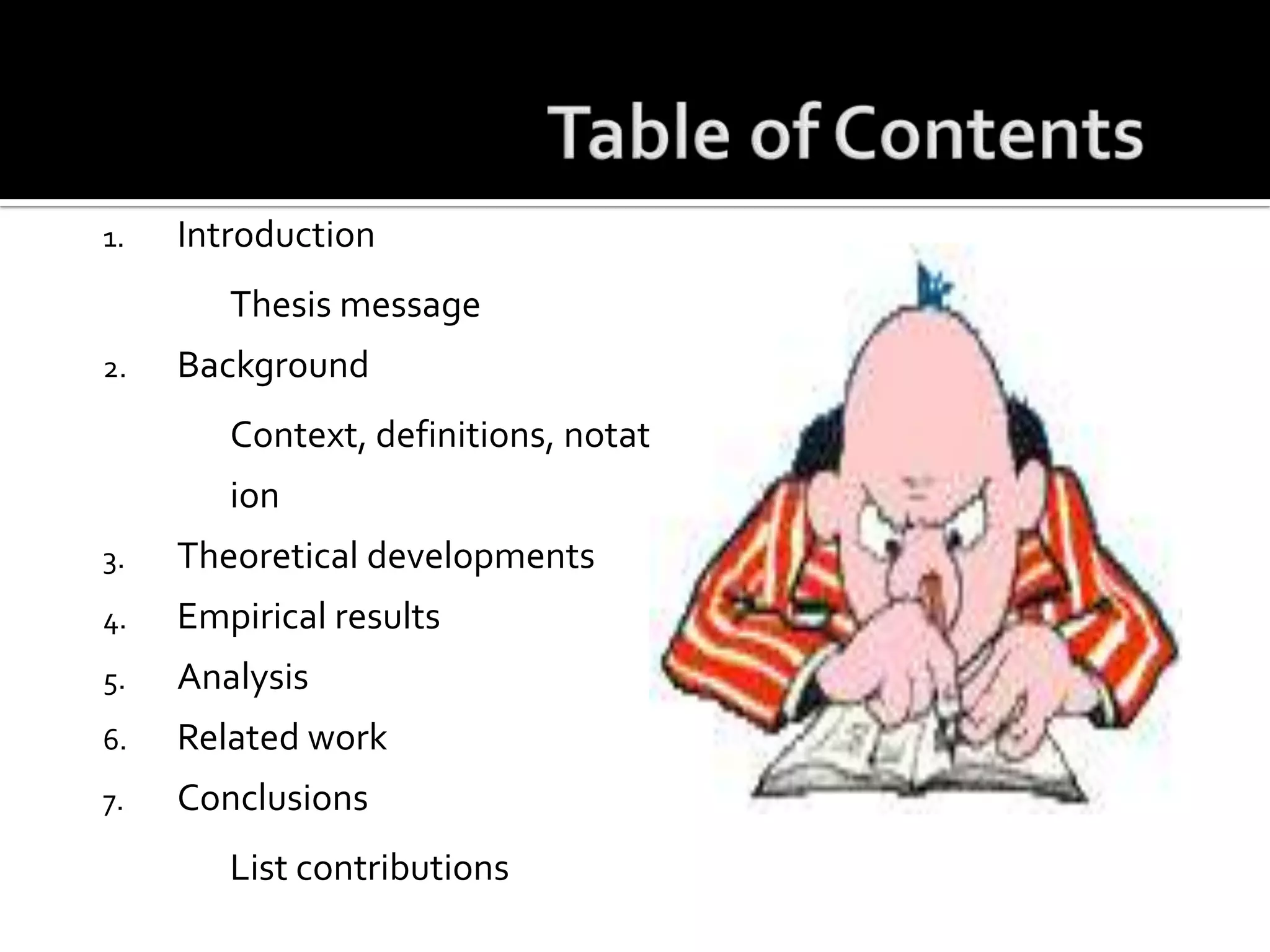
What next?So, I’ve got a good thesis messageWhat do I do next?Write the table of contentsLogical structure of your thesis
Plan Your Argument
Table of ContentsIntroduction	Thesis messageBackground	Context, definitions, notationTheoretical developmentsEmpirical resultsAnalysisRelated workConclusions	List contributions
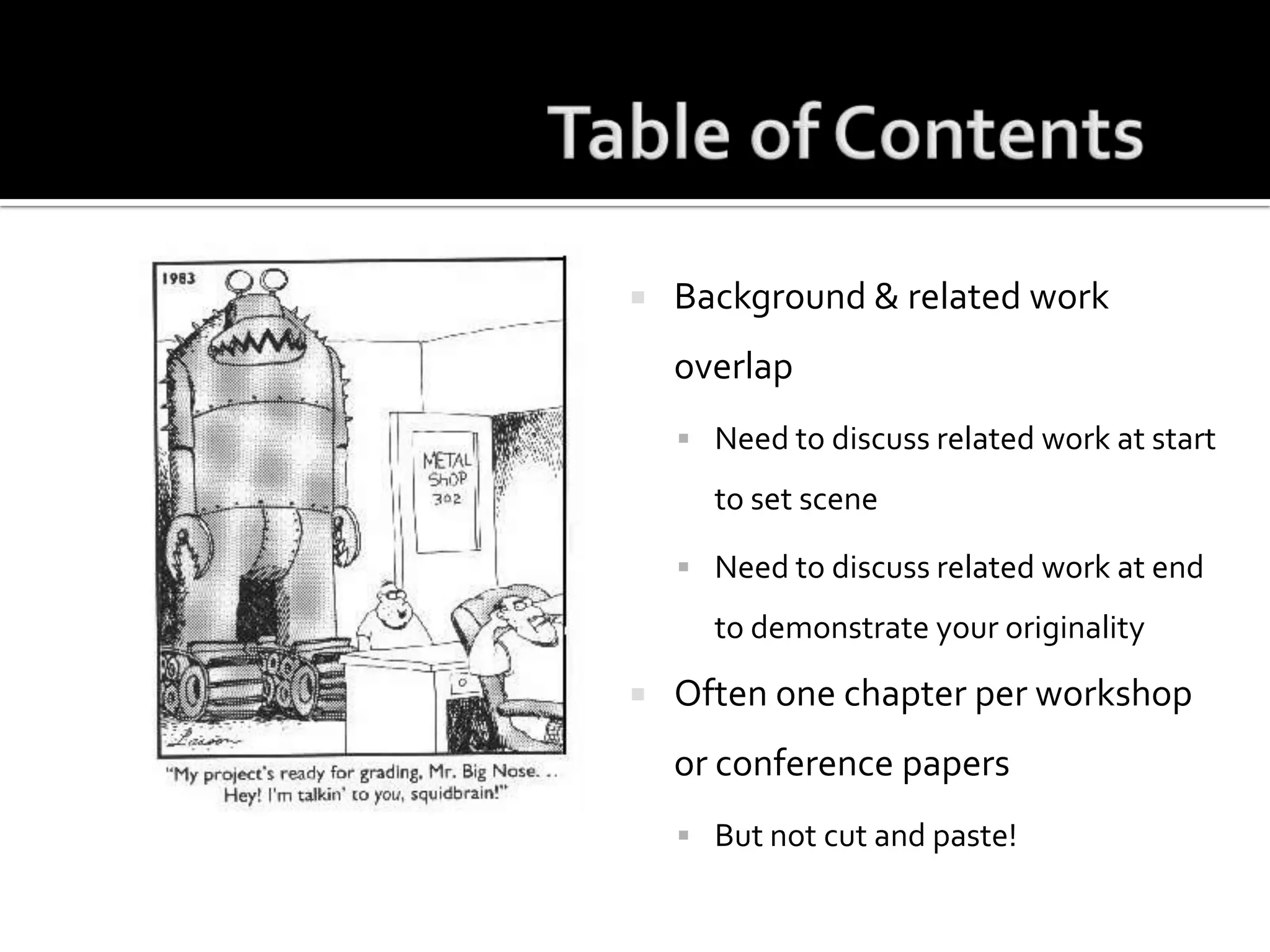
Table of ContentsBackground & related work overlapNeed to discuss related work at start to set sceneNeed to discuss related work at end to demonstrate your originalityOften one chapter per workshop or conference papersBut not cut and paste!
What next?So, I’ve got a good thesis messageAnd a table of contentsWhat do I do next?Make a timetableTargets to meetLight at the end of the tunnel
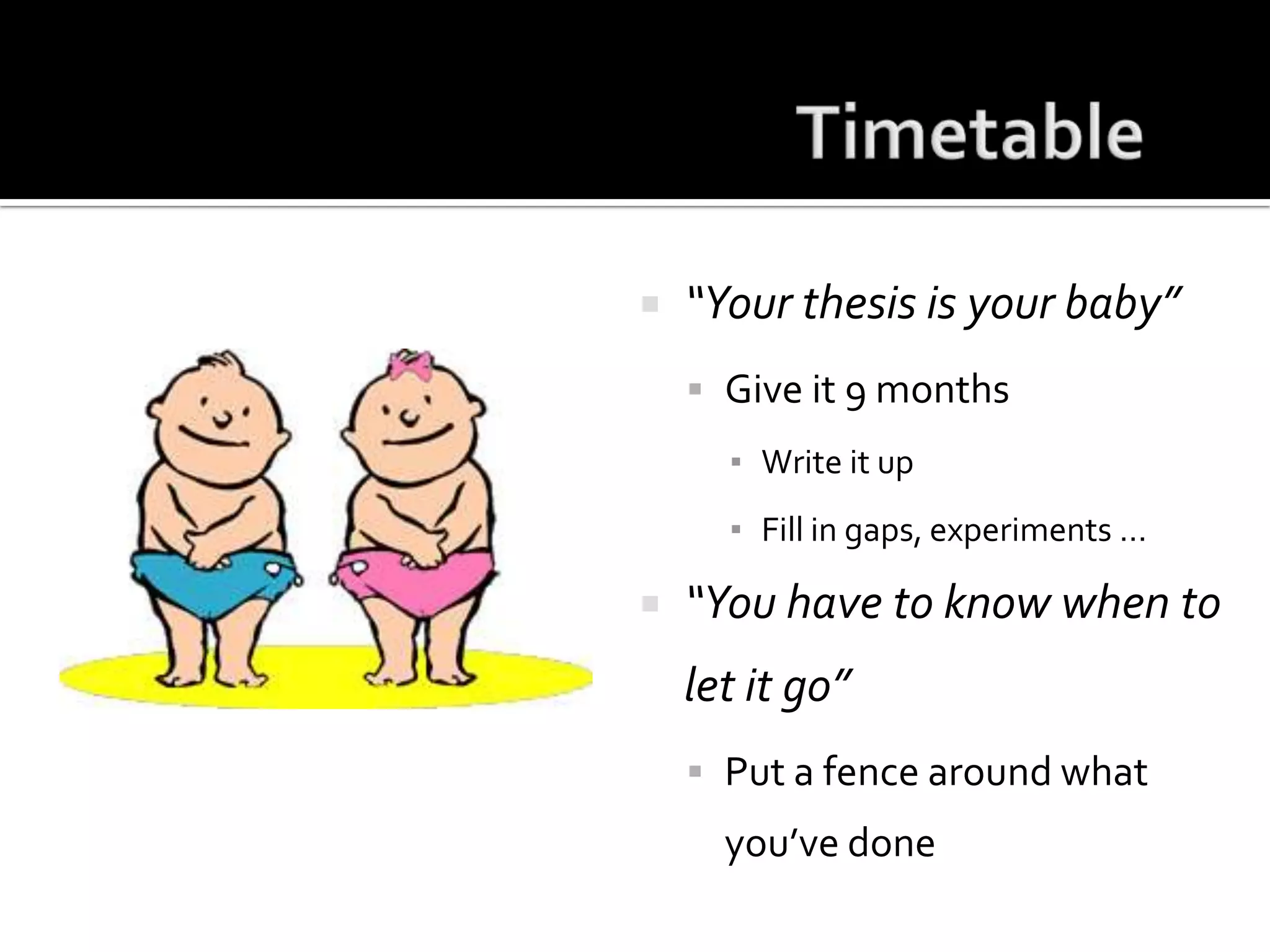
Timetable“Your thesis is your baby”Give it 9 monthsWrite it upFill in gaps, experiments …“You have to know when to let it go”Put a fence around what you’ve done
Writing each chapterDon’t start with the Introduction or ConclusionStart where you feel happiestTypically a middle chapterWrite outwardsFinally Conclusions and end with the IntroductionWrite everything with your thesis message in mind
Don’t omit any of theseTitle (and title page) - conveys a messageAbstract - for the librarianContents Listing - shows the right things are thereAcknowledgements - get your supervisor on your side!Introduction - says “I am going to look at the following things”.Review of Previous Work - show you know the subjectPhilosophy of Approach - show you can pick out important ideas succinctly
Contd..Plan of Attack - show you approached the problem in a systematic wayDescription of the work - details, so that others can follow what you didCritical analysis of the results - show you know its limitationsFuture Work - show you know what’s missingConclusions - repetition of the intro, but with reference to the detail.References - Cover the field; examiners will look for the key references.
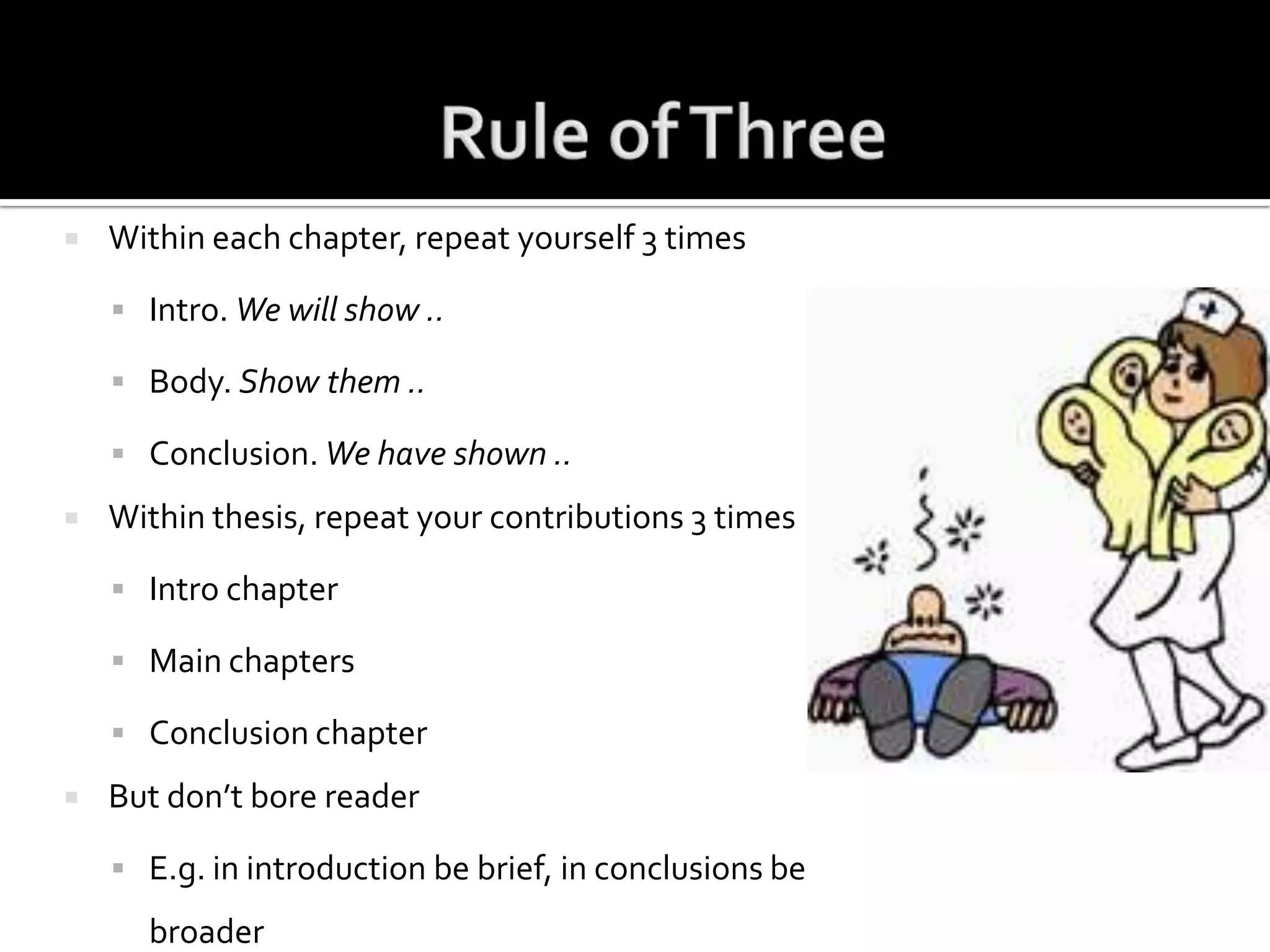
Rule of ThreeWithin each chapter, repeat yourself 3 timesIntro. We will show ..Body. Show them ..Conclusion. We have shown ..Within thesis, repeat your contributions 3 timesIntro chapterMain chaptersConclusion chapterBut don’t bore readerE.g. in introduction be brief, in conclusions be broader
BibliographyKeep a database of complete referencesUse a consistent citation styleUse a toolAttention to detail is importantGet the spellings rightKeep complete referencespage numbers, volume numbers, editors names, locations and dates for conference proceedings, etc.Find out what the local rules are for citation styleAssume the reader is familiar with the main referencesBut that doesn’t mean you should skip them!
ReviewingGet other people to read your draftsPeers will give friendly comments (and may have the most time!)Supervisor will steer youOther academics will spot things your supervisor has missed.Above all: 	…get the bugs out before the examiners see it.
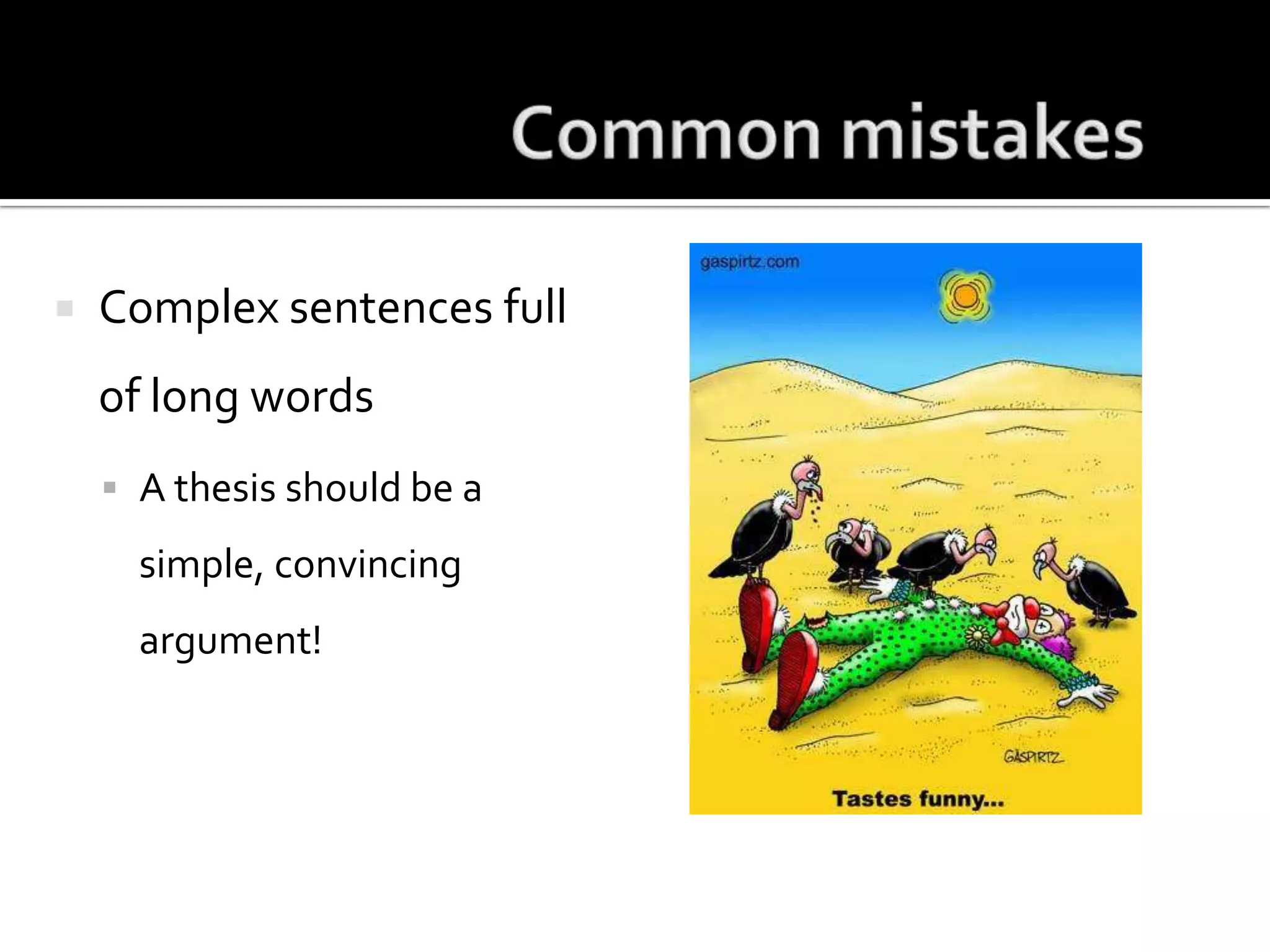
Common mistakesComplex sentences full of long wordsA thesis should be a simple, convincing argument!
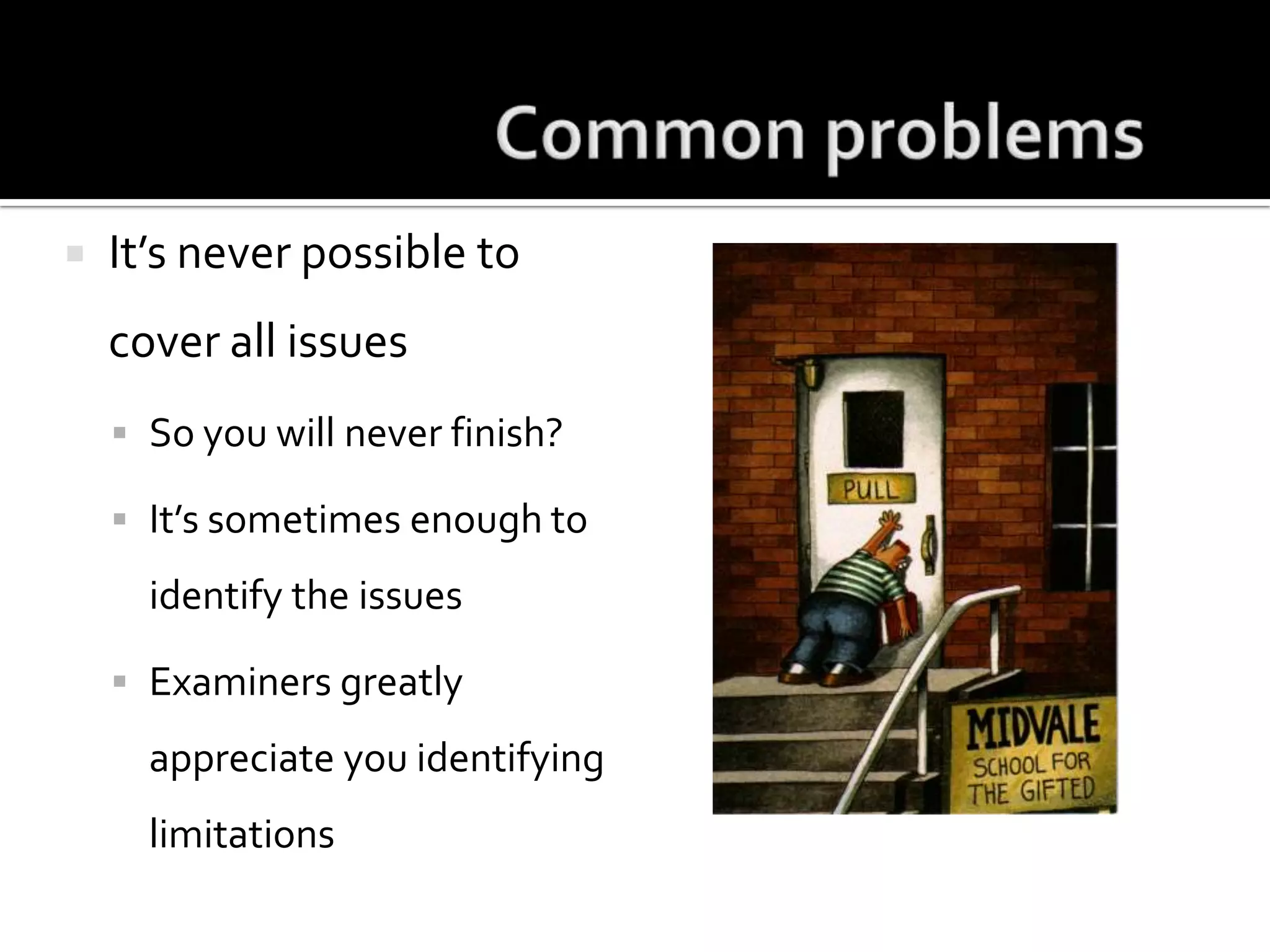
Common problemsIt’s never possible to cover all issuesSo you will never finish?It’s sometimes enough to identify the issuesExaminers greatly appreciate you identifying limitations
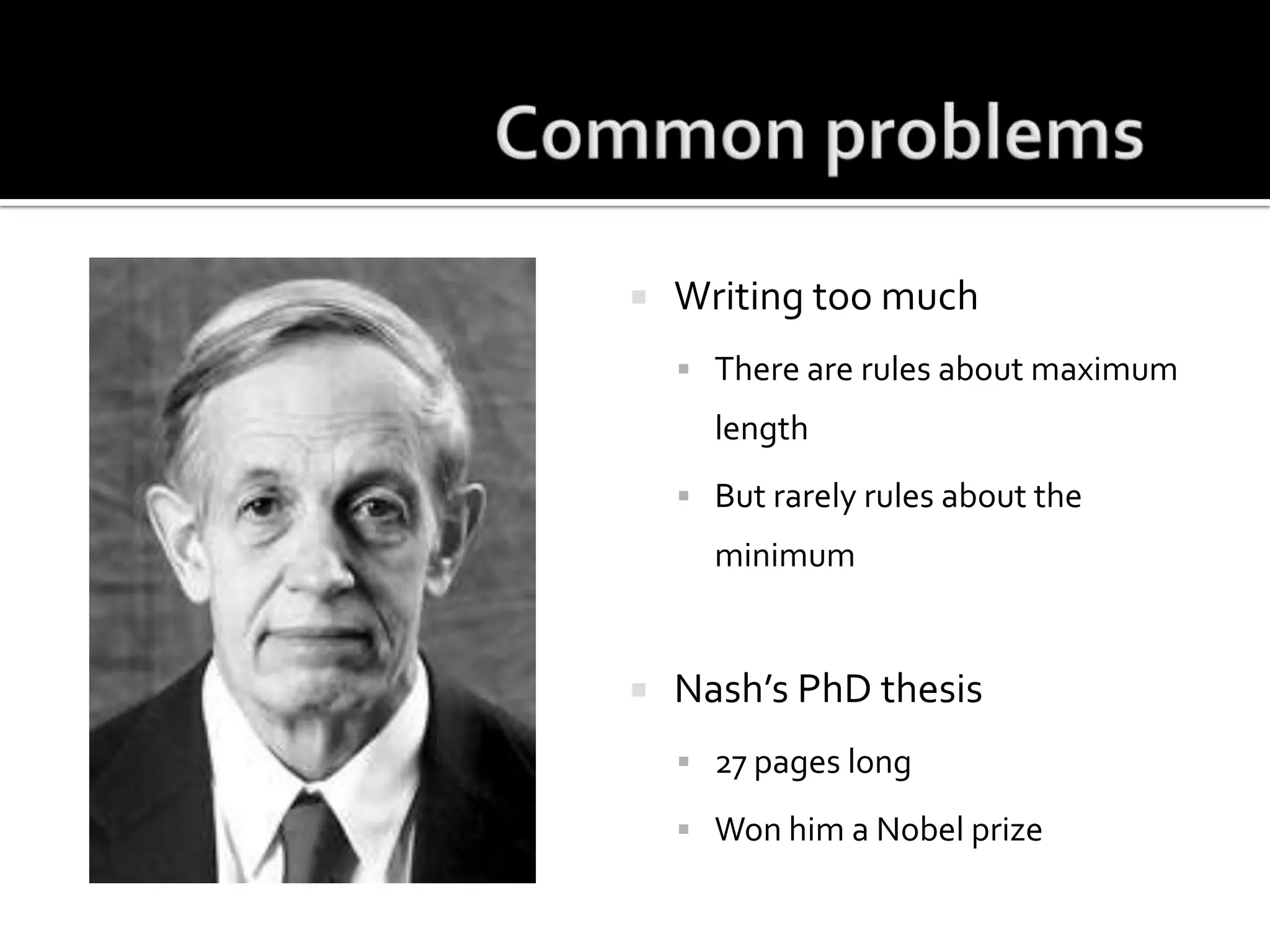
Common problemsWriting too muchThere are rules about maximum lengthBut rarely rules about the minimumNash’s PhD thesis27 pages longWon him a Nobel prize
What to expect from your advisor?Your not in this on your ownYour supervisor is on your sideYour success is their success
What to expect from your advisor?Intellectual supportWhat standard a thesis should reachIndication of when to stopEmotional supportEncouragementConstructive atmosphere
What not to expect from your advisor?SmilesIf draft chapters contain simple spelling mistakes and typosMind-reading skillsMotivation dippingAbsence = illness
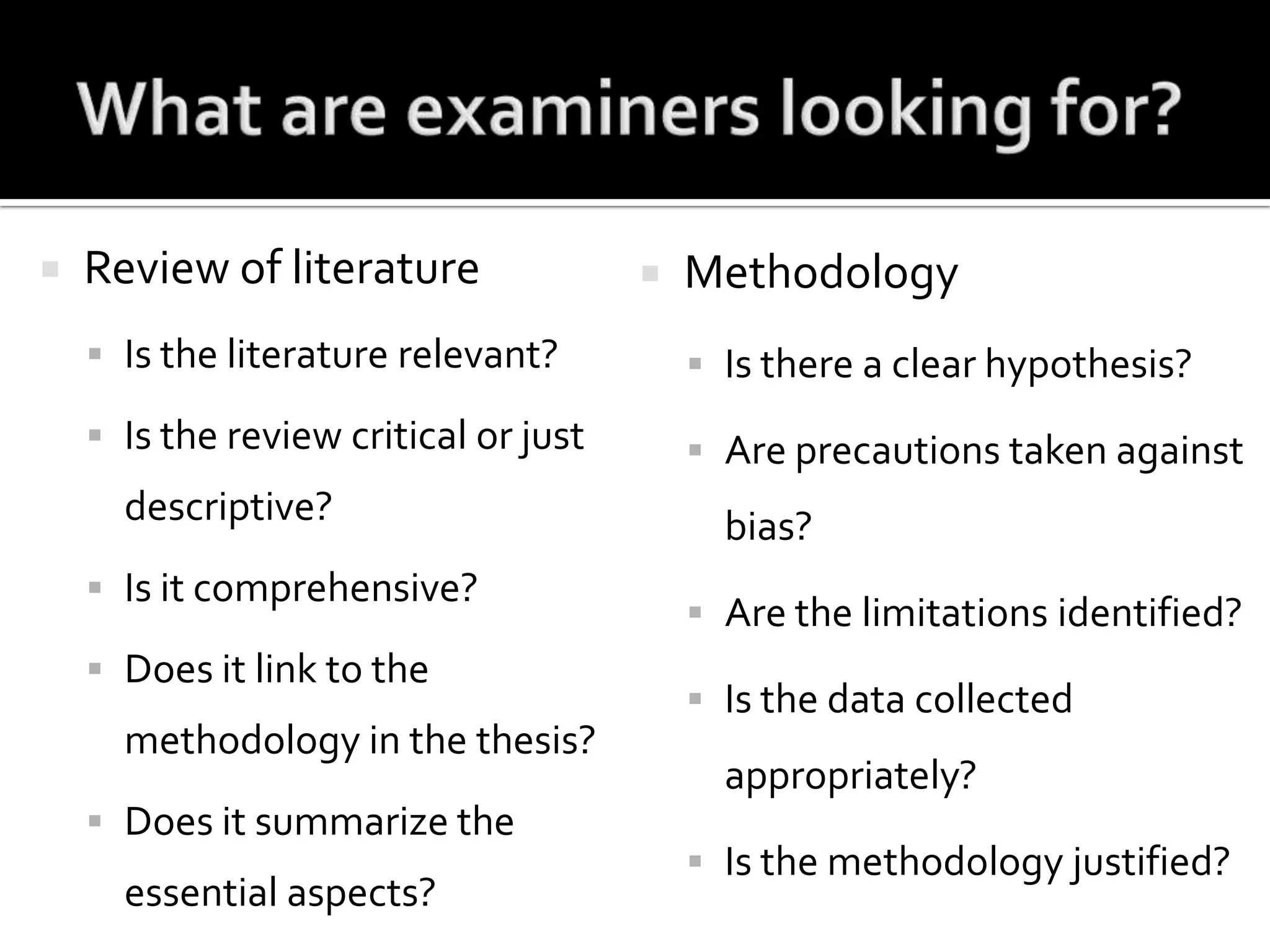
What are examiners looking for?Review of literatureIs the literature relevant?Is the review critical or just descriptive?Is it comprehensive?Does it link to the methodology in the thesis?Does it summarize the essential aspects?MethodologyIs there a clear hypothesis?Are precautions taken against bias?Are the limitations identified?Is the data collected appropriately?Is the methodology justified?
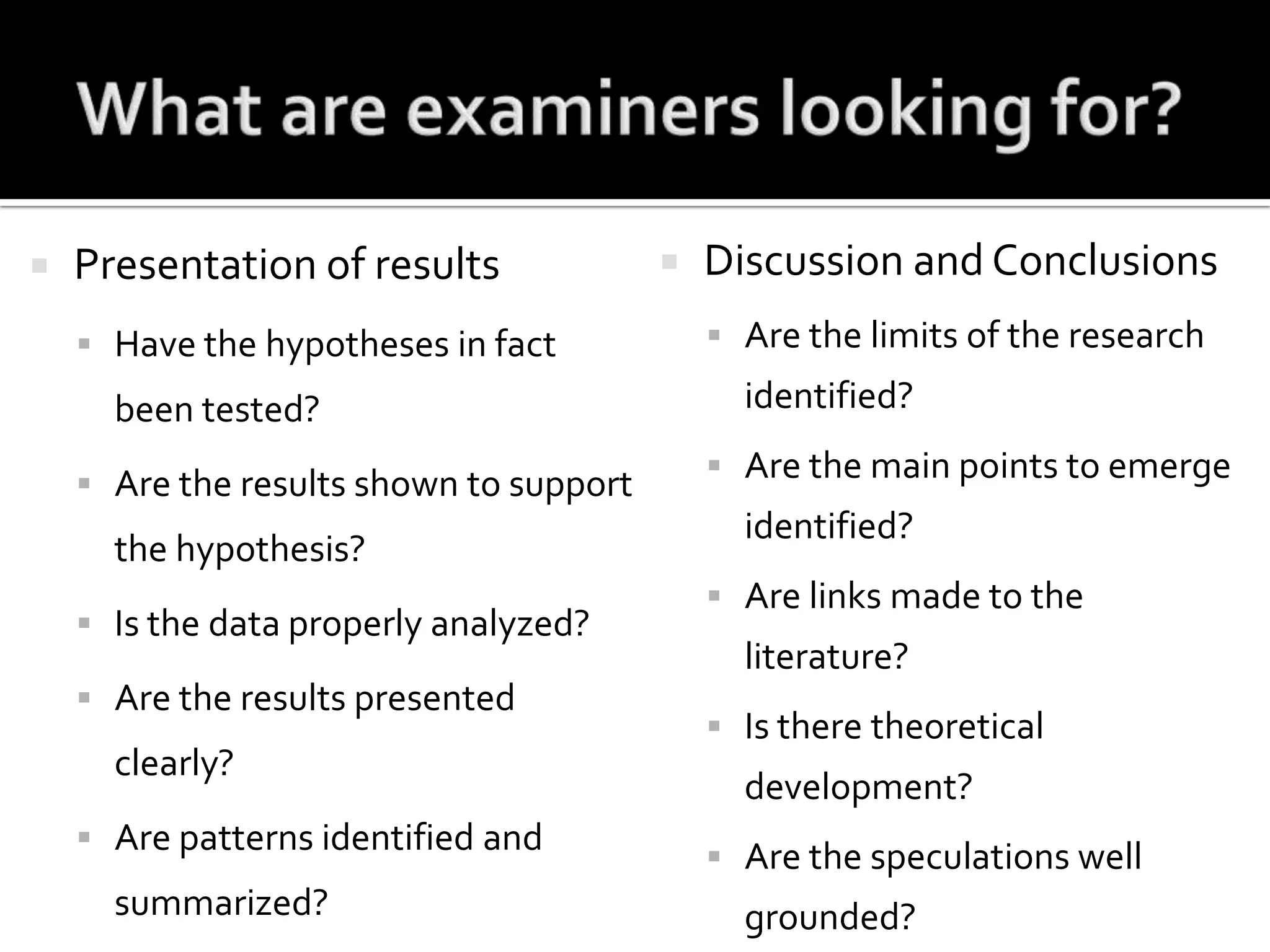
What are examiners looking for?Presentation of resultsHave the hypotheses in fact been tested?Are the results shown to support the hypothesis? Is the data properly analyzed?Are the results presented clearly?Are patterns identified and summarized?Discussion and ConclusionsAre the limits of the research identified?Are the main points to emerge identified?Are links made to the literature?Is there theoretical development?Are the speculations well grounded?
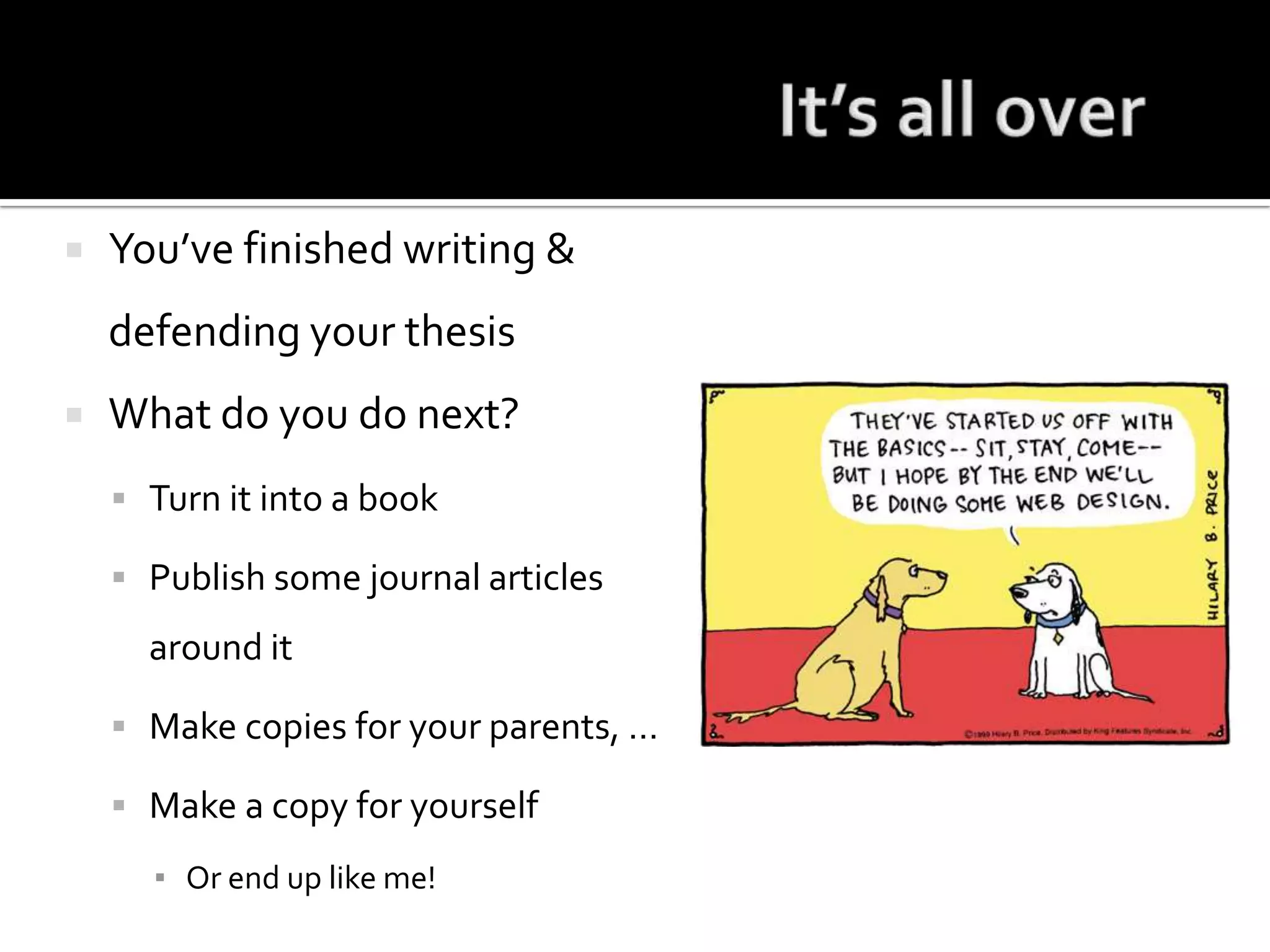
It’s all overYou’ve finished writing & defending your thesisWhat do you do next?Turn it into a bookPublish some journal articles around itMake copies for your parents, …Make a copy for yourselfOr end up like me!
It’s all overYou’ve finished writing & defending your thesisWhat do you do next?Just think, you’ll never have to do it again!Unless you’re French or German
SummaryStart writing today (never tomorrow)Make up a title page for inspirationWrite down your argument succinctlyTurn the argument into a chapter planMaintain a binder of stuff to put into these chaptersDon’t be afraid to change the plan
The Examiner’s ViewUh oh, not another thesis to read...Your examiners are busy peopleExamining theses is a chore, but:“It might help me keep up to date with an area of research”“I might learn something”“I might gain a new colleague”Note: the reading will be done in trains, planes, and departmental meetings!
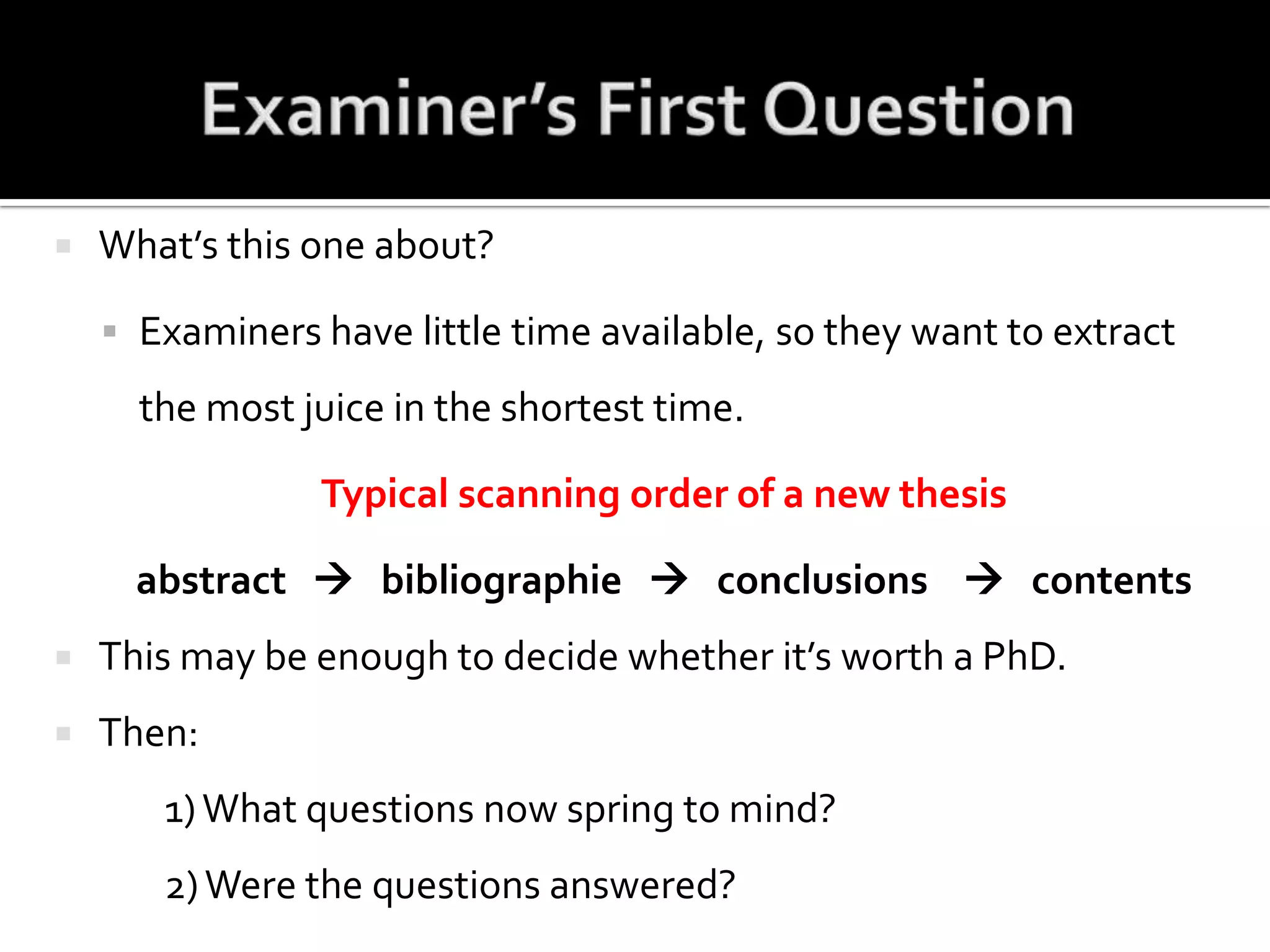
Examiner’s First QuestionWhat’s this one about?Examiners have little time available, so they want to extract the most juice in the shortest time.Typical scanning order of a new thesisabstract      bibliographie      conclusions       contents This may be enough to decide whether it’s worth a PhD.Then:		1) What questions now spring to mind?		2) Were the questions answered?
Corrections“Now there must be some corrections…”Some examiners don’t feel they’ve done the job unless they find some corrections to do.Typical correctionsTypographical / grammatical errorsPoor presentationMissing statements / referencesSuperfluous / redundant statements)
CorrectionsMissing pieces of workWhole sections missing … for example:research questionscritical review of literatureresearch methodologypresentation of resultsvalidation of resultsdiscussion and conclusions
Thesis Defence“Let’s see, what can I ask the candidate?”The examiners may have decided before the exam whether to pass you.Defence, oral, viva, exam, ...viva = “viva voce” = “lively discussion”
Thesis DefenceThe exam is to check it’s your work...Talk fluently about the work;show you’ve thought about it (which you have!).This is easyafter all you’ve spent four+ years talking about it!...and a chance to clarify things that aren’t clear in the thesis.These are areas where corrections are likely.
Making PowerPoint SlidesAvoiding the Pitfalls of Bad Slides Make a good PresentationPresentation of Research work
Tips to be CoveredOutlinesSlide StructureFontsColorBackgroundGraphsSpelling and GrammarConclusionsQuestions
Outline	Make your 1st or 2nd slide an outline of your presentationEx: previous slideFollow the order of your outline for the rest of the presentationOnly place main points on the outline slideEx: Use the titles of each slide as main points
Slide Structure – GoodUse 1-2 slides per minute of your presentationWrite in point form, not complete sentencesInclude 4-5 points per slideAvoid wordiness: use key words and phrases only
Slide Structure - BadThis page contains too many words for a presentation slide.  It is not written in point form, making it difficult both for your audience to read and for you to present each point. Although there are exactly the same number of points on this slide as the previous slide, it looks much more complicated.  In short, your audience will spend too much time trying to read this paragraph instead of listening to you.
Slide Structure – GoodShow one point at a time:Will help audience concentrate on what you are sayingWill prevent audience from reading aheadWill help you keep your presentation focused
Slide Structure - BadDo not use distracting animationDo not go overboard with the animationBe consistent with the animation that you use
Fonts - GoodUse at least an 18-point fontUse different size fonts for main points and secondary pointsthis font is 24-point, the main point font is 28-point, and the title font is 36-pointUse a standard font like Times New Roman or Arial
Fonts - BadIf you use a small font, your audience won’t be able to read what you have writtenCAPITALIZE ONLY WHEN NECESSARY.  IT IS DIFFICULT TO READDon’t use a complicated font
Color - GoodUse a color of font that contrasts sharply with the backgroundEx: blue font on white backgroundUse color to reinforce the logic of your structureEx: light blue title and dark blue textUse color to emphasize a pointBut only use this occasionally
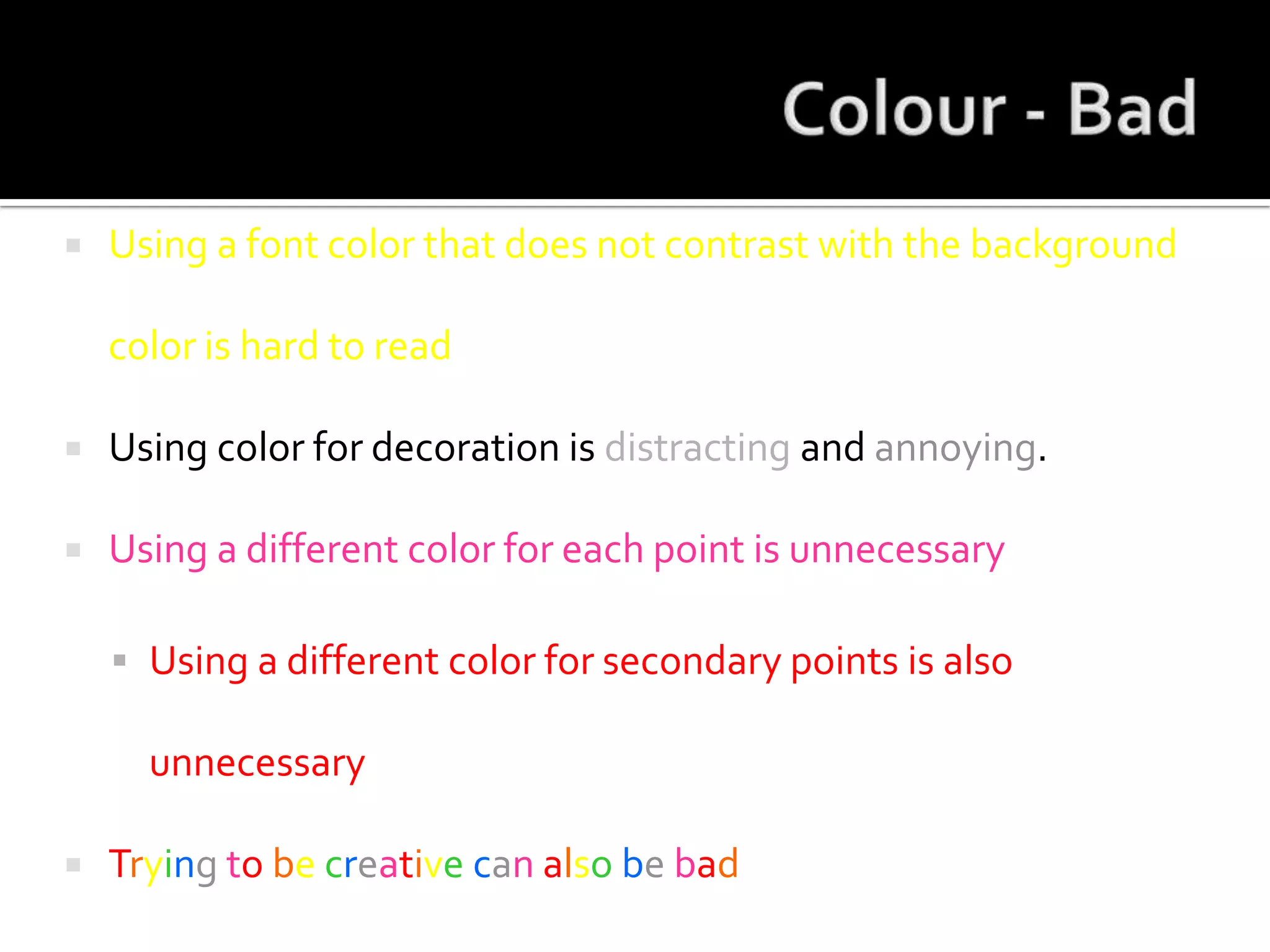
Colour - BadUsing a font color that does not contrast with the background color is hard to read Using color for decoration is distracting and annoying.Using a different color for each point is unnecessaryUsing a different color for secondary points is also unnecessaryTrying tobe creativecan alsobebad
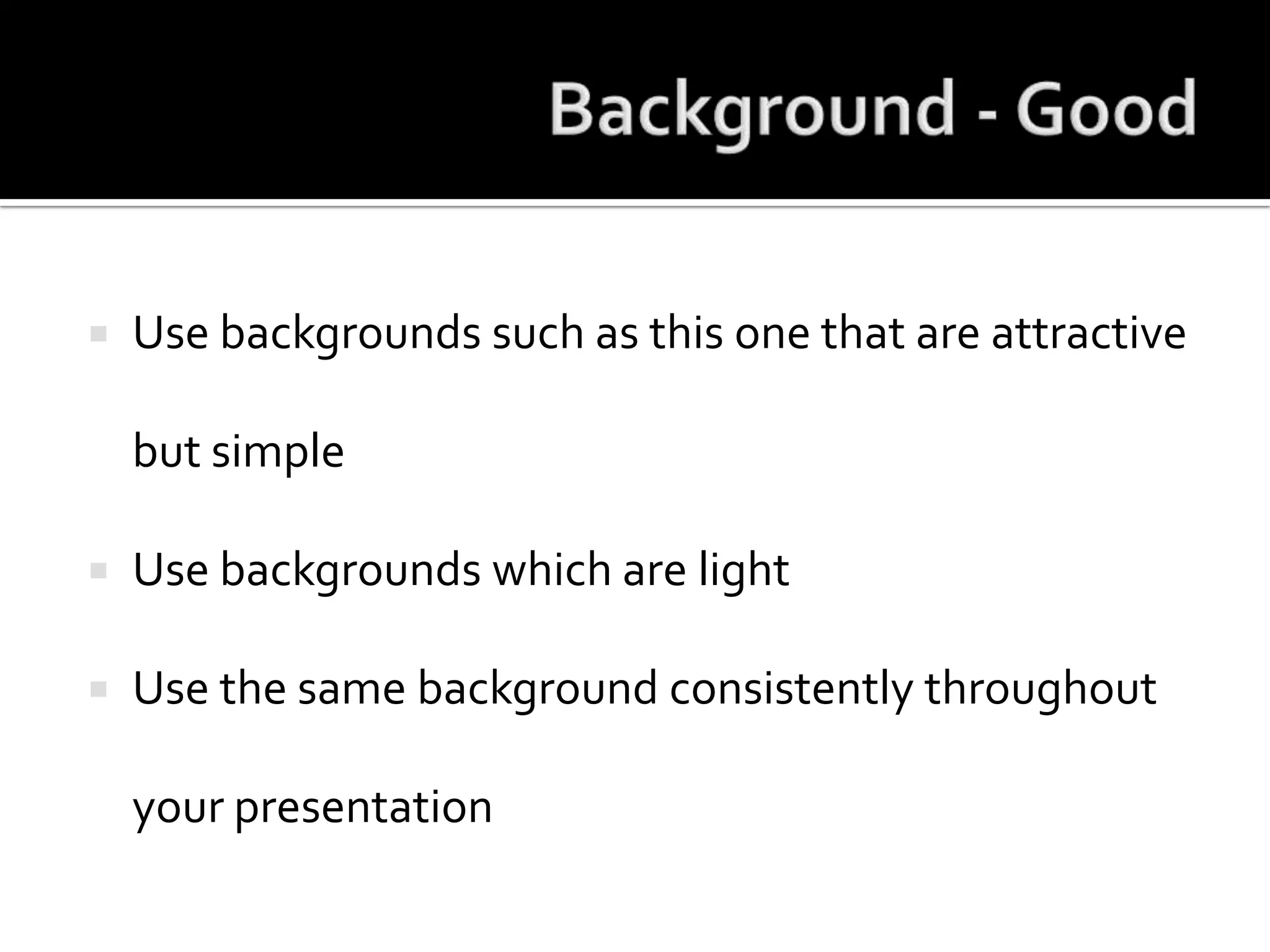
Background - GoodUse backgrounds such as this one that are attractive but simpleUse backgrounds which are lightUse the same background consistently throughout your presentation
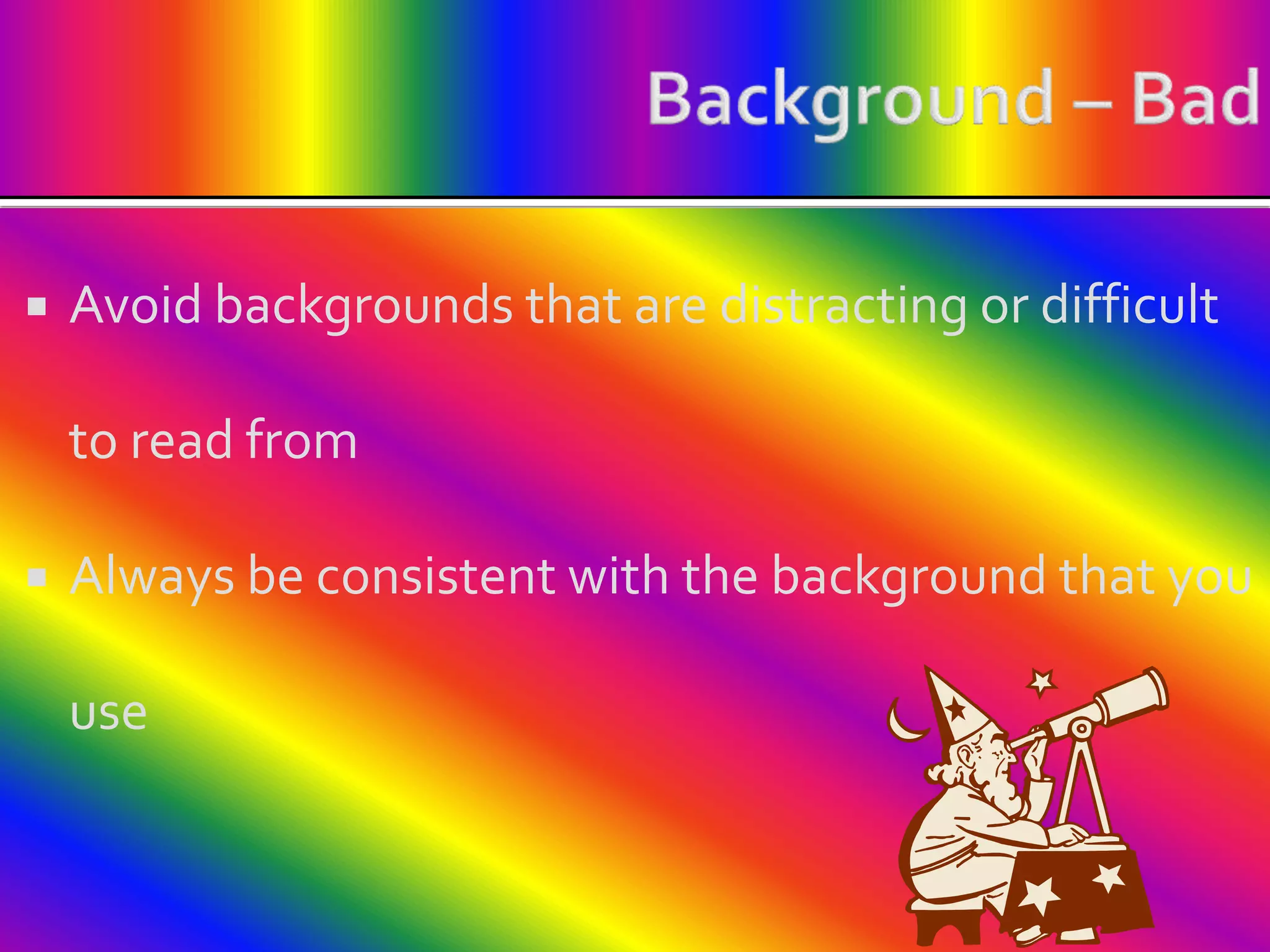
Background – BadAvoid backgrounds that are distracting or difficult to read fromAlways be consistent with the background that you use
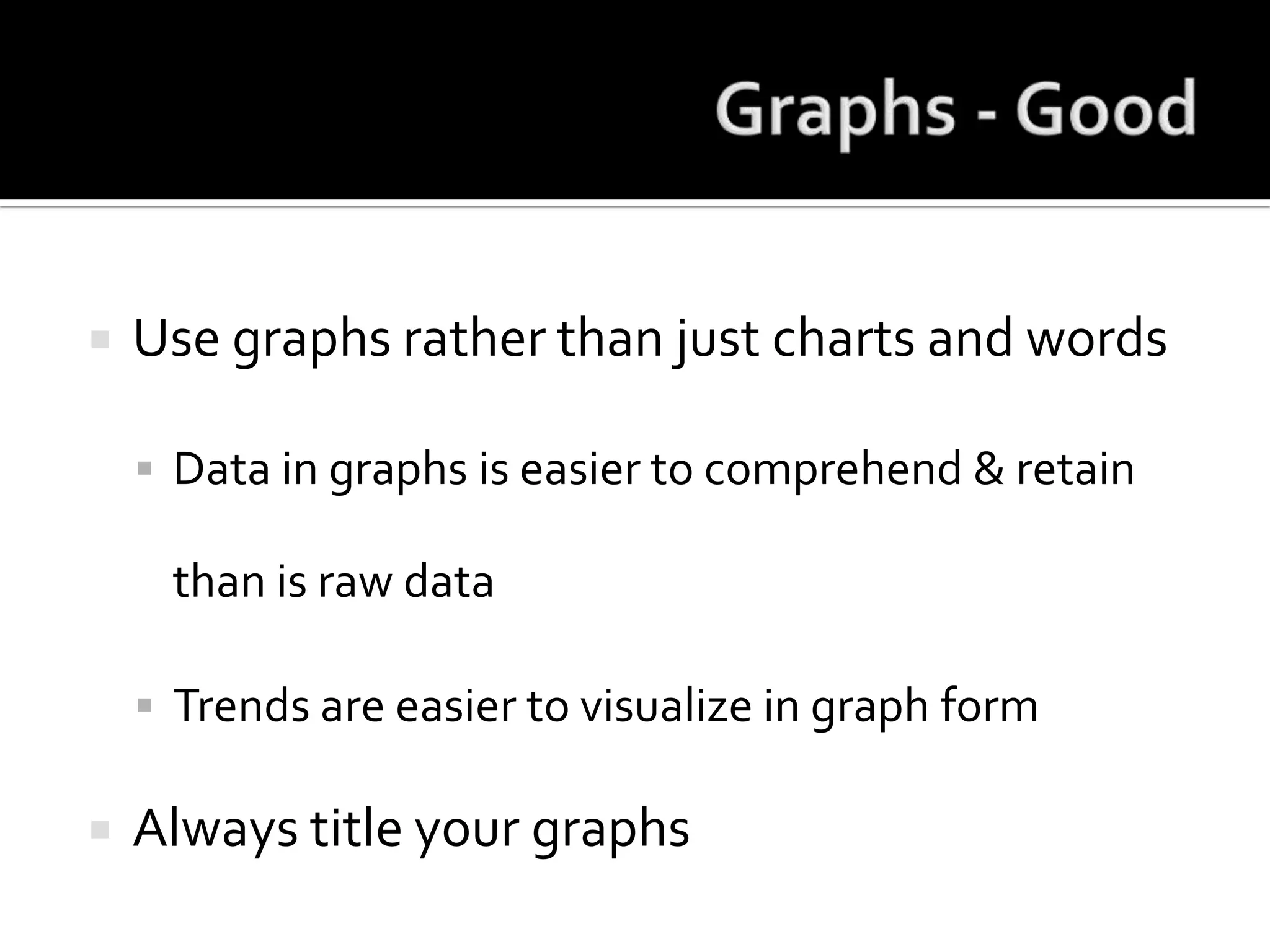
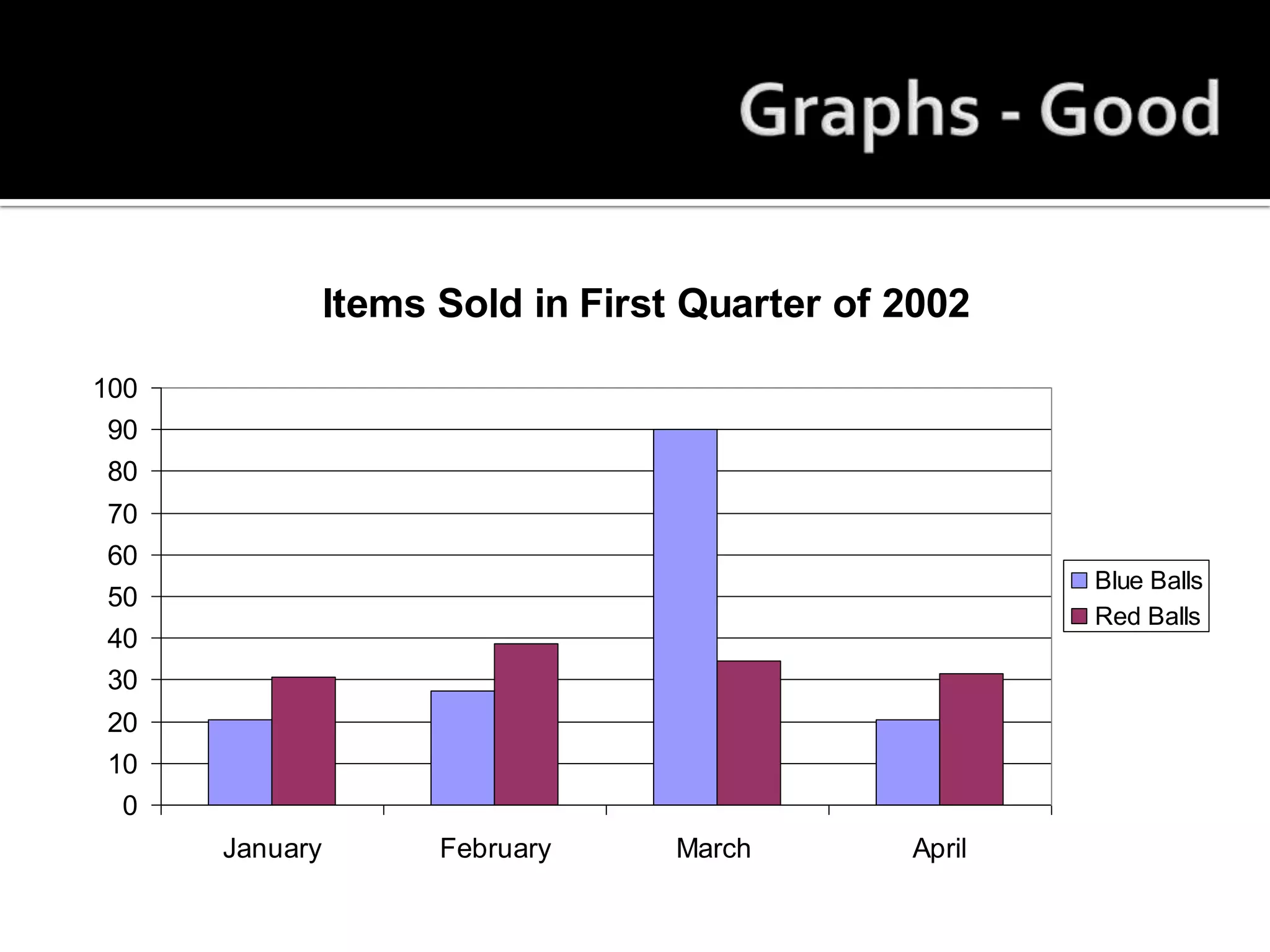
Graphs - GoodUse graphs rather than just charts and wordsData in graphs is easier to comprehend & retain than is raw dataTrends are easier to visualize in graph formAlways title your graphs
Graphs - Good
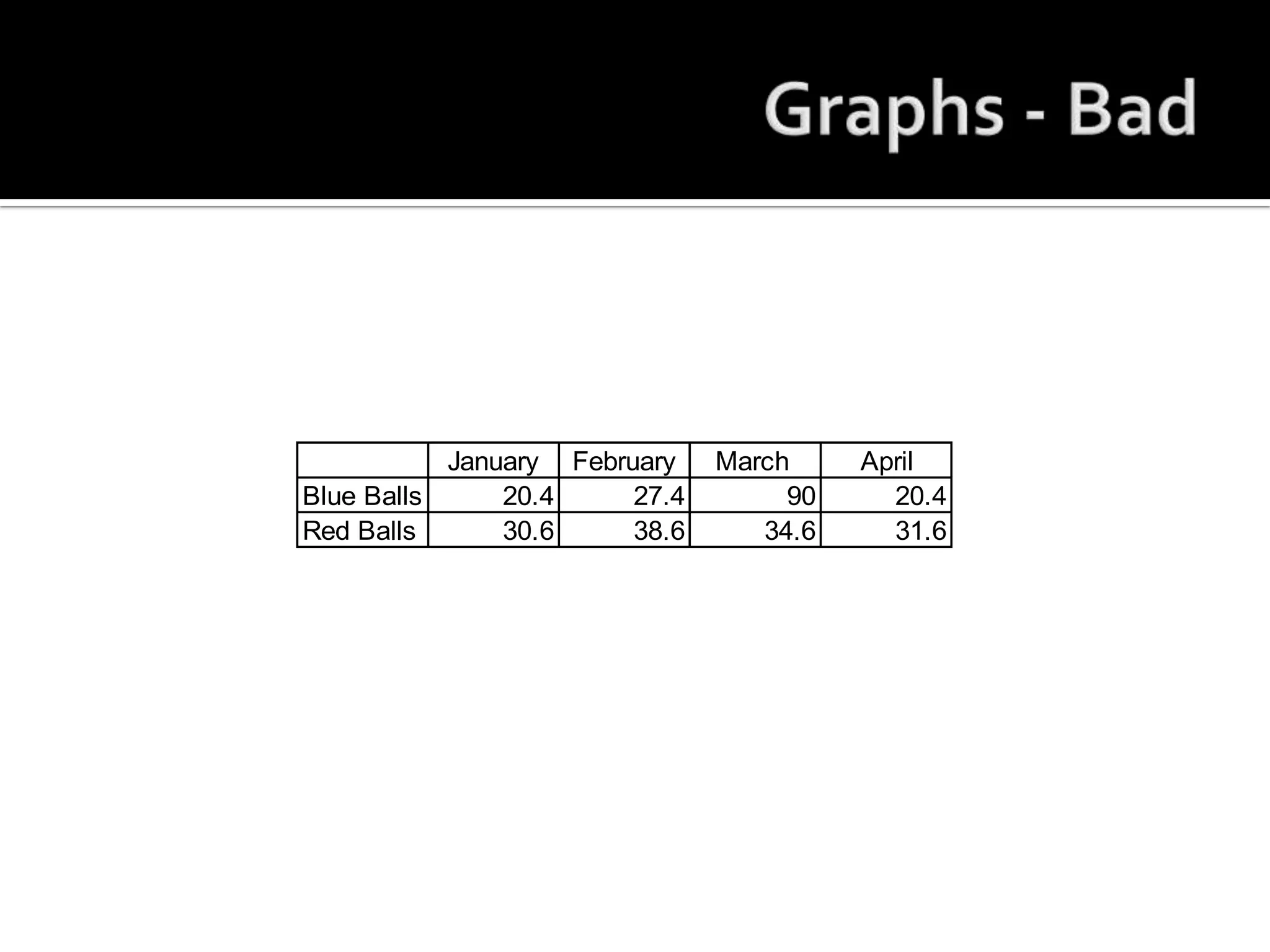
Graphs - Bad
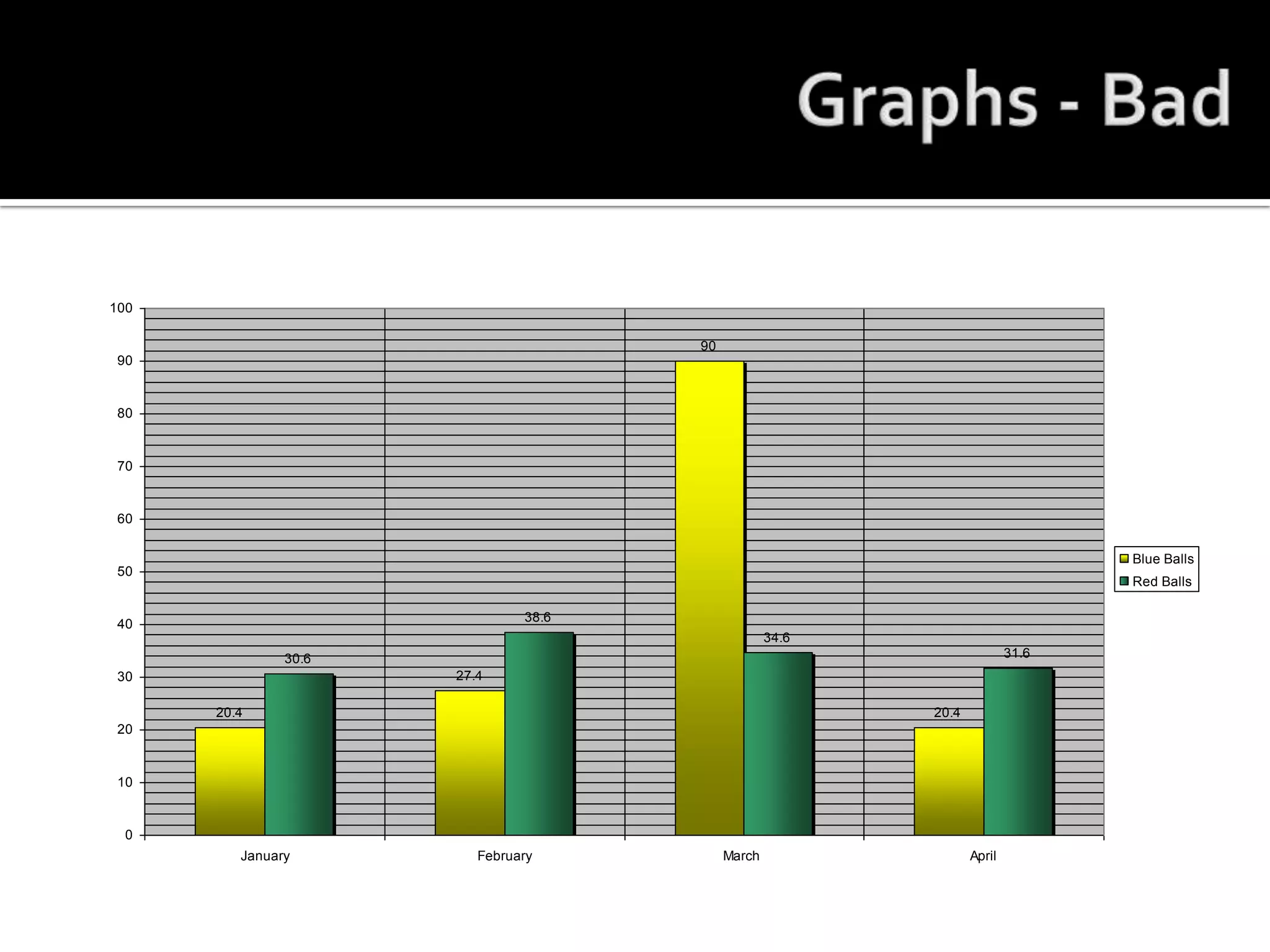
Graphs - Bad
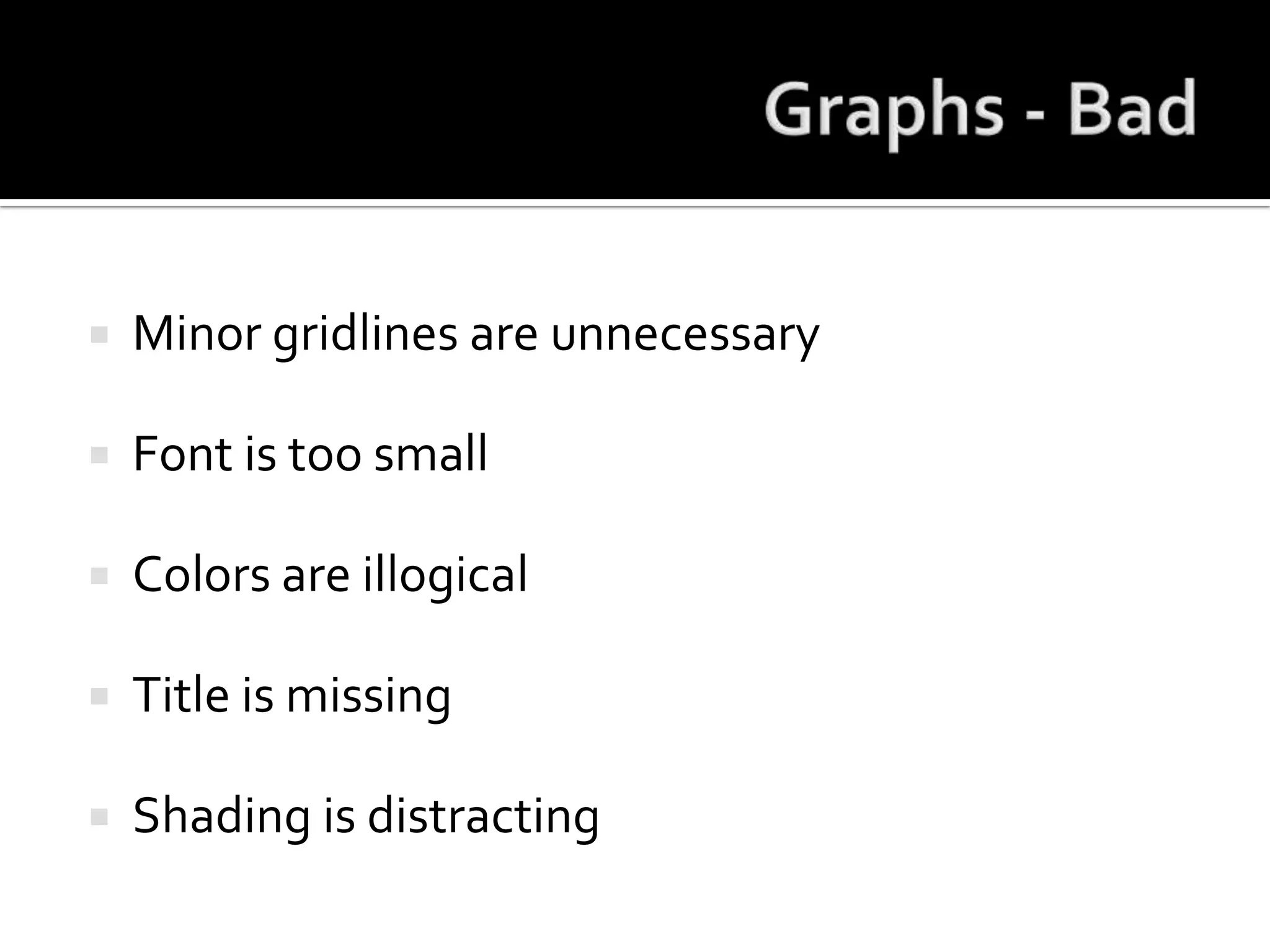
Graphs - BadMinor gridlines are unnecessaryFont is too smallColors are illogicalTitle is missingShading is distracting
Spelling and GrammarProof your slides for:speling mistakesthe use of of repeated wordsgrammatical errors you might have make If English is not your first language, please have someone else check your presentation!
ConclusionUse an effective and strong closingYour audience is likely to remember your last wordsUse a conclusion slide to:Summarize the main points of your presentationSuggest future avenues of research
Questions??End your presentation with a simple question slide to:Invite your audience to ask questionsProvide a visual aid during question periodAvoid ending a presentation abruptly
Good Luck!

Presentation Of Research Work

  • 1.
    Presentation of ResearchWorkHow to make an efficient presentation…?
  • 2.
    ContentsThesis WritingHow tomake a GOOD presentation
  • 3.
    How to Writea Thesis
  • 4.
  • 5.
    The Good NewsYouonly have to write ONE thesisExcept you French and Germans who have to do a habilitation (highest academic qualification a person can achieve)At the end, you can add “Dr” to your nameGood for upgrades on planes
  • 6.
    The Bad NewsWritinga thesis is hard, painful workYou’ve already done the fun part (the research)It’s unlike any other documentThesis writing is not a marketable skill
  • 7.
    What is athesis?An argumentAn exposition of an original piece of researchProbably the largest (most self-indulgent) piece of work you’ll ever doSomething that could be published:E.g. at least one paper in a scholarly journalbut you will probably never publish the whole thesis
  • 8.
    Ok, when doI start?So I’m motivatedWhen do I actuallystart writing?6 months before the end of my grant?No, the day you start your research work.Write it all down!Don’t worry, it’s never too late to start
  • 9.
    How do Iget started?Do this today:Decide your titleWrite your title pageStart a binderLook at some theses in your areaPlan your argument…You can change things laterBut you can’t change it unless you have something to change!I do really mean it today!Before you go to bed tonight.Tomorrow is too late….!
  • 10.
    What a thesisisn’t?What I did in the lab over the last 3 yearsI first read the background materialI then implemented an procedureI ran some experiments A thesis is a logical reconstructionNot a historical narrative
  • 11.
    What a thesisisn’t?A brain dump of everything you’ve doneYou get to leave out the dead-endsBut you have to fill in any obvious gaps!A thesis is a logical reconstructionWith a single coherent message
  • 12.
    What a thesisisn’t?Available to buyEven if www.thesis-master.com offer you one at $15/pageI wish I got those rates!
  • 13.
    What is athesis?Demonstration of an understanding of the state of the artCritical appreciation of existing workA novel contributionEvaluated systematically
  • 14.
    So, how doI start?Write a thesis message1 sentence1 paragraph1 pageEverything you write should be directed at thisThesis (noun). 1. A proposition maintained by argument2. A dissertation advancing original research
  • 15.
    Thesis messageYou’re tacklingan important research problemE.g. development of a methodYou’ve made an original contribution to its resolution
  • 16.
    What next?So, I’vegot a good thesis messageWhat do I do next?Write the table of contentsLogical structure of your thesis
  • 17.
  • 18.
    Table of ContentsIntroduction ThesismessageBackground Context, definitions, notationTheoretical developmentsEmpirical resultsAnalysisRelated workConclusions List contributions
  • 19.
    Table of ContentsBackground& related work overlapNeed to discuss related work at start to set sceneNeed to discuss related work at end to demonstrate your originalityOften one chapter per workshop or conference papersBut not cut and paste!
  • 20.
    What next?So, I’vegot a good thesis messageAnd a table of contentsWhat do I do next?Make a timetableTargets to meetLight at the end of the tunnel
  • 21.
    Timetable“Your thesis isyour baby”Give it 9 monthsWrite it upFill in gaps, experiments …“You have to know when to let it go”Put a fence around what you’ve done
  • 22.
    Writing each chapterDon’tstart with the Introduction or ConclusionStart where you feel happiestTypically a middle chapterWrite outwardsFinally Conclusions and end with the IntroductionWrite everything with your thesis message in mind
  • 23.
    Don’t omit anyof theseTitle (and title page) - conveys a messageAbstract - for the librarianContents Listing - shows the right things are thereAcknowledgements - get your supervisor on your side!Introduction - says “I am going to look at the following things”.Review of Previous Work - show you know the subjectPhilosophy of Approach - show you can pick out important ideas succinctly
  • 24.
    Contd..Plan of Attack- show you approached the problem in a systematic wayDescription of the work - details, so that others can follow what you didCritical analysis of the results - show you know its limitationsFuture Work - show you know what’s missingConclusions - repetition of the intro, but with reference to the detail.References - Cover the field; examiners will look for the key references.
  • 25.
    Rule of ThreeWithineach chapter, repeat yourself 3 timesIntro. We will show ..Body. Show them ..Conclusion. We have shown ..Within thesis, repeat your contributions 3 timesIntro chapterMain chaptersConclusion chapterBut don’t bore readerE.g. in introduction be brief, in conclusions be broader
  • 26.
    BibliographyKeep a databaseof complete referencesUse a consistent citation styleUse a toolAttention to detail is importantGet the spellings rightKeep complete referencespage numbers, volume numbers, editors names, locations and dates for conference proceedings, etc.Find out what the local rules are for citation styleAssume the reader is familiar with the main referencesBut that doesn’t mean you should skip them!
  • 27.
    ReviewingGet other peopleto read your draftsPeers will give friendly comments (and may have the most time!)Supervisor will steer youOther academics will spot things your supervisor has missed.Above all: …get the bugs out before the examiners see it.
  • 28.
    Common mistakesComplex sentencesfull of long wordsA thesis should be a simple, convincing argument!
  • 29.
    Common problemsIt’s neverpossible to cover all issuesSo you will never finish?It’s sometimes enough to identify the issuesExaminers greatly appreciate you identifying limitations
  • 30.
    Common problemsWriting toomuchThere are rules about maximum lengthBut rarely rules about the minimumNash’s PhD thesis27 pages longWon him a Nobel prize
  • 31.
    What to expectfrom your advisor?Your not in this on your ownYour supervisor is on your sideYour success is their success
  • 32.
    What to expectfrom your advisor?Intellectual supportWhat standard a thesis should reachIndication of when to stopEmotional supportEncouragementConstructive atmosphere
  • 33.
    What not toexpect from your advisor?SmilesIf draft chapters contain simple spelling mistakes and typosMind-reading skillsMotivation dippingAbsence = illness
  • 34.
    What are examinerslooking for?Review of literatureIs the literature relevant?Is the review critical or just descriptive?Is it comprehensive?Does it link to the methodology in the thesis?Does it summarize the essential aspects?MethodologyIs there a clear hypothesis?Are precautions taken against bias?Are the limitations identified?Is the data collected appropriately?Is the methodology justified?
  • 35.
    What are examinerslooking for?Presentation of resultsHave the hypotheses in fact been tested?Are the results shown to support the hypothesis? Is the data properly analyzed?Are the results presented clearly?Are patterns identified and summarized?Discussion and ConclusionsAre the limits of the research identified?Are the main points to emerge identified?Are links made to the literature?Is there theoretical development?Are the speculations well grounded?
  • 36.
    It’s all overYou’vefinished writing & defending your thesisWhat do you do next?Turn it into a bookPublish some journal articles around itMake copies for your parents, …Make a copy for yourselfOr end up like me!
  • 37.
    It’s all overYou’vefinished writing & defending your thesisWhat do you do next?Just think, you’ll never have to do it again!Unless you’re French or German
  • 38.
    SummaryStart writing today(never tomorrow)Make up a title page for inspirationWrite down your argument succinctlyTurn the argument into a chapter planMaintain a binder of stuff to put into these chaptersDon’t be afraid to change the plan
  • 39.
    The Examiner’s ViewUhoh, not another thesis to read...Your examiners are busy peopleExamining theses is a chore, but:“It might help me keep up to date with an area of research”“I might learn something”“I might gain a new colleague”Note: the reading will be done in trains, planes, and departmental meetings!
  • 40.
    Examiner’s First QuestionWhat’sthis one about?Examiners have little time available, so they want to extract the most juice in the shortest time.Typical scanning order of a new thesisabstract  bibliographie  conclusions  contents This may be enough to decide whether it’s worth a PhD.Then: 1) What questions now spring to mind? 2) Were the questions answered?
  • 41.
    Corrections“Now there mustbe some corrections…”Some examiners don’t feel they’ve done the job unless they find some corrections to do.Typical correctionsTypographical / grammatical errorsPoor presentationMissing statements / referencesSuperfluous / redundant statements)
  • 42.
    CorrectionsMissing pieces ofworkWhole sections missing … for example:research questionscritical review of literatureresearch methodologypresentation of resultsvalidation of resultsdiscussion and conclusions
  • 43.
    Thesis Defence“Let’s see,what can I ask the candidate?”The examiners may have decided before the exam whether to pass you.Defence, oral, viva, exam, ...viva = “viva voce” = “lively discussion”
  • 44.
    Thesis DefenceThe examis to check it’s your work...Talk fluently about the work;show you’ve thought about it (which you have!).This is easyafter all you’ve spent four+ years talking about it!...and a chance to clarify things that aren’t clear in the thesis.These are areas where corrections are likely.
  • 45.
    Making PowerPoint SlidesAvoidingthe Pitfalls of Bad Slides Make a good PresentationPresentation of Research work
  • 46.
    Tips to beCoveredOutlinesSlide StructureFontsColorBackgroundGraphsSpelling and GrammarConclusionsQuestions
  • 47.
    Outline Make your 1stor 2nd slide an outline of your presentationEx: previous slideFollow the order of your outline for the rest of the presentationOnly place main points on the outline slideEx: Use the titles of each slide as main points
  • 48.
    Slide Structure –GoodUse 1-2 slides per minute of your presentationWrite in point form, not complete sentencesInclude 4-5 points per slideAvoid wordiness: use key words and phrases only
  • 49.
    Slide Structure -BadThis page contains too many words for a presentation slide. It is not written in point form, making it difficult both for your audience to read and for you to present each point. Although there are exactly the same number of points on this slide as the previous slide, it looks much more complicated. In short, your audience will spend too much time trying to read this paragraph instead of listening to you.
  • 50.
    Slide Structure –GoodShow one point at a time:Will help audience concentrate on what you are sayingWill prevent audience from reading aheadWill help you keep your presentation focused
  • 51.
    Slide Structure -BadDo not use distracting animationDo not go overboard with the animationBe consistent with the animation that you use
  • 52.
    Fonts - GoodUseat least an 18-point fontUse different size fonts for main points and secondary pointsthis font is 24-point, the main point font is 28-point, and the title font is 36-pointUse a standard font like Times New Roman or Arial
  • 53.
    Fonts - BadIfyou use a small font, your audience won’t be able to read what you have writtenCAPITALIZE ONLY WHEN NECESSARY. IT IS DIFFICULT TO READDon’t use a complicated font
  • 54.
    Color - GoodUsea color of font that contrasts sharply with the backgroundEx: blue font on white backgroundUse color to reinforce the logic of your structureEx: light blue title and dark blue textUse color to emphasize a pointBut only use this occasionally
  • 55.
    Colour - BadUsinga font color that does not contrast with the background color is hard to read Using color for decoration is distracting and annoying.Using a different color for each point is unnecessaryUsing a different color for secondary points is also unnecessaryTrying tobe creativecan alsobebad
  • 56.
    Background - GoodUsebackgrounds such as this one that are attractive but simpleUse backgrounds which are lightUse the same background consistently throughout your presentation
  • 57.
    Background – BadAvoidbackgrounds that are distracting or difficult to read fromAlways be consistent with the background that you use
  • 58.
    Graphs - GoodUsegraphs rather than just charts and wordsData in graphs is easier to comprehend & retain than is raw dataTrends are easier to visualize in graph formAlways title your graphs
  • 59.
  • 60.
  • 61.
  • 62.
    Graphs - BadMinorgridlines are unnecessaryFont is too smallColors are illogicalTitle is missingShading is distracting
  • 63.
    Spelling and GrammarProofyour slides for:speling mistakesthe use of of repeated wordsgrammatical errors you might have make If English is not your first language, please have someone else check your presentation!
  • 64.
    ConclusionUse an effectiveand strong closingYour audience is likely to remember your last wordsUse a conclusion slide to:Summarize the main points of your presentationSuggest future avenues of research
  • 65.
    Questions??End your presentationwith a simple question slide to:Invite your audience to ask questionsProvide a visual aid during question periodAvoid ending a presentation abruptly
  • 66.