Advanced Research Methodsin
Science and Engineering
Statistics and Research Methods
Lecture I:
Overview of Research Methods
and the Scientific Method
2.
Course objectives
Main goal… plan and carry out your own research work
and also understand and interpret scholarly works…
By the end of the course the you should be able:
• To identify and describe researchable ideas, projects
and themes.
• To design and specify methods for carrying out a
scientific research and demonstrate possession of skills
and attitudes to conduct such research
• To be able to analyze data using scientific
methodologies.
• To present research results in a systematic and objective
way.
3.
Course Management
• Coursedelivery methods:
– lectures and discussions
– self study assignments
– case studies and group discussions
• Course Assessment:
– Coursework: Home assignments, class room and
project work and presentations, this will carry a
total of 40%
– (Assignments 5%, Tests 10% and Project Work 25%).
– Written examinations, a total of 60% of the marks.
4.
Course outline
• Overviewof research methods – Introduction to the
scientific method and research methodology.
• Selection and definition of a research problem,
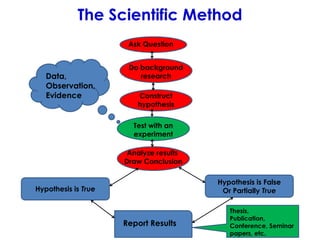
searching and evaluation of relevant literature.
• Preparation and evaluation of a research plan.
• Analysis. Constructs, Models and variables, Hypothesis,
R&D and experimental designs and methods,
• Statistical analysis and applications in research.
• Preparation and evaluation of research reports and
theses.
• Case Studies
5.
Defining Research
• Researchis an art of investigating of new and
innovative aspects of any branch of knowledge.
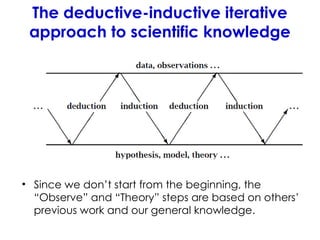
• It comprises of defining and refining problems,
formulating hypothese, suggest solutions or
solution approaches, collecting and analyzing
data, deriving, experimenting, and enventually
validating the hypothesis or deducing new
conclusions.
• Research is also defined as search for knowledge
through objective and systematic methods of
finding solutions to a problem or developing
foundation theories.
6.
What’s Research?
• Asystematic and organized form of continuous
attention applied to a field of knowledge,
undertaken to establish facts, relationships,
principles and theories.
– ”re” ... implies returns to study
– Systematic and organized ... the scientific method...
– Establishing facts ... description
– Establishing relations ... explanations and correlations
– Establish principles and theories ... exploratory and
discovery
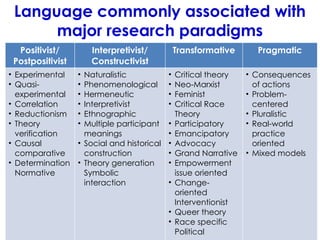
7.
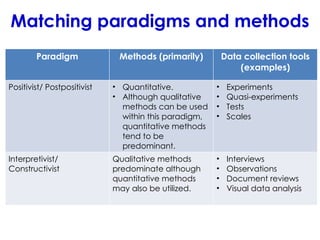
Meaning of Research
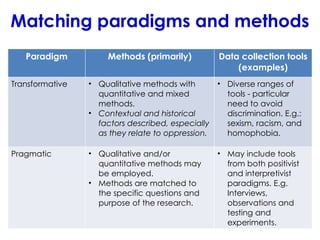
•Research is:
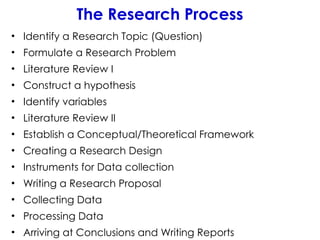
– A process of enquiry and investigation
– Systematic and methodical, and
– Increases knowledge.
• Implies that researchers need to use
appropriate methods for collecting and
analyzing research data, and to apply them
rigorously.
• The purpose of research is to investigate a
research question with a view to generating
knowledge.
8.
Meaning of Research
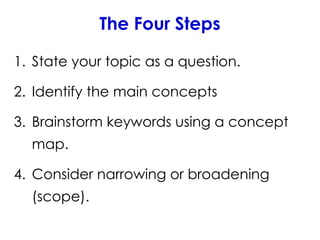
•Research refers to
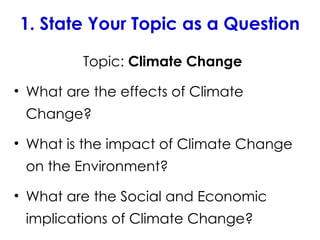
– a systematic method consisting of articulating
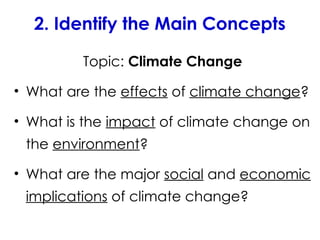
the problem,
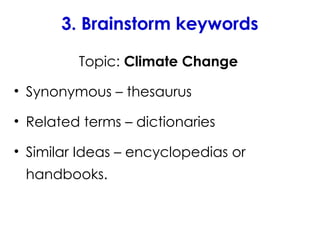
– formulating a hypothesis (research questions),
– collecting the facts or data, analyzing the
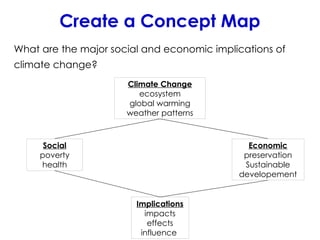
facts,
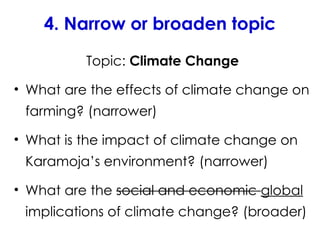
– and reaching conclusions either in form of
solutions towards the concerned problem or
in certain generalization for some theoretical
formulation.
9.
Characteristics of Research
•Controlled – set up controls or qualify effects
• Rigorous – follow relevant procedure
• Systematic – follow logical sequences,
necessary and sufficient conditions
• Valid and verifiable – universally repeatable
• Empirical – conclusion based on sensory inputs
• Critical – all procedure can be questioned.
10.
The Importance ofResearch
• Direct impact of science and
technology in our lives.
• Its understanding is beneficial to our
welfare
– Enable us to differentiate between science
and pseudoscience
• Help us to develop reasoning skills.
• Allows us to challenge and find
limitations in research claims.
11.
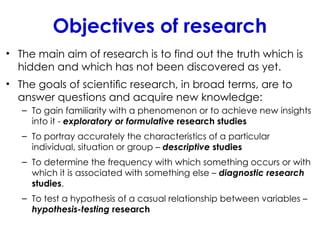
Objectives of research
•The main aim of research is to find out the truth which is
hidden and which has not been discovered as yet.
• The goals of scientific research, in broad terms, are to
answer questions and acquire new knowledge:
– To gain familiarity with a phenomenon or to achieve new insights
into it - exploratory or formulative research studies
– To portray accurately the characteristics of a particular
individual, situation or group – descriptive studies
– To determine the frequency with which something occurs or with
which it is associated with something else – diagnostic research
studies.
– To test a hypothesis of a casual relationship between variables –
hypothesis-testing research
12.
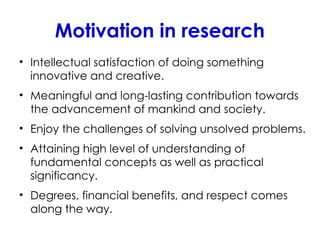
Motivation in research
•Intellectual satisfaction of doing something
innovative and creative.
• Meaningful and long-lasting contribution towards
the advancement of mankind and society.
• Enjoy the challenges of solving unsolved problems.
• Attaining high level of understanding of
fundamental concepts as well as practical
significancy.
• Degrees, financial benefits, and respect comes
along the way.
13.
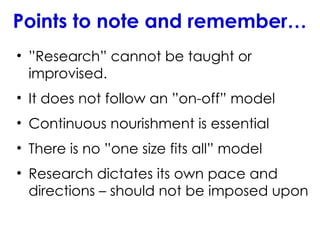
Points to noteand remember…
• ”Research” cannot be taught or
improvised.
• It does not follow an ”on-off” model
• Continuous nourishment is essential
• There is no ”one size fits all” model
• Research dictates its own pace and
directions – should not be imposed upon
14.
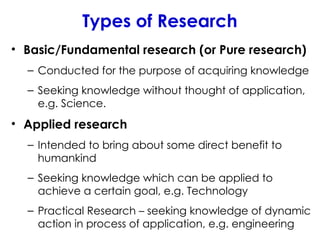
Types of Research
•Basic/Fundamental research (or Pure research)
– Conducted for the purpose of acquiring knowledge
– Seeking knowledge without thought of application,
e.g. Science.
• Applied research
– Intended to bring about some direct benefit to
humankind
– Seeking knowledge which can be applied to
achieve a certain goal, e.g. Technology
– Practical Research – seeking knowledge of dynamic
action in process of application, e.g. engineering
15.
Descriptive Research
• Descriptionrefers to the process of defining,
classifying, or categorizing phenomena of interest.
• Describe what is happening behaviorally.
– Example:
• Students’ failure at undergraduate.
• Plevalency rate of HIV infection in the
community
• Necessary first step.
• Foundation for future inquiries.
• Does not explain how or why.
16.
Relational (Correlational) Research
•In correlational research, the goal is to determine
whether two or more variables are related.
• Measure and estimate relationship between two or
more variables
– Example: Learning aids and student knowledge
• Examines:
– If variables are significantly related
– Direction of relationship
– Strength of relationship
• Does not demonstrate causality!
17.
Experimental Research
• Experimentalresearch involves comparing two groups on one
outcome measure to test some hypothesis regarding causation.
• Manipulate conditions responsible for effect.
– Example: Presence of books on student learning.
• Implies causation.
• For example, if a researcher is interested in the effects of a new
medication on headaches, the researcher would randomly
divide a group of people with headaches into two groups.
• One of the groups, the experimental group, would receive the
new medication being tested. The other group, the control
group, would receive a placebo medication (i.e., a medication
containing a harmless substance, such as sugar, that has no
physiological effects).
18.
Approaches to ConductingResearch
Quantitative Research
• Involves studies that make use of statistical analyses
to obtain their findings.
• Key features include formal and systematic
measurement and the use of statistics.
– Generates numerical data (numbers)
• Formal experiments
• Standardized instruments/scales
(surveys/questionnaires)
• Typically have large sample sizes
• Often entails hypothesis testing
• Often entails generalizability
19.
Qualitative research
• Involvesstudies that do not attempt to quantify their
results through statistical summary or analysis.
• Qualitative studies typically involve interviews and
observations without formal measurement
– Generates categorized information and/or impressions
or descriptions
• concern is with process, not merely outcomes
• less structured
• typically have small sample sizes
• provides extensive detail on attitudes and behavior
• examples: case study, focus group, in-depth interview,
naturalistic observation.
Approaches to Conducting Research
20.
• Mixed Methods(Multi-method)
– Combination of quantitative and
qualitative.
• a specific method may be used to
strengthen another method.
• example: focus group used to support
survey results.
• example: structured job satisfaction
survey developed by conducting one-
on-one interviews with employees.
Approaches to Conducting Research
21.
Empirical Reasoning andthe Scientific
Method
• Empirical = “based on observation”
• The “key” to empirical reasoning
– Careful logic
– Organized observation/measurement
– Replicable
– Open to scrutiny by others
22.
The Scientific Method
•Scientific method refers to a body of
techniques using tools such as observations,
experiments, and statistical analysis to
investigating phenomena, acquiring new
knowledge, or correcting and integrating
previous knowledge.
• To be termed scientific, a method of inquiry
must be based on gathering empirical and
measurable evidence subject to specific
principles of reasoning.
23.
The Scientific Method
•It is a method of procedure that has
characterized natural science since the
17th
century, consisting in
– systematic observation,
– measurement and experiment,
– and the formulation, testing,
– and modification of hypotheses.
24.
Characteristics of theScientific Method
• The Scientific Method is characterized by the
following elements:
– Empirical approach
– Observations
– Questions
– Hypotheses
– Experiments
– Analyses
– Conclusions
– Replication
25.
Empirical Approach
• Thescientific method is firmly based on the empirical
approach.
• An evidence-based approach that relies on direct
observation and experimentation in the acquisition of
new knowledge.
• Scientific decisions are made based on the data derived
from direct observation and experimentation.
– Contrast this approach to decision making with the way that
most nonscientific Decisions are made in our daily lives. For
example, we have all made decisions based on feelings,
hunches, or “gut” instinct.
– Other times we often reach conclusions or make decisions that
are not necessarily based on data, but rather on opinions,
speculation, and a hope for the best.
26.
Empirical Approach
• Theempirical approach, with its emphasis on direct,
systematic, and careful observation, is best thought
of as the guiding principle behind all research
conducted in accordance with the scientific
method.
27.
Observations
• An importantcomponent in any scientific investigation is
observation.
• In this sense, observation refers to two distinct concepts—being
aware of the world around us and making careful
measurements.
• Observations of the world around us often give rise to the
questions that are addressed through scientific research.
– For example, the Newtonian observation that apples fall from trees
stimulated much research into the effects of gravity.
• Therefore, a keen eye to your surroundings can often provide
you with many ideas for research studies.
• Observation also refers to the process of making careful and
accurate measurements, which is a distinguishing feature of
well-conducted scientific investigations.
28.
Questions
• After gettinga research idea, perhaps from making
observations of the world around us, the next step in the
research process involves translating that research idea
into an answerable question.
• It is therefore important to formulate a research
question that can be answered through available
scientific methods and procedures.
• One might ask, for example, whether exercising (i.e.,
perhaps operationally defined as running 3 times/week
for 30 minutes each time) reduces cholesterol levels.
• This question could be researched and answered using
established scientific methods.
29.
Hypotheses
• The nextstep in the scientific method is coming up with
a hypothesis, which is simply an educated—and
testable—guess about the answer to your research
question.
• A hypothesis is often described as an attempt by the
researcher to explain the phenomenon of interest.
• A key feature of all hypotheses is that each must make
a prediction.
• For example, a researcher may hypothesize that:
– “if people exercise for 30 minutes/day at least three
days/week, then their cholesterol levels will be reduced.”
30.
Experiments
• After articulatingthe hypothesis, the next step
involves actually conducting the experiment (or
research study).
• For example, if the study involves investigating the
effects of exercise on levels of cholesterol, the
researcher would design and conduct a study that
would attempt to address that question.
31.
Analyses
• After conductingthe study and gathering the
data, the next step involves analyzing the data,
which generally calls for the use of statistical
techniques.
• The type of statistical techniques used by a
researcher depends on the design of the study, the
type of data being gathered, and the questions
being asked.
• Statistics help researchers minimize the likelihood of
reaching an erroneous conclusion about the
relationship between the variables being studied.
32.
Conclusions
• After analyzingthe data and determining whether
to reject the null hypothesis, the researcher is now in
a position to draw some conclusions about the
results of the study.
33.
Replication
• Replication essentiallymeans conducting the same
research study a second time with another group of
participants to see whether the same results are obtained.
• Illustrates an important point about scientific research:
– that researchers should avoid drawing broad conclusions based
on the results of a single research study because it is always
possible that the results of that particular study were an aberration.
• Integral purposes of replication, including
– establishing the reliability (i.e., consistency) of the research study’s
findings
– determining whether the same results can be obtained with a
different group of participants.
34.
Steps in theScientific Method
• A linearized, pragmatic scheme of the four points above
is sometimes offered as a guideline for proceeding:
1. Define a question
2. Gather information and resources (observe)
3. Form an explanatory hypothesis (formulate questions)
4. Test the hypothesis by performing an experiment and
collecting data in a reproducible manner
(Method/Measurement)
5. Analyze the data (Result)
6. Interpret the data and draw conclusions that serve as a
starting point for new hypothesis (Conclusion)
– (Publish results)
– (Retest (frequently done by other scientists))
35.
Advantages of theScientific Method
• Clarity and Precision
– avoids logic, casual observation, and
common sense.
• Intolerance of Error
– scientists are trained to be critical thinkers.
36.
Elements of scientificmethod
• Four essential elements of a scientific
method
– Characterizations (observations, definitions, and
measurements of the subject of inquiry)
– Hypotheses (theoretical,
hypothetical/imaginary explanations of
observations and measurements of the subject)
– Predictions (reasoning including logical
deduction from the hypothesis or theory)
– Experiments (tests of all of the above)
37.
The Scientific Method
AskQuestion
Do background
research
Construct
hypothesis
Test with an
experiment
Analyze results
Draw Conclusion
Hypothesis is False
Or Partially True
Hypothesis is True
Report Results
Data,
Observation,
Evidence
Thesis,
Publication,
Conference, Seminar
papers, etc.
38.
The Scientific Method
•Question – You
ask a question
about what
you observe.
• State the
problem or
question
39.
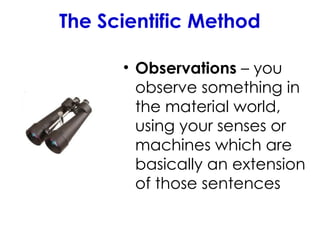
The Scientific Method
•Observations – you
observe something in
the material world,
using your senses or
machines which are
basically an extension
of those sentences
40.
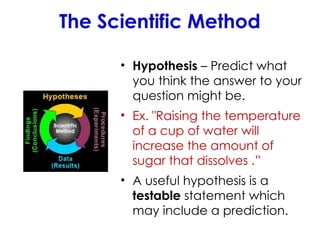
The Scientific Method
•Hypothesis – Predict what
you think the answer to your
question might be.
• Ex. "Raising the temperature
of a cup of water will
increase the amount of
sugar that dissolves .”
• A useful hypothesis is a
testable statement which
may include a prediction.
41.
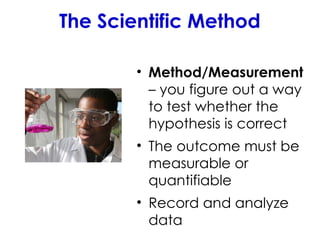
The Scientific Method
•Method/Measurement
– you figure out a way
to test whether the
hypothesis is correct
• The outcome must be
measurable or
quantifiable
• Record and analyze
data
42.
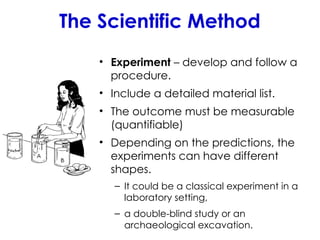
The Scientific Method
•Experiment – develop and follow a
procedure.
• Include a detailed material list.
• The outcome must be measurable
(quantifiable)
• Depending on the predictions, the
experiments can have different
shapes.
– It could be a classical experiment in a
laboratory setting,
– a double-blind study or an
archaeological excavation.
43.
Reporting and Communicationof
Research
As a working research scientist, you have a duty
to communicate with those who:
• Fund your work (donors, research councils
and/or committees);
• Can use your work to further their work
(colleagues);
• Benefit from your work (society at large);
• Evaluate your work (superiors, external review
commissions).
44.
Important aspect ofthe scientific
method
• A built-in mechanism to check and revise itself.
• Any statement in science is subject to revision
or even falsification using the same
methodology that was used to establish it in
the first place.
• Thus it is self-consistent and does not allow for
any super-natural reasoning.
45.
Types of sciences
•Experimental: controlled conditions
under which measurements are made
– e.g. laboratory experiments in physics or
chemistry;
• Variable level of control of the context,
but always quantifiable
– e.g. temperature in a growth chamber can
be controlled with a known precision
46.
Types of Sciences
•Observational: uncontrolled or semi–
controlled conditions
– e.g. we can’t order up an earthquake,
landslide or extreme rainfall event.
– e.g. we can’t manufacture survey
respondents with certain characteristics.
• Requires a sound sampling design.
47.
Types of Sciences
•Historical: we have evidence from the past,
which can never be re-created experimentally
– e.g. geology, archaeology.
• Can relate to current processes, assuming that
the laws of physics etc. have not changed in
the meantime.
• Perhaps can reproduce some of the supposed
processes in the lab.
• Relies heavily on inference and weight of
evidence.
48.
Science vs. engineering
•Scientific research is a method to discover facts about
nature and to put these in a theoretical context
– ‘why’ the observed facts are so
• Engineering is the design and manufacture of objects
– which may be virtual, e.g. a computer program.
• They both use logical thinking, and during the course of
an engineering project many small experiments may be
carried out to improve the design.
• The fundamental difference is that science investigates
the world as it is and tries to explain it, whereas
engineering changes the world by human activity.
49.
The deductive-inductive scientific
method
Thebest-known scientific method is known as the
“deductive-inductive” approach. It has the
following structure:
1. Observe;
2. Invent a theory to explain the observations
→ induction;
3. Use the theory to make predictions
→ deduction;
4. Design experiments to test these predictions;
50.
The deductive-inductive scientific
method
5.Modify the theory in the light of results →
induction;
6. Repeat from step 3 until you can’t think of
any new predictions that might falsify or
modify the theory.
• As given above, this applies to the
experimental sciences. For observational or
historical sciences, Step 4 is modified:
• Make more observations to test these
predictions.
51.
The deductive-inductive iterative
approachto scientific knowledge
• Since we don’t start from the beginning, the
“Observe” and “Theory” steps are based on others’
previous work and our general knowledge.
52.
Logical thinking
• Inscience we use a combination of
strict deductive logic and probabilistic
inductive reasoning.
• How we actually think ‘logically’ in
science is a fascinating topic.
• Below we give only a simplified view on
induction, deduction, assumptions, etc.
53.
Induction and deduction
•Induction: generalize from observations to
theories:
– Logical process of inference
– This is how we make theories and laws
• E.g. We have taken a transect of soil samples every 100
m across a dry lake bed, and these show higher salinity
towards the centre of the lake bed. We generalize to
all possible soil samples in the study area. Further, we
develop an equation to predict salinity based on the
distance from the edge of the lake.
54.
Deduction
• Deduction: specializefrom a general law to a
specific case
– Provides ideas for experiments or observations
– “If this theory is true, then the following should occur
or be observed”
• Following the previous example, the equation predicts the salinity
we should observe at any point in the study area. We may take a
further step and apply this equation to all dry lake beds in the
region (. . . to all dry lake beds in the world?)
55.
Levels of certainty
•We use the words:
–“fact”,
–“hypothesis”,
–“theory” and
–“law”
in common speech with a variety of
meanings which often overlap.
Hypothesis
• Hypothesis: atentative theory, not yet tested;
• What we believe to be the true explanation or true
state of nature, based on previous work or first
principles;
• “[An] idea or a suggestion that is based on known
facts and is used as a basis for reasoning or further
investigation.
• Note the emphasis on “starting point”, so that if a
hypothesis is then supported by more evidence it
becomes a . . (theory)
58.
Theory
• Theory: aconceptual framework:
– which explains existing facts;
– allows predictions;
– and is in principle falsifiable (some experiment or
observation could contradict it or force its
modification).
• “A reasoned supposition put forward to
explain facts or events”
– note the emphasis on “reasoned”, meaning that a theory
must be supported by evidence and logical argument from
this.
59.
Law
• Law: atheory with overwhelming evidence
including the conditions under which it is true.
• Ex: Newton’s “laws” of motion are valid in cases
where relativistic effects are not important
(velocities low compared to the speed of light).
• The boundaries in the sequence:
hypothesis → theory→ law
are of course fuzzy.
• A law can be defined as a theory whose
falsification, within its context, is almost
inconceivable.
60.
Is a hypothesisnecessary for science?
• A hypothesis is a reasonable first explanation
of the true state of nature based on previous
work or first principles; the research must be
designed to test or challenge this hypothesis.
• The research will either:
a) confirm;
b) contradict; or
c) cause a modification of . . .
. . . the hypothesis.
61.
Modes of Knowingin Research
(Epistemology)
1. Intuitive – belief, faith, hunches, feeling –
building hypotheses.
2. Authoritative – based on established sources
or authorities – professional literature.
3. Logical – exercise of induction and
deduction – reasoning from findings to
conclusion.
4. Empirical – based of objective facts
established through sensory observations –
procedures lead to findings.
62.
Research Paradigm
• Aworld view underlying the theories and
methodology of a science subject.
• The theoretical framework, as distinct from a theory, is
sometimes referred to as the paradigm and
influences the way knowledge is studied and
interpreted.
• It is the choice of paradigm that sets down the intent,
motivation and expectations for the research.
• Without nominating a paradigm as the first step,
there is no basis for subsequent choices regarding
methodology, methods, literature or research design.
63.
Postpositivist (and positivist)
paradigm
•Positivism is sometimes referred to as 'scientific
method' or 'science research'
– "based on the rationalistic, empiricist philosophy that
originated with Aristotle, Francis Bacon, John Locke,
August Comte, and Emmanuel Kant" and "reflects a
deterministic philosophy in which causes probably
determine effects or outcomes".
• Positivists aim to test a theory or describe an
experience "through observation and
measurement in order to predict and control
forces that surround us".
Interpretivist/constructivist paradigm
• Researchertends to rely upon the "participants' views
of the situation being studied" and recognizes the
impact on the research of their own background and
experiences.
• Constructivists do not generally begin with a theory (as
with postpositivists) rather they "generate or inductively
develop a theory or pattern of meanings" throughout
the research process.
• The constructivist researcher is most likely to rely on
qualitative data collection methods and analysis or a
combination of both qualitative and quantitative
methods (mixed methods).
66.
Transformative paradigm
• Aroseduring the 1980s/1990s partially due
to
– dissatisfaction with the existing and dominant
research paradigms and practices
– but also because of a realization that much
sociological and psychological theory which
lay behind the dominant paradigms "had
been developed from the white, able-bodied
male perspective and was based on the
study of male subjects".
67.
Transformative paradigm
• Transformativeresearchers felt that the
interpretivist/constructivist approach to research did
not adequately address issues of social justice and
marginalized peoples.
• Transformative researchers "believe that inquiry needs
to be intertwined with politics and a political agenda"
and contain an action agenda for reform "that may
change the lives of the participants, the institutions in
which individuals work or live, and the researcher's life“.
68.
Pragmatic paradigm
• Pragmatismis not committed to any one
system of philosophy or reality.
• Dealing with things in a way that is based on
practical rather than theoretical
considerations.
• Pragmatist researchers focus on the 'what'
and 'how' of the research problem.
69.
Pragmatic paradigm
• Thepragmatic paradigm places "the
research problem" as central and applies all
approaches to understanding the problem.
• With the research question 'central', data
collection and analysis methods are chosen
as those most likely to provide insights into
the question with no philosophical loyalty to
any alternative paradigm.
70.
Methodology and paradigms
•Methodology is the science of
methods, especially:
– branch of logic dealing with the logical
principles underlying the organization of
the various special sciences, and the
conduct of scientific inquiry.
– A system of methods used in a particular
field.
71.
Language commonly associatedwith
major research paradigms
Positivist/
Postpositivist
Interpretivist/
Constructivist
Transformative Pragmatic
• Experimental
• Quasi-
experimental
• Correlation
• Reductionism
• Theory
verification
• Causal
comparative
• Determination
Normative
• Naturalistic
• Phenomenological
• Hermeneutic
• Interpretivist
• Ethnographic
• Multiple participant
meanings
• Social and historical
construction
• Theory generation
Symbolic
interaction
• Critical theory
• Neo-Marxist
• Feminist
• Critical Race
Theory
• Participatory
• Emancipatory
• Advocacy
• Grand Narrative
• Empowerment
issue oriented
• Change-
oriented
Interventionist
• Queer theory
• Race specific
Political
• Consequences
of actions
• Problem-
centered
• Pluralistic
• Real-world
practice
oriented
• Mixed models
72.
Matching paradigms andmethods
Paradigm Methods (primarily) Data collection tools
(examples)
Positivist/ Postpositivist • Quantitative.
• Although qualitative
methods can be used
within this paradigm,
quantitative methods
tend to be
predominant.
• Experiments
• Quasi-experiments
• Tests
• Scales
Interpretivist/
Constructivist
Qualitative methods
predominate although
quantitative methods
may also be utilized.
• Interviews
• Observations
• Document reviews
• Visual data analysis
73.
Matching paradigms andmethods
Paradigm Methods (primarily) Data collection tools
(examples)
Transformative • Qualitative methods with
quantitative and mixed
methods.
• Contextual and historical
factors described, especially
as they relate to oppression.
• Diverse ranges of
tools - particular
need to avoid
discrimination. E.g.:
sexism, racism, and
homophobia.
Pragmatic • Qualitative and/or
quantitative methods may
be employed.
• Methods are matched to
the specific questions and
purpose of the research.
• May include tools
from both positivist
and interpretivist
paradigms. E.g.
Interviews,
observations and
testing and
experiments.
74.
The Research Process
•Identify a Research Topic (Question)
• Formulate a Research Problem
• Literature Review I
• Construct a hypothesis
• Identify variables
• Literature Review II
• Establish a Conceptual/Theoretical Framework
• Creating a Research Design
• Instruments for Data collection
• Writing a Research Proposal
• Collecting Data
• Processing Data
• Arriving at Conclusions and Writing Reports
75.
What makes agood Prosposal?
• Relevance, either to the work of the funding body or
to the student’s course.
• The research is unique, or o ers new insight or
ff
development.
• The title, aims and objectives are all clear and
succinct.
• Comprehensive and thorough background research
and literature review has been undertaken.
• There is a good match between the issues to be
addressed and the approach being adopted.
76.
What makes agood Prosposal?
• The researcher demonstrates relevant
background knowledge and/or experience.
• Timetable, resources and budget have all
been worked out thoroughly, with most
eventualities covered.
• Useful policy and practice implications.
77.
Reasons Why Researchproposals Fail
• Aims and objectives are unclear or vague.
• There is a mismatch between the approach
being adopted and the issues to be addressed.
• The overall plan is too ambitious and di cult to
ffi
achieve in the timescale.
• The researcher does not seem to have
conducted enough in-depth background
research.
• Problem is of insu cient importance.
ffi
78.
Reasons Why Researchproposals Fail
• Information about the data collection is
insu ciently detailed.
ffi
• Information about the data analysis method is
insu ciently detailed.
ffi
• Timeframe is inappropriate or unrealistic.
• Resources and budget have not been carefully
thought out.
• This topic has been done too many times before
– indicates a lack in background research.
79.
Characteristics of GoodResearch
• Clearly defined purpose or objective.
• Detailed process
– Providing procedures used to conduct the study
• Well planned research design
– Results should be as objective as possible
• Maintain high ethical standards
– Being responsible and concerned for the welfare
of the participants
80.
Characteristics of GoodResearch
• Reveal limitations
– Acknowledge shortcomings in the research
• Adequate analysis
– Method chosen is appropriate
• Conclusions justified
– Not over-generalizing
• Findings/results presented clearly
– Readily understood language
81.
Characteristics of GoodResearchers
• Enthusiastic
• Open-minded
• Common sense (sound judgement in
practical issues)
• Ability to assume other roles
• Self-confident
• Creative and inventive
82.
Characteristics of GoodResearchers
• Effective communicator
• Attentive to details
• Possesses integrity and honesty
• Ethical
• Accepting of valid criticism
• Address real-world issues
83.
Topic Selection
• Realizeyour expertize and limitations
• Focus on your breadth of knowledge first.
• Be specific about your topic, but flexible about
the scope
• Do not set rigid barriers regarding the topic
• The topic may not be discipline specific
• Be prepared to revisit the topic selection if
needed.
84.
Topic Selection
Three importantthings
1. It is a topic that strongly interests you
2. It’s creative
3. It is not too broad, (time, how many
pages...?)
85.
Define Your ResearchTopic
Why define your research topic?
• Helps clarify your reseach focus.
• Identifies concepts and keywords
• Gives direction to your writing.
86.
The Four Steps
1.State your topic as a question.
2. Identify the main concepts
3. Brainstorm keywords using a concept
map.
4. Consider narrowing or broadening
(scope).
87.
1. State YourTopic as a Question
Topic: Climate Change
• What are the effects of Climate
Change?
• What is the impact of Climate Change
on the Environment?
• What are the Social and Economic
implications of Climate Change?
88.
2. Identify theMain Concepts
Topic: Climate Change
• What are the effects of climate change?
• What is the impact of climate change on
the environment?
• What are the major social and economic
implications of climate change?
89.
3. Brainstorm keywords
Topic:Climate Change
• Synonymous – thesaurus
• Related terms – dictionaries
• Similar Ideas – encyclopedias or
handbooks.
90.
Create a ConceptMap
Topic: Climate Change
• A concept map is a way to visually
display your ideas and the relationships
among them.
91.
Create a ConceptMap
What are the major social and economic implications of
climate change?
Climate Change
ecosystem
global warming
weather patterns
Social
poverty
health
Economic
preservation
Sustainable
developement
Implications
impacts
effects
influence
92.
4. Narrow orbroaden topic
Topic: Climate Change
• What are the effects of climate change on
farming? (narrower)
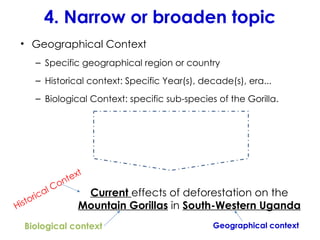
• What is the impact of climate change on
Karamoja’s environment? (narrower)
• What are the social and economic global
implications of climate change? (broader)
93.
4. Narrow orbroaden topic
• Environmental Science
• Write a research paper on a topic dealing
with a current environmental issue. Your
paper should not exceed 5 pages and should
be on a topic that strongly interests you.
• Let’s say... Topic – the effect of deforestation
on Gorillas in Africa
• Fit into a good scope...
94.
4. Narrow orbroaden topic
• Geographical Context
– Specific geographical region or country
– Historical context: Specific Year(s), decade(s), era...
– Biological Context: specific sub-species of the Gorilla.
Current effects of deforestation on the
Mountain Gorillas in South-Western Uganda
Historical Context
Biological context Geographical context
95.
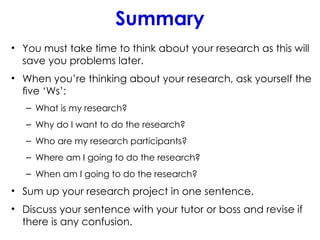
Summary
• You musttake time to think about your research as this will
save you problems later.
• When you’re thinking about your research, ask yourself the
five ‘Ws’:
– What is my research?
– Why do I want to do the research?
– Who are my research participants?
– Where am I going to do the research?
– When am I going to do the research?
• Sum up your research project in one sentence.
• Discuss your sentence with your tutor or boss and revise if
there is any confusion.

![Hypothesis
• Hypothesis: a tentative theory, not yet tested;
• What we believe to be the true explanation or true
state of nature, based on previous work or first
principles;
• “[An] idea or a suggestion that is based on known
facts and is used as a basis for reasoning or further
investigation.
• Note the emphasis on “starting point”, so that if a
hypothesis is then supported by more evidence it
becomes a . . (theory)](https://image.slidesharecdn.com/overviewofresearchmethods1-250424073924-2fc4076e/85/Overview_of_research_methods-in-engineering-pptx-57-320.jpg)