SEP

DGEST
INSTITUTO

TECNOLÓGICO

SNEST

DE

MATAMOROS

DEPARTAMENTO DE INGENIERÍA ELÉCTRICA Y ELECTRÓNICA

Diseño Digital con VHDL
Equipo:

Alumno(s):

Núm. de control:

Mario Arturo Cruz Colunga

11260077

Miguel Angel Fierros Peña

11260081

Hermenegildo Martínez de la Cruz

11260095

Jorge Alejandro Reyes Torres

11260108

H. MATAMOROS, TAM.

1 de Noviembre del 2013
Practica 9
Objetivo:
Realizar la implementación de un cronometro de 2 dígitos mediante aldechdl y
basys2.
Material:
Laptop
Kit spartan3e
Software aldec HDL, xilinx ISE, adept.
Procedimiento:
Se crea nuevo proyecto en aldec HDL
Se crea un diagrama de estados
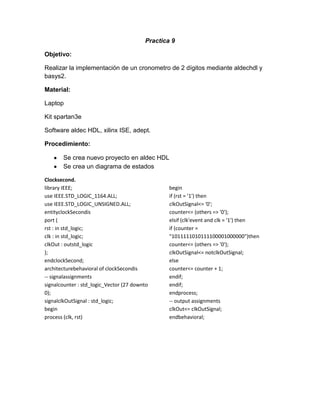
Clocksecond.
library IEEE;
use IEEE.STD_LOGIC_1164.ALL;
use IEEE.STD_LOGIC_UNSIGNED.ALL;
entityclockSecondis
port (
rst : in std_logic;
clk : in std_logic;
clkOut : outstd_logic
);
endclockSecond;
architecturebehavioral of clockSecondis
-- signalassignments
signalcounter : std_logic_Vector (27 downto
0);
signalclkOutSignal : std_logic;
begin
process (clk, rst)

begin
if (rst = '1') then
clkOutSignal<= '0';
counter<= (others => '0');
elsif (clk'event and clk = '1') then
if (counter =
"1011111010111100001000000")then
counter<= (others => '0');
clkOutSignal<= notclkOutSignal;
else
counter<= counter + 1;
endif;
endif;
endprocess;
-- output assignments
clkOut<= clkOutSignal;
endbehavioral;
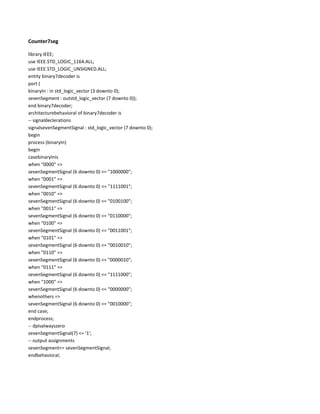
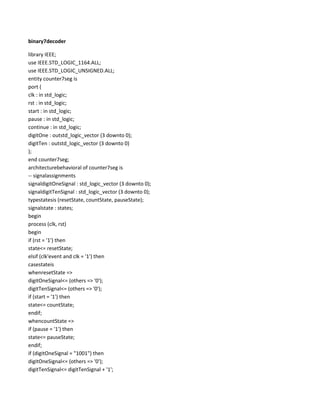
Counter7seg
library IEEE;
use IEEE.STD_LOGIC_1164.ALL;
use IEEE.STD_LOGIC_UNSIGNED.ALL;
entity binary7decoder is
port (
binaryIn : in std_logic_vector (3 downto 0);
sevenSegment : outstd_logic_vector (7 downto 0));
end binary7decoder;
architecturebehavioral of binary7decoder is
-- signaldeclerations
signalsevenSegmentSignal : std_logic_vector (7 downto 0);
begin
process (binaryIn)
begin
casebinaryInis
when "0000" =>
sevenSegmentSignal (6 downto 0) <= "1000000";
when "0001" =>
sevenSegmentSignal (6 downto 0) <= "1111001";
when "0010" =>
sevenSegmentSignal (6 downto 0) <= "0100100";
when "0011" =>
sevenSegmentSignal (6 downto 0) <= "0110000";
when "0100" =>
sevenSegmentSignal (6 downto 0) <= "0011001";
when "0101" =>
sevenSegmentSignal (6 downto 0) <= "0010010";
when "0110" =>
sevenSegmentSignal (6 downto 0) <= "0000010";
when "0111" =>
sevenSegmentSignal (6 downto 0) <= "1111000";
when "1000" =>
sevenSegmentSignal (6 downto 0) <= "0000000";
whenothers =>
sevenSegmentSignal (6 downto 0) <= "0010000";
end case;
endprocess;
-- dpisalwayszero
sevenSegmentSignal(7) <= '1';
-- output assignments
sevenSegment<= sevenSegmentSignal;
endbehavioral;
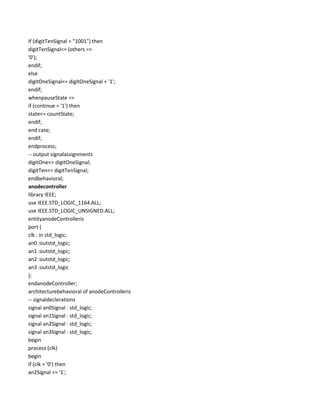
binary7decoder
library IEEE;
use IEEE.STD_LOGIC_1164.ALL;
use IEEE.STD_LOGIC_UNSIGNED.ALL;
entity counter7seg is
port (
clk : in std_logic;
rst : in std_logic;
start : in std_logic;
pause : in std_logic;
continue : in std_logic;
digitOne : outstd_logic_vector (3 downto 0);
digitTen : outstd_logic_vector (3 downto 0)
);
end counter7seg;
architecturebehavioral of counter7seg is
-- signalassignments
signaldigitOneSignal : std_logic_vector (3 downto 0);
signaldigitTenSignal : std_logic_vector (3 downto 0);
typestatesis (resetState, countState, pauseState);
signalstate : states;
begin
process (clk, rst)
begin
if (rst = '1') then
state<= resetState;
elsif (clk'event and clk = '1') then
casestateis
whenresetState =>
digitOneSignal<= (others => '0');
digitTenSignal<= (others => '0');
if (start = '1') then
state<= countState;
endif;
whencountState =>
if (pause = '1') then
state<= pauseState;
endif;
if (digitOneSignal = "1001") then
digitOneSignal<= (others => '0');
digitTenSignal<= digitTenSignal + '1';
if (digitTenSignal = "1001") then
digitTenSignal<= (others =>
'0');
endif;
else
digitOneSignal<= digitOneSignal + '1';
endif;
whenpauseState =>
if (continue = '1') then
state<= countState;
endif;
end case;
endif;
endprocess;
-- output signalassignments
digitOne<= digitOneSignal;
digitTen<= digitTenSignal;
endbehavioral;
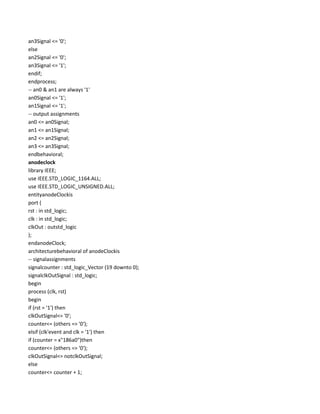
anodecontroller
library IEEE;
use IEEE.STD_LOGIC_1164.ALL;
use IEEE.STD_LOGIC_UNSIGNED.ALL;
entityanodeControlleris
port (
clk : in std_logic;
an0 :outstd_logic;
an1 :outstd_logic;
an2 :outstd_logic;
an3 :outstd_logic
);
endanodeController;
architecturebehavioral of anodeControlleris
-- signaldeclerations
signal an0Signal : std_logic;
signal an1Signal : std_logic;
signal an2Signal : std_logic;
signal an3Signal : std_logic;
begin
process (clk)
begin
if (clk = '0') then
an2Signal <= '1';
an3Signal <= '0';
else
an2Signal <= '0';
an3Signal <= '1';
endif;
endprocess;
-- an0 & an1 are always '1'
an0Signal <= '1';
an1Signal <= '1';
-- output assignments
an0 <= an0Signal;
an1 <= an1Signal;
an2 <= an2Signal;
an3 <= an3Signal;
endbehavioral;
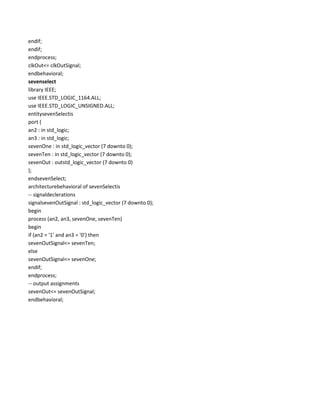
anodeclock
library IEEE;
use IEEE.STD_LOGIC_1164.ALL;
use IEEE.STD_LOGIC_UNSIGNED.ALL;
entityanodeClockis
port (
rst : in std_logic;
clk : in std_logic;
clkOut : outstd_logic
);
endanodeClock;
architecturebehavioral of anodeClockis
-- signalassignments
signalcounter : std_logic_Vector (19 downto 0);
signalclkOutSignal : std_logic;
begin
process (clk, rst)
begin
if (rst = '1') then
clkOutSignal<= '0';
counter<= (others => '0');
elsif (clk'event and clk = '1') then
if (counter = x"186a0")then
counter<= (others => '0');
clkOutSignal<= notclkOutSignal;
else
counter<= counter + 1;
endif;
endif;
endprocess;
clkOut<= clkOutSignal;
endbehavioral;
sevenselect
library IEEE;
use IEEE.STD_LOGIC_1164.ALL;
use IEEE.STD_LOGIC_UNSIGNED.ALL;
entitysevenSelectis
port (
an2 : in std_logic;
an3 : in std_logic;
sevenOne : in std_logic_vector (7 downto 0);
sevenTen : in std_logic_vector (7 downto 0);
sevenOut : outstd_logic_vector (7 downto 0)
);
endsevenSelect;
architecturebehavioral of sevenSelectis
-- signaldeclerations
signalsevenOutSignal : std_logic_vector (7 downto 0);
begin
process (an2, an3, sevenOne, sevenTen)
begin
if (an2 = '1' and an3 = '0') then
sevenOutSignal<= sevenTen;
else
sevenOutSignal<= sevenOne;
endif;
endprocess;
-- output assignments
sevenOut<= sevenOutSignal;
endbehavioral;
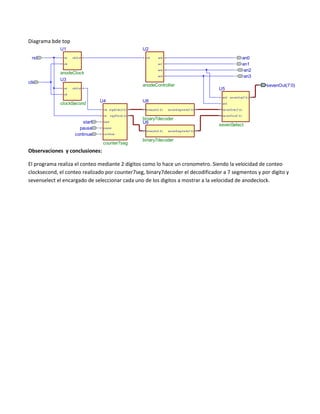
Diagrama bde top
U1
rst

rs t

U2
c lk O ut

c lk

c lk

clk

an0
an1
an2
an3

an0
an1
an2

anodeClock
U3

an3

anodeController
rs t

c lk O ut

sevenOut(7:0)

U5

c lk
an2

clockSecond

U4

U8

c lk

start
pause
continue

d ig itO ne (3:0 )

rs t

d ig itT e n(3 :0 )

s tart

b inary In(3 :0 )

s e v enO ut(7:0 )

an3
s e v enS eg m e nt(7:0 )

binary7decoder
U6

s e v enO ne (7:0 )
s e v e nT e n(7 :0 )

sevenSelect

p aus e
b inary In(3 :0 )

s e v enS eg m e nt(7:0 )

c o ntinue

counter7seg

binary7decoder

Observaciones y conclusiones:
El programa realiza el conteo mediante 2 dígitos como lo hace un cronometro. Siendo la velocidad de conteo
clocksecond, el conteo realizado por counter7seg, binary7decoder el decodificador a 7 segmentos y por digito y
sevenselect el encargado de seleccionar cada uno de los digitos a mostrar a la velocidad de anodeclock.

Reporte vhdl9

  • 1.
    SEP DGEST INSTITUTO TECNOLÓGICO SNEST DE MATAMOROS DEPARTAMENTO DE INGENIERÍAELÉCTRICA Y ELECTRÓNICA Diseño Digital con VHDL Equipo: Alumno(s): Núm. de control: Mario Arturo Cruz Colunga 11260077 Miguel Angel Fierros Peña 11260081 Hermenegildo Martínez de la Cruz 11260095 Jorge Alejandro Reyes Torres 11260108 H. MATAMOROS, TAM. 1 de Noviembre del 2013
  • 2.
    Practica 9 Objetivo: Realizar laimplementación de un cronometro de 2 dígitos mediante aldechdl y basys2. Material: Laptop Kit spartan3e Software aldec HDL, xilinx ISE, adept. Procedimiento: Se crea nuevo proyecto en aldec HDL Se crea un diagrama de estados Clocksecond. library IEEE; use IEEE.STD_LOGIC_1164.ALL; use IEEE.STD_LOGIC_UNSIGNED.ALL; entityclockSecondis port ( rst : in std_logic; clk : in std_logic; clkOut : outstd_logic ); endclockSecond; architecturebehavioral of clockSecondis -- signalassignments signalcounter : std_logic_Vector (27 downto 0); signalclkOutSignal : std_logic; begin process (clk, rst) begin if (rst = '1') then clkOutSignal<= '0'; counter<= (others => '0'); elsif (clk'event and clk = '1') then if (counter = "1011111010111100001000000")then counter<= (others => '0'); clkOutSignal<= notclkOutSignal; else counter<= counter + 1; endif; endif; endprocess; -- output assignments clkOut<= clkOutSignal; endbehavioral;
  • 3.
    Counter7seg library IEEE; use IEEE.STD_LOGIC_1164.ALL; useIEEE.STD_LOGIC_UNSIGNED.ALL; entity binary7decoder is port ( binaryIn : in std_logic_vector (3 downto 0); sevenSegment : outstd_logic_vector (7 downto 0)); end binary7decoder; architecturebehavioral of binary7decoder is -- signaldeclerations signalsevenSegmentSignal : std_logic_vector (7 downto 0); begin process (binaryIn) begin casebinaryInis when "0000" => sevenSegmentSignal (6 downto 0) <= "1000000"; when "0001" => sevenSegmentSignal (6 downto 0) <= "1111001"; when "0010" => sevenSegmentSignal (6 downto 0) <= "0100100"; when "0011" => sevenSegmentSignal (6 downto 0) <= "0110000"; when "0100" => sevenSegmentSignal (6 downto 0) <= "0011001"; when "0101" => sevenSegmentSignal (6 downto 0) <= "0010010"; when "0110" => sevenSegmentSignal (6 downto 0) <= "0000010"; when "0111" => sevenSegmentSignal (6 downto 0) <= "1111000"; when "1000" => sevenSegmentSignal (6 downto 0) <= "0000000"; whenothers => sevenSegmentSignal (6 downto 0) <= "0010000"; end case; endprocess; -- dpisalwayszero sevenSegmentSignal(7) <= '1'; -- output assignments sevenSegment<= sevenSegmentSignal; endbehavioral;
  • 4.
    binary7decoder library IEEE; use IEEE.STD_LOGIC_1164.ALL; useIEEE.STD_LOGIC_UNSIGNED.ALL; entity counter7seg is port ( clk : in std_logic; rst : in std_logic; start : in std_logic; pause : in std_logic; continue : in std_logic; digitOne : outstd_logic_vector (3 downto 0); digitTen : outstd_logic_vector (3 downto 0) ); end counter7seg; architecturebehavioral of counter7seg is -- signalassignments signaldigitOneSignal : std_logic_vector (3 downto 0); signaldigitTenSignal : std_logic_vector (3 downto 0); typestatesis (resetState, countState, pauseState); signalstate : states; begin process (clk, rst) begin if (rst = '1') then state<= resetState; elsif (clk'event and clk = '1') then casestateis whenresetState => digitOneSignal<= (others => '0'); digitTenSignal<= (others => '0'); if (start = '1') then state<= countState; endif; whencountState => if (pause = '1') then state<= pauseState; endif; if (digitOneSignal = "1001") then digitOneSignal<= (others => '0'); digitTenSignal<= digitTenSignal + '1';
  • 5.
    if (digitTenSignal ="1001") then digitTenSignal<= (others => '0'); endif; else digitOneSignal<= digitOneSignal + '1'; endif; whenpauseState => if (continue = '1') then state<= countState; endif; end case; endif; endprocess; -- output signalassignments digitOne<= digitOneSignal; digitTen<= digitTenSignal; endbehavioral; anodecontroller library IEEE; use IEEE.STD_LOGIC_1164.ALL; use IEEE.STD_LOGIC_UNSIGNED.ALL; entityanodeControlleris port ( clk : in std_logic; an0 :outstd_logic; an1 :outstd_logic; an2 :outstd_logic; an3 :outstd_logic ); endanodeController; architecturebehavioral of anodeControlleris -- signaldeclerations signal an0Signal : std_logic; signal an1Signal : std_logic; signal an2Signal : std_logic; signal an3Signal : std_logic; begin process (clk) begin if (clk = '0') then an2Signal <= '1';
  • 6.
    an3Signal <= '0'; else an2Signal<= '0'; an3Signal <= '1'; endif; endprocess; -- an0 & an1 are always '1' an0Signal <= '1'; an1Signal <= '1'; -- output assignments an0 <= an0Signal; an1 <= an1Signal; an2 <= an2Signal; an3 <= an3Signal; endbehavioral; anodeclock library IEEE; use IEEE.STD_LOGIC_1164.ALL; use IEEE.STD_LOGIC_UNSIGNED.ALL; entityanodeClockis port ( rst : in std_logic; clk : in std_logic; clkOut : outstd_logic ); endanodeClock; architecturebehavioral of anodeClockis -- signalassignments signalcounter : std_logic_Vector (19 downto 0); signalclkOutSignal : std_logic; begin process (clk, rst) begin if (rst = '1') then clkOutSignal<= '0'; counter<= (others => '0'); elsif (clk'event and clk = '1') then if (counter = x"186a0")then counter<= (others => '0'); clkOutSignal<= notclkOutSignal; else counter<= counter + 1;
  • 7.
    endif; endif; endprocess; clkOut<= clkOutSignal; endbehavioral; sevenselect library IEEE; useIEEE.STD_LOGIC_1164.ALL; use IEEE.STD_LOGIC_UNSIGNED.ALL; entitysevenSelectis port ( an2 : in std_logic; an3 : in std_logic; sevenOne : in std_logic_vector (7 downto 0); sevenTen : in std_logic_vector (7 downto 0); sevenOut : outstd_logic_vector (7 downto 0) ); endsevenSelect; architecturebehavioral of sevenSelectis -- signaldeclerations signalsevenOutSignal : std_logic_vector (7 downto 0); begin process (an2, an3, sevenOne, sevenTen) begin if (an2 = '1' and an3 = '0') then sevenOutSignal<= sevenTen; else sevenOutSignal<= sevenOne; endif; endprocess; -- output assignments sevenOut<= sevenOutSignal; endbehavioral;
  • 8.
    Diagrama bde top U1 rst rst U2 c lk O ut c lk c lk clk an0 an1 an2 an3 an0 an1 an2 anodeClock U3 an3 anodeController rs t c lk O ut sevenOut(7:0) U5 c lk an2 clockSecond U4 U8 c lk start pause continue d ig itO ne (3:0 ) rs t d ig itT e n(3 :0 ) s tart b inary In(3 :0 ) s e v enO ut(7:0 ) an3 s e v enS eg m e nt(7:0 ) binary7decoder U6 s e v enO ne (7:0 ) s e v e nT e n(7 :0 ) sevenSelect p aus e b inary In(3 :0 ) s e v enS eg m e nt(7:0 ) c o ntinue counter7seg binary7decoder Observaciones y conclusiones: El programa realiza el conteo mediante 2 dígitos como lo hace un cronometro. Siendo la velocidad de conteo clocksecond, el conteo realizado por counter7seg, binary7decoder el decodificador a 7 segmentos y por digito y sevenselect el encargado de seleccionar cada uno de los digitos a mostrar a la velocidad de anodeclock.