Timer's [stopwatch) function is to find out how long it takes in an
activity. Here we have tried to realize a timer of reasonable
accuracy and reliability. This timer project is a software and
hardware co-design. The time will be shown on the FPGA board
and on the seven-segment display.
The system will be modeled in VHDL (Very-high-speed integrated
circuit Hardware Description Language) and implemented on the
Altera DEZ Cyclone FPGA board.
Introduction
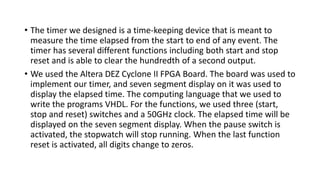
• The timer we designed is a time-keeping device that is meant to
measure the time elapsed from the start to end of any event. The
timer has several different functions including both start and stop
reset and is able to clear the hundredth of a second output.
• We used the Altera DEZ Cyclone II FPGA Board. The board was used to
implement our timer, and seven segment display on it was used to
display the elapsed time. The computing language that we used to
write the programs VHDL. For the functions, we used three (start,
stop and reset) switches and a 50GHz clock. The elapsed time will be
displayed on the seven segment display. When the pause switch is
activated, the stopwatch will stop running. When the last function
reset is activated, all digits change to zeros.
Block diagram
To simplify the development of complex designs, the design is broken up
in to a number of smaller, less complex blocks. This approach is called
“Divide-and-Conquer”.
The FPGA will run on a high clock frequency.
Hence, a single button press of the user will lead to an active signal at
the input of our blocks for many thousand or even millions of clock
cycles. Thus, an edge detection circuit is needed to ensure that each
acknowledge of a button translates only to a signal being active for one
clock cycle. To control the different states of the stop watch, an FSM
(Finite-State-Machine) has to be employed in the design and
subsequently this FSM has to trigger a counter counting the time. This
binary value has to be decoded into a representation matching the
inputs of the seven-segment driver.
Clock and reset signals have been omitted for simplicity, however, we
have to highlight that all sequential circuits need to be reseted using
the system reset signal. Throughout, all docked gates should be
sensitive to the rising edge of the clock.
Implementation
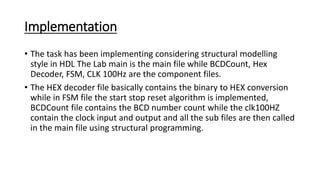
• The task has been implementing considering structural modelling
style in HDL The Lab main is the main file while BCDCount, Hex
Decoder, FSM, CLK 100Hz are the component files.
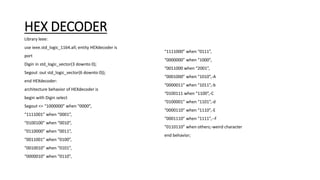
• The HEX decoder file basically contains the binary to HEX conversion
while in FSM file the start stop reset algorithm is implemented,
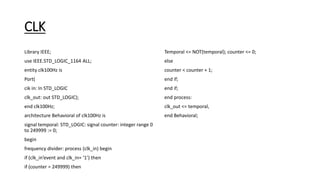
BCDCount file contains the BCD number count while the clk100HZ
contain the clock input and output and all the sub files are then called
in the main file using structural programming.
LIBRARY ieee :
USE ieee std_logic_1164.all;
USE ieee std_logic_unsigned.all:
ENTITY labmain IS
PORT (start stop,reset,clock_50 :IN STD_LOGIC
HEX3,HEX2,HEX1,HEXO:OUTSTD_LOGIC_VECTOR(6
DOWNTO 0));
5
END labmain;
ARCHITECTURE structure OF labmain IS
COMPONENT BCDCount
PORT(clock.reset,enable
IN STD LOGIC;
carry BCD
END COMPONENT;
:OUT STD LOGIC:
OUT STD_LOGIC_VECTOR(3 DOWNTO 0}};
COMPONENT CLK100Hz
PORT(clk in IN STD_LOGIC
cik_out:OUT STD_LOGIC);
END COMPONENT;
COMPONENT HEXdecoder
PORT(Digin IN STD_LOGIC_VECTOR(3 DOWNTO 0); Segout
:OUT STD_LOGIC_VECTOR(6 DOWNTO 0});
END COMPONENT:
COMPONENT fam
PORT(clock,start, stop,reset IN STD_LOGIC
clear, enable OUT STD_LOGIC);
END COMPONENT;
SIGNAL clear, enable,clk100 STD_LOGIC,
Main File
SIGNAL carry2,carry1, carry0: STD_LOGIC;
SIGNAL BCD3,BCD2,BCD1,BCD0 : STD_LOGIC_VECTOR(3 DOWNTO 0);
BEGIN
fsm1 : fsm PORT MAP(clock 50,start, stop, reset,clear,enable);
clkdvd :dk100Hz PORT MAP(clock_50, clk100);
BCDCO: BCDcount PORT MAP(clk100,clear, enable, carry,BCD0);
BCDC1: BCDcount PORT MAP(carry0,clear,1,carry1,BCD1);
BCDC2: BCDcount PORT MAP(carry1,clear, ‘1’, carry2,BCD2);
BCDC3: BCDcount PORT MAP(carry2,clear,’1’,OPEN, BCD3);
HEXDO:HEXdecoder PORT MAP(BCDO, HEXO);
HEXD1: HEXdecoder PORT MAP(BCD1,HEX1);
HEXD2: HEXdecoder PORT MAP(BCD2, HEX2); HEXD3 HEXdecoder PORT MAP(BCD3, HEX3);
END structure;
Main File
FSM
LIBRARY leee;
USE leee.std_logic_1164.all;
USE ieee std_logic_unsigned.all;
ENTITY fsm IS
PORT(clock,start stop,reset IN STD LOGIC;
clear,enable OUT STD_LOGIC);
END fam;
ARCHITECTURE Behavior OF FSM IS
TYPE state_type IS (nocount,nocountreset.count.countreset);
SIGNAL V: state_type;
BEGIN
PROCESS(clock)
BEGIN
IF(clock’EVENT AND clock=1’) THEN
CASE y IS
WHEN nocount=>
IF reset=‘0” THEN
y<=nocountreset;
ELSIF start=‘0’ THEN
Y< count;
ELSE
ycenocount;
END IF;
WHEN nocountreset->
IF reset=‘1’ THEN
yanocount; ELSE
ycenocountreset;
END IF;
WHEN Count>
IF reset-’O’ THEN
y<=countreset;
ELSIF stop=‘0’ THEN
ELSE
ye count;
END IF: WHEN countreset->
IF reset-’1’ THEN
y<=count;
ELSE
y<=countreset:
END IF;
END CASE;
END IF;
END PROCESS;
WITH Y SELECT
clear ‘0 WHEN nocount,
‘1’ WHEN nocountreset,
‘0’ WHEN count,
‘I’ WHEN countreset,
‘0’ WHEN OTHERS; WITH Y SELECT
enable<=‘0’ WHEN nocount,
‘0’ WHEN nocountreset,
‘1’ WHEN count, ‘1’ WHEN OTHERS:
7
end Behavior;
FSM
HEX DECODER
Library leee:
use ieee.std_logic_1164.all; entity HEXdecoder is
port
Digin in std_logic_vector(3 downto 0);
Segout :out std_logic_vector(6 downto 0));
end HEXdecoder:
architecture behavior of HEXdecoder is
begin with Digin select
Segout <= “1000000” when “0000”,
“1111001” when “0001”,
“0100100” when “0010”,
“0110000” when “0011”,
“0011001” when “0100”,
“0010010” when “0101”,
“0000010” when “0110”,
“1111000” when “0111”,
“0000000” when “1000”,
“0011000 when “2001”,
“0001000” when “1010”,-A
“0000011” when “1011”,-b
“0100111 when “1100”,-C
“0100001” when “1101”,-d
“0000110” when “1110”,-E
“0001110” when “1111”,--F
“0110110” when others;-weird character
end behavior;
CLK
Library IEEE;
use IEEE.STD_LOGIC_1164 ALL;
entity clk100Hz is
Port(
cik in: In STD_LOGIC
clk_out: out STD_LOGIC);
end clk100Hz;
architecture Behavioral of clk100Hz is
signal temporal: STD_LOGIC: signal counter: integer range 0
to 249999 := 0;
begin
frequency divider: process (clk_in) begin
if (clk_in’event and clk_in= ‘1’) then
if (counter = 249999) then
Temporal <= NOT(temporal); counter <= 0;
else
counter < counter + 1;
end if;
end if;
end process:
clk_out <= temporal,
end Behavioral;
BCD Counter enable
LIBRARY leee;
USE ieee.std_logic_1164.all;
USE leee.std_logic_unsigned.all:
ENTITY BCD countenable (S
PORT (clock,reset, enable, E: IN STD_LOGIC
carry:OUT STD_LOGIC: BCDO : BUFFER
STD_LOGIC_VECTOR(3 DOWNTO 0)};
END BCDcountenable;
ARCHITECTURE Behavior Of BCDcountenable IS
BEGIN
PROCESS (clock)
BEGIN IF (clock’EVENT AND clock = “1”) THEN
IF Reset = ‘1’ THEN
BCD00000”;
ELSIF E=“I’ THEN
IF BCDO”1001” THEN
BCDD <= “0000”;
Carry <= ‘1’; ELSE
BCD0BCDO+1;
carry <= ‘0’;
END IF:
END IF;
END IF;
END PROCESS;
END Behavior;
BCD Count
LIBRARY ieee;
USE ieee.std_logic_1164.all;
USE ieee std_logic_unsigned.all;
ENTITY BCDcount IS
PORT (Clock
IN Reset
STD_LOGIC:
IN STD_LOGIC
Enable
Carry
IN STD_LOGIC
OUT STD_LOGIC OUT STD_LOGIC_VECTOR(3 DOWNTO 0));
BCD
END BCDCount;
ARCHITECTURE Behavior OF BCDcount IS signal count:
std_logic_vector(3 downto 0);
BEGIN
PROCESS (Reset, Clock)
BEGIN
IF Reset = ‘1’ THEN
count <= “0000”;
Carry <= ‘0’;
ELSIF Clock’EVENT AND Clock = ‘1’ THEN IF Enable = 1 THEN
IF count = “1001” THEN
count <= “0000”;
Carry ‘1’; ELSE
count < count+1;
Carry <= ‘0’;
END IF; END IF:
END IF;
END PROCESS:
BCD<=count;
END Behavior;
Block scheme
Waveform diagram

hdl timer ppt.pptx

  • 1.
    Timer's [stopwatch) functionis to find out how long it takes in an activity. Here we have tried to realize a timer of reasonable accuracy and reliability. This timer project is a software and hardware co-design. The time will be shown on the FPGA board and on the seven-segment display. The system will be modeled in VHDL (Very-high-speed integrated circuit Hardware Description Language) and implemented on the Altera DEZ Cyclone FPGA board. Introduction
  • 2.
    • The timerwe designed is a time-keeping device that is meant to measure the time elapsed from the start to end of any event. The timer has several different functions including both start and stop reset and is able to clear the hundredth of a second output. • We used the Altera DEZ Cyclone II FPGA Board. The board was used to implement our timer, and seven segment display on it was used to display the elapsed time. The computing language that we used to write the programs VHDL. For the functions, we used three (start, stop and reset) switches and a 50GHz clock. The elapsed time will be displayed on the seven segment display. When the pause switch is activated, the stopwatch will stop running. When the last function reset is activated, all digits change to zeros.
  • 3.
    Block diagram To simplifythe development of complex designs, the design is broken up in to a number of smaller, less complex blocks. This approach is called “Divide-and-Conquer”. The FPGA will run on a high clock frequency.
  • 4.
    Hence, a singlebutton press of the user will lead to an active signal at the input of our blocks for many thousand or even millions of clock cycles. Thus, an edge detection circuit is needed to ensure that each acknowledge of a button translates only to a signal being active for one clock cycle. To control the different states of the stop watch, an FSM (Finite-State-Machine) has to be employed in the design and subsequently this FSM has to trigger a counter counting the time. This binary value has to be decoded into a representation matching the inputs of the seven-segment driver. Clock and reset signals have been omitted for simplicity, however, we have to highlight that all sequential circuits need to be reseted using the system reset signal. Throughout, all docked gates should be sensitive to the rising edge of the clock.
  • 5.
    Implementation • The taskhas been implementing considering structural modelling style in HDL The Lab main is the main file while BCDCount, Hex Decoder, FSM, CLK 100Hz are the component files. • The HEX decoder file basically contains the binary to HEX conversion while in FSM file the start stop reset algorithm is implemented, BCDCount file contains the BCD number count while the clk100HZ contain the clock input and output and all the sub files are then called in the main file using structural programming.
  • 6.
    LIBRARY ieee : USEieee std_logic_1164.all; USE ieee std_logic_unsigned.all: ENTITY labmain IS PORT (start stop,reset,clock_50 :IN STD_LOGIC HEX3,HEX2,HEX1,HEXO:OUTSTD_LOGIC_VECTOR(6 DOWNTO 0)); 5 END labmain; ARCHITECTURE structure OF labmain IS COMPONENT BCDCount PORT(clock.reset,enable IN STD LOGIC; carry BCD END COMPONENT; :OUT STD LOGIC: OUT STD_LOGIC_VECTOR(3 DOWNTO 0}}; COMPONENT CLK100Hz PORT(clk in IN STD_LOGIC cik_out:OUT STD_LOGIC); END COMPONENT; COMPONENT HEXdecoder PORT(Digin IN STD_LOGIC_VECTOR(3 DOWNTO 0); Segout :OUT STD_LOGIC_VECTOR(6 DOWNTO 0}); END COMPONENT: COMPONENT fam PORT(clock,start, stop,reset IN STD_LOGIC clear, enable OUT STD_LOGIC); END COMPONENT; SIGNAL clear, enable,clk100 STD_LOGIC, Main File
  • 7.
    SIGNAL carry2,carry1, carry0:STD_LOGIC; SIGNAL BCD3,BCD2,BCD1,BCD0 : STD_LOGIC_VECTOR(3 DOWNTO 0); BEGIN fsm1 : fsm PORT MAP(clock 50,start, stop, reset,clear,enable); clkdvd :dk100Hz PORT MAP(clock_50, clk100); BCDCO: BCDcount PORT MAP(clk100,clear, enable, carry,BCD0); BCDC1: BCDcount PORT MAP(carry0,clear,1,carry1,BCD1); BCDC2: BCDcount PORT MAP(carry1,clear, ‘1’, carry2,BCD2); BCDC3: BCDcount PORT MAP(carry2,clear,’1’,OPEN, BCD3); HEXDO:HEXdecoder PORT MAP(BCDO, HEXO); HEXD1: HEXdecoder PORT MAP(BCD1,HEX1); HEXD2: HEXdecoder PORT MAP(BCD2, HEX2); HEXD3 HEXdecoder PORT MAP(BCD3, HEX3); END structure; Main File
  • 8.
    FSM LIBRARY leee; USE leee.std_logic_1164.all; USEieee std_logic_unsigned.all; ENTITY fsm IS PORT(clock,start stop,reset IN STD LOGIC; clear,enable OUT STD_LOGIC); END fam; ARCHITECTURE Behavior OF FSM IS TYPE state_type IS (nocount,nocountreset.count.countreset); SIGNAL V: state_type; BEGIN PROCESS(clock) BEGIN IF(clock’EVENT AND clock=1’) THEN CASE y IS WHEN nocount=> IF reset=‘0” THEN y<=nocountreset; ELSIF start=‘0’ THEN Y< count; ELSE ycenocount; END IF; WHEN nocountreset-> IF reset=‘1’ THEN yanocount; ELSE ycenocountreset; END IF; WHEN Count> IF reset-’O’ THEN y<=countreset; ELSIF stop=‘0’ THEN ELSE ye count; END IF: WHEN countreset-> IF reset-’1’ THEN y<=count; ELSE y<=countreset: END IF; END CASE;
  • 9.
    END IF; END PROCESS; WITHY SELECT clear ‘0 WHEN nocount, ‘1’ WHEN nocountreset, ‘0’ WHEN count, ‘I’ WHEN countreset, ‘0’ WHEN OTHERS; WITH Y SELECT enable<=‘0’ WHEN nocount, ‘0’ WHEN nocountreset, ‘1’ WHEN count, ‘1’ WHEN OTHERS: 7 end Behavior; FSM
  • 10.
    HEX DECODER Library leee: useieee.std_logic_1164.all; entity HEXdecoder is port Digin in std_logic_vector(3 downto 0); Segout :out std_logic_vector(6 downto 0)); end HEXdecoder: architecture behavior of HEXdecoder is begin with Digin select Segout <= “1000000” when “0000”, “1111001” when “0001”, “0100100” when “0010”, “0110000” when “0011”, “0011001” when “0100”, “0010010” when “0101”, “0000010” when “0110”, “1111000” when “0111”, “0000000” when “1000”, “0011000 when “2001”, “0001000” when “1010”,-A “0000011” when “1011”,-b “0100111 when “1100”,-C “0100001” when “1101”,-d “0000110” when “1110”,-E “0001110” when “1111”,--F “0110110” when others;-weird character end behavior;
  • 11.
    CLK Library IEEE; use IEEE.STD_LOGIC_1164ALL; entity clk100Hz is Port( cik in: In STD_LOGIC clk_out: out STD_LOGIC); end clk100Hz; architecture Behavioral of clk100Hz is signal temporal: STD_LOGIC: signal counter: integer range 0 to 249999 := 0; begin frequency divider: process (clk_in) begin if (clk_in’event and clk_in= ‘1’) then if (counter = 249999) then Temporal <= NOT(temporal); counter <= 0; else counter < counter + 1; end if; end if; end process: clk_out <= temporal, end Behavioral;
  • 12.
    BCD Counter enable LIBRARYleee; USE ieee.std_logic_1164.all; USE leee.std_logic_unsigned.all: ENTITY BCD countenable (S PORT (clock,reset, enable, E: IN STD_LOGIC carry:OUT STD_LOGIC: BCDO : BUFFER STD_LOGIC_VECTOR(3 DOWNTO 0)}; END BCDcountenable; ARCHITECTURE Behavior Of BCDcountenable IS BEGIN PROCESS (clock) BEGIN IF (clock’EVENT AND clock = “1”) THEN IF Reset = ‘1’ THEN BCD00000”; ELSIF E=“I’ THEN IF BCDO”1001” THEN BCDD <= “0000”; Carry <= ‘1’; ELSE BCD0BCDO+1; carry <= ‘0’; END IF: END IF; END IF; END PROCESS; END Behavior;
  • 13.
    BCD Count LIBRARY ieee; USEieee.std_logic_1164.all; USE ieee std_logic_unsigned.all; ENTITY BCDcount IS PORT (Clock IN Reset STD_LOGIC: IN STD_LOGIC Enable Carry IN STD_LOGIC OUT STD_LOGIC OUT STD_LOGIC_VECTOR(3 DOWNTO 0)); BCD END BCDCount; ARCHITECTURE Behavior OF BCDcount IS signal count: std_logic_vector(3 downto 0); BEGIN PROCESS (Reset, Clock) BEGIN IF Reset = ‘1’ THEN count <= “0000”; Carry <= ‘0’; ELSIF Clock’EVENT AND Clock = ‘1’ THEN IF Enable = 1 THEN IF count = “1001” THEN count <= “0000”; Carry ‘1’; ELSE count < count+1; Carry <= ‘0’; END IF; END IF: END IF; END PROCESS: BCD<=count; END Behavior;
  • 14.
  • 15.