1
Digital Systems and Microprocessor Design
(H7068)
Daniel Roggen
d.roggen@sussex.ac.uk
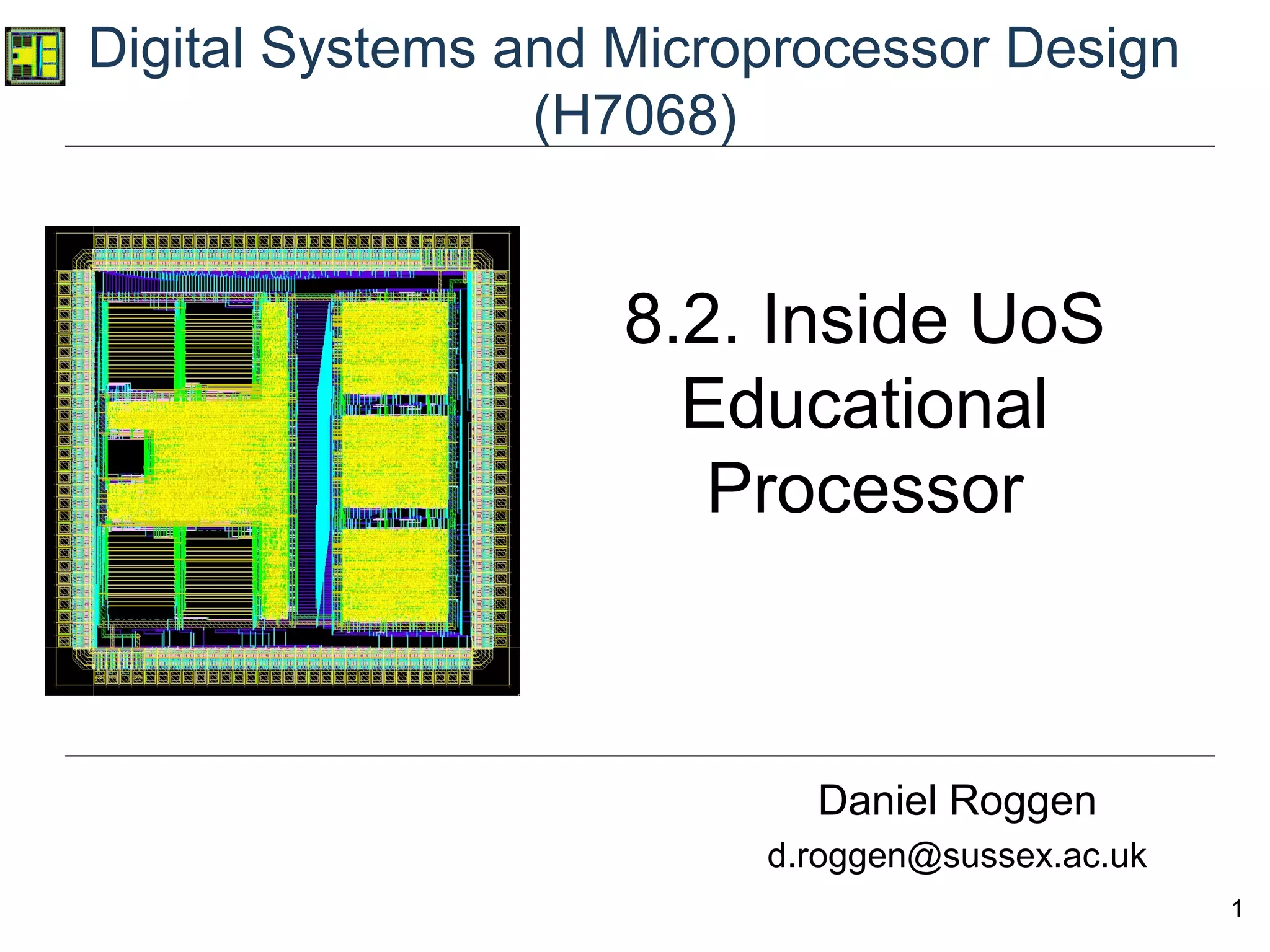
8.2. Inside UoS
Educational
Processor
2
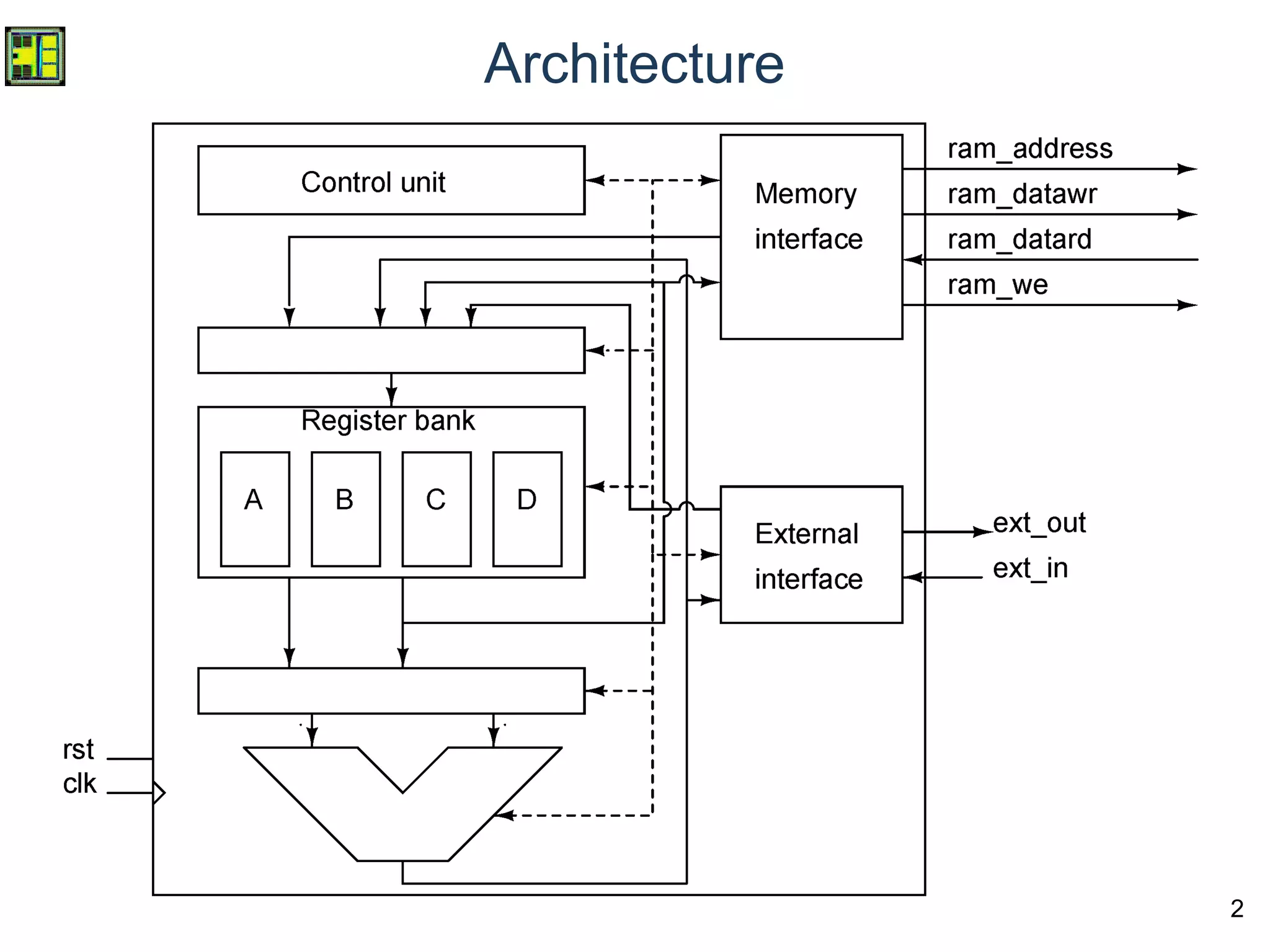
Architecture
3
VHDL files
• cpu.vhd: top file for CPU
• cpusequencer.vhd: fetch/execute sequence
• cpuregbank.vhd: register file
• cpualu.vhd: ALU
4
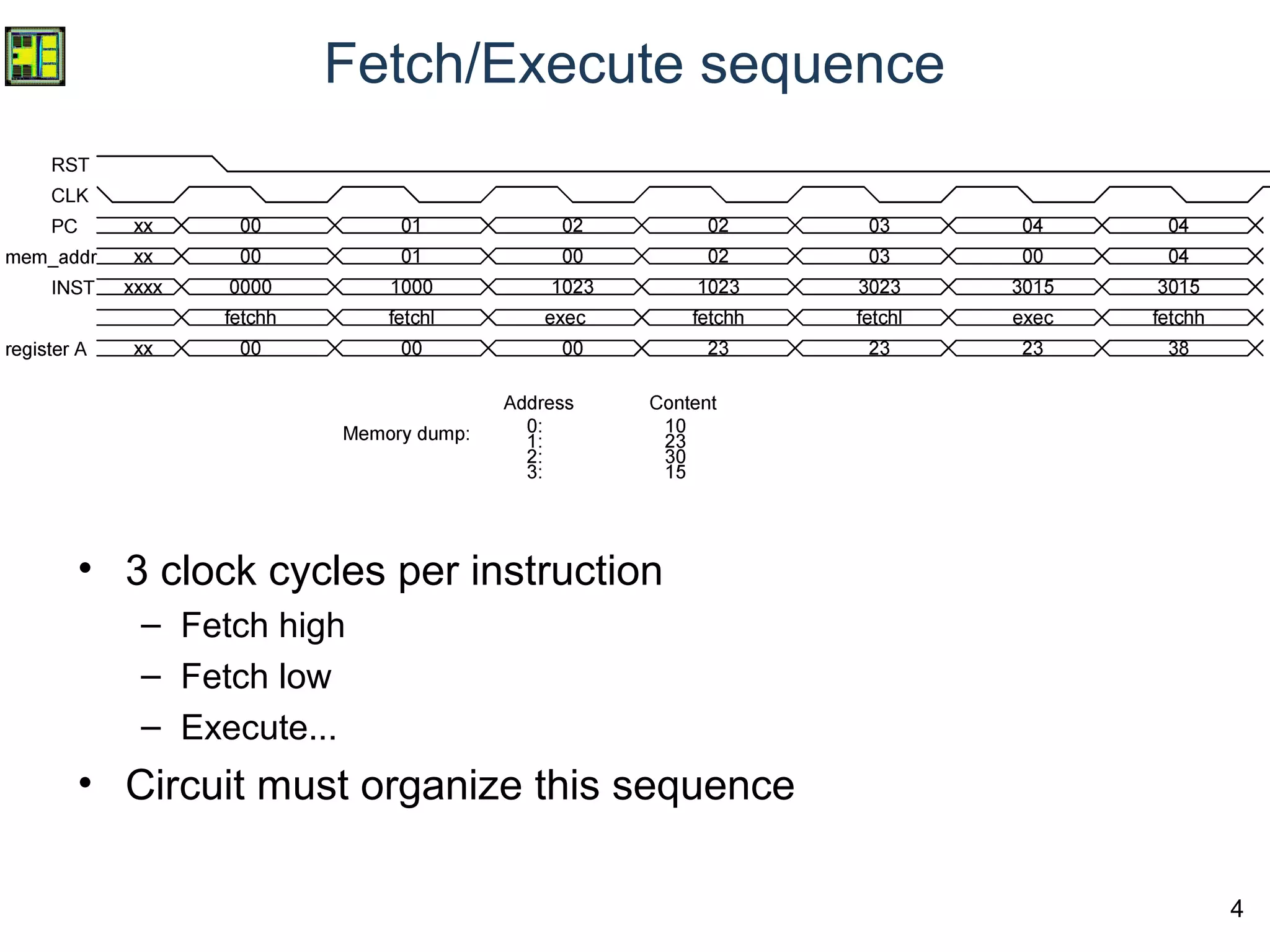
Fetch/Execute sequence
• 3 clock cycles per instruction
– Fetch high
– Fetch low
– Execute...
• Circuit must organize this sequence
5
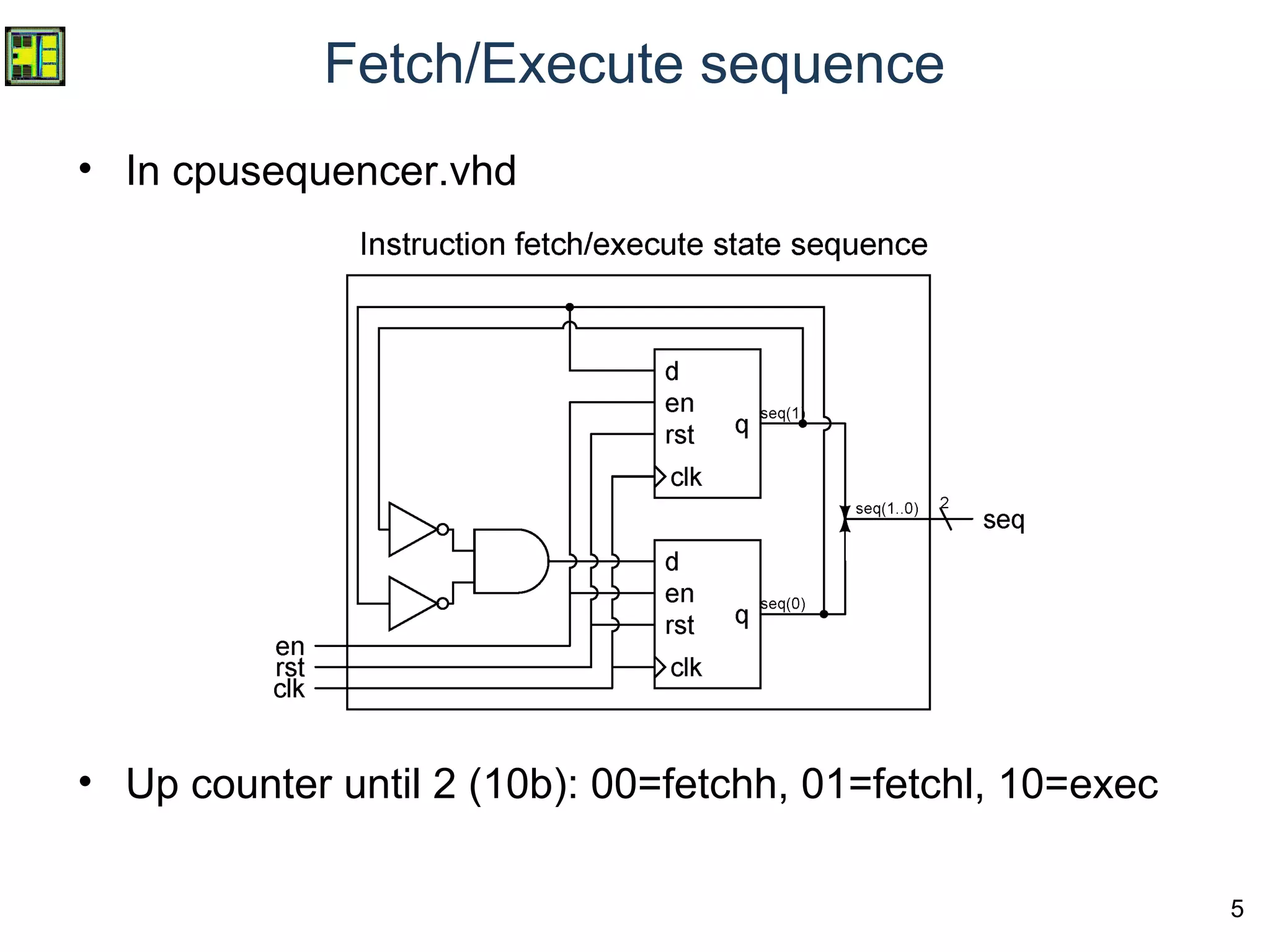
Fetch/Execute sequence
• In cpusequencer.vhd
• Up counter until 2 (10b): 00=fetchh, 01=fetchl, 10=exec
6
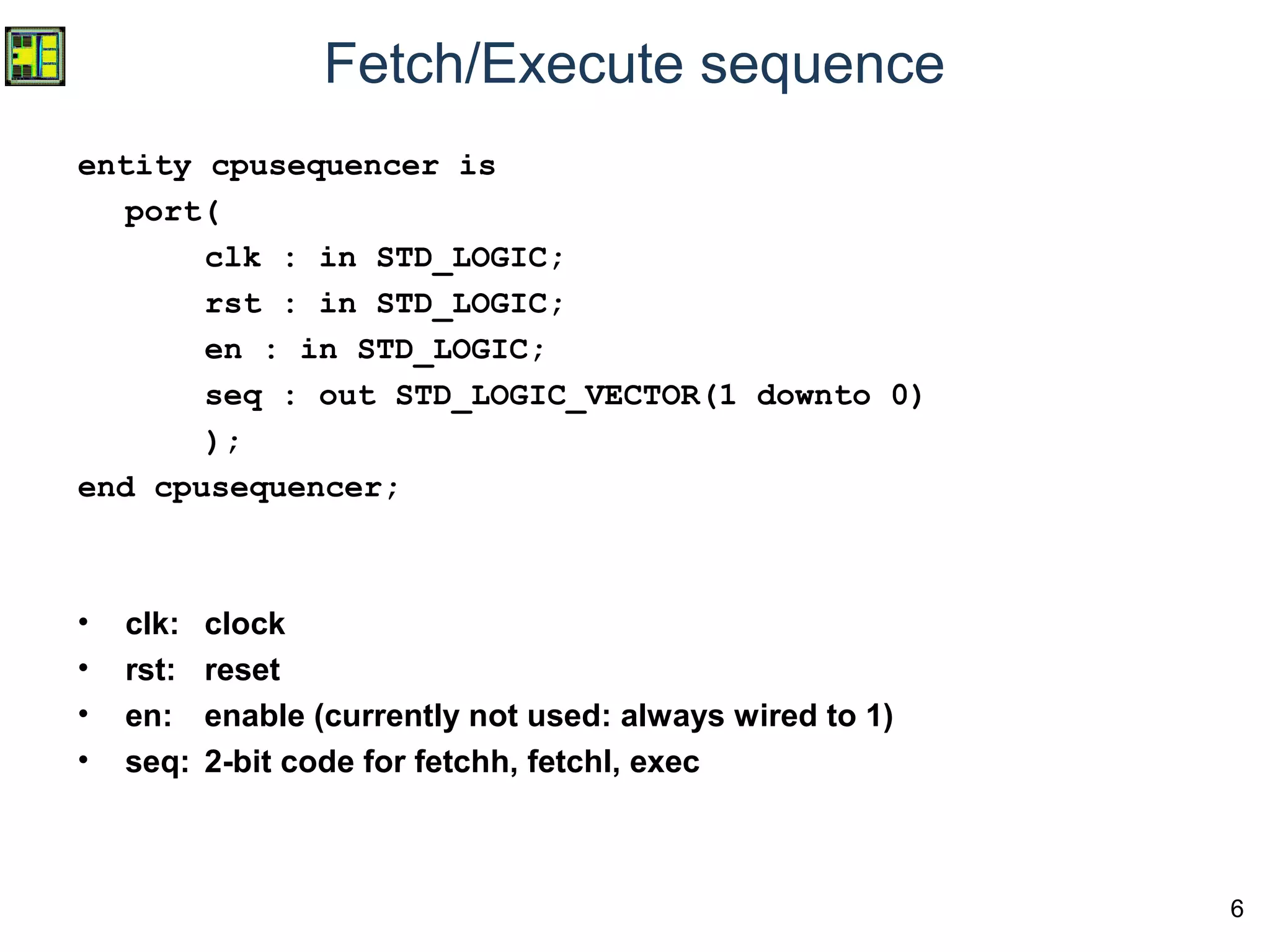
Fetch/Execute sequence
entity cpusequencer is
port(
clk : in STD_LOGIC;
rst : in STD_LOGIC;
en : in STD_LOGIC;
seq : out STD_LOGIC_VECTOR(1 downto 0)
);
end cpusequencer;
• clk: clock
• rst: reset
• en: enable (currently not used: always wired to 1)
• seq: 2-bit code for fetchh, fetchl, exec
7
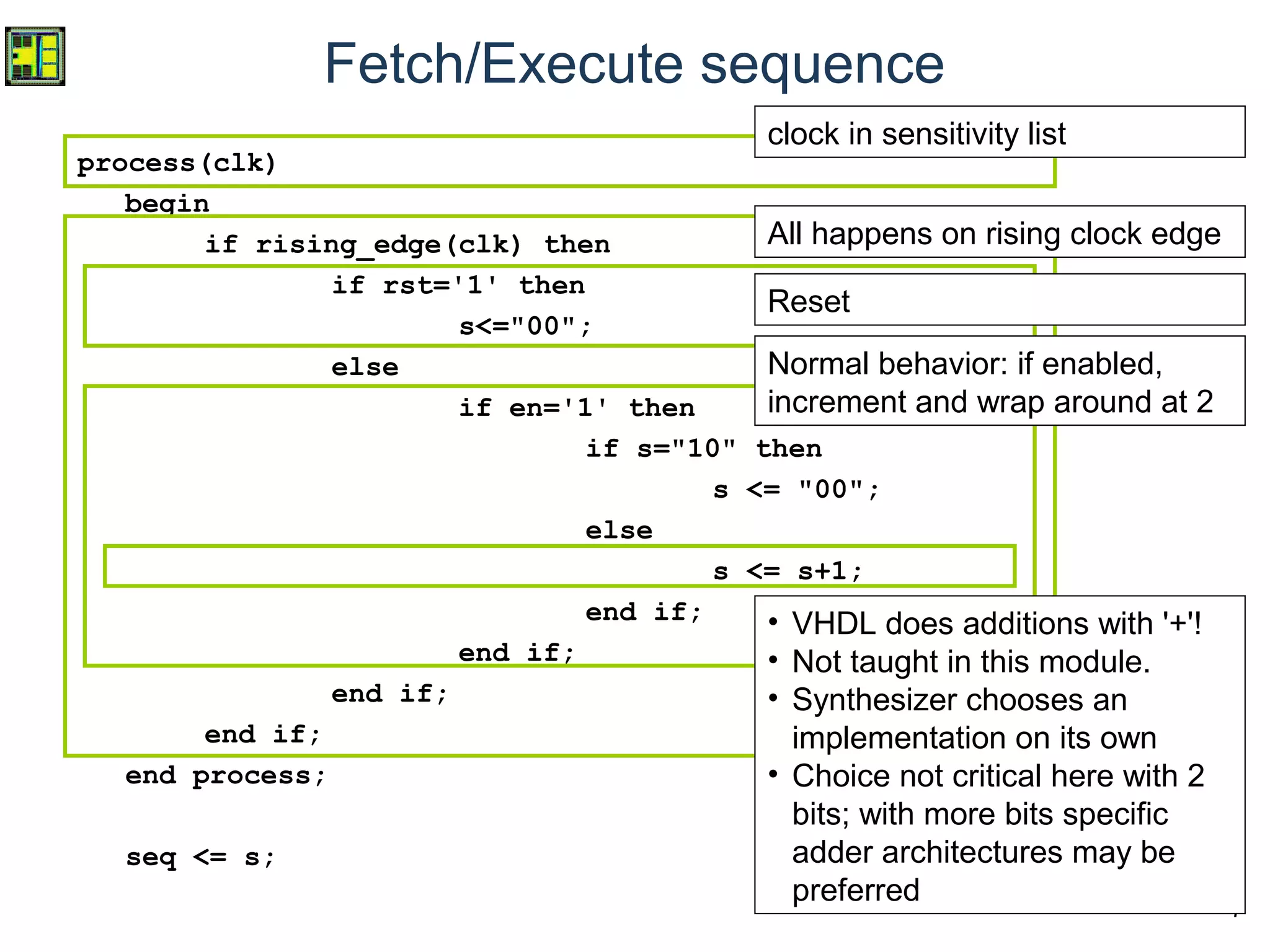
Fetch/Execute sequence
process(clk)
begin
if rising_edge(clk) then
if rst='1' then
s<="00";
else
if en='1' then
if s="10" then
s <= "00";
else
s <= s+1;
end if;
end if;
end if;
end if;
end process;
seq <= s;
clock in sensitivity list
All happens on rising clock edge
Reset
Normal behavior: if enabled,
increment and wrap around at 2
• VHDL does additions with '+'!
• Not taught in this module.
• Synthesizer chooses an
implementation on its own
• Choice not critical here with 2
bits; with more bits specific
adder architectures may be
preferred
8
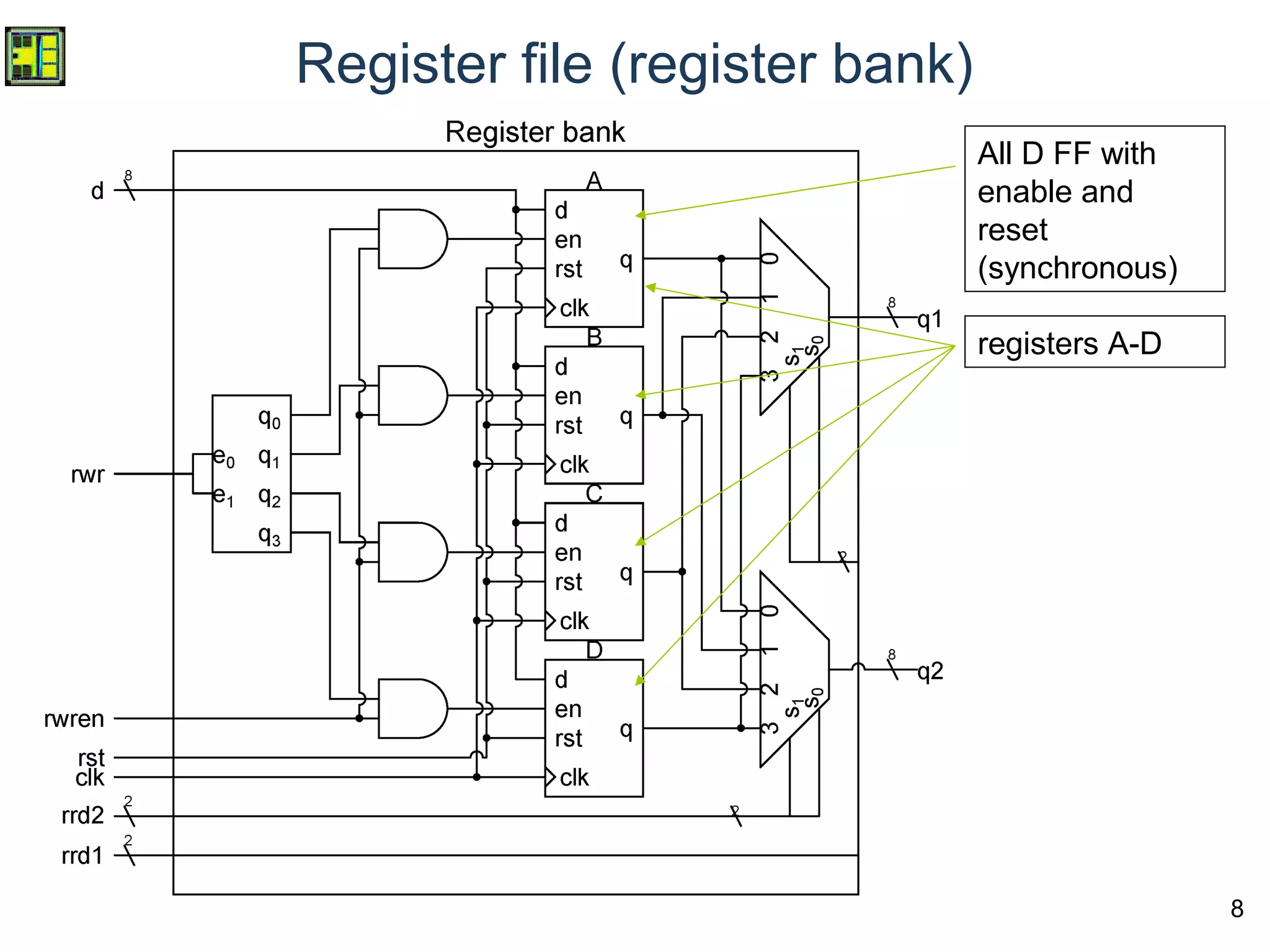
Register file (register bank)
All D FF with
enable and
reset
(synchronous)
registers A-D
9
Register file (register bank)
• Reminder: move instruction
• Always operation between dst and src, with result in dst
• Let's consider what to read from our register bank:
– The register defined by dst and src (even if we deal with an
immediate-this is handled elsewhere
Instructions instruction(15..8) Instruction(7..0)
Move Opcode dd#m sd#m dreg src
mov r, r 0 0 0 0 0 0 r r - - - - - - r r
mov r, i 0 0 0 1 0 0 r r i i i i i i i i
mov r, [r] 0 0 0 0 0 1 r r - - - - - - r r
mov r, [i] 0 0 0 1 0 1 r r i i i i i i i i
mov [r], r 0 0 0 0 1 0 r r - - - - - - r r
mov [r], i 0 0 0 1 1 0 r r i i i i i i i i
10
Register file (register bank)
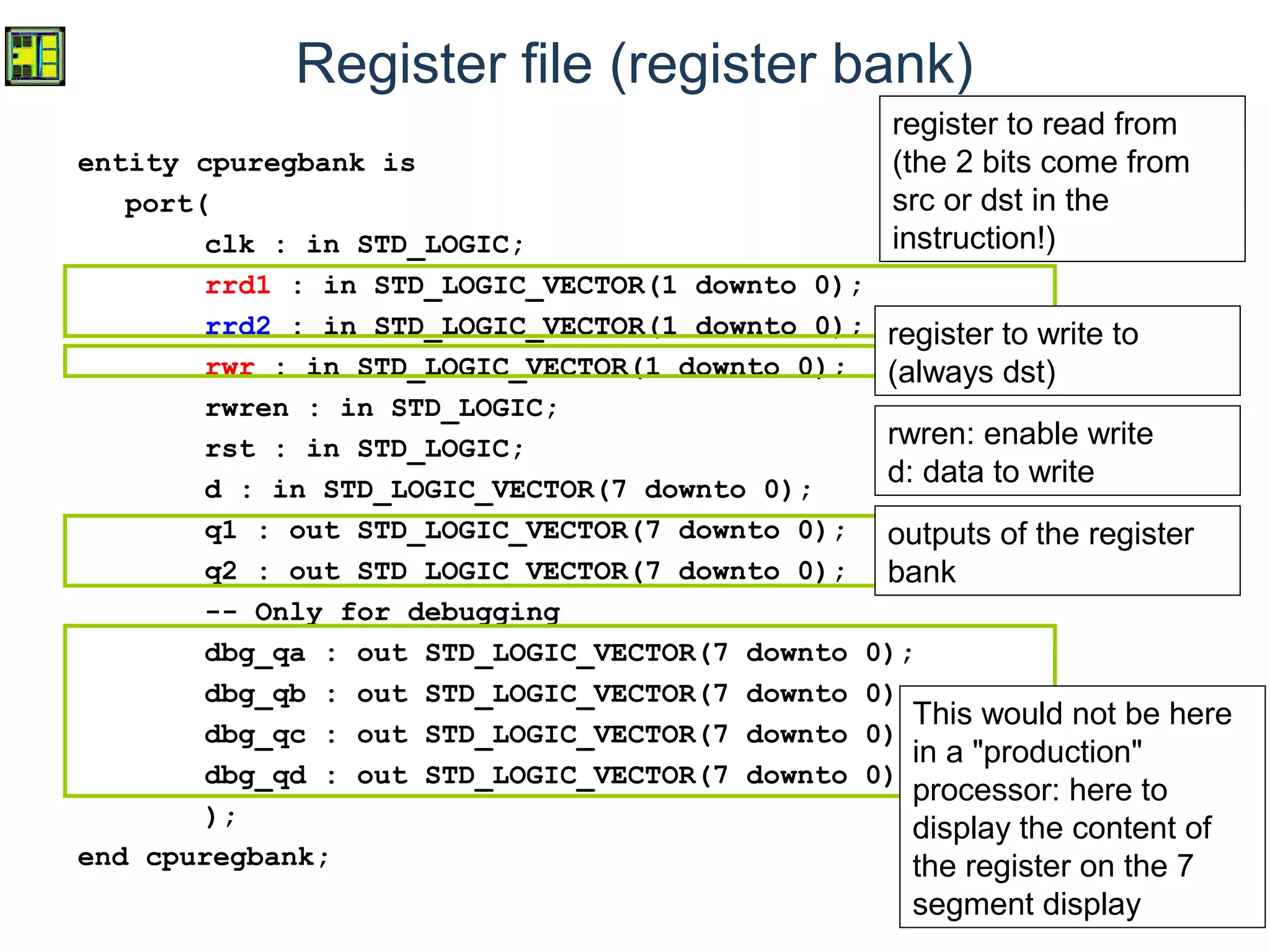
entity cpuregbank is
port(
clk : in STD_LOGIC;
rrd1 : in STD_LOGIC_VECTOR(1 downto 0);
rrd2 : in STD_LOGIC_VECTOR(1 downto 0);
rwr : in STD_LOGIC_VECTOR(1 downto 0);
rwren : in STD_LOGIC;
rst : in STD_LOGIC;
d : in STD_LOGIC_VECTOR(7 downto 0);
q1 : out STD_LOGIC_VECTOR(7 downto 0);
q2 : out STD_LOGIC_VECTOR(7 downto 0);
-- Only for debugging
dbg_qa : out STD_LOGIC_VECTOR(7 downto 0);
dbg_qb : out STD_LOGIC_VECTOR(7 downto 0);
dbg_qc : out STD_LOGIC_VECTOR(7 downto 0);
dbg_qd : out STD_LOGIC_VECTOR(7 downto 0)
);
end cpuregbank;
register to read from
(the 2 bits come from
src or dst in the
instruction!)
outputs of the register
bank
This would not be here
in a "production"
processor: here to
display the content of
the register on the 7
segment display
register to write to
(always dst)
rwren: enable write
d: data to write
11
Register file (register bank)
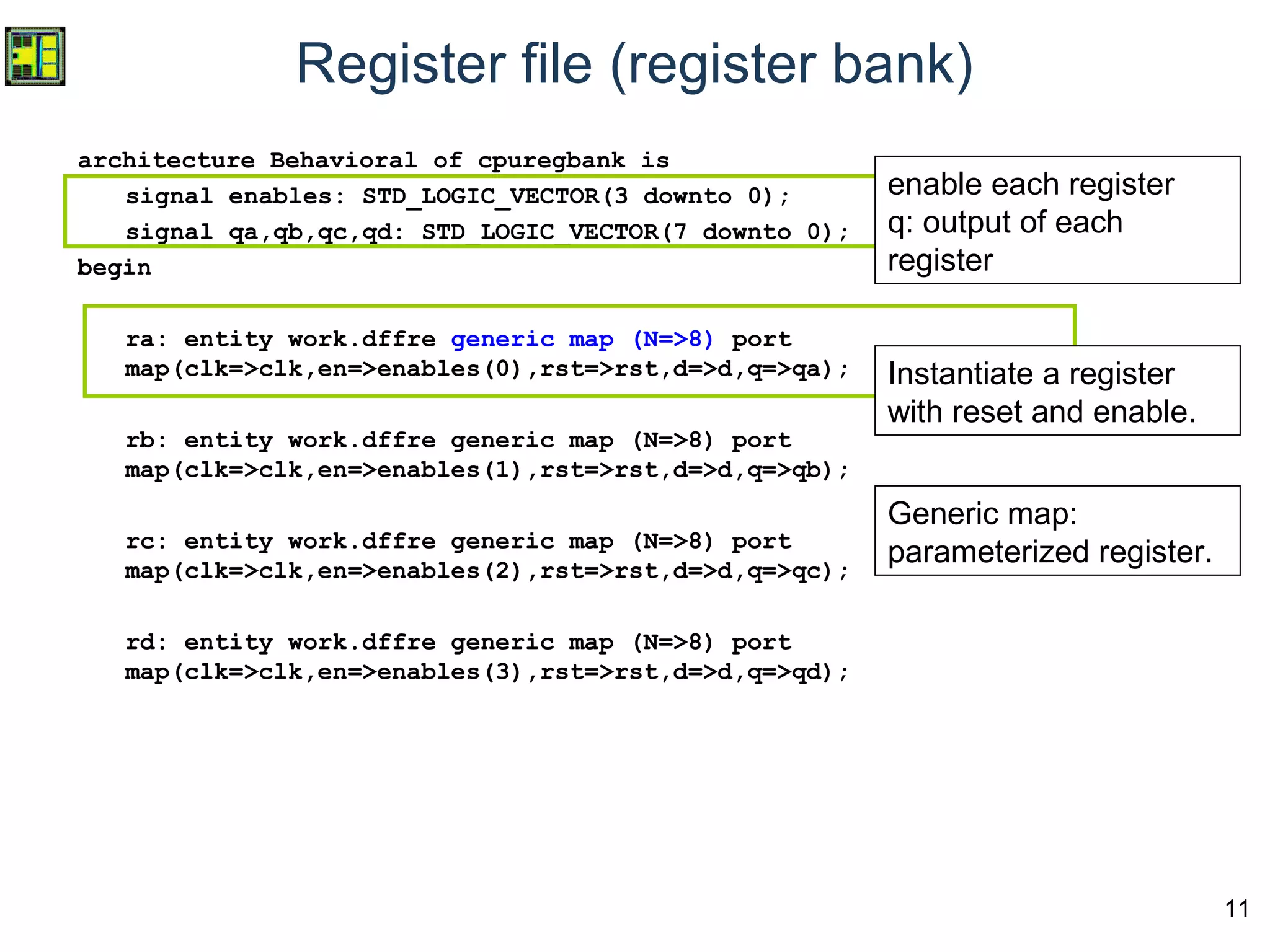
architecture Behavioral of cpuregbank is
signal enables: STD_LOGIC_VECTOR(3 downto 0);
signal qa,qb,qc,qd: STD_LOGIC_VECTOR(7 downto 0);
begin
ra: entity work.dffre generic map (N=>8) port
map(clk=>clk,en=>enables(0),rst=>rst,d=>d,q=>qa);
rb: entity work.dffre generic map (N=>8) port
map(clk=>clk,en=>enables(1),rst=>rst,d=>d,q=>qb);
rc: entity work.dffre generic map (N=>8) port
map(clk=>clk,en=>enables(2),rst=>rst,d=>d,q=>qc);
rd: entity work.dffre generic map (N=>8) port
map(clk=>clk,en=>enables(3),rst=>rst,d=>d,q=>qd);
enable each register
q: output of each
register
Instantiate a register
with reset and enable.
Generic map:
parameterized register.
12
Register file (register bank)
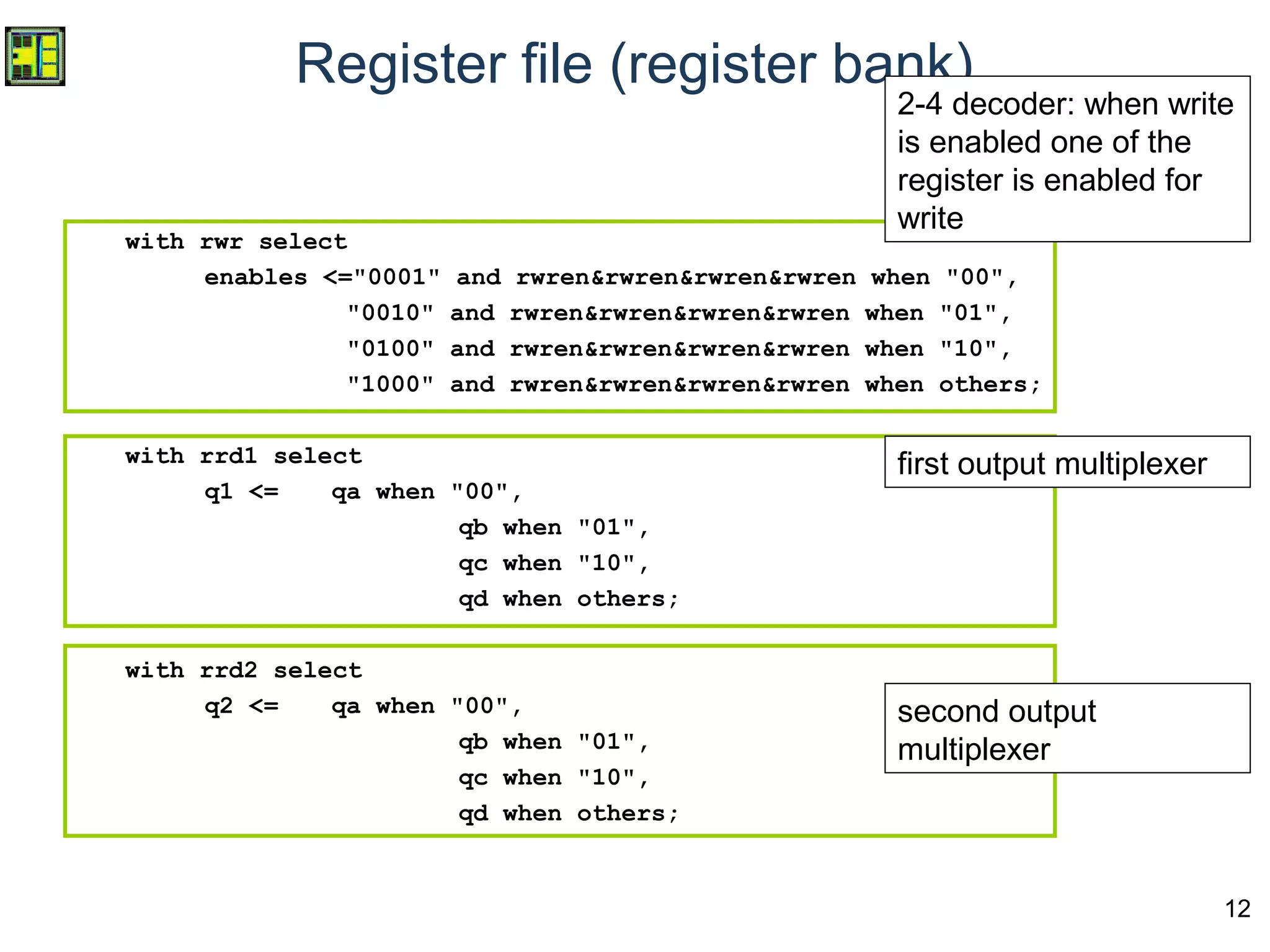
with rwr select
enables <="0001" and rwren&rwren&rwren&rwren when "00",
"0010" and rwren&rwren&rwren&rwren when "01",
"0100" and rwren&rwren&rwren&rwren when "10",
"1000" and rwren&rwren&rwren&rwren when others;
with rrd1 select
q1 <= qa when "00",
qb when "01",
qc when "10",
qd when others;
with rrd2 select
q2 <= qa when "00",
qb when "01",
qc when "10",
qd when others;
2-4 decoder: when write
is enabled one of the
register is enabled for
write
first output multiplexer
second output
multiplexer
13
Register
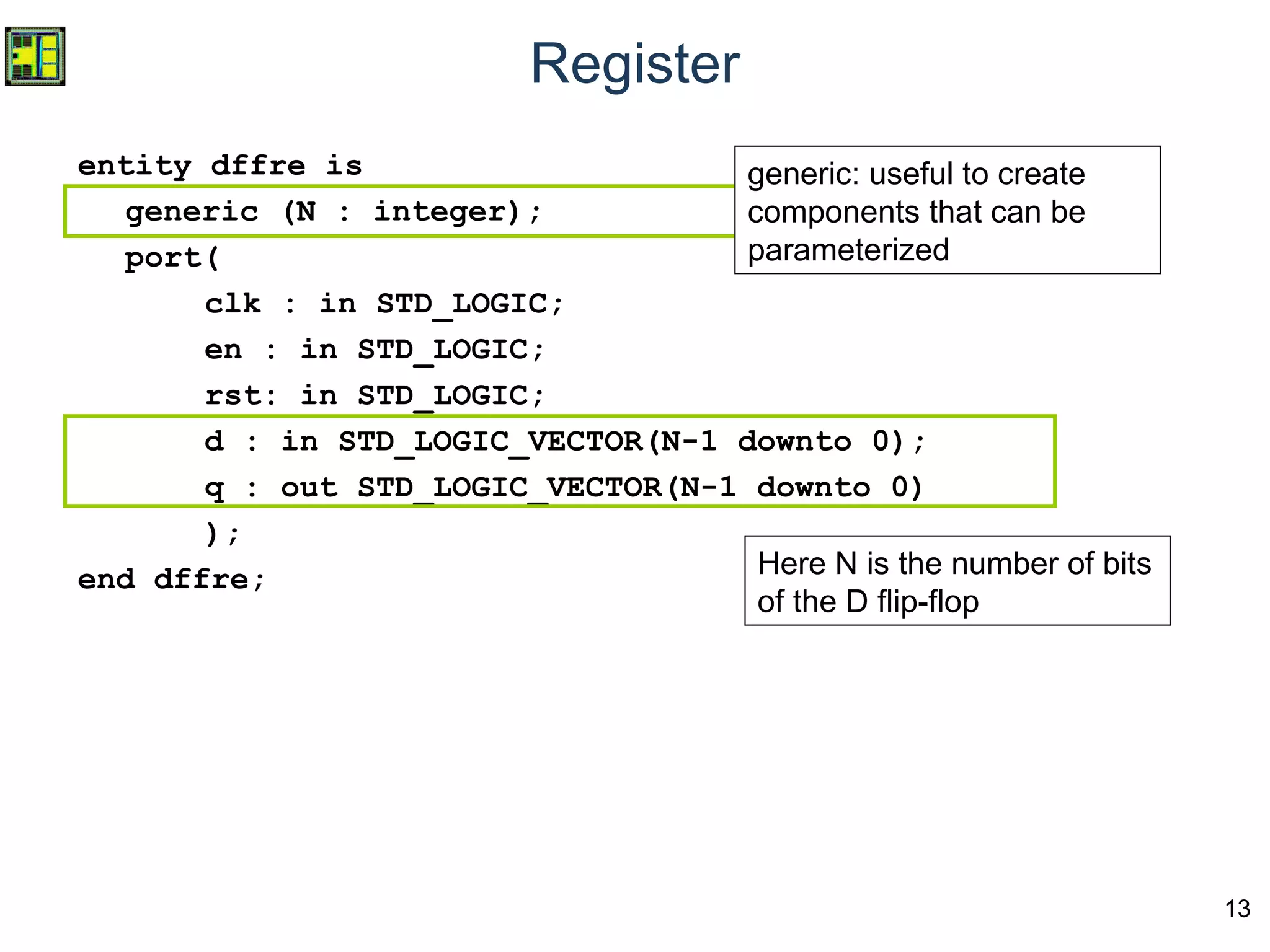
entity dffre is
generic (N : integer);
port(
clk : in STD_LOGIC;
en : in STD_LOGIC;
rst: in STD_LOGIC;
d : in STD_LOGIC_VECTOR(N-1 downto 0);
q : out STD_LOGIC_VECTOR(N-1 downto 0)
);
end dffre;
generic: useful to create
components that can be
parameterized
Here N is the number of bits
of the D flip-flop
generic: useful to create
components that can be
parameterized
14
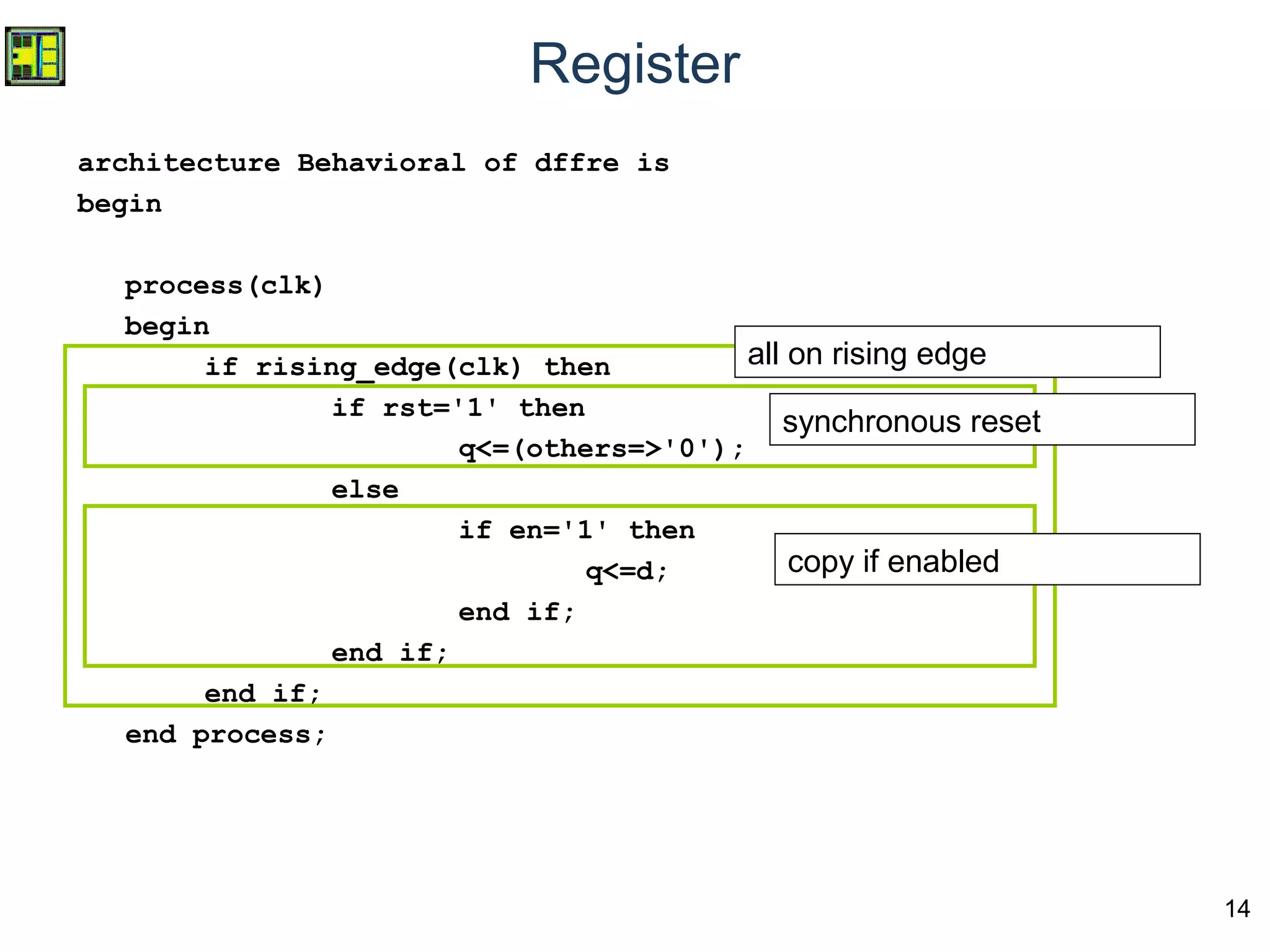
Register
architecture Behavioral of dffre is
begin
process(clk)
begin
if rising_edge(clk) then
if rst='1' then
q<=(others=>'0');
else
if en='1' then
q<=d;
end if;
end if;
end if;
end process;
all on rising edge
synchronous reset
copy if enabled
15
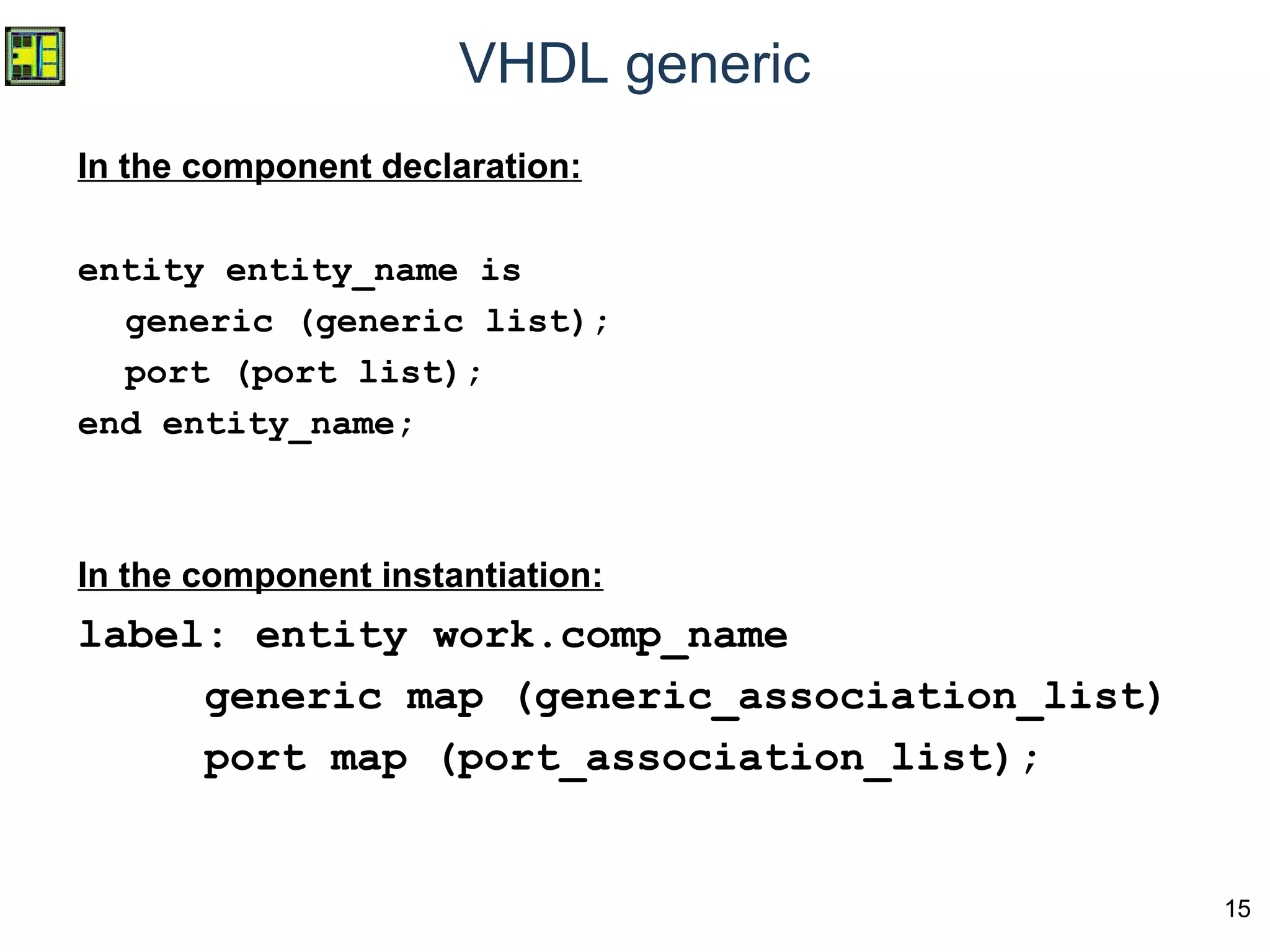
VHDL generic
In the component declaration:
entity entity_name is
generic (generic list);
port (port list);
end entity_name;
In the component instantiation:
label: entity work.comp_name
generic map (generic_association_list)
port map (port_association_list);
16
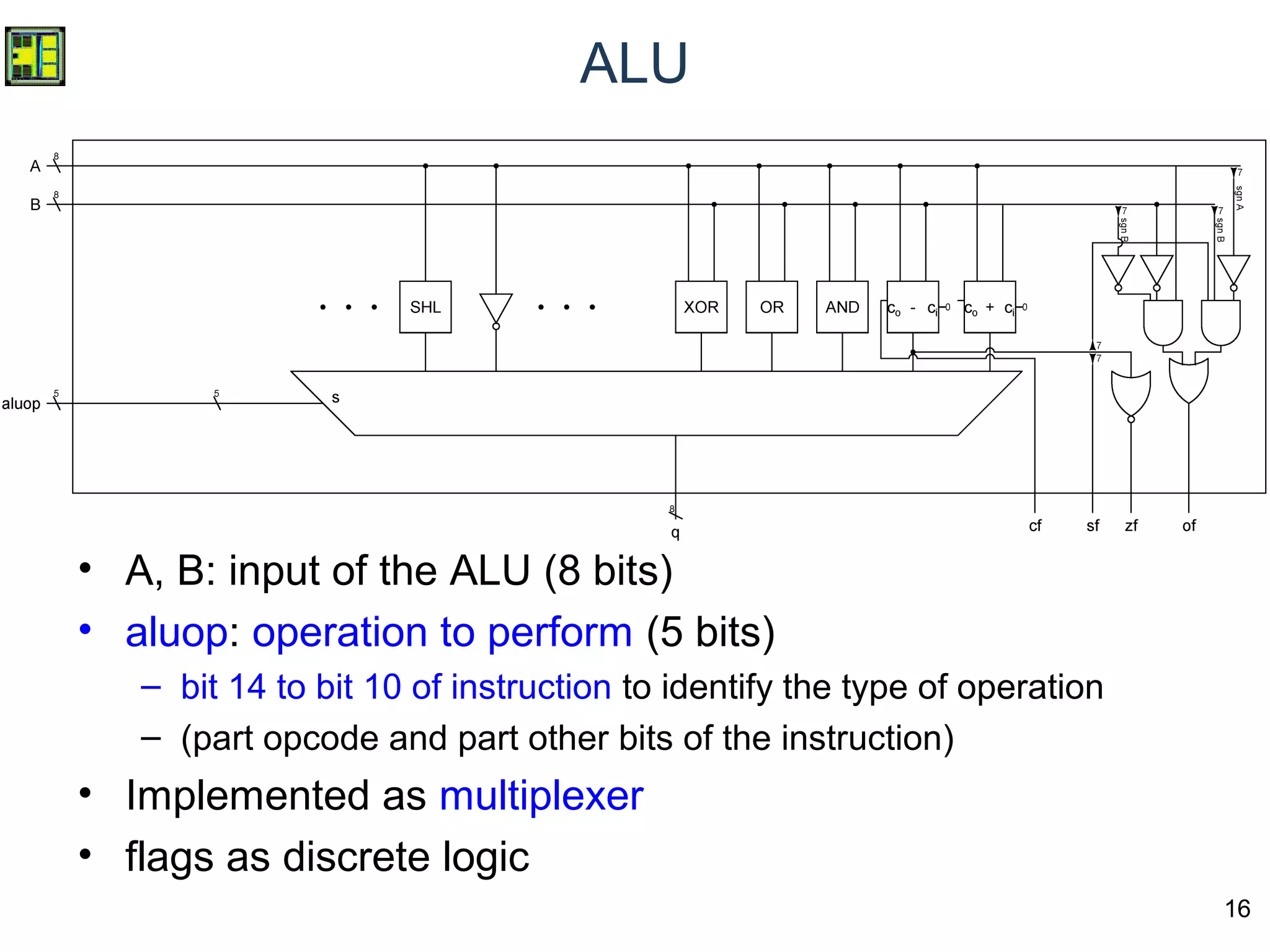
ALU
• A, B: input of the ALU (8 bits)
• aluop: operation to perform (5 bits)
– bit 14 to bit 10 of instruction to identify the type of operation
– (part opcode and part other bits of the instruction)
• Implemented as multiplexer
• flags as discrete logic
17
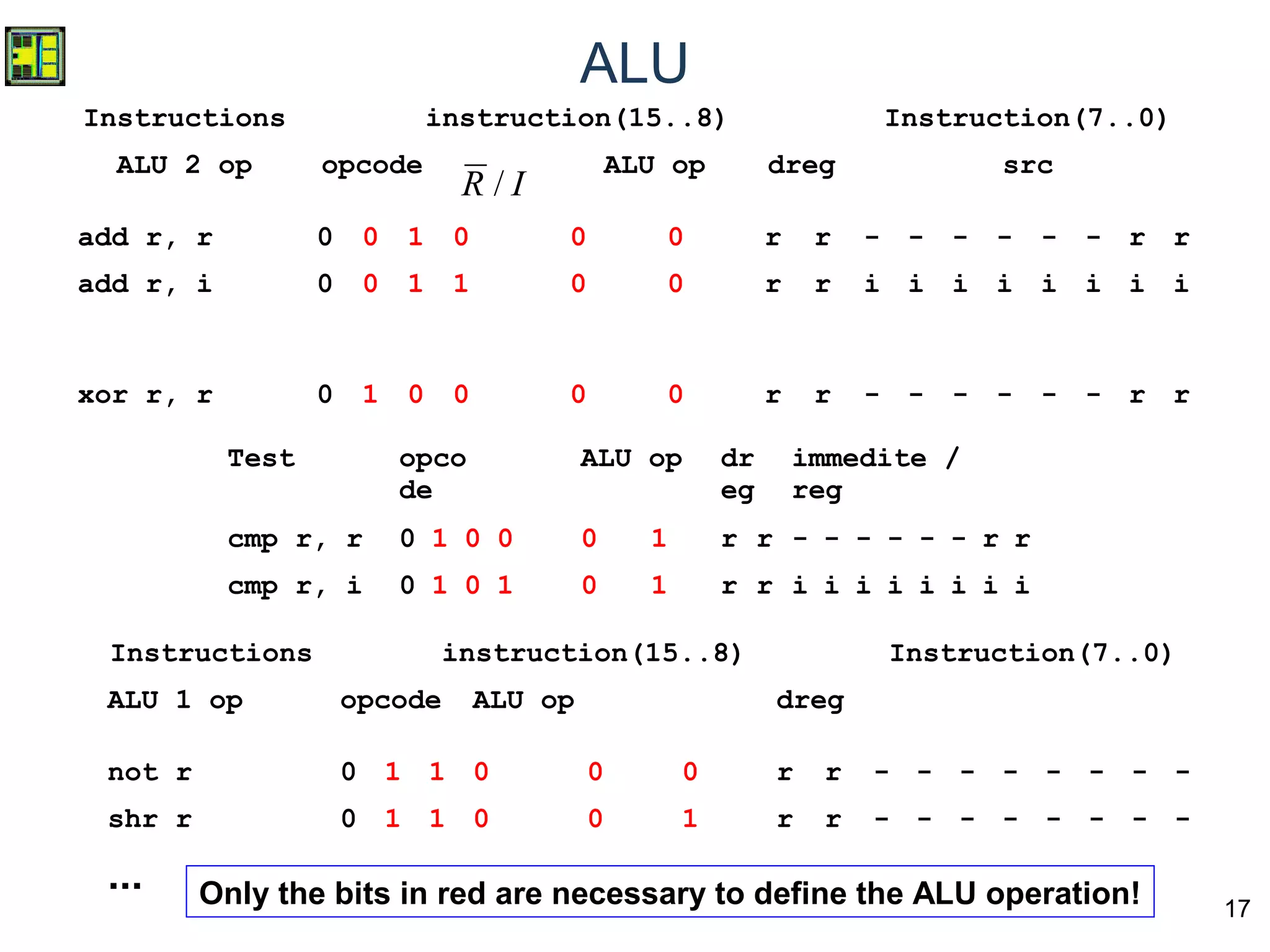
ALU
Instructions instruction(15..8) Instruction(7..0)
ALU 2 op opcode ALU op dreg src
add r, r 0 0 1 0 0 0 r r - - - - - - r r
add r, i 0 0 1 1 0 0 r r i i i i i i i i
xor r, r 0 1 0 0 0 0 r r - - - - - - r r
IR /
Test opco
de
ALU op dr
eg
immedite /
reg
cmp r, r 0 1 0 0 0 1 r r - - - - - - r r
cmp r, i 0 1 0 1 0 1 r r i i i i i i i i
Instructions instruction(15..8) Instruction(7..0)
ALU 1 op opcode ALU op dreg
not r 0 1 1 0 0 0 r r - - - - - - - -
shr r 0 1 1 0 0 1 r r - - - - - - - -
... Only the bits in red are necessary to define the ALU operation!
18
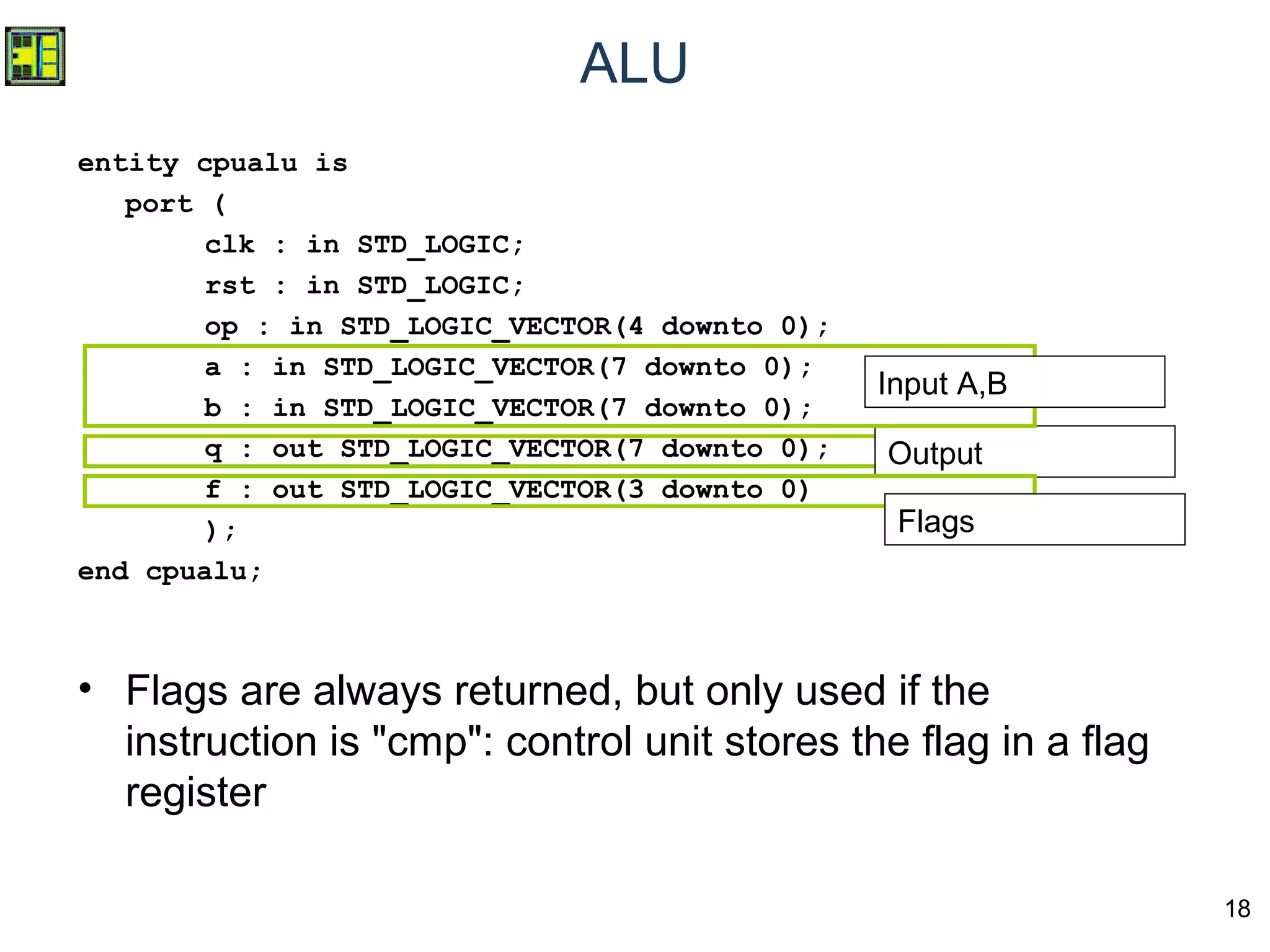
ALU
entity cpualu is
port (
clk : in STD_LOGIC;
rst : in STD_LOGIC;
op : in STD_LOGIC_VECTOR(4 downto 0);
a : in STD_LOGIC_VECTOR(7 downto 0);
b : in STD_LOGIC_VECTOR(7 downto 0);
q : out STD_LOGIC_VECTOR(7 downto 0);
f : out STD_LOGIC_VECTOR(3 downto 0)
);
end cpualu;
Output
Flags
• Flags are always returned, but only used if the
instruction is "cmp": control unit stores the flag in a flag
register
Input A,B
19
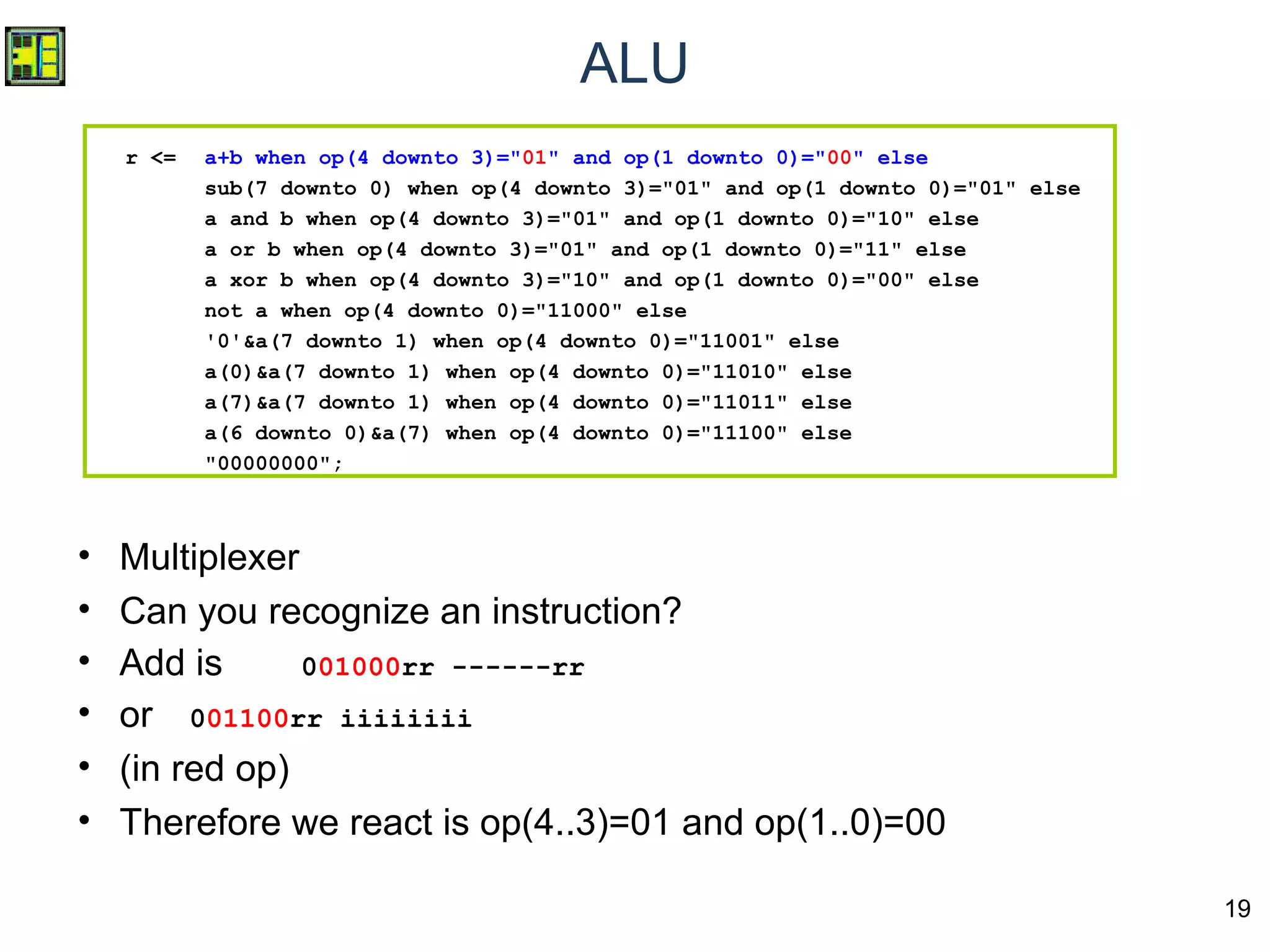
ALU
r <= a+b when op(4 downto 3)="01" and op(1 downto 0)="00" else
sub(7 downto 0) when op(4 downto 3)="01" and op(1 downto 0)="01" else
a and b when op(4 downto 3)="01" and op(1 downto 0)="10" else
a or b when op(4 downto 3)="01" and op(1 downto 0)="11" else
a xor b when op(4 downto 3)="10" and op(1 downto 0)="00" else
not a when op(4 downto 0)="11000" else
'0'&a(7 downto 1) when op(4 downto 0)="11001" else
a(0)&a(7 downto 1) when op(4 downto 0)="11010" else
a(7)&a(7 downto 1) when op(4 downto 0)="11011" else
a(6 downto 0)&a(7) when op(4 downto 0)="11100" else
"00000000";
• Multiplexer
• Can you recognize an instruction?
• Add is 001000rr ------rr
• or 001100rr iiiiiiii
• (in red op)
• Therefore we react is op(4..3)=01 and op(1..0)=00
20
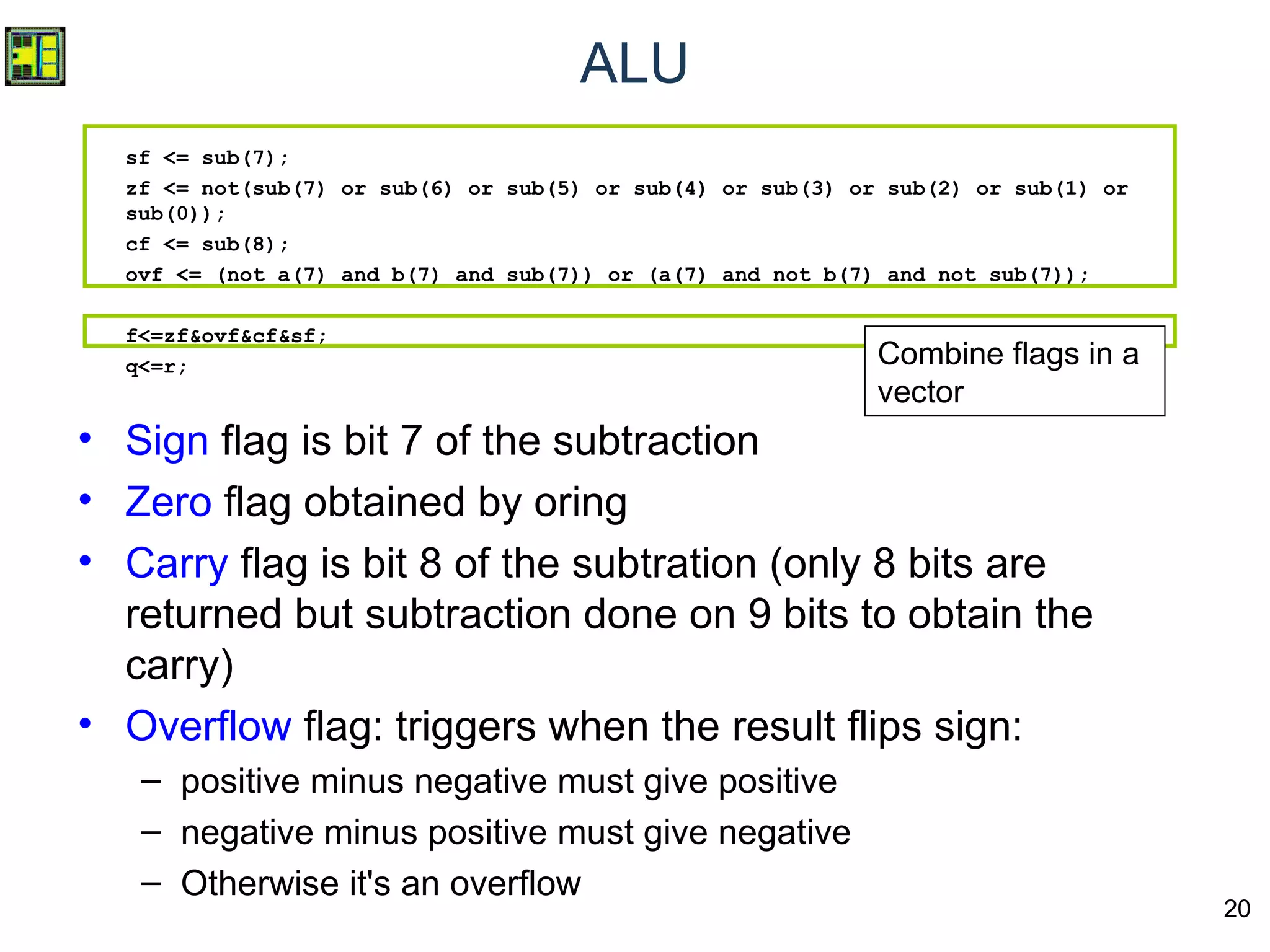
ALU
sf <= sub(7);
zf <= not(sub(7) or sub(6) or sub(5) or sub(4) or sub(3) or sub(2) or sub(1) or
sub(0));
cf <= sub(8);
ovf <= (not a(7) and b(7) and sub(7)) or (a(7) and not b(7) and not sub(7));
f<=zf&ovf&cf&sf;
q<=r;
• Sign flag is bit 7 of the subtraction
• Zero flag obtained by oring
• Carry flag is bit 8 of the subtration (only 8 bits are
returned but subtraction done on 9 bits to obtain the
carry)
• Overflow flag: triggers when the result flips sign:
– positive minus negative must give positive
– negative minus positive must give negative
– Otherwise it's an overflow
Combine flags in a
vector
21
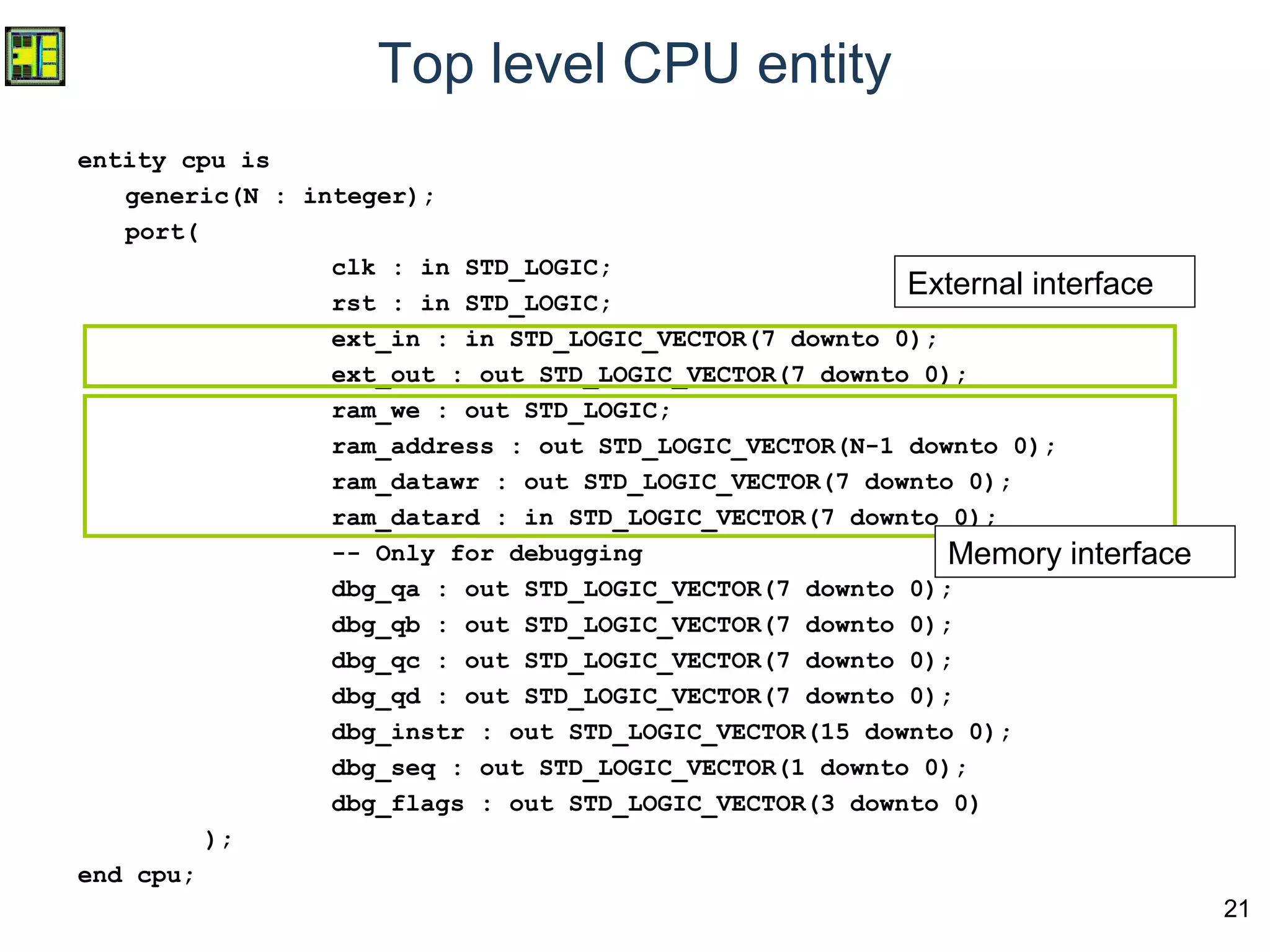
Top level CPU entity
entity cpu is
generic(N : integer);
port(
clk : in STD_LOGIC;
rst : in STD_LOGIC;
ext_in : in STD_LOGIC_VECTOR(7 downto 0);
ext_out : out STD_LOGIC_VECTOR(7 downto 0);
ram_we : out STD_LOGIC;
ram_address : out STD_LOGIC_VECTOR(N-1 downto 0);
ram_datawr : out STD_LOGIC_VECTOR(7 downto 0);
ram_datard : in STD_LOGIC_VECTOR(7 downto 0);
-- Only for debugging
dbg_qa : out STD_LOGIC_VECTOR(7 downto 0);
dbg_qb : out STD_LOGIC_VECTOR(7 downto 0);
dbg_qc : out STD_LOGIC_VECTOR(7 downto 0);
dbg_qd : out STD_LOGIC_VECTOR(7 downto 0);
dbg_instr : out STD_LOGIC_VECTOR(15 downto 0);
dbg_seq : out STD_LOGIC_VECTOR(1 downto 0);
dbg_flags : out STD_LOGIC_VECTOR(3 downto 0)
);
end cpu;
External interface
Memory interface
22
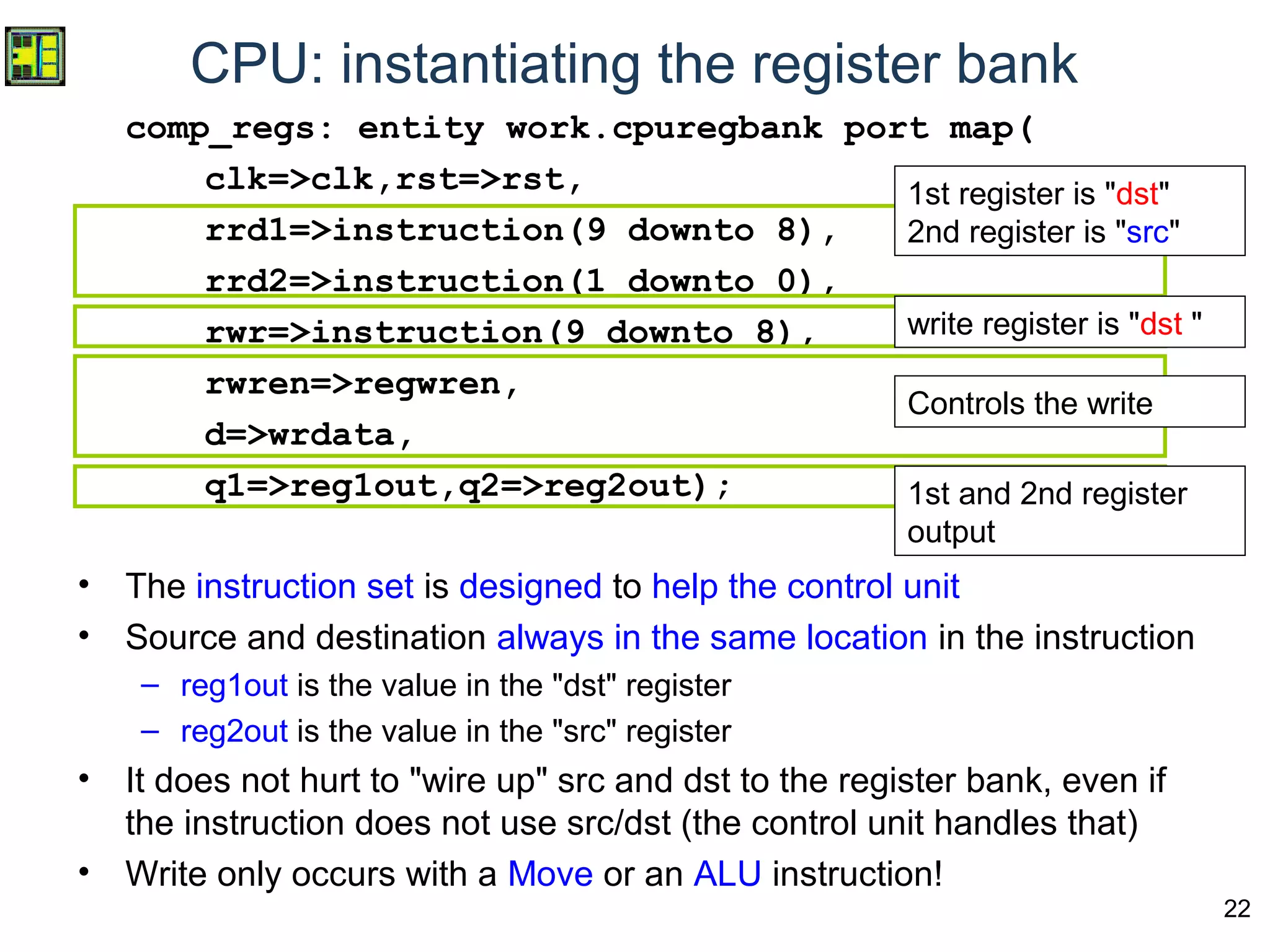
CPU: instantiating the register bank
comp_regs: entity work.cpuregbank port map(
clk=>clk,rst=>rst,
rrd1=>instruction(9 downto 8),
rrd2=>instruction(1 downto 0),
rwr=>instruction(9 downto 8),
rwren=>regwren,
d=>wrdata,
q1=>reg1out,q2=>reg2out);
• The instruction set is designed to help the control unit
• Source and destination always in the same location in the instruction
– reg1out is the value in the "dst" register
– reg2out is the value in the "src" register
• It does not hurt to "wire up" src and dst to the register bank, even if
the instruction does not use src/dst (the control unit handles that)
• Write only occurs with a Move or an ALU instruction!
1st register is "dst"
2nd register is "src"
write register is "dst "
Controls the write
1st and 2nd register
output
23
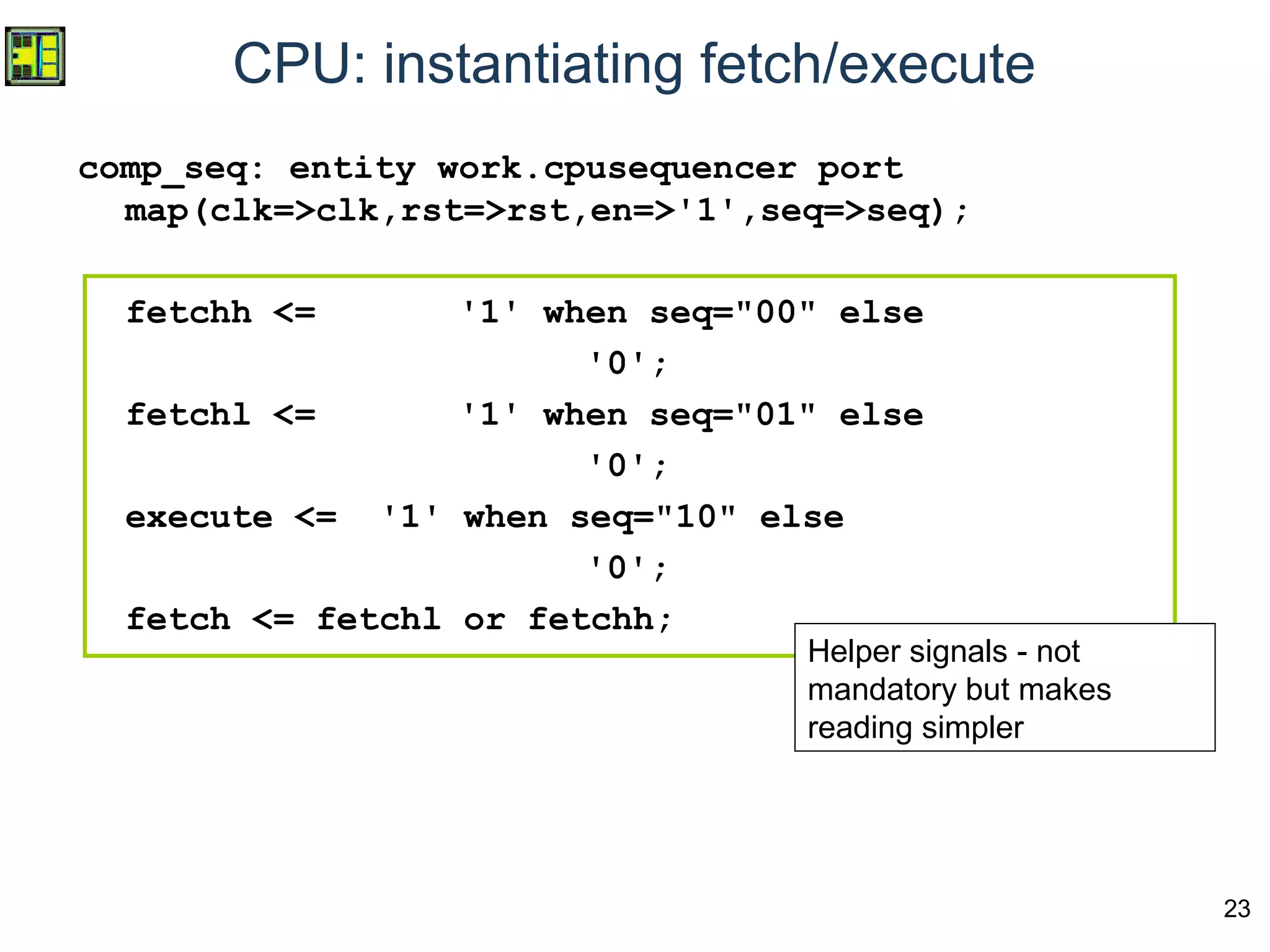
CPU: instantiating fetch/execute
comp_seq: entity work.cpusequencer port
map(clk=>clk,rst=>rst,en=>'1',seq=>seq);
fetchh <= '1' when seq="00" else
'0';
fetchl <= '1' when seq="01" else
'0';
execute <= '1' when seq="10" else
'0';
fetch <= fetchl or fetchh;
Helper signals - not
mandatory but makes
reading simpler
24
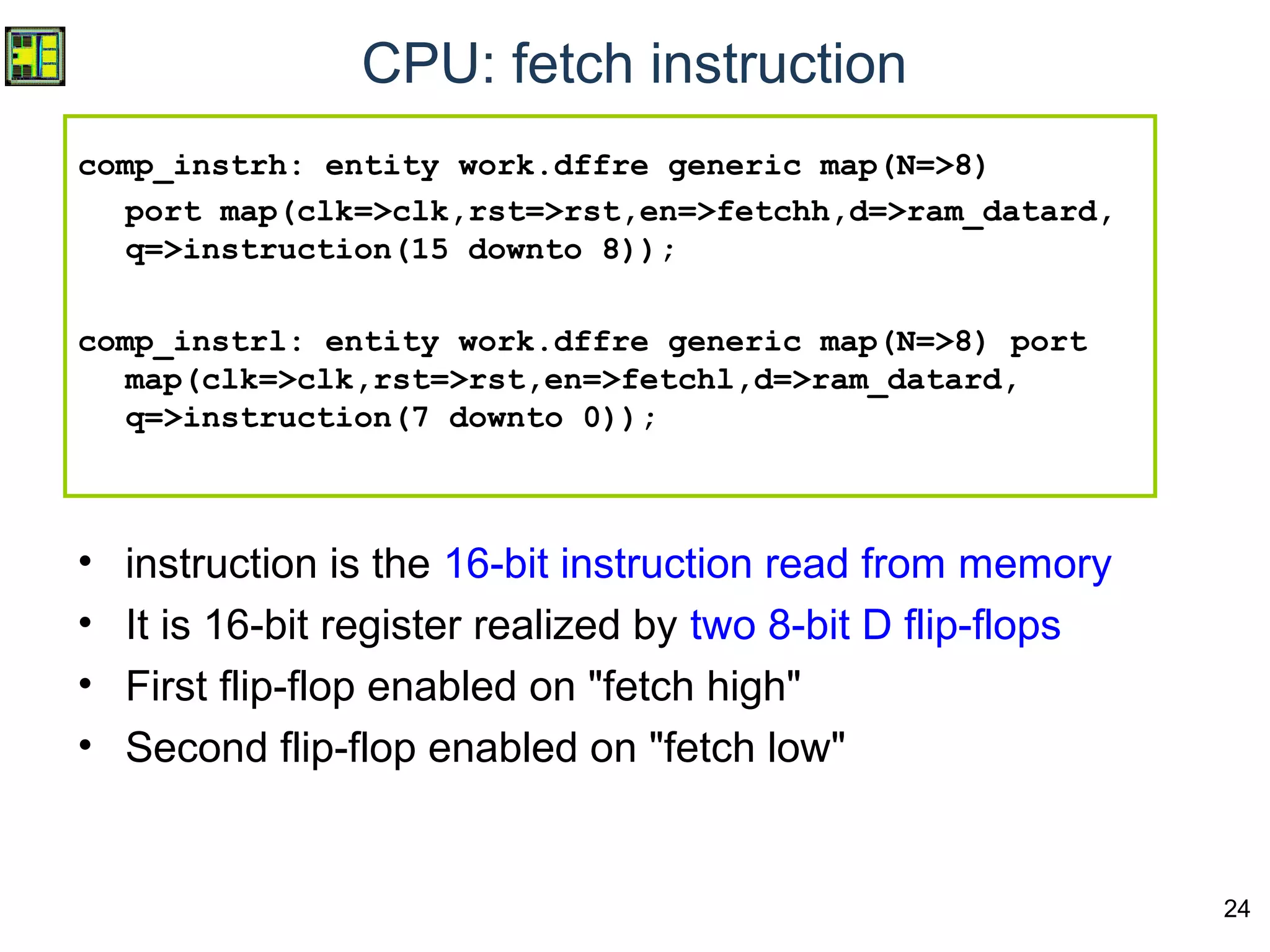
CPU: fetch instruction
comp_instrh: entity work.dffre generic map(N=>8)
port map(clk=>clk,rst=>rst,en=>fetchh,d=>ram_datard,
q=>instruction(15 downto 8));
comp_instrl: entity work.dffre generic map(N=>8) port
map(clk=>clk,rst=>rst,en=>fetchl,d=>ram_datard,
q=>instruction(7 downto 0));
• instruction is the 16-bit instruction read from memory
• It is 16-bit register realized by two 8-bit D flip-flops
• First flip-flop enabled on "fetch high"
• Second flip-flop enabled on "fetch low"
25
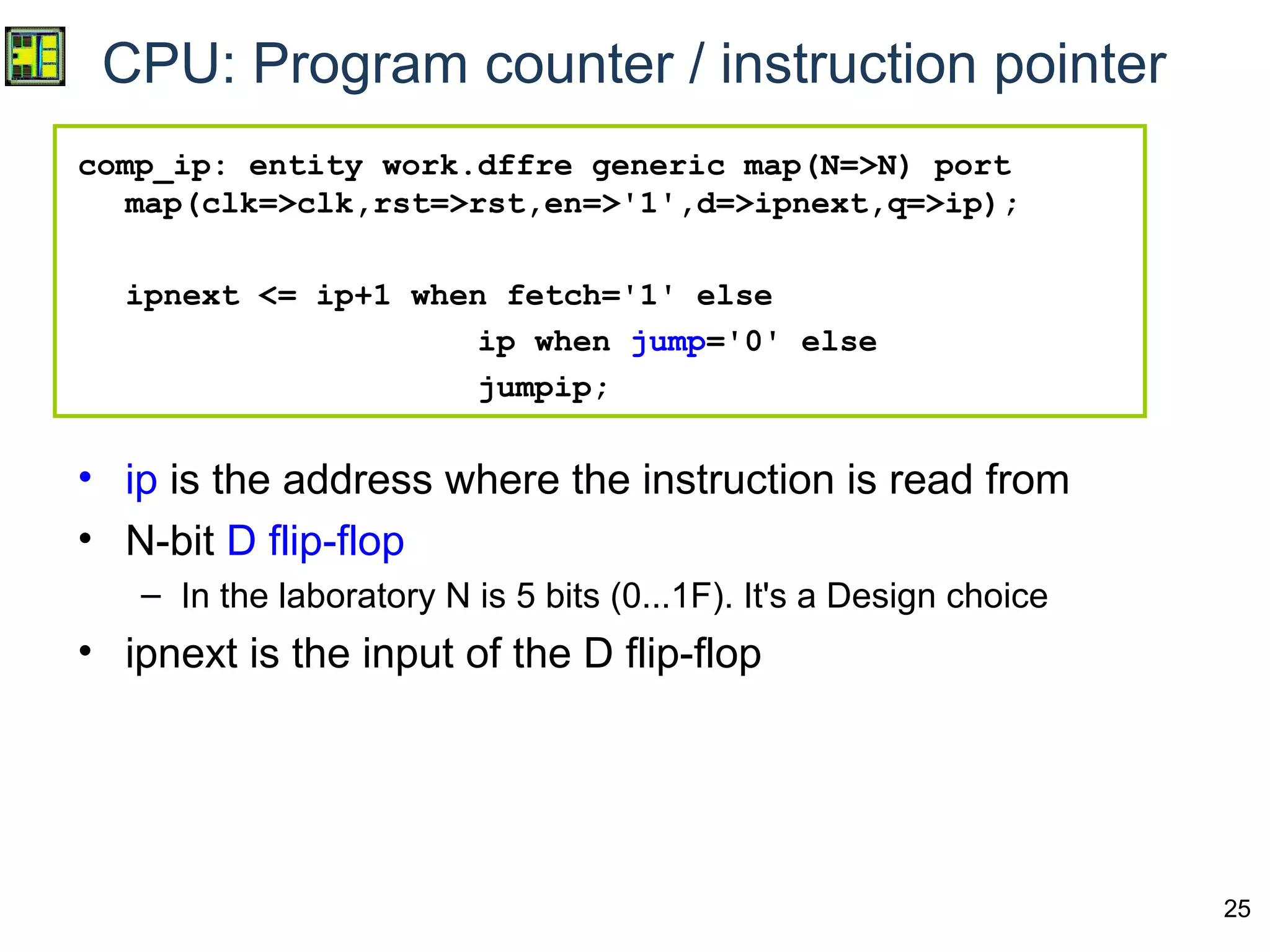
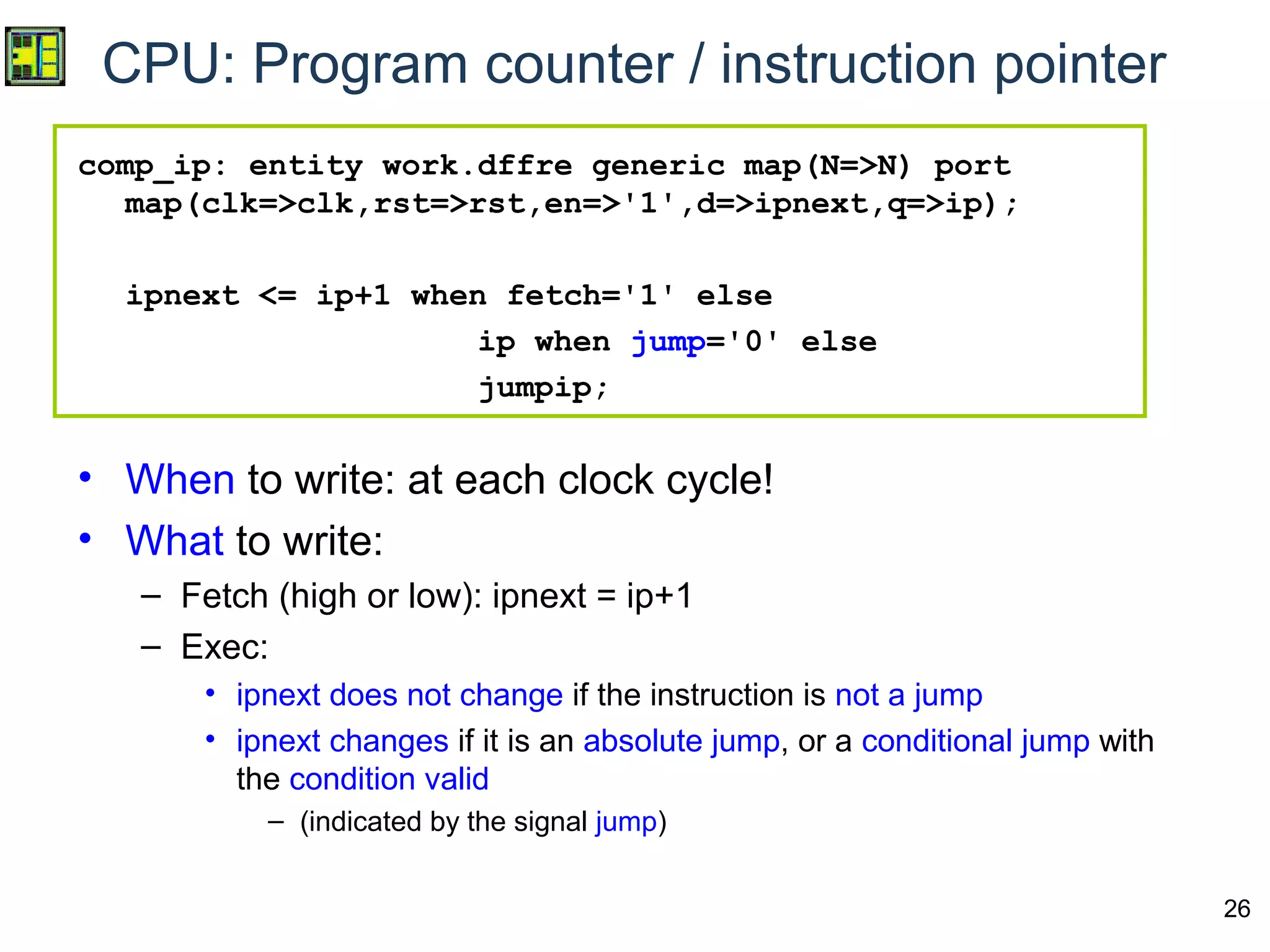
CPU: Program counter / instruction pointer
comp_ip: entity work.dffre generic map(N=>N) port
map(clk=>clk,rst=>rst,en=>'1',d=>ipnext,q=>ip);
ipnext <= ip+1 when fetch='1' else
ip when jump='0' else
jumpip;
• ip is the address where the instruction is read from
• N-bit D flip-flop
– In the laboratory N is 5 bits (0...1F). It's a Design choice
• ipnext is the input of the D flip-flop
26
CPU: Program counter / instruction pointer
comp_ip: entity work.dffre generic map(N=>N) port
map(clk=>clk,rst=>rst,en=>'1',d=>ipnext,q=>ip);
ipnext <= ip+1 when fetch='1' else
ip when jump='0' else
jumpip;
• When to write: at each clock cycle!
• What to write:
– Fetch (high or low): ipnext = ip+1
– Exec:
• ipnext does not change if the instruction is not a jump
• ipnext changes if it is an absolute jump, or a conditional jump with
the condition valid
– (indicated by the signal jump)
27
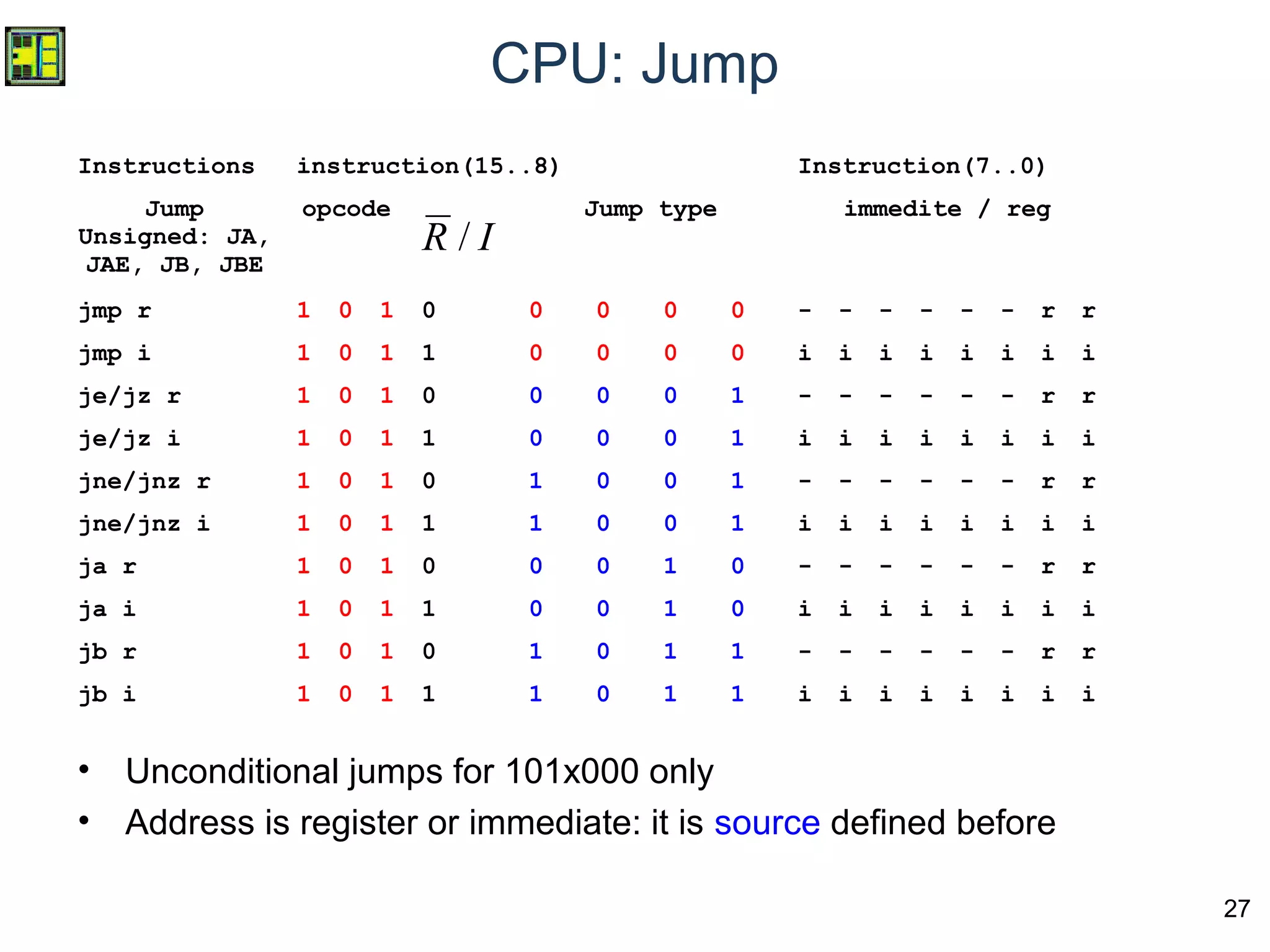
CPU: Jump
• Unconditional jumps for 101x000 only
• Address is register or immediate: it is source defined before
Instructions instruction(15..8) Instruction(7..0)
Jump
Unsigned: JA,
JAE, JB, JBE
opcode Jump type immedite / reg
jmp r 1 0 1 0 0 0 0 0 - - - - - - r r
jmp i 1 0 1 1 0 0 0 0 i i i i i i i i
je/jz r 1 0 1 0 0 0 0 1 - - - - - - r r
je/jz i 1 0 1 1 0 0 0 1 i i i i i i i i
jne/jnz r 1 0 1 0 1 0 0 1 - - - - - - r r
jne/jnz i 1 0 1 1 1 0 0 1 i i i i i i i i
ja r 1 0 1 0 0 0 1 0 - - - - - - r r
ja i 1 0 1 1 0 0 1 0 i i i i i i i i
jb r 1 0 1 0 1 0 1 1 - - - - - - r r
jb i 1 0 1 1 1 0 1 1 i i i i i i i i
IR /
28
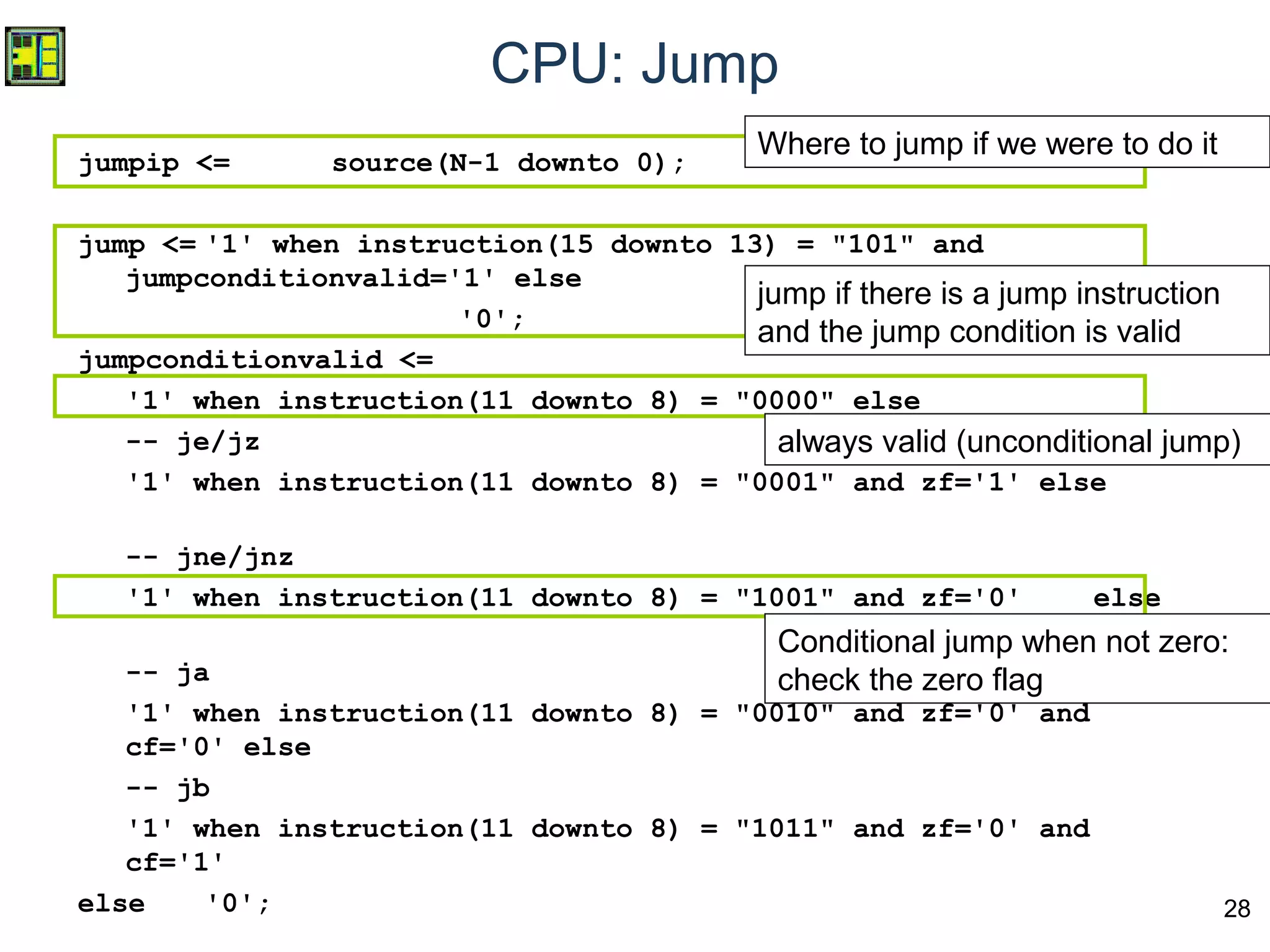
CPU: Jump
jumpip <= source(N-1 downto 0);
jump <= '1' when instruction(15 downto 13) = "101" and
jumpconditionvalid='1' else
'0';
jumpconditionvalid <=
'1' when instruction(11 downto 8) = "0000" else
-- je/jz
'1' when instruction(11 downto 8) = "0001" and zf='1' else
-- jne/jnz
'1' when instruction(11 downto 8) = "1001" and zf='0' else
-- ja
'1' when instruction(11 downto 8) = "0010" and zf='0' and
cf='0' else
-- jb
'1' when instruction(11 downto 8) = "1011" and zf='0' and
cf='1'
else '0';
Where to jump if we were to do it
jump if there is a jump instruction
and the jump condition is valid
always valid (unconditional jump)
Conditional jump when not zero:
check the zero flag
29
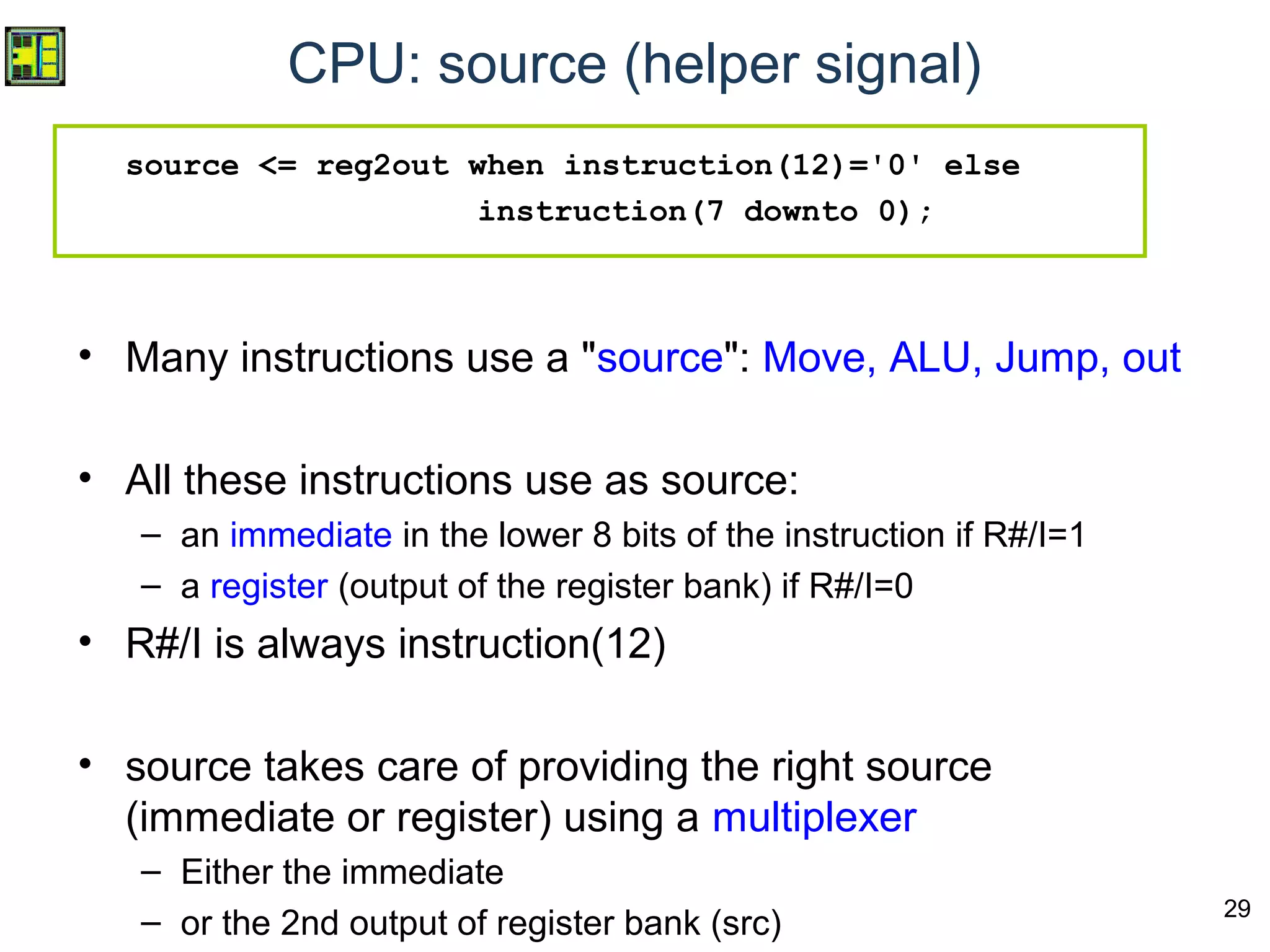
CPU: source (helper signal)
source <= reg2out when instruction(12)='0' else
instruction(7 downto 0);
• Many instructions use a "source": Move, ALU, Jump, out
• All these instructions use as source:
– an immediate in the lower 8 bits of the instruction if R#/I=1
– a register (output of the register bank) if R#/I=0
• R#/I is always instruction(12)
• source takes care of providing the right source
(immediate or register) using a multiplexer
– Either the immediate
– or the 2nd output of register bank (src)
30
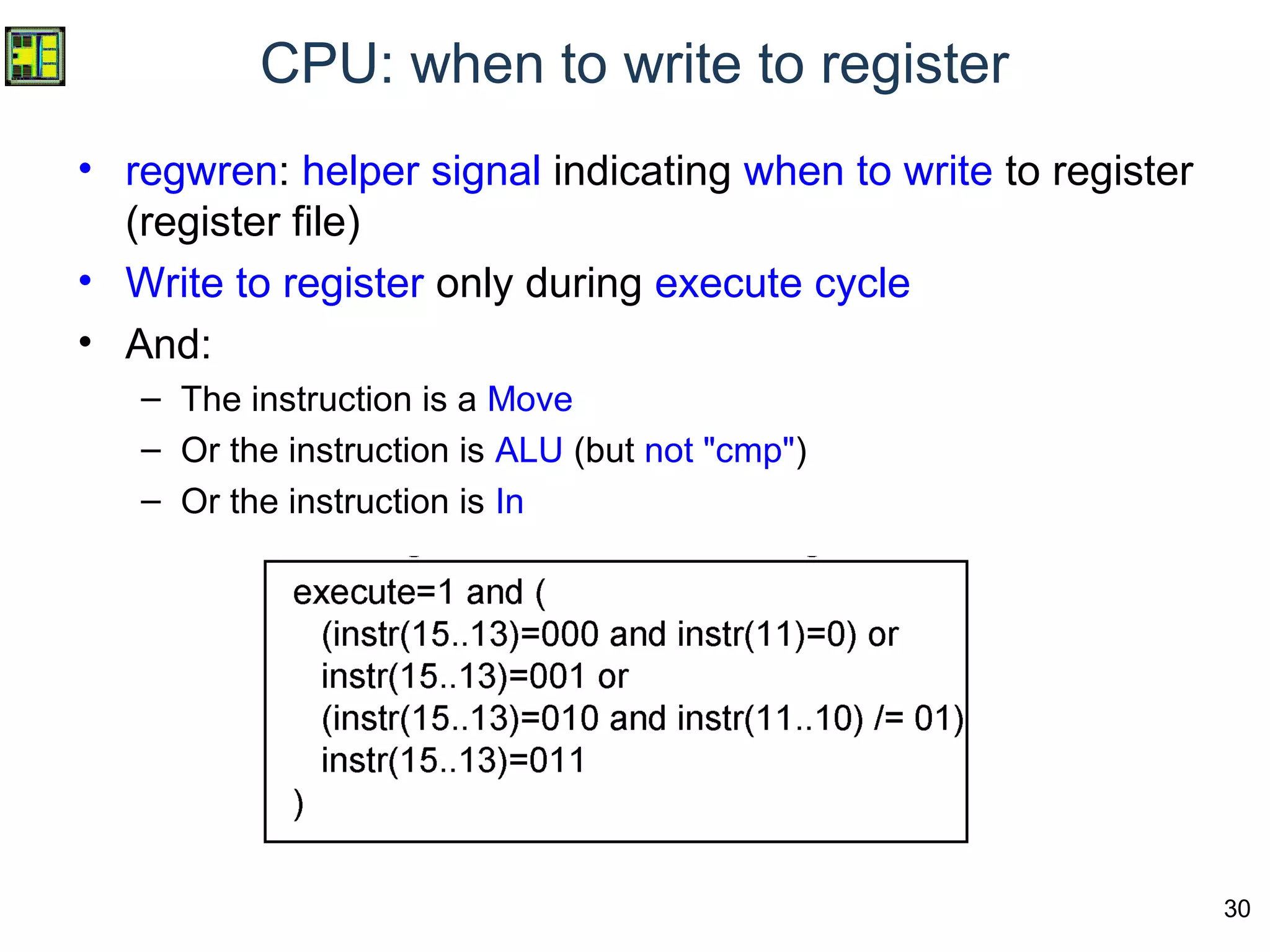
CPU: when to write to register
• regwren: helper signal indicating when to write to register
(register file)
• Write to register only during execute cycle
• And:
– The instruction is a Move
– Or the instruction is ALU (but not "cmp")
– Or the instruction is In
31
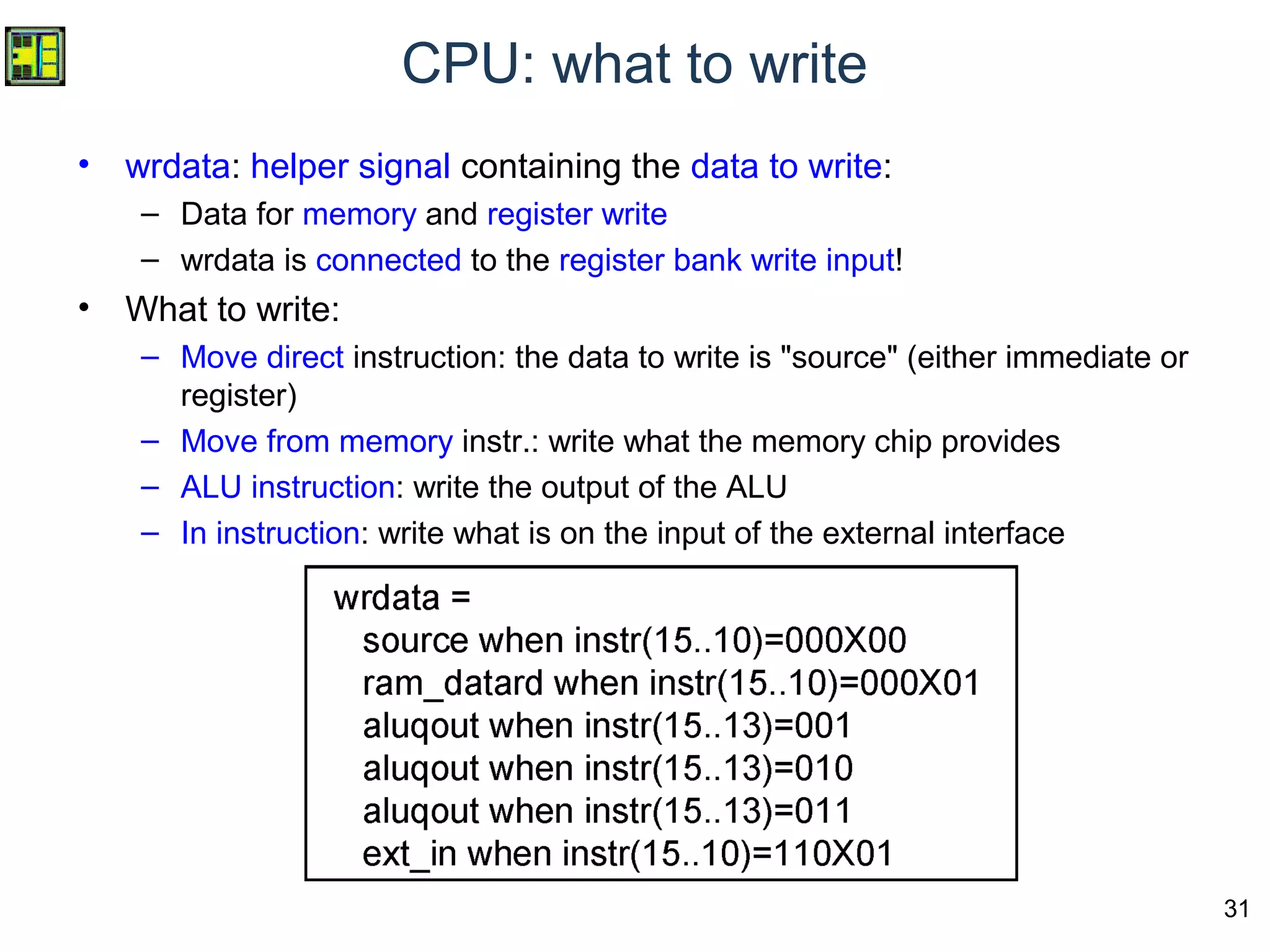
CPU: what to write
• wrdata: helper signal containing the data to write:
– Data for memory and register write
– wrdata is connected to the register bank write input!
• What to write:
– Move direct instruction: the data to write is "source" (either immediate or
register)
– Move from memory instr.: write what the memory chip provides
– ALU instruction: write the output of the ALU
– In instruction: write what is on the input of the external interface
32
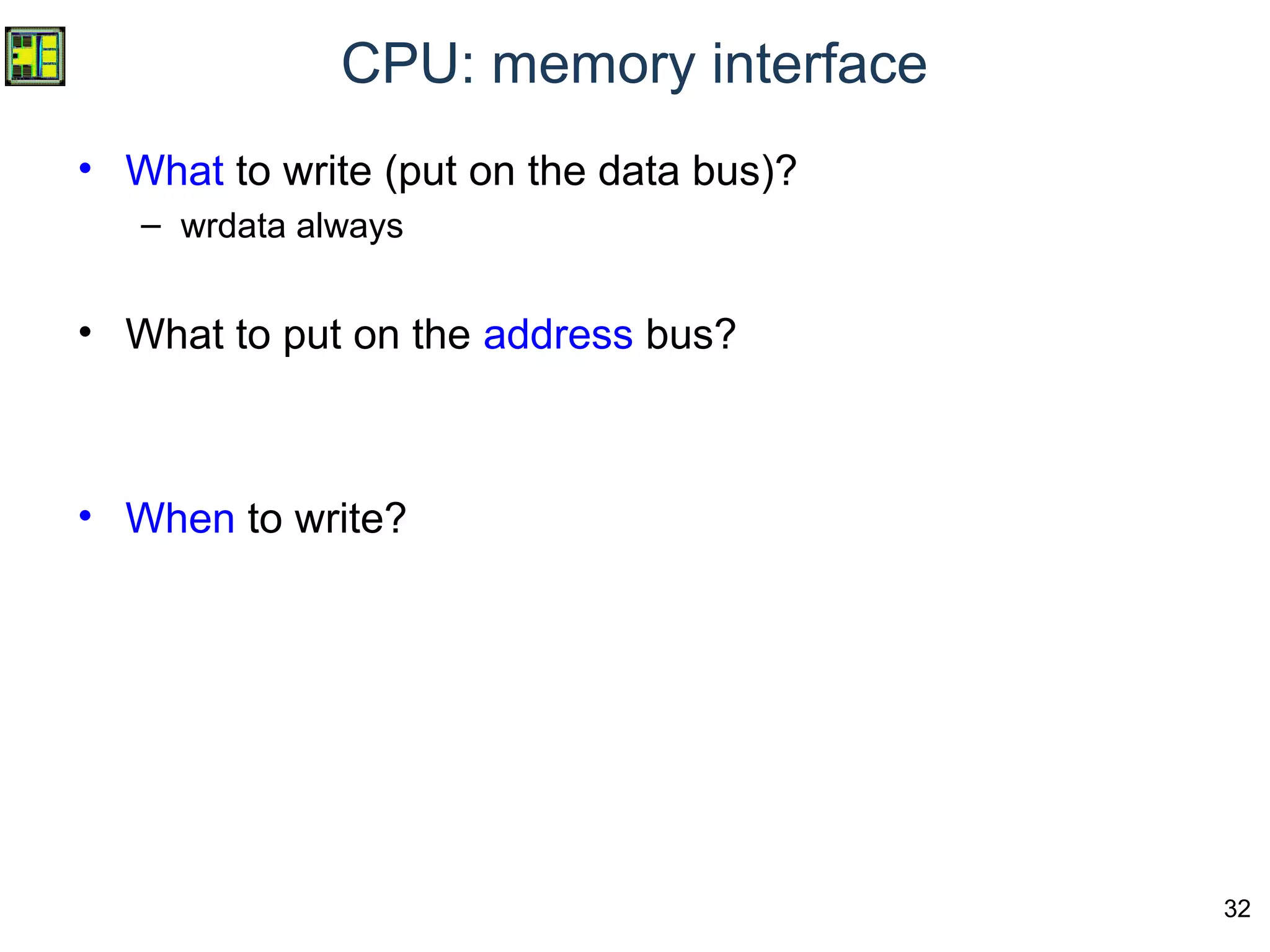
CPU: memory interface
• What to write (put on the data bus)?
– wrdata always
• What to put on the address bus?
• When to write?
33
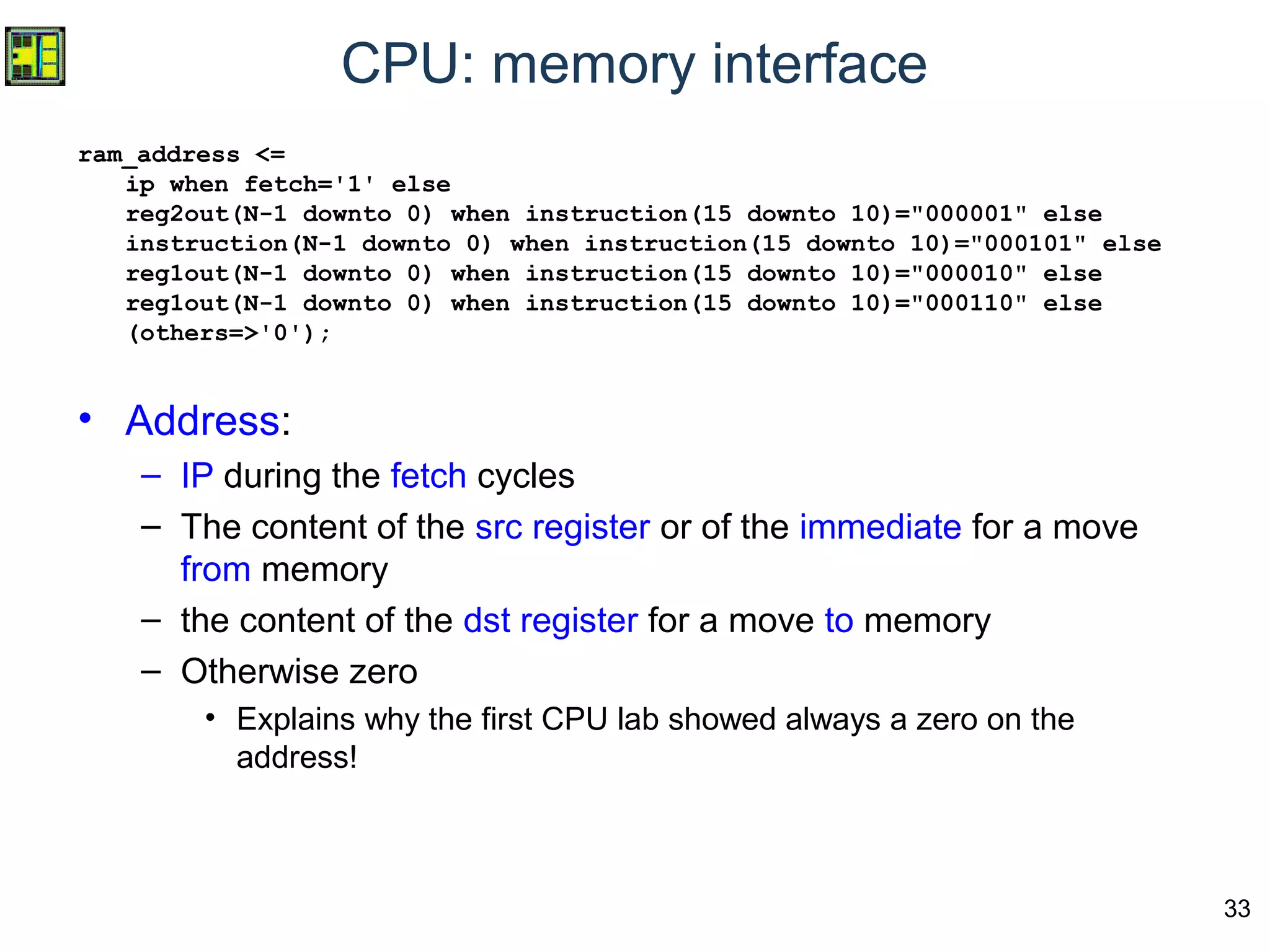
CPU: memory interface
ram_address <=
ip when fetch='1' else
reg2out(N-1 downto 0) when instruction(15 downto 10)="000001" else
instruction(N-1 downto 0) when instruction(15 downto 10)="000101" else
reg1out(N-1 downto 0) when instruction(15 downto 10)="000010" else
reg1out(N-1 downto 0) when instruction(15 downto 10)="000110" else
(others=>'0');
• Address:
– IP during the fetch cycles
– The content of the src register or of the immediate for a move
from memory
– the content of the dst register for a move to memory
– Otherwise zero
• Explains why the first CPU lab showed always a zero on the
address!
34
CPU: when to write to memory?
• Move to memory during the exec cycle:
– mov [b],23h
ram_we <=
'1' when execute='1' and instruction(15 downto 13)="000"
and instruction(11 downto 10)="10"
else '0';
35
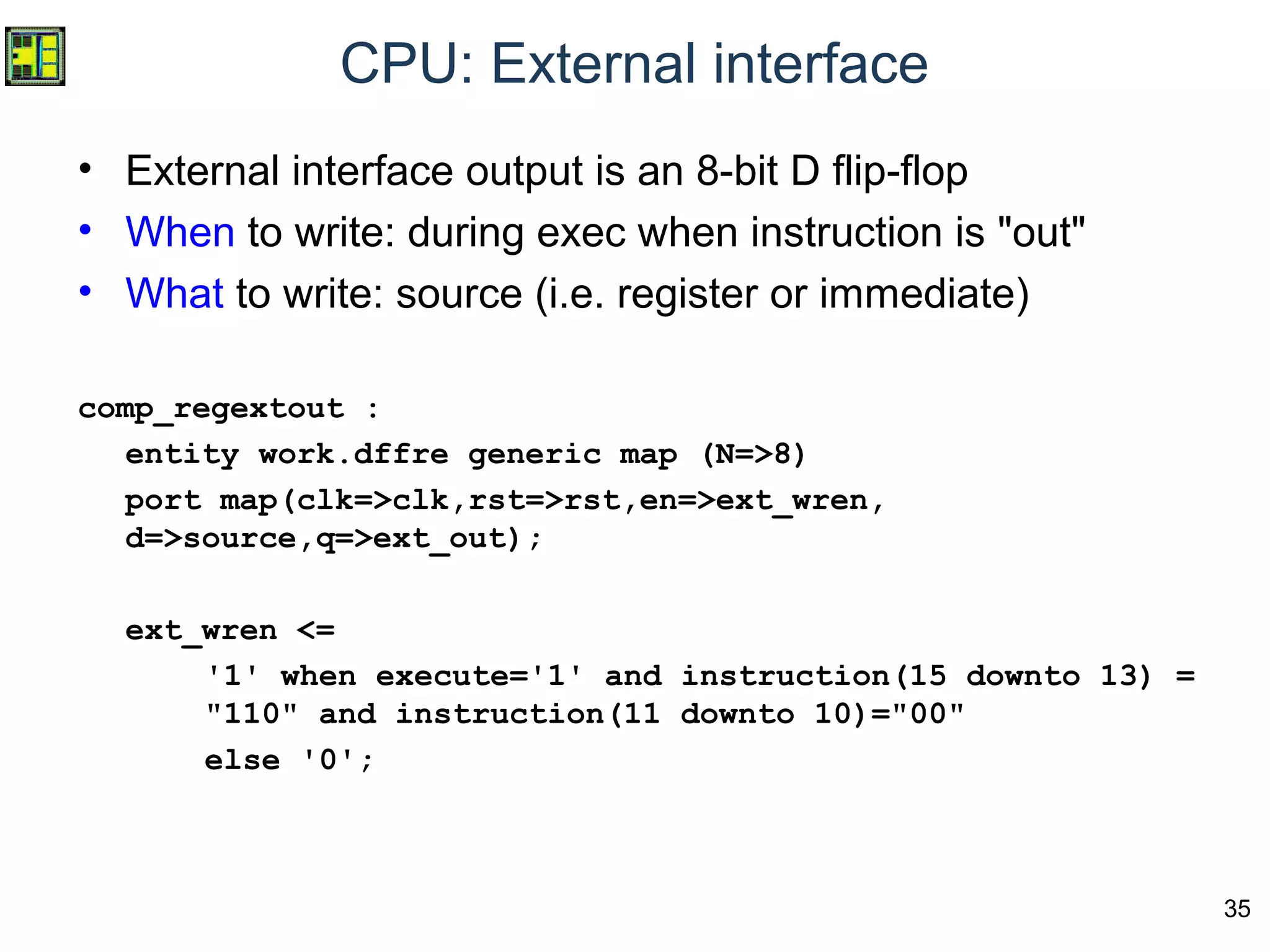
CPU: External interface
• External interface output is an 8-bit D flip-flop
• When to write: during exec when instruction is "out"
• What to write: source (i.e. register or immediate)
comp_regextout :
entity work.dffre generic map (N=>8)
port map(clk=>clk,rst=>rst,en=>ext_wren,
d=>source,q=>ext_out);
ext_wren <=
'1' when execute='1' and instruction(15 downto 13) =
"110" and instruction(11 downto 10)="00"
else '0';
36
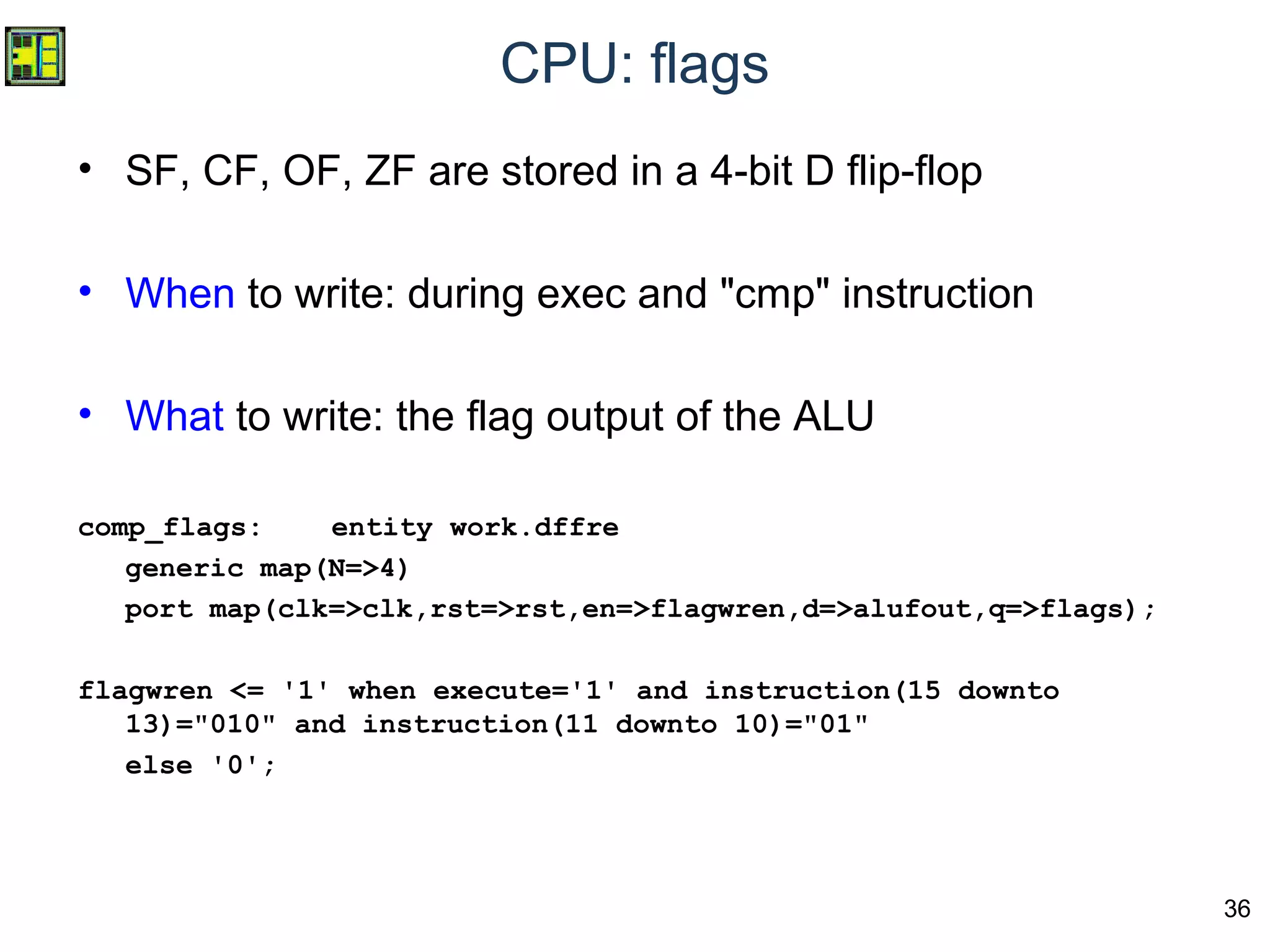
CPU: flags
• SF, CF, OF, ZF are stored in a 4-bit D flip-flop
• When to write: during exec and "cmp" instruction
• What to write: the flag output of the ALU
comp_flags: entity work.dffre
generic map(N=>4)
port map(clk=>clk,rst=>rst,en=>flagwren,d=>alufout,q=>flags);
flagwren <= '1' when execute='1' and instruction(15 downto
13)="010" and instruction(11 downto 10)="01"
else '0';
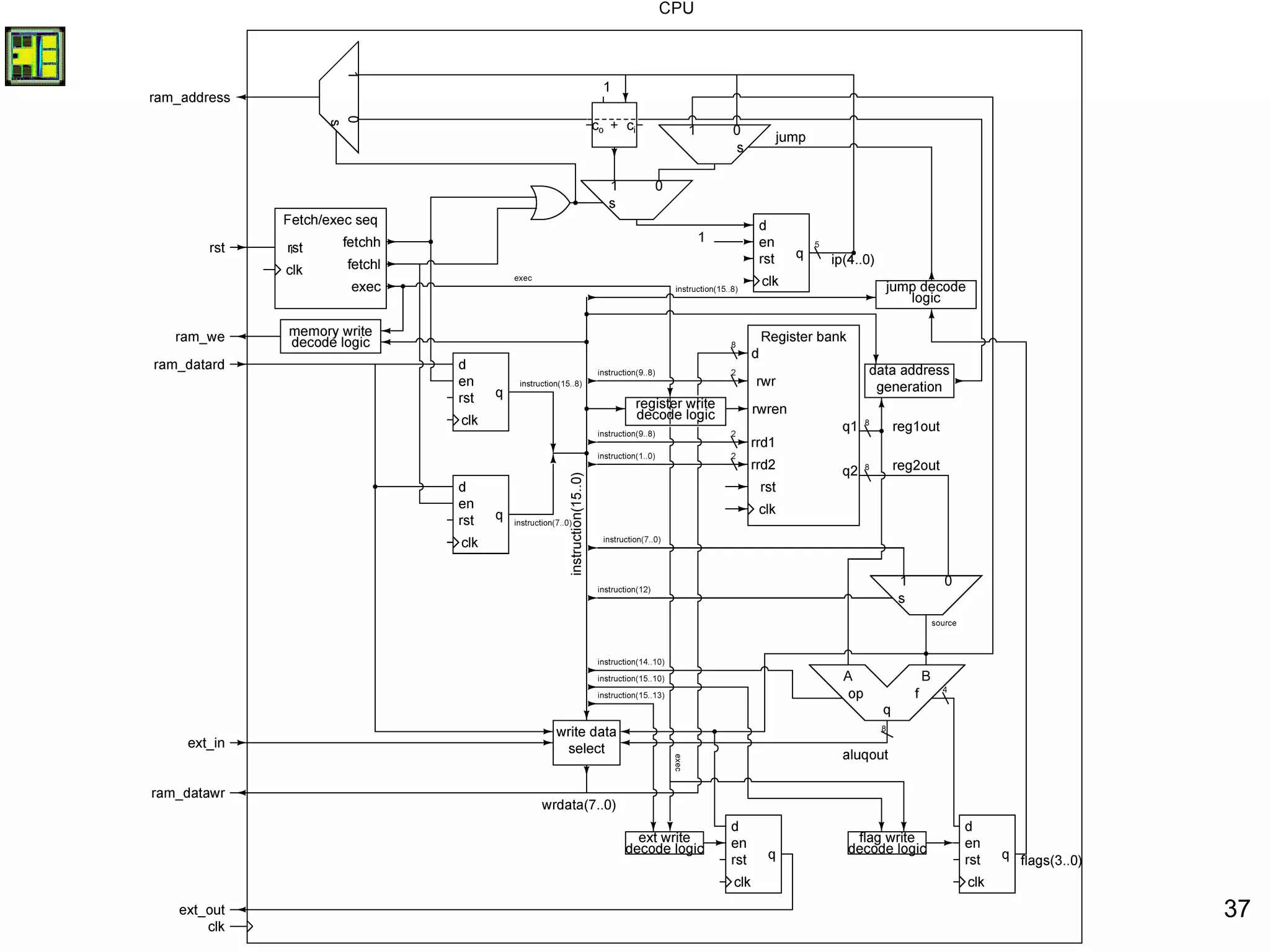
37
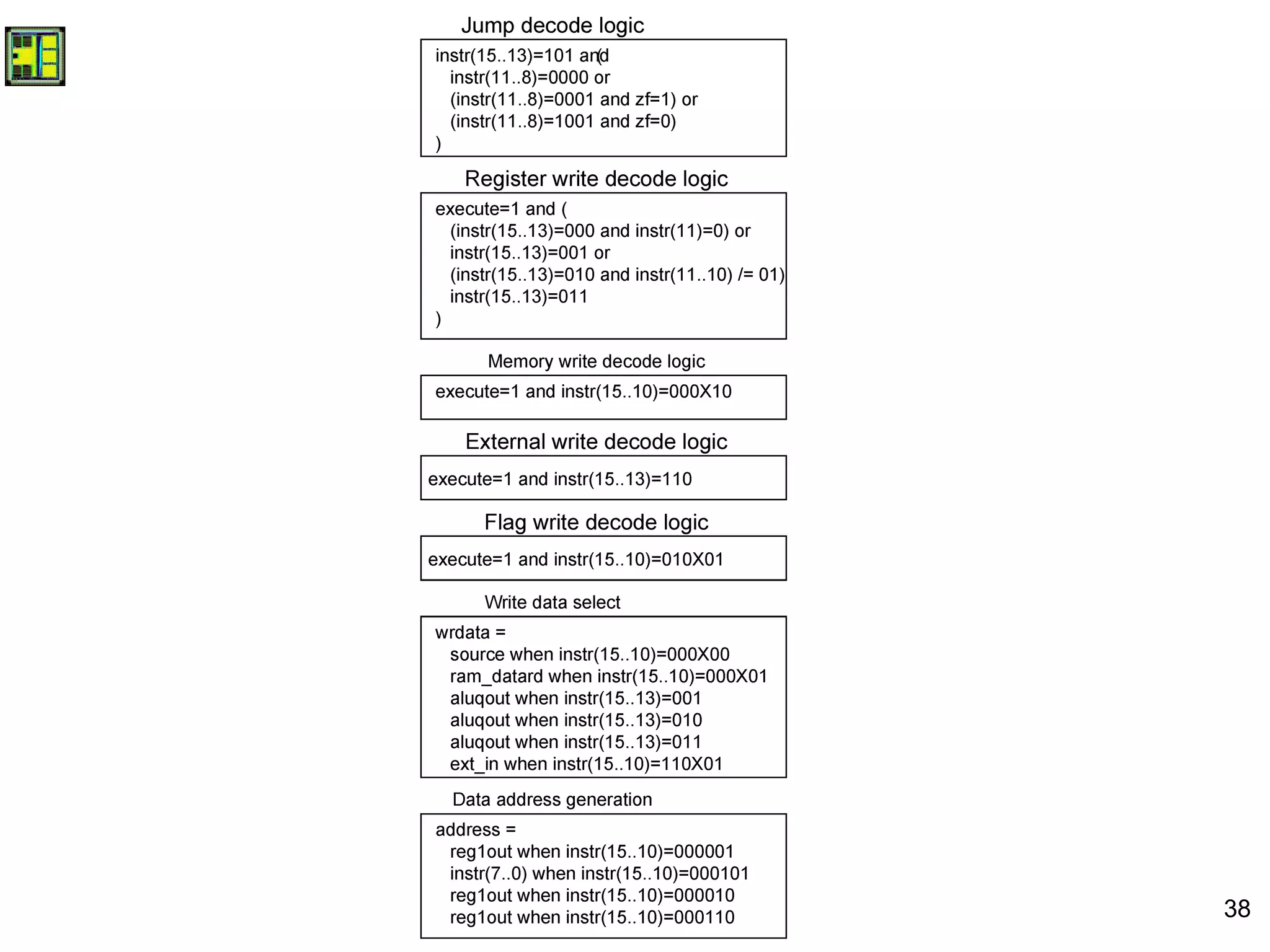
38
39
Summary
• Brief insight into the processor architecture
• Basic understanding of the control unit function:
– deciding what and when to "store" data in register
• Sufficient knowledge to perform the coursework
assignment on:
– Modifying the instruction set (adding instruction)
– Tracing the state of key signals for a given instruction

W8_2: Inside the UoS Educational Processor

  • 1.
    1 Digital Systems andMicroprocessor Design (H7068) Daniel Roggen d.roggen@sussex.ac.uk 8.2. Inside UoS Educational Processor
  • 2.
  • 3.
    3 VHDL files • cpu.vhd:top file for CPU • cpusequencer.vhd: fetch/execute sequence • cpuregbank.vhd: register file • cpualu.vhd: ALU
  • 4.
    4 Fetch/Execute sequence • 3clock cycles per instruction – Fetch high – Fetch low – Execute... • Circuit must organize this sequence
  • 5.
    5 Fetch/Execute sequence • Incpusequencer.vhd • Up counter until 2 (10b): 00=fetchh, 01=fetchl, 10=exec
  • 6.
    6 Fetch/Execute sequence entity cpusequenceris port( clk : in STD_LOGIC; rst : in STD_LOGIC; en : in STD_LOGIC; seq : out STD_LOGIC_VECTOR(1 downto 0) ); end cpusequencer; • clk: clock • rst: reset • en: enable (currently not used: always wired to 1) • seq: 2-bit code for fetchh, fetchl, exec
  • 7.
    7 Fetch/Execute sequence process(clk) begin if rising_edge(clk)then if rst='1' then s<="00"; else if en='1' then if s="10" then s <= "00"; else s <= s+1; end if; end if; end if; end if; end process; seq <= s; clock in sensitivity list All happens on rising clock edge Reset Normal behavior: if enabled, increment and wrap around at 2 • VHDL does additions with '+'! • Not taught in this module. • Synthesizer chooses an implementation on its own • Choice not critical here with 2 bits; with more bits specific adder architectures may be preferred
  • 8.
    8 Register file (registerbank) All D FF with enable and reset (synchronous) registers A-D
  • 9.
    9 Register file (registerbank) • Reminder: move instruction • Always operation between dst and src, with result in dst • Let's consider what to read from our register bank: – The register defined by dst and src (even if we deal with an immediate-this is handled elsewhere Instructions instruction(15..8) Instruction(7..0) Move Opcode dd#m sd#m dreg src mov r, r 0 0 0 0 0 0 r r - - - - - - r r mov r, i 0 0 0 1 0 0 r r i i i i i i i i mov r, [r] 0 0 0 0 0 1 r r - - - - - - r r mov r, [i] 0 0 0 1 0 1 r r i i i i i i i i mov [r], r 0 0 0 0 1 0 r r - - - - - - r r mov [r], i 0 0 0 1 1 0 r r i i i i i i i i
  • 10.
    10 Register file (registerbank) entity cpuregbank is port( clk : in STD_LOGIC; rrd1 : in STD_LOGIC_VECTOR(1 downto 0); rrd2 : in STD_LOGIC_VECTOR(1 downto 0); rwr : in STD_LOGIC_VECTOR(1 downto 0); rwren : in STD_LOGIC; rst : in STD_LOGIC; d : in STD_LOGIC_VECTOR(7 downto 0); q1 : out STD_LOGIC_VECTOR(7 downto 0); q2 : out STD_LOGIC_VECTOR(7 downto 0); -- Only for debugging dbg_qa : out STD_LOGIC_VECTOR(7 downto 0); dbg_qb : out STD_LOGIC_VECTOR(7 downto 0); dbg_qc : out STD_LOGIC_VECTOR(7 downto 0); dbg_qd : out STD_LOGIC_VECTOR(7 downto 0) ); end cpuregbank; register to read from (the 2 bits come from src or dst in the instruction!) outputs of the register bank This would not be here in a "production" processor: here to display the content of the register on the 7 segment display register to write to (always dst) rwren: enable write d: data to write
  • 11.
    11 Register file (registerbank) architecture Behavioral of cpuregbank is signal enables: STD_LOGIC_VECTOR(3 downto 0); signal qa,qb,qc,qd: STD_LOGIC_VECTOR(7 downto 0); begin ra: entity work.dffre generic map (N=>8) port map(clk=>clk,en=>enables(0),rst=>rst,d=>d,q=>qa); rb: entity work.dffre generic map (N=>8) port map(clk=>clk,en=>enables(1),rst=>rst,d=>d,q=>qb); rc: entity work.dffre generic map (N=>8) port map(clk=>clk,en=>enables(2),rst=>rst,d=>d,q=>qc); rd: entity work.dffre generic map (N=>8) port map(clk=>clk,en=>enables(3),rst=>rst,d=>d,q=>qd); enable each register q: output of each register Instantiate a register with reset and enable. Generic map: parameterized register.
  • 12.
    12 Register file (registerbank) with rwr select enables <="0001" and rwren&rwren&rwren&rwren when "00", "0010" and rwren&rwren&rwren&rwren when "01", "0100" and rwren&rwren&rwren&rwren when "10", "1000" and rwren&rwren&rwren&rwren when others; with rrd1 select q1 <= qa when "00", qb when "01", qc when "10", qd when others; with rrd2 select q2 <= qa when "00", qb when "01", qc when "10", qd when others; 2-4 decoder: when write is enabled one of the register is enabled for write first output multiplexer second output multiplexer
  • 13.
    13 Register entity dffre is generic(N : integer); port( clk : in STD_LOGIC; en : in STD_LOGIC; rst: in STD_LOGIC; d : in STD_LOGIC_VECTOR(N-1 downto 0); q : out STD_LOGIC_VECTOR(N-1 downto 0) ); end dffre; generic: useful to create components that can be parameterized Here N is the number of bits of the D flip-flop generic: useful to create components that can be parameterized
  • 14.
    14 Register architecture Behavioral ofdffre is begin process(clk) begin if rising_edge(clk) then if rst='1' then q<=(others=>'0'); else if en='1' then q<=d; end if; end if; end if; end process; all on rising edge synchronous reset copy if enabled
  • 15.
    15 VHDL generic In thecomponent declaration: entity entity_name is generic (generic list); port (port list); end entity_name; In the component instantiation: label: entity work.comp_name generic map (generic_association_list) port map (port_association_list);
  • 16.
    16 ALU • A, B:input of the ALU (8 bits) • aluop: operation to perform (5 bits) – bit 14 to bit 10 of instruction to identify the type of operation – (part opcode and part other bits of the instruction) • Implemented as multiplexer • flags as discrete logic
  • 17.
    17 ALU Instructions instruction(15..8) Instruction(7..0) ALU2 op opcode ALU op dreg src add r, r 0 0 1 0 0 0 r r - - - - - - r r add r, i 0 0 1 1 0 0 r r i i i i i i i i xor r, r 0 1 0 0 0 0 r r - - - - - - r r IR / Test opco de ALU op dr eg immedite / reg cmp r, r 0 1 0 0 0 1 r r - - - - - - r r cmp r, i 0 1 0 1 0 1 r r i i i i i i i i Instructions instruction(15..8) Instruction(7..0) ALU 1 op opcode ALU op dreg not r 0 1 1 0 0 0 r r - - - - - - - - shr r 0 1 1 0 0 1 r r - - - - - - - - ... Only the bits in red are necessary to define the ALU operation!
  • 18.
    18 ALU entity cpualu is port( clk : in STD_LOGIC; rst : in STD_LOGIC; op : in STD_LOGIC_VECTOR(4 downto 0); a : in STD_LOGIC_VECTOR(7 downto 0); b : in STD_LOGIC_VECTOR(7 downto 0); q : out STD_LOGIC_VECTOR(7 downto 0); f : out STD_LOGIC_VECTOR(3 downto 0) ); end cpualu; Output Flags • Flags are always returned, but only used if the instruction is "cmp": control unit stores the flag in a flag register Input A,B
  • 19.
    19 ALU r <= a+bwhen op(4 downto 3)="01" and op(1 downto 0)="00" else sub(7 downto 0) when op(4 downto 3)="01" and op(1 downto 0)="01" else a and b when op(4 downto 3)="01" and op(1 downto 0)="10" else a or b when op(4 downto 3)="01" and op(1 downto 0)="11" else a xor b when op(4 downto 3)="10" and op(1 downto 0)="00" else not a when op(4 downto 0)="11000" else '0'&a(7 downto 1) when op(4 downto 0)="11001" else a(0)&a(7 downto 1) when op(4 downto 0)="11010" else a(7)&a(7 downto 1) when op(4 downto 0)="11011" else a(6 downto 0)&a(7) when op(4 downto 0)="11100" else "00000000"; • Multiplexer • Can you recognize an instruction? • Add is 001000rr ------rr • or 001100rr iiiiiiii • (in red op) • Therefore we react is op(4..3)=01 and op(1..0)=00
  • 20.
    20 ALU sf <= sub(7); zf<= not(sub(7) or sub(6) or sub(5) or sub(4) or sub(3) or sub(2) or sub(1) or sub(0)); cf <= sub(8); ovf <= (not a(7) and b(7) and sub(7)) or (a(7) and not b(7) and not sub(7)); f<=zf&ovf&cf&sf; q<=r; • Sign flag is bit 7 of the subtraction • Zero flag obtained by oring • Carry flag is bit 8 of the subtration (only 8 bits are returned but subtraction done on 9 bits to obtain the carry) • Overflow flag: triggers when the result flips sign: – positive minus negative must give positive – negative minus positive must give negative – Otherwise it's an overflow Combine flags in a vector
  • 21.
    21 Top level CPUentity entity cpu is generic(N : integer); port( clk : in STD_LOGIC; rst : in STD_LOGIC; ext_in : in STD_LOGIC_VECTOR(7 downto 0); ext_out : out STD_LOGIC_VECTOR(7 downto 0); ram_we : out STD_LOGIC; ram_address : out STD_LOGIC_VECTOR(N-1 downto 0); ram_datawr : out STD_LOGIC_VECTOR(7 downto 0); ram_datard : in STD_LOGIC_VECTOR(7 downto 0); -- Only for debugging dbg_qa : out STD_LOGIC_VECTOR(7 downto 0); dbg_qb : out STD_LOGIC_VECTOR(7 downto 0); dbg_qc : out STD_LOGIC_VECTOR(7 downto 0); dbg_qd : out STD_LOGIC_VECTOR(7 downto 0); dbg_instr : out STD_LOGIC_VECTOR(15 downto 0); dbg_seq : out STD_LOGIC_VECTOR(1 downto 0); dbg_flags : out STD_LOGIC_VECTOR(3 downto 0) ); end cpu; External interface Memory interface
  • 22.
    22 CPU: instantiating theregister bank comp_regs: entity work.cpuregbank port map( clk=>clk,rst=>rst, rrd1=>instruction(9 downto 8), rrd2=>instruction(1 downto 0), rwr=>instruction(9 downto 8), rwren=>regwren, d=>wrdata, q1=>reg1out,q2=>reg2out); • The instruction set is designed to help the control unit • Source and destination always in the same location in the instruction – reg1out is the value in the "dst" register – reg2out is the value in the "src" register • It does not hurt to "wire up" src and dst to the register bank, even if the instruction does not use src/dst (the control unit handles that) • Write only occurs with a Move or an ALU instruction! 1st register is "dst" 2nd register is "src" write register is "dst " Controls the write 1st and 2nd register output
  • 23.
    23 CPU: instantiating fetch/execute comp_seq:entity work.cpusequencer port map(clk=>clk,rst=>rst,en=>'1',seq=>seq); fetchh <= '1' when seq="00" else '0'; fetchl <= '1' when seq="01" else '0'; execute <= '1' when seq="10" else '0'; fetch <= fetchl or fetchh; Helper signals - not mandatory but makes reading simpler
  • 24.
    24 CPU: fetch instruction comp_instrh:entity work.dffre generic map(N=>8) port map(clk=>clk,rst=>rst,en=>fetchh,d=>ram_datard, q=>instruction(15 downto 8)); comp_instrl: entity work.dffre generic map(N=>8) port map(clk=>clk,rst=>rst,en=>fetchl,d=>ram_datard, q=>instruction(7 downto 0)); • instruction is the 16-bit instruction read from memory • It is 16-bit register realized by two 8-bit D flip-flops • First flip-flop enabled on "fetch high" • Second flip-flop enabled on "fetch low"
  • 25.
    25 CPU: Program counter/ instruction pointer comp_ip: entity work.dffre generic map(N=>N) port map(clk=>clk,rst=>rst,en=>'1',d=>ipnext,q=>ip); ipnext <= ip+1 when fetch='1' else ip when jump='0' else jumpip; • ip is the address where the instruction is read from • N-bit D flip-flop – In the laboratory N is 5 bits (0...1F). It's a Design choice • ipnext is the input of the D flip-flop
  • 26.
    26 CPU: Program counter/ instruction pointer comp_ip: entity work.dffre generic map(N=>N) port map(clk=>clk,rst=>rst,en=>'1',d=>ipnext,q=>ip); ipnext <= ip+1 when fetch='1' else ip when jump='0' else jumpip; • When to write: at each clock cycle! • What to write: – Fetch (high or low): ipnext = ip+1 – Exec: • ipnext does not change if the instruction is not a jump • ipnext changes if it is an absolute jump, or a conditional jump with the condition valid – (indicated by the signal jump)
  • 27.
    27 CPU: Jump • Unconditionaljumps for 101x000 only • Address is register or immediate: it is source defined before Instructions instruction(15..8) Instruction(7..0) Jump Unsigned: JA, JAE, JB, JBE opcode Jump type immedite / reg jmp r 1 0 1 0 0 0 0 0 - - - - - - r r jmp i 1 0 1 1 0 0 0 0 i i i i i i i i je/jz r 1 0 1 0 0 0 0 1 - - - - - - r r je/jz i 1 0 1 1 0 0 0 1 i i i i i i i i jne/jnz r 1 0 1 0 1 0 0 1 - - - - - - r r jne/jnz i 1 0 1 1 1 0 0 1 i i i i i i i i ja r 1 0 1 0 0 0 1 0 - - - - - - r r ja i 1 0 1 1 0 0 1 0 i i i i i i i i jb r 1 0 1 0 1 0 1 1 - - - - - - r r jb i 1 0 1 1 1 0 1 1 i i i i i i i i IR /
  • 28.
    28 CPU: Jump jumpip <=source(N-1 downto 0); jump <= '1' when instruction(15 downto 13) = "101" and jumpconditionvalid='1' else '0'; jumpconditionvalid <= '1' when instruction(11 downto 8) = "0000" else -- je/jz '1' when instruction(11 downto 8) = "0001" and zf='1' else -- jne/jnz '1' when instruction(11 downto 8) = "1001" and zf='0' else -- ja '1' when instruction(11 downto 8) = "0010" and zf='0' and cf='0' else -- jb '1' when instruction(11 downto 8) = "1011" and zf='0' and cf='1' else '0'; Where to jump if we were to do it jump if there is a jump instruction and the jump condition is valid always valid (unconditional jump) Conditional jump when not zero: check the zero flag
  • 29.
    29 CPU: source (helpersignal) source <= reg2out when instruction(12)='0' else instruction(7 downto 0); • Many instructions use a "source": Move, ALU, Jump, out • All these instructions use as source: – an immediate in the lower 8 bits of the instruction if R#/I=1 – a register (output of the register bank) if R#/I=0 • R#/I is always instruction(12) • source takes care of providing the right source (immediate or register) using a multiplexer – Either the immediate – or the 2nd output of register bank (src)
  • 30.
    30 CPU: when towrite to register • regwren: helper signal indicating when to write to register (register file) • Write to register only during execute cycle • And: – The instruction is a Move – Or the instruction is ALU (but not "cmp") – Or the instruction is In
  • 31.
    31 CPU: what towrite • wrdata: helper signal containing the data to write: – Data for memory and register write – wrdata is connected to the register bank write input! • What to write: – Move direct instruction: the data to write is "source" (either immediate or register) – Move from memory instr.: write what the memory chip provides – ALU instruction: write the output of the ALU – In instruction: write what is on the input of the external interface
  • 32.
    32 CPU: memory interface •What to write (put on the data bus)? – wrdata always • What to put on the address bus? • When to write?
  • 33.
    33 CPU: memory interface ram_address<= ip when fetch='1' else reg2out(N-1 downto 0) when instruction(15 downto 10)="000001" else instruction(N-1 downto 0) when instruction(15 downto 10)="000101" else reg1out(N-1 downto 0) when instruction(15 downto 10)="000010" else reg1out(N-1 downto 0) when instruction(15 downto 10)="000110" else (others=>'0'); • Address: – IP during the fetch cycles – The content of the src register or of the immediate for a move from memory – the content of the dst register for a move to memory – Otherwise zero • Explains why the first CPU lab showed always a zero on the address!
  • 34.
    34 CPU: when towrite to memory? • Move to memory during the exec cycle: – mov [b],23h ram_we <= '1' when execute='1' and instruction(15 downto 13)="000" and instruction(11 downto 10)="10" else '0';
  • 35.
    35 CPU: External interface •External interface output is an 8-bit D flip-flop • When to write: during exec when instruction is "out" • What to write: source (i.e. register or immediate) comp_regextout : entity work.dffre generic map (N=>8) port map(clk=>clk,rst=>rst,en=>ext_wren, d=>source,q=>ext_out); ext_wren <= '1' when execute='1' and instruction(15 downto 13) = "110" and instruction(11 downto 10)="00" else '0';
  • 36.
    36 CPU: flags • SF,CF, OF, ZF are stored in a 4-bit D flip-flop • When to write: during exec and "cmp" instruction • What to write: the flag output of the ALU comp_flags: entity work.dffre generic map(N=>4) port map(clk=>clk,rst=>rst,en=>flagwren,d=>alufout,q=>flags); flagwren <= '1' when execute='1' and instruction(15 downto 13)="010" and instruction(11 downto 10)="01" else '0';
  • 37.
  • 38.
  • 39.
    39 Summary • Brief insightinto the processor architecture • Basic understanding of the control unit function: – deciding what and when to "store" data in register • Sufficient knowledge to perform the coursework assignment on: – Modifying the instruction set (adding instruction) – Tracing the state of key signals for a given instruction