HEMODIALYSIS ADEQUACY
Definition
• Dialysis adequacy is defined as the minimum
amount of urea clearance and nutritional intake
that prevents adverse outcomes.
• Adequacy of dialysis refers to how well we
remove toxins and waste products from the
patient’s blood, and has a major impact on
their well-being
Aspects of dialysis adequacy
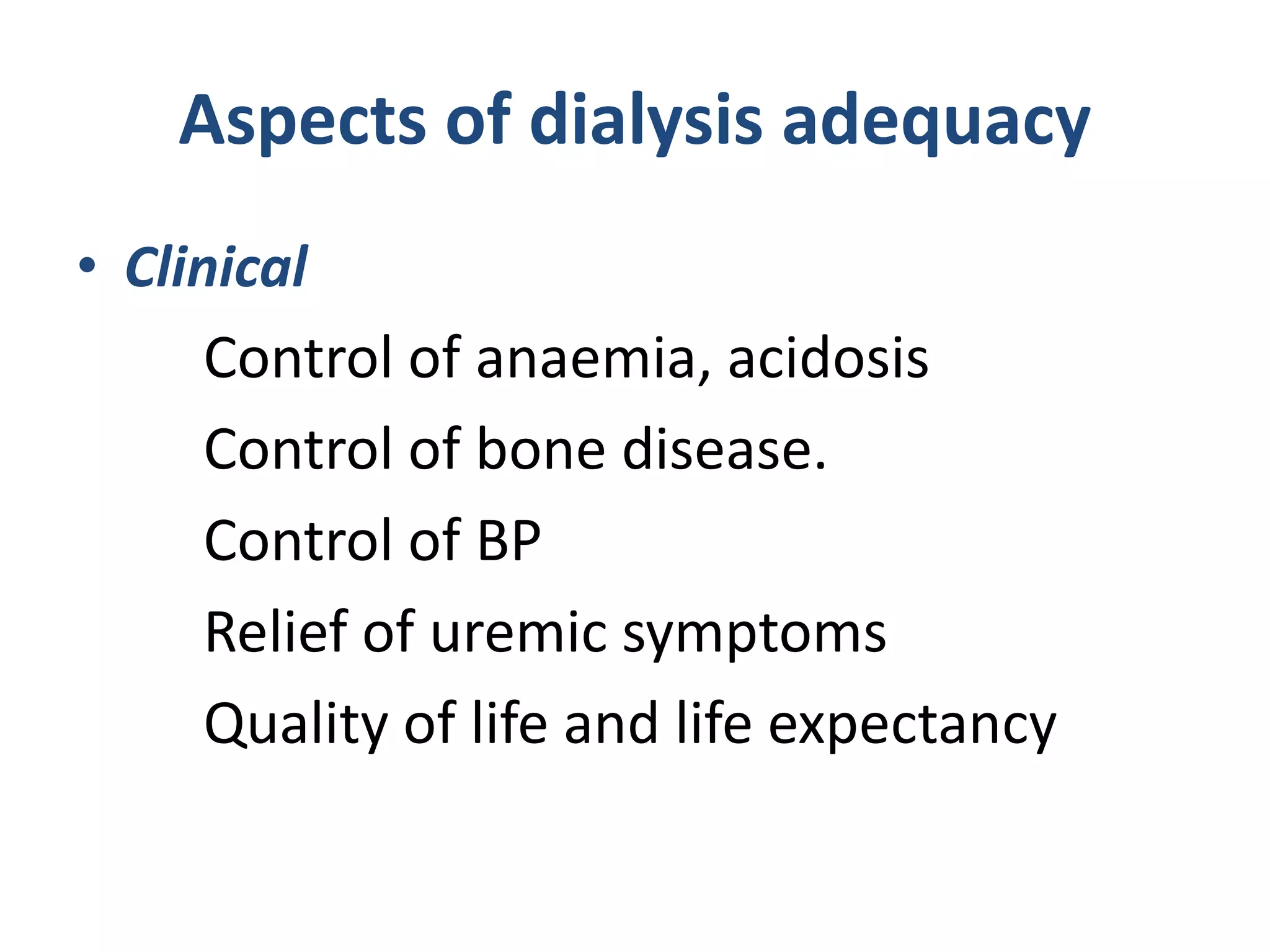
• Clinical
Control of anaemia, acidosis
Control of bone disease.
Control of BP
Relief of uremic symptoms
Quality of life and life expectancy
• Measurement
• Small solute clearance (urea kinetic modelling
(UKM)
• Kt/V
• urea reduction ratio (URR)).
How do we know if a Patient is
Adequately Dialyzed ?
• The National Cooperative Dialysis Study (NCDS)
established urea kinetic modeling (UKM) as the
accepted method of measuring small solute
clearance.
Moleular Weight of 60
a marker for small MW uremic toxins
Urea removal < ---> other small toxin
removal
WHY UREA ?
The clearance of urea has been selected as the
basis for all the calculations of dialysis adequacy
Urea Clearance Factor
• The urea clearance coefficient of the dialyzer
• The pre and post treatment blood urea
• The treatment time,
• The total body water,
• The UF,
• Residual renal function and
• The interdialytic urea generation rate.
UKM
• When calculations of dialysis adequacy use
both urea clearance and patient nutritional
status (i.e., urea generation rate), this is called
UKM.
• It takes into account residual renal function,
predicted dialyser clearance, blood and
dialysate flow, time on dialysis and fluid
removal.
Measures of dialysis adequacy
• URR
• spKt/V = single pool
• eqKt/V = equilibrated (Double pool)
• Std Kt/V = weekly standard
URR
• It is calculated as follows:
[(Pre-dialysis urea – post-dialysis urea)/Pre-
dialysis urea] × 100.
• Simple
• Prediction of mortality
Limitation:
• Does not account for the contribution of UF to
dialysis dose
Kt/V = fractional urea clearance
K = dialyzer clearance (ml/min or L/hr)
t = time (min or hr)
V = distribution volume of urea (ml or L)
K x t = L/hr x hr = LITERS
V = LITERS
Kt/V = LITERS/LITERS = ratio
What is Kt/V ?
• K stands for the dialyzer clearance, the rate at
which blood passes through the dialyzer,
expressed in milliliters per minute (mL/min)
• Kt, the top part of the fraction, is clearance
multiplied by time, representing the volume
of fluid completely cleared of urea during a
single treatment
spKt/V = single pool
eqKt/V = equilibrated (Double pool)
Std Kt/V = weekly standard
Kt/V
• A urea Kt/V value <0.8 was found to be
associated with a high likelihood of morbidity
and/or treatment failure, while a Kt/V >1.0
was associated with a good outcome
• Guidelines have recommended a minimum
Kt/V value of at least 1.2 for hemodialysis
patients being dialyzed three times per week
spKt/V
• The single pool Kt/V assumes that, at the end
of dialysis, the concentrations of intracellular
and extracellular Ur are equal
• (Upre, urea pre-dialysis; Upost, urea post-dialysis; UFvol,
volume removed on dialysis)
Single-Pool vs Double-Pool
Single-pool
• Does not account for urea transfer between fluid
compartments
• With  dialyzer clearance, urea removed from
extracellular compartment can exceed transfer
from intracellular compartment
• Urea rebound (30-60 min)
• So Dialysis dose will be overestimated if this urea
pool is large.
Equilibrated Kt/V
• eKt/v is 0.2 units less than single-pool kt/v, but
it can be as great 0.6 unit less.
• urea rebound is nearly complete in 15 minutes
after hemodialysis but may require up to 50-
60 minutes
Contd.
• The degree of rebound is high in small patient
• eKt/V= spKt/V - 0.6 x (spKt/V) / t + 0.03 (for
arterial access)
• eKt/V= spKt/V - 0.47 x (spKt/V) / t + 0.02 (for
venous access)
STANDARD Kt/V UREA.
The so-called “standard” Kt/V urea grew out of
two desires:
(1) to come up with a measure of hemodialysis
adequacy that was not dependent on number of
treatments per week and
(2) to have a measure where the minimum dose
for hemodialysis would be similar to the
minimum dose for peritoneal dialysis.
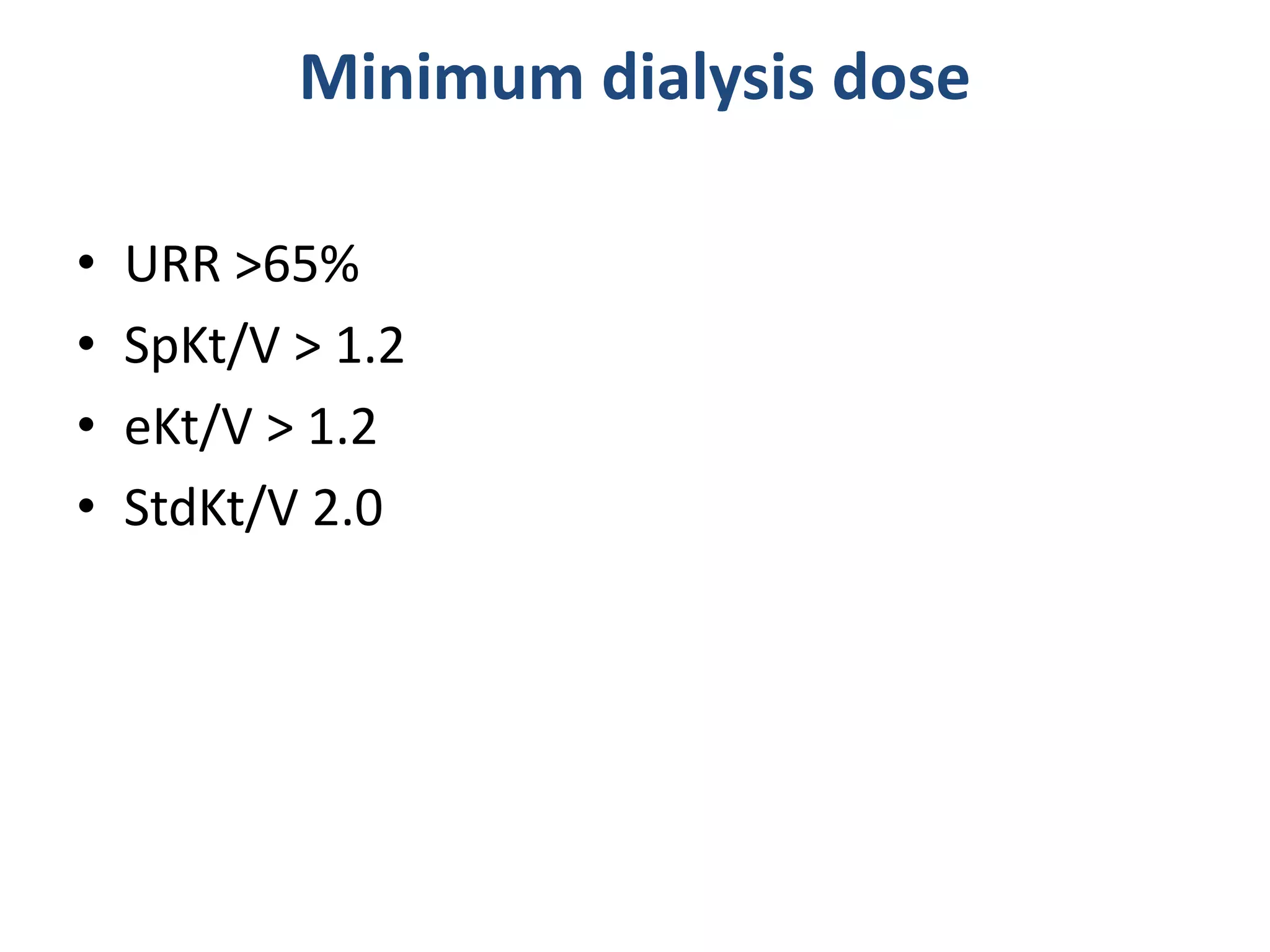
Minimum dialysis dose
• URR >65%
• SpKt/V > 1.2
• eKt/V > 1.2
• StdKt/V 2.0
1. To recommend a target single pool Kt/V (spKt/V) of 1.4
per hemodialysis session for patients treated thrice
weekly, with a minimum delivered spKt/V of 1.2.
2. In patients with significant residual native kidney
function (Kr), the dose of hemodialysis may be
reduced provided Kr is measured periodically.
3. For hemodialysis schedules other than thrice weekly, a
target standard Kt/V of 2.3 volumes per week with a
minimum delivered dose of 2.1 using a method of
calculation that includes the contributions of ultrafiltration
and residual kidney function.
Measurement of Dialysis: Urea Kinetics
Clearance of other molecules:
• ‘ Middle ’ molecule clearance thought to be
important to prevent the long-term complications
of dialysis.
• B2 microglobulin is the most used marker.
• Phosphate clearance is also important and
appears to correlate more with hours of dialysis
than rate of small molecule clearance.
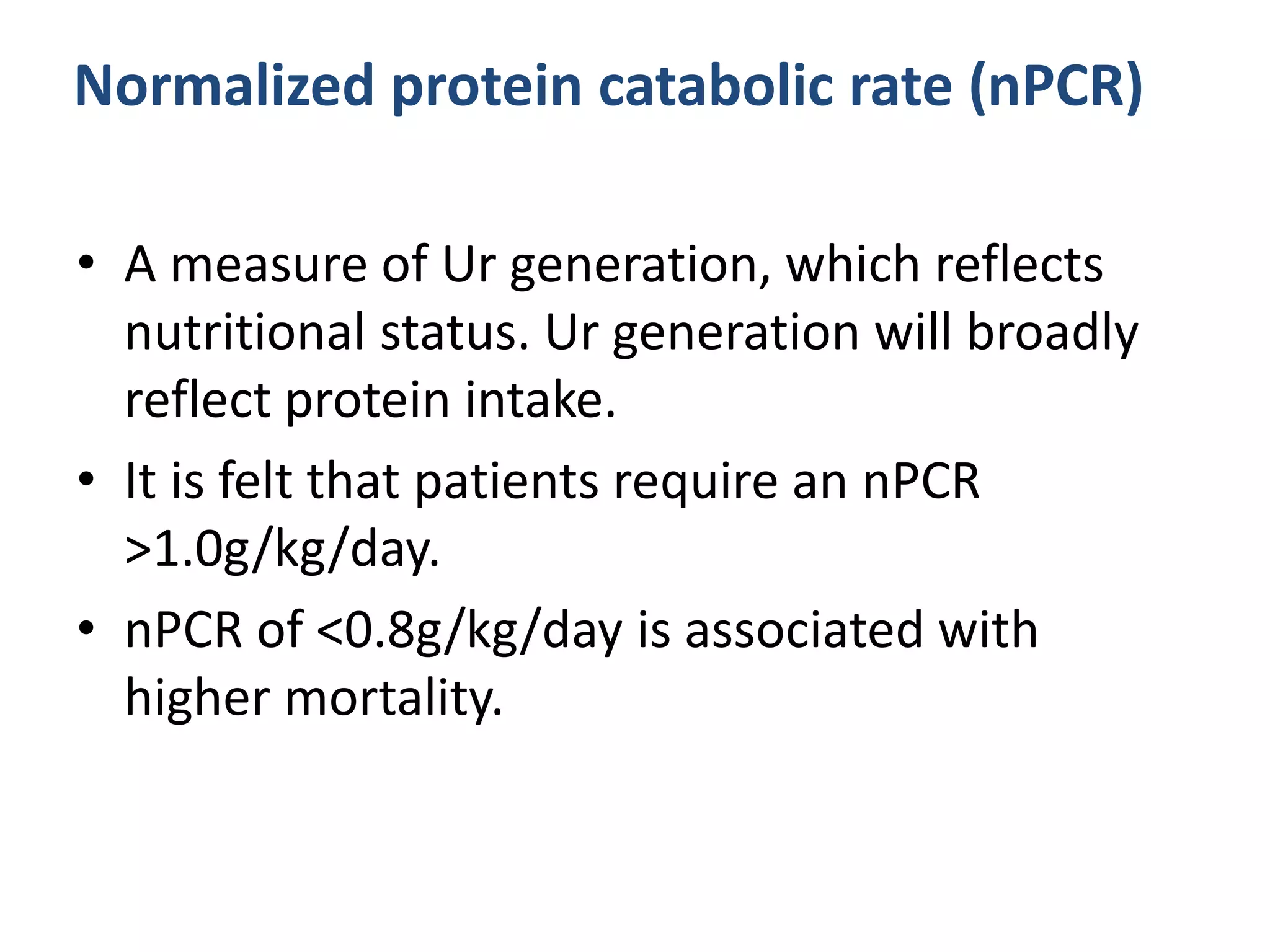
Normalized protein catabolic rate (nPCR)
• A measure of Ur generation, which reflects
nutritional status. Ur generation will broadly
reflect protein intake.
• It is felt that patients require an nPCR
>1.0g/kg/day.
• nPCR of <0.8g/kg/day is associated with
higher mortality.
Nutrition
Targets:
• Serum albumin >35g/L.
• Normalized protein catabolic rate (nPCR)
>1.0g/kg/day.
• Acceptable anthropometric measures.
Residual function
• When HD is first commenced, residual renal
function may contribute greatly to the total
amount of solute clearance (Kru).
• This is usually calculated with a 24h urine
collection.
• Residual function tends to diminish quickly on
HD.
Ensuring adequacy
• Kt/V
a sp Kt/V >1.2 for patients dialysed x 3/week,
equating to a URR of ~65%.
• Residual renal function should always be taken
into account.
Causes of Inadequate Dialysis
• Improper dialysis prescription
• Inadequate blood flow
• Reduction in treatment time
• Dialyzer clotting, leaks
• Recirculation
How to improve clearance?
 Improve vascular access — if flows are poor
or if there is access recirculation, it will be hard
to improve clearances.
 Increase blood flow/larger needles .
 Increase dialyser size — modest impact.
 Increase dialysate flow.
 Increase dialysis time/frequency — major
benefit.
 Consider HDF.
Home Message
Dialysis can be considered adequate if it provides
 relief of uraemic symptoms and
 controls acidosis,
 Control of BP,
 Correction of anemia
 fluid & Electrolyte balance,
 feeling of physical and psychological well-
being
references
• KDOQI Hemodialysis Adequacy-Clinical
Practice Guideline Update 2015: What You
Need to Know by NKF
• Daugirdas dialysis book
• Questionnaire from journals

ADEQUACY OF HEMODIALYSIS

  • 1.
  • 2.
    Definition • Dialysis adequacyis defined as the minimum amount of urea clearance and nutritional intake that prevents adverse outcomes. • Adequacy of dialysis refers to how well we remove toxins and waste products from the patient’s blood, and has a major impact on their well-being
  • 3.
    Aspects of dialysisadequacy • Clinical Control of anaemia, acidosis Control of bone disease. Control of BP Relief of uremic symptoms Quality of life and life expectancy
  • 4.
    • Measurement • Smallsolute clearance (urea kinetic modelling (UKM) • Kt/V • urea reduction ratio (URR)).
  • 5.
    How do weknow if a Patient is Adequately Dialyzed ? • The National Cooperative Dialysis Study (NCDS) established urea kinetic modeling (UKM) as the accepted method of measuring small solute clearance.
  • 6.
    Moleular Weight of60 a marker for small MW uremic toxins Urea removal < ---> other small toxin removal WHY UREA ? The clearance of urea has been selected as the basis for all the calculations of dialysis adequacy
  • 7.
    Urea Clearance Factor •The urea clearance coefficient of the dialyzer • The pre and post treatment blood urea • The treatment time, • The total body water, • The UF, • Residual renal function and • The interdialytic urea generation rate.
  • 8.
    UKM • When calculationsof dialysis adequacy use both urea clearance and patient nutritional status (i.e., urea generation rate), this is called UKM. • It takes into account residual renal function, predicted dialyser clearance, blood and dialysate flow, time on dialysis and fluid removal.
  • 10.
    Measures of dialysisadequacy • URR • spKt/V = single pool • eqKt/V = equilibrated (Double pool) • Std Kt/V = weekly standard
  • 11.
    URR • It iscalculated as follows: [(Pre-dialysis urea – post-dialysis urea)/Pre- dialysis urea] × 100. • Simple • Prediction of mortality Limitation: • Does not account for the contribution of UF to dialysis dose
  • 12.
    Kt/V = fractionalurea clearance K = dialyzer clearance (ml/min or L/hr) t = time (min or hr) V = distribution volume of urea (ml or L) K x t = L/hr x hr = LITERS V = LITERS Kt/V = LITERS/LITERS = ratio What is Kt/V ?
  • 13.
    • K standsfor the dialyzer clearance, the rate at which blood passes through the dialyzer, expressed in milliliters per minute (mL/min) • Kt, the top part of the fraction, is clearance multiplied by time, representing the volume of fluid completely cleared of urea during a single treatment
  • 15.
    spKt/V = singlepool eqKt/V = equilibrated (Double pool) Std Kt/V = weekly standard Kt/V
  • 16.
    • A ureaKt/V value <0.8 was found to be associated with a high likelihood of morbidity and/or treatment failure, while a Kt/V >1.0 was associated with a good outcome • Guidelines have recommended a minimum Kt/V value of at least 1.2 for hemodialysis patients being dialyzed three times per week
  • 17.
    spKt/V • The singlepool Kt/V assumes that, at the end of dialysis, the concentrations of intracellular and extracellular Ur are equal • (Upre, urea pre-dialysis; Upost, urea post-dialysis; UFvol, volume removed on dialysis)
  • 18.
    Single-Pool vs Double-Pool Single-pool •Does not account for urea transfer between fluid compartments • With  dialyzer clearance, urea removed from extracellular compartment can exceed transfer from intracellular compartment • Urea rebound (30-60 min) • So Dialysis dose will be overestimated if this urea pool is large.
  • 21.
    Equilibrated Kt/V • eKt/vis 0.2 units less than single-pool kt/v, but it can be as great 0.6 unit less. • urea rebound is nearly complete in 15 minutes after hemodialysis but may require up to 50- 60 minutes
  • 30.
    Contd. • The degreeof rebound is high in small patient • eKt/V= spKt/V - 0.6 x (spKt/V) / t + 0.03 (for arterial access) • eKt/V= spKt/V - 0.47 x (spKt/V) / t + 0.02 (for venous access)
  • 31.
    STANDARD Kt/V UREA. Theso-called “standard” Kt/V urea grew out of two desires: (1) to come up with a measure of hemodialysis adequacy that was not dependent on number of treatments per week and (2) to have a measure where the minimum dose for hemodialysis would be similar to the minimum dose for peritoneal dialysis.
  • 32.
    Minimum dialysis dose •URR >65% • SpKt/V > 1.2 • eKt/V > 1.2 • StdKt/V 2.0
  • 33.
    1. To recommenda target single pool Kt/V (spKt/V) of 1.4 per hemodialysis session for patients treated thrice weekly, with a minimum delivered spKt/V of 1.2. 2. In patients with significant residual native kidney function (Kr), the dose of hemodialysis may be reduced provided Kr is measured periodically. 3. For hemodialysis schedules other than thrice weekly, a target standard Kt/V of 2.3 volumes per week with a minimum delivered dose of 2.1 using a method of calculation that includes the contributions of ultrafiltration and residual kidney function. Measurement of Dialysis: Urea Kinetics
  • 34.
    Clearance of othermolecules: • ‘ Middle ’ molecule clearance thought to be important to prevent the long-term complications of dialysis. • B2 microglobulin is the most used marker. • Phosphate clearance is also important and appears to correlate more with hours of dialysis than rate of small molecule clearance.
  • 35.
    Normalized protein catabolicrate (nPCR) • A measure of Ur generation, which reflects nutritional status. Ur generation will broadly reflect protein intake. • It is felt that patients require an nPCR >1.0g/kg/day. • nPCR of <0.8g/kg/day is associated with higher mortality.
  • 36.
    Nutrition Targets: • Serum albumin>35g/L. • Normalized protein catabolic rate (nPCR) >1.0g/kg/day. • Acceptable anthropometric measures.
  • 37.
    Residual function • WhenHD is first commenced, residual renal function may contribute greatly to the total amount of solute clearance (Kru). • This is usually calculated with a 24h urine collection. • Residual function tends to diminish quickly on HD.
  • 38.
    Ensuring adequacy • Kt/V asp Kt/V >1.2 for patients dialysed x 3/week, equating to a URR of ~65%. • Residual renal function should always be taken into account.
  • 39.
    Causes of InadequateDialysis • Improper dialysis prescription • Inadequate blood flow • Reduction in treatment time • Dialyzer clotting, leaks • Recirculation
  • 40.
    How to improveclearance?  Improve vascular access — if flows are poor or if there is access recirculation, it will be hard to improve clearances.  Increase blood flow/larger needles .  Increase dialyser size — modest impact.  Increase dialysate flow.  Increase dialysis time/frequency — major benefit.  Consider HDF.
  • 41.
    Home Message Dialysis canbe considered adequate if it provides  relief of uraemic symptoms and  controls acidosis,  Control of BP,  Correction of anemia  fluid & Electrolyte balance,  feeling of physical and psychological well- being
  • 42.
    references • KDOQI HemodialysisAdequacy-Clinical Practice Guideline Update 2015: What You Need to Know by NKF • Daugirdas dialysis book • Questionnaire from journals