Fluid Management in PD
Patients
1
Dina A Abdellatif
Consultant Nephrologist
Kasr El-Ainy Hospital
ISN Fellow
Improving pt lifetime
Access
BP control
Adequacy
Compliance
Nutrition
Fluid control
Infection
QOL
Optimising Treatment2
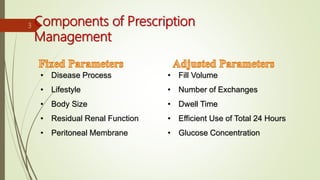
• Disease Process
• Lifestyle
• Body Size
• Residual Renal Function
• Peritoneal Membrane
• Fill Volume
• Number of Exchanges
• Dwell Time
• Efficient Use of Total 24 Hours
• Glucose Concentration
Components of Prescription
Management
3
“First … Do no harm”
Balancing sufficient solute clearance with
avoidance of too much dialysis fluid
exposure
Risks
Membrane injury
Worsening metabolic syndrome / obesity
Cost
Balancing Volume control
Risks
Loss of residual kidney function
Membrane injury
4
How PD works?
Anatomy & Physiology
3 Pore Model
6
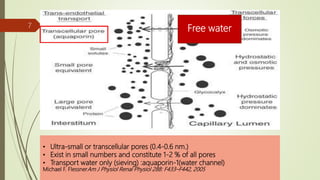
• Ultra-small or transcellular pores (0.4-0.6 nm.)
• Exist in small numbers and constitute 1-2 % of all pores
• Transport water only (sieving) :aquaporin-1(water channel)
Michael F. FlessnerAm J Physiol Renal Physiol 288: F433–F442, 2005
Free water7
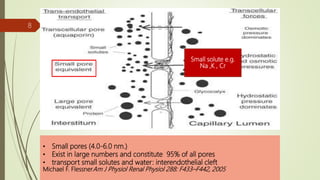
• Small pores (4.0-6.0 nm.)
• Exist in large numbers and constitute 95% of all pores
• transport small solutes and water: interendothelial cleft
Michael F. FlessnerAm J Physiol Renal Physiol 288: F433–F442, 2005
Small solute e.g.
Na ,K , Cr
8
• Large pores (20-24 nm)
• Exist in small numbers and constitute < 3% of all pores
• Transport macromolecules and anatomically large clefts between
endothelial cells : convection
Michael F. FlessnerAm J Physiol Renal Physiol 288: F433–F442, 2005
albumin
9
How PD works?
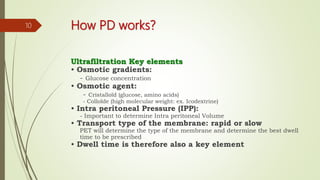
Ultrafiltration Key elements
• Osmotic gradients:
- Glucose concentration
• Osmotic agent:
- Cristalloïd (glucose, amino acids)
- Colloïde (high molecular weight: ex. Icodextrine)
• Intra peritoneal Pressure (IPP):
- Important to determine Intra peritoneal Volume
• Transport type of the membrane: rapid or slow
PET will determine the type of the membrane and determine the best dwell
time to be prescribed
• Dwell time is therefore also a key element
10
1.5 %
Solution
2.5 %
Solution
4.25 %
Solution
Osmotic Pressure of Dextrose Solution
PLoS One. 2018 Aug 13;13(8):
doi: 10.1371/journal.pone.0202203.
Initial Prescription13
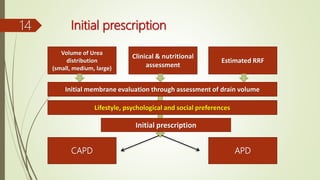
Initial prescription14
Volume of Urea
distribution
(small, medium, large)
Clinical & nutritional
assessment
Estimated RRF
Initial membrane evaluation through assessment of drain volume
Lifestyle, psychological and social preferences
Initial prescription
APDCAPD
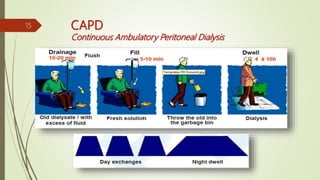
CAPD
Continuous Ambulatory Peritoneal Dialysis
15
CCPD – APD
Continuous Cycling Peritoneal Dialysis
16
Adequacy17
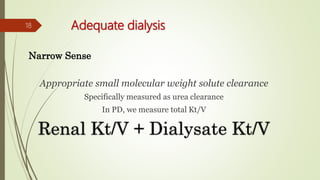
Adequate dialysis
Narrow Sense
Appropriate small molecular weight solute clearance
Specifically measured as urea clearance
In PD, we measure total Kt/V
Renal Kt/V + Dialysate Kt/V
18
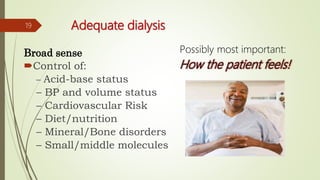
Adequate dialysis
Broad sense
Control of:
– Acid-base status
– BP and volume status
– Cardiovascular Risk
– Diet/nutrition
– Mineral/Bone disorders
– Small/middle molecules
19
Possibly most important:
How the patient feels!
20
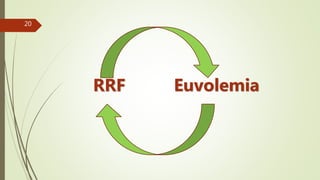
RRF Euvolemia
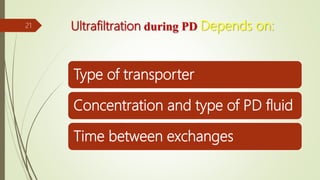
Ultrafiltration during PD Depends on:
Type of transporter
Concentration and type of PD fluid
Time between exchanges
21
Copyrights apply
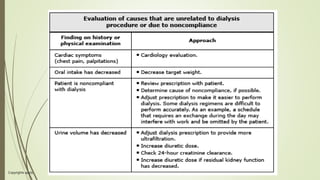
Treatment
Sodium and fluid restriction — We review the
sodium restriction of <2 grams/day. We restrict
fluids to approximately 2 L/day.
Loop diuretics — We treat all patients who have
residual renal function with diuretics. We increase
the dose in patients who develop hypervolemia.
Combination therapy with furosemide and a
thiazide diuretic (eg, metolazone) may also be
effective.
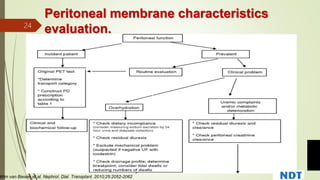
Wim van Biesen et al. Nephrol. Dial. Transplant. 2010;25:2052-2062
Peritoneal membrane characteristics
evaluation.24
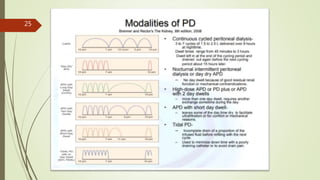
25
Peritoneal Membrane types26
Membrane Types
“High”
solute
transport
“High
Average”
solute
transport
“Low
Average”
solute
transport
“Low”
solute
transport
27
Peritoneal
Equilibration Test
(PET) done to arrive at
membrane
classification
28
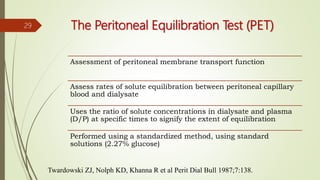
Twardowski ZJ, Nolph KD, Khanna R et al Perit Dial Bull 1987;7:138.
The Peritoneal Equilibration Test (PET)
Assessment of peritoneal membrane transport function
Assess rates of solute equilibration between peritoneal capillary
blood and dialysate
Uses the ratio of solute concentrations in dialysate and plasma
(D/P) at specific times to signify the extent of equilibration

Performed using a standardized method, using standard
solutions (2.27% glucose)
29
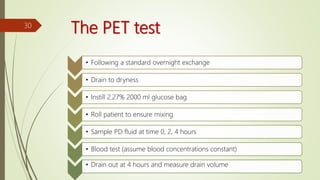
The PET test
• Following a standard overnight exchange
• Drain to dryness
• Instill 2.27% 2000 ml glucose bag
• Roll patient to ensure mixing
• Sample PD fluid at time 0, 2, 4 hours
• Blood test (assume blood concentrations constant)
• Drain out at 4 hours and measure drain volume
30
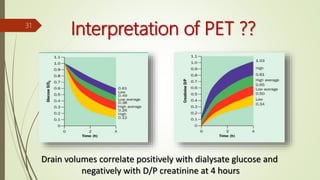
Interpretation of PET ??31
Drain volumes correlate positively with dialysate glucose and
negatively with D/P creatinine at 4 hours
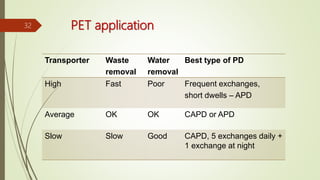
PET application
Transporter Waste
removal
Water
removal
Best type of PD
High Fast Poor Frequent exchanges,
short dwells – APD
Average OK OK CAPD or APD
Slow Slow Good CAPD, 5 exchanges daily +
1 exchange at night
32
Initiate Therapy
Measure Clearances
Adjust Therapy
35
Prescription Modification36
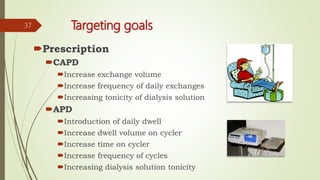
Targeting goals
Prescription
CAPD
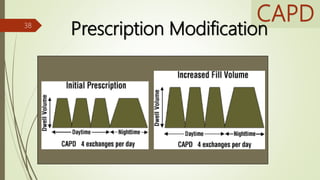
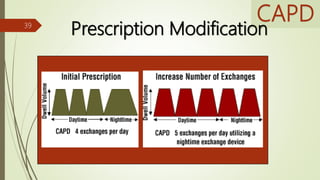
Increase exchange volume
Increase frequency of daily exchanges
Increasing tonicity of dialysis solution
APD
Introduction of daily dwell
Increase dwell volume on cycler
Increase time on cycler
Increase frequency of cycles
Increasing dialysis solution tonicity
37
CAPD
Prescription Modification38
CAPD
Prescription Modification39
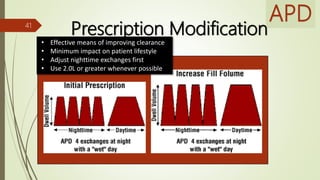
APD Prescription Modification40
APD
Prescription Modification41
• Effective means of improving clearance
• Minimum impact on patient lifestyle
• Adjust nighttime exchanges first
• Use 2.0L or greater whenever possible
APD
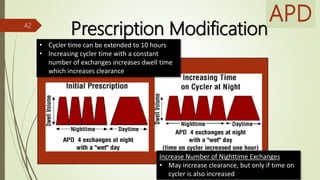
Prescription Modification42
• Cycler time can be extended to 10 hours
• Increasing cycler time with a constant
number of exchanges increases dwell time
which increases clearance
Increase Number of Nighttime Exchanges
• May increase clearance, but only if time on
cycler is also increased
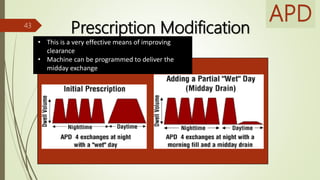
Prescription Modification43
• This is a very effective means of improving
clearance
• Machine can be programmed to deliver the
midday exchange
APD
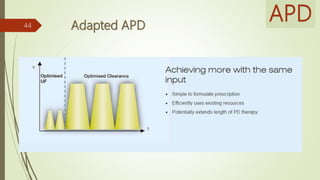
Adapted APD44
APD
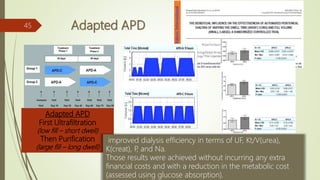
Adapted APD45
Adapted APD
First Ultrafiltration
(low fill – short dwell)
Then Purification
(large fill – long dwell)
improved dialysis efficiency in terms of UF, Kt/V(urea),
K(creat), P, and Na.
Those results were achieved without incurring any extra
financial costs and with a reduction in the metabolic cost
(assessed using glucose absorption).
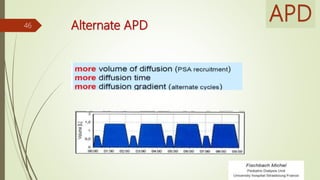
Alternate APD46
APD
Targeting goals
Prescription pitfalls in PD
Loss of residual renal function
Non compliance
Prescription with “dry” time
Inappropriate switch from CAPD to APD
Inadequate attention to fluid removal
47
Extra Measures
Resting the peritoneum – We
occasionally temporarily switch to
maintenance hemodialysis via a
temporary central venous catheter in
order to rest the peritoneum
Clinical Practice Guidelines of the Canadian Society of Nephrology for treatments of Patients with CRF
JASN 10: S287-S321, 1999
Monitoring frequency
KT/V and Ccl:
Within 6-8 weeks after commencing dialysis
Every subsequent 6 month
If patients clinical status changes unexpectedly,
or if prescription is altered, take supplemental
clearance measurements
PET
Within 6 weeks of initiating PD
Repeat if unexpected changes in peritoneal UF
occur
49
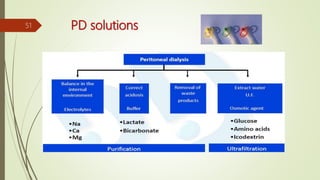
PD solutions50
PD solutions51
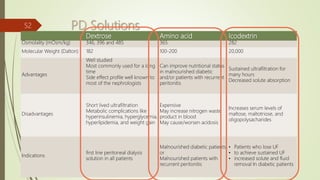
Dextrose Amino acid Icodextrin
Osmolality (mOsm/kg) 346, 396 and 485 365 282
Molecular Weight (Dalton) 182 100-200 20,000
Advantages
Well studied
Most commonly used for a long
time
Side effect profile well known to
most of the nephrologists
Can improve nutritional status
in malnourished diabetic
and/or patients with recurrent
peritonitis
Sustained ultrafiltration for
many hours
Decreased solute absorption
Disadvantages
Short lived ultrafiltration
Metabolic complications like
hyperinsulinemia, hyperglycemia,
hyperlipidemia, and weight gain
Expensive
May increase nitrogen waste
product in blood
May cause/worsen acidosis
Increases serum levels of
maltose, maltotriose, and
oligopolysacharides
Indications
first line peritoneal dialysis
solution in all patients
Malnourished diabetic patients
or
Malnourished patients with
recurrent peritonitis
• Patients who lose UF
• to achieve sustained UF
• increased solute and fluid
removal In diabetic patients
PD Solutions52
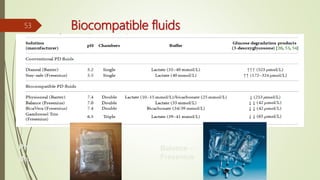
Biocompatible fluids
Physioneal –
Baxter
53
Balance –
Fresenius
54
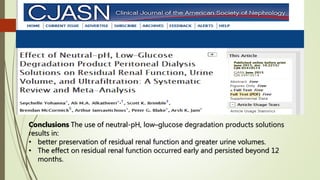
Conclusions The use of neutral-pH, low–glucose degradation products solutions
results in:
• better preservation of residual renal function and greater urine volumes.
• The effect on residual renal function occurred early and persisted beyond 12
months.
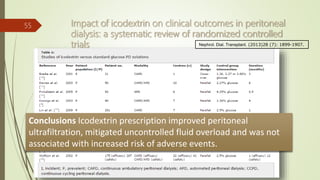
Impact of icodextrin on clinical outcomes in peritoneal
dialysis: a systematic review of randomized controlled
trials
55
Conclusions Icodextrin prescription improved peritoneal
ultrafiltration, mitigated uncontrolled fluid overload and was not
associated with increased risk of adverse events.
Nephrol. Dial. Transplant. (2013)28 (7): 1899-1907.
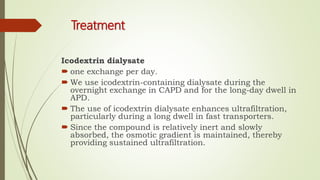
Treatment
Icodextrin dialysate
 one exchange per day.
 We use icodextrin-containing dialysate during the
overnight exchange in CAPD and for the long-day dwell in
APD.
 The use of icodextrin dialysate enhances ultrafiltration,
particularly during a long dwell in fast transporters.
 Since the compound is relatively inert and slowly
absorbed, the osmotic gradient is maintained, thereby
providing sustained ultrafiltration.
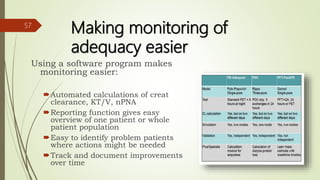
Making monitoring of
adequacy easier
Using a software program makes
monitoring easier:
Automated calculations of creat
clearance, KT/V, nPNA
Reporting function gives easy
overview of one patient or whole
patient population
Easy to identify problem patients
where actions might be needed
Track and document improvements
over time
57
Copyrights apply
58
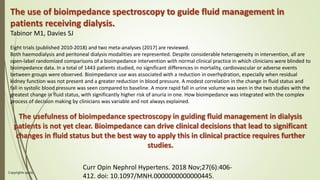
The use of bioimpedance spectroscopy to guide fluid management in
patients receiving dialysis.
Tabinor M1, Davies SJ
Eight trials (published 2010-2018) and two meta-analyses (2017) are reviewed.
Both haemodialysis and peritoneal dialysis modalities are represented. Despite considerable heterogeneity in intervention, all are
open-label randomized comparisons of a bioimpedance intervention with normal clinical practice in which clinicians were blinded to
bioimpedance data. In a total of 1443 patients studied, no significant differences in mortality, cardiovascular or adverse events
between groups were observed. Bioimpedance use was associated with a reduction in overhydration, especially when residual
kidney function was not present and a greater reduction in blood pressure. A modest correlation in the change in fluid status and
fall in systolic blood pressure was seen compared to baseline. A more rapid fall in urine volume was seen in the two studies with the
greatest change in fluid status, with significantly higher risk of anuria in one. How bioimpedance was integrated with the complex
process of decision making by clinicians was variable and not always explained.
The usefulness of bioimpedance spectroscopy in guiding fluid management in dialysis
patients is not yet clear. Bioimpedance can drive clinical decisions that lead to significant
changes in fluid status but the best way to apply this in clinical practice requires further
studies.
Curr Opin Nephrol Hypertens. 2018 Nov;27(6):406-
412. doi: 10.1097/MNH.0000000000000445.
Guidelines59
60
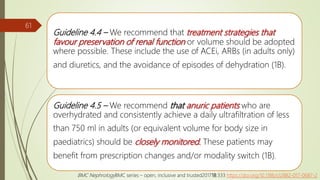
Guideline 4.4 – We recommend that treatment strategies that
favour preservation of renal function or volume should be adopted
where possible. These include the use of ACEi, ARBs (in adults only)
and diuretics, and the avoidance of episodes of dehydration (1B).
Guideline 4.5 – We recommend that anuric patients who are
overhydrated and consistently achieve a daily ultrafiltration of less
than 750 ml in adults (or equivalent volume for body size in
paediatrics) should be closely monitored. These patients may
benefit from prescription changes and/or modality switch (1B).
61
BMC NephrologyBMC series – open, inclusive and trusted201718:333 https://doi.org/10.1186/s12882-017-0687-2
Take home message62
Copyrights apply
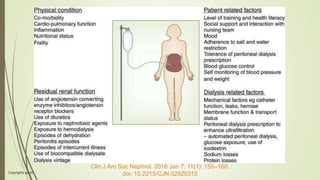
Clin J Am Soc Nephrol. 2016 Jan 7; 11(1): 155–160.
doi: 10.2215/CJN.02920315
64

Fluid management in pd patient

  • 1.
    Fluid Management inPD Patients 1 Dina A Abdellatif Consultant Nephrologist Kasr El-Ainy Hospital ISN Fellow
  • 2.
    Improving pt lifetime Access BPcontrol Adequacy Compliance Nutrition Fluid control Infection QOL Optimising Treatment2
  • 3.
    • Disease Process •Lifestyle • Body Size • Residual Renal Function • Peritoneal Membrane • Fill Volume • Number of Exchanges • Dwell Time • Efficient Use of Total 24 Hours • Glucose Concentration Components of Prescription Management 3
  • 4.
    “First … Dono harm” Balancing sufficient solute clearance with avoidance of too much dialysis fluid exposure Risks Membrane injury Worsening metabolic syndrome / obesity Cost Balancing Volume control Risks Loss of residual kidney function Membrane injury 4
  • 5.
  • 6.
  • 7.
    • Ultra-small ortranscellular pores (0.4-0.6 nm.) • Exist in small numbers and constitute 1-2 % of all pores • Transport water only (sieving) :aquaporin-1(water channel) Michael F. FlessnerAm J Physiol Renal Physiol 288: F433–F442, 2005 Free water7
  • 8.
    • Small pores(4.0-6.0 nm.) • Exist in large numbers and constitute 95% of all pores • transport small solutes and water: interendothelial cleft Michael F. FlessnerAm J Physiol Renal Physiol 288: F433–F442, 2005 Small solute e.g. Na ,K , Cr 8
  • 9.
    • Large pores(20-24 nm) • Exist in small numbers and constitute < 3% of all pores • Transport macromolecules and anatomically large clefts between endothelial cells : convection Michael F. FlessnerAm J Physiol Renal Physiol 288: F433–F442, 2005 albumin 9
  • 10.
    How PD works? UltrafiltrationKey elements • Osmotic gradients: - Glucose concentration • Osmotic agent: - Cristalloïd (glucose, amino acids) - Colloïde (high molecular weight: ex. Icodextrine) • Intra peritoneal Pressure (IPP): - Important to determine Intra peritoneal Volume • Transport type of the membrane: rapid or slow PET will determine the type of the membrane and determine the best dwell time to be prescribed • Dwell time is therefore also a key element 10
  • 11.
    1.5 % Solution 2.5 % Solution 4.25% Solution Osmotic Pressure of Dextrose Solution
  • 12.
    PLoS One. 2018Aug 13;13(8): doi: 10.1371/journal.pone.0202203.
  • 13.
  • 14.
    Initial prescription14 Volume ofUrea distribution (small, medium, large) Clinical & nutritional assessment Estimated RRF Initial membrane evaluation through assessment of drain volume Lifestyle, psychological and social preferences Initial prescription APDCAPD
  • 15.
  • 16.
    CCPD – APD ContinuousCycling Peritoneal Dialysis 16
  • 17.
  • 18.
    Adequate dialysis Narrow Sense Appropriatesmall molecular weight solute clearance Specifically measured as urea clearance In PD, we measure total Kt/V Renal Kt/V + Dialysate Kt/V 18
  • 19.
    Adequate dialysis Broad sense Controlof: – Acid-base status – BP and volume status – Cardiovascular Risk – Diet/nutrition – Mineral/Bone disorders – Small/middle molecules 19 Possibly most important: How the patient feels!
  • 20.
  • 21.
    Ultrafiltration during PDDepends on: Type of transporter Concentration and type of PD fluid Time between exchanges 21
  • 22.
  • 23.
    Treatment Sodium and fluidrestriction — We review the sodium restriction of <2 grams/day. We restrict fluids to approximately 2 L/day. Loop diuretics — We treat all patients who have residual renal function with diuretics. We increase the dose in patients who develop hypervolemia. Combination therapy with furosemide and a thiazide diuretic (eg, metolazone) may also be effective.
  • 24.
    Wim van Biesenet al. Nephrol. Dial. Transplant. 2010;25:2052-2062 Peritoneal membrane characteristics evaluation.24
  • 25.
  • 26.
  • 27.
  • 28.
    Peritoneal Equilibration Test (PET) doneto arrive at membrane classification 28
  • 29.
    Twardowski ZJ, NolphKD, Khanna R et al Perit Dial Bull 1987;7:138. The Peritoneal Equilibration Test (PET) Assessment of peritoneal membrane transport function Assess rates of solute equilibration between peritoneal capillary blood and dialysate Uses the ratio of solute concentrations in dialysate and plasma (D/P) at specific times to signify the extent of equilibration Performed using a standardized method, using standard solutions (2.27% glucose) 29
  • 30.
    The PET test •Following a standard overnight exchange • Drain to dryness • Instill 2.27% 2000 ml glucose bag • Roll patient to ensure mixing • Sample PD fluid at time 0, 2, 4 hours • Blood test (assume blood concentrations constant) • Drain out at 4 hours and measure drain volume 30
  • 31.
    Interpretation of PET??31 Drain volumes correlate positively with dialysate glucose and negatively with D/P creatinine at 4 hours
  • 32.
    PET application Transporter Waste removal Water removal Besttype of PD High Fast Poor Frequent exchanges, short dwells – APD Average OK OK CAPD or APD Slow Slow Good CAPD, 5 exchanges daily + 1 exchange at night 32
  • 33.
  • 34.
  • 35.
    Targeting goals Prescription CAPD Increase exchangevolume Increase frequency of daily exchanges Increasing tonicity of dialysis solution APD Introduction of daily dwell Increase dwell volume on cycler Increase time on cycler Increase frequency of cycles Increasing dialysis solution tonicity 37

  • 36.
  • 37.
  • 38.
  • 39.
    APD Prescription Modification41 • Effectivemeans of improving clearance • Minimum impact on patient lifestyle • Adjust nighttime exchanges first • Use 2.0L or greater whenever possible
  • 40.
    APD Prescription Modification42 • Cyclertime can be extended to 10 hours • Increasing cycler time with a constant number of exchanges increases dwell time which increases clearance Increase Number of Nighttime Exchanges • May increase clearance, but only if time on cycler is also increased
  • 41.
    Prescription Modification43 • Thisis a very effective means of improving clearance • Machine can be programmed to deliver the midday exchange APD
  • 42.
  • 43.
    Adapted APD45 Adapted APD FirstUltrafiltration (low fill – short dwell) Then Purification (large fill – long dwell) improved dialysis efficiency in terms of UF, Kt/V(urea), K(creat), P, and Na. Those results were achieved without incurring any extra financial costs and with a reduction in the metabolic cost (assessed using glucose absorption).
  • 44.
  • 45.
    Targeting goals Prescription pitfallsin PD Loss of residual renal function Non compliance Prescription with “dry” time Inappropriate switch from CAPD to APD Inadequate attention to fluid removal 47
  • 46.
    Extra Measures Resting theperitoneum – We occasionally temporarily switch to maintenance hemodialysis via a temporary central venous catheter in order to rest the peritoneum
  • 47.
    Clinical Practice Guidelinesof the Canadian Society of Nephrology for treatments of Patients with CRF JASN 10: S287-S321, 1999 Monitoring frequency KT/V and Ccl: Within 6-8 weeks after commencing dialysis Every subsequent 6 month If patients clinical status changes unexpectedly, or if prescription is altered, take supplemental clearance measurements PET Within 6 weeks of initiating PD Repeat if unexpected changes in peritoneal UF occur 49
  • 48.
  • 49.
  • 50.
    Dextrose Amino acidIcodextrin Osmolality (mOsm/kg) 346, 396 and 485 365 282 Molecular Weight (Dalton) 182 100-200 20,000 Advantages Well studied Most commonly used for a long time Side effect profile well known to most of the nephrologists Can improve nutritional status in malnourished diabetic and/or patients with recurrent peritonitis Sustained ultrafiltration for many hours Decreased solute absorption Disadvantages Short lived ultrafiltration Metabolic complications like hyperinsulinemia, hyperglycemia, hyperlipidemia, and weight gain Expensive May increase nitrogen waste product in blood May cause/worsen acidosis Increases serum levels of maltose, maltotriose, and oligopolysacharides Indications first line peritoneal dialysis solution in all patients Malnourished diabetic patients or Malnourished patients with recurrent peritonitis • Patients who lose UF • to achieve sustained UF • increased solute and fluid removal In diabetic patients PD Solutions52
  • 51.
  • 52.
    54 Conclusions The useof neutral-pH, low–glucose degradation products solutions results in: • better preservation of residual renal function and greater urine volumes. • The effect on residual renal function occurred early and persisted beyond 12 months.
  • 53.
    Impact of icodextrinon clinical outcomes in peritoneal dialysis: a systematic review of randomized controlled trials 55 Conclusions Icodextrin prescription improved peritoneal ultrafiltration, mitigated uncontrolled fluid overload and was not associated with increased risk of adverse events. Nephrol. Dial. Transplant. (2013)28 (7): 1899-1907.
  • 54.
    Treatment Icodextrin dialysate  oneexchange per day.  We use icodextrin-containing dialysate during the overnight exchange in CAPD and for the long-day dwell in APD.  The use of icodextrin dialysate enhances ultrafiltration, particularly during a long dwell in fast transporters.  Since the compound is relatively inert and slowly absorbed, the osmotic gradient is maintained, thereby providing sustained ultrafiltration.
  • 55.
    Making monitoring of adequacyeasier Using a software program makes monitoring easier: Automated calculations of creat clearance, KT/V, nPNA Reporting function gives easy overview of one patient or whole patient population Easy to identify problem patients where actions might be needed Track and document improvements over time 57
  • 56.
    Copyrights apply 58 The useof bioimpedance spectroscopy to guide fluid management in patients receiving dialysis. Tabinor M1, Davies SJ Eight trials (published 2010-2018) and two meta-analyses (2017) are reviewed. Both haemodialysis and peritoneal dialysis modalities are represented. Despite considerable heterogeneity in intervention, all are open-label randomized comparisons of a bioimpedance intervention with normal clinical practice in which clinicians were blinded to bioimpedance data. In a total of 1443 patients studied, no significant differences in mortality, cardiovascular or adverse events between groups were observed. Bioimpedance use was associated with a reduction in overhydration, especially when residual kidney function was not present and a greater reduction in blood pressure. A modest correlation in the change in fluid status and fall in systolic blood pressure was seen compared to baseline. A more rapid fall in urine volume was seen in the two studies with the greatest change in fluid status, with significantly higher risk of anuria in one. How bioimpedance was integrated with the complex process of decision making by clinicians was variable and not always explained. The usefulness of bioimpedance spectroscopy in guiding fluid management in dialysis patients is not yet clear. Bioimpedance can drive clinical decisions that lead to significant changes in fluid status but the best way to apply this in clinical practice requires further studies. Curr Opin Nephrol Hypertens. 2018 Nov;27(6):406- 412. doi: 10.1097/MNH.0000000000000445.
  • 57.
  • 58.
  • 59.
    Guideline 4.4 –We recommend that treatment strategies that favour preservation of renal function or volume should be adopted where possible. These include the use of ACEi, ARBs (in adults only) and diuretics, and the avoidance of episodes of dehydration (1B). Guideline 4.5 – We recommend that anuric patients who are overhydrated and consistently achieve a daily ultrafiltration of less than 750 ml in adults (or equivalent volume for body size in paediatrics) should be closely monitored. These patients may benefit from prescription changes and/or modality switch (1B). 61 BMC NephrologyBMC series – open, inclusive and trusted201718:333 https://doi.org/10.1186/s12882-017-0687-2
  • 60.
  • 61.
    Copyrights apply Clin JAm Soc Nephrol. 2016 Jan 7; 11(1): 155–160. doi: 10.2215/CJN.02920315
  • 62.