New Mansoura General Hospital
Nephrology Department
Mohamed Abd Allah
Nephrology Specialist -NMGH
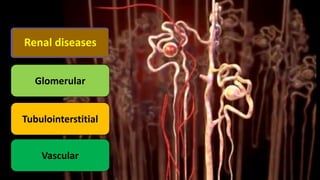
Glomerular
Tubulointerstitial
Vascular
Renal diseases
A Pattern of renal injury usually characterized by :
• Clinically; Abrupt deterioration in renal function
• Triad of fever ,esinophilia and skin rash.
• Histopathological; inflammation & oedema of interstitium, tubular
atrophy. .
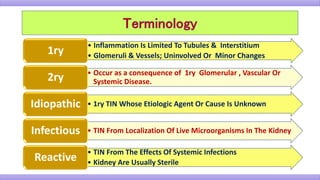
• Inflammation Is Limited To Tubules & Interstitium
• Glomeruli & Vessels; Uninvolved Or Minor Changes1ry
• Occur as a consequence of 1ry Glomerular , Vascular Or
Systemic Disease.2ry
• 1ry TIN Whose Etiologic Agent Or Cause Is UnknownIdiopathic
• TIN From Localization Of Live Microorganisms In The KidneyInfectious
• TIN From The Effects Of Systemic Infections
• Kidney Are Usually Sterile
Reactive
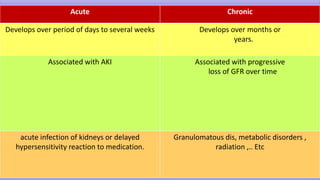
Acute Chronic
Develops over period of days to several weeks Develops over months or
years.
Associated with AKI Associated with progressive
loss of GFR over time
acute infection of kidneys or delayed
hypersensitivity reaction to medication.
Granulomatous dis, metabolic disorders ,
radiation ,.. Etc
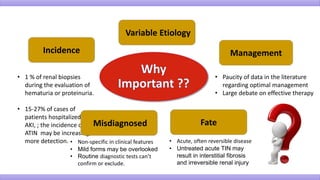
Incidence
• 1 % of renal biopsies
during the evaluation of
hematuria or proteinuria.
• 15-27% of cases of
patients hospitalized for
AKI, ; the incidence of
ATIN may be increasing;
more detection.
Misdiagnosed
• Non-specific in clinical features
• Mild forms may be overlooked
• Routine diagnostic tests can’t
confirm or exclude.
Variable Etiology
Management
• Paucity of data in the literature
regarding optimal management
• Large debate on effective therapy
Fate
• Acute, often reversible disease
• Untreated acute TIN may
result in interstitial fibrosis
and irreversible renal injury
Causes
Pathogenesis
Diagnosis
Management
Prognosis
Special issues
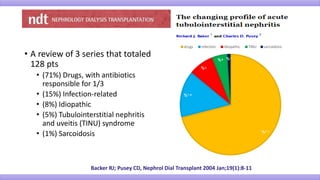
• A review of 3 series that totaled
128 pts
• (71%) Drugs, with antibiotics
responsible for 1/3
• (15%) Infection-related
• (8%) Idiopathic
• (5%) Tubulointerstitial nephritis
and uveitis (TINU) syndrome
• (1%) Sarcoidosis
Backer RJ; Pusey CD, Nephrol Dial Transplant 2004 Jan;19(1):8-11
71%
15%
8%
5% 1%
drugs infection idiopathic TINU sarcoidosis
Causes
Pathogenesis
Diagnosis
Management
Prognosis
Special issues
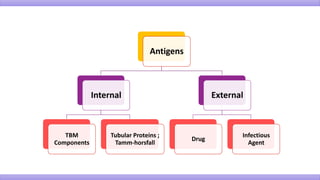
Antigens
Internal
TBM
Components
Tubular Proteins ;
Tamm-horsfall
External
Drug
Infectious
Agent
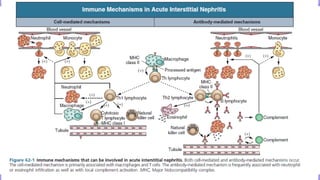
• Drug-induced AIN is secondary to immune reaction
• AIN occurs only in a small percentage of individuals taking the drug
• AIN is not dose-dependent
• Association with extrarenal manifestations of hypersensitivity
• Recurrence after re-exposure to the drug
Causes
Pathogenesis
Diagnosis
Management
Prognosis
Special issues
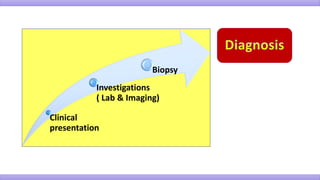
Clinical
presentation
Investigations
( Lab & Imaging)
Biopsy
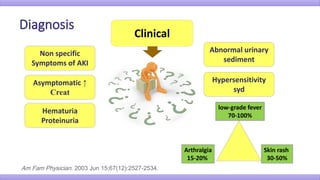
Clinical
Non specific
Symptoms of AKI
Asymptomatic ↑
Creat
Abnormal urinary
sediment
Hypersensitivity
syd
low-grade fever
70-100%
Skin rash
30-50%
Arthralgia
15-20%
Am Fam Physician. 2003 Jun 15;67(12):2527-2534.
Hematuria
Proteinuria
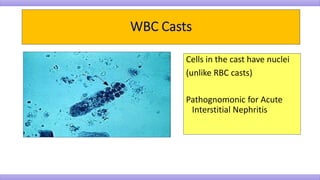
Cells in the cast have nuclei
(unlike RBC casts)
Pathognomonic for Acute
Interstitial Nephritis
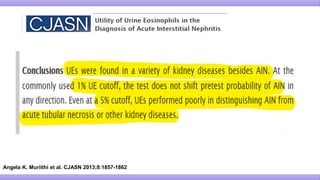
Angela K. Muriithi et al. CJASN 2013;8:1857-1862
Imaging
Contrib Nephrol. Basel, Karger, 2016, 188; 39–47
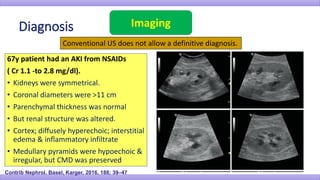
Conventional US does not allow a definitive diagnosis.
67y patient had an AKI from NSAIDs
( Cr 1.1 -to 2.8 mg/dl).
• Kidneys were symmetrical.
• Coronal diameters were >11 cm
• Parenchymal thickness was normal
• But renal structure was altered.
• Cortex; diffusely hyperechoic; interstitial
edema & inflammatory infiltrate
• Medullary pyramids were hypoechoic &
irregular, but CMD was preserved
• Doppler wave showed a high
difference between systolic and
diastolic phase, because of the
decrease of diastolic flow.
Imaging
Conventional Doppler US does not allow a definitive diagnosis.
• Hemodynamic variations are
commonly related to severity
and progression of the
anatomical damage.
• RIs are commonly <0.70.
Contrib Nephrol. Basel, Karger, 2016, 188; 39–47
The gold standard method for
diagnosis
Done for ALL suspected
patients ??
Biopsy
Done for ALL suspected
patients ??
• Probable precipitating
drug can be withdrawn
• Improve readily after
withdrawal of an
offending drug
• Supportive management
can proceed safely with
good outcome
• Not improve after
withdrawal of likely
precipitating drugs
• No contraindications to
renal biopsy
• No refusal to procedure
• Considered for steroid
therapy
Biopsy
Biopsy
LM
• Interstitium: edema & lymphocytic infiltration, non-necrotizing
granulomas, fibrosis is initially sparse, but develops later in the
course of the illness.
• Vessles normal
• Glomeruli: normal , GN may has TIN as complication , MC with
NSAIDs, Necrotizing GN or vasculitis is commonly associated
with AIN that, in limited samples with no glomeruli, may be
mistaken as AIN.
• Tubules: Variable tubulitis with associated acute tubular injury
Am J Kidney Dis. 2016;67(6):e35-e36
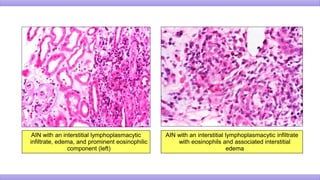
AIN with an interstitial lymphoplasmacytic
infiltrate, edema, and prominent eosinophilic
component (left)
AIN with an interstitial lymphoplasmacytic infiltrate
with eosinophils and associated interstitial
edema
Biopsy
LM
IF
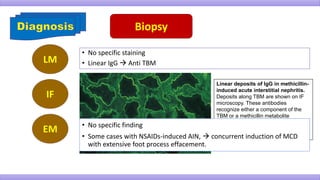
• No specific staining
• Linear IgG  Anti TBM
Linear deposits of IgG in methicillin-
induced acute interstitial nephritis.
Deposits along TBM are shown on IF
microscopy. These antibodies
recognize either a component of the
TBM or a methicillin metabolite
(dimethoxyphenylpenicilloyl) bound to
the TBM. (Courtesy Dr. B Mougenot,
Paris VI University, Paris.)
EM • No specific finding
• Some cases with NSAIDs-induced AIN,  concurrent induction of MCD
with extensive foot process effacement.
Causes
Pathogenesis
Diagnosis
Management
Prognosis
Special issues
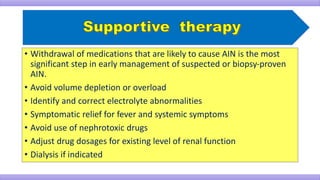
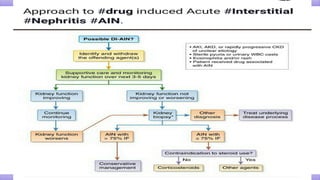
• Withdrawal of medications that are likely to cause AIN is the most
significant step in early management of suspected or biopsy-proven
AIN.
• Avoid volume depletion or overload
• Identify and correct electrolyte abnormalities
• Symptomatic relief for fever and systemic symptoms
• Avoid use of nephrotoxic drugs
• Adjust drug dosages for existing level of renal function
• Dialysis if indicated
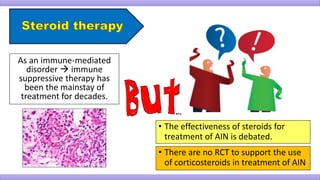
As an immune-mediated
disorder  immune
suppressive therapy has
been the mainstay of
treatment for decades.
• The effectiveness of steroids for
treatment of AIN is debated.
• There are no RCT to support the use
of corticosteroids in treatment of AIN
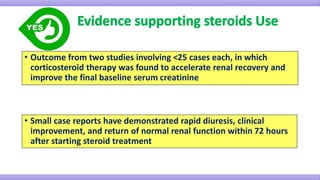
• Outcome from two studies involving <25 cases each, in which
corticosteroid therapy was found to accelerate renal recovery and
improve the final baseline serum creatinine
• Small case reports have demonstrated rapid diuresis, clinical
improvement, and return of normal renal function within 72 hours
after starting steroid treatment
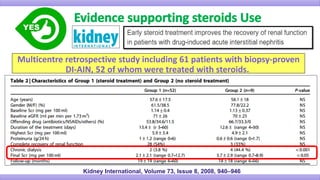
Multicentre retrospective study including 61 patients with biopsy-proven
DI-AIN, 52 of whom were treated with steroids.
Kidney International, Volume 73, Issue 8, 2008, 940–946
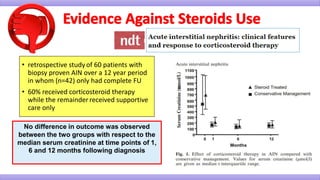
• retrospective study of 60 patients with
biopsy proven AIN over a 12 year period
in whom (n=42) only had complete FU
• 60% received corticosteroid therapy
while the remainder received supportive
care only
No difference in outcome was observed
between the two groups with respect to the
median serum creatinine at time points of 1,
6 and 12 months following diagnosis
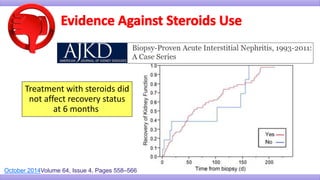
Treatment with steroids did
not affect recovery status
at 6 months
October 2014Volume 64, Issue 4, Pages 558–566
• Guided by the clinical course following
withdrawal of offending medications &
delayed recovery of renal function
• A reasonable dosage is prednisone, 1
mg per kg per day orally (or equivalent
intravenous dose) for two to three
weeks followed by a gradually tapering
dose over three to four weeks.
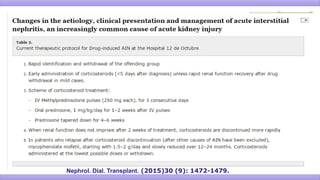
Nephrol. Dial. Transplant. (2015)30 (9): 1472-1479.
Causes
Pathogenesis
Diagnosis
Management
Prognosis
Special issues
Nephrol. Dial. Transplant. (2004)19 (11): 2778-2783.
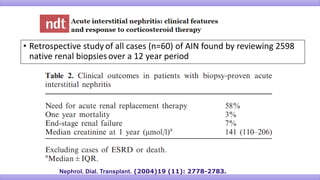
• Retrospective study of all cases (n=60) of AIN found by reviewing 2598
native renal biopsiesover a 12 year period
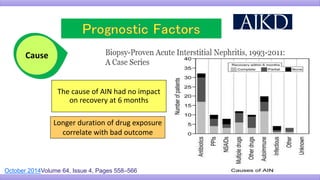
Cause
The cause of AIN had no impact
on recovery at 6 months
October 2014Volume 64, Issue 4, Pages 558–566
Longer duration of drug exposure
correlate with bad outcome
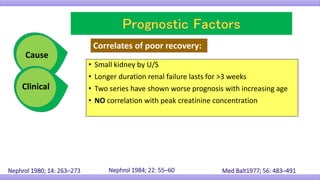
• Small kidney by U/S
• Longer duration renal failure lasts for >3 weeks
• Two series have shown worse prognosis with increasing age
• NO correlation with peak creatinine concentration
Correlates of poor recovery:
Med Balt1977; 56: 483–491Nephrol 1984; 22: 55–60Nephrol 1980; 14: 263–273
Cause
Clinical
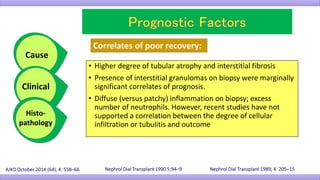
• Higher degree of tubular atrophy and interstitial fibrosis
• Presence of interstitial granulomas on biopsy were marginally
significant correlates of prognosis.
• Diffuse (versus patchy) inflammation on biopsy; excess
number of neutrophils. However, recent studies have not
supported a correlation between the degree of cellular
infiltration or tubulitis and outcome
AJKD October 2014 (64), 4: 558–66 Nephrol Dial Transplant 1989; 4: 205–15
Correlates of poor recovery:
Cause
Clinical
Histo-
pathology
Nephrol Dial Transplant 1990 5:94–9
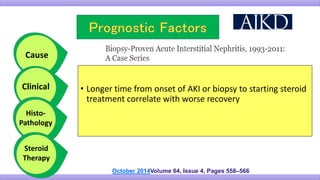
• Longer time from onset of AKI or biopsy to starting steroid
treatment correlate with worse recovery
Cause
Clinical
Histo-
Pathology
October 2014Volume 64, Issue 4, Pages 558–566
Steroid
Therapy
Causes
Pathogenesis
Diagnosis
Management
Prognosis
Special issues
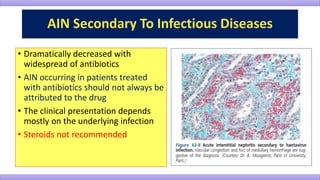
• Dramatically decreased with
widespread of antibiotics
• AIN occurring in patients treated
with antibiotics should not always be
attributed to the drug
• The clinical presentation depends
mostly on the underlying infection
• Steroids not recommended
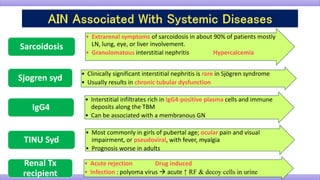
• Extrarenal symptoms of sarcoidosis in about 90% of patients mostly
LN, lung, eye, or liver involvement.
• Granulomatous interstitial nephritis Hypercalcemia
Sarcoidosis
• Clinically significant interstitial nephritis is rare in Sjögren syndrome
• Usually results in chronic tubular dysfunction
Sjogren syd
• Interstitial infiltrates rich in IgG4-positive plasma cells and immune
deposits along the TBM
• Can be associated with a membranous GN
IgG4
• Most commonly in girls of pubertal age; ocular pain and visual
impairment, or pseudoviral, with fever, myalgia
• Prognosis worse in adults
TINU Syd
• Acute rejection Drug induced
• Infection : polyoma virus  acute ↑ RF & decoy cells in urine
Renal Tx
recipient
references
UP TO DATE
Nephrology secrets
Nephrology Library (Dr Ahmed Elkeraie)
Interstial nephr mohamed abdallah

Interstial nephr mohamed abdallah

  • 1.
    New Mansoura GeneralHospital Nephrology Department Mohamed Abd Allah Nephrology Specialist -NMGH
  • 3.
  • 4.
    A Pattern ofrenal injury usually characterized by : • Clinically; Abrupt deterioration in renal function • Triad of fever ,esinophilia and skin rash. • Histopathological; inflammation & oedema of interstitium, tubular atrophy. .
  • 5.
    • Inflammation IsLimited To Tubules & Interstitium • Glomeruli & Vessels; Uninvolved Or Minor Changes1ry • Occur as a consequence of 1ry Glomerular , Vascular Or Systemic Disease.2ry • 1ry TIN Whose Etiologic Agent Or Cause Is UnknownIdiopathic • TIN From Localization Of Live Microorganisms In The KidneyInfectious • TIN From The Effects Of Systemic Infections • Kidney Are Usually Sterile Reactive
  • 6.
    Acute Chronic Develops overperiod of days to several weeks Develops over months or years. Associated with AKI Associated with progressive loss of GFR over time acute infection of kidneys or delayed hypersensitivity reaction to medication. Granulomatous dis, metabolic disorders , radiation ,.. Etc
  • 7.
    Incidence • 1 %of renal biopsies during the evaluation of hematuria or proteinuria. • 15-27% of cases of patients hospitalized for AKI, ; the incidence of ATIN may be increasing; more detection. Misdiagnosed • Non-specific in clinical features • Mild forms may be overlooked • Routine diagnostic tests can’t confirm or exclude. Variable Etiology Management • Paucity of data in the literature regarding optimal management • Large debate on effective therapy Fate • Acute, often reversible disease • Untreated acute TIN may result in interstitial fibrosis and irreversible renal injury
  • 8.
  • 9.
    • A reviewof 3 series that totaled 128 pts • (71%) Drugs, with antibiotics responsible for 1/3 • (15%) Infection-related • (8%) Idiopathic • (5%) Tubulointerstitial nephritis and uveitis (TINU) syndrome • (1%) Sarcoidosis Backer RJ; Pusey CD, Nephrol Dial Transplant 2004 Jan;19(1):8-11 71% 15% 8% 5% 1% drugs infection idiopathic TINU sarcoidosis
  • 11.
  • 13.
  • 14.
    • Drug-induced AINis secondary to immune reaction • AIN occurs only in a small percentage of individuals taking the drug • AIN is not dose-dependent • Association with extrarenal manifestations of hypersensitivity • Recurrence after re-exposure to the drug
  • 15.
  • 16.
  • 17.
    Clinical Non specific Symptoms ofAKI Asymptomatic ↑ Creat Abnormal urinary sediment Hypersensitivity syd low-grade fever 70-100% Skin rash 30-50% Arthralgia 15-20% Am Fam Physician. 2003 Jun 15;67(12):2527-2534. Hematuria Proteinuria
  • 19.
    Cells in thecast have nuclei (unlike RBC casts) Pathognomonic for Acute Interstitial Nephritis
  • 20.
    Angela K. Muriithiet al. CJASN 2013;8:1857-1862
  • 21.
    Imaging Contrib Nephrol. Basel,Karger, 2016, 188; 39–47 Conventional US does not allow a definitive diagnosis. 67y patient had an AKI from NSAIDs ( Cr 1.1 -to 2.8 mg/dl). • Kidneys were symmetrical. • Coronal diameters were >11 cm • Parenchymal thickness was normal • But renal structure was altered. • Cortex; diffusely hyperechoic; interstitial edema & inflammatory infiltrate • Medullary pyramids were hypoechoic & irregular, but CMD was preserved
  • 22.
    • Doppler waveshowed a high difference between systolic and diastolic phase, because of the decrease of diastolic flow. Imaging Conventional Doppler US does not allow a definitive diagnosis. • Hemodynamic variations are commonly related to severity and progression of the anatomical damage. • RIs are commonly <0.70. Contrib Nephrol. Basel, Karger, 2016, 188; 39–47
  • 23.
    The gold standardmethod for diagnosis Done for ALL suspected patients ?? Biopsy
  • 24.
    Done for ALLsuspected patients ?? • Probable precipitating drug can be withdrawn • Improve readily after withdrawal of an offending drug • Supportive management can proceed safely with good outcome • Not improve after withdrawal of likely precipitating drugs • No contraindications to renal biopsy • No refusal to procedure • Considered for steroid therapy Biopsy
  • 25.
    Biopsy LM • Interstitium: edema& lymphocytic infiltration, non-necrotizing granulomas, fibrosis is initially sparse, but develops later in the course of the illness. • Vessles normal • Glomeruli: normal , GN may has TIN as complication , MC with NSAIDs, Necrotizing GN or vasculitis is commonly associated with AIN that, in limited samples with no glomeruli, may be mistaken as AIN. • Tubules: Variable tubulitis with associated acute tubular injury Am J Kidney Dis. 2016;67(6):e35-e36
  • 26.
    AIN with aninterstitial lymphoplasmacytic infiltrate, edema, and prominent eosinophilic component (left) AIN with an interstitial lymphoplasmacytic infiltrate with eosinophils and associated interstitial edema
  • 27.
    Biopsy LM IF • No specificstaining • Linear IgG  Anti TBM Linear deposits of IgG in methicillin- induced acute interstitial nephritis. Deposits along TBM are shown on IF microscopy. These antibodies recognize either a component of the TBM or a methicillin metabolite (dimethoxyphenylpenicilloyl) bound to the TBM. (Courtesy Dr. B Mougenot, Paris VI University, Paris.) EM • No specific finding • Some cases with NSAIDs-induced AIN,  concurrent induction of MCD with extensive foot process effacement.
  • 28.
  • 29.
    • Withdrawal ofmedications that are likely to cause AIN is the most significant step in early management of suspected or biopsy-proven AIN. • Avoid volume depletion or overload • Identify and correct electrolyte abnormalities • Symptomatic relief for fever and systemic symptoms • Avoid use of nephrotoxic drugs • Adjust drug dosages for existing level of renal function • Dialysis if indicated
  • 30.
    As an immune-mediated disorder immune suppressive therapy has been the mainstay of treatment for decades. • The effectiveness of steroids for treatment of AIN is debated. • There are no RCT to support the use of corticosteroids in treatment of AIN
  • 31.
    • Outcome fromtwo studies involving <25 cases each, in which corticosteroid therapy was found to accelerate renal recovery and improve the final baseline serum creatinine • Small case reports have demonstrated rapid diuresis, clinical improvement, and return of normal renal function within 72 hours after starting steroid treatment
  • 32.
    Multicentre retrospective studyincluding 61 patients with biopsy-proven DI-AIN, 52 of whom were treated with steroids. Kidney International, Volume 73, Issue 8, 2008, 940–946
  • 33.
    • retrospective studyof 60 patients with biopsy proven AIN over a 12 year period in whom (n=42) only had complete FU • 60% received corticosteroid therapy while the remainder received supportive care only No difference in outcome was observed between the two groups with respect to the median serum creatinine at time points of 1, 6 and 12 months following diagnosis
  • 34.
    Treatment with steroidsdid not affect recovery status at 6 months October 2014Volume 64, Issue 4, Pages 558–566
  • 35.
    • Guided bythe clinical course following withdrawal of offending medications & delayed recovery of renal function • A reasonable dosage is prednisone, 1 mg per kg per day orally (or equivalent intravenous dose) for two to three weeks followed by a gradually tapering dose over three to four weeks.
  • 37.
    Nephrol. Dial. Transplant.(2015)30 (9): 1472-1479.
  • 38.
  • 39.
    Nephrol. Dial. Transplant.(2004)19 (11): 2778-2783. • Retrospective study of all cases (n=60) of AIN found by reviewing 2598 native renal biopsiesover a 12 year period
  • 40.
    Cause The cause ofAIN had no impact on recovery at 6 months October 2014Volume 64, Issue 4, Pages 558–566 Longer duration of drug exposure correlate with bad outcome
  • 41.
    • Small kidneyby U/S • Longer duration renal failure lasts for >3 weeks • Two series have shown worse prognosis with increasing age • NO correlation with peak creatinine concentration Correlates of poor recovery: Med Balt1977; 56: 483–491Nephrol 1984; 22: 55–60Nephrol 1980; 14: 263–273 Cause Clinical
  • 42.
    • Higher degreeof tubular atrophy and interstitial fibrosis • Presence of interstitial granulomas on biopsy were marginally significant correlates of prognosis. • Diffuse (versus patchy) inflammation on biopsy; excess number of neutrophils. However, recent studies have not supported a correlation between the degree of cellular infiltration or tubulitis and outcome AJKD October 2014 (64), 4: 558–66 Nephrol Dial Transplant 1989; 4: 205–15 Correlates of poor recovery: Cause Clinical Histo- pathology Nephrol Dial Transplant 1990 5:94–9
  • 43.
    • Longer timefrom onset of AKI or biopsy to starting steroid treatment correlate with worse recovery Cause Clinical Histo- Pathology October 2014Volume 64, Issue 4, Pages 558–566 Steroid Therapy
  • 44.
  • 45.
    • Dramatically decreasedwith widespread of antibiotics • AIN occurring in patients treated with antibiotics should not always be attributed to the drug • The clinical presentation depends mostly on the underlying infection • Steroids not recommended
  • 46.
    • Extrarenal symptomsof sarcoidosis in about 90% of patients mostly LN, lung, eye, or liver involvement. • Granulomatous interstitial nephritis Hypercalcemia Sarcoidosis • Clinically significant interstitial nephritis is rare in Sjögren syndrome • Usually results in chronic tubular dysfunction Sjogren syd • Interstitial infiltrates rich in IgG4-positive plasma cells and immune deposits along the TBM • Can be associated with a membranous GN IgG4 • Most commonly in girls of pubertal age; ocular pain and visual impairment, or pseudoviral, with fever, myalgia • Prognosis worse in adults TINU Syd • Acute rejection Drug induced • Infection : polyoma virus  acute ↑ RF & decoy cells in urine Renal Tx recipient
  • 47.
    references UP TO DATE Nephrologysecrets Nephrology Library (Dr Ahmed Elkeraie)