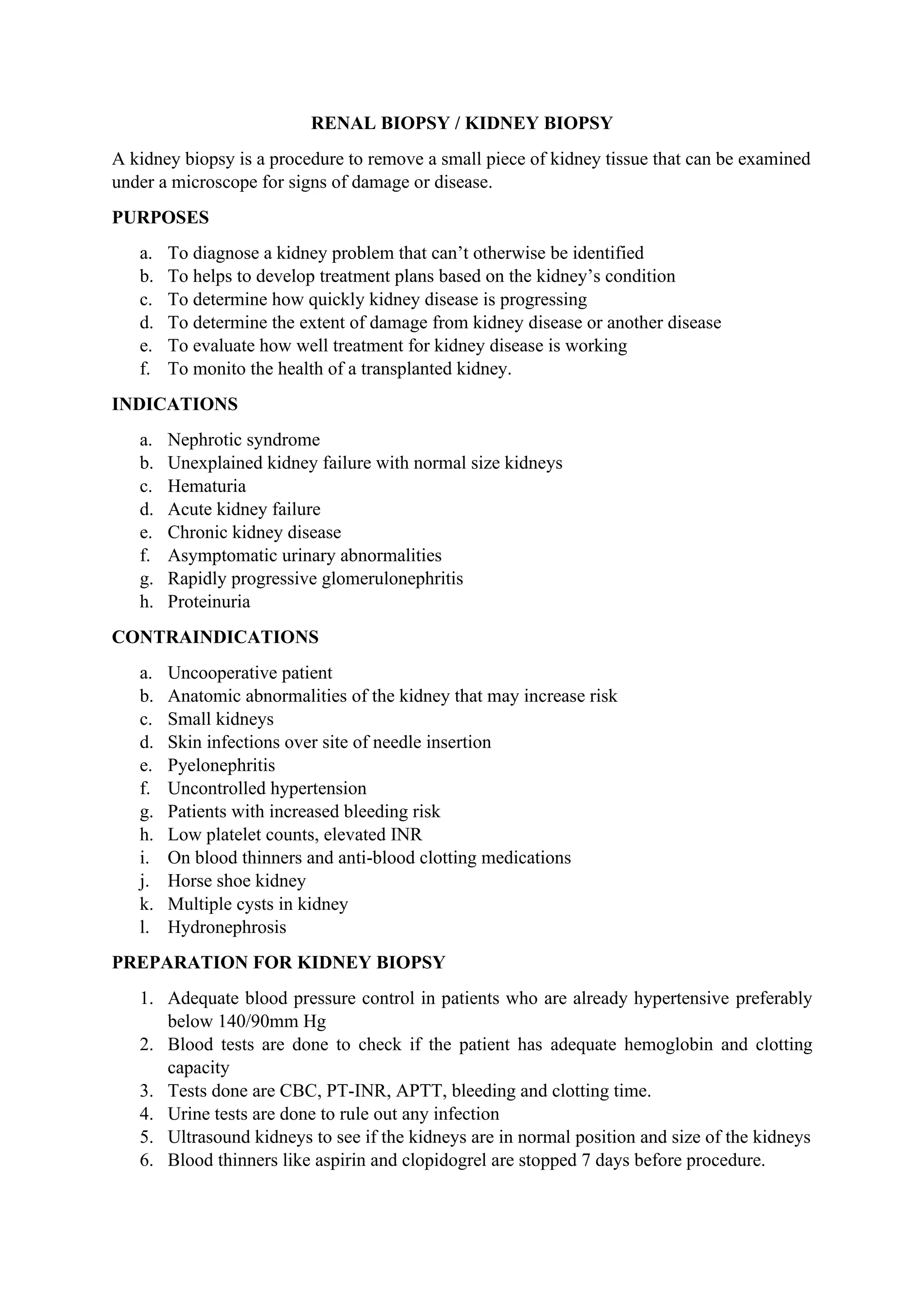
RENAL BIOPSY / KIDNEY BIOPSY
A kidney biopsy is a procedure to remove a small piece of kidney tissue that can be examined
under a microscope for signs of damage or disease.
PURPOSES
a. To diagnose a kidney problem that can’t otherwise be identified
b. To helps to develop treatment plans based on the kidney’s condition
c. To determine how quickly kidney disease is progressing
d. To determine the extent of damage from kidney disease or another disease
e. To evaluate how well treatment for kidney disease is working
f. To monito the health of a transplanted kidney.
INDICATIONS
a. Nephrotic syndrome
b. Unexplained kidney failure with normal size kidneys
c. Hematuria
d. Acute kidney failure
e. Chronic kidney disease
f. Asymptomatic urinary abnormalities
g. Rapidly progressive glomerulonephritis
h. Proteinuria
CONTRAINDICATIONS
a. Uncooperative patient
b. Anatomic abnormalities of the kidney that may increase risk
c. Small kidneys
d. Skin infections over site of needle insertion
e. Pyelonephritis
f. Uncontrolled hypertension
g. Patients with increased bleeding risk
h. Low platelet counts, elevated INR
i. On blood thinners and anti-blood clotting medications
j. Horse shoe kidney
k. Multiple cysts in kidney
l. Hydronephrosis
PREPARATION FOR KIDNEY BIOPSY
1. Adequate blood pressure control in patients who are already hypertensive preferably
below 140/90mm Hg
2. Blood tests are done to check if the patient has adequate hemoglobin and clotting
capacity
3. Tests done are CBC, PT-INR, APTT, bleeding and clotting time.
4. Urine tests are done to rule out any infection
5. Ultrasound kidneys to see if the kidneys are in normal position and size of the kidneys
6. Blood thinners like aspirin and clopidogrel are stopped 7 days before procedure.
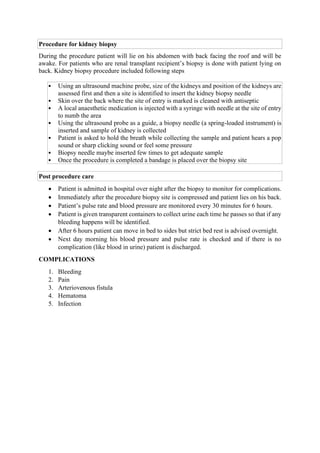
Procedure for kidney biopsy
During the procedure patient will lie on his abdomen with back facing the roof and will be
awake. For patients who are renal transplant recipient’s biopsy is done with patient lying on
back. Kidney biopsy procedure included following steps
• Using an ultrasound machine probe, size of the kidneys and position of the kidneys are
assessed first and then a site is identified to insert the kidney biopsy needle
• Skin over the back where the site of entry is marked is cleaned with antiseptic
• A local anaesthetic medication is injected with a syringe with needle at the site of entry
to numb the area
• Using the ultrasound probe as a guide, a biopsy needle (a spring-loaded instrument) is
inserted and sample of kidney is collected
• Patient is asked to hold the breath while collecting the sample and patient hears a pop
sound or sharp clicking sound or feel some pressure
• Biopsy needle maybe inserted few times to get adequate sample
• Once the procedure is completed a bandage is placed over the biopsy site
Post procedure care
• Patient is admitted in hospital over night after the biopsy to monitor for complications.
• Immediately after the procedure biopsy site is compressed and patient lies on his back.
• Patient’s pulse rate and blood pressure are monitored every 30 minutes for 6 hours.
• Patient is given transparent containers to collect urine each time he passes so that if any
bleeding happens will be identified.
• After 6 hours patient can move in bed to sides but strict bed rest is advised overnight.
• Next day morning his blood pressure and pulse rate is checked and if there is no
complication (like blood in urine) patient is discharged.
COMPLICATIONS
1. Bleeding
2. Pain
3. Arteriovenous fistula
4. Hematoma
5. Infection

RENAL BIOPSY.pdf

  • 1.
    RENAL BIOPSY /KIDNEY BIOPSY A kidney biopsy is a procedure to remove a small piece of kidney tissue that can be examined under a microscope for signs of damage or disease. PURPOSES a. To diagnose a kidney problem that can’t otherwise be identified b. To helps to develop treatment plans based on the kidney’s condition c. To determine how quickly kidney disease is progressing d. To determine the extent of damage from kidney disease or another disease e. To evaluate how well treatment for kidney disease is working f. To monito the health of a transplanted kidney. INDICATIONS a. Nephrotic syndrome b. Unexplained kidney failure with normal size kidneys c. Hematuria d. Acute kidney failure e. Chronic kidney disease f. Asymptomatic urinary abnormalities g. Rapidly progressive glomerulonephritis h. Proteinuria CONTRAINDICATIONS a. Uncooperative patient b. Anatomic abnormalities of the kidney that may increase risk c. Small kidneys d. Skin infections over site of needle insertion e. Pyelonephritis f. Uncontrolled hypertension g. Patients with increased bleeding risk h. Low platelet counts, elevated INR i. On blood thinners and anti-blood clotting medications j. Horse shoe kidney k. Multiple cysts in kidney l. Hydronephrosis PREPARATION FOR KIDNEY BIOPSY 1. Adequate blood pressure control in patients who are already hypertensive preferably below 140/90mm Hg 2. Blood tests are done to check if the patient has adequate hemoglobin and clotting capacity 3. Tests done are CBC, PT-INR, APTT, bleeding and clotting time. 4. Urine tests are done to rule out any infection 5. Ultrasound kidneys to see if the kidneys are in normal position and size of the kidneys 6. Blood thinners like aspirin and clopidogrel are stopped 7 days before procedure.
  • 2.
    Procedure for kidneybiopsy During the procedure patient will lie on his abdomen with back facing the roof and will be awake. For patients who are renal transplant recipient’s biopsy is done with patient lying on back. Kidney biopsy procedure included following steps • Using an ultrasound machine probe, size of the kidneys and position of the kidneys are assessed first and then a site is identified to insert the kidney biopsy needle • Skin over the back where the site of entry is marked is cleaned with antiseptic • A local anaesthetic medication is injected with a syringe with needle at the site of entry to numb the area • Using the ultrasound probe as a guide, a biopsy needle (a spring-loaded instrument) is inserted and sample of kidney is collected • Patient is asked to hold the breath while collecting the sample and patient hears a pop sound or sharp clicking sound or feel some pressure • Biopsy needle maybe inserted few times to get adequate sample • Once the procedure is completed a bandage is placed over the biopsy site Post procedure care • Patient is admitted in hospital over night after the biopsy to monitor for complications. • Immediately after the procedure biopsy site is compressed and patient lies on his back. • Patient’s pulse rate and blood pressure are monitored every 30 minutes for 6 hours. • Patient is given transparent containers to collect urine each time he passes so that if any bleeding happens will be identified. • After 6 hours patient can move in bed to sides but strict bed rest is advised overnight. • Next day morning his blood pressure and pulse rate is checked and if there is no complication (like blood in urine) patient is discharged. COMPLICATIONS 1. Bleeding 2. Pain 3. Arteriovenous fistula 4. Hematoma 5. Infection