Dr. Hanan Mostafa
Nephrology Specialist
New Mansoura General Hospital
 Introduction.
 Aim of renal biopsy.
 Indications for renal biopsy.
 Contraindications for renal biopsy.
 Workup for renal biopsy.
 Renal biopsy procedure.
 Biopsy adequacy.
 Post biopsy monitoring.
 Renal biopsy complications.
Agenda
 Definition: A renal biopsy is a procedure
used to obtain a segment of renal tissue,
usually through a needle or another surgical
instrument.
 Percutaneous renal biopsy was first
described in the early 1950s .
 Renal biopsy is now able to provide a tissue
diagnosis in more than 95% of patients, with
a life-threatening complication rate of less
than 0.1%
Introduction
 It may be done to determine:
- Cause.
- Severity.
- Treatment of a kidney disorder.
- Prognosis.
 Renal biopsy identifies a diagnosis different
from that predicted on clinical grounds in 50%
to 60% of patients and leads to a treatment
change in 20% to 50%.
Aim Of Renal Biopsy
 Adult nephrotic syndrome.
 Nephrotic children with atypical features :
- Microscopic hematuria.
- Reduced serum complement levels.
- Renal impairment.
- Failure to respond to corticosteroids.
Indications
 Isolated non nephrotic proteinuria (>1 g/24 h):
Indications
-The value of renal biopsy in patients is debatable.
- All conditions that result in nephrotic syndrome
can cause non-nephrotic proteinuria, except MCD.
- In patients with proteinuria of more than 1 g/day,
treatment with strict blood pressure control and
(ACE) inhibitors or (ARBs) reduces proteinuria and
reduces the risk for progressive renal dysfunction .
 Isolated glomerular hematuria:
Indications
- IgA nephropathy is the most common lesion,
followed by thin basement membrane .
- In the absence of nephrotic proteinuria, renal
impairment, or hypertension, the prognosis is
excellent .
- As no specific therapies are available, renal
biopsy is not necessary and patients require only
follow-up.
 Unexplained acute or rapidly progressive renal
failure.
 Certain cases of unexplained chronic renal
failure.
 Renal allograft dysfunction Renal transplant
rejection.
 Systemic diseases with renal involvement:
- Small-vessel vasculitis.
- Anti–glomerular basement membrane disease.
- Systemic lupus.
Indications
Indications
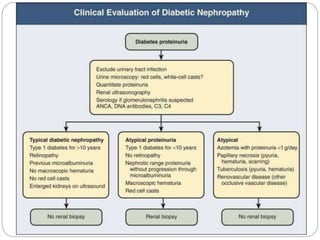
 30y, DM type 1 (15y), Nephrotic range proteinuria, N.
S.Cr, eGFR more than 60,No retinopathy,
Macroscopic hematuria.
 30y, DM type 1(15y), Nephrotic range proteinuria, N.
S.Cr, eGFR more than 60, Retinopathy.
 55y, normotensive, proteinuria 1 gm, US normal,
normal S.Cr, normal immunology.
 55y, normotensive, proteinuria 1 gm, US normal,
normal S.Cr, ANA +ve.
 45y,BMI 40, BP 150/100, proteinuria 4 gm, S.Cr
normal, S. Alb. 3.9, normal US, Normal immunology.
Absolute
 Patient Refusal.
 Bleeding diathesis.
 Uncontrolled severe
hypertension.
Contraindications
 Azotemia.
 Anatomical abnormalities
of the kidney(multiple
cysts).
 skin infection.
 Hemostasis-altering
drugs.
 pregnancy.
 urinary tract infections.
 obesity.
 Uncooperative patient.
 Solitary native kidney.
 Small sized kidney.
Relative
Contraindications
Informed Consent
Answering 5W Questions
 What?
 Why?
 How?
 What is the risk benefit?
 What are the precautions?
Workup For Renal Biopsy
 Biopsy is performed by nephrologists with ultrasound
guidance and disposable automated biopsy needles.
 We use 16-gauge needles and the trend toward
fewer bleeding complications of smaller needles.
 For most patients, premedication or sedation is not
required.
 The patient is prone, and a pillow is placed under the
abdomen at the level of the umbilicus to straighten
the lumbar spine and to splint the kidneys.
Renal Biopsy Procedure
 Ultrasound is used to localize the lower pole of the
kidney where the biopsy will be performed (usually
the left kidney).
 A pen mark is used to indicate the point of entry of the
biopsy needle.
 The skin is sterilized with povidone-iodine (Betadine) .
A sterile fenestrated sheet is placed over the area to
maintain a sterile field.
 Local anesthetic (2% lidocaine ) is infiltrated into the
skin at the point previously marked.
Renal Biopsy Procedure
 While the anesthetic takes effect, the ultrasound
probe is covered in a sterile sheath. Sterile ultrasound
jelly is applied to the skin
 Under ultrasound guidance, a 10-cm, needle is
guided to the renal capsule.
 A stab incision is made through the dermis to ease
passage of the biopsy needle. This is passed under
ultrasound guidance to the kidney capsule .
Renal Biopsy Procedure
 As the needle approaches the capsule, the patient is
instructed to take a breath until the kidney is moved to
a position such that the lower pole rests just under the
biopsy needle, and then to stop breathing.
 The biopsy needle tip is advanced to the renal
capsule, and the trigger mechanism is released, firing
the needle into the kidney .
 The needle is immediately withdrawn, and the
contents of the needle are examined .
Renal Biopsy Procedure
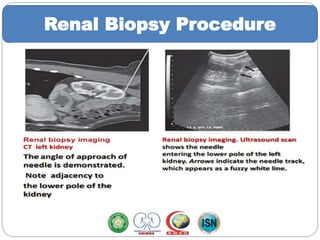
The biopsy needle is introduced at an angle of 70
degrees to the skin and is guided by continuous
ultrasound.
Renal Biopsy Procedure
 We are examining the tissue core under an operating
microscope to ensure that renal cortex has been obtained.
 A second pass of the needle is usually necessary to
obtain additional tissue for immunohistology and EM.
 If insufficient tissue is obtained, further passes of the
needle are made.
 However, passing the needle more than four times is
associated with a modest increase in the post biopsy
complication rate.
 Once sufficient renal tissue has been obtained, the skin
incision is dressed and the patient rolled directly into bed
for observation.
Renal Biopsy Procedure
 renal tissue is divided into three samples and placed in
# Formalin for light microscopy
# Normal saline for immunofluorescence
# Glutaraldehyde for EM
 Some centers are able to produce satisfactory light
microscopy, immunohistochemistry, and EM on
formalin-fixed biopsy material, this depends on the
expertise of individual laboratories.
Renal Biopsy Procedure
Renal Transplant Biopsy
 Biopsy of the transplant kidney is facilitated by the proximity of the kidney to
the anterior abdominal wall and the lack of movement on respiration.
 It is performed under real-time ultrasound guidance with use of an
automated biopsy needle.
 In most patients, renal transplant biopsy is performed to identify cause of
acute allograft dysfunction (acute rejection), therefore diagnosis can be
made on a formalin fixed sample alone for light microscopy.
 If vascular rejection is suspected, a snap-frozen sample for C4d
immunostaining should also be obtained (although some laboratories are
able to detect C4d on formalin-fixed material).
 If recurrent or de novo GN is suspected in patients with chronic allograft
dysfunction, additional samples for EM and immunohistology should be
collected.
Biopsy Adequacy
 An adequate biopsy should provide samples for:
immunohistology and electron microscopy (EM).
 A typical diagnostically useful biopsy sample will
contain 10 to 15 glomeruli .
 Cortex and medulla
 1-2 glomeruli EM
 3-5 glomeruli IF
 6 glomeruli (native kidney)
 10 glomeruli (renal allograft)
Stains
 After the physician has finished obtaining all the tissue
for the biopsy, the needle is removed and pressure is
applied to the biopsy site to tamponade any potential
bleeding, and, finally, a bandage is applied.
 The patient should typically lay supine in bed for 6-8
hours immediately after the procedure.
 In total the patient should expect to stay in the hospital
for at least 12 hours and may have to spend one night
in the hospital after the procedure.
 During this time, the patient will be given proper pain
medication, urine will be checked for blood, and blood
counts and vital signs will be monitored throughout the
patient’s stay in the hospital.
Post Biopsy Monitoring
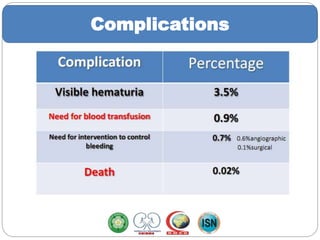
Complications
 Dull ache Pain.
 Perirenal hematomas .
 Visible hematuria.
 Arteriovenous fistulas.
 Death.
Complications
Renal biopsy

Renal biopsy

  • 1.
    Dr. Hanan Mostafa NephrologySpecialist New Mansoura General Hospital
  • 2.
     Introduction.  Aimof renal biopsy.  Indications for renal biopsy.  Contraindications for renal biopsy.  Workup for renal biopsy.  Renal biopsy procedure.  Biopsy adequacy.  Post biopsy monitoring.  Renal biopsy complications. Agenda
  • 3.
     Definition: Arenal biopsy is a procedure used to obtain a segment of renal tissue, usually through a needle or another surgical instrument.  Percutaneous renal biopsy was first described in the early 1950s .  Renal biopsy is now able to provide a tissue diagnosis in more than 95% of patients, with a life-threatening complication rate of less than 0.1% Introduction
  • 4.
     It maybe done to determine: - Cause. - Severity. - Treatment of a kidney disorder. - Prognosis.  Renal biopsy identifies a diagnosis different from that predicted on clinical grounds in 50% to 60% of patients and leads to a treatment change in 20% to 50%. Aim Of Renal Biopsy
  • 5.
     Adult nephroticsyndrome.  Nephrotic children with atypical features : - Microscopic hematuria. - Reduced serum complement levels. - Renal impairment. - Failure to respond to corticosteroids. Indications
  • 6.
     Isolated nonnephrotic proteinuria (>1 g/24 h): Indications -The value of renal biopsy in patients is debatable. - All conditions that result in nephrotic syndrome can cause non-nephrotic proteinuria, except MCD. - In patients with proteinuria of more than 1 g/day, treatment with strict blood pressure control and (ACE) inhibitors or (ARBs) reduces proteinuria and reduces the risk for progressive renal dysfunction .
  • 7.
     Isolated glomerularhematuria: Indications - IgA nephropathy is the most common lesion, followed by thin basement membrane . - In the absence of nephrotic proteinuria, renal impairment, or hypertension, the prognosis is excellent . - As no specific therapies are available, renal biopsy is not necessary and patients require only follow-up.
  • 8.
     Unexplained acuteor rapidly progressive renal failure.  Certain cases of unexplained chronic renal failure.  Renal allograft dysfunction Renal transplant rejection.  Systemic diseases with renal involvement: - Small-vessel vasculitis. - Anti–glomerular basement membrane disease. - Systemic lupus. Indications
  • 10.
    Indications  30y, DMtype 1 (15y), Nephrotic range proteinuria, N. S.Cr, eGFR more than 60,No retinopathy, Macroscopic hematuria.  30y, DM type 1(15y), Nephrotic range proteinuria, N. S.Cr, eGFR more than 60, Retinopathy.  55y, normotensive, proteinuria 1 gm, US normal, normal S.Cr, normal immunology.  55y, normotensive, proteinuria 1 gm, US normal, normal S.Cr, ANA +ve.  45y,BMI 40, BP 150/100, proteinuria 4 gm, S.Cr normal, S. Alb. 3.9, normal US, Normal immunology.
  • 11.
    Absolute  Patient Refusal. Bleeding diathesis.  Uncontrolled severe hypertension. Contraindications  Azotemia.  Anatomical abnormalities of the kidney(multiple cysts).  skin infection.  Hemostasis-altering drugs.  pregnancy.  urinary tract infections.  obesity.  Uncooperative patient.  Solitary native kidney.  Small sized kidney. Relative
  • 12.
  • 13.
    Informed Consent Answering 5WQuestions  What?  Why?  How?  What is the risk benefit?  What are the precautions? Workup For Renal Biopsy
  • 14.
  • 15.
     Biopsy isperformed by nephrologists with ultrasound guidance and disposable automated biopsy needles.  We use 16-gauge needles and the trend toward fewer bleeding complications of smaller needles.  For most patients, premedication or sedation is not required.  The patient is prone, and a pillow is placed under the abdomen at the level of the umbilicus to straighten the lumbar spine and to splint the kidneys. Renal Biopsy Procedure
  • 16.
    Renal Biopsy Procedure Ultrasound is used to localize the lower pole of the kidney where the biopsy will be performed (usually the left kidney).  A pen mark is used to indicate the point of entry of the biopsy needle.  The skin is sterilized with povidone-iodine (Betadine) . A sterile fenestrated sheet is placed over the area to maintain a sterile field.  Local anesthetic (2% lidocaine ) is infiltrated into the skin at the point previously marked.
  • 17.
    Renal Biopsy Procedure While the anesthetic takes effect, the ultrasound probe is covered in a sterile sheath. Sterile ultrasound jelly is applied to the skin  Under ultrasound guidance, a 10-cm, needle is guided to the renal capsule.  A stab incision is made through the dermis to ease passage of the biopsy needle. This is passed under ultrasound guidance to the kidney capsule .
  • 18.
    Renal Biopsy Procedure As the needle approaches the capsule, the patient is instructed to take a breath until the kidney is moved to a position such that the lower pole rests just under the biopsy needle, and then to stop breathing.  The biopsy needle tip is advanced to the renal capsule, and the trigger mechanism is released, firing the needle into the kidney .  The needle is immediately withdrawn, and the contents of the needle are examined .
  • 19.
    Renal Biopsy Procedure Thebiopsy needle is introduced at an angle of 70 degrees to the skin and is guided by continuous ultrasound.
  • 20.
  • 21.
    Renal Biopsy Procedure We are examining the tissue core under an operating microscope to ensure that renal cortex has been obtained.  A second pass of the needle is usually necessary to obtain additional tissue for immunohistology and EM.  If insufficient tissue is obtained, further passes of the needle are made.  However, passing the needle more than four times is associated with a modest increase in the post biopsy complication rate.  Once sufficient renal tissue has been obtained, the skin incision is dressed and the patient rolled directly into bed for observation.
  • 22.
  • 23.
    Renal Biopsy Procedure renal tissue is divided into three samples and placed in # Formalin for light microscopy # Normal saline for immunofluorescence # Glutaraldehyde for EM  Some centers are able to produce satisfactory light microscopy, immunohistochemistry, and EM on formalin-fixed biopsy material, this depends on the expertise of individual laboratories.
  • 24.
    Renal Biopsy Procedure RenalTransplant Biopsy  Biopsy of the transplant kidney is facilitated by the proximity of the kidney to the anterior abdominal wall and the lack of movement on respiration.  It is performed under real-time ultrasound guidance with use of an automated biopsy needle.  In most patients, renal transplant biopsy is performed to identify cause of acute allograft dysfunction (acute rejection), therefore diagnosis can be made on a formalin fixed sample alone for light microscopy.  If vascular rejection is suspected, a snap-frozen sample for C4d immunostaining should also be obtained (although some laboratories are able to detect C4d on formalin-fixed material).  If recurrent or de novo GN is suspected in patients with chronic allograft dysfunction, additional samples for EM and immunohistology should be collected.
  • 25.
    Biopsy Adequacy  Anadequate biopsy should provide samples for: immunohistology and electron microscopy (EM).  A typical diagnostically useful biopsy sample will contain 10 to 15 glomeruli .  Cortex and medulla  1-2 glomeruli EM  3-5 glomeruli IF  6 glomeruli (native kidney)  10 glomeruli (renal allograft)
  • 27.
  • 29.
     After thephysician has finished obtaining all the tissue for the biopsy, the needle is removed and pressure is applied to the biopsy site to tamponade any potential bleeding, and, finally, a bandage is applied.  The patient should typically lay supine in bed for 6-8 hours immediately after the procedure.  In total the patient should expect to stay in the hospital for at least 12 hours and may have to spend one night in the hospital after the procedure.  During this time, the patient will be given proper pain medication, urine will be checked for blood, and blood counts and vital signs will be monitored throughout the patient’s stay in the hospital. Post Biopsy Monitoring
  • 30.
    Complications  Dull achePain.  Perirenal hematomas .  Visible hematuria.  Arteriovenous fistulas.  Death.
  • 31.