HARD SKILLS AND SOFT SKILLS
HARD SKILLS
Hard skills are technical abilities possessed by a human being which can
be measured. It can be learned through education, expertise and
experience.
They are the skills we acquire through learning.
It includes skills such as programming, typing, ability to use softwares,
etc.
Hard skills are often associated with one’s left brain or logic center.
Hard skills are part of the skill set that is required for a job. The are job-
specific and are typically listed in job postings and job descriptions.
They are acquired through formal education and training programs.
These skills are defined, evaluated and measured.
Hard skills involve rules which remains the same regardless of what
business or circumstances a person is in at any given time.
SOFT SKILLS
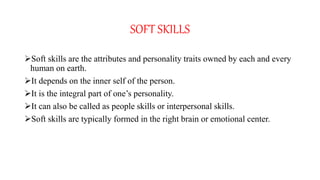
Soft skills are the attributes and personality traits owned by each and every
human on earth.
It depends on the inner self of the person.
It is the integral part of one’s personality.
It can also be called as people skills or interpersonal skills.
Soft skills are typically formed in the right brain or emotional center.
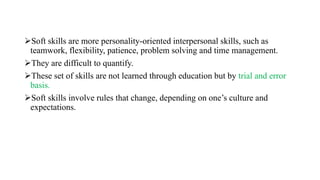
Soft skills are more personality-oriented interpersonal skills, such as
teamwork, flexibility, patience, problem solving and time management.
They are difficult to quantify.
These set of skills are not learned through education but by trial and error
basis.
Soft skills involve rules that change, depending on one’s culture and
expectations.
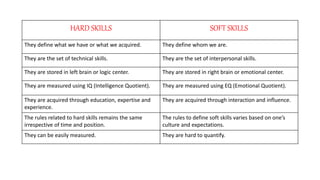
HARD SKILLS SOFT SKILLS
They define what we have or what we acquired. They define whom we are.
They are the set of technical skills. They are the set of interpersonal skills.
They are stored in left brain or logic center. They are stored in right brain or emotional center.
They are measured using IQ (Intelligence Quotient). They are measured using EQ (Emotional Quotient).
They are acquired through education, expertise and
experience.
They are acquired through interaction and influence.
The rules related to hard skills remains the same
irrespective of time and position.
The rules to define soft skills varies based on one’s
culture and expectations.
They can be easily measured. They are hard to quantify.
Communication Skills
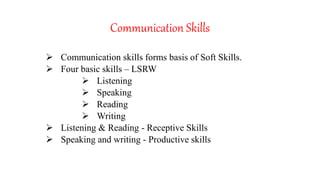
 Communication skills forms basis of Soft Skills.
 Four basic skills – LSRW
 Listening
 Speaking
 Reading
 Writing
 Listening & Reading - Receptive Skills
 Speaking and writing - Productive skills
LISTENING
Patiently listening to others on their difficulties helps in better
communication.
It facilitates good relationship with the society.
Listening enables to analyze situations in a broad perspective.
READING
 Reading is the most rewarding receptive skill.
 More we read, more knowledge we tend to acquire.
 It improves our IQ.
WRITING
Writing is much demanded skill.
Professionals have to develop the skill of writing
 Drafting official
 Letters
 Names
 Technical reports
 Publish articles
 Guard plagiarism (copying)
SPEAKING
Speaking is a vital Component of Soft Skills
It helps scientists in presenting a proposal for financial assistance before
funding agencies.
It allows marketing executive to present a product & its merits to persuade
to buy the product.
Mode of speaking differs based on to whom we communicate.
THANK YOU

Hard skills and soft skills

  • 1.
    HARD SKILLS ANDSOFT SKILLS
  • 2.
    HARD SKILLS Hard skillsare technical abilities possessed by a human being which can be measured. It can be learned through education, expertise and experience. They are the skills we acquire through learning. It includes skills such as programming, typing, ability to use softwares, etc. Hard skills are often associated with one’s left brain or logic center.
  • 3.
    Hard skills arepart of the skill set that is required for a job. The are job- specific and are typically listed in job postings and job descriptions. They are acquired through formal education and training programs. These skills are defined, evaluated and measured. Hard skills involve rules which remains the same regardless of what business or circumstances a person is in at any given time.
  • 4.
    SOFT SKILLS Soft skillsare the attributes and personality traits owned by each and every human on earth. It depends on the inner self of the person. It is the integral part of one’s personality. It can also be called as people skills or interpersonal skills. Soft skills are typically formed in the right brain or emotional center.
  • 5.
    Soft skills aremore personality-oriented interpersonal skills, such as teamwork, flexibility, patience, problem solving and time management. They are difficult to quantify. These set of skills are not learned through education but by trial and error basis. Soft skills involve rules that change, depending on one’s culture and expectations.
  • 6.
    HARD SKILLS SOFTSKILLS They define what we have or what we acquired. They define whom we are. They are the set of technical skills. They are the set of interpersonal skills. They are stored in left brain or logic center. They are stored in right brain or emotional center. They are measured using IQ (Intelligence Quotient). They are measured using EQ (Emotional Quotient). They are acquired through education, expertise and experience. They are acquired through interaction and influence. The rules related to hard skills remains the same irrespective of time and position. The rules to define soft skills varies based on one’s culture and expectations. They can be easily measured. They are hard to quantify.
  • 7.
    Communication Skills  Communicationskills forms basis of Soft Skills.  Four basic skills – LSRW  Listening  Speaking  Reading  Writing  Listening & Reading - Receptive Skills  Speaking and writing - Productive skills
  • 8.
    LISTENING Patiently listening toothers on their difficulties helps in better communication. It facilitates good relationship with the society. Listening enables to analyze situations in a broad perspective.
  • 9.
    READING  Reading isthe most rewarding receptive skill.  More we read, more knowledge we tend to acquire.  It improves our IQ.
  • 10.
    WRITING Writing is muchdemanded skill. Professionals have to develop the skill of writing  Drafting official  Letters  Names  Technical reports  Publish articles  Guard plagiarism (copying)
  • 11.
    SPEAKING Speaking is avital Component of Soft Skills It helps scientists in presenting a proposal for financial assistance before funding agencies. It allows marketing executive to present a product & its merits to persuade to buy the product. Mode of speaking differs based on to whom we communicate.
  • 12.