Q: Define Land use planning. Briefly discuss the application of aerial photographs
and remote sensing techniques in land use planning.
Land Use planning:
According to WB, land use planning refers to the process by which a society, through
its institutions, decides where, within its territory, different socioeconomic
activities such as agriculture, residence, industry, recreation, and commerce should
take place.
According to Encyclopedia, Land-use planning is the process of regulating the use of
land in an effort to promote more desirable social and environmental outcomes as
well as a more efficient use of resources.
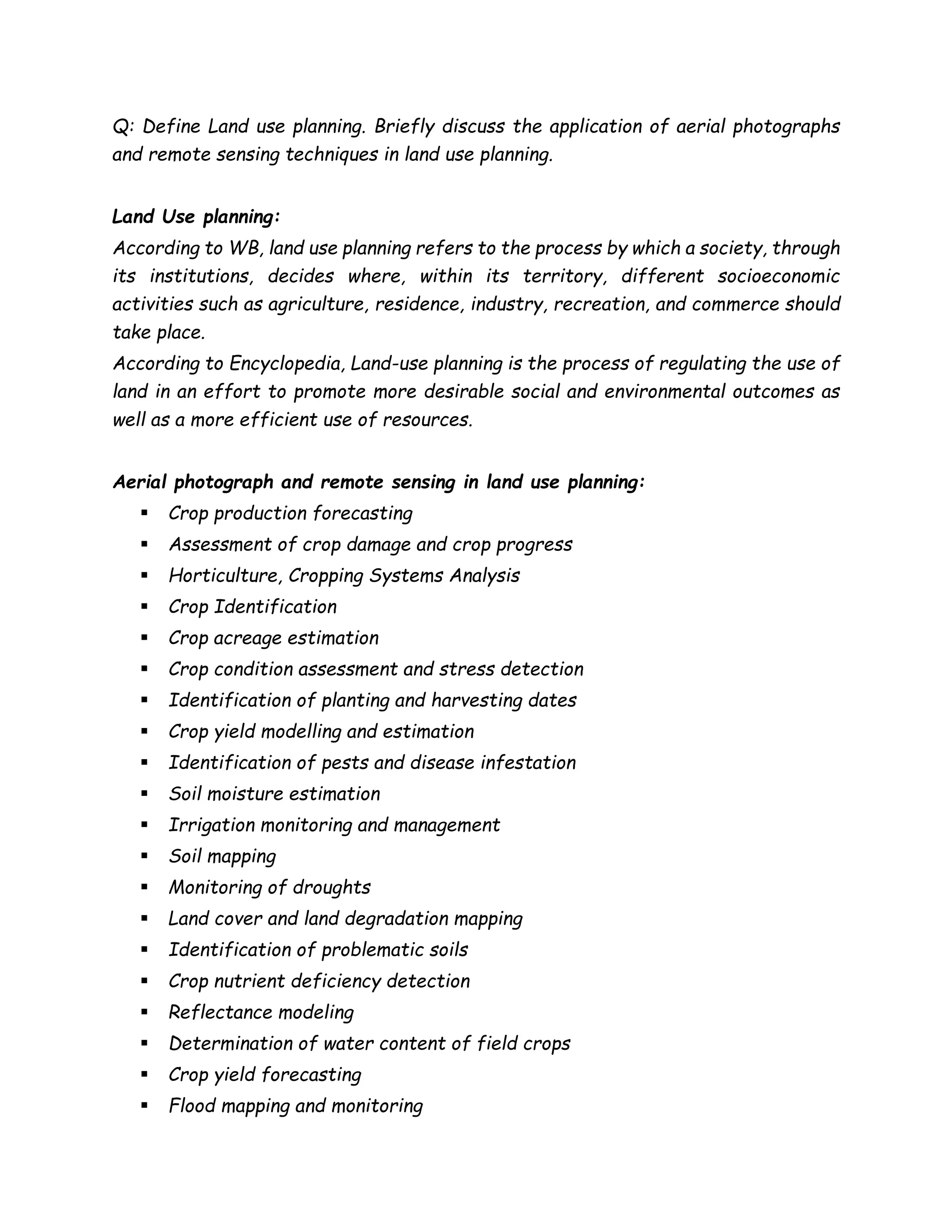
Aerial photograph and remote sensing in land use planning:
 Crop production forecasting
 Assessment of crop damage and crop progress
 Horticulture, Cropping Systems Analysis
 Crop Identification
 Crop acreage estimation
 Crop condition assessment and stress detection
 Identification of planting and harvesting dates
 Crop yield modelling and estimation
 Identification of pests and disease infestation
 Soil moisture estimation
 Irrigation monitoring and management
 Soil mapping
 Monitoring of droughts
 Land cover and land degradation mapping
 Identification of problematic soils
 Crop nutrient deficiency detection
 Reflectance modeling
 Determination of water content of field crops
 Crop yield forecasting
 Flood mapping and monitoring
 Collection of past and current weather data
 Crop intensification
 Water resources mapping
 Precision farming
 Climate change monitoring
 Compliance monitoring
 Soil management practices
 Air moisture estimation
 Crop health analysis
 Land mapping
Q: Define LCC (Land Capability Classification). Classification land on the basis of
suitability classification and discuss them elaborately
Land Capability Classification:
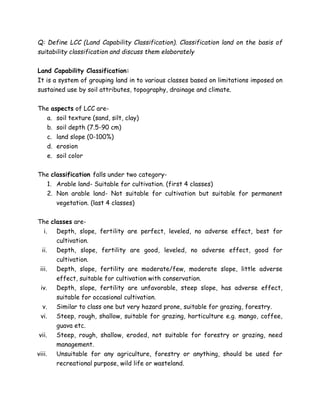
It is a system of grouping land in to various classes based on limitations imposed on
sustained use by soil attributes, topography, drainage and climate.
The aspects of LCC are-
a. soil texture (sand, silt, clay)
b. soil depth (7.5-90 cm)
c. land slope (0-100%)
d. erosion
e. soil color
The classification falls under two category-
1. Arable land- Suitable for cultivation. (first 4 classes)
2. Non arable land- Not suitable for cultivation but suitable for permanent
vegetation. (last 4 classes)
The classes are-
i. Depth, slope, fertility are perfect, leveled, no adverse effect, best for
cultivation.
ii. Depth, slope, fertility are good, leveled, no adverse effect, good for
cultivation.
iii. Depth, slope, fertility are moderate/few, moderate slope, little adverse
effect, suitable for cultivation with conservation.
iv. Depth, slope, fertility are unfavorable, steep slope, has adverse effect,
suitable for occasional cultivation.
v. Similar to class one but very hazard prone, suitable for grazing, forestry.
vi. Steep, rough, shallow, suitable for grazing, horticulture e.g. mango, coffee,
guava etc.
vii. Steep, rough, shallow, eroded, not suitable for forestry or grazing, need
management.
viii. Unsuitable for any agriculture, forestry or anything, should be used for
recreational purpose, wild life or wasteland.
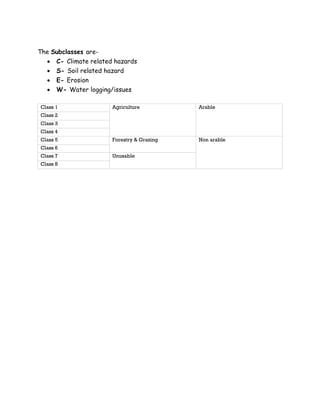
The Subclasses are-
 C- Climate related hazards
 S- Soil related hazard
 E- Erosion
 W- Water logging/issues
Class 1 Agriculture Arable
Class 2
Class 3
Class 4
Class 5 Forestry & Grazing Non arable
Class 6
Class 7 Unusable
Class 8
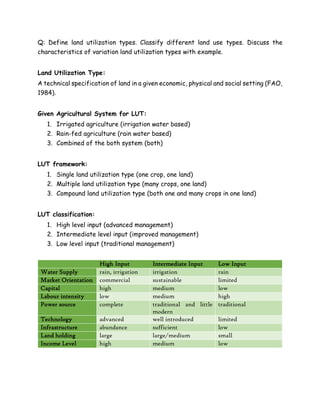
Q: Define land utilization types. Classify different land use types. Discuss the
characteristics of variation land utilization types with example.
Land Utilization Type:
A technical specification of land in a given economic, physical and social setting (FAO,
1984).
Given Agricultural System for LUT:
1. Irrigated agriculture (irrigation water based)
2. Rain-fed agriculture (rain water based)
3. Combined of the both system (both)
LUT framework:
1. Single land utilization type (one crop, one land)
2. Multiple land utilization type (many crops, one land)
3. Compound land utilization type (both one and many crops in one land)
LUT classification:
1. High level input (advanced management)
2. Intermediate level input (improved management)
3. Low level input (traditional management)
High Input Intermediate Input Low Input
Water Supply rain, irrigation irrigation rain
Market Orientation commercial sustainable limited
Capital high medium low
Labour intensity low medium high
Power source complete traditional and little
modern
traditional
Technology advanced well introduced limited
Infrastructure abundance sufficient low
Land holding large large/medium small
Income Level high medium low
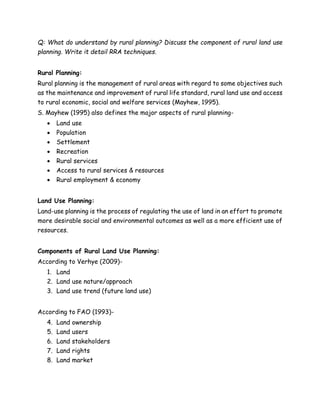
Q: What do understand by rural planning? Discuss the component of rural land use
planning. Write it detail RRA techniques.
Rural Planning:
Rural planning is the management of rural areas with regard to some objectives such
as the maintenance and improvement of rural life standard, rural land use and access
to rural economic, social and welfare services (Mayhew, 1995).
S. Mayhew (1995) also defines the major aspects of rural planning-
 Land use
 Population
 Settlement
 Recreation
 Rural services
 Access to rural services & resources
 Rural employment & economy
Land Use Planning:
Land-use planning is the process of regulating the use of land in an effort to promote
more desirable social and environmental outcomes as well as a more efficient use of
resources.
Components of Rural Land Use Planning:
According to Verhye (2009)-
1. Land
2. Land use nature/approach
3. Land use trend (future land use)
According to FAO (1993)-
4. Land ownership
5. Land users
6. Land stakeholders
7. Land rights
8. Land market
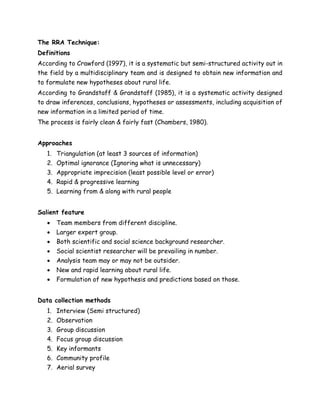
The RRA Technique:
Definitions
According to Crawford (1997), it is a systematic but semi-structured activity out in
the field by a multidisciplinary team and is designed to obtain new information and
to formulate new hypotheses about rural life.
According to Grandstaff & Grandstaff (1985), it is a systematic activity designed
to draw inferences, conclusions, hypotheses or assessments, including acquisition of
new information in a limited period of time.
The process is fairly clean & fairly fast (Chambers, 1980).
Approaches
1. Triangulation (at least 3 sources of information)
2. Optimal ignorance (Ignoring what is unnecessary)
3. Appropriate imprecision (least possible level or error)
4. Rapid & progressive learning
5. Learning from & along with rural people
Salient feature
 Team members from different discipline.
 Larger expert group.
 Both scientific and social science background researcher.
 Social scientist researcher will be prevailing in number.
 Analysis team may or may not be outsider.
 New and rapid learning about rural life.
 Formulation of new hypothesis and predictions based on those.
Data collection methods
1. Interview (Semi structured)
2. Observation
3. Group discussion
4. Focus group discussion
5. Key informants
6. Community profile
7. Aerial survey
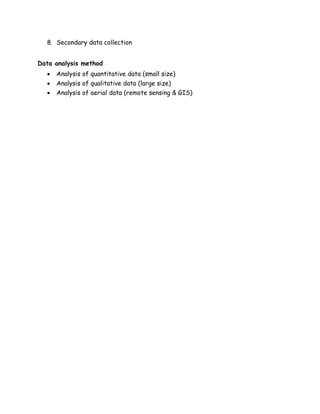
8. Secondary data collection
Data analysis method
 Analysis of quantitative data (small size)
 Analysis of qualitative data (large size)
 Analysis of aerial data (remote sensing & GIS)
Q: Define land degradation. Discuss the cause and consequence of land degradation.
Illustrate the desertification process with reference to Bangladesh.
Land Degradation:
According to International Encyclopedia of the Soil & Behavioral Sciences (2001)-
Land degradation is permanent or temporary declination of the productive
capacity of the land and the reduction of productive potential including the
land use, farming system and economic resource value.
According to FAO (2000)-
Land degradation refers to the loss of soil productivity in terms of soil
fertility, soil biodiversity and resource degradation.
Causes of Land Degradation:
1. Deforestation
2. Over use of pesticides and fertilizers
3. Overgrazing
4. Salinity
5. Soil erosion
6. Desertification
7. Overpopulation
8. Water logging
9. Wasteland
10. Drought
Consequences of Land Degradation:
According to Pacheco et al. (2018)-
1. Loss of soil fertility
2. Declining soil biodiversity
3. Loss of ecosystem services
4. Water quality deterioration (through runoff)
5. Deterioration of aquifer water
6. Loss of vegetation cover
7. Changes in the soil characteristics
8. Loss of land value as an economic resource
9. Soil resource degradation
Desertification:
According to Princeton University Dictionary-
Desertification is a process of transforming fertile land into deserts due to
drought, deforestation and inappropriate agriculture.
According to Oxford Dictionary of Geography-
Desertification refers to the spread of desert like condition of semi-arid
environment.
Desertification Facts:
 Dry land covers 41-42% of the total land of the world (Baurer, 2007).
 2 billion inhabitants are on the dry lands (Johnson et al., 2006).
 6-12 million sqkm is affected by desertification and 1 billion inhabitants are
at the risk (Holtz, 2007).
Causes of Desertification:
In general-
1. Drought
2. Deforestation/ vegetation cover loss
3. Overgrazing
4. Inappropriate agriculture system
5. Climate change
6. Overpopulation
Expert driven-
According Dr. H. Dregne (1985) in the book Desertification of Arid Lands-
1. Degradation of vegetation cover
2. Water erosion
3. Wind erosion
4. Salinization
5. Reduction of organic matter
6. Excess of toxic substances
Stages of desertification:
1. Lessening the concentration of vegetation cover.
2. Origination of empty spaces among the vegetation covered area, the land looks
like stripe and the phenomenon is called as Tiger Fur Pattern.
3. Increases of empty spaces among the trees.
4. The empty spaces are prevailing over the previously green area.
Consequences:
The desertification leads to soil infertility, soil organic material and biodiversity
loss, food insecurity, sand storm and ultimate poverty of the region.
Q: What do mean by land use and land use model? List various principle & factors
governing land use in the light of Von Thunen model with necessary diagrams.
Land use:
According to FAO (1997)-
The arrangements, activities and inputs people undertake in a certain land
cover type to produce, change or maintain it.
The land use types are (Mayhew, 1995)-
1. Agricultural
2. Industrial
3. Residential
4. Recreational
Land use model:
The land use models are theories that interprets the land use, urban land use,
settlement, urban settlement, urban and rural structure and urban market growth in
relation with space and economy.
The prominent land use models are-
1. Von Thunen Model
2. Burgess model
3. Hoyt’s model
4. Harris & Ullman model
Von Thunen Model
Johann Heinrich Von Thünen (1783-1850) developed a Model of Land Use in 1826
explaining influencing forces of agricultural land use.
Factors/Assumption:
1. The city is located centrally within an "Isolated State" which is self-sufficient
and has no external influences.
2. The Isolated State is surrounded by an unoccupied wilderness.
3. The land of the State is completely flat and has no rivers or mountains to
interrupt the terrain.
4. The soil quality and climate are consistent throughout the State.
5. Farmers in the Isolated State transport their own goods to market via oxcart,
across land, directly to the central city. Therefore, there are no roads.
6. Farmers act to maximize profits.
Principles/postulations:
1. Dairying and intensive farming occur in the ring closest to the city.
2. Timber and firewood would be produced for fuel and building materials in the
second zone (Basically forest).
3. The third zone consists of extensive fields crops such as grains for bread.
4. Ranching is located in the final ring surrounding the central city.
5. Beyond the fourth ring lies the unoccupied wilderness.
The cost approach of the theory:
The model compares the relationships between production cost, the market price
and the transport cost of an agricultural commodity and is expressed as follows:
R= Y (p-c) - YFm
R = Land rent
Y = Yield per unit of land
c = Production expenses per unit of commodity
p = Market price per unit of commodity
F = Freight rate
m = Distance to market.
Criticism:
1. An isolated state is very hypothetical.
2. Physical features, topographic features are not taken into consideration.
3. Economic change and demand-supply aspect, rate change, cost variation etc.
are not taken into account.
4. Soil fertility, topographic change, river system, mountain system are not
taken into consideration.
5. Also the societal attitude, governmental policy should have been emphasized.
SHORT NOTES
Land Use Zoning
According to Oxford Dictionary of Geography, the segregation of land into different
areas for each type of use-agricultural, industrial, residential and recreational.
According to Shawn, Land zoning is a system for the local government to restrict
the development of land, regulate the use of land for specific goal and regulate the
land use activities accordingly.
Land use zoning can be of many types-
1. Functional zoning (based on the function of land, such as- agricultural,
industrial, residential, recreational, commercial)
2. Form-based zoning (based on the formation of area, such as- uptown,
downtown, CBD, periphery)
3. Intensity zoning (based on the intensity of land use such as- high density,
medium density, low density)
4. Incentive zoning (Incentives, no incentives)
Tiger Fur Pattern
Tiger fur pattern is an origination of empty spaces among the vegetation covered
area, the land looks like stripe and the phenomenon is called as Tiger Fur Pattern. It
is one of the desertification process.
Process and continuation of tiger fur pattern:
1. Lessening the concentration of vegetation cover.
2. Origination of empty spaces among the vegetation covered area, the land looks
like stripe and the phenomenon is called as Tiger Fur Pattern.
3. Increases of empty spaces among the trees.
4. The empty spaces are prevailing over the previously green area.
Agro ecological zone
Agroecological zones are land areas recognised on the basis of hydrology,
physiography, soil types, tidal activity, cropping patterns, and seasons.
1. Old Himalayan Piedmont Plain
2. Active Tista Floodplain
3. Tista Meander Floodplain
4. Karatoya-Bangali Floodplain
5. Lower Atrai Basin
6. Lower Punarbhaba Floodplain
7. Active Brahmaputra-Jamuna Floodplain
8. Young Brahmaputra-Jamuna Floodplain
9. Old Brahmaputra Floodplain
10. Active Ganges Floodplain
11. High Ganges River Floodplain
12. Low Ganges River Floodplain
13. Ganges Tidal Floodplain
14. Gopalganj-Khulna Beels
15. Arial Beel
16. Middle Meghna River Floodplain
17. Lower Meghna River Floodplain
18. Young Meghna Estuarine Floodplain
19. Old Meghna Estuarine Floodplain
20.Eastern Surma-Kushiyara Floodplain
21. Sylhet Basin
22.Northern and Eastern Piedmont Plain
23.Chittagong Coastal Plain
24.St Martin’s Coral Island
25.Level Barind Tract
26.High Barind Tract
27.North-eastern Barind Tract
28.Madhupur Tract
29.Northern and Eastern Hills
30.Akhaura Terrace
The elements aez-highland, medium highland, medium lowland, lowland, very lowland.
Land Reform Model
Land reform is the redistribution of land (usually agricultural land) by govt. for a
newer, more effective, revolutionary programme that dismisses the present system
of that particular land. And land reform model is a theoretical framework to
implement such reform with a predefined set of characteristics (Moll, 2008).
Some land reform models are-
1. The Italian land reform (1950s in Italy, with agricultural land reform)
2. The Mexican land reform (by 1970s, non-communist approach)
3. USA new resettlement programme (The idea was to relocate farm families
from exhausted land onto superior unused farmland. It was in 1930s.)
Land Evaluation
Land evaluation is concerned with the assessment of land performance when used
for specified purposes. It involves the execution and interpretation of basic surveys
of climate, soils, vegetation and other aspects of land in terms of the requirements
of alternative forms of land use (FAO, 1976).
The processes are-
1. Defining goal
2. Assessing the land features
3. Specifying vulnerabilities
4. Assessing change
5. Planning for the alternative
6. Implementation
Land Conservation
Land conservation is the process of protecting natural land and returning developed
land to its natural state. Methods include-
1. Intensive farming
2. Cultivation of cover crop
3. Bonding
4. Terracing
5. Reduce gully erosion
6. Crop rotation
7. Wind break
8. Forestry
Land Quality
Land quality is a measure of the condition of land and soil relative to the
requirements of biodiversity, land productivity and or to any other human need or
purpose.
According to FAO, the indicators of land quality are-
1. Land use type
2. Land nature
3. Soil quality and nature
4. Soil elements
5. Soil biodiversity
6. Plant nutrients etc.
Mohammad Mohaiminul Islam
Dept. of Geography & Environmental Studies
University of Chittagong
mmohaiminul@yahoo.com

Land Use Planning & Management

  • 1.
    Q: Define Landuse planning. Briefly discuss the application of aerial photographs and remote sensing techniques in land use planning. Land Use planning: According to WB, land use planning refers to the process by which a society, through its institutions, decides where, within its territory, different socioeconomic activities such as agriculture, residence, industry, recreation, and commerce should take place. According to Encyclopedia, Land-use planning is the process of regulating the use of land in an effort to promote more desirable social and environmental outcomes as well as a more efficient use of resources. Aerial photograph and remote sensing in land use planning:  Crop production forecasting  Assessment of crop damage and crop progress  Horticulture, Cropping Systems Analysis  Crop Identification  Crop acreage estimation  Crop condition assessment and stress detection  Identification of planting and harvesting dates  Crop yield modelling and estimation  Identification of pests and disease infestation  Soil moisture estimation  Irrigation monitoring and management  Soil mapping  Monitoring of droughts  Land cover and land degradation mapping  Identification of problematic soils  Crop nutrient deficiency detection  Reflectance modeling  Determination of water content of field crops  Crop yield forecasting  Flood mapping and monitoring
  • 2.
     Collection ofpast and current weather data  Crop intensification  Water resources mapping  Precision farming  Climate change monitoring  Compliance monitoring  Soil management practices  Air moisture estimation  Crop health analysis  Land mapping
  • 3.
    Q: Define LCC(Land Capability Classification). Classification land on the basis of suitability classification and discuss them elaborately Land Capability Classification: It is a system of grouping land in to various classes based on limitations imposed on sustained use by soil attributes, topography, drainage and climate. The aspects of LCC are- a. soil texture (sand, silt, clay) b. soil depth (7.5-90 cm) c. land slope (0-100%) d. erosion e. soil color The classification falls under two category- 1. Arable land- Suitable for cultivation. (first 4 classes) 2. Non arable land- Not suitable for cultivation but suitable for permanent vegetation. (last 4 classes) The classes are- i. Depth, slope, fertility are perfect, leveled, no adverse effect, best for cultivation. ii. Depth, slope, fertility are good, leveled, no adverse effect, good for cultivation. iii. Depth, slope, fertility are moderate/few, moderate slope, little adverse effect, suitable for cultivation with conservation. iv. Depth, slope, fertility are unfavorable, steep slope, has adverse effect, suitable for occasional cultivation. v. Similar to class one but very hazard prone, suitable for grazing, forestry. vi. Steep, rough, shallow, suitable for grazing, horticulture e.g. mango, coffee, guava etc. vii. Steep, rough, shallow, eroded, not suitable for forestry or grazing, need management. viii. Unsuitable for any agriculture, forestry or anything, should be used for recreational purpose, wild life or wasteland.
  • 4.
    The Subclasses are- C- Climate related hazards  S- Soil related hazard  E- Erosion  W- Water logging/issues Class 1 Agriculture Arable Class 2 Class 3 Class 4 Class 5 Forestry & Grazing Non arable Class 6 Class 7 Unusable Class 8
  • 5.
    Q: Define landutilization types. Classify different land use types. Discuss the characteristics of variation land utilization types with example. Land Utilization Type: A technical specification of land in a given economic, physical and social setting (FAO, 1984). Given Agricultural System for LUT: 1. Irrigated agriculture (irrigation water based) 2. Rain-fed agriculture (rain water based) 3. Combined of the both system (both) LUT framework: 1. Single land utilization type (one crop, one land) 2. Multiple land utilization type (many crops, one land) 3. Compound land utilization type (both one and many crops in one land) LUT classification: 1. High level input (advanced management) 2. Intermediate level input (improved management) 3. Low level input (traditional management) High Input Intermediate Input Low Input Water Supply rain, irrigation irrigation rain Market Orientation commercial sustainable limited Capital high medium low Labour intensity low medium high Power source complete traditional and little modern traditional Technology advanced well introduced limited Infrastructure abundance sufficient low Land holding large large/medium small Income Level high medium low
  • 6.
    Q: What dounderstand by rural planning? Discuss the component of rural land use planning. Write it detail RRA techniques. Rural Planning: Rural planning is the management of rural areas with regard to some objectives such as the maintenance and improvement of rural life standard, rural land use and access to rural economic, social and welfare services (Mayhew, 1995). S. Mayhew (1995) also defines the major aspects of rural planning-  Land use  Population  Settlement  Recreation  Rural services  Access to rural services & resources  Rural employment & economy Land Use Planning: Land-use planning is the process of regulating the use of land in an effort to promote more desirable social and environmental outcomes as well as a more efficient use of resources. Components of Rural Land Use Planning: According to Verhye (2009)- 1. Land 2. Land use nature/approach 3. Land use trend (future land use) According to FAO (1993)- 4. Land ownership 5. Land users 6. Land stakeholders 7. Land rights 8. Land market
  • 7.
    The RRA Technique: Definitions Accordingto Crawford (1997), it is a systematic but semi-structured activity out in the field by a multidisciplinary team and is designed to obtain new information and to formulate new hypotheses about rural life. According to Grandstaff & Grandstaff (1985), it is a systematic activity designed to draw inferences, conclusions, hypotheses or assessments, including acquisition of new information in a limited period of time. The process is fairly clean & fairly fast (Chambers, 1980). Approaches 1. Triangulation (at least 3 sources of information) 2. Optimal ignorance (Ignoring what is unnecessary) 3. Appropriate imprecision (least possible level or error) 4. Rapid & progressive learning 5. Learning from & along with rural people Salient feature  Team members from different discipline.  Larger expert group.  Both scientific and social science background researcher.  Social scientist researcher will be prevailing in number.  Analysis team may or may not be outsider.  New and rapid learning about rural life.  Formulation of new hypothesis and predictions based on those. Data collection methods 1. Interview (Semi structured) 2. Observation 3. Group discussion 4. Focus group discussion 5. Key informants 6. Community profile 7. Aerial survey
  • 8.
    8. Secondary datacollection Data analysis method  Analysis of quantitative data (small size)  Analysis of qualitative data (large size)  Analysis of aerial data (remote sensing & GIS)
  • 9.
    Q: Define landdegradation. Discuss the cause and consequence of land degradation. Illustrate the desertification process with reference to Bangladesh. Land Degradation: According to International Encyclopedia of the Soil & Behavioral Sciences (2001)- Land degradation is permanent or temporary declination of the productive capacity of the land and the reduction of productive potential including the land use, farming system and economic resource value. According to FAO (2000)- Land degradation refers to the loss of soil productivity in terms of soil fertility, soil biodiversity and resource degradation. Causes of Land Degradation: 1. Deforestation 2. Over use of pesticides and fertilizers 3. Overgrazing 4. Salinity 5. Soil erosion 6. Desertification 7. Overpopulation 8. Water logging 9. Wasteland 10. Drought Consequences of Land Degradation: According to Pacheco et al. (2018)- 1. Loss of soil fertility 2. Declining soil biodiversity 3. Loss of ecosystem services 4. Water quality deterioration (through runoff) 5. Deterioration of aquifer water 6. Loss of vegetation cover 7. Changes in the soil characteristics
  • 10.
    8. Loss ofland value as an economic resource 9. Soil resource degradation Desertification: According to Princeton University Dictionary- Desertification is a process of transforming fertile land into deserts due to drought, deforestation and inappropriate agriculture. According to Oxford Dictionary of Geography- Desertification refers to the spread of desert like condition of semi-arid environment. Desertification Facts:  Dry land covers 41-42% of the total land of the world (Baurer, 2007).  2 billion inhabitants are on the dry lands (Johnson et al., 2006).  6-12 million sqkm is affected by desertification and 1 billion inhabitants are at the risk (Holtz, 2007). Causes of Desertification: In general- 1. Drought 2. Deforestation/ vegetation cover loss 3. Overgrazing 4. Inappropriate agriculture system 5. Climate change 6. Overpopulation Expert driven- According Dr. H. Dregne (1985) in the book Desertification of Arid Lands- 1. Degradation of vegetation cover 2. Water erosion 3. Wind erosion 4. Salinization
  • 11.
    5. Reduction oforganic matter 6. Excess of toxic substances Stages of desertification: 1. Lessening the concentration of vegetation cover. 2. Origination of empty spaces among the vegetation covered area, the land looks like stripe and the phenomenon is called as Tiger Fur Pattern. 3. Increases of empty spaces among the trees. 4. The empty spaces are prevailing over the previously green area. Consequences: The desertification leads to soil infertility, soil organic material and biodiversity loss, food insecurity, sand storm and ultimate poverty of the region.
  • 12.
    Q: What domean by land use and land use model? List various principle & factors governing land use in the light of Von Thunen model with necessary diagrams. Land use: According to FAO (1997)- The arrangements, activities and inputs people undertake in a certain land cover type to produce, change or maintain it. The land use types are (Mayhew, 1995)- 1. Agricultural 2. Industrial 3. Residential 4. Recreational Land use model: The land use models are theories that interprets the land use, urban land use, settlement, urban settlement, urban and rural structure and urban market growth in relation with space and economy. The prominent land use models are- 1. Von Thunen Model 2. Burgess model 3. Hoyt’s model 4. Harris & Ullman model Von Thunen Model Johann Heinrich Von Thünen (1783-1850) developed a Model of Land Use in 1826 explaining influencing forces of agricultural land use. Factors/Assumption: 1. The city is located centrally within an "Isolated State" which is self-sufficient and has no external influences. 2. The Isolated State is surrounded by an unoccupied wilderness.
  • 13.
    3. The landof the State is completely flat and has no rivers or mountains to interrupt the terrain. 4. The soil quality and climate are consistent throughout the State. 5. Farmers in the Isolated State transport their own goods to market via oxcart, across land, directly to the central city. Therefore, there are no roads. 6. Farmers act to maximize profits. Principles/postulations: 1. Dairying and intensive farming occur in the ring closest to the city. 2. Timber and firewood would be produced for fuel and building materials in the second zone (Basically forest). 3. The third zone consists of extensive fields crops such as grains for bread. 4. Ranching is located in the final ring surrounding the central city. 5. Beyond the fourth ring lies the unoccupied wilderness. The cost approach of the theory: The model compares the relationships between production cost, the market price and the transport cost of an agricultural commodity and is expressed as follows: R= Y (p-c) - YFm R = Land rent Y = Yield per unit of land c = Production expenses per unit of commodity
  • 14.
    p = Marketprice per unit of commodity F = Freight rate m = Distance to market. Criticism: 1. An isolated state is very hypothetical. 2. Physical features, topographic features are not taken into consideration. 3. Economic change and demand-supply aspect, rate change, cost variation etc. are not taken into account. 4. Soil fertility, topographic change, river system, mountain system are not taken into consideration. 5. Also the societal attitude, governmental policy should have been emphasized.
  • 15.
    SHORT NOTES Land UseZoning According to Oxford Dictionary of Geography, the segregation of land into different areas for each type of use-agricultural, industrial, residential and recreational. According to Shawn, Land zoning is a system for the local government to restrict the development of land, regulate the use of land for specific goal and regulate the land use activities accordingly. Land use zoning can be of many types- 1. Functional zoning (based on the function of land, such as- agricultural, industrial, residential, recreational, commercial) 2. Form-based zoning (based on the formation of area, such as- uptown, downtown, CBD, periphery) 3. Intensity zoning (based on the intensity of land use such as- high density, medium density, low density) 4. Incentive zoning (Incentives, no incentives) Tiger Fur Pattern Tiger fur pattern is an origination of empty spaces among the vegetation covered area, the land looks like stripe and the phenomenon is called as Tiger Fur Pattern. It is one of the desertification process. Process and continuation of tiger fur pattern: 1. Lessening the concentration of vegetation cover. 2. Origination of empty spaces among the vegetation covered area, the land looks like stripe and the phenomenon is called as Tiger Fur Pattern. 3. Increases of empty spaces among the trees. 4. The empty spaces are prevailing over the previously green area. Agro ecological zone Agroecological zones are land areas recognised on the basis of hydrology, physiography, soil types, tidal activity, cropping patterns, and seasons. 1. Old Himalayan Piedmont Plain 2. Active Tista Floodplain 3. Tista Meander Floodplain 4. Karatoya-Bangali Floodplain
  • 16.
    5. Lower AtraiBasin 6. Lower Punarbhaba Floodplain 7. Active Brahmaputra-Jamuna Floodplain 8. Young Brahmaputra-Jamuna Floodplain 9. Old Brahmaputra Floodplain 10. Active Ganges Floodplain 11. High Ganges River Floodplain 12. Low Ganges River Floodplain 13. Ganges Tidal Floodplain 14. Gopalganj-Khulna Beels 15. Arial Beel 16. Middle Meghna River Floodplain 17. Lower Meghna River Floodplain 18. Young Meghna Estuarine Floodplain 19. Old Meghna Estuarine Floodplain 20.Eastern Surma-Kushiyara Floodplain 21. Sylhet Basin 22.Northern and Eastern Piedmont Plain 23.Chittagong Coastal Plain 24.St Martin’s Coral Island 25.Level Barind Tract 26.High Barind Tract 27.North-eastern Barind Tract 28.Madhupur Tract 29.Northern and Eastern Hills 30.Akhaura Terrace The elements aez-highland, medium highland, medium lowland, lowland, very lowland. Land Reform Model Land reform is the redistribution of land (usually agricultural land) by govt. for a newer, more effective, revolutionary programme that dismisses the present system of that particular land. And land reform model is a theoretical framework to implement such reform with a predefined set of characteristics (Moll, 2008). Some land reform models are-
  • 17.
    1. The Italianland reform (1950s in Italy, with agricultural land reform) 2. The Mexican land reform (by 1970s, non-communist approach) 3. USA new resettlement programme (The idea was to relocate farm families from exhausted land onto superior unused farmland. It was in 1930s.) Land Evaluation Land evaluation is concerned with the assessment of land performance when used for specified purposes. It involves the execution and interpretation of basic surveys of climate, soils, vegetation and other aspects of land in terms of the requirements of alternative forms of land use (FAO, 1976). The processes are- 1. Defining goal 2. Assessing the land features 3. Specifying vulnerabilities 4. Assessing change 5. Planning for the alternative 6. Implementation Land Conservation Land conservation is the process of protecting natural land and returning developed land to its natural state. Methods include- 1. Intensive farming 2. Cultivation of cover crop 3. Bonding 4. Terracing 5. Reduce gully erosion 6. Crop rotation 7. Wind break 8. Forestry Land Quality Land quality is a measure of the condition of land and soil relative to the requirements of biodiversity, land productivity and or to any other human need or purpose.
  • 18.
    According to FAO,the indicators of land quality are- 1. Land use type 2. Land nature 3. Soil quality and nature 4. Soil elements 5. Soil biodiversity 6. Plant nutrients etc. Mohammad Mohaiminul Islam Dept. of Geography & Environmental Studies University of Chittagong mmohaiminul@yahoo.com