Geographic Information System (GIS)
Definition -Components -functions
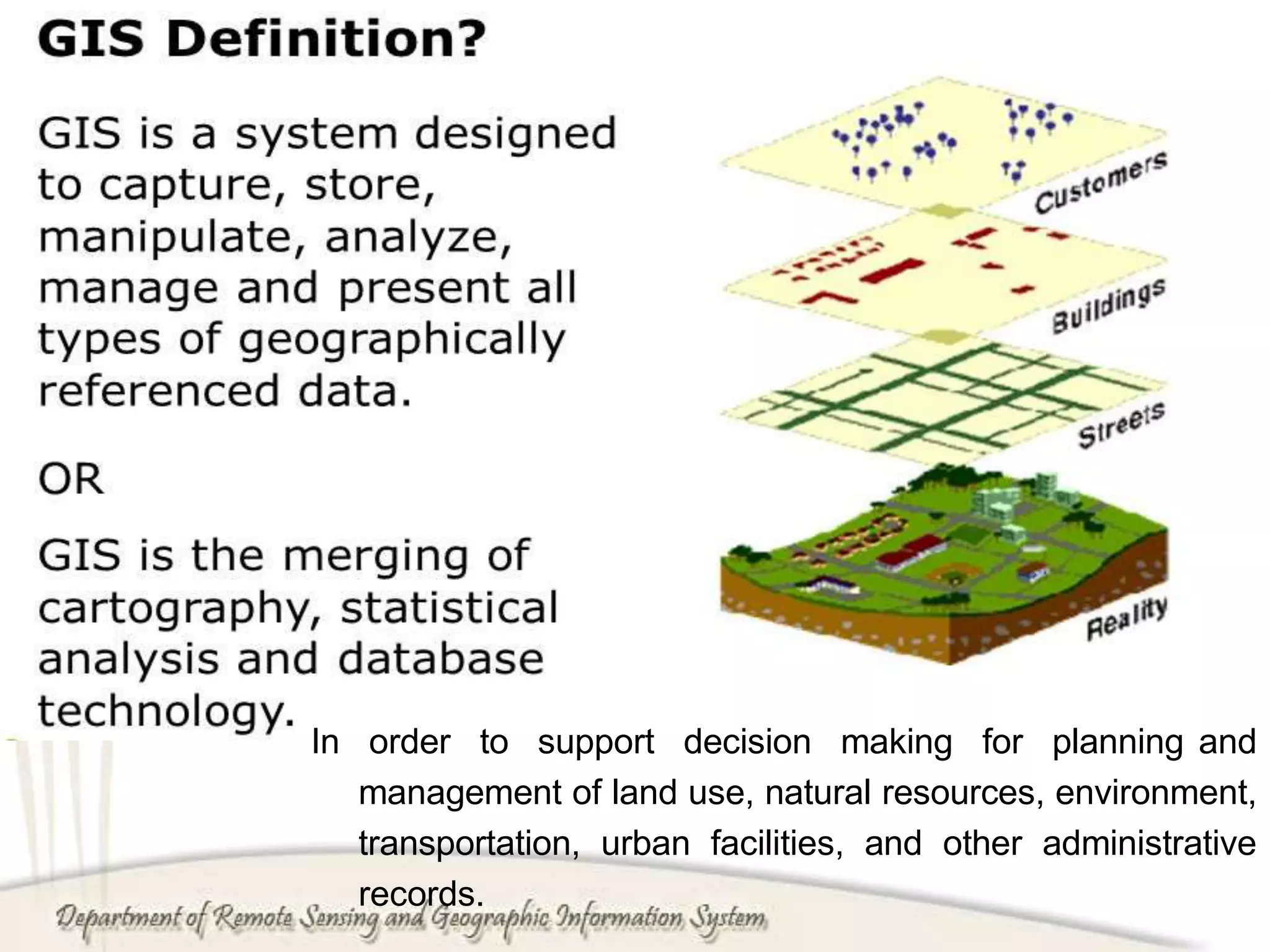
In order to support decision making for planning and
management of land use, natural resources, environment,
transportation, urban facilities, and other administrative
records.
History
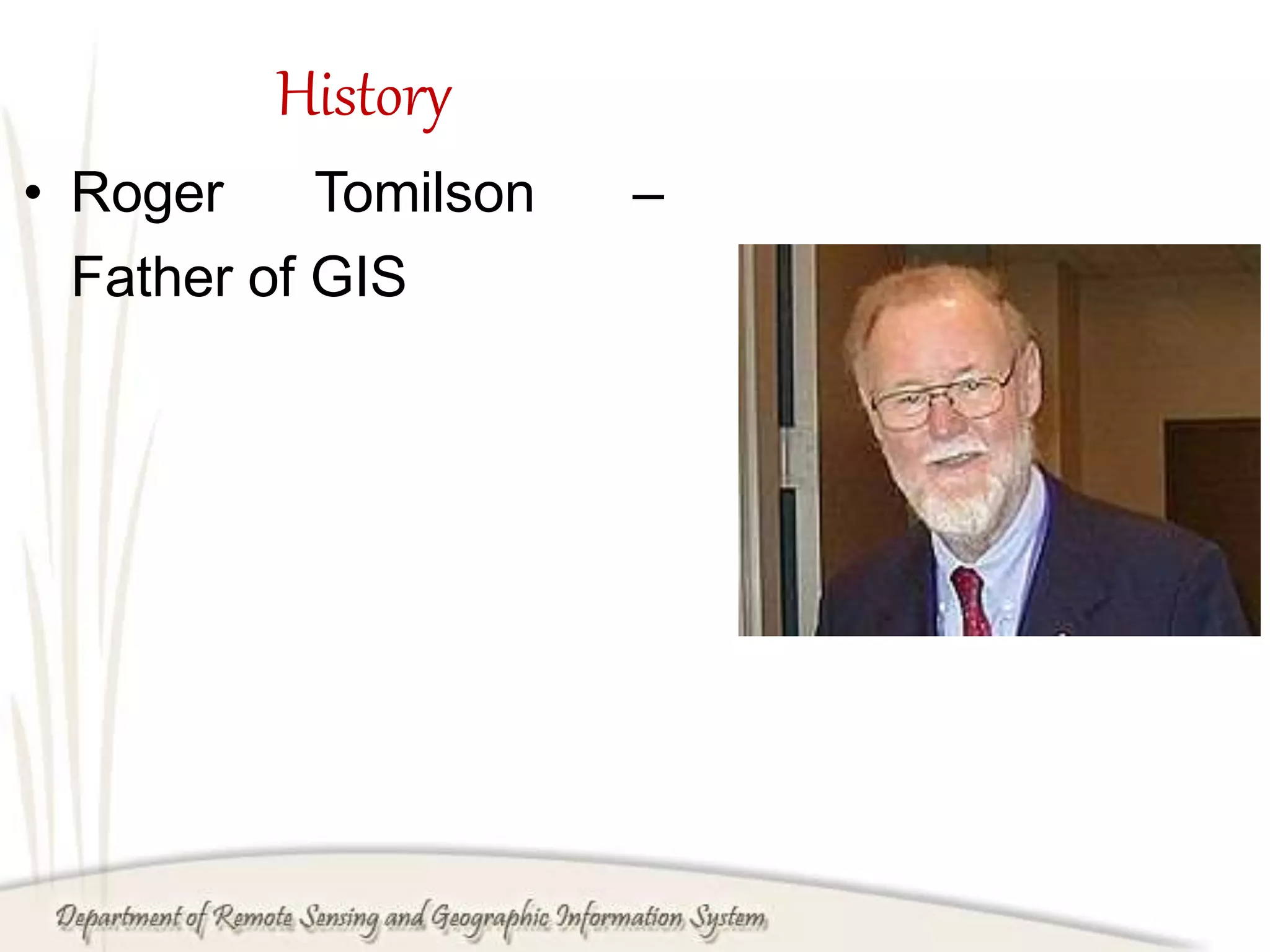
• Roger Tomilson –
Father of GIS
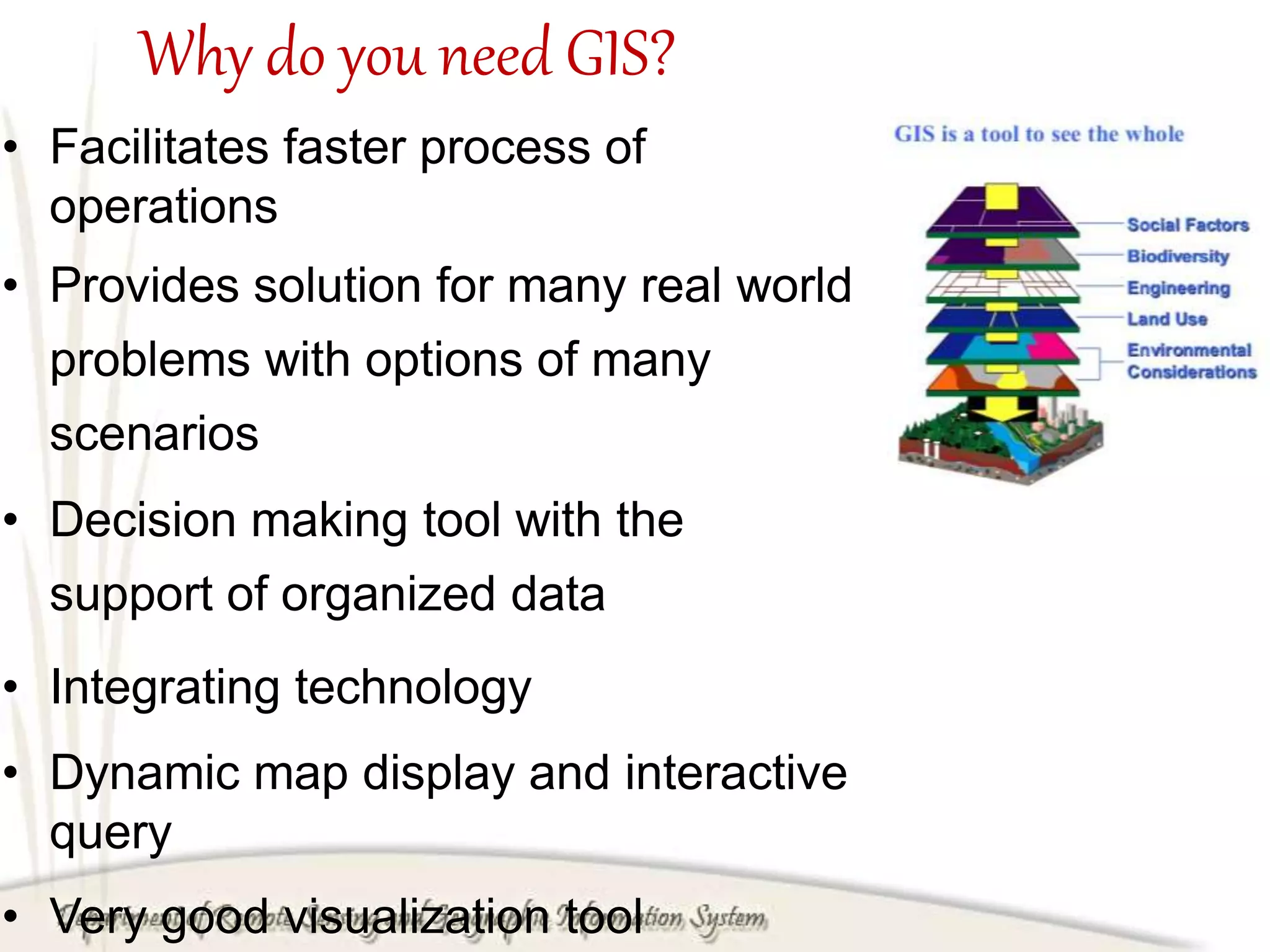
Why do you need GIS?
• Facilitates faster process of
operations
• Provides solution for many real world
problems with options of many
scenarios
• Decision making tool with the
support of organized data
• Integrating technology
• Dynamic map display and interactive
query
• Very good visualization tool
Technologies that support GIS
• Remote Sensing
• Photogrammetry (in surveying and mapping to ascertain
measurements between objects)
• Cartography (Manual/Automated)
• CAD/CAM (Computer-Aided Design & Manufacturing)
• Geodesy/Surveying/Mapping
• Geo-ICT (Geospatial information and
communication)
Where it is used?
• Natural resource management
• Infrastructure development
• Utility services
• Business applications
• Investigation services
• e-governance
• Scientific research
• Environment & Disaster management
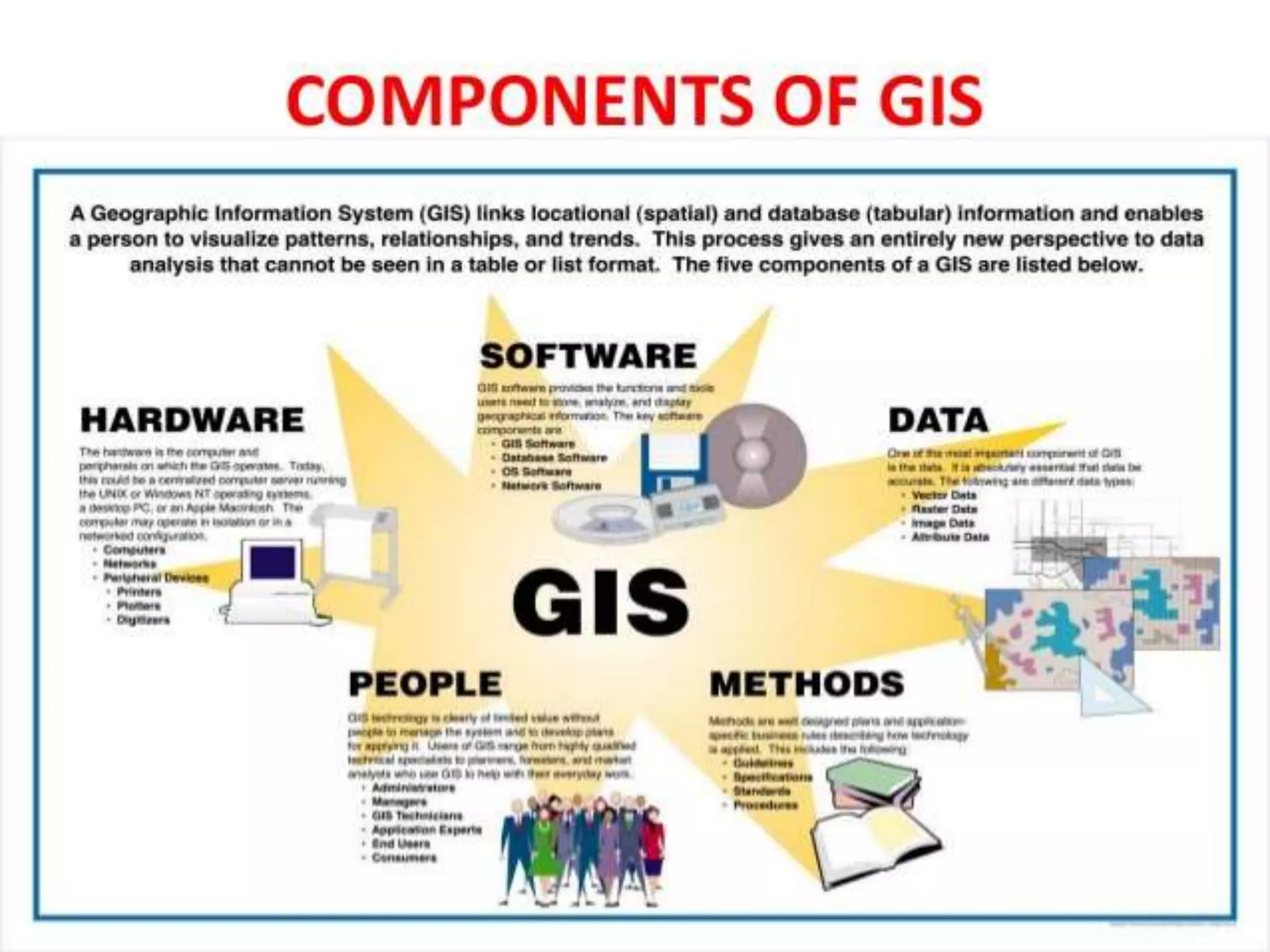
Software
• GIS software provides the functions and tools
needed to store, analyze, and display
geographic information.
Key software components are:
• Tools for the input and manipulation of
geographic information
• A database management system
• Tools that support geographic query,
analysis and visualization
• A graphical user interface (GUI) for easy
access to tools
Data
• Possibly the most important component of a GIS
is the data.
• Geographic data and related tabular data can be
collected in-house or purchased from a
commercial data provider.
• A GIS will integrate spatial data (numerical
value) with other data resources and can even
use a DBMS (data base mgt system), used by
most organizations to organize and maintain
their data, to manage spatial data.
People
• GIS technology is of limited value without
the people who manage the system and
develop plans for applying it to real-world
problems.
GIS users range from technical specialists
who design and maintain the system to
those who use it to help them perform
METHODS
• A successful GIS operates according to
a well-designed plan and business rules,
which are the models and operating
practices unique to each organization.
Benefits for GIS
• Opportunity to reduce sets of manual maps held and associated
storage costs.
• Faster and more extensive access to geographic information.
• Improved analysis e.g. areas, distances, patterns, etc.
• Better communication of information to public officers,
members.
• Improved quality of services.
• Better targeting and coordination of services.
• Improved productivity in providing public information
• Improved efficiency in updating maps.
• Improved ability to aggregate data for specific sub areas.
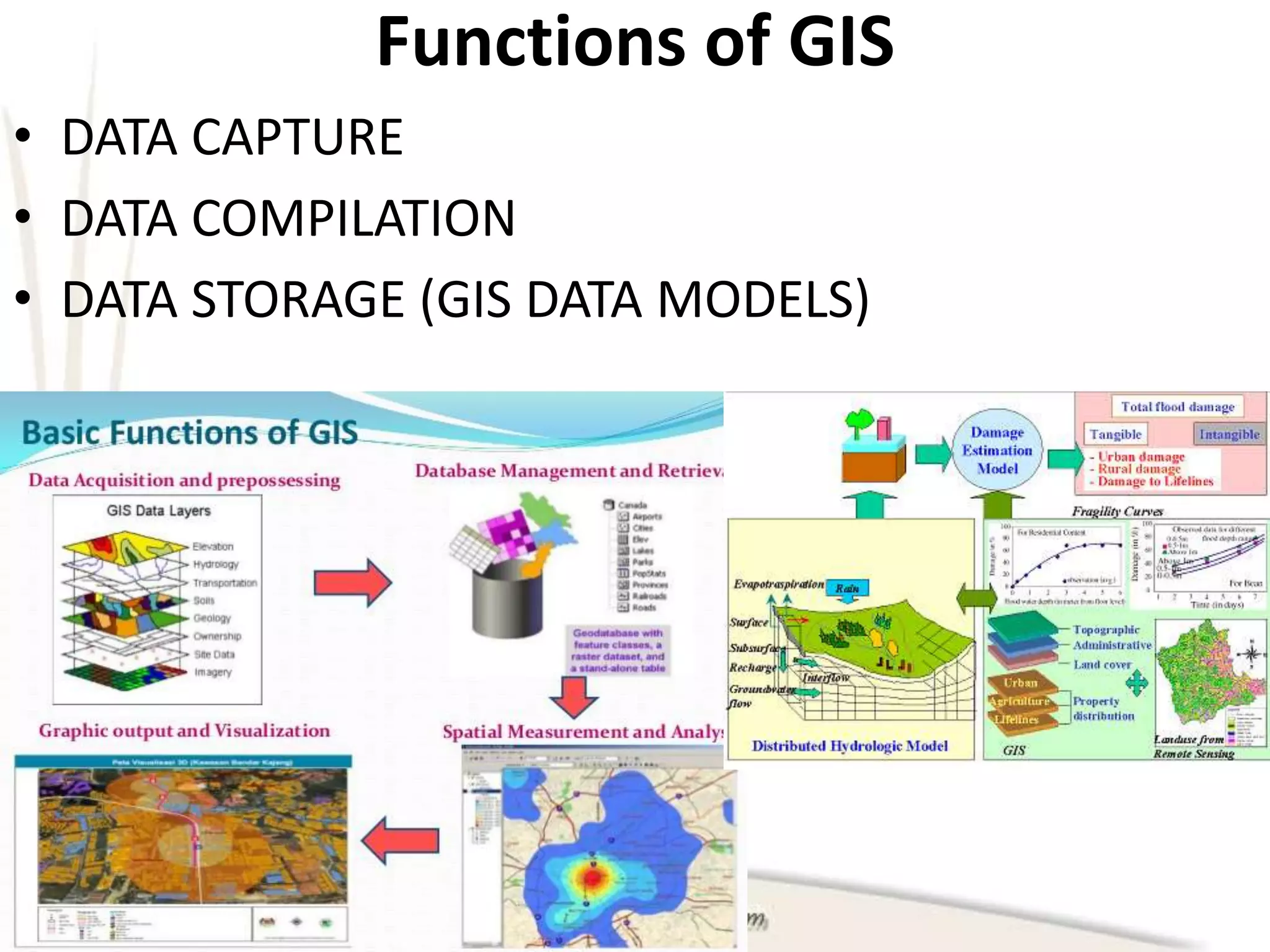
Functions of GIS
• DATA CAPTURE
• DATA COMPILATION
• DATA STORAGE (GIS DATA MODELS)
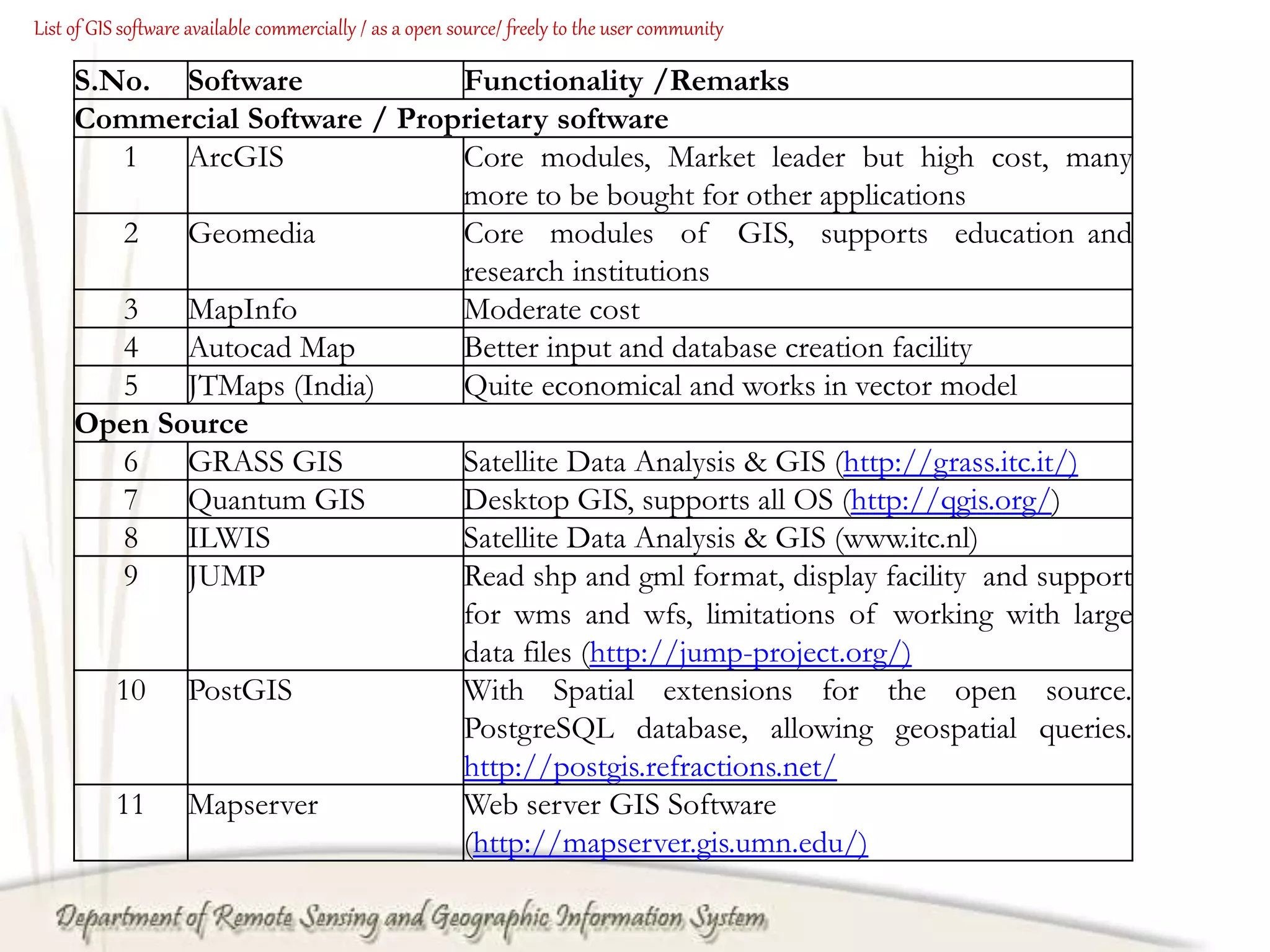
S.No. Software Functionality /Remarks
Commercial Software / Proprietary software
1 ArcGIS Core modules, Market leader but high cost, many
more to be bought for other applications
2 Geomedia Core modules of GIS, supports education and
research institutions
3 MapInfo Moderate cost
4 Autocad Map Better input and database creation facility
5 JTMaps (India) Quite economical and works in vector model
Open Source
6 GRASS GIS Satellite Data Analysis & GIS (http://grass.itc.it/)
7 Quantum GIS Desktop GIS, supports all OS (http://qgis.org/)
8 ILWIS Satellite Data Analysis & GIS (www.itc.nl)
9 JUMP Read shp and gml format, display facility and support
for wms and wfs, limitations of working with large
data files (http://jump-project.org/)
10 PostGIS With Spatial extensions for the open source.
PostgreSQL database, allowing geospatial queries.
http://postgis.refractions.net/
11 Mapserver Web server GIS Software
(http://mapserver.gis.umn.edu/)
List of GIS software available commercially / as a open source/ freely to the user community
Advantages of GIS
• Exploring both geographical and thematic components of data in
a holistic way
• Stresses geographical aspects of a research question
• Large volumes of data
• Integration of data from widely disparate sources
• Allows a wide variety of forms of visualisation
Disadvantages of GIS
• Data are expensive
• Learning curve on GIS software can be long
• Shows spatial relationships but does not provide absolute solutions
• Origins in the Earth sciences and computer science.
• Solutions may not be appropriate for humanities research
Potential of GIS
The application of GIS is limited only by the imagination of
those who use it
~ Jack Dangermond
BY:B.SUBHASH

GEOGRAPHICAL INFORMATION SYSTEM (GIS)

  • 1.
    Geographic Information System(GIS) Definition -Components -functions
  • 2.
    In order tosupport decision making for planning and management of land use, natural resources, environment, transportation, urban facilities, and other administrative records.
  • 4.
    History • Roger Tomilson– Father of GIS
  • 5.
    Why do youneed GIS? • Facilitates faster process of operations • Provides solution for many real world problems with options of many scenarios • Decision making tool with the support of organized data • Integrating technology • Dynamic map display and interactive query • Very good visualization tool
  • 6.
    Technologies that supportGIS • Remote Sensing • Photogrammetry (in surveying and mapping to ascertain measurements between objects) • Cartography (Manual/Automated) • CAD/CAM (Computer-Aided Design & Manufacturing) • Geodesy/Surveying/Mapping • Geo-ICT (Geospatial information and communication)
  • 7.
    Where it isused? • Natural resource management • Infrastructure development • Utility services • Business applications • Investigation services • e-governance • Scientific research • Environment & Disaster management
  • 9.
    Software • GIS softwareprovides the functions and tools needed to store, analyze, and display geographic information. Key software components are: • Tools for the input and manipulation of geographic information • A database management system • Tools that support geographic query, analysis and visualization • A graphical user interface (GUI) for easy access to tools
  • 10.
    Data • Possibly themost important component of a GIS is the data. • Geographic data and related tabular data can be collected in-house or purchased from a commercial data provider. • A GIS will integrate spatial data (numerical value) with other data resources and can even use a DBMS (data base mgt system), used by most organizations to organize and maintain their data, to manage spatial data.
  • 11.
    People • GIS technologyis of limited value without the people who manage the system and develop plans for applying it to real-world problems. GIS users range from technical specialists who design and maintain the system to those who use it to help them perform
  • 12.
    METHODS • A successfulGIS operates according to a well-designed plan and business rules, which are the models and operating practices unique to each organization.
  • 13.
    Benefits for GIS •Opportunity to reduce sets of manual maps held and associated storage costs. • Faster and more extensive access to geographic information. • Improved analysis e.g. areas, distances, patterns, etc. • Better communication of information to public officers, members. • Improved quality of services. • Better targeting and coordination of services. • Improved productivity in providing public information • Improved efficiency in updating maps. • Improved ability to aggregate data for specific sub areas.
  • 14.
    Functions of GIS •DATA CAPTURE • DATA COMPILATION • DATA STORAGE (GIS DATA MODELS)
  • 15.
    S.No. Software Functionality/Remarks Commercial Software / Proprietary software 1 ArcGIS Core modules, Market leader but high cost, many more to be bought for other applications 2 Geomedia Core modules of GIS, supports education and research institutions 3 MapInfo Moderate cost 4 Autocad Map Better input and database creation facility 5 JTMaps (India) Quite economical and works in vector model Open Source 6 GRASS GIS Satellite Data Analysis & GIS (http://grass.itc.it/) 7 Quantum GIS Desktop GIS, supports all OS (http://qgis.org/) 8 ILWIS Satellite Data Analysis & GIS (www.itc.nl) 9 JUMP Read shp and gml format, display facility and support for wms and wfs, limitations of working with large data files (http://jump-project.org/) 10 PostGIS With Spatial extensions for the open source. PostgreSQL database, allowing geospatial queries. http://postgis.refractions.net/ 11 Mapserver Web server GIS Software (http://mapserver.gis.umn.edu/) List of GIS software available commercially / as a open source/ freely to the user community
  • 16.
    Advantages of GIS •Exploring both geographical and thematic components of data in a holistic way • Stresses geographical aspects of a research question • Large volumes of data • Integration of data from widely disparate sources • Allows a wide variety of forms of visualisation Disadvantages of GIS • Data are expensive • Learning curve on GIS software can be long • Shows spatial relationships but does not provide absolute solutions • Origins in the Earth sciences and computer science. • Solutions may not be appropriate for humanities research
  • 17.
    Potential of GIS Theapplication of GIS is limited only by the imagination of those who use it ~ Jack Dangermond
  • 18.