Dr Ajai Agrawal
Additional Professor
Department of Ophthalmology
AIIMS Rishikesh
Acknowledgement
• Photographs in this presentation are courtesy of
Kanski’s Clinical Ophthalmology.
2
Learning Objectives
At the end of the class, students shall be able to
•Understand what is refraction.
•Have basic knowledge of myopia and its management.
3
What is Refraction
• When rays of light traveling through air enter a
denser transparent medium, the speed of the
light is reduced and the light rays proceed at a
different angle, i.e., they are refracted.
• Except when the rays are normal
Refraction in Ophthalmology
• Methods for evaluating the optical and refractive
state of the eye
4
Emmetropia
• Parallel light rays, from an object more than 6 m away,
are focused at the plane of the retina when accomodation
is at rest.
• Clear image of a distant object formed without any
internal adjustment of the optics of the eye.
• Absence of emmetropia = Ametropia
5
Progress of refractive state of eye
• Birth : +2 to +3 D
• 90% of children at age 5 yrs are Hypermetropic
• 50% of children at age 16 yrs are Hypermetropic
• After the period of growth has passed the refractive state
tends to remain stationary, until in old age a further
tendency of hypermetropia is evident.
6
Refractive data in adult
• Normal axial length ≈ 24 mm
• Change in axial length by 1mm = ±3D
• Refraction at corneal surface= +40 to 45(+43)D
• Change in Corneal Curvature by 1mm = ±6D
• Refraction by unaccomodated lens= +16 to
20(+17)D
7
Angle kappa (κ)
κ (
F
M
B
N
D
FNM = Visual axis
Optic axis
FD = Pupillary line
• M = Macula
• D= Centre of pupil, on cornea
• N = Nodal point
κ = “Between the visual axis and pupillary line, hence roughly corresponds to
angle α”.
8
Anisometropia
• Anisometropia is a state in which there is a difference in
the refractive errors of the two eyes, i.e., one eye is
myopic and the other hyperopic, or both are hyperopic
or myopic but to different degrees.
• This condition may be congenital or acquired due to
asymmetric age changes or disease.
9
Anomalies of the optical state of the eye
•Myopia
•Hypermetropia
•Astigmatism
10
What is Myopia ?
• Diopteric condition of the eye
where parallel incident rays from
optical infinity
focus anterior to light
sensitive layers of retina
when accomodation
is at rest
11
Myopia – Optics
Diverging lens
Emmetropia
12
Optics of Myopic eye
• Far point is at a finite distance inversely proportional to
the degree of myopia
• Weakest concave lens that diverges rays just sufficiently
to focus them at the retina is to be used
• Poor visual acuity is compensated to some extent by
enlarged image size due to the nodal point being further
from the retina
13
Causes of Myopia
• The causes of myopia are not known.
• Epidemiological correlation suggest...
▫ lengthy periods of close work are probably a
contributory factor
▫ there is some genetic predisposition to myopia and its
severity
14
• Axial
• Curvature
• Index
• Positional
15
Axial Myopia
• AP diameter increased to 25.5 to 32.5 mm
• 90-95% cases
• There may be…
▫ pseudoproptosis resulting from the abnormally large
anterior segment,
▫ a peripapillary myopic crescent from an exaggerated
scleral ring,
▫ posterior staphyloma
16
Curvature Myopia
• Corneal curvature steeper than average, e.g.,
keratoconus,
• Radius <7-8.5 mm (normal); 1 mm=6 D
• Lens curvature is increased
• moderate to severe hyperglycemia (intumescence)
lenticonus (ant/post)
spasm of accomodation
spherophakia
17
Index Myopia
• Increased index of refraction in early to moderate
nuclear sclerotic cataracts in the elderly.
• Many people find themselves ultimately able to read
without glasses or having gained “second sight.”
• Decrease in refractive index of cortex – diabetic
myopia
18
Positional Myopia
• Anterior movement of the lens is often seen after
glaucoma surgery and will increase the myopic error in
the eye.
• Axial myopia of buphthalmos is countered to a large
extent due to posterior displacement of lens-iris
diaphragm and flattening of the cornea
19
• Simple
• Pathological
20
Simple Myopia
• Rarely present at birth, but often begins to
develop as the child grows.
• Usually detected by age 9 or 10 years in the
school vision tests
• May increase during the years of growth,
stabilizing around the mid-teens, usually at
about 5 D or less.
21
Pathological Myopia
• 2-3% population
• Increases by as much as 4 D/yr
• Usually stabilizes at about age 20 years and frequently
results in myopia – 10 to 20 D.
• If progress is rapid from age 15-20, likely to reach 20-30
dioptres
• Commoner in women, Jews and Japanese
22
Pathological Myopia-Etiology
• Developmental defect affecting posterior segment
• Retina grows extensively stretching sclera
• Adjuvants- growth influences during puberty and
physical debility
• Excessive convergence- stretching
23
Pathological Myopia
• Associated vitreous floaters, liquefaction, posterior
staphyloma and chorioretinal changes.
• Degeneration is not necessarily comparable with degree
of myopia
• Genetic predisposition in offspring as per laws of
recessive Mendelian inheritance – if both parents
affected, close supervision needed
24
School/ Physiologic/Pseudo-Myopia
• ≤ 2D
• Excessive near work causing accomodative
spasm
• Inherited predisposition-more in Orientals and
Jews
25
26
Symptoms
1. Blurred distance vision.
2. Squinting to sharpen distance vision by attempting a
pinhole effect through narrowing of the palpebral
fissures.
3. Eye strain seen in patients with uncorrected low
myopic errors
4. Closer working distance at near that typically gets
closer and closer as the person sustains working at
near.
5. Delayed dark adaptation
6. Floaters, photopsiae
7. Visual deterioration
27
Signs
• Small eyeball
• Smaller cornea
• Shallow anterior chamber predisposes to angle closure
glaucoma since size of lens is normal
• Apparent divergent squint
28
Clinical Signs –
Apparent convergent squint
•The problem begins at near and spreads to distance
leading to a cascade of changes in the findings over time
•Results usually in apparent convergent squint due to
excess convergence
29
Clinical Signs –
True divergent squint
• Excess convergence for near work disorients
accommodation which may increase causing ciliary
spasm or
• more frequently, attempt at convergence is given up, its
latent insufficiency causing muscular imbalance till
• advantage of binocular vision is given up, one eye is
relied upon for vision while the other deviates outwards
causing true divergent squint
30
Pathology
• Eye appears large and prominent – pseudoproptosis
• Deep anterior chamber
• Large, sluggish pupil
• Post segment sclera is thinned up to 25% of normal
• Post vitreous detachment – Weiss ring
• Liquefaction – muscae volitantes, large floaters
31
Fundus
• Atrophy of retina and choroid –
depigmentation
• Tigroid fundus with prominent
choroidal vessels
• Patches of choroidal atrophy
surrounded by pigment associated
with haemorrhages
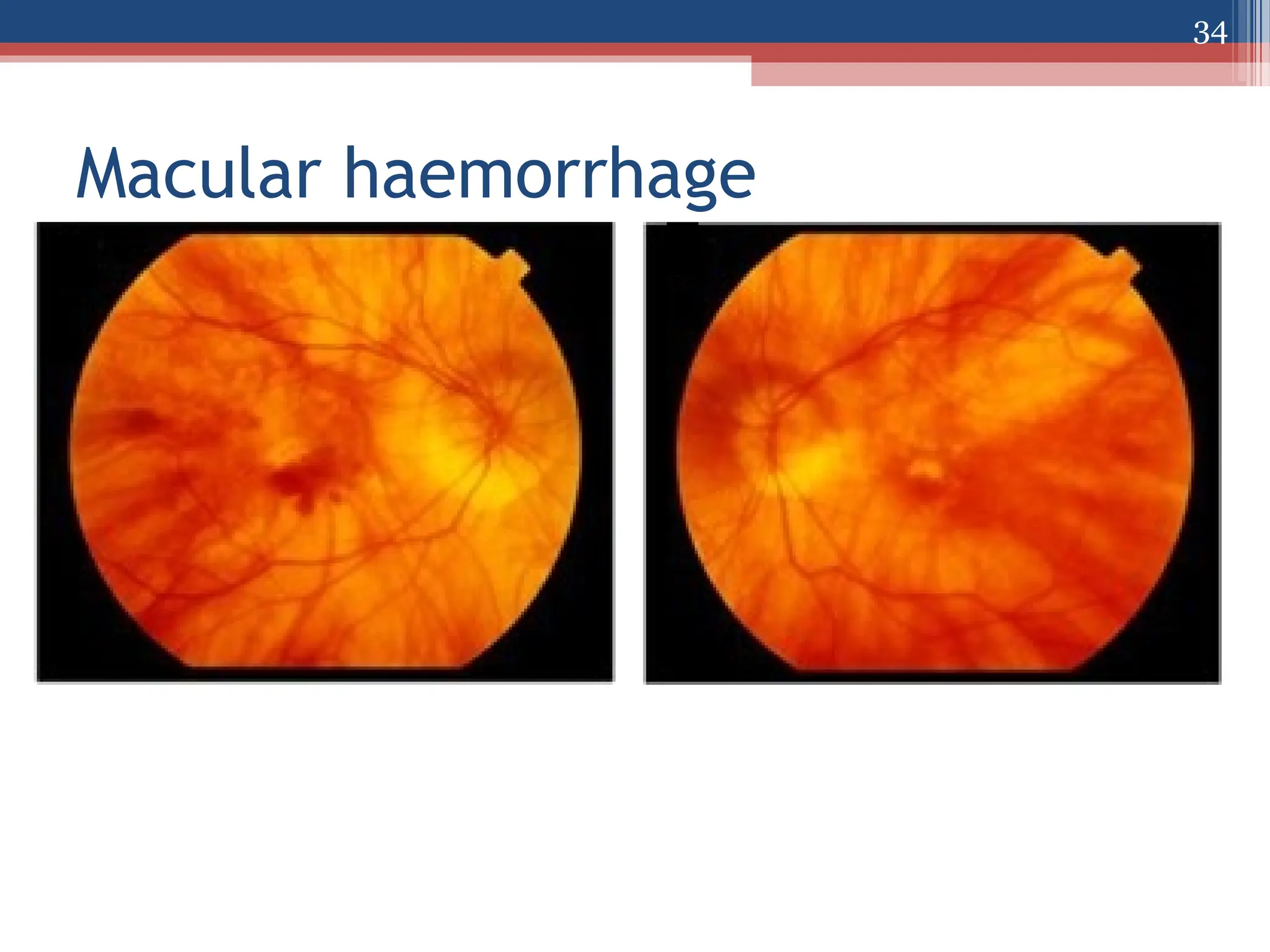
• Atrophic patch at macula
associated with loss of central
vision
32
Fundus
• Appearance of dark pigmented area at macula-Foster-
Fuch’s fleck – rare, sudden, proliferation of pigmentary
epithelium with intra-choroidal haemorrhage or
thrombosis
• Macular bunches of dilated capillaries or aneurysms
• Myopic crescent – temporal or annular
• Nasal supertraction crescent
33
Macular haemorrhage
34
Posterior staphyloma
• Herniation of posterior pole
• Crescentric shadow 2-3 DD temporal to disc,
• Sudden kinking of retinal vessels as they dip over the edges,
• Gross atrophy
35
Peripheral
Degenerations
Not requiring
prophylaxis:
Paving stone
36
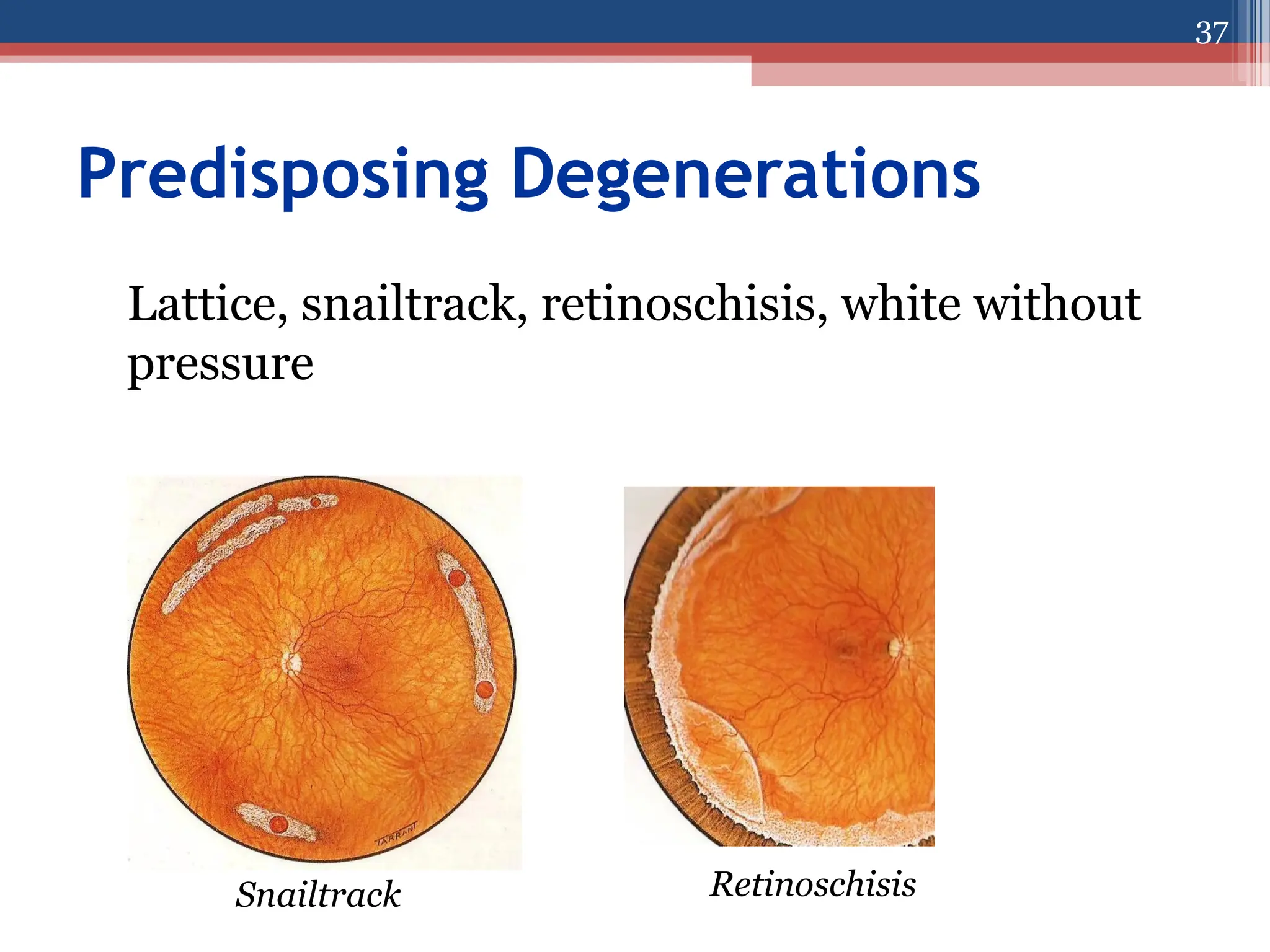
Predisposing Degenerations
Lattice, snailtrack, retinoschisis, white without
pressure
Snailtrack Retinoschisis
37
Lattice degeneration
Figure:
38
Complications
• Atrophy – scotomata
– macular most incapacitating
• Vitreous degeneration + floaters
• Tears + haemorrhages
• Detachment – post traumatic or spontaneous
associated with peripheral degenerations due to
vitreous adhesion
• Lenticular opacities, esp. posterior cortical
• Open angle glaucoma
Horseshoe Tear
39
Night myopia
• Manifest in reduced illumination
• ~ 0.5 D
• Cone-rod shift in retina, pupillary dilatation,
ciliary muscle activity
• If night vision appears seriously impaired,
appropriate correction may be given
40
1. Optical correction after subjective and objective
refraction
▫ Spectacles
▫ Contact lens (including Orthokeratology)
2. Visual hygiene
3. Refractive surgery
▫ LASIK 
LASEK
▫ Wavefront Lasik 
Clear lens Extraction
▫ Phakic IOL 
ICRS
4. Pharmacological intervention
41
42
Myopia – Optics
Diverging lens
43
Cycloplegic Refraction
• Cycloplegia is the employment of
pharmaceutical agents to paralyze the ciliary
muscle temporarily to stabilize the
accommodative reflex of the eye so that a
definitive end point may be measured.
• Benefit of relaxing the accommodative tone is
especially important in young individuals.
• Cycloplegic + Mydriatic = Relaxes accomodation
+ dilates pupil for better reflex
44
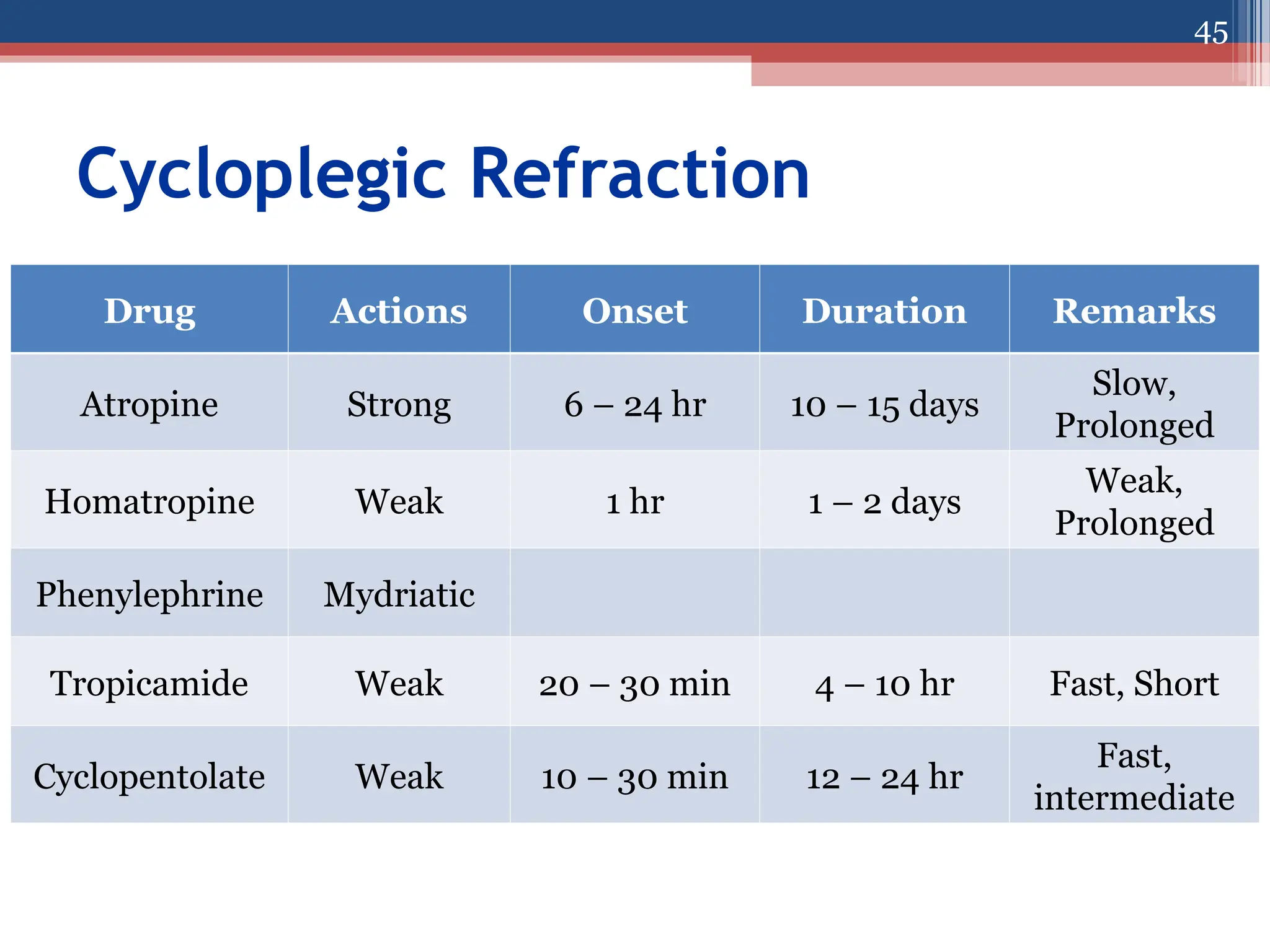
Cycloplegic Refraction
Drug Actions Onset Duration Remarks
Atropine Strong 6 – 24 hr 10 – 15 days
Slow,
Prolonged
Homatropine Weak 1 hr 1 – 2 days
Weak,
Prolonged
Phenylephrine Mydriatic
Tropicamide Weak 20 – 30 min 4 – 10 hr Fast, Short
Cyclopentolate Weak 10 – 30 min 12 – 24 hr
Fast,
intermediate
45
• Proper illumination
• Proper posture
• Clear print
• Better contrast
• Avoid ocular fatigue
• Proper occupation in case of degenerative
myopia
• May need special institutions if low vision
dictates
46
Summary
• Refraction is a method for evaluating the optical and
refractive state of the eye.
• Myopia is a diopteric condition of the eye where
parallel incident rays from optical infinity
focus anterior to light sensitive layers
of retina when
accomodation is at rest.
• Myopia is corrected by concave lenses prescribed after
cycloplegic refraction.
47
Thank you
48

741_Refraction_I.ppt eye structure and movements

  • 1.
    Dr Ajai Agrawal AdditionalProfessor Department of Ophthalmology AIIMS Rishikesh
  • 2.
    Acknowledgement • Photographs inthis presentation are courtesy of Kanski’s Clinical Ophthalmology. 2
  • 3.
    Learning Objectives At theend of the class, students shall be able to •Understand what is refraction. •Have basic knowledge of myopia and its management. 3
  • 4.
    What is Refraction •When rays of light traveling through air enter a denser transparent medium, the speed of the light is reduced and the light rays proceed at a different angle, i.e., they are refracted. • Except when the rays are normal Refraction in Ophthalmology • Methods for evaluating the optical and refractive state of the eye 4
  • 5.
    Emmetropia • Parallel lightrays, from an object more than 6 m away, are focused at the plane of the retina when accomodation is at rest. • Clear image of a distant object formed without any internal adjustment of the optics of the eye. • Absence of emmetropia = Ametropia 5
  • 6.
    Progress of refractivestate of eye • Birth : +2 to +3 D • 90% of children at age 5 yrs are Hypermetropic • 50% of children at age 16 yrs are Hypermetropic • After the period of growth has passed the refractive state tends to remain stationary, until in old age a further tendency of hypermetropia is evident. 6
  • 7.
    Refractive data inadult • Normal axial length ≈ 24 mm • Change in axial length by 1mm = ±3D • Refraction at corneal surface= +40 to 45(+43)D • Change in Corneal Curvature by 1mm = ±6D • Refraction by unaccomodated lens= +16 to 20(+17)D 7
  • 8.
    Angle kappa (κ) κ( F M B N D FNM = Visual axis Optic axis FD = Pupillary line • M = Macula • D= Centre of pupil, on cornea • N = Nodal point κ = “Between the visual axis and pupillary line, hence roughly corresponds to angle α”. 8
  • 9.
    Anisometropia • Anisometropia isa state in which there is a difference in the refractive errors of the two eyes, i.e., one eye is myopic and the other hyperopic, or both are hyperopic or myopic but to different degrees. • This condition may be congenital or acquired due to asymmetric age changes or disease. 9
  • 10.
    Anomalies of theoptical state of the eye •Myopia •Hypermetropia •Astigmatism 10
  • 11.
    What is Myopia? • Diopteric condition of the eye where parallel incident rays from optical infinity focus anterior to light sensitive layers of retina when accomodation is at rest 11
  • 12.
    Myopia – Optics Diverginglens Emmetropia 12
  • 13.
    Optics of Myopiceye • Far point is at a finite distance inversely proportional to the degree of myopia • Weakest concave lens that diverges rays just sufficiently to focus them at the retina is to be used • Poor visual acuity is compensated to some extent by enlarged image size due to the nodal point being further from the retina 13
  • 14.
    Causes of Myopia •The causes of myopia are not known. • Epidemiological correlation suggest... ▫ lengthy periods of close work are probably a contributory factor ▫ there is some genetic predisposition to myopia and its severity 14
  • 15.
    • Axial • Curvature •Index • Positional 15
  • 16.
    Axial Myopia • APdiameter increased to 25.5 to 32.5 mm • 90-95% cases • There may be… ▫ pseudoproptosis resulting from the abnormally large anterior segment, ▫ a peripapillary myopic crescent from an exaggerated scleral ring, ▫ posterior staphyloma 16
  • 17.
    Curvature Myopia • Cornealcurvature steeper than average, e.g., keratoconus, • Radius <7-8.5 mm (normal); 1 mm=6 D • Lens curvature is increased • moderate to severe hyperglycemia (intumescence) lenticonus (ant/post) spasm of accomodation spherophakia 17
  • 18.
    Index Myopia • Increasedindex of refraction in early to moderate nuclear sclerotic cataracts in the elderly. • Many people find themselves ultimately able to read without glasses or having gained “second sight.” • Decrease in refractive index of cortex – diabetic myopia 18
  • 19.
    Positional Myopia • Anteriormovement of the lens is often seen after glaucoma surgery and will increase the myopic error in the eye. • Axial myopia of buphthalmos is countered to a large extent due to posterior displacement of lens-iris diaphragm and flattening of the cornea 19
  • 20.
  • 21.
    Simple Myopia • Rarelypresent at birth, but often begins to develop as the child grows. • Usually detected by age 9 or 10 years in the school vision tests • May increase during the years of growth, stabilizing around the mid-teens, usually at about 5 D or less. 21
  • 22.
    Pathological Myopia • 2-3%population • Increases by as much as 4 D/yr • Usually stabilizes at about age 20 years and frequently results in myopia – 10 to 20 D. • If progress is rapid from age 15-20, likely to reach 20-30 dioptres • Commoner in women, Jews and Japanese 22
  • 23.
    Pathological Myopia-Etiology • Developmentaldefect affecting posterior segment • Retina grows extensively stretching sclera • Adjuvants- growth influences during puberty and physical debility • Excessive convergence- stretching 23
  • 24.
    Pathological Myopia • Associatedvitreous floaters, liquefaction, posterior staphyloma and chorioretinal changes. • Degeneration is not necessarily comparable with degree of myopia • Genetic predisposition in offspring as per laws of recessive Mendelian inheritance – if both parents affected, close supervision needed 24
  • 25.
    School/ Physiologic/Pseudo-Myopia • ≤2D • Excessive near work causing accomodative spasm • Inherited predisposition-more in Orientals and Jews 25
  • 26.
  • 27.
    Symptoms 1. Blurred distancevision. 2. Squinting to sharpen distance vision by attempting a pinhole effect through narrowing of the palpebral fissures. 3. Eye strain seen in patients with uncorrected low myopic errors 4. Closer working distance at near that typically gets closer and closer as the person sustains working at near. 5. Delayed dark adaptation 6. Floaters, photopsiae 7. Visual deterioration 27
  • 28.
    Signs • Small eyeball •Smaller cornea • Shallow anterior chamber predisposes to angle closure glaucoma since size of lens is normal • Apparent divergent squint 28
  • 29.
    Clinical Signs – Apparentconvergent squint •The problem begins at near and spreads to distance leading to a cascade of changes in the findings over time •Results usually in apparent convergent squint due to excess convergence 29
  • 30.
    Clinical Signs – Truedivergent squint • Excess convergence for near work disorients accommodation which may increase causing ciliary spasm or • more frequently, attempt at convergence is given up, its latent insufficiency causing muscular imbalance till • advantage of binocular vision is given up, one eye is relied upon for vision while the other deviates outwards causing true divergent squint 30
  • 31.
    Pathology • Eye appearslarge and prominent – pseudoproptosis • Deep anterior chamber • Large, sluggish pupil • Post segment sclera is thinned up to 25% of normal • Post vitreous detachment – Weiss ring • Liquefaction – muscae volitantes, large floaters 31
  • 32.
    Fundus • Atrophy ofretina and choroid – depigmentation • Tigroid fundus with prominent choroidal vessels • Patches of choroidal atrophy surrounded by pigment associated with haemorrhages • Atrophic patch at macula associated with loss of central vision 32
  • 33.
    Fundus • Appearance ofdark pigmented area at macula-Foster- Fuch’s fleck – rare, sudden, proliferation of pigmentary epithelium with intra-choroidal haemorrhage or thrombosis • Macular bunches of dilated capillaries or aneurysms • Myopic crescent – temporal or annular • Nasal supertraction crescent 33
  • 34.
  • 35.
    Posterior staphyloma • Herniationof posterior pole • Crescentric shadow 2-3 DD temporal to disc, • Sudden kinking of retinal vessels as they dip over the edges, • Gross atrophy 35
  • 36.
  • 37.
    Predisposing Degenerations Lattice, snailtrack,retinoschisis, white without pressure Snailtrack Retinoschisis 37
  • 38.
  • 39.
    Complications • Atrophy –scotomata – macular most incapacitating • Vitreous degeneration + floaters • Tears + haemorrhages • Detachment – post traumatic or spontaneous associated with peripheral degenerations due to vitreous adhesion • Lenticular opacities, esp. posterior cortical • Open angle glaucoma Horseshoe Tear 39
  • 40.
    Night myopia • Manifestin reduced illumination • ~ 0.5 D • Cone-rod shift in retina, pupillary dilatation, ciliary muscle activity • If night vision appears seriously impaired, appropriate correction may be given 40
  • 41.
    1. Optical correctionafter subjective and objective refraction ▫ Spectacles ▫ Contact lens (including Orthokeratology) 2. Visual hygiene 3. Refractive surgery ▫ LASIK  LASEK ▫ Wavefront Lasik  Clear lens Extraction ▫ Phakic IOL  ICRS 4. Pharmacological intervention 41
  • 42.
  • 43.
  • 44.
    Cycloplegic Refraction • Cycloplegiais the employment of pharmaceutical agents to paralyze the ciliary muscle temporarily to stabilize the accommodative reflex of the eye so that a definitive end point may be measured. • Benefit of relaxing the accommodative tone is especially important in young individuals. • Cycloplegic + Mydriatic = Relaxes accomodation + dilates pupil for better reflex 44
  • 45.
    Cycloplegic Refraction Drug ActionsOnset Duration Remarks Atropine Strong 6 – 24 hr 10 – 15 days Slow, Prolonged Homatropine Weak 1 hr 1 – 2 days Weak, Prolonged Phenylephrine Mydriatic Tropicamide Weak 20 – 30 min 4 – 10 hr Fast, Short Cyclopentolate Weak 10 – 30 min 12 – 24 hr Fast, intermediate 45
  • 46.
    • Proper illumination •Proper posture • Clear print • Better contrast • Avoid ocular fatigue • Proper occupation in case of degenerative myopia • May need special institutions if low vision dictates 46
  • 47.
    Summary • Refraction isa method for evaluating the optical and refractive state of the eye. • Myopia is a diopteric condition of the eye where parallel incident rays from optical infinity focus anterior to light sensitive layers of retina when accomodation is at rest. • Myopia is corrected by concave lenses prescribed after cycloplegic refraction. 47
  • 48.