B.Sc Degree Course in Nursing
(Basic)
MEDICAL SURGICAL NURSING
UNIT II: Nursing Care of patients
with Eye Disorders.
Topic: Refractive Errors.
PRESENTED BY
Mrs. SOUMYA SUBRAMANI, M.Sc.(N)
LECTURER, MSN DEPARTMENT
CON- SRIPMS, COIMBATORE.
OBJECTIVES
• Introduction of refractory error
• Define refractory error
• Explain the types of refractory error
• Enlist the etiological factors of refractory error
• Describe the pathophysiology of refractory error
• Enlist the symptoms of refratory error
• Enumerate the diagnostic evaluation of refractory error
• Explain the medical, surgical and nursing management of refractory
error
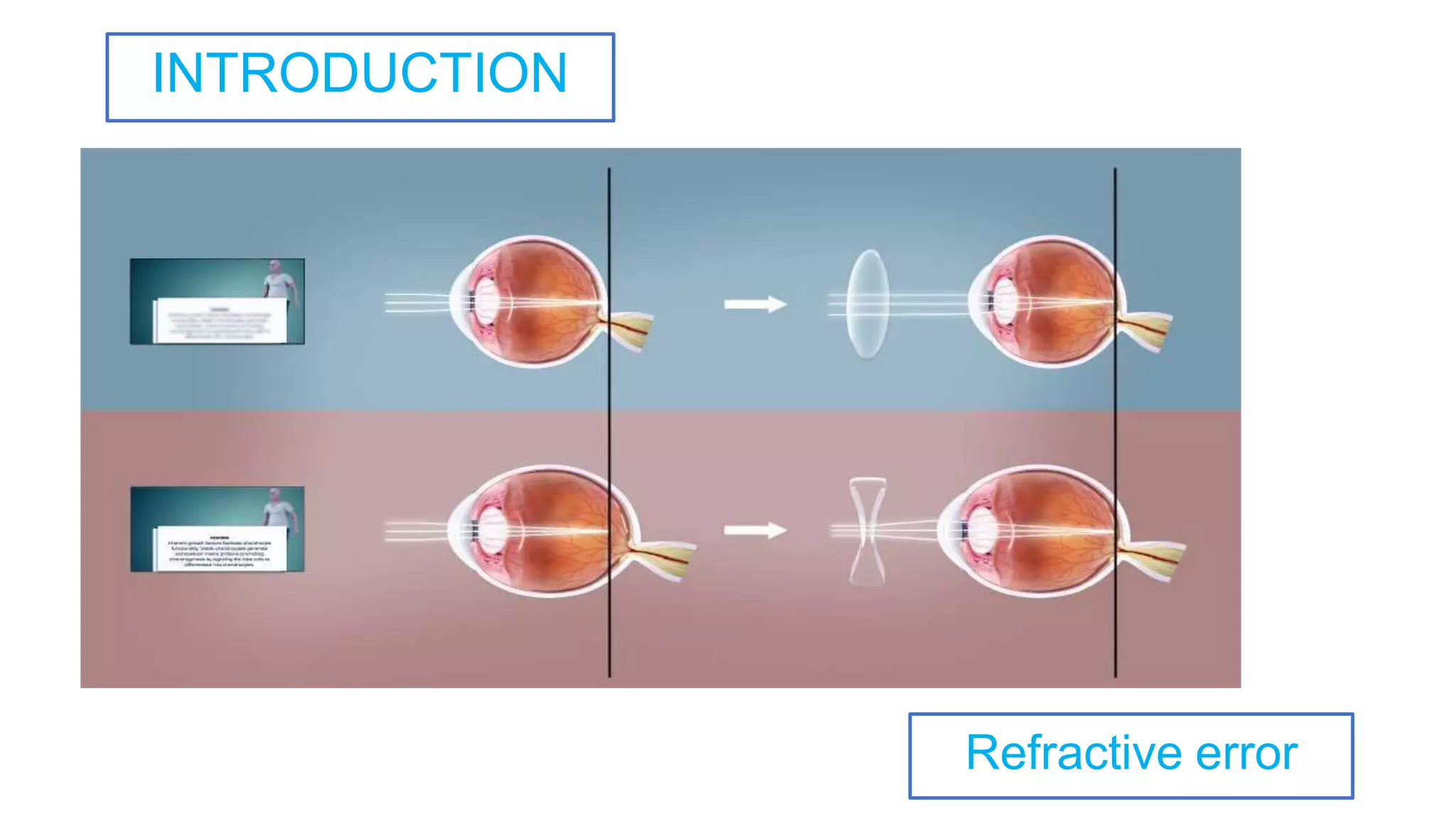
Refractive error
INTRODUCTION
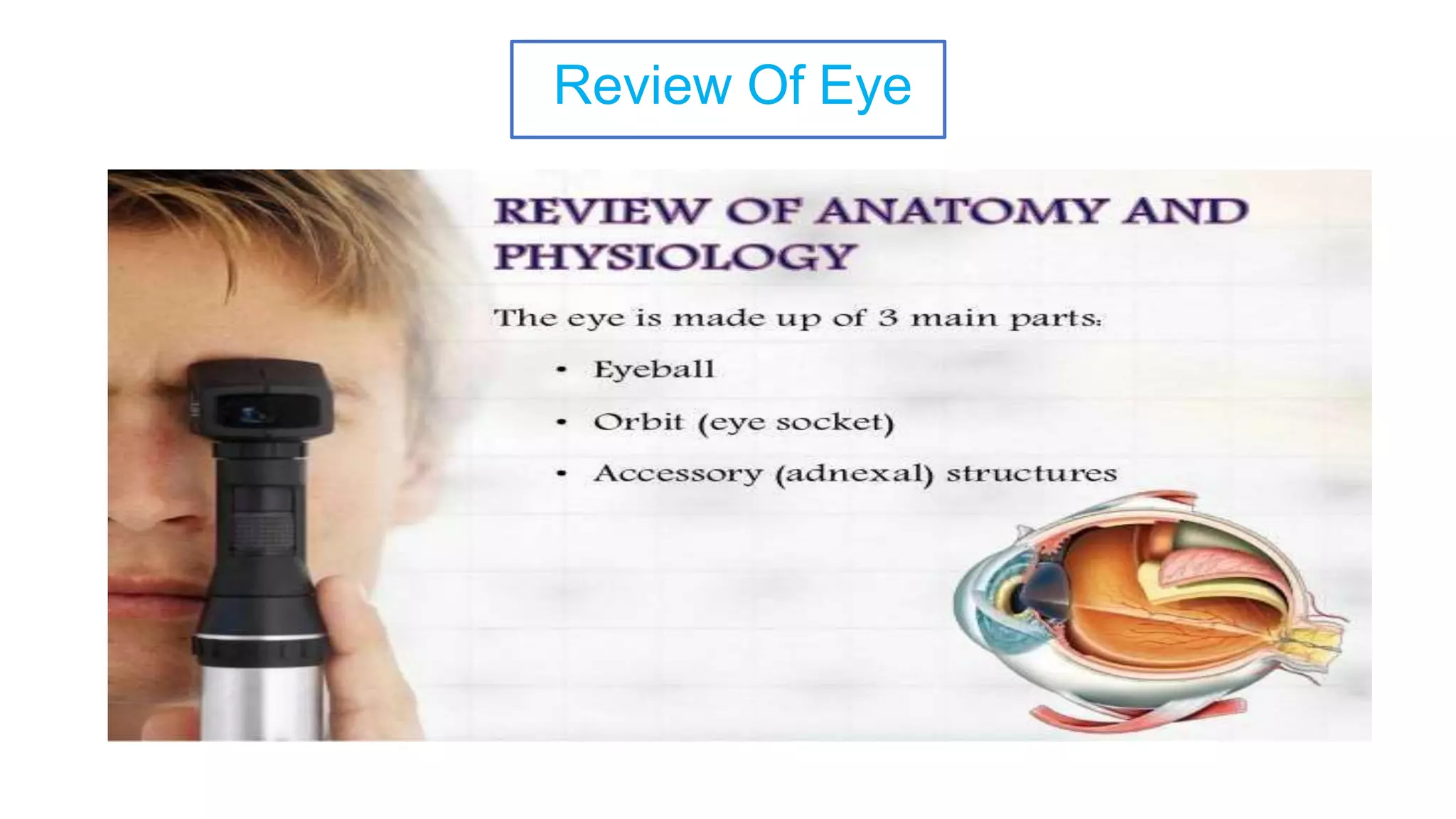
Review Of Eye
CONTD....
CONTD.....
CONTD.....
CONTD....
CONTD....
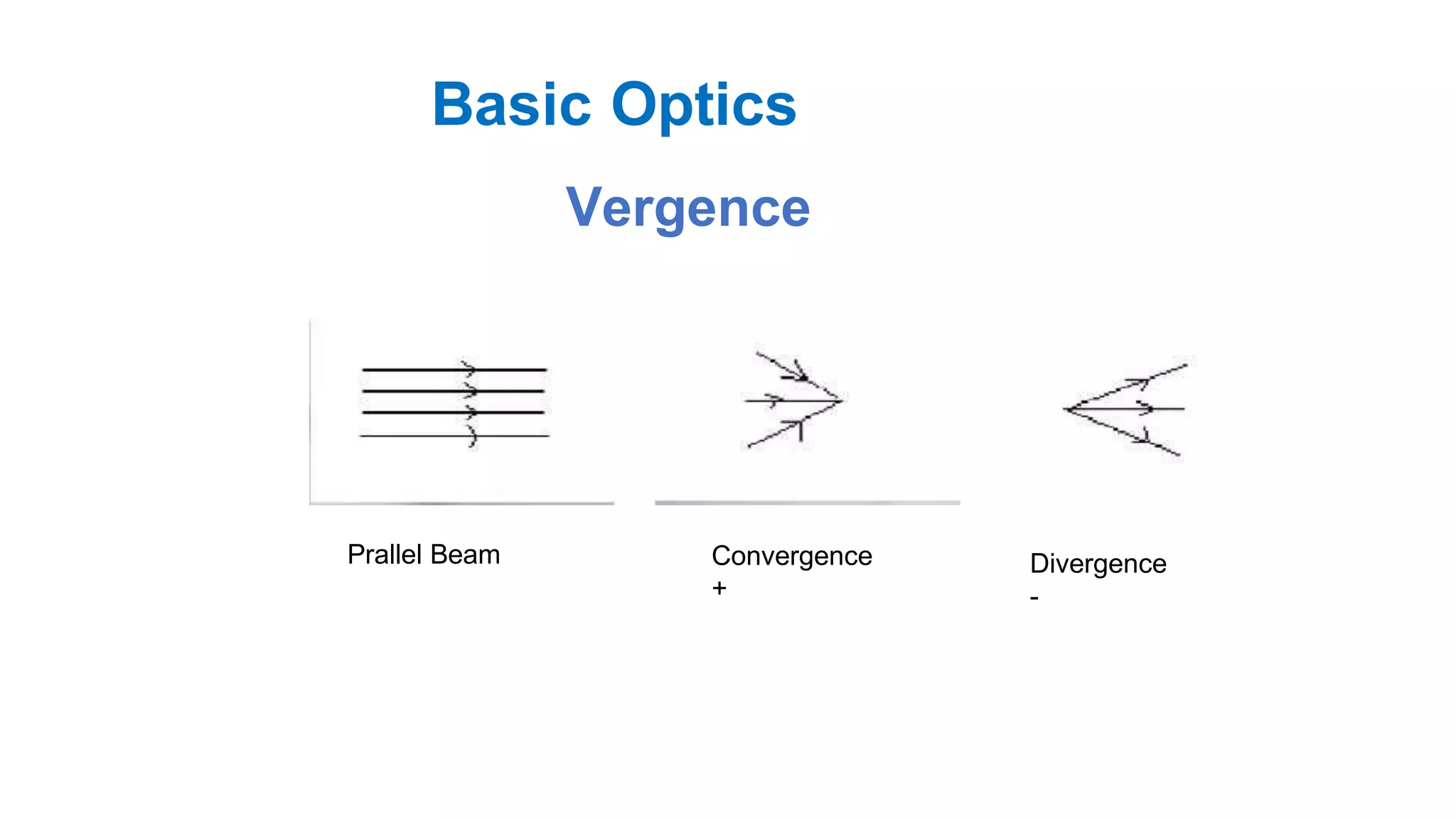
Vergence
Prallel Beam Convergence
+
Divergence
-
Basic Optics
REFRACTION
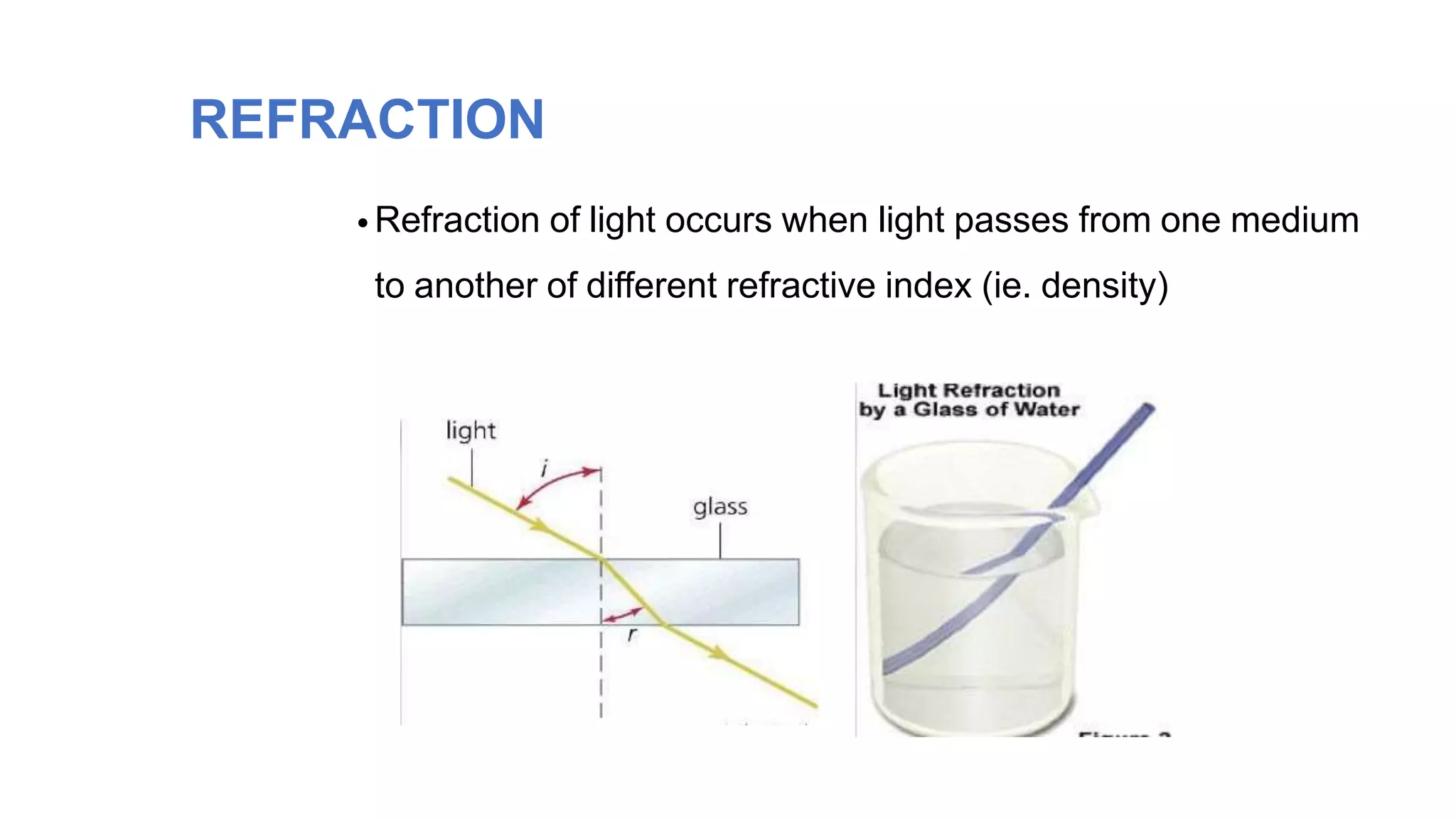
•Refraction of light occurs when light passes from one medium
to another of different refractive index (ie. density)
Refractive Components of the Eye
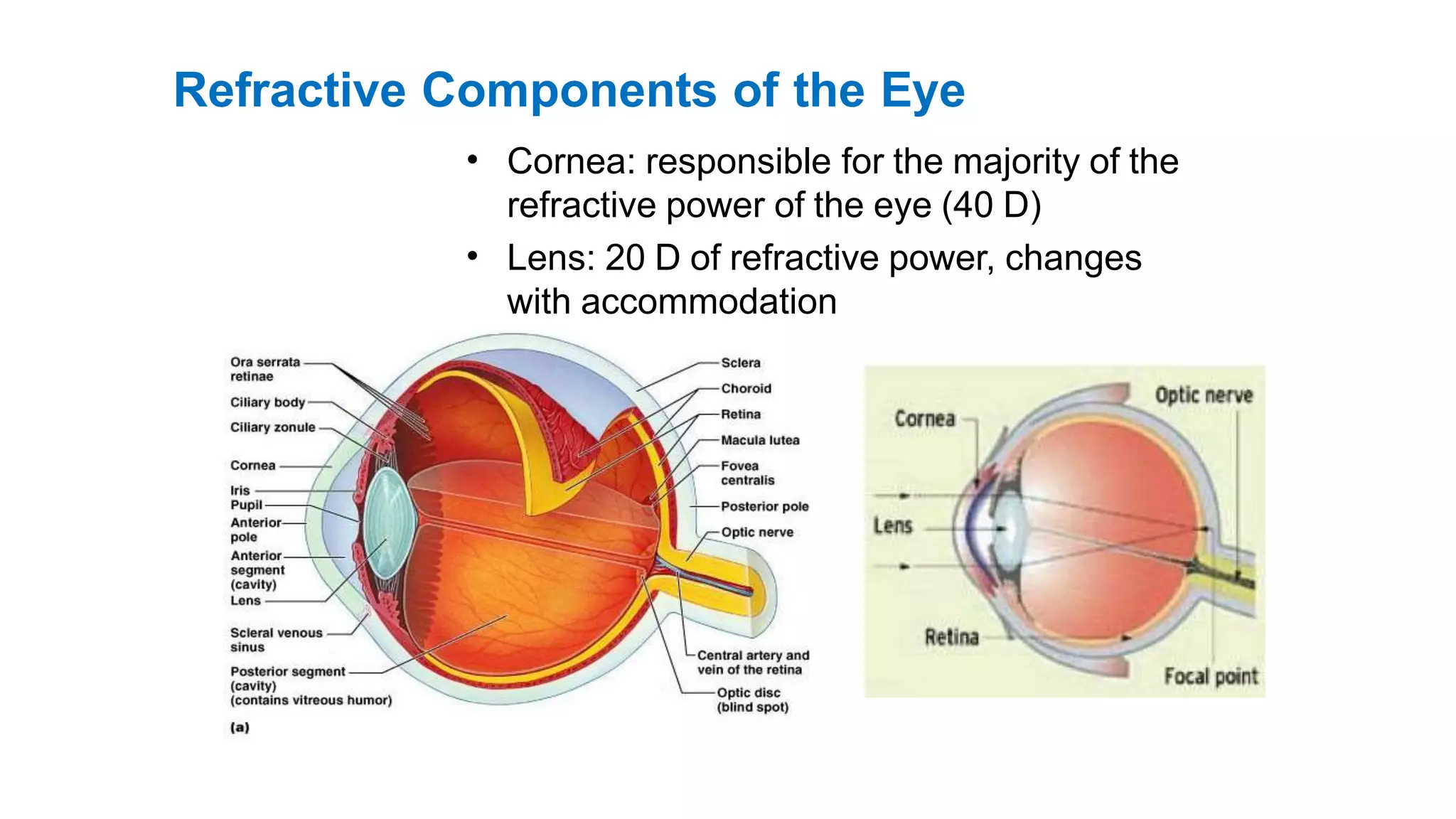
• Cornea: responsible for the majority of the
refractive power of the eye (40 D)
Lens: 20 D of refractive power, changes
with accommodation
•
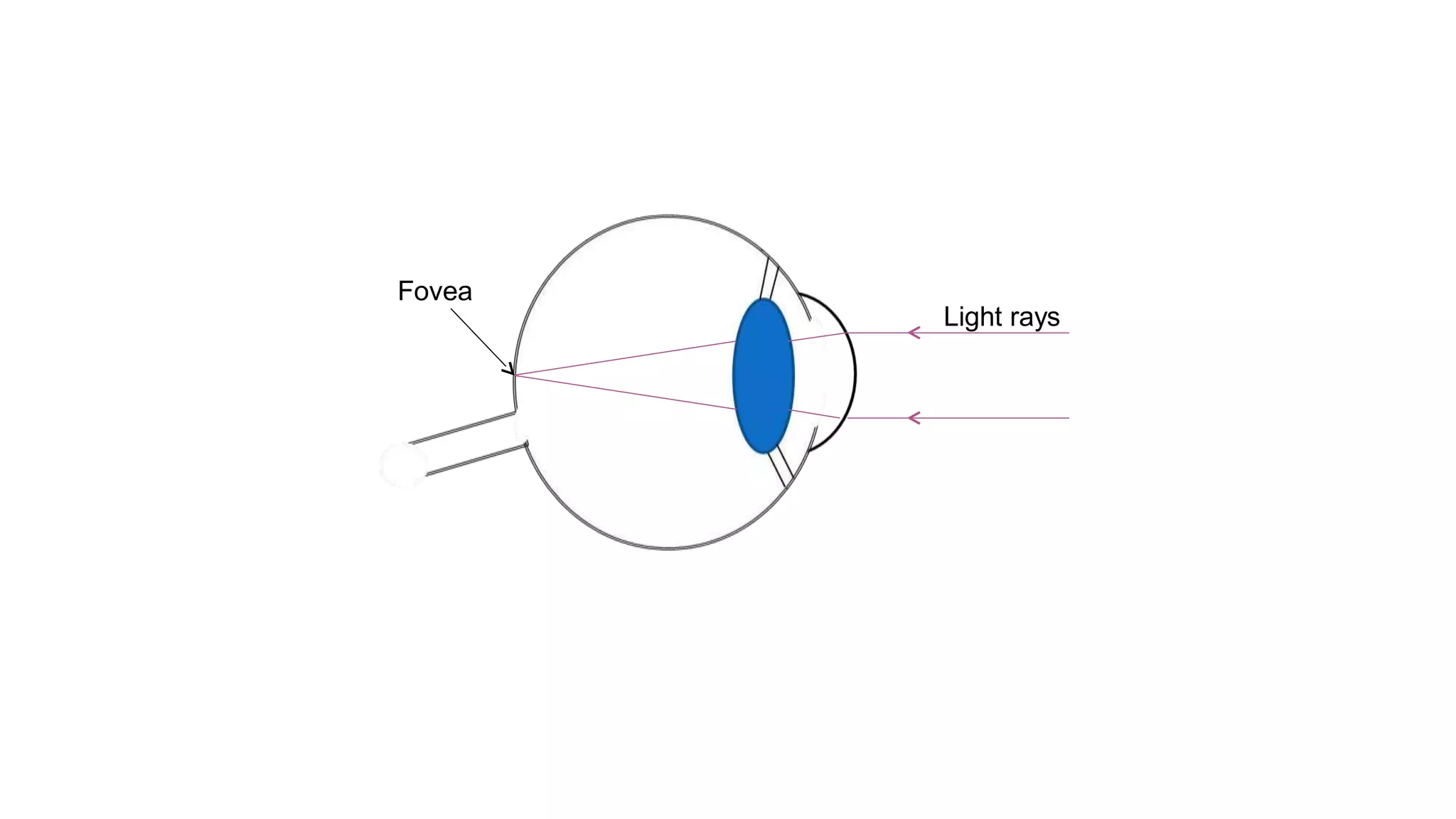
REFRACTIVE PHYSIOLOGY
• Light rays are focused on the retina because they are
refracted by passing through the cornea and lens (Snell’s
Law)
Corneal refractive power is constant
Lens refractive power is modifiable with accommodation
Axial length of the eye is constant except under certain
conditions
•
•
Fovea
Light rays
Emmetropia•
 The state of refraction of the eye in which parallel
rays, are focused exactly on the retina when the eye
is at rest.
 Adequate correlation between axial length and
refractive power
Accommodation•
Emmetropic eye
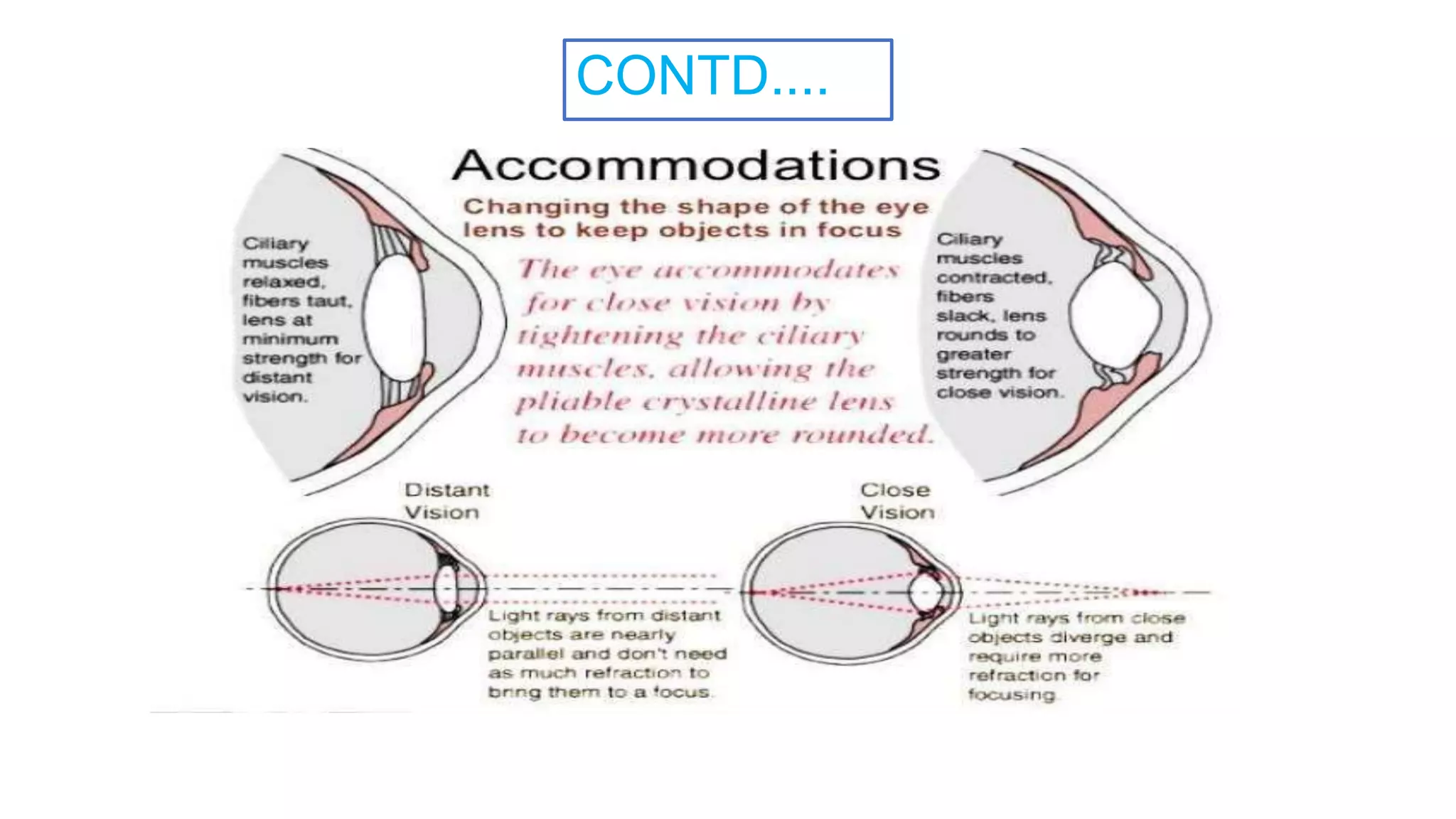
•object closer than 6 M send divergent light that focus behind
retina , adaptative mechanism of eye is increase refractive
power by accommodation
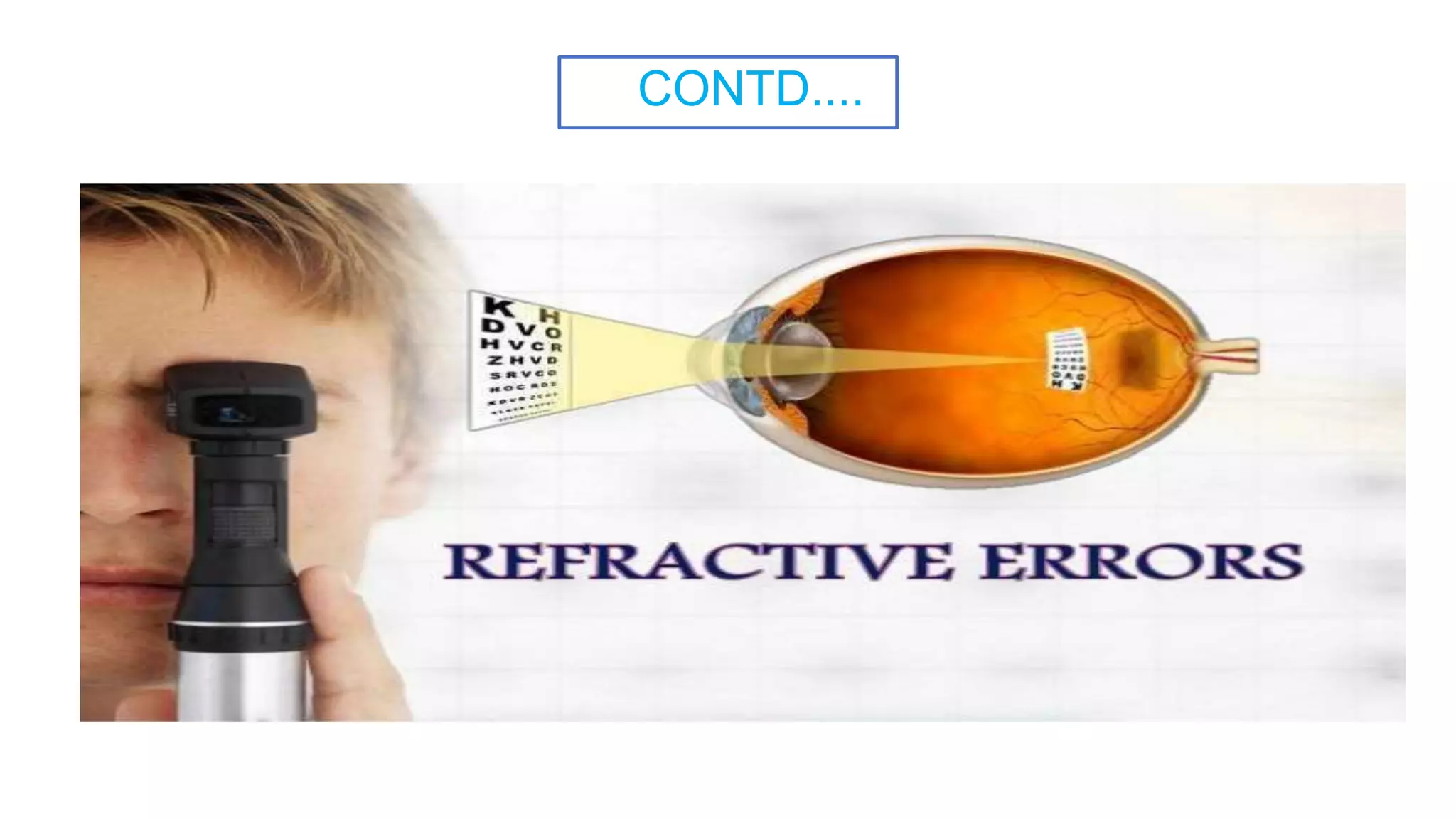
CONTD....
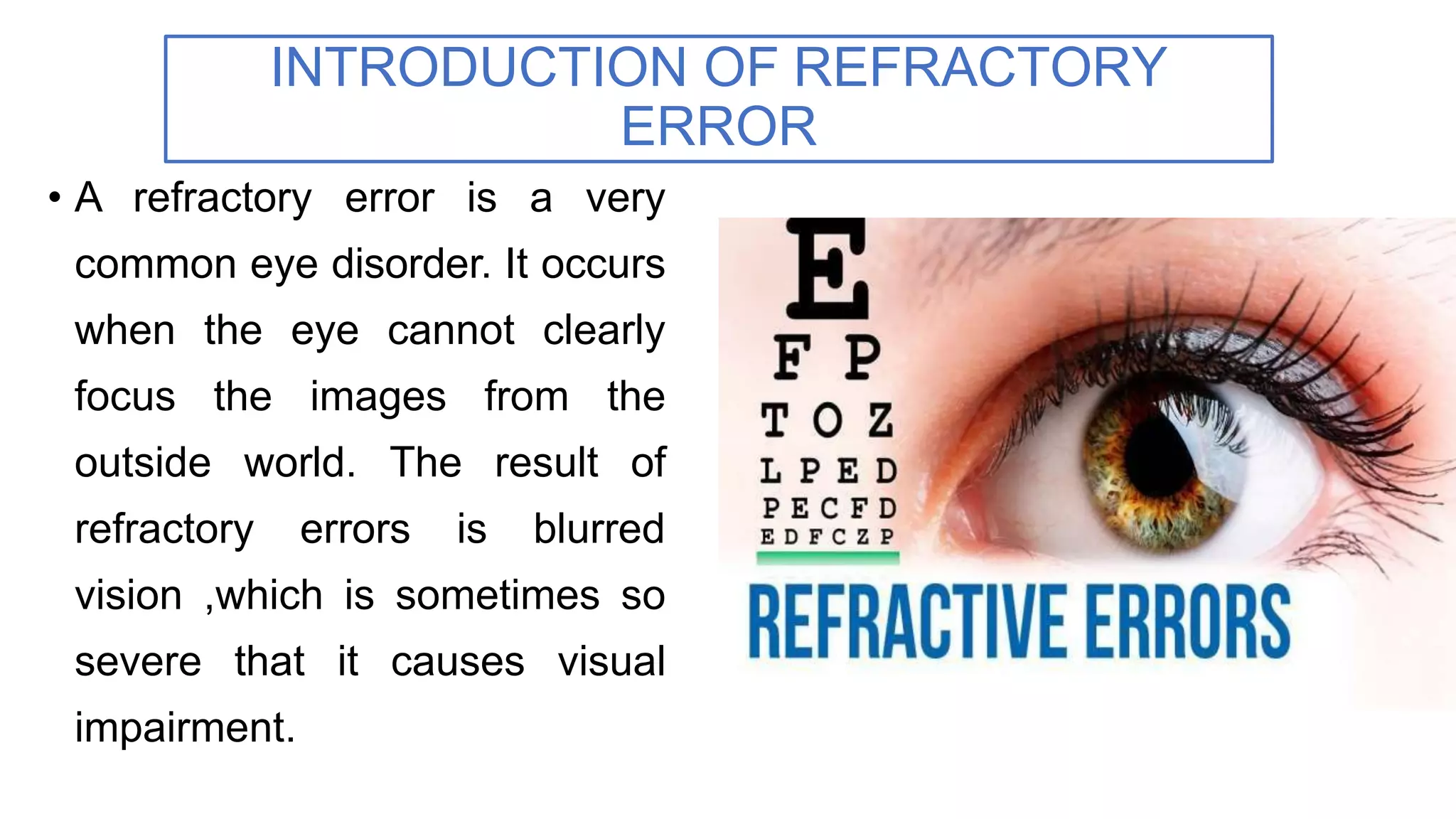
• A refractory error is a very
common eye disorder. It occurs
when the eye cannot clearly
focus the images from the
outside world. The result of
refractory errors is blurred
vision ,which is sometimes so
severe that it causes visual
impairment.
INTRODUCTION OF REFRACTORY
ERROR
Ametropia (Refractive error)
• Mismatch between axial length and refractive power.
• Problem with focusing of light on the retina resulting in blurred
image.
• Parallel light rays don’t fall on the retina (no accommodation)
• Refractory error means that the shape of your eye does not bend
light correctly, resulting in a blurred image.
• The main types of refractive errors are;
1. Myopia (near sightedness)
2. Hyperopia(farsightedness),
3. Presbyopia(loss Of Near Vision With Age)
4. Astigmatism(both Near Sightedness And Long Sightedness)
DEFINITION OF REFRACTORY ERROR
TYPES
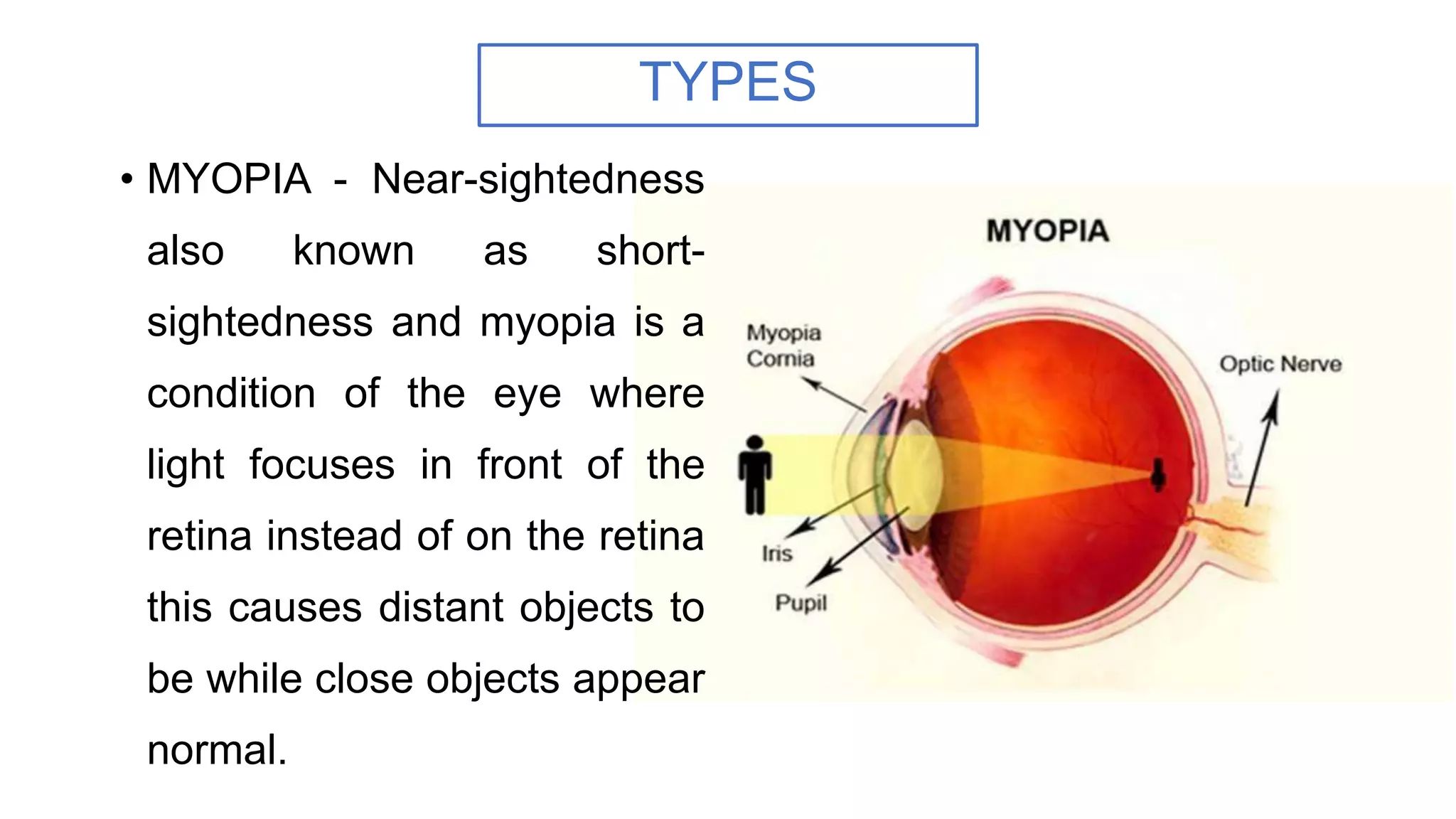
• MYOPIA - Near-sightedness
also known as short-
sightedness and myopia is a
condition of the eye where
light focuses in front of the
retina instead of on the retina
this causes distant objects to
be while close objects appear
normal.
CONTD....
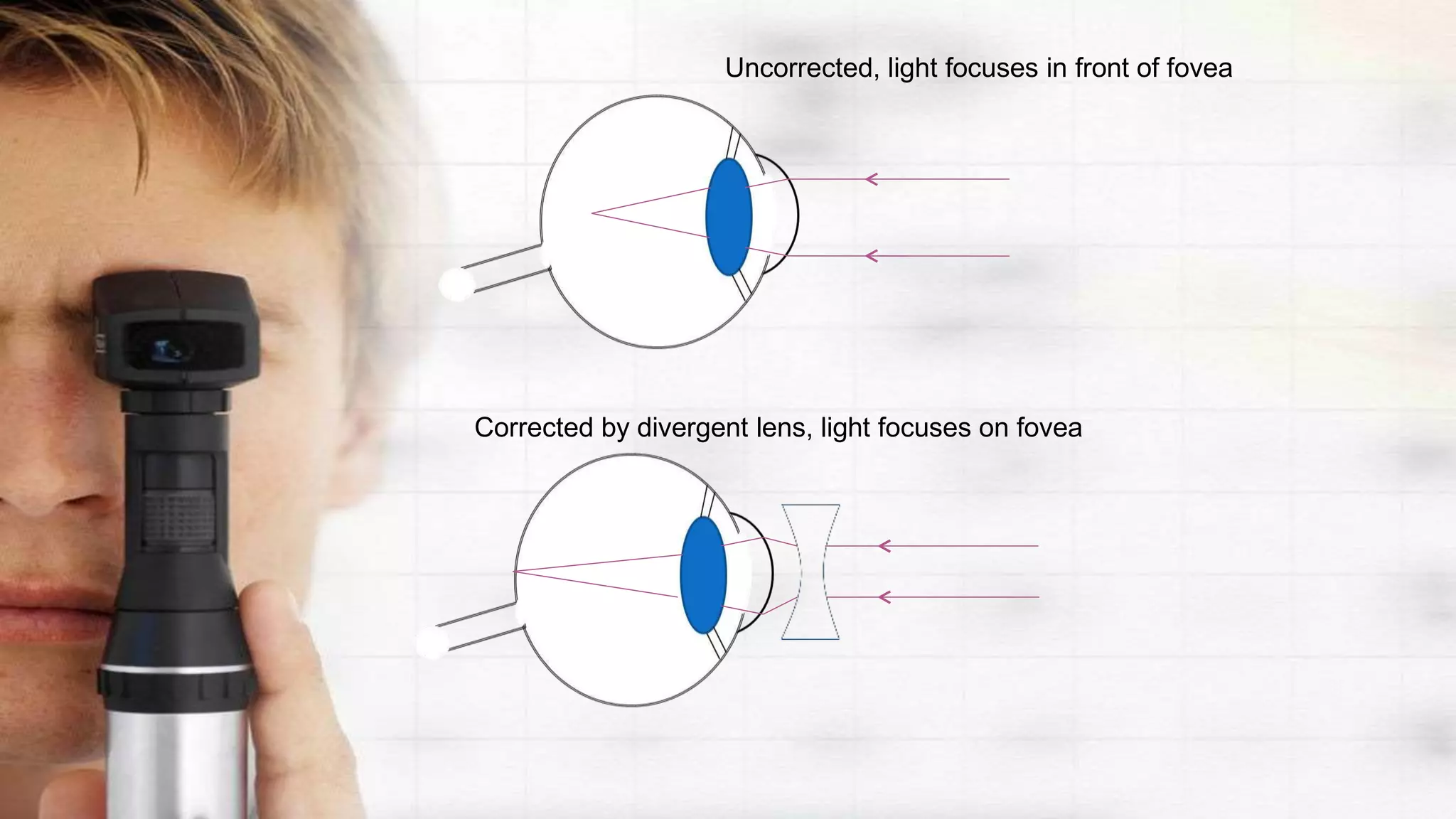
Uncorrected, light focuses in front of fovea
Corrected by divergent lens, light focuses on fovea
CONTD....
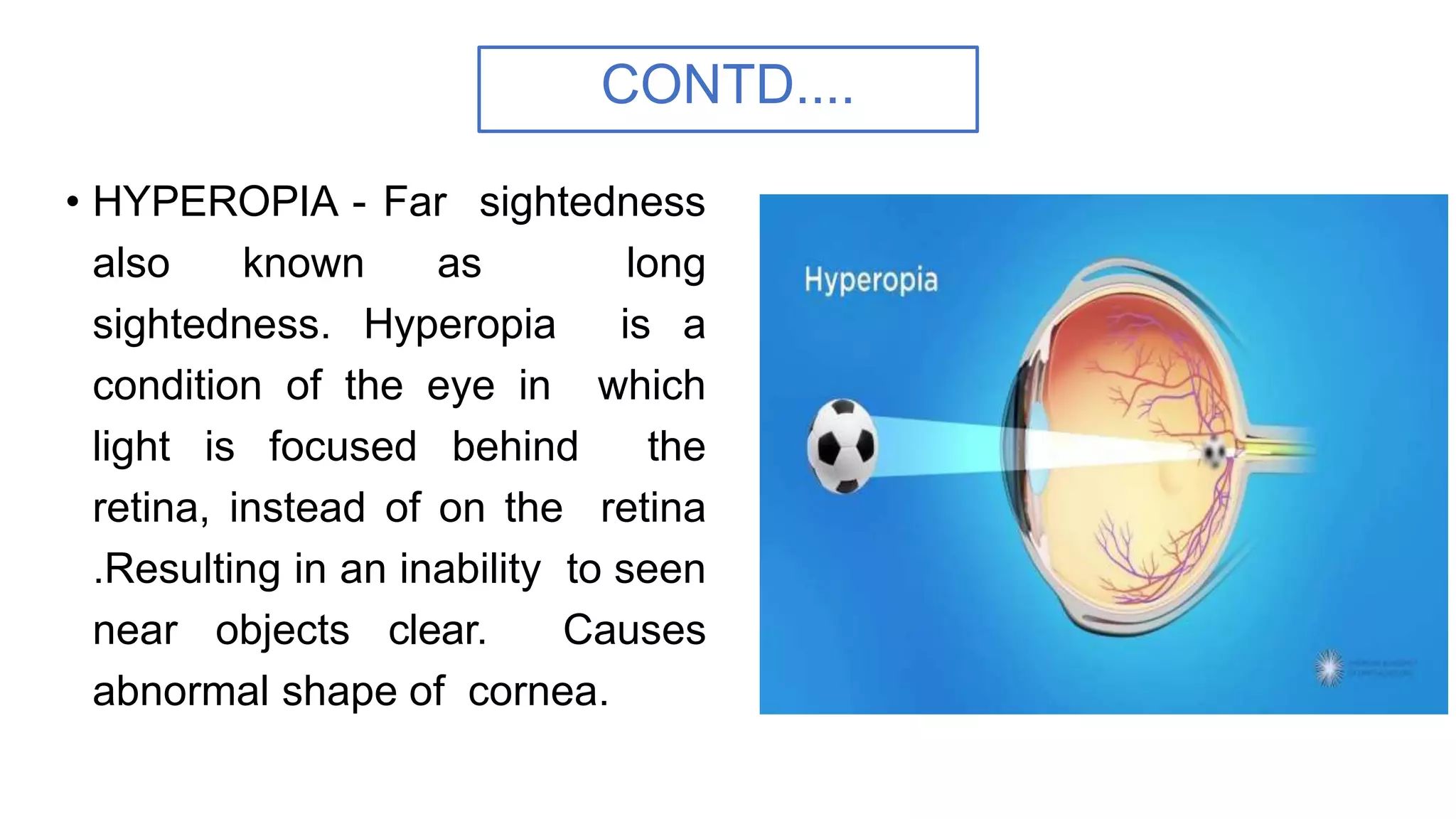
• HYPEROPIA - Far sightedness
also known as long
sightedness. Hyperopia is a
condition of the eye in which
light is focused behind the
retina, instead of on the retina
.Resulting in an inability to seen
near objects clear. Causes
abnormal shape of cornea.
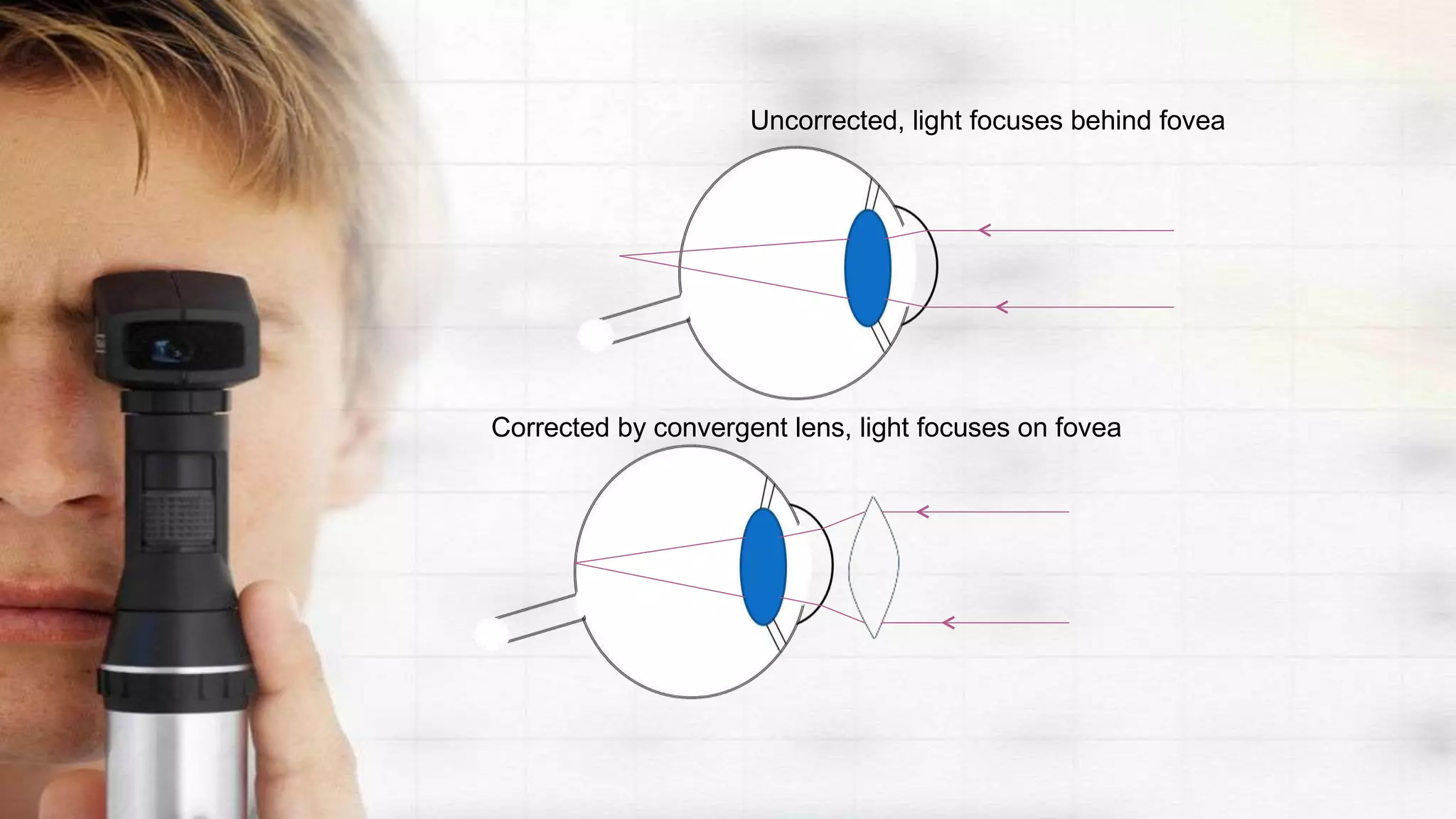
Uncorrected, light focuses behind fovea
Corrected by convergent lens, light focuses on fovea
CONTD....
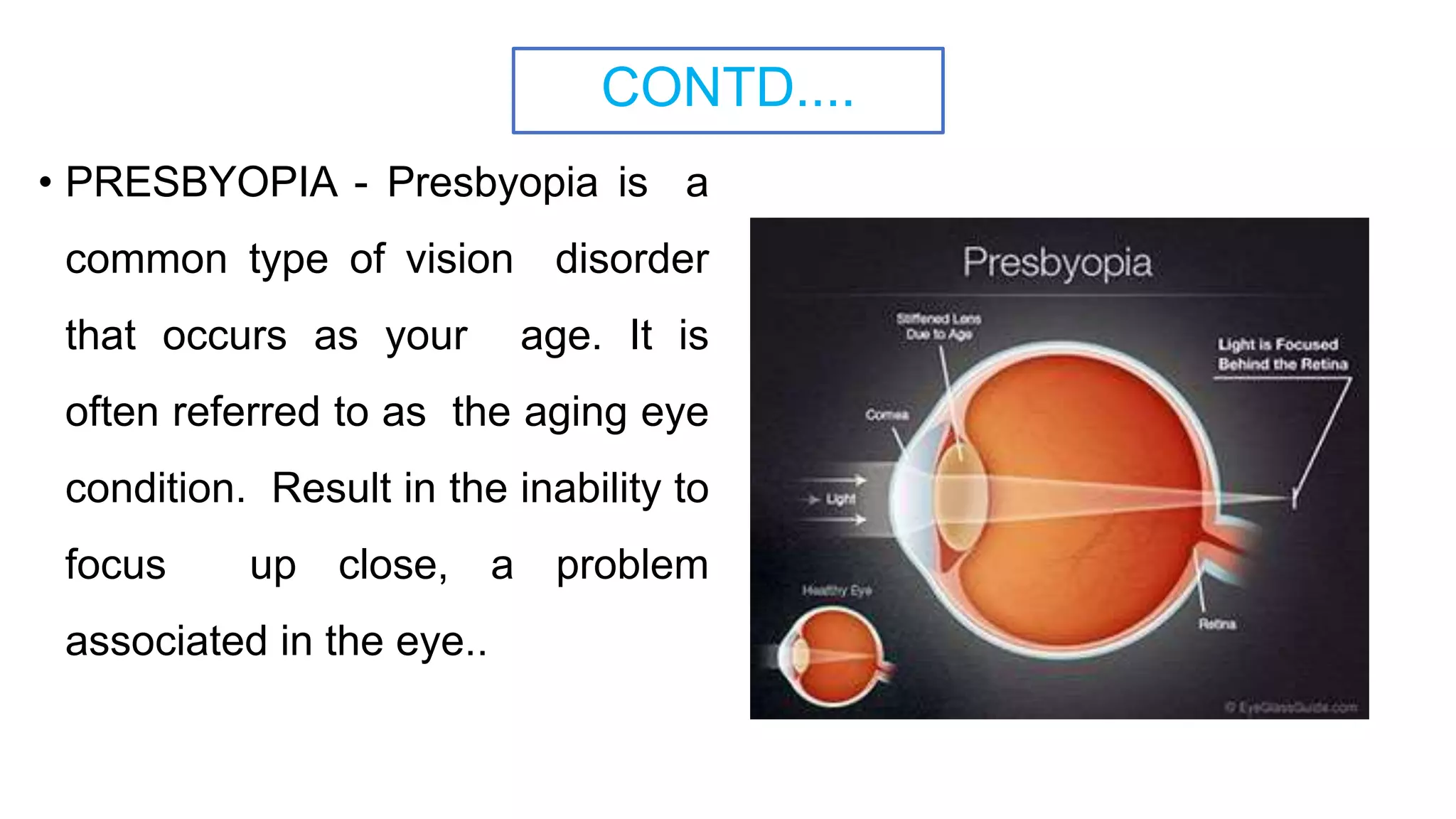
• PRESBYOPIA - Presbyopia is a
common type of vision disorder
that occurs as your age. It is
often referred to as the aging eye
condition. Result in the inability to
focus up close, a problem
associated in the eye..
CONTD....
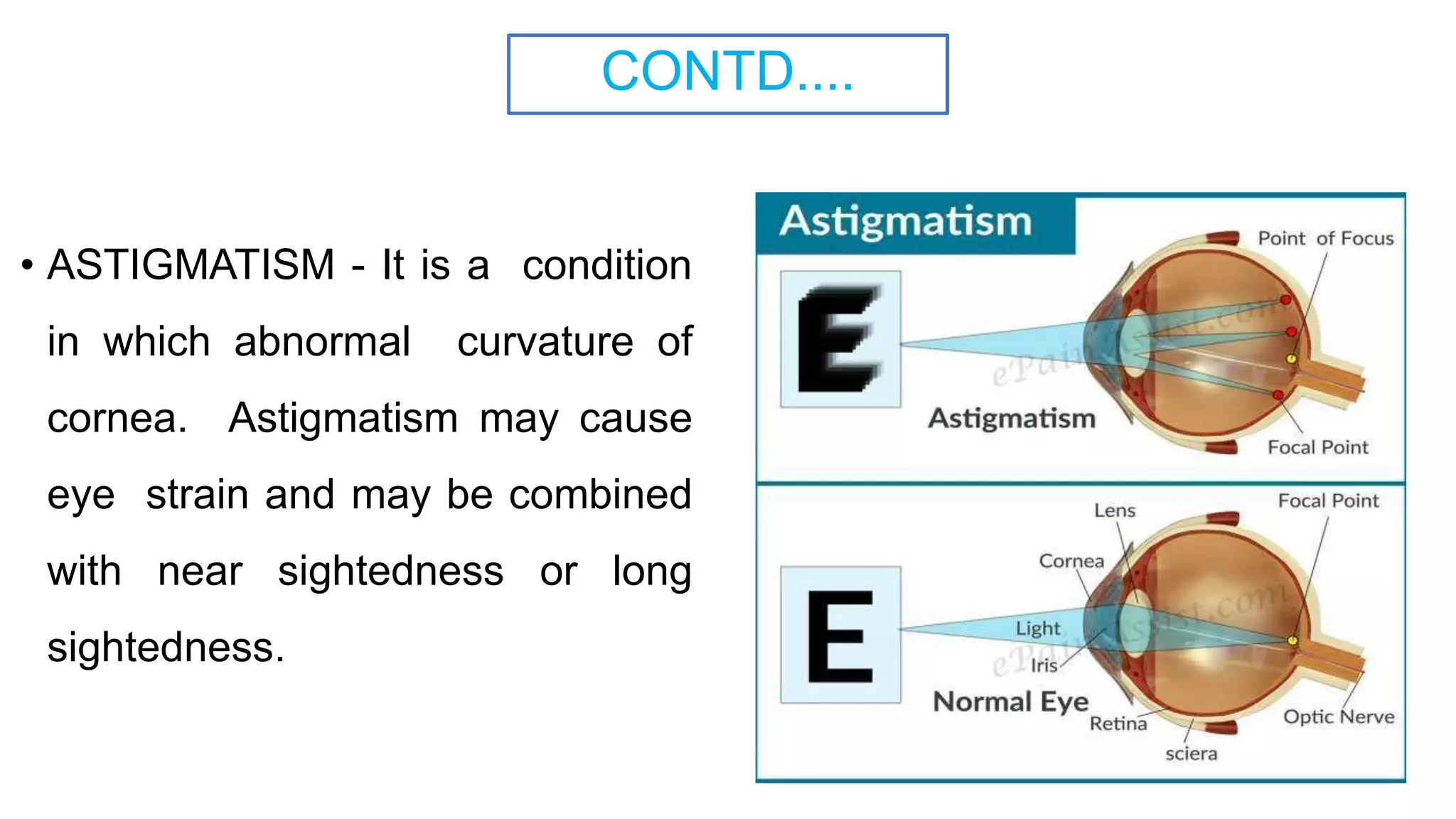
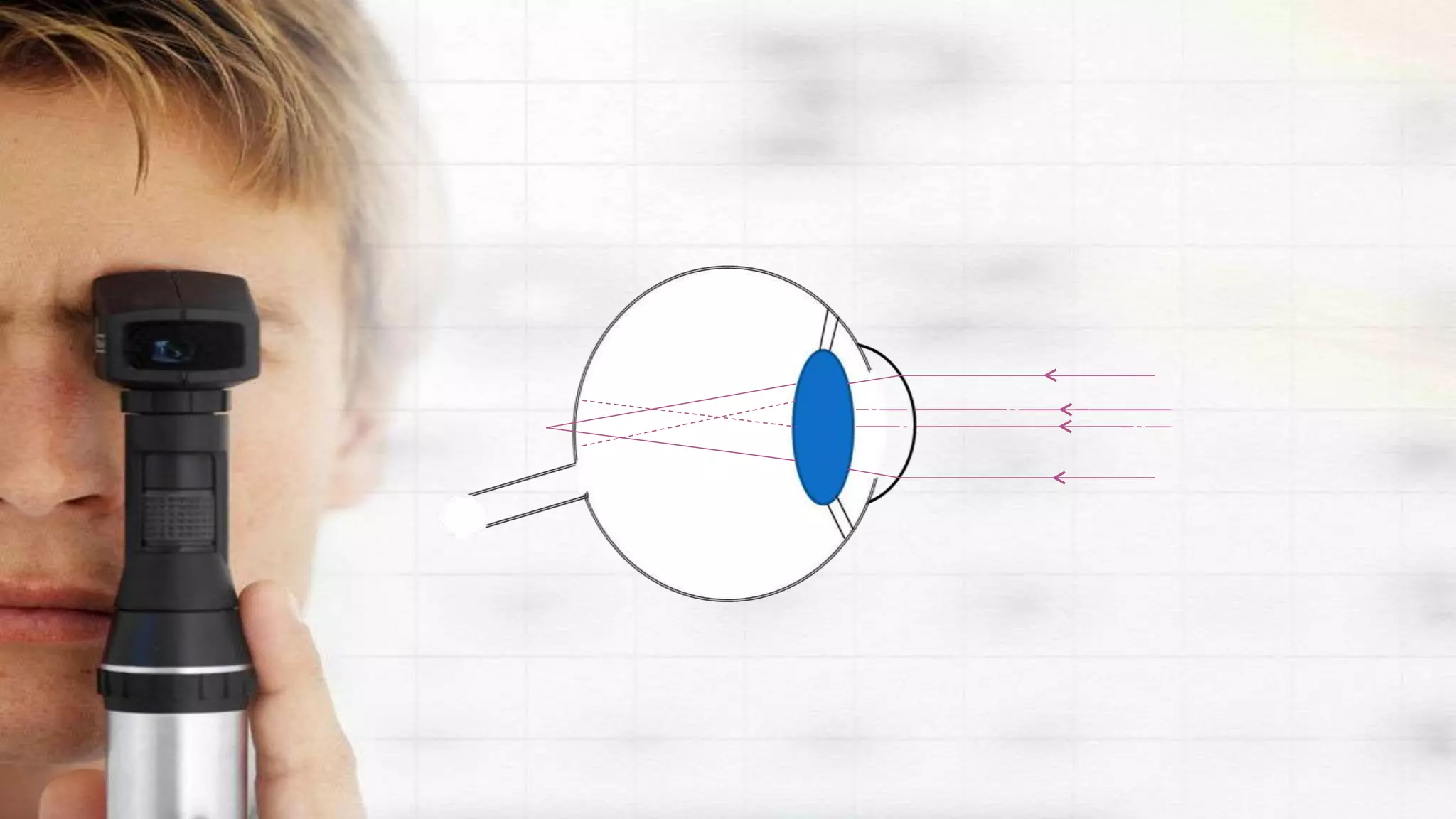
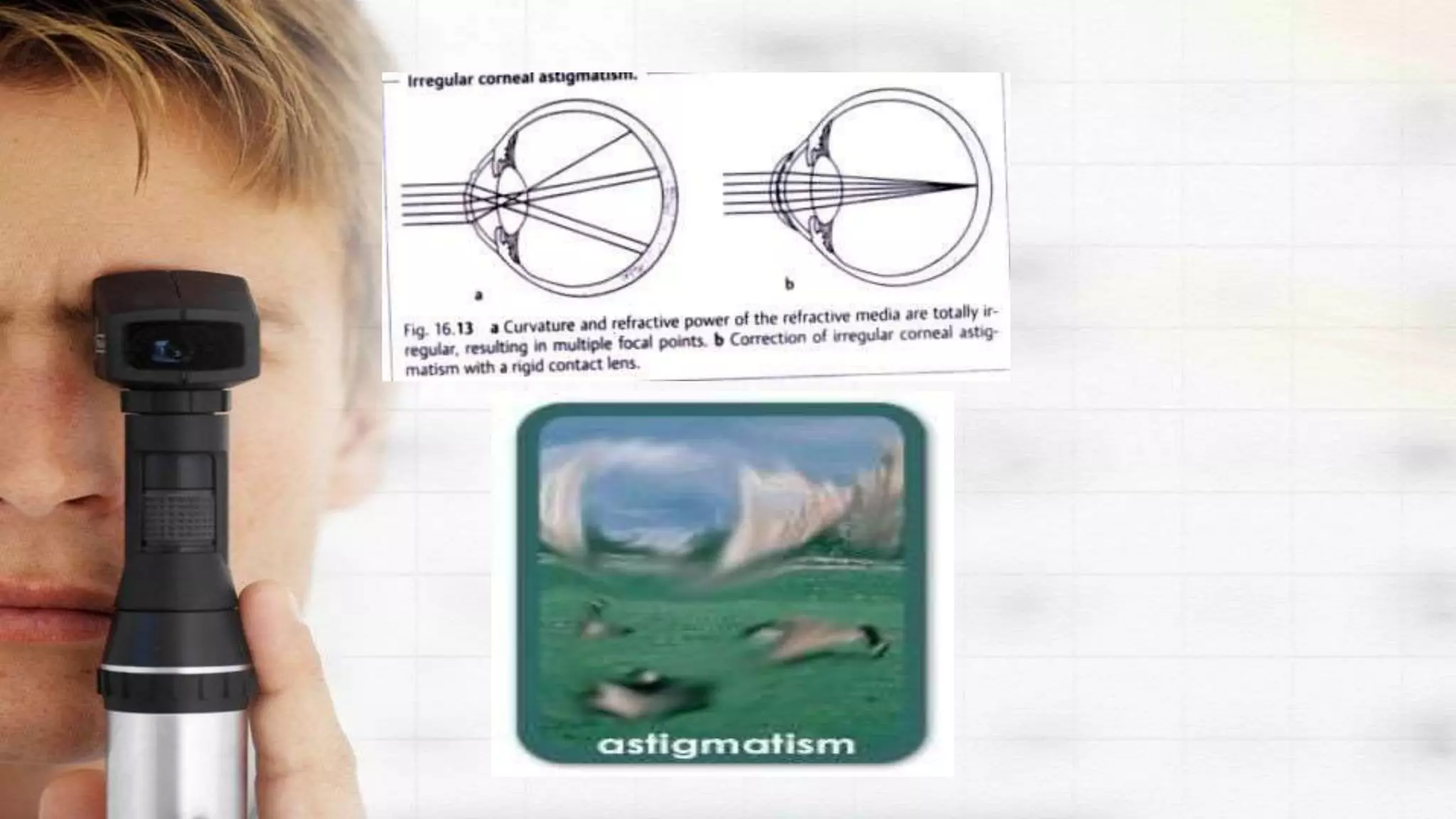
• ASTIGMATISM - It is a condition
in which abnormal curvature of
cornea. Astigmatism may cause
eye strain and may be combined
with near sightedness or long
sightedness.
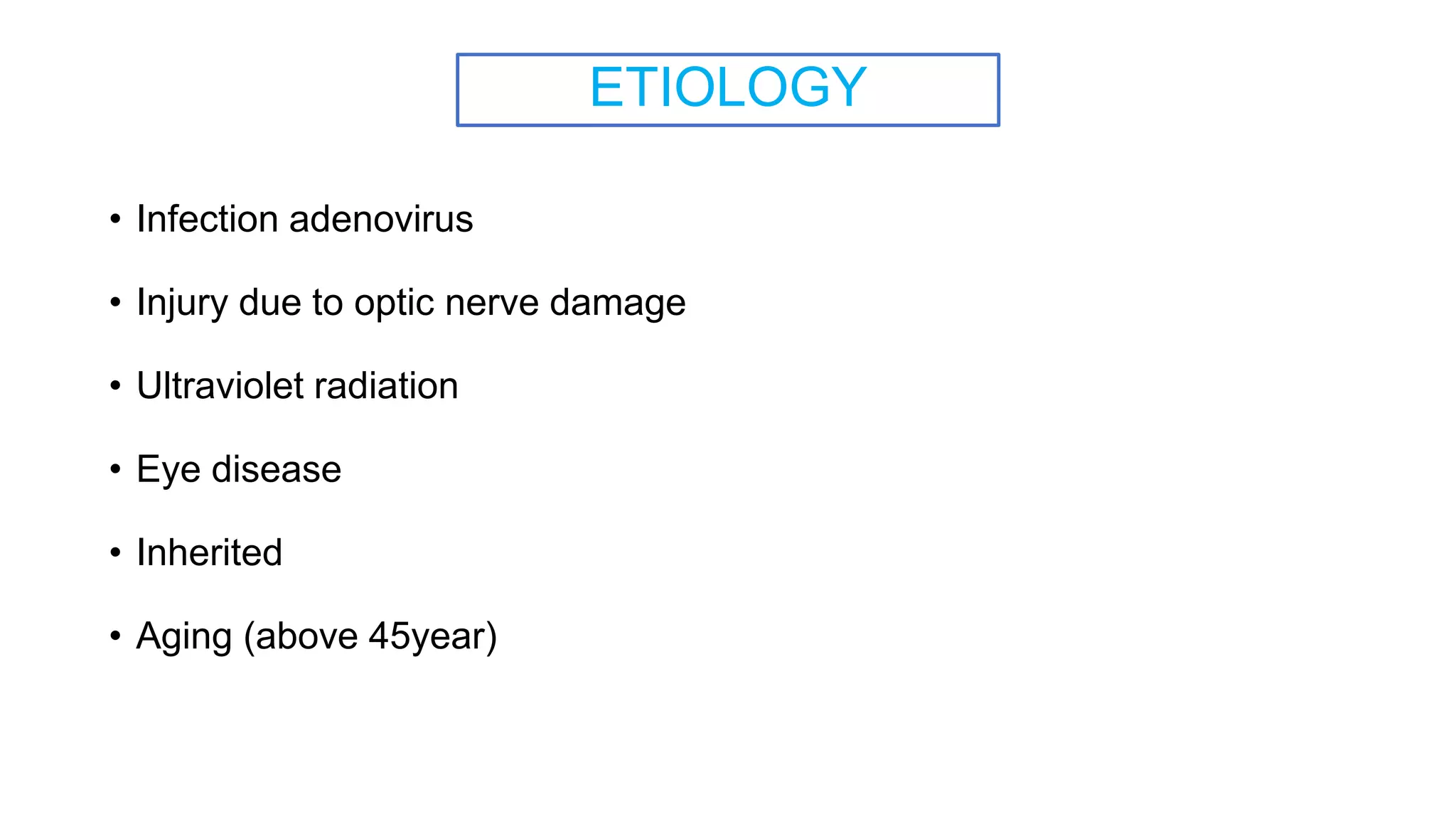
ETIOLOGY
• Infection adenovirus
• Injury due to optic nerve damage
• Ultraviolet radiation
• Eye disease
• Inherited
• Aging (above 45year)
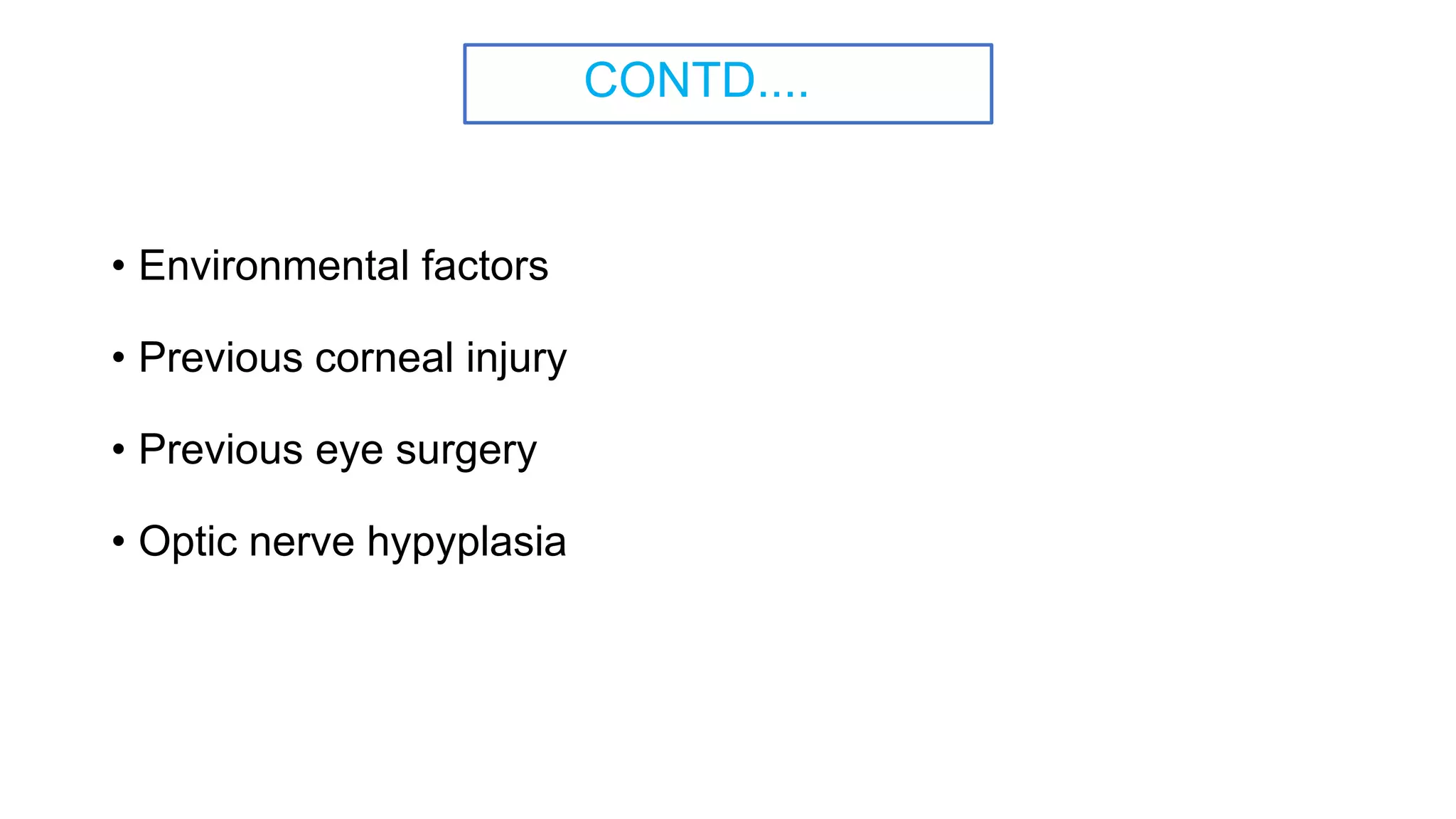
CONTD....
• Environmental factors
• Previous corneal injury
• Previous eye surgery
• Optic nerve hypyplasia
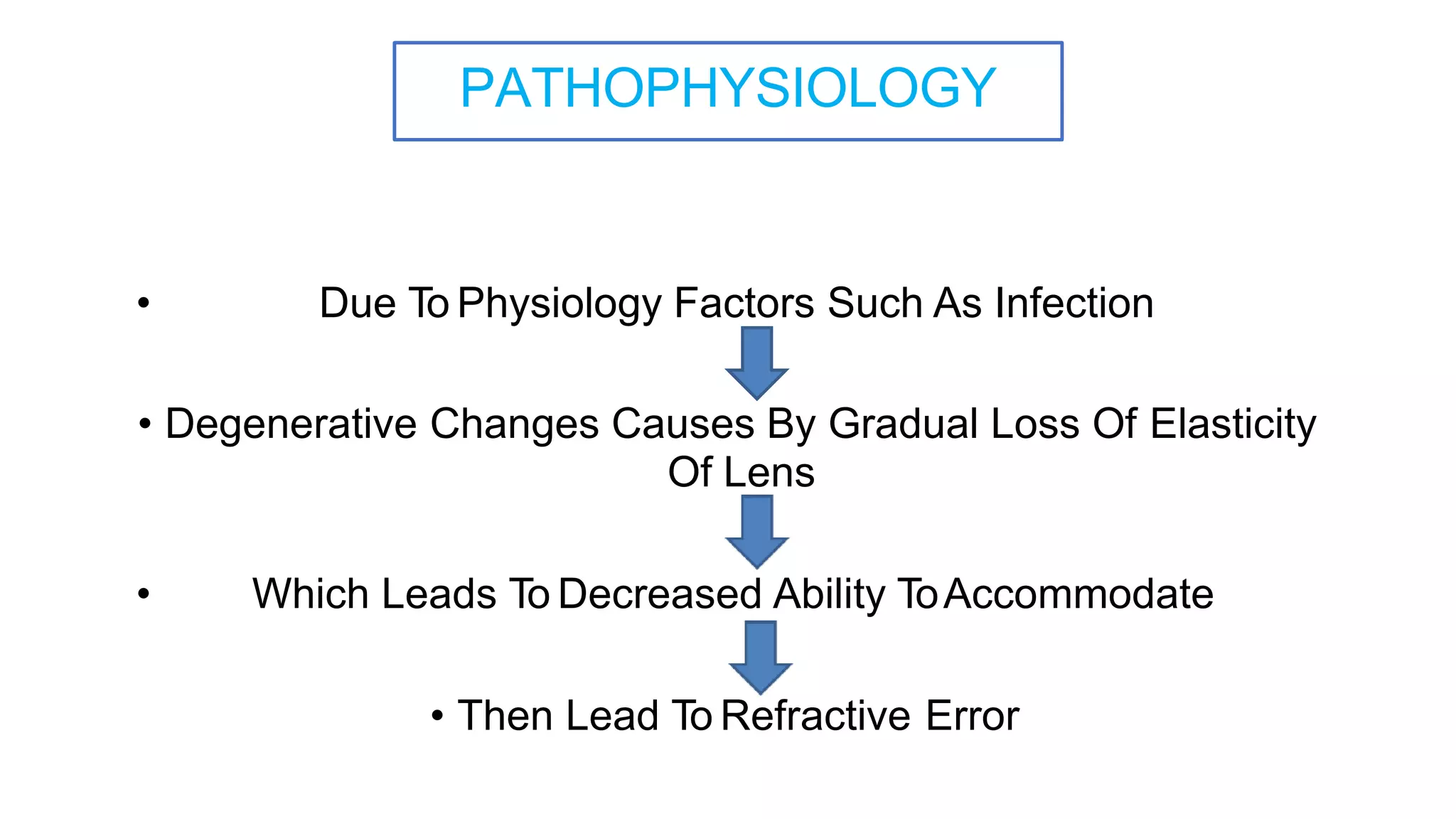
PATHOPHYSIOLOGY
• Due To Physiology Factors Such As Infection
• Degenerative Changes Causes By Gradual Loss Of Elasticity
Of Lens
• Which Leads To Decreased Ability ToAccommodate
• Then Lead To Refractive Error
SYMPTOMS
• Double vision
• Haziness (unclearness)
• Glare or halos around bright light
• Squinting (it is a condition where the eyes do not look in the
same direction)
CONTD....
• Headaches
• Eye strain fatigue pain in or around the eyes blurred vision,
headache, occasional double vision
• Eye irritation
DIAGNOSTIC Evaluation
• HISTORY TAKING
• CORNEAL TOPOGRAPHY
This is computerized test maps the curve of your eye cornea, it can
show problem with eye surface like swelling or scarring.
• SLIT LAMP EXAM
The doctor uses this microscope to shine a beam of light shaped like a
small slit on effected eye. He may dilated pupils during the test it help
diagnose.
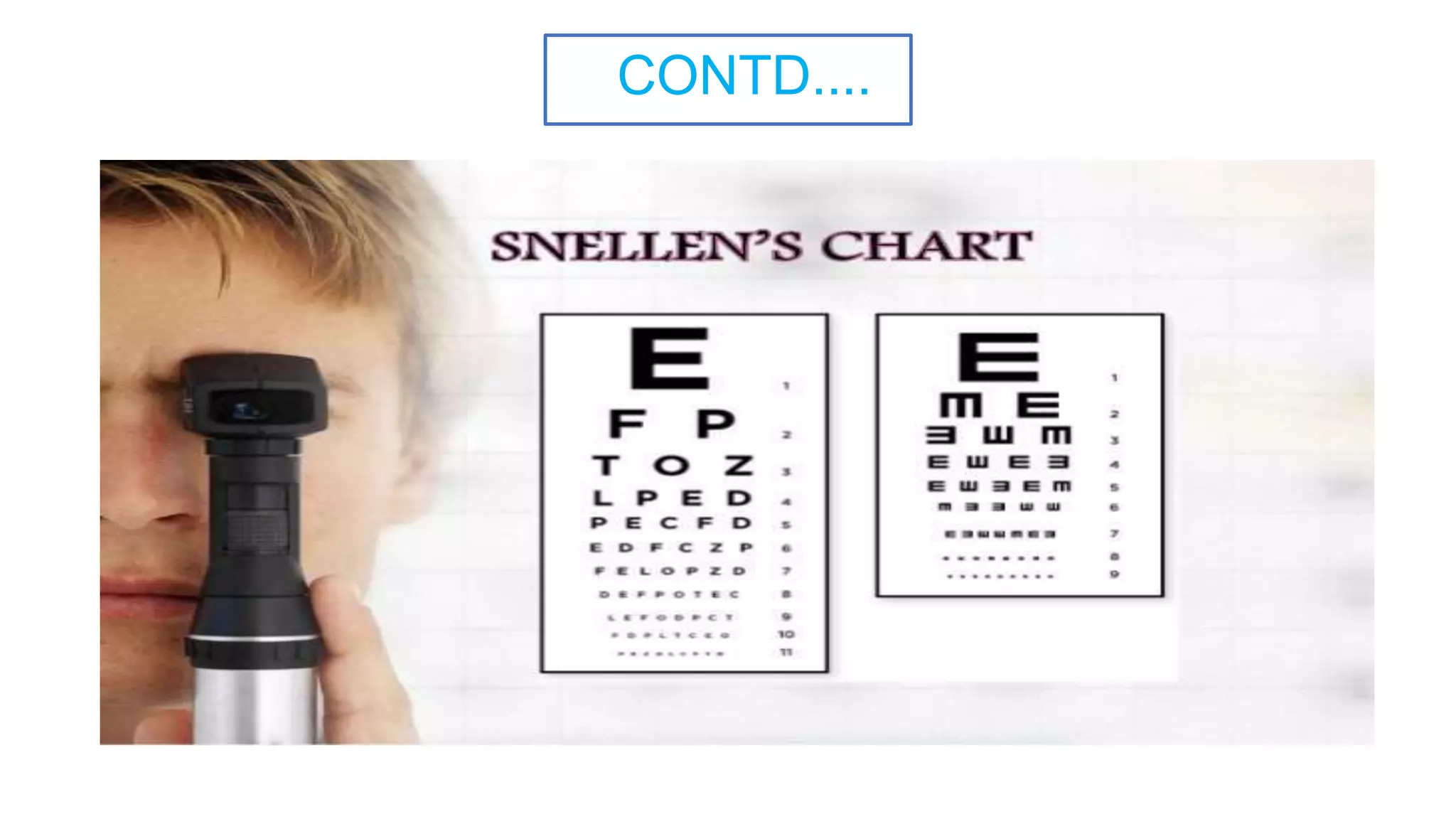
CONTD....
• TONOMETRY
This test measures the pressure inside eye which is
called intra ocular pressure
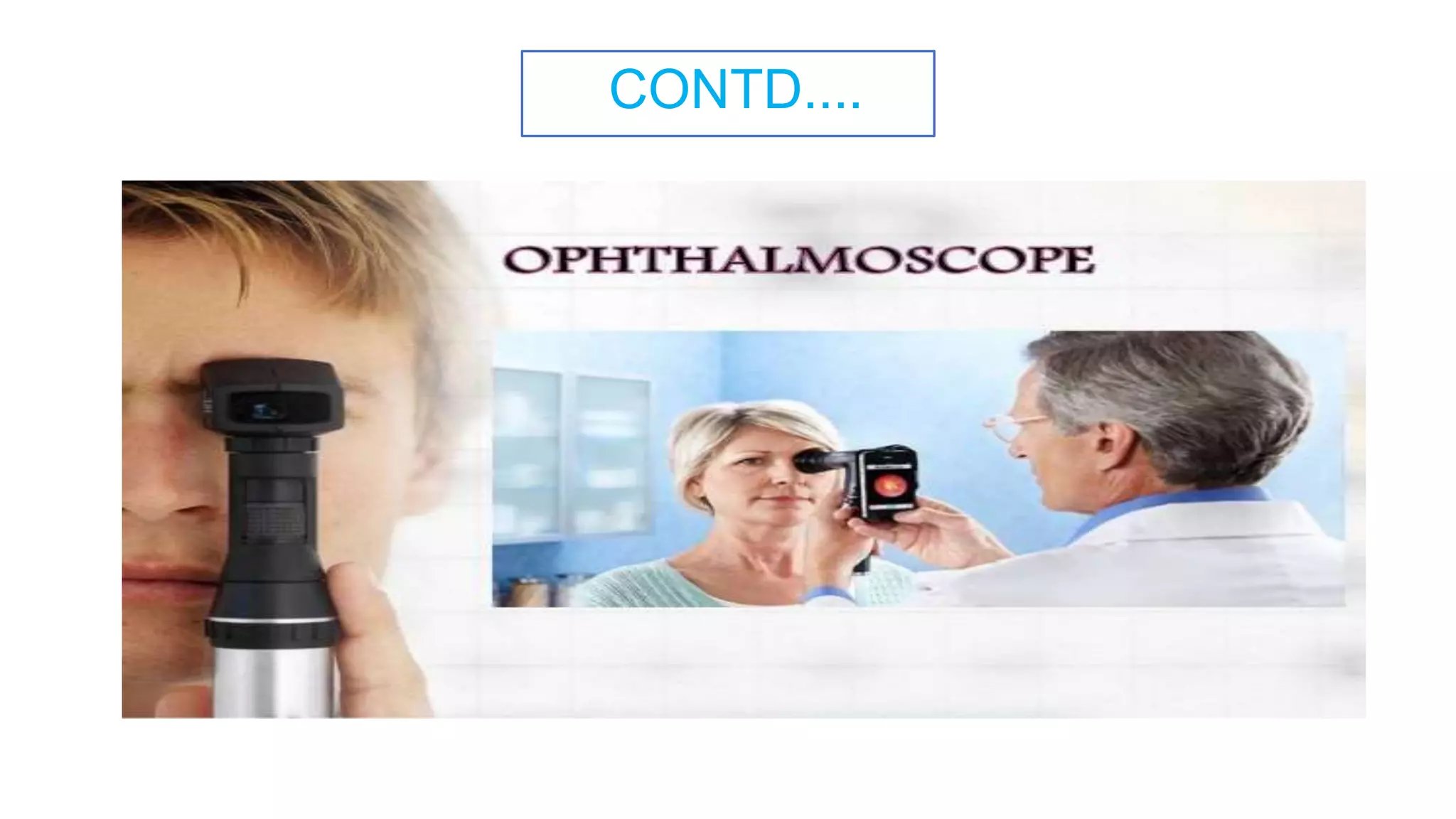
• RETINOSCOPY
Is a technique obtain an objective measurement of the
refractive error of a patients eye.
CONTD....
CONTD....
MEDICAL MANAGEMENT
• Identify the cause and eliminate the cause
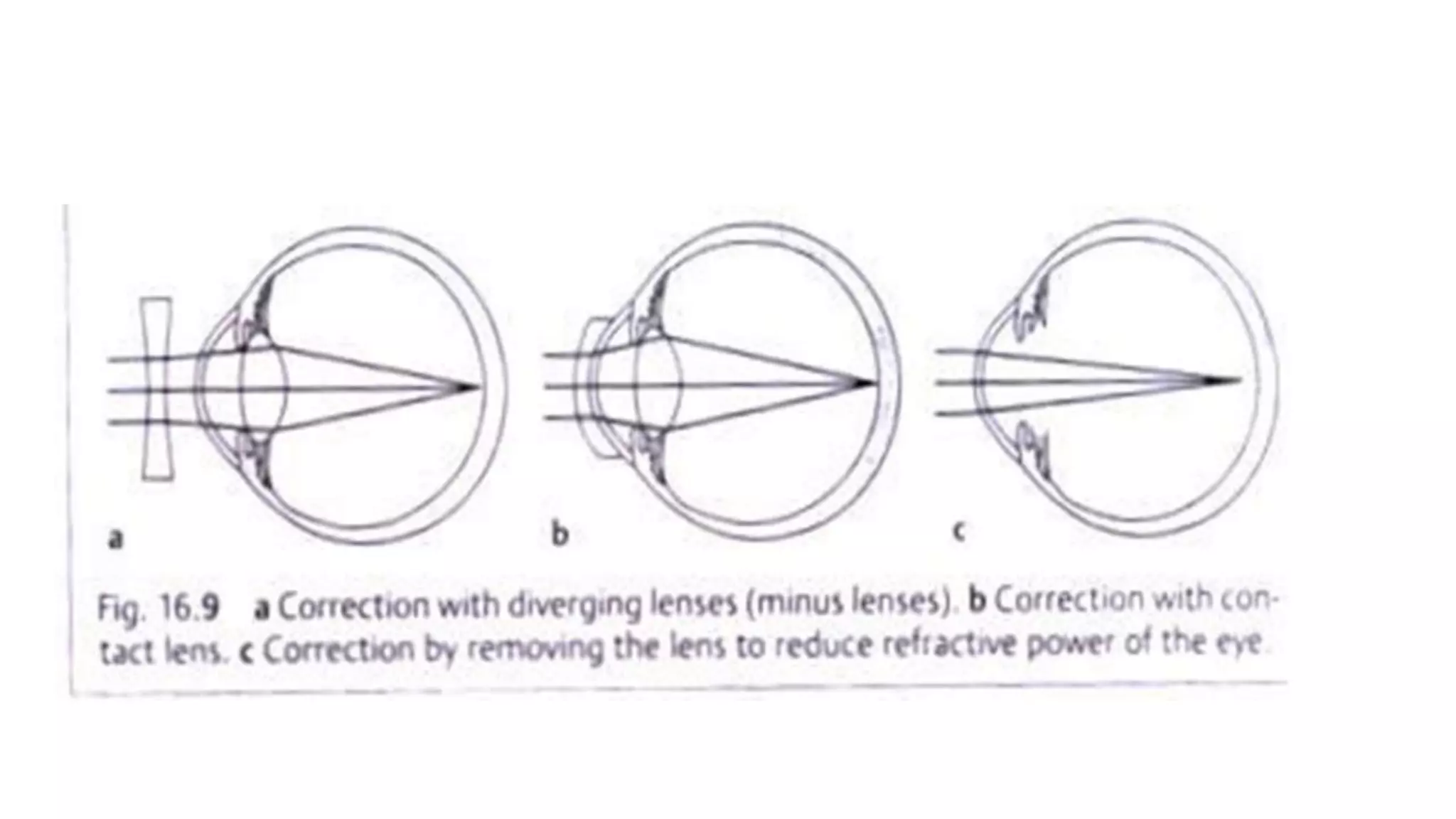
• Lens correction
• Prevention foreign particles enter in eye
• Use of sunglasses
• Use of antibiotics prevention from infection
Management
• Cycloplegic drug are used to refraction ( to paralyze the ciliary
muscle in order to determine the true refractive error of eye).
• Cholinergics (miotics): pilocarpine, carbachol: It increases
aqueous fluid outflow by contracting the ciliary muscles.
• Beta blockers: Betaxolol,Timolol: Decreased aqueous humor
production.
SURGICAL MANAGEMENT
• KERATOMILEUSIS
Is a method of reshaping the cornea surface to change its
optical power.
CONTD....
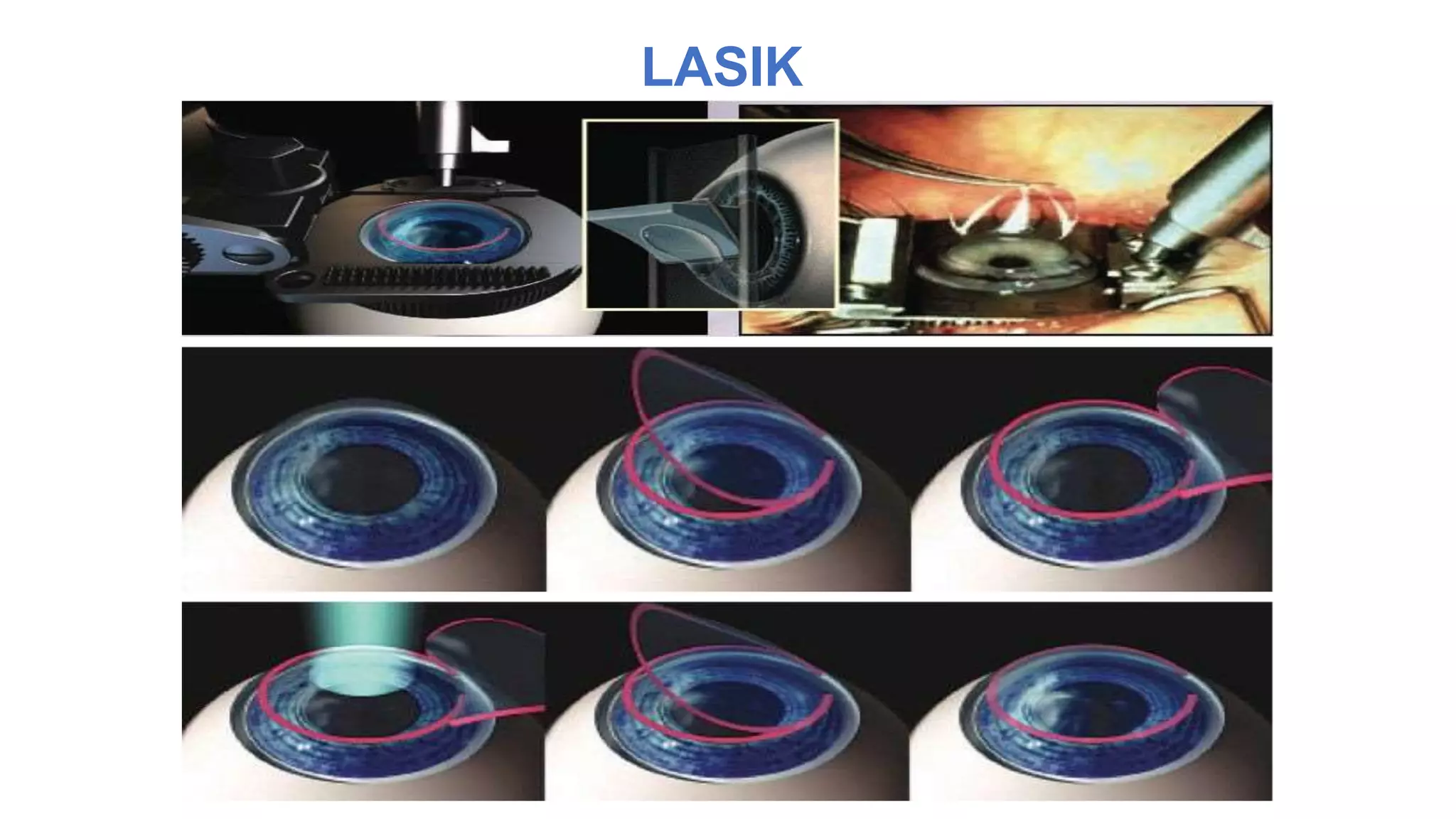
• LASIK - LASER EYE SURGERY (LASER ASSISTED IN SITU
KERETO-MILEUSIS)
This procedure used to treat near sightedness,
farsightedness.
A laser is used to reshape the cornea the clear, round dome at
the front of the eye.
To improve the way the eye focuses light rays into the retina at
the back of the eye.
LASIK
SURGICAL MANAGEMENT
• AUTOMATIC LAME-LLAR KERATO PLASTY (LLK)
• Keratoplasty is the procedure where by abnormal corneal
tissue is replaced by a healthy donor conrea.
• This is a older type of vision surgery carried out by making
a flap in the cornea to help correct severe short
sightedness and long sightedness.
SURGICAL MANAGEMENT
• LASEK
• LASSER ASSISTED SUB EPITHELIALKERATOMILEUSIS
• The hinged flap made in laser assisted epithelial
keratomileusis surgery is created in the layer of eye.
• Inserted of creating a thicker corneal flap as in laser
assisted epithelial keratomileusis surgery.
SURGICAL MANAGEMENT
• PHOTO REFRACTIVE KERETOTOMY(PRK)
• To correct myopia
• The eye surgeon then gently removing the surface
corneal cells(epithelium)
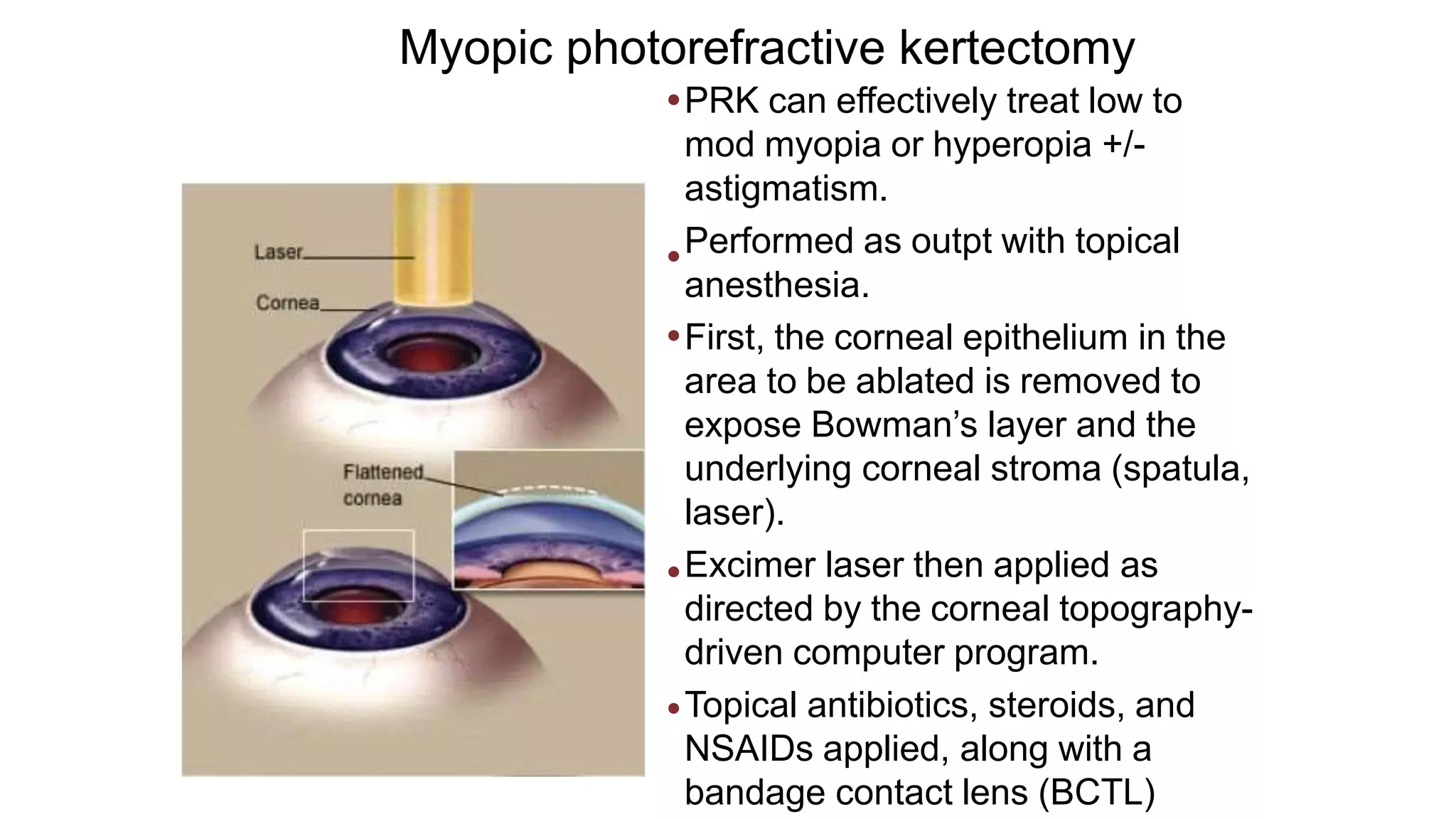
Myopic photorefractive kertectomy
•PRK can effectively treat low to
mod myopia or hyperopia +/-
astigmatism.
Performed as outpt with topical
anesthesia.
First, the corneal epithelium in the
area to be ablated is removed to
expose Bowman’s layer and the
underlying corneal stroma (spatula,
laser).
Excimer laser then applied as
directed by the corneal topography-
driven computer program.
Topical antibiotics, steroids, and
NSAIDs applied, along with a
bandage contact lens (BCTL)
•
•
•
•
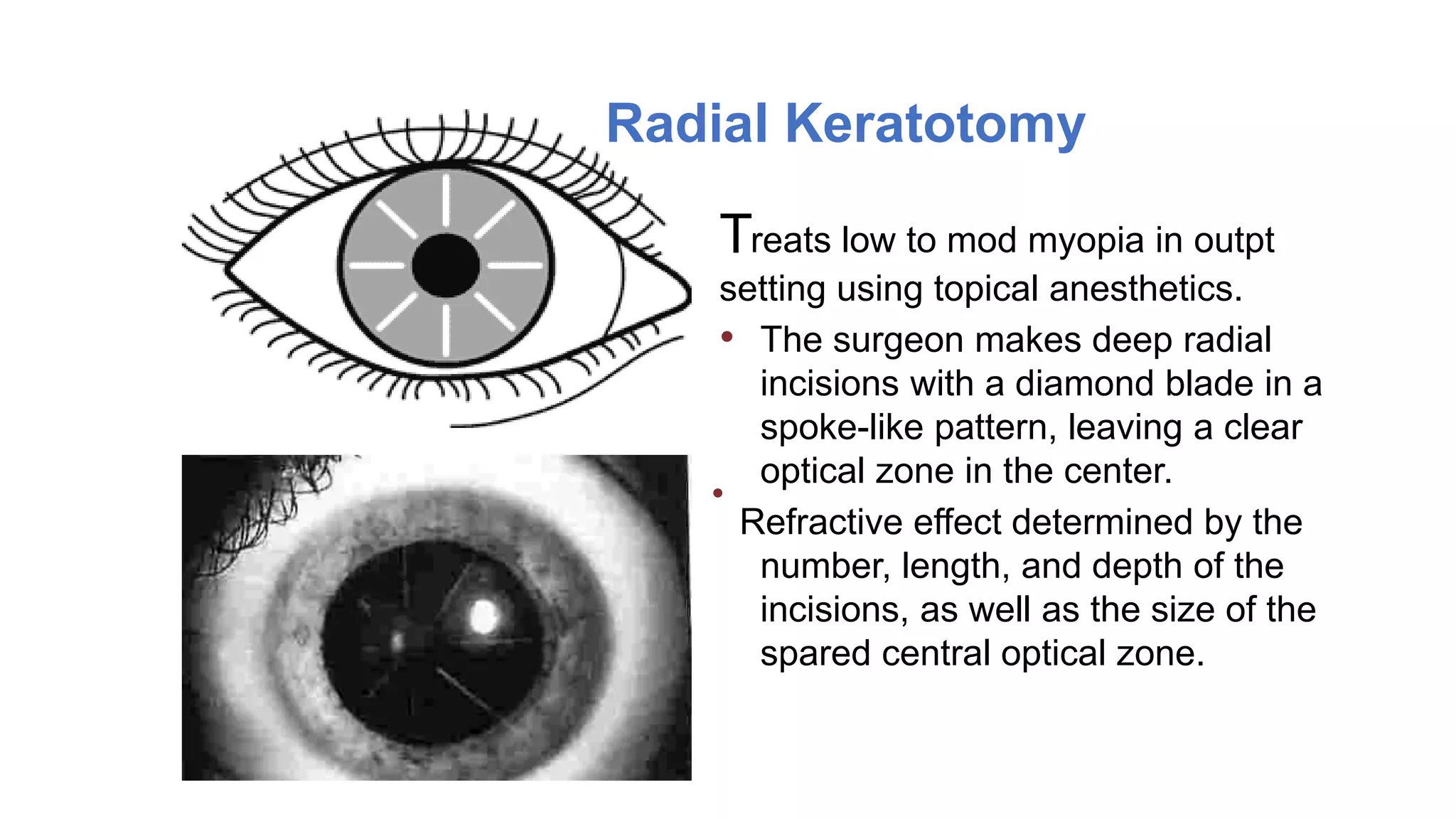
Treats low to mod myopia in outpt
setting using topical anesthetics.
• The surgeon makes deep radial
incisions with a diamond blade in a
spoke-like pattern, leaving a clear
optical zone in the center.
Refractive effect determined by the
number, length, and depth of the
incisions, as well as the size of the
spared central optical zone.
•
Radial Keratotomy
NURSING MANAGEMENT
• Safe administration of the prescribed fluid
• Right documentation
• Monitor the hemodynamic pressure, vital sign, arterial blood gas
Nursing management
• `Assess the patient for any previous allergy to medicine, fruits
etc.
• When we administer any new medicine we have to observe the
side effect of it.
• We must have the knowledge about the sign symptoms of
shock.
• Observe the response to the treatment.
Nursing diagnosis
• Impaired in visual perception relaterd to refrative error.
• Knowledge deficite about treatment of refractive error.
• Risk for injury related to impaired visual perception.
SUMMARY
• We have discussed about the
• Anatomy and physiology
• Definition
• Types
• Etiology
• Pathophysiology
• Clinical manifestation
• Diagnostic evaluation
• Management
References
• BLACK.M.JOYCE,Medical Surgical Nursing , published by
Elsevier edition 8th ,volume-1
• LEWIS, Medical Surgical Nursing,published by Elsevier, 7th
edition
Refractive errors

Refractive errors

  • 1.
    B.Sc Degree Coursein Nursing (Basic) MEDICAL SURGICAL NURSING UNIT II: Nursing Care of patients with Eye Disorders. Topic: Refractive Errors. PRESENTED BY Mrs. SOUMYA SUBRAMANI, M.Sc.(N) LECTURER, MSN DEPARTMENT CON- SRIPMS, COIMBATORE.
  • 2.
    OBJECTIVES • Introduction ofrefractory error • Define refractory error • Explain the types of refractory error • Enlist the etiological factors of refractory error • Describe the pathophysiology of refractory error • Enlist the symptoms of refratory error • Enumerate the diagnostic evaluation of refractory error • Explain the medical, surgical and nursing management of refractory error
  • 3.
  • 4.
  • 5.
  • 6.
  • 7.
  • 8.
  • 9.
  • 10.
  • 11.
    REFRACTION •Refraction of lightoccurs when light passes from one medium to another of different refractive index (ie. density)
  • 12.
    Refractive Components ofthe Eye • Cornea: responsible for the majority of the refractive power of the eye (40 D) Lens: 20 D of refractive power, changes with accommodation •
  • 13.
    REFRACTIVE PHYSIOLOGY • Lightrays are focused on the retina because they are refracted by passing through the cornea and lens (Snell’s Law) Corneal refractive power is constant Lens refractive power is modifiable with accommodation Axial length of the eye is constant except under certain conditions • •
  • 14.
  • 15.
    Emmetropia•  The stateof refraction of the eye in which parallel rays, are focused exactly on the retina when the eye is at rest.  Adequate correlation between axial length and refractive power
  • 16.
    Accommodation• Emmetropic eye •object closerthan 6 M send divergent light that focus behind retina , adaptative mechanism of eye is increase refractive power by accommodation
  • 17.
  • 18.
    • A refractoryerror is a very common eye disorder. It occurs when the eye cannot clearly focus the images from the outside world. The result of refractory errors is blurred vision ,which is sometimes so severe that it causes visual impairment. INTRODUCTION OF REFRACTORY ERROR
  • 19.
    Ametropia (Refractive error) •Mismatch between axial length and refractive power. • Problem with focusing of light on the retina resulting in blurred image. • Parallel light rays don’t fall on the retina (no accommodation)
  • 20.
    • Refractory errormeans that the shape of your eye does not bend light correctly, resulting in a blurred image. • The main types of refractive errors are; 1. Myopia (near sightedness) 2. Hyperopia(farsightedness), 3. Presbyopia(loss Of Near Vision With Age) 4. Astigmatism(both Near Sightedness And Long Sightedness) DEFINITION OF REFRACTORY ERROR
  • 21.
    TYPES • MYOPIA -Near-sightedness also known as short- sightedness and myopia is a condition of the eye where light focuses in front of the retina instead of on the retina this causes distant objects to be while close objects appear normal.
  • 22.
  • 23.
    Uncorrected, light focusesin front of fovea Corrected by divergent lens, light focuses on fovea
  • 25.
    CONTD.... • HYPEROPIA -Far sightedness also known as long sightedness. Hyperopia is a condition of the eye in which light is focused behind the retina, instead of on the retina .Resulting in an inability to seen near objects clear. Causes abnormal shape of cornea.
  • 27.
    Uncorrected, light focusesbehind fovea Corrected by convergent lens, light focuses on fovea
  • 28.
    CONTD.... • PRESBYOPIA -Presbyopia is a common type of vision disorder that occurs as your age. It is often referred to as the aging eye condition. Result in the inability to focus up close, a problem associated in the eye..
  • 29.
    CONTD.... • ASTIGMATISM -It is a condition in which abnormal curvature of cornea. Astigmatism may cause eye strain and may be combined with near sightedness or long sightedness.
  • 32.
    ETIOLOGY • Infection adenovirus •Injury due to optic nerve damage • Ultraviolet radiation • Eye disease • Inherited • Aging (above 45year)
  • 33.
    CONTD.... • Environmental factors •Previous corneal injury • Previous eye surgery • Optic nerve hypyplasia
  • 34.
    PATHOPHYSIOLOGY • Due ToPhysiology Factors Such As Infection • Degenerative Changes Causes By Gradual Loss Of Elasticity Of Lens • Which Leads To Decreased Ability ToAccommodate • Then Lead To Refractive Error
  • 35.
    SYMPTOMS • Double vision •Haziness (unclearness) • Glare or halos around bright light • Squinting (it is a condition where the eyes do not look in the same direction)
  • 36.
    CONTD.... • Headaches • Eyestrain fatigue pain in or around the eyes blurred vision, headache, occasional double vision • Eye irritation
  • 37.
    DIAGNOSTIC Evaluation • HISTORYTAKING • CORNEAL TOPOGRAPHY This is computerized test maps the curve of your eye cornea, it can show problem with eye surface like swelling or scarring. • SLIT LAMP EXAM The doctor uses this microscope to shine a beam of light shaped like a small slit on effected eye. He may dilated pupils during the test it help diagnose.
  • 38.
    CONTD.... • TONOMETRY This testmeasures the pressure inside eye which is called intra ocular pressure • RETINOSCOPY Is a technique obtain an objective measurement of the refractive error of a patients eye.
  • 39.
  • 40.
  • 41.
    MEDICAL MANAGEMENT • Identifythe cause and eliminate the cause • Lens correction • Prevention foreign particles enter in eye • Use of sunglasses • Use of antibiotics prevention from infection
  • 42.
    Management • Cycloplegic drugare used to refraction ( to paralyze the ciliary muscle in order to determine the true refractive error of eye). • Cholinergics (miotics): pilocarpine, carbachol: It increases aqueous fluid outflow by contracting the ciliary muscles. • Beta blockers: Betaxolol,Timolol: Decreased aqueous humor production.
  • 43.
    SURGICAL MANAGEMENT • KERATOMILEUSIS Isa method of reshaping the cornea surface to change its optical power.
  • 44.
    CONTD.... • LASIK -LASER EYE SURGERY (LASER ASSISTED IN SITU KERETO-MILEUSIS) This procedure used to treat near sightedness, farsightedness. A laser is used to reshape the cornea the clear, round dome at the front of the eye. To improve the way the eye focuses light rays into the retina at the back of the eye.
  • 45.
  • 46.
    SURGICAL MANAGEMENT • AUTOMATICLAME-LLAR KERATO PLASTY (LLK) • Keratoplasty is the procedure where by abnormal corneal tissue is replaced by a healthy donor conrea. • This is a older type of vision surgery carried out by making a flap in the cornea to help correct severe short sightedness and long sightedness.
  • 47.
    SURGICAL MANAGEMENT • LASEK •LASSER ASSISTED SUB EPITHELIALKERATOMILEUSIS • The hinged flap made in laser assisted epithelial keratomileusis surgery is created in the layer of eye. • Inserted of creating a thicker corneal flap as in laser assisted epithelial keratomileusis surgery.
  • 48.
    SURGICAL MANAGEMENT • PHOTOREFRACTIVE KERETOTOMY(PRK) • To correct myopia • The eye surgeon then gently removing the surface corneal cells(epithelium)
  • 49.
    Myopic photorefractive kertectomy •PRKcan effectively treat low to mod myopia or hyperopia +/- astigmatism. Performed as outpt with topical anesthesia. First, the corneal epithelium in the area to be ablated is removed to expose Bowman’s layer and the underlying corneal stroma (spatula, laser). Excimer laser then applied as directed by the corneal topography- driven computer program. Topical antibiotics, steroids, and NSAIDs applied, along with a bandage contact lens (BCTL) • • • •
  • 50.
    Treats low tomod myopia in outpt setting using topical anesthetics. • The surgeon makes deep radial incisions with a diamond blade in a spoke-like pattern, leaving a clear optical zone in the center. Refractive effect determined by the number, length, and depth of the incisions, as well as the size of the spared central optical zone. • Radial Keratotomy
  • 51.
    NURSING MANAGEMENT • Safeadministration of the prescribed fluid • Right documentation • Monitor the hemodynamic pressure, vital sign, arterial blood gas
  • 52.
    Nursing management • `Assessthe patient for any previous allergy to medicine, fruits etc. • When we administer any new medicine we have to observe the side effect of it. • We must have the knowledge about the sign symptoms of shock. • Observe the response to the treatment.
  • 53.
    Nursing diagnosis • Impairedin visual perception relaterd to refrative error. • Knowledge deficite about treatment of refractive error. • Risk for injury related to impaired visual perception.
  • 54.
    SUMMARY • We havediscussed about the • Anatomy and physiology • Definition • Types • Etiology • Pathophysiology • Clinical manifestation • Diagnostic evaluation • Management
  • 55.
    References • BLACK.M.JOYCE,Medical SurgicalNursing , published by Elsevier edition 8th ,volume-1 • LEWIS, Medical Surgical Nursing,published by Elsevier, 7th edition