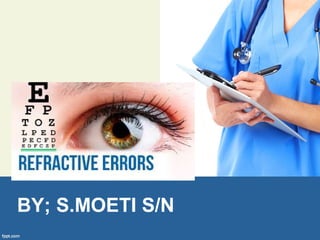
BY; S.MOETI S/N
DEFINATION
• Refractive errors; are optical
imperfections that prevent eye
from properly focusing light on the
retina.
Or
A disorder in which light is not bent
correctly on the retina resulting in
a blurred image.
CONT.
• N:B emmetropia ; a normal refractive
condition resulting in clear focus on retina
with no optical defects.
• it is a normal vision.
RISK FACTORS
1. GENETICS; Some errors such as
myopia may be present in
heritable connective tissues such
as knobloch syndrome.
-linked disorders caused by
mutations in loci involved in photo
receptor function e.g retinitis
pigmentosa
CONT.
2. ENVIROMENTAL;
I.Visually intensive occupations
II.Reading is predicted in children
III.Socio economic status and higher level of
education has also been reported as a risk
factor.
TYPES OF REFRACTIVE
ERRORS
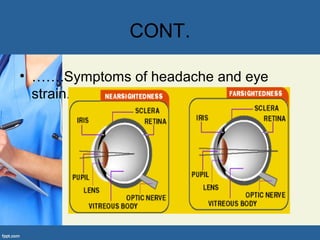
MYOPIA;
near sightedness, difficulty in seeing
distant objects.
Close objects are clear, distant objects are
blurry.
Occurs in peoplewith elongated eye balls,
because of excessive length of the eye,
light rays focus in the vitreous body before
CONT.
…..They can reach the retina.
HYPEROPIA;
Farsightedness
Difficulty in seeing close objects clearly
Results when the eyeball is shorter than
normal causing light rays to focus at a
theoritical point behind the retina.
Demands of reading usually bring
CONT.
• …….Symptoms of headache and eye
strain.
CONT.
ASTIGMATISM;
Rays of light are not bent equally by the
cornea in all direction so the point of focus
is not attained.
Results from unequal curvatures in the
shape of cornea i.e. distorted vision
resulting from an irregularly curved
cornea.
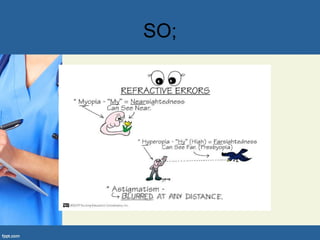
SO;
CONT.
PRESBYOPIA;
The natural loss of accommodative
capacity with age. Leads to difficulty in
reading and even seeing at arms length…
Occurs because of degenerative changes
caused by gradual loss of elasticity of
lens, which leads to decreased ability to
accommodate or focus for near vision
CONT.
• N:B; transient refractive errors occur in
diabetes typically when diabetic control is
eratic.
• Transient myopia may be due to
medications such as suphonamides
PATHOPHYSIOLOGY
• In normal vision, light rays are bent to
focus on the retina.
• In refractive errors, vision is impaired
because the light rays are not sharply
focused on the retina.
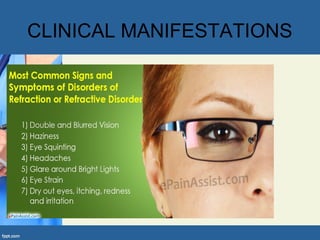
CLINICAL MANIFESTATIONS
DIAGNOSTIC MEASURES
• A comprehensive dilated eye examination.
• Retinoscopy:Vision of myopes improves
when concave trial lenses correct the
focusing power of the eyes.
• Hypropes experience improvement when
convex lenses are used.
• Visual acuity:Snellen chart
MEDICAL MANAGEMENT
MYOPIA Concave /minus
lens
HYPEROPIA Convex/plus lens
ASTIGMATISM Cylindric lens
PRESBYOPIA Plus lens
CONT.
• Refractive errors can be corrected with
eyeglasses, contact lenses or surgery.
• Eyeglasses: They are the simplest and
safety way to correct refractive errors.
Appropriate lenses are prescribed to
correct refractive error and give one an
optimal vision.
CONT.
• Contact Lenses: Work by becoming the
first refractive surface for light rays
entering the eye causing a more precise
refraction or focus. It provides clearer
vision, a wider field of vision and greater
comfort
CONT.
• Refractive Surgery: Aims to change
shape of the cornea permanently. This
change in the eye shape restores the
focusing power of the eye by allowing the
light rays to focus precisely on the retina
for improved vision.
CONT.
• Incisional radial keratotomy( RK):Under local
anesthesia,the cornea is reshaped by making
incisions.
• Laser assisted situ Keratectomy (LASIK):A
corneal flap is created to expose the inner
cornea.
• Photo refractive Keratectomy(PRK):Removal of
the epithelial layer(top surface)of the cornea
exposing the inner cornea curvature of the eye.
NURSING DIAGNOSIS
• Difficulty in reading due to hyperopia as
manifested by headache/eye strain
• At risk of injuries due to blurred vision
• Difficulty in learning due to hazziness as
manifested by low grades in class.
• Impaired comfort due to pain(headache)
AS manifested by groaning/closing of eyes
• Low self esteem due to impaired vision as
CONT.
• …..manifested by social withdrawal
MANAGEMENT.
• Health educate the patient about his/her
condition so that the patient could cope well with
the situation and on proper eye care
• Comfort and Reassurance
• Family therapy so that they will assist the
patient.
CONT.
• Assist the patient to choose the right treatment
for him/herself.
• Provide or improve patients safety(side rails,
non slippery flow and not wet, no hanging or
electrical cords on the floor)
• Pain destructive measures(meditation, soft
music) and pain killers.
COMPLICATIONS
• Dry eye syndrome
• Epithelial abrasion
• Infection
THANK YOU!!!!!THANK YOU!!!!!

Refractive errors s.moeti

  • 1.
  • 2.
    DEFINATION • Refractive errors;are optical imperfections that prevent eye from properly focusing light on the retina. Or A disorder in which light is not bent correctly on the retina resulting in a blurred image.
  • 3.
    CONT. • N:B emmetropia; a normal refractive condition resulting in clear focus on retina with no optical defects. • it is a normal vision.
  • 4.
    RISK FACTORS 1. GENETICS;Some errors such as myopia may be present in heritable connective tissues such as knobloch syndrome. -linked disorders caused by mutations in loci involved in photo receptor function e.g retinitis pigmentosa
  • 5.
    CONT. 2. ENVIROMENTAL; I.Visually intensiveoccupations II.Reading is predicted in children III.Socio economic status and higher level of education has also been reported as a risk factor.
  • 6.
    TYPES OF REFRACTIVE ERRORS MYOPIA; nearsightedness, difficulty in seeing distant objects. Close objects are clear, distant objects are blurry. Occurs in peoplewith elongated eye balls, because of excessive length of the eye, light rays focus in the vitreous body before
  • 7.
    CONT. …..They can reachthe retina. HYPEROPIA; Farsightedness Difficulty in seeing close objects clearly Results when the eyeball is shorter than normal causing light rays to focus at a theoritical point behind the retina. Demands of reading usually bring
  • 8.
    CONT. • …….Symptoms ofheadache and eye strain.
  • 9.
    CONT. ASTIGMATISM; Rays of lightare not bent equally by the cornea in all direction so the point of focus is not attained. Results from unequal curvatures in the shape of cornea i.e. distorted vision resulting from an irregularly curved cornea.
  • 10.
  • 11.
    CONT. PRESBYOPIA; The natural lossof accommodative capacity with age. Leads to difficulty in reading and even seeing at arms length… Occurs because of degenerative changes caused by gradual loss of elasticity of lens, which leads to decreased ability to accommodate or focus for near vision
  • 12.
    CONT. • N:B; transientrefractive errors occur in diabetes typically when diabetic control is eratic. • Transient myopia may be due to medications such as suphonamides
  • 13.
    PATHOPHYSIOLOGY • In normalvision, light rays are bent to focus on the retina. • In refractive errors, vision is impaired because the light rays are not sharply focused on the retina.
  • 14.
  • 15.
    DIAGNOSTIC MEASURES • Acomprehensive dilated eye examination. • Retinoscopy:Vision of myopes improves when concave trial lenses correct the focusing power of the eyes. • Hypropes experience improvement when convex lenses are used. • Visual acuity:Snellen chart
  • 16.
    MEDICAL MANAGEMENT MYOPIA Concave/minus lens HYPEROPIA Convex/plus lens ASTIGMATISM Cylindric lens PRESBYOPIA Plus lens
  • 17.
    CONT. • Refractive errorscan be corrected with eyeglasses, contact lenses or surgery. • Eyeglasses: They are the simplest and safety way to correct refractive errors. Appropriate lenses are prescribed to correct refractive error and give one an optimal vision.
  • 18.
    CONT. • Contact Lenses:Work by becoming the first refractive surface for light rays entering the eye causing a more precise refraction or focus. It provides clearer vision, a wider field of vision and greater comfort
  • 19.
    CONT. • Refractive Surgery:Aims to change shape of the cornea permanently. This change in the eye shape restores the focusing power of the eye by allowing the light rays to focus precisely on the retina for improved vision.
  • 20.
    CONT. • Incisional radialkeratotomy( RK):Under local anesthesia,the cornea is reshaped by making incisions. • Laser assisted situ Keratectomy (LASIK):A corneal flap is created to expose the inner cornea. • Photo refractive Keratectomy(PRK):Removal of the epithelial layer(top surface)of the cornea exposing the inner cornea curvature of the eye.
  • 21.
    NURSING DIAGNOSIS • Difficultyin reading due to hyperopia as manifested by headache/eye strain • At risk of injuries due to blurred vision • Difficulty in learning due to hazziness as manifested by low grades in class. • Impaired comfort due to pain(headache) AS manifested by groaning/closing of eyes • Low self esteem due to impaired vision as
  • 22.
    CONT. • …..manifested bysocial withdrawal MANAGEMENT. • Health educate the patient about his/her condition so that the patient could cope well with the situation and on proper eye care • Comfort and Reassurance • Family therapy so that they will assist the patient.
  • 23.
    CONT. • Assist thepatient to choose the right treatment for him/herself. • Provide or improve patients safety(side rails, non slippery flow and not wet, no hanging or electrical cords on the floor) • Pain destructive measures(meditation, soft music) and pain killers.
  • 24.
    COMPLICATIONS • Dry eyesyndrome • Epithelial abrasion • Infection
  • 25.