REFRACTIVE ERRORS
GRACIOUS COLEGE OF NURSING
RAIPUR C.G.
REFRACTIVE ERRORS
PRESENTED BY-
OM VERMA
ASSISTANT PROFESSOR
INTRODUCTION
close object appear clear but far ones don’t
Nearby objects are blurry
DEFINITION
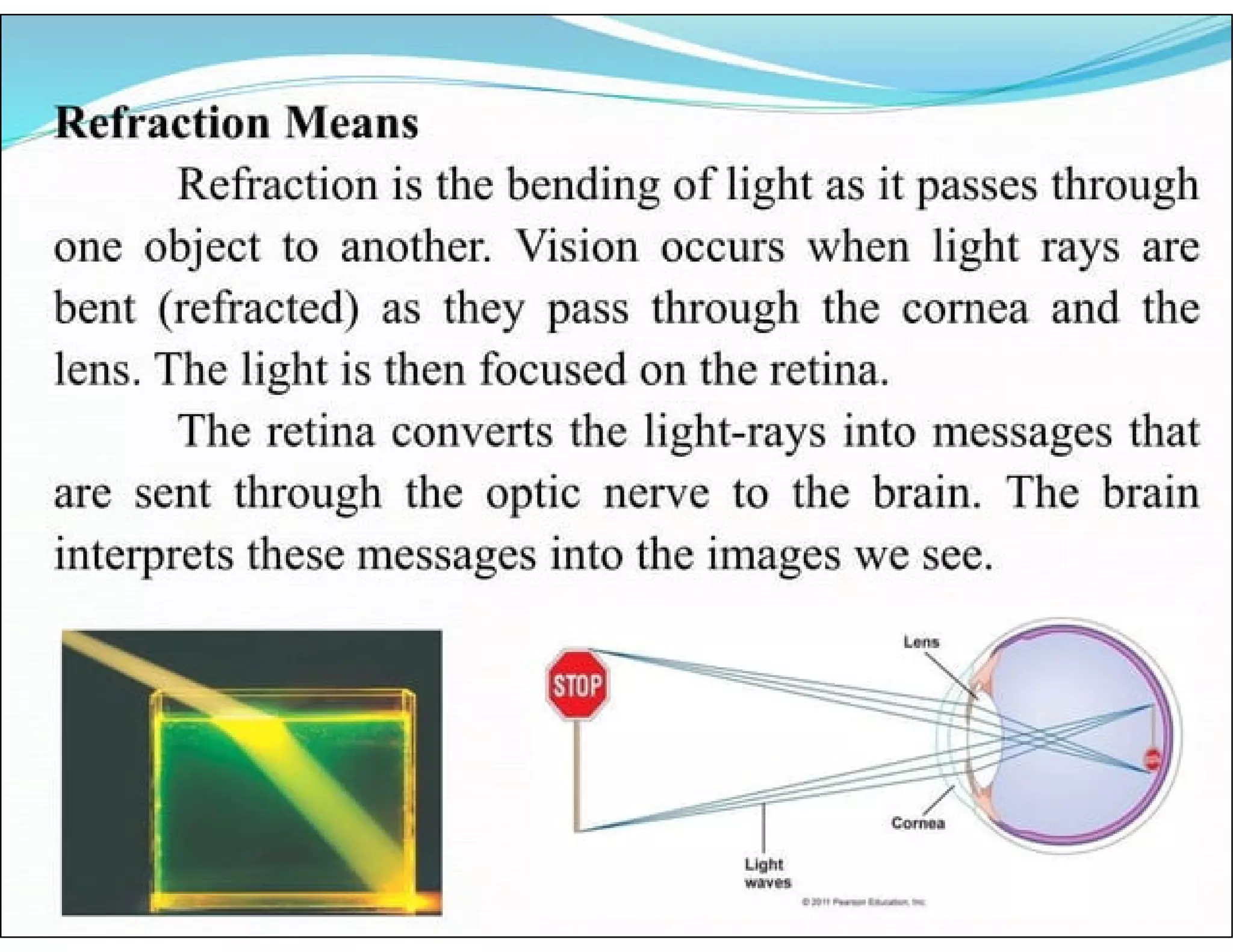
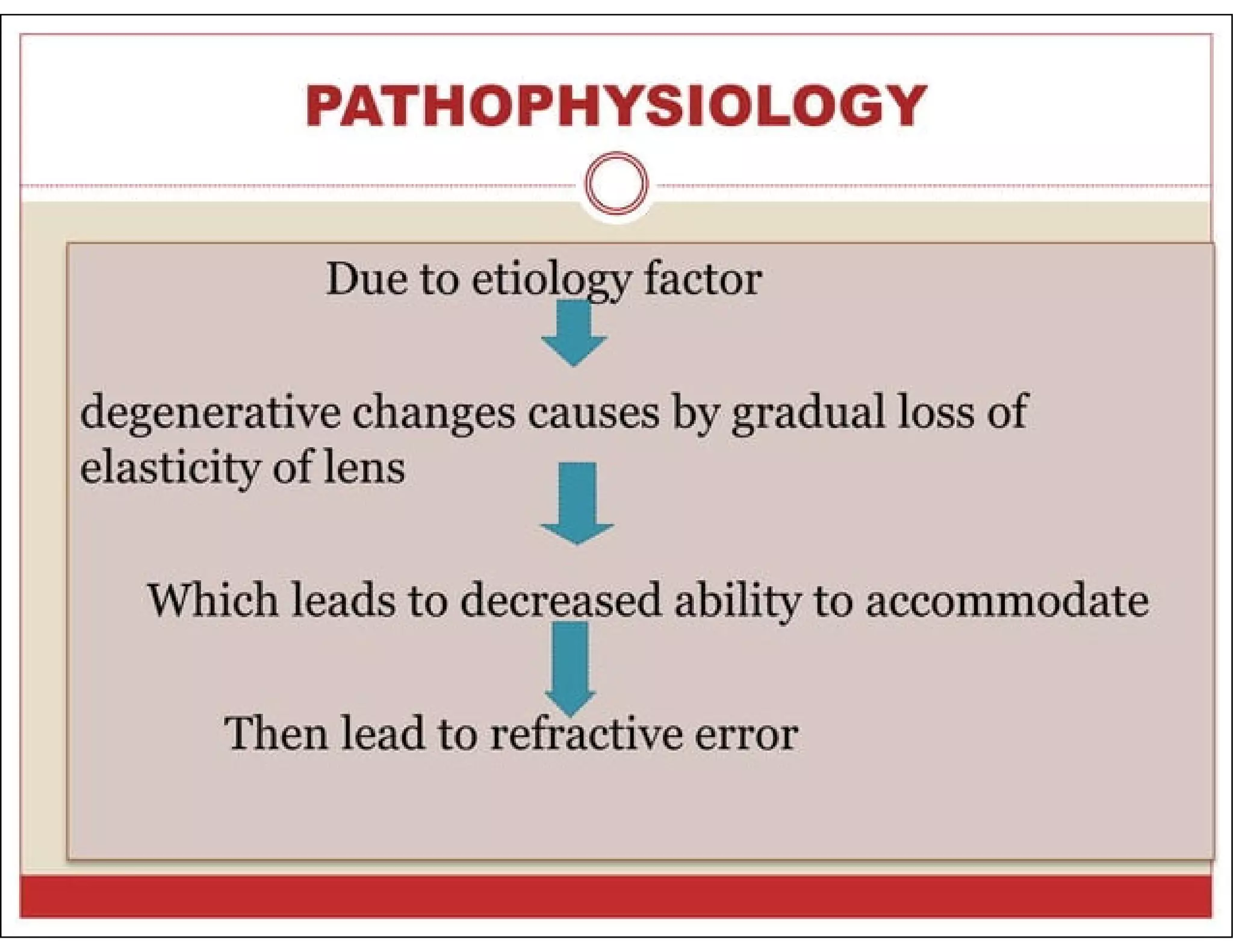
Refractive error also known as refraction error is
problem with focusing of light on the retina .
According to lippen cott
Refractive error means that the shape of the eye
does not bend light proper and correct resulting
in a blurred image .
According to luckmans
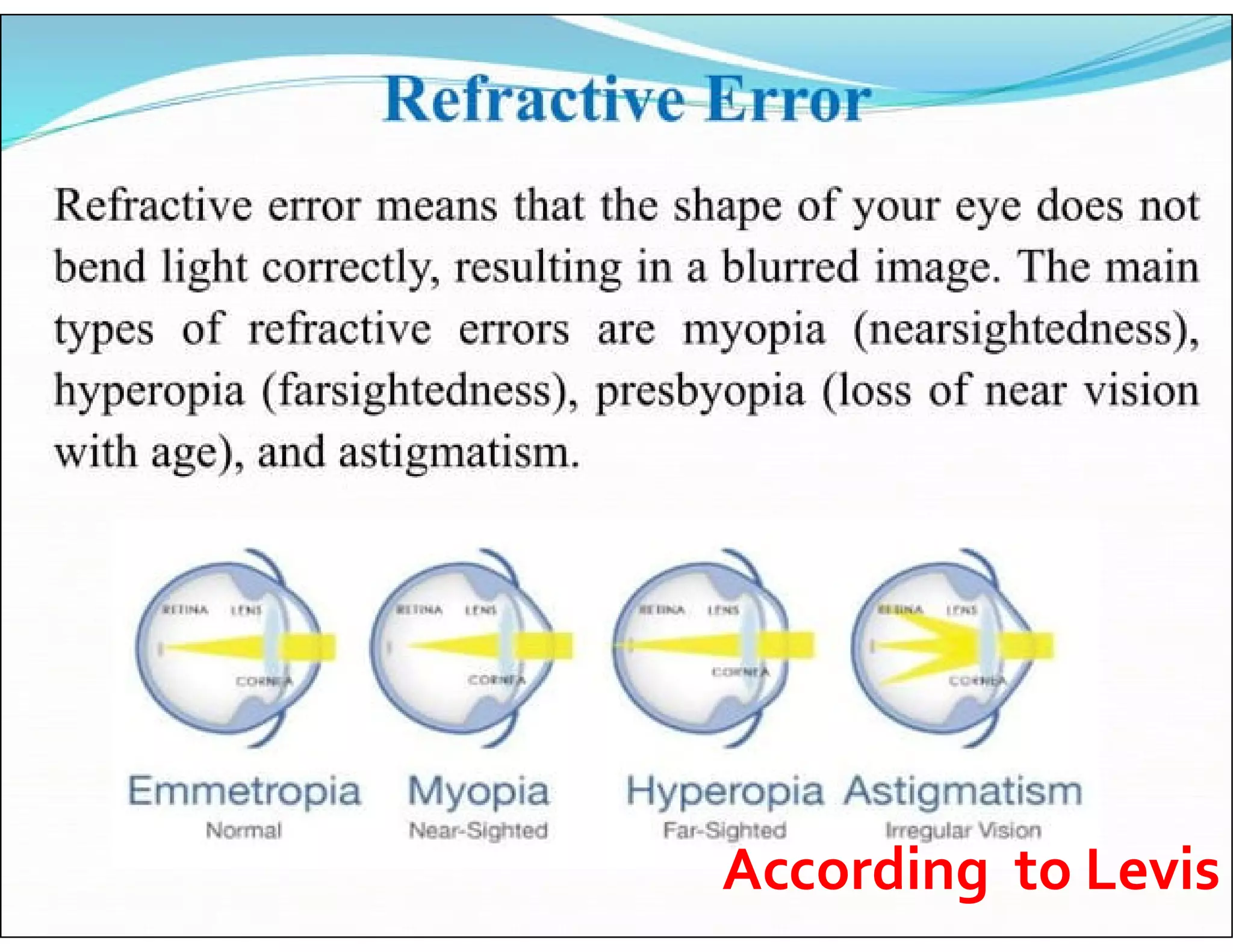
According to Levis
TYPES
TYPES
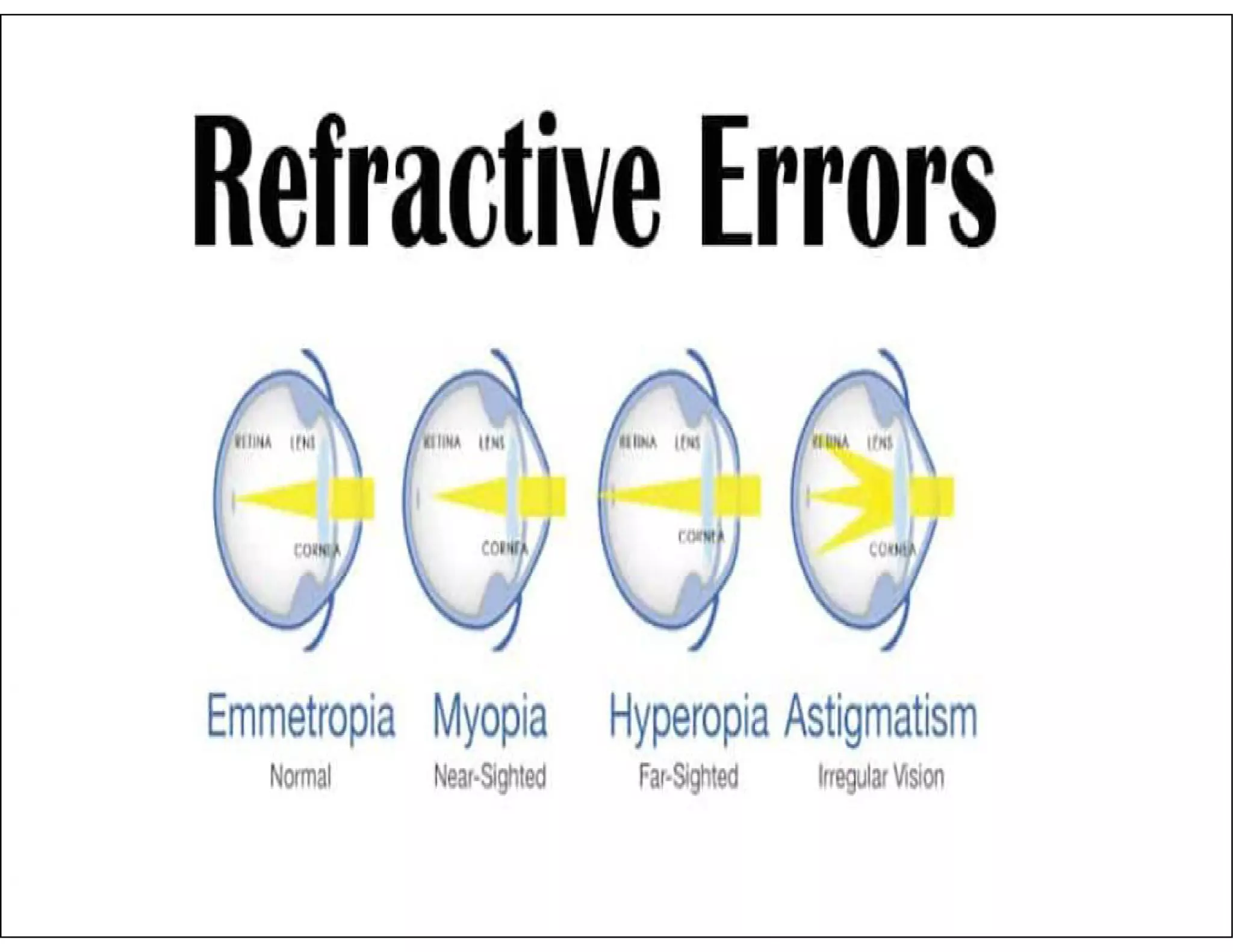
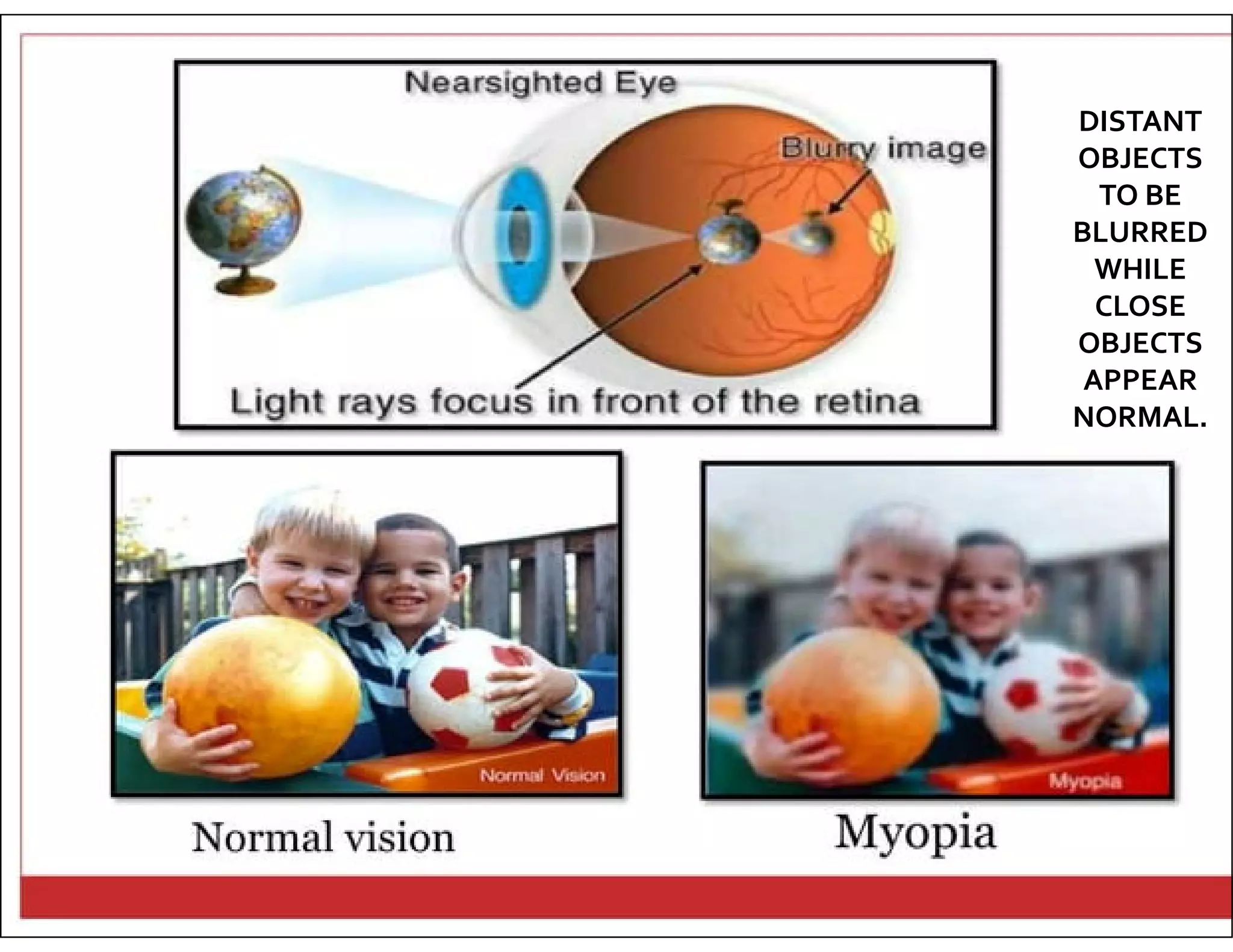
1. MYOPIA -
 Near-sightedness also known as short –
sightedness and myopia is a condition of the
eye where light focuses in front of the retina
instead of on the retina this causes distant
objects to be blurred while close objects
appear normal.
DISTANT
OBJECTS
TO BE
BLURRED
WHILE
CLOSE
OBJECTS
APPEAR
NORMAL.
Nuclear sclerosis refers to cloudiness, hardening,
and yellowing of the central region of the lens in the
eye called the nucleus. Nuclear sclerosis
( In humans, the total optical power of the relaxed eye is approximately
60 dioptres. )
2.HYPEROPIA
 Far-sightedness also known as long
sightedness ….
 Hyperopia is a condition of the eye in which
light is focused behind the retina , instead
(different side ) of on the retina . Resulting in an
inability to seen near objects clear .
 Causes - abnormal shape of cornea ( difficulty
in near objects )
3. PRESBYOPIA
 Pres-byopia is a common type of vision
disorder. It is often referred to as the
aging eye condition and due to causes of
hardening of lens of the eye.
Lens becomes less flexible, it can no
 Lens becomes less flexible, it can no
longer change shape to focus on close-up
images. Result in the inability to focus on
close – up image , a problem associated
with refraction in the eye ..
4. ASTIGMATISM
 Is a condition in which an abnormal
curvature of the cornea .
 Asti-gmatisms may cause eye
strain (People who look at screens two
or more hours in a row every day ) and
may be combined with
nearsightedness or long-
sightedness .
ETIOLOGY
ETIOLOGY
InfectionAdenovirus
Injury Due To Optic Nerve Damage
Ultraviolet Radiation
 Eye Disease
Inherited
Aging ( Above 45 year )
Environmental Factors
Previous Corneal Injury
Previous Eye Surgery
Optic Nerve Hyperplasia
Infection adenovirus
 conjunctivitis. One site of infection that has
received sparse attention is the cornea, a
transparent tissue and the window of the eye.
While most adenovirus infections are self-
limited, corneal inflammation (keratitis) due
to adenovirus can persist or recur for months
to years after infection, leading to reduced
vision, discomfort, and light sensitivity.
Injury due to optic nerve
damage
 Optic nerves are vital to your eyesight.
Damage to these nerves can lead
to temporary or permanent vision
loss. Glaucoma is the most common
optic nerve disorder. If left untreated,
optic nerve damage can lead to
refractive error and blindness.
Ultraviolet radiation
 UV light effect the all structures
of the eye. Corneal damage,
cataracts ( a cloudy lens ) and
macular degeneration are all
cataracts ( a cloudy lens ) and
macular degeneration are all
possible chronic effects from UV
exposure and can ultimately lead
to decreased vision and refractive
error .
Eye disorder /disease
 A refractive error is a very common
eye disorder. It occurs when the eye
cannot clearly focus the images
from the outside world.The result of
refractive errors is blurred vision,
which is sometimes so severe that it
causes visual impairment.
inherited
 Research suggests that refractive
errors can, in some cases, be
inherited. If one or both parents have
a refractive error, a child is more likely
to suffer from one as well. Babies may
be born with a refractive error and the
condition can worsen over time.
Aging ( Above 45 year )
 Change in muscle tissue of structure of
eye lead refractive error
Environmental factors
Such as pollutants, toxic gasses and chemicals,
bacteria, smoking, and ultraviolet radiation can
all harm different parts of our eyes.
Previous Corneal Injury
Corneal injury is a wound to the part of the
eye known as the cornea.The cornea is the
crystal clear (transparent) tissue that covers
the front of the eye. It works with the lens of
the eye to focus images on the retina. Any
injury lead to refractive error
Previous Eye Surgery
Any eye surgery lead the
complication of eye and change in
structure of eye the lead the
refractive error
Optic Nerve Hyperplasia
Optic Nerve Hyperplasia
( collection of more than a
million nerve fibers that
transmit visual signals from
the eye )
SYMPTOMS
symptoms
1. Double vision
2. Haziness ( unclearness )
3. Glare or halos around bright light ( LIGHT
IRRRITATION BUS CAR )
4. Squinting ( it is a condition where the eyes do
not look in the same direction )
5. Headaches
6. Eye strain ( BLURRED ) fatigue pain in or
around the eyes blurred vision ,headache,
occasional double vision.
7. Eye irritation
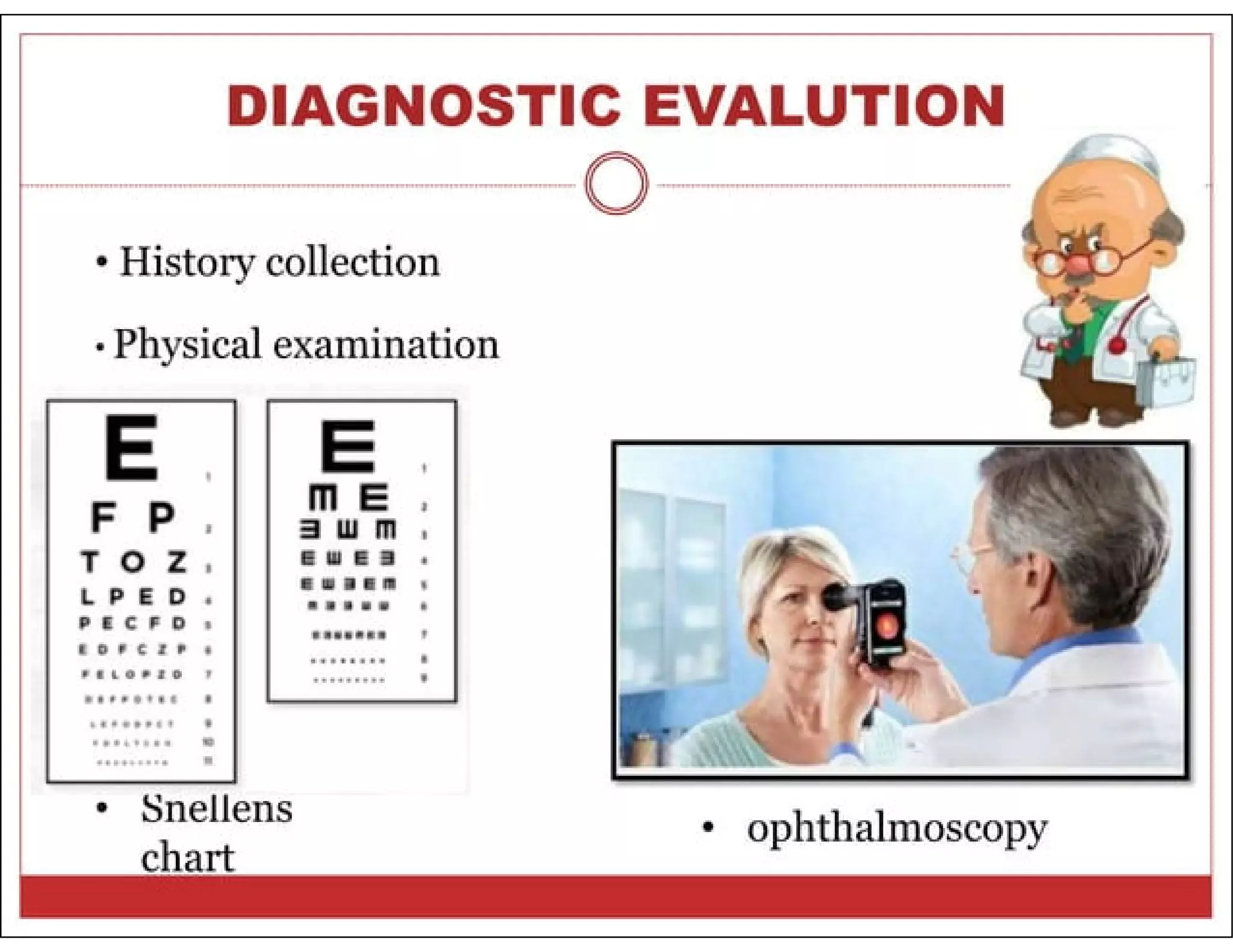
Ophthalmoscopy
 is an examination of the back part of
the eye (fundus), which includes the
retina , optic disc, choroid , and blood
vessels.
 CORNEALTOPOGRAPHY
 This computerized test maps the curve of
eye cornea , it can show problem with eye
surface like swelling or scarring .
SLIT LAMP EXAM –
SLIT LAMP EXAM –
The doctor uses this microscope to shine a
beam of light shaped like a small slit on
effected eye .he may dilated pupils during
the test it help diagnose .
 TONOMETRY
 Test measures the pressure inside eye
.which is called intra ocular pressure
 RETINOSCOPY
 It is a technique obtain an objective measurement of
the refractive error of a patients eye .
 Retinoscopy is an examination of the retina that
provides an objective measurement of refractive
error.The procedure is performed by an optometrist
during an eye exam to determine if a patient has
myopia (nearsightedness), hyperopia
(farsightedness) or astigmatism
MANAGEMENT
MEDICAL MANAGEMENT
 Identify the cause & eliminate the cause
 Lens correction – a concave lens is used
to correct the problem
 Prevention foreign particles enter in eye
 Use of sunglasses
 Use of antibiotics prevention from
infection
SURGICAL
SURGICAL
MANAGEMENT
Surgical management
 LASIK-
 laser eye surgery
 ( laser assisted in situ kereto-mileusis )
 This procedure used to treat nearsightedness
,farsightedness K
 IS A METHOD OF RESHAPING THE CORNEA SURFACE TO
CHANGE ITS OPTICAL POWER.
 A laser is used to reshape the cornea – the clear ,round
dome at the front of the eye ..
 To improve the way the eye focuses light rays on to the
retina at the back of the eye.
AUTOMATIC LAME -LLAR
KERATOPLASTY (ALK)
 Keratoplasty is the procedure where by
abnormal corneal tissue is replaced by a
healthy donor cornea.
 Is a older type of vision surgery carried out
by making a flap in the cornea to help
correct severe short sightedness and long-
sightedness.
PHOTO REFRACTIVE
KERETOTOMY (PRK)
To correct myopia
The eye surgeon then gently
removing the surface corneal
cells ( epithelium )
NURSING MANAGEMENT
Assess the patient for any previous allergy
to medicine, fruits etc
When we administer any new medicine we
have to observe the side effect of it
We must have the knowledge about the
sign symptoms of shock
Observe the response to the treatment
NURSING MANAGEMENT
 Safe administration of the prescribed fluid
 Right documentation
 Monitor the hemodynamic pressure, vital
sign, arterial blood gas
refractive error OM VERMA 2023.pdf

refractive error OM VERMA 2023.pdf

  • 1.
    REFRACTIVE ERRORS GRACIOUS COLEGEOF NURSING RAIPUR C.G. REFRACTIVE ERRORS PRESENTED BY- OM VERMA ASSISTANT PROFESSOR
  • 5.
    INTRODUCTION close object appearclear but far ones don’t Nearby objects are blurry
  • 6.
    DEFINITION Refractive error alsoknown as refraction error is problem with focusing of light on the retina . According to lippen cott Refractive error means that the shape of the eye does not bend light proper and correct resulting in a blurred image . According to luckmans
  • 7.
  • 8.
  • 9.
    TYPES 1. MYOPIA - Near-sightedness also known as short – sightedness and myopia is a condition of the sightedness and myopia is a condition of the eye where light focuses in front of the retina instead of on the retina this causes distant objects to be blurred while close objects appear normal.
  • 10.
  • 11.
    Nuclear sclerosis refersto cloudiness, hardening, and yellowing of the central region of the lens in the eye called the nucleus. Nuclear sclerosis
  • 12.
    ( In humans,the total optical power of the relaxed eye is approximately 60 dioptres. )
  • 13.
    2.HYPEROPIA  Far-sightedness alsoknown as long sightedness ….  Hyperopia is a condition of the eye in which light is focused behind the retina , instead light is focused behind the retina , instead (different side ) of on the retina . Resulting in an inability to seen near objects clear .  Causes - abnormal shape of cornea ( difficulty in near objects )
  • 14.
    3. PRESBYOPIA  Pres-byopiais a common type of vision disorder. It is often referred to as the aging eye condition and due to causes of hardening of lens of the eye. Lens becomes less flexible, it can no  Lens becomes less flexible, it can no longer change shape to focus on close-up images. Result in the inability to focus on close – up image , a problem associated with refraction in the eye ..
  • 15.
    4. ASTIGMATISM  Isa condition in which an abnormal curvature of the cornea .  Asti-gmatisms may cause eye  Asti-gmatisms may cause eye strain (People who look at screens two or more hours in a row every day ) and may be combined with nearsightedness or long- sightedness .
  • 16.
  • 17.
    InfectionAdenovirus Injury Due ToOptic Nerve Damage Ultraviolet Radiation  Eye Disease Inherited Aging ( Above 45 year ) Aging ( Above 45 year ) Environmental Factors Previous Corneal Injury Previous Eye Surgery Optic Nerve Hyperplasia
  • 18.
    Infection adenovirus  conjunctivitis.One site of infection that has received sparse attention is the cornea, a transparent tissue and the window of the eye. While most adenovirus infections are self- While most adenovirus infections are self- limited, corneal inflammation (keratitis) due to adenovirus can persist or recur for months to years after infection, leading to reduced vision, discomfort, and light sensitivity.
  • 19.
    Injury due tooptic nerve damage  Optic nerves are vital to your eyesight. Damage to these nerves can lead to temporary or permanent vision loss. Glaucoma is the most common loss. Glaucoma is the most common optic nerve disorder. If left untreated, optic nerve damage can lead to refractive error and blindness.
  • 20.
    Ultraviolet radiation  UVlight effect the all structures of the eye. Corneal damage, cataracts ( a cloudy lens ) and macular degeneration are all cataracts ( a cloudy lens ) and macular degeneration are all possible chronic effects from UV exposure and can ultimately lead to decreased vision and refractive error .
  • 21.
    Eye disorder /disease A refractive error is a very common eye disorder. It occurs when the eye cannot clearly focus the images cannot clearly focus the images from the outside world.The result of refractive errors is blurred vision, which is sometimes so severe that it causes visual impairment.
  • 22.
    inherited  Research suggeststhat refractive errors can, in some cases, be inherited. If one or both parents have inherited. If one or both parents have a refractive error, a child is more likely to suffer from one as well. Babies may be born with a refractive error and the condition can worsen over time.
  • 23.
    Aging ( Above45 year )  Change in muscle tissue of structure of eye lead refractive error Environmental factors Such as pollutants, toxic gasses and chemicals, bacteria, smoking, and ultraviolet radiation can all harm different parts of our eyes.
  • 24.
    Previous Corneal Injury Cornealinjury is a wound to the part of the eye known as the cornea.The cornea is the crystal clear (transparent) tissue that covers the front of the eye. It works with the lens of the eye to focus images on the retina. Any injury lead to refractive error Previous Eye Surgery Any eye surgery lead the complication of eye and change in structure of eye the lead the refractive error
  • 25.
    Optic Nerve Hyperplasia OpticNerve Hyperplasia ( collection of more than a million nerve fibers that million nerve fibers that transmit visual signals from the eye )
  • 26.
  • 27.
    symptoms 1. Double vision 2.Haziness ( unclearness ) 3. Glare or halos around bright light ( LIGHT IRRRITATION BUS CAR ) IRRRITATION BUS CAR ) 4. Squinting ( it is a condition where the eyes do not look in the same direction ) 5. Headaches 6. Eye strain ( BLURRED ) fatigue pain in or around the eyes blurred vision ,headache, occasional double vision. 7. Eye irritation
  • 31.
    Ophthalmoscopy  is anexamination of the back part of the eye (fundus), which includes the the eye (fundus), which includes the retina , optic disc, choroid , and blood vessels.
  • 32.
     CORNEALTOPOGRAPHY  Thiscomputerized test maps the curve of eye cornea , it can show problem with eye surface like swelling or scarring . SLIT LAMP EXAM – SLIT LAMP EXAM – The doctor uses this microscope to shine a beam of light shaped like a small slit on effected eye .he may dilated pupils during the test it help diagnose .
  • 33.
     TONOMETRY  Testmeasures the pressure inside eye .which is called intra ocular pressure  RETINOSCOPY  It is a technique obtain an objective measurement of the refractive error of a patients eye . the refractive error of a patients eye .  Retinoscopy is an examination of the retina that provides an objective measurement of refractive error.The procedure is performed by an optometrist during an eye exam to determine if a patient has myopia (nearsightedness), hyperopia (farsightedness) or astigmatism
  • 34.
  • 35.
    MEDICAL MANAGEMENT  Identifythe cause & eliminate the cause  Lens correction – a concave lens is used to correct the problem  Prevention foreign particles enter in eye  Prevention foreign particles enter in eye  Use of sunglasses  Use of antibiotics prevention from infection
  • 37.
  • 38.
    Surgical management  LASIK- laser eye surgery  ( laser assisted in situ kereto-mileusis )  This procedure used to treat nearsightedness ,farsightedness K  IS A METHOD OF RESHAPING THE CORNEA SURFACE TO CHANGE ITS OPTICAL POWER.  A laser is used to reshape the cornea – the clear ,round dome at the front of the eye ..  To improve the way the eye focuses light rays on to the retina at the back of the eye.
  • 39.
    AUTOMATIC LAME -LLAR KERATOPLASTY(ALK)  Keratoplasty is the procedure where by abnormal corneal tissue is replaced by a healthy donor cornea. healthy donor cornea.  Is a older type of vision surgery carried out by making a flap in the cornea to help correct severe short sightedness and long- sightedness.
  • 40.
    PHOTO REFRACTIVE KERETOTOMY (PRK) Tocorrect myopia The eye surgeon then gently The eye surgeon then gently removing the surface corneal cells ( epithelium )
  • 41.
    NURSING MANAGEMENT Assess thepatient for any previous allergy to medicine, fruits etc When we administer any new medicine we have to observe the side effect of it have to observe the side effect of it We must have the knowledge about the sign symptoms of shock Observe the response to the treatment
  • 42.
    NURSING MANAGEMENT  Safeadministration of the prescribed fluid  Right documentation  Monitor the hemodynamic pressure, vital sign, arterial blood gas sign, arterial blood gas