 Introduction
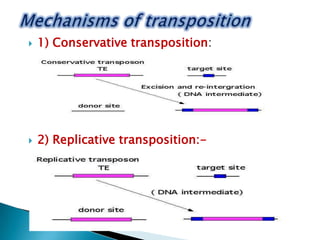
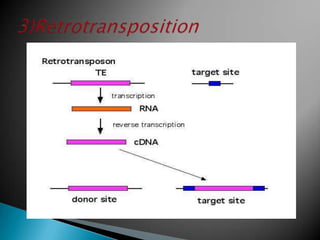
 Mechanisms of transposition
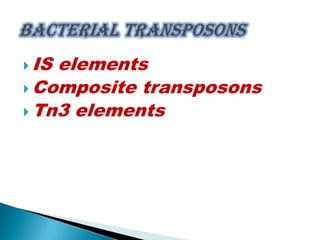
 Bacterial transposons
 IS elements
 Composite transposons
 Non-composite transposons
 Medical significance of bacterial
transposons
 Conclusion
 References
 Transposable elements are also known as
“TRANSPOSONS” , “JUMPING GENES” ,
“MOBILE GENETIC ELEMENTS”.
 A DNA sequence that can change its position
within the genome, sometimes creating or
reversing mutations and altering the cells genome
size.
 Term was given by “Hedges and Jacob(1947).
 Barbara McClintock’s discovery of these
jumping genes, through an analysis of genetic
instability in Maize, earn her noble prize in 1983.
 1) Conservative transposition:
-
 2) Replicative transposition:-
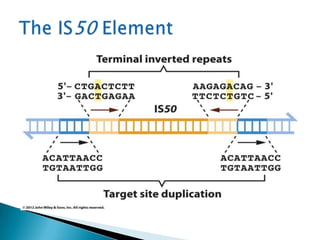
 IS elements
 Composite transposons
 Tn3 elements
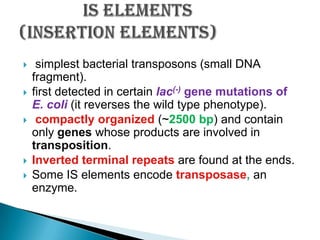
 simplest bacterial transposons (small DNA
fragment).
 first detected in certain lac(-) gene mutations of
E. coli (it reverses the wild type phenotype).
 compactly organized (~2500 bp) and contain
only genes whose products are involved in
transposition.
 Inverted terminal repeats are found at the ends.
 Some IS elements encode transposase, an
enzyme.
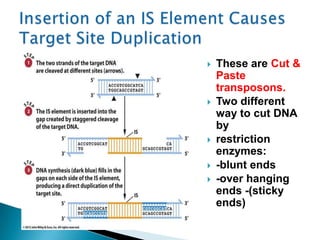
 These are Cut &
Paste
transposons.
 Two different
way to cut DNA
by
 restriction
enzymes:
 -blunt ends
 -over hanging
ends -(sticky
ends)
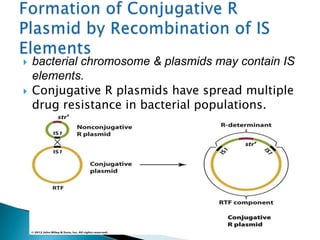
 bacterial chromosome & plasmids may contain IS
elements.
 Conjugative R plasmids have spread multiple
drug resistance in bacterial populations.
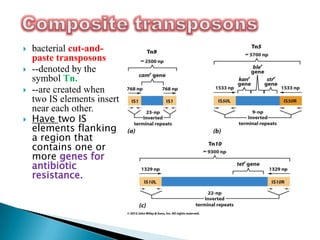
 bacterial cut-and-
paste transposons
 --denoted by the
symbol Tn.
 --are created when
two IS elements insert
near each other.
 Have two IS
elements flanking
a region that
contains one or
more genes for
antibiotic
resistance.
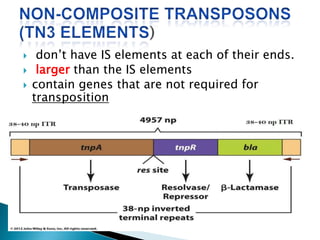
 don’t have IS elements at each of their ends.
 larger than the IS elements
 contain genes that are not required for
transposition
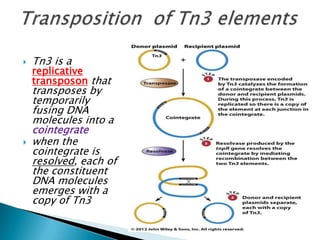
 Tn3 is a
replicative
transposon that
transposes by
temporarily
fusing DNA
molecules into a
cointegrate
 when the
cointegrate is
resolved, each of
the constituent
DNA molecules
emerges with a
copy of Tn3
 Many bacterial transposons carry genes for
antibiotic resistance.
 It is relatively simple matter for these genes to
move from one DNA molecule to another- for
instance, from a chromosome to a plasmid. This
genetic flux has a profound medical significance
because many of the DNA molecules that acquire
resistance genes can be passed on to other cells.
 This process has occurred in several species
pathogenic to humans, including strains of
Staphylococcus, Neisseria, Sbigella & Salmonella.
 Many bacterial infections causing diseases such
as dysentery, tuberculosis, & gonorrhea are
difficult to treat.
 The spread of multiple drug resistamnce in bacterial
populations has been accelerated by evolution of
conjugative R plasmids that carry the resistance
genes .
 These plasmids have two components- one called
the resistance transfer factor , or RTF, contains the
genes for conjugative transfer between cells, the
other, called the R-determent, contains the genes for
antibiotic resistance.
 These can be passed from one species to another,
even between quite dissimilar cell types-for e.g
between a coccus and a bacillus.
 Thus, once multiple drug resistance has evolved in a
part of the microbial kingdom, it can spread to other
parts with relative ease.
 Snustad, D.Peter & Simmons J.Michael.2003. Principles
Of Genetics(2nd edition) John Wiley & Sons. Newyork.
page no. 441-446.
 Weaver , F Robert & Hedrick W.Philip .1997. Genetics(3rd
edition). Wm.C.Publishers. page no. 354-365
 Web links:-
 http://www.nature.com/scitable/topicpage/transposons-the-
jumping-genes-518
 http://www.ndsu.edu/pubweb/~mcclean/plsc431/transelem/t
rans5.htm
 http://bio.classes.ucsc.edu/bio105l/EXERCISES/F%20TRA
NSFER/Tn.pdf
Reeta yadav. roll no. 01. transposable elements in prokaryotes

Reeta yadav. roll no. 01. transposable elements in prokaryotes

  • 2.
     Introduction  Mechanismsof transposition  Bacterial transposons  IS elements  Composite transposons  Non-composite transposons  Medical significance of bacterial transposons  Conclusion  References
  • 3.
     Transposable elementsare also known as “TRANSPOSONS” , “JUMPING GENES” , “MOBILE GENETIC ELEMENTS”.  A DNA sequence that can change its position within the genome, sometimes creating or reversing mutations and altering the cells genome size.  Term was given by “Hedges and Jacob(1947).  Barbara McClintock’s discovery of these jumping genes, through an analysis of genetic instability in Maize, earn her noble prize in 1983.
  • 4.
     1) Conservativetransposition: -  2) Replicative transposition:-
  • 6.
     IS elements Composite transposons  Tn3 elements
  • 7.
     simplest bacterialtransposons (small DNA fragment).  first detected in certain lac(-) gene mutations of E. coli (it reverses the wild type phenotype).  compactly organized (~2500 bp) and contain only genes whose products are involved in transposition.  Inverted terminal repeats are found at the ends.  Some IS elements encode transposase, an enzyme.
  • 9.
     These areCut & Paste transposons.  Two different way to cut DNA by  restriction enzymes:  -blunt ends  -over hanging ends -(sticky ends)
  • 10.
     bacterial chromosome& plasmids may contain IS elements.  Conjugative R plasmids have spread multiple drug resistance in bacterial populations.
  • 11.
     bacterial cut-and- pastetransposons  --denoted by the symbol Tn.  --are created when two IS elements insert near each other.  Have two IS elements flanking a region that contains one or more genes for antibiotic resistance.
  • 13.
     don’t haveIS elements at each of their ends.  larger than the IS elements  contain genes that are not required for transposition
  • 14.
     Tn3 isa replicative transposon that transposes by temporarily fusing DNA molecules into a cointegrate  when the cointegrate is resolved, each of the constituent DNA molecules emerges with a copy of Tn3
  • 15.
     Many bacterialtransposons carry genes for antibiotic resistance.  It is relatively simple matter for these genes to move from one DNA molecule to another- for instance, from a chromosome to a plasmid. This genetic flux has a profound medical significance because many of the DNA molecules that acquire resistance genes can be passed on to other cells.  This process has occurred in several species pathogenic to humans, including strains of Staphylococcus, Neisseria, Sbigella & Salmonella.  Many bacterial infections causing diseases such as dysentery, tuberculosis, & gonorrhea are difficult to treat.
  • 16.
     The spreadof multiple drug resistamnce in bacterial populations has been accelerated by evolution of conjugative R plasmids that carry the resistance genes .  These plasmids have two components- one called the resistance transfer factor , or RTF, contains the genes for conjugative transfer between cells, the other, called the R-determent, contains the genes for antibiotic resistance.  These can be passed from one species to another, even between quite dissimilar cell types-for e.g between a coccus and a bacillus.  Thus, once multiple drug resistance has evolved in a part of the microbial kingdom, it can spread to other parts with relative ease.
  • 17.
     Snustad, D.Peter& Simmons J.Michael.2003. Principles Of Genetics(2nd edition) John Wiley & Sons. Newyork. page no. 441-446.  Weaver , F Robert & Hedrick W.Philip .1997. Genetics(3rd edition). Wm.C.Publishers. page no. 354-365  Web links:-  http://www.nature.com/scitable/topicpage/transposons-the- jumping-genes-518  http://www.ndsu.edu/pubweb/~mcclean/plsc431/transelem/t rans5.htm  http://bio.classes.ucsc.edu/bio105l/EXERCISES/F%20TRA NSFER/Tn.pdf