Overview 
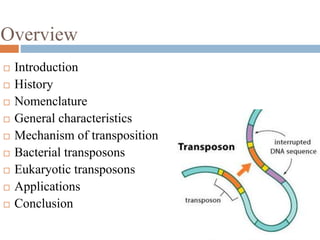
 Introduction 
 History 
 Nomenclature 
 General characteristics 
 Mechanism of transposition 
 Bacterial transposons 
 Eukaryotic transposons 
 Applications 
 Conclusion
Introduction 
 Transposable or mobile genetic elements/Jumping 
genes/ Molecular parasite 
 “Piece of DNA that can move from one location to 
another in a cell's genome” 
 Recombination b/w transposon and another DNA – 
target site 
 Bacteria – target site within chromosome or from 
plasmid to chromosome or b/w plasmid (vice versa) 
 Jump from one location to another (cut-and-paste 
translocation)
 Identified in eukaryotes, prokaryotes etc. 
 More abundant in eukaryotic genomes than prokaryotes 
 High proportion of species genome 
10% of several fish species 
12 % of the Caenorhabditis. elegans genome 
37% of the mouse genome 
45% human genome 
up to >80% - some plants like maize
History 
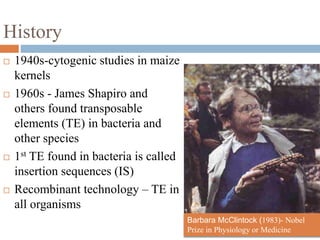
 1940s-cytogenic studies in maize 
kernels 
 1960s - James Shapiro and 
others found transposable 
elements (TE) in bacteria and 
other species 
 1st TE found in bacteria is called 
insertion sequences (IS) 
 Recombinant technology – TE in 
all organisms 
Barbara McClintock (1983)- Nobel 
Prize in Physiology or Medicine
Nomenclature 
 Campbell et al., 1977 – nomenclature in prokaryotes 
 Named as insertion sequences – IS1, IS2, IS3 etc. 
 Antibiotic resistance genes named as Tn (Tn1-ampr, 
Tn2, Tn3 etc). 
 Eukaryotes – nonstandard way 
Drosophila- copia, p-elements 
Yeast- Ty, 
maize- Ac&Ds, 
Human- Alu
General characteristics of TE 
 DNA sequences – code for enzymes – insertion of 
identical copy – new DNA site 
 Recombination and replication process – lead to two 
daughter copies (Parent site and target site) 
 TE cannot replicate apart from the host chromosome 
 Most have inverted repeats (IR) – EM 
 Transposition-not require extensive areas of homology 
b/w the transposon & target site
 Transposons – IIIr lysogenic prophages – except – 
originate in one chromosomal location – move - 
different location in the same chromosome 
 TEs differ from phages (lack virus life cycle) & 
plasmids (unable to reproduce autonomously and exist 
apart from the chromosome) 
 Multiple copies - antibiotic resistance - single R plasmid 
by moving genes - different plasmids
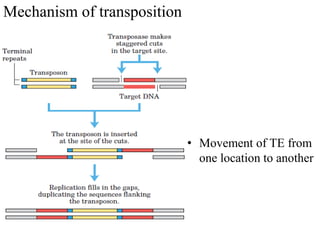
• Movement of TE from 
one location to another 
Mechanism of transposition
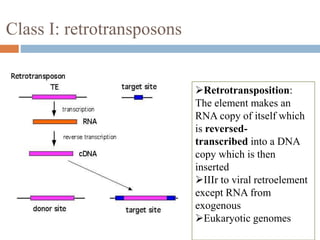
Class I: retrotransposons 
Retrotransposition: 
The element makes an 
RNA copy of itself which 
is reversed-transcribed 
into a DNA 
copy which is then 
inserted 
IIIr to viral retroelement 
except RNA from 
exogenous 
Eukaryotic genomes
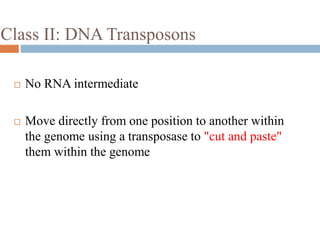
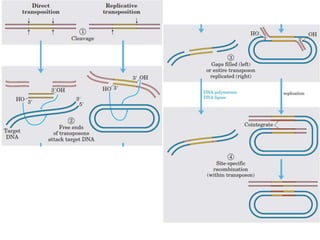
Class II: DNA Transposons 
 No RNA intermediate 
 Move directly from one position to another within 
the genome using a transposase to "cut and paste" 
them within the genome
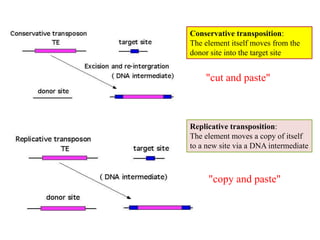
Conservative transposition: 
The element itself moves from the 
donor site into the target site 
"cut and paste" 
Replicative transposition: 
The element moves a copy of itself 
to a new site via a DNA intermediate 
"copy and paste"
Class III: Miniature-inverted-repeats-transposable 
elements ( MITEs) 
 Too small to code for any protein 
 Transposition- unknown 
 Human, plants and animals
Bacteria 
 Vary in structure 
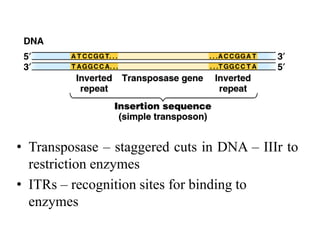
1. Insertion sequences 
2. Composite transposons 
3. Tn3-type transposon 
4. Transposable phage Mu
Insertion sequence (IS) 
 Simplest TE 
 750 -1600 bp (0.3 kb) 
1. Transposase genes – enzymes required for transposition 
2. Both ends – identical or very similar sequences of nt in 
reversed orientation – inverted repeats (9 to 41 bp – vary) 
 Replicatively or conservatively 
 IS-cause mutations - within the coding sequence of a gene 
or within a DNA region that regulates gene expression 
 Single E.coli may contain 20 types-IS1, IS2, IS3 etc.
• Transposase – staggered cuts in DNA – IIIr to 
restriction enzymes 
• ITRs – recognition sites for binding to 
enzymes
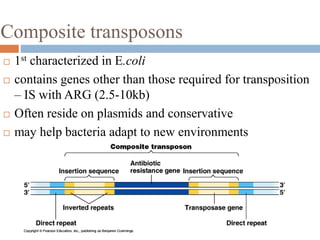
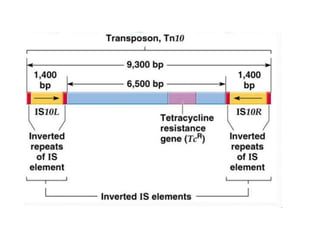
Composite transposons 
 1st characterized in E.coli 
 contains genes other than those required for transposition 
– IS with ARG (2.5-10kb) 
 Often reside on plasmids and conservative 
 may help bacteria adapt to new environments
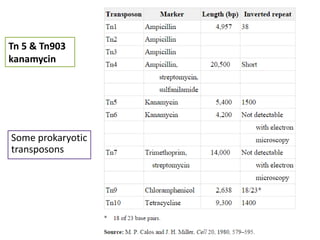
Tn 5 & Tn903 
kanamycin 
Some prokaryotic 
transposons
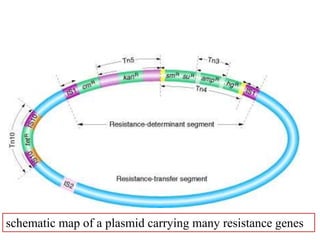
schematic map of a plasmid carrying many resistance genes
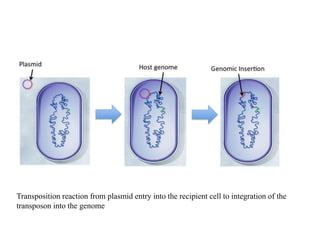
Transposition reaction from plasmid entry into the recipient cell to integration of the 
transposon into the genome
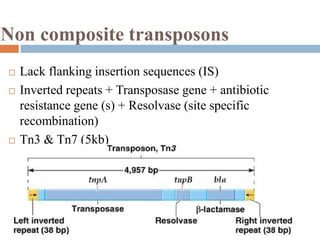
Non composite transposons 
 Lack flanking insertion sequences (IS) 
 Inverted repeats + Transposase gene + antibiotic 
resistance gene (s) + Resolvase (site specific 
recombination) 
 Tn3 & Tn7 (5kb)
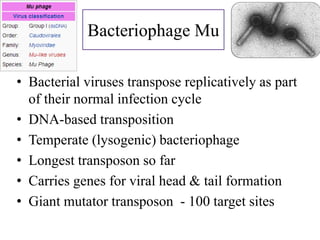
Bacteriophage Mu 
• Bacterial viruses transpose replicatively as part 
of their normal infection cycle 
• DNA-based transposition 
• Temperate (lysogenic) bacteriophage 
• Longest transposon so far 
• Carries genes for viral head & tail formation 
• Giant mutator transposon - 100 target sites
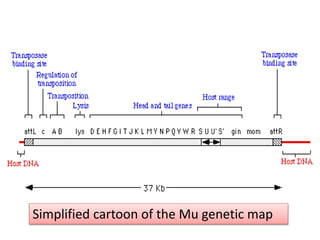
Simplified cartoon of the Mu genetic map
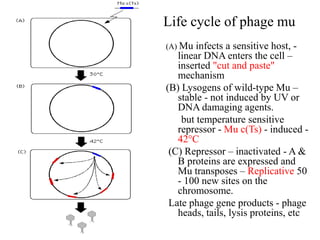
Life cycle of phage mu 
(A) Mu infects a sensitive host, - 
linear DNA enters the cell – 
inserted "cut and paste" 
mechanism 
(B) Lysogens of wild-type Mu – 
stable - not induced by UV or 
DNA damaging agents. 
but temperature sensitive 
repressor - Mu c(Ts) - induced - 
42°C 
(C) Repressor – inactivated - A & 
B proteins are expressed and 
Mu transposes – Replicative 50 
- 100 new sites on the 
chromosome. 
Late phage gene products - phage 
heads, tails, lysis proteins, etc
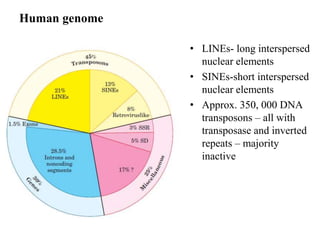
Human genome 
• LINEs- long interspersed 
nuclear elements 
• SINEs-short interspersed 
nuclear elements 
• Approx. 350, 000 DNA 
transposons – all with 
transposase and inverted 
repeats – majority 
inactive
Plants 
 Active transposons 
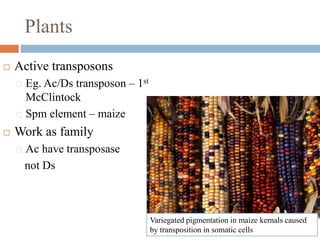
Eg. Ac/Ds transposon – 1st 
McClintock 
Spm element – maize 
 Work as family 
Ac have transposase 
not Ds 
Variegated pigmentation in maize kernals caused 
by transposition in somatic cells
Effects 
 Gene inactivation 
 Mutation 
 Gene alterations (Insertions, excisions, Duplication or 
translocation) 
 Moderate gene expression or induce recombination 
 Mutations results in diseases 
Hemophilia A & B, 
X-linked severe combined immunodeficiency 
Porphyria, cancer etc.,
Applications 
 Induce mutations (Insertional mutagenesis) 
 TE – insert - specific site - genome of an organism give 
it a high potential to be used for genetic modification 
 Gene therapy (Non-viral alternative) 
 Act – probe for cloning genes that are mutated by 
insertion of a particular element. Initially genetic 
screening is used to identify the mutation caused by 
transposon 
 Genes are isolated from given species due to transposon 
tagging (preferred choice if one specific gene is desired)
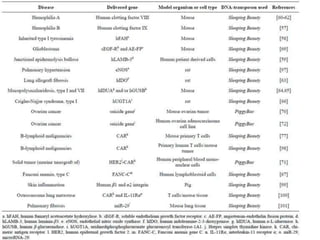
 DNA transposons, PiggyBac, Tol2 and Sleeping Beauty 
have been evaluated for gene therapy in animal 
experiments, primary cell gene delivery and a few pre-clinical 
trials 
 Several DNA transposons, such as P element, 
PiggyBac, Tol2, Hsmar1 and Sleeping Beauty, have 
been utilized for mutagenesis in invertebrate and 
vertebrate cells
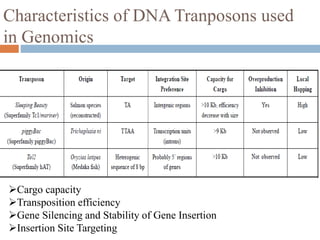
Characteristics of DNA Tranposons used 
in Genomics 
Cargo capacity 
Transposition efficiency 
Gene Silencing and Stability of Gene Insertion 
Insertion Site Targeting
• All the organisms – present – huge fraction of 
total DNA sequences 
• Major cause of mutations and genome 
rearrangement 
• Used in genetic studies 
• Mutation – used to produce different colors of 
grapes, corn and other fruits
Thank you

Transposons ask

  • 2.
    Overview  Introduction  History  Nomenclature  General characteristics  Mechanism of transposition  Bacterial transposons  Eukaryotic transposons  Applications  Conclusion
  • 3.
    Introduction  Transposableor mobile genetic elements/Jumping genes/ Molecular parasite  “Piece of DNA that can move from one location to another in a cell's genome”  Recombination b/w transposon and another DNA – target site  Bacteria – target site within chromosome or from plasmid to chromosome or b/w plasmid (vice versa)  Jump from one location to another (cut-and-paste translocation)
  • 4.
     Identified ineukaryotes, prokaryotes etc.  More abundant in eukaryotic genomes than prokaryotes  High proportion of species genome 10% of several fish species 12 % of the Caenorhabditis. elegans genome 37% of the mouse genome 45% human genome up to >80% - some plants like maize
  • 5.
    History  1940s-cytogenicstudies in maize kernels  1960s - James Shapiro and others found transposable elements (TE) in bacteria and other species  1st TE found in bacteria is called insertion sequences (IS)  Recombinant technology – TE in all organisms Barbara McClintock (1983)- Nobel Prize in Physiology or Medicine
  • 6.
    Nomenclature  Campbellet al., 1977 – nomenclature in prokaryotes  Named as insertion sequences – IS1, IS2, IS3 etc.  Antibiotic resistance genes named as Tn (Tn1-ampr, Tn2, Tn3 etc).  Eukaryotes – nonstandard way Drosophila- copia, p-elements Yeast- Ty, maize- Ac&Ds, Human- Alu
  • 7.
    General characteristics ofTE  DNA sequences – code for enzymes – insertion of identical copy – new DNA site  Recombination and replication process – lead to two daughter copies (Parent site and target site)  TE cannot replicate apart from the host chromosome  Most have inverted repeats (IR) – EM  Transposition-not require extensive areas of homology b/w the transposon & target site
  • 8.
     Transposons –IIIr lysogenic prophages – except – originate in one chromosomal location – move - different location in the same chromosome  TEs differ from phages (lack virus life cycle) & plasmids (unable to reproduce autonomously and exist apart from the chromosome)  Multiple copies - antibiotic resistance - single R plasmid by moving genes - different plasmids
  • 9.
    • Movement ofTE from one location to another Mechanism of transposition
  • 10.
    Class I: retrotransposons Retrotransposition: The element makes an RNA copy of itself which is reversed-transcribed into a DNA copy which is then inserted IIIr to viral retroelement except RNA from exogenous Eukaryotic genomes
  • 11.
    Class II: DNATransposons  No RNA intermediate  Move directly from one position to another within the genome using a transposase to "cut and paste" them within the genome
  • 12.
    Conservative transposition: Theelement itself moves from the donor site into the target site "cut and paste" Replicative transposition: The element moves a copy of itself to a new site via a DNA intermediate "copy and paste"
  • 14.
    Class III: Miniature-inverted-repeats-transposable elements ( MITEs)  Too small to code for any protein  Transposition- unknown  Human, plants and animals
  • 15.
    Bacteria  Varyin structure 1. Insertion sequences 2. Composite transposons 3. Tn3-type transposon 4. Transposable phage Mu
  • 16.
    Insertion sequence (IS)  Simplest TE  750 -1600 bp (0.3 kb) 1. Transposase genes – enzymes required for transposition 2. Both ends – identical or very similar sequences of nt in reversed orientation – inverted repeats (9 to 41 bp – vary)  Replicatively or conservatively  IS-cause mutations - within the coding sequence of a gene or within a DNA region that regulates gene expression  Single E.coli may contain 20 types-IS1, IS2, IS3 etc.
  • 17.
    • Transposase –staggered cuts in DNA – IIIr to restriction enzymes • ITRs – recognition sites for binding to enzymes
  • 18.
    Composite transposons 1st characterized in E.coli  contains genes other than those required for transposition – IS with ARG (2.5-10kb)  Often reside on plasmids and conservative  may help bacteria adapt to new environments
  • 20.
    Tn 5 &Tn903 kanamycin Some prokaryotic transposons
  • 21.
    schematic map ofa plasmid carrying many resistance genes
  • 22.
    Transposition reaction fromplasmid entry into the recipient cell to integration of the transposon into the genome
  • 23.
    Non composite transposons  Lack flanking insertion sequences (IS)  Inverted repeats + Transposase gene + antibiotic resistance gene (s) + Resolvase (site specific recombination)  Tn3 & Tn7 (5kb)
  • 25.
    Bacteriophage Mu •Bacterial viruses transpose replicatively as part of their normal infection cycle • DNA-based transposition • Temperate (lysogenic) bacteriophage • Longest transposon so far • Carries genes for viral head & tail formation • Giant mutator transposon - 100 target sites
  • 26.
    Simplified cartoon ofthe Mu genetic map
  • 27.
    Life cycle ofphage mu (A) Mu infects a sensitive host, - linear DNA enters the cell – inserted "cut and paste" mechanism (B) Lysogens of wild-type Mu – stable - not induced by UV or DNA damaging agents. but temperature sensitive repressor - Mu c(Ts) - induced - 42°C (C) Repressor – inactivated - A & B proteins are expressed and Mu transposes – Replicative 50 - 100 new sites on the chromosome. Late phage gene products - phage heads, tails, lysis proteins, etc
  • 28.
    Human genome •LINEs- long interspersed nuclear elements • SINEs-short interspersed nuclear elements • Approx. 350, 000 DNA transposons – all with transposase and inverted repeats – majority inactive
  • 29.
    Plants  Activetransposons Eg. Ac/Ds transposon – 1st McClintock Spm element – maize  Work as family Ac have transposase not Ds Variegated pigmentation in maize kernals caused by transposition in somatic cells
  • 30.
    Effects  Geneinactivation  Mutation  Gene alterations (Insertions, excisions, Duplication or translocation)  Moderate gene expression or induce recombination  Mutations results in diseases Hemophilia A & B, X-linked severe combined immunodeficiency Porphyria, cancer etc.,
  • 31.
    Applications  Inducemutations (Insertional mutagenesis)  TE – insert - specific site - genome of an organism give it a high potential to be used for genetic modification  Gene therapy (Non-viral alternative)  Act – probe for cloning genes that are mutated by insertion of a particular element. Initially genetic screening is used to identify the mutation caused by transposon  Genes are isolated from given species due to transposon tagging (preferred choice if one specific gene is desired)
  • 32.
     DNA transposons,PiggyBac, Tol2 and Sleeping Beauty have been evaluated for gene therapy in animal experiments, primary cell gene delivery and a few pre-clinical trials  Several DNA transposons, such as P element, PiggyBac, Tol2, Hsmar1 and Sleeping Beauty, have been utilized for mutagenesis in invertebrate and vertebrate cells
  • 33.
    Characteristics of DNATranposons used in Genomics Cargo capacity Transposition efficiency Gene Silencing and Stability of Gene Insertion Insertion Site Targeting
  • 36.
    • All theorganisms – present – huge fraction of total DNA sequences • Major cause of mutations and genome rearrangement • Used in genetic studies • Mutation – used to produce different colors of grapes, corn and other fruits
  • 37.

Editor's Notes

  • #2 manojamor457@gmail.com
  • #4  Genes didn’t have to have a fixed position. She also discovered an activator gene, one that could turn another gene on and off, and a gene that could cause the activator gene to move, causing another gene to turn off.  James Shapiro and others found transposable elements in bacteria and other species. In 1979, Prof. Shapiro formulated the first precise molecular model for transposition and replication of phage Mu and other transposons
  • #8 Transposable elements are found in bacterial chromosomes, as well as in plasmids
  • #11 Not discovered in prokaryotes
  • #12 move directly from one position to another within the genome using a transposase to "cut and paste" them within the genom
  • #19 http://microbiollogy.blogspot.in/2013_10_01_archive.html Tn3 (ampicillin), Tn5 (Kanamycin), Tn10 (Tetracycline)
  • #22 Figure 20-17 The role of transposable elements in the evolution of antibiotic-resistance plasmids is illustrated by a schematic map of a plasmid carrying many resistance genes. The plasmid appears to have been formed by the joining of a resistance-determinant segment and a resistance-transfer segment; there are insertion elements (IS1) at the junctions, where the two segments sometimes dissociate reversibly. Genes encoding resistance to the antibiotics chloramphenicol (cmR), kanamycin (kanR), streptomycin (smR), sulfonamide (suR), and ampicillin (ampR) and to mercury (HgR) are clustered on the resistance-determinant segment, which consists of multiple transposable elements; inverted repeat termini are designated by arrows pointing outward from the element. A transposon encoding resistance to tetracycline (tetR) is on the resistance-transfer segment. Transposon Tn3 is within Tn4. Each transposon can be transferred independently. (From S. N. Cohen and J. A Shapiro, “Transposable Genetic Elements.” Copyright © 1980 by Scientific American, Inc. All rights reserved.)
  • #24 Methylation
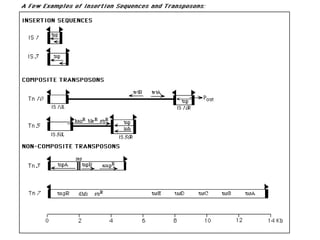
  • #25 Transposable elements fall into three general groups: insertion sequences (which only encode gene products required for transposase synthesis and regulation), composite transposons (which are flanked by insertion sequenceson the left and right ends), and non-composite transposons (which lack flanking insertion sequences). In each case, transposition requires specific DNA sequences located at the ends where IS1, IS3, Tn5, Tn10, and Tn3) or a multisubunit complex (e.g. Tn7). Many transposons carry antibiotic resistance genes, but some transposons carry other genes (e.g. "catabolic transposons" carry genes for the catabolism of hydrocarbons). A few examples of transposable elements are shown below.
  • #26 The vegetative replication of mu produces about 100 viral chromosomes in a cell arises from the transposition of mu to about 100 diff target sites
  • #27 Note the following features of Mu phage: The A and B gene products encode transposase -- the A protein is required for all transposition events, but the B protein is only required for replicative transposition events. Expression of the transposase genes is repressed by the c gene product. Transposition requires the two ends of Mu, labeled attL and attR (sometimes called MuL and MuR). When Mu DNA is packaged into a phage head it includes about 50-150 bp of host DNA at the left end and a variable amount of host DNA on the right end. For wild-type Mu the amount of host DNA on the right end is about 2 Kb but, because of the headful packaging mechanism shown below, the length of host DNA on this end increases if part of the Mu genome is deleted. Each Mu is packaged from a different site in the host genome, so the host DNA on the ends of Mu is unique in every different phage head.
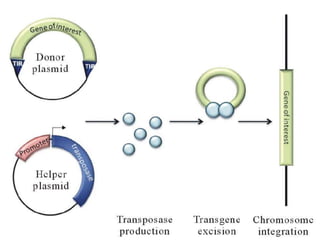

  • #36 Schematic view of a DNA-transposon system for gene delivery. Both donor and helper plasmids are transfected into the host cells. The helper plasmid is an expression vector that allows transposase production and the donor plasmid bears the gene of interest that will be integrated into the host genome by the transposase. The light blue circles represent the trans- posase proteins produced from helper plasmid.